


19,99 €
Mehr erfahren.
- Herausgeber: John Wiley & Sons
- Kategorie: Geisteswissenschaft
- Sprache: Englisch
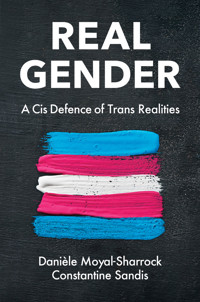
Societies around the world are struggling to think clearly about trans realities and understand trans identities. Real Gender is the first book to present a cis defence of what it means to be transgender.
Moyal-Sharrock and Sandis delve into the various factors which make many trans people’s experience of their gender (or lack thereof) as natural and unquestionable as that of cis people. While recognising the undeniably social aspects of gender, they find that gender cannot be completely divorced from our biological underpinnings. Contrary to popular opinion, gender self-identification does not require the denial of either biology or sex. What is needed is a more liberal understanding of our gender concepts, which would prevent us from confusing diversity with pathology.
Steeped in published and personal trans testimonials, Real Gender does not seek to provoke or attack, but to unequivocally defend trans realities. A powerful exploration of a divisive topic, this book will be of interest to a wide audience of readers.
Sie lesen das E-Book in den Legimi-Apps auf:
Seitenzahl: 509
Veröffentlichungsjahr: 2024
Ähnliche




















Table of Contents
Cover
Dedication
Title Page
Copyright Page
Preface
Notes
Acknowledgements
Text and Image Credits
Prologue from ‘The Wild Side’
1: Transformers
2: Finding our words
3: Twenty-first-century trans
Notes
1 The Woman Question
1.1: The TERF definition: Woman as (oppressed) natal female
1.2: Gender as class: Woman as necessarily oppressed
1.3: Gender as identity: Female inner maps
1.4: Who is entitled to be called a woman?
1.5: What about ‘the man question’?
Notes
2 False Alarms
2.1: TERF alarms
2.2: The abolition of sex
2.3: Self-identification seen as a harm
2.4: Women-only spaces
2.5: The woman trap
2.6: Conflicts of interest and rights
2.7: Men in tights
2.8: The sport controversy
Notes
3 ‘I Say Therefore I Am?’: Gender and Self-Identification
3.1: Trans self-identification as ‘unreliable’
3.2: The seriousness of self-identification
3.3: The validity of authentic self-identification
3.4: Identifying as a teapot (and other absurdities)
3.5: The authority of authentic self-identification
3.6: Definitional injustice
Notes
4 Trans Kids: ‘Out of the Mouths of Babes’
4.1: Gender is not (usually) a choice
4.2 Trans kids: Early spontaneous certainty
Mattie Lents
Sasha
Penelope
Holly, parent of a nonbinary child
Jack and Jace
Avery Jackson, 9 years old
Jamison Green, activist, educator; author of
Becoming a Visible Man
Jan Morris, historian, travel writer; author of
Conundrum
Kai Shappley, a girl growing up in Texas
Bobbi Pickard, Co-Chair of BP Pride’s Transgender Group
Juno Roche, writer and campaigner; author of
Gender Explorers
Julia Serano, biologist; author of
Whipping Girl
Lorimer Shenher, fiction writer, former police officer; author of
This One Looks Like a Boy
Martie Sirois, mother of a 14-year-old ‘gender-creative’ child
Bobbi Ullinger, audio technician
4.3: Not just a trend
4.4: ‘Persistence’ and ‘desistance’
4.5: Gender-affirming and gender-negating approaches
4.6: Parental support
4.7: Desistance and detransitioning: Facts and falsehoods
Notes
5 Bedrock Gender
5.1: Existential self-identity
5.2:
Feeling
one’s gender
5.3: Gender as embodied
5.4: Gender as
bedrock certainty
5.5: A hard-lived certainty
5.6: Gender uncertainty
5.7: Divergent gender identities: Within and beyond the binary
Notes
6 Gender Born and Lived
6.1: Biology matters
6.2: Gender as an ‘intrinsic inclination’
6.3 Born this way?
6.4: Becoming who one is
6.5: The natural limits of social construction
6.6: Transgender identity as fiction
6.7: Nature and culture
Notes
7 Gender Across Time and Place
7.1: Nature vs. nurture
7.2: Biological roots of gender
7.3: Which culture? What constructs?
7.4: Hijras and
warias
7.5 Two-Spirit people
7.6: Conceptual anthropology
Notes
8 Reconceptualizing Gender (from the Stream of Life)
8.1: The life of concepts
8.2: War of the words: Neologisms and pronouns
8.3: Family resemblance
8.4: The vegan analogy
8.5: The XYZ analogy
8.6: The adoptive parent analogy
8.7: The naturalized citizen analogy
8.8: Conceptual engineering
8.9: Gender eliminativism
Notes
Epilogue: The Way Forward
Notes
Detailed Contents
References
Index
End User License Agreement
List of Illustrations
Prologue
Figure 0.1: ‘Warhol superstar Candy Darling’, 1 January 1971.
Chapter 1
Figure 1.1: Julia Serano, writer, geneticist, performer, activist; photo used with permissio...
Figure 1.2: Charlie Kiss, the first trans man to stand for the UK Parliament; photo used wit...
Chapter 2
Figure 2.1: Laverne Cox, actress and activist, discussing her career as an actress and being...
Figure 2.2: New York Dolls 1973 vinyl record sleeve.
Figure 2.3: Super featherweight Patricio Manuel is the first openly trans man to compete in ...
Figure 2.4: Hurdler María José Martínez-Patiño in 1989.
Chapter 3
Figure 3.1: Professor Talia Mae Bettcher, California State University, LA; used with permiss...
Chapter 4
Figure 4.1: ‘Ruthie is a girl. It just took her some time to let people know.’...
Figure 4.2: ‘Film still from
Little Girl
’ (2020).
Figure 4.3: Dr Jamison Green, author of
Becoming a Visible Man
; used with permission.
Chapter 5
Figure 5.1: Professor Joy Ladin, first openly transgender professor at an Orthodox Jewish in...
Figure 5.2: Dr Jay Prosser, Reader in Humanities, University of Leeds, UK.
Figure 5.3: Janet Mock, writer, director, producer, named Harvard Artist of the Year.
Figure 5.4: Paul Preciado.
Figure 5.5: Actor and comedian Suzy Eddie Izzard (2021).
Figure 5.6: Stephen Whittle, Professor Emeritus of Equalities Law, Manchester Metropolitan U...
Chapter 6
Figure 6.1: Angela Ponce, Miss Spain 2018, first transgender woman to compete in the Miss Un...
Figure 6.2: Jan Morris at the
Sydney Morning Herald
literary lunch (1988).
Figure 6.3: Thomas Page McBee. First trans man to box at Madison Square Garden, NY.
Chapter 7
Figure 7.1: Cultural anthropologist Margaret Mead (1901–78).
Figure 7.2: Painting of Ardhanarishvara (
c
.1800).
Figure 7.3: Hijra portrait from Pushkar.
Figure 7.4: Two-Spirit basketmaker, educator, storyteller and drag performer Geo Soctomah Ne...
Figure 7.5: Leslie Feinberg, ‘Self Portrait, Setting Sun’ (2011).
Figure 7.6: Beyon wren moor (she/her) Two-Spirit Nehiyaw from the Pimicikamac Nation; tattoo...
Figure 7.7: Min-Taylor Bai-Woo, a queer trans gender-fluid woman of northern Korean, Chinese...
Chapter 8
Figure 8.1: Professor Sophie Grace Chappell (2020).
Figure 8.2: Nikki Ernst, August 2021.
Epilogue
Figure 9.1: Trans model and social activist, Munroe Bergdorf, ‘London Trans + Pride 2...
Guide
Cover
Table of Contents
Begin Reading
Pages
ii
iii
iv
vi
vii
viii
ix
x
xi
xii
xiii
xiv
xv
xvi
1
2
3
4
5
6
7
8
9
10
11
12
13
14
15
16
17
18
19
20
21
22
23
24
25
26
27
28
29
30
31
32
33
34
35
36
37
38
39
40
41
42
43
44
45
46
47
48
49
50
51
52
53
54
55
56
57
58
59
60
61
62
63
64
65
66
67
68
69
70
71
72
73
74
75
76
77
78
79
80
81
82
83
84
85
86
87
88
89
90
91
92
93
94
95
96
97
98
99
100
101
102
103
104
105
106
107
108
109
110
111
112
113
114
115
116
117
118
119
120
121
122
123
124
125
126
127
128
129
130
131
132
133
134
135
136
137
138
139
140
141
142
143
144
145
146
147
148
149
150
151
152
153
154
155
156
157
158
159
160
161
162
163
164
165
166
167
168
169
170
171
172
173
174
175
176
177
178
179
180
181
182
183
184
185
186
187
188
189
190
191
192
193
194
195
196
197
198
199
200
201
202
203
204
205
206
207
208
209
210
211
212
213
240
241
242
243
244
245
246
247
248
249
250
251
252
253
254
255
256
257
258
259
260
261
262
263
264
265
266
267
268
269
270
Dedication
For Louise Chapman and Peter Sharrock
Real Gender
A Cis Defence of Trans Realities
Danièle Moyal-SharrockandConstantine Sandis
polity
Copyright Page
Copyright © Danièle Moyal-Sharrock and Constantine Sandis 2024
The right of Danièle Moyal-Sharrock and Constantine Sandis to be identified as Authors of this Work has been asserted in accordance with the UK Copyright, Designs and Patents Act 1988.
First published in 2024 by Polity Press
Polity Press
65 Bridge Street
Cambridge CB2 1UR, UK
Polity Press
111 River Street
Hoboken, NJ 07030, USA
All rights reserved. Except for the quotation of short passages for the purpose of criticism and review, no part of this publication may be reproduced, stored in a retrieval system or transmitted, in any form or by any means, electronic, mechanical, photocopying, recording or otherwise, without the prior permission of the publisher.
ISBN-13: 978-1-5095-5584-0
ISBN-13: 978-1-5095-5585-7(pb)
A catalogue record for this book is available from the British Library.
Library of Congress Control Number: 2023937105
by Fakenham Prepress Solutions, Fakenham, Norfolk NR21 8NL
The publisher has used its best endeavours to ensure that the URLs for external websites referred to in this book are correct and active at the time of going to press. However, the publisher has no responsibility for the websites and can make no guarantee that a site will remain live or that the content is or will remain appropriate.
Every effort has been made to trace all copyright holders, but if any have been overlooked the publisher will be pleased to include any necessary credits in any subsequent reprint or edition.
For further information on Polity, visit our website: politybooks.com
PREFACE
Transgender is not an ism or an ideology or a lifestyle choice or a sexual fetish: it’s another way of being human.
Sophie Grace Chappell1
This is a book about the realities of being a transgender person: man, woman, genderqueer (nonbinary, bigender, gender-fluid, agender, etc.). Here, we include those who identify as ‘third gender’ or ‘Two-Spirit’, as well as other members of māhū, hijra, waria, two-spirited and Fa’afafine communities, while noting that the extension of the adjective ‘transgender’ to characterize everyone on the trans spectrum is not without its problems.2 This book is written by two philosophers seeking to understand and convey trans realities. While it addresses major aspects of the debates surrounding trans issues, no prior knowledge of these is required on the reader’s part.
While Real Gender is the work of cis authors and is largely aimed at a cis readership, it is replete with trans voices. Broadly speaking, trans people are people whose gender (or lack thereof) does not match the gender they were assigned at birth. Unlike cis (that is, nontransgender) people, trans people typically cross or transition from one gender identity to another, hence the use of the Latin prefixes ‘trans’ (meaning ‘across from’ or ‘on the other side of’) and ‘cis’ (meaning ‘on this side of’). Such transitions are personal, social and/or physical, and are often fraught with pain and hardship. In writing this book, we have learned that this suffering is less the result of the experience that some trans people describe as ‘being born in the wrong body’ than it is the result of prejudice and rejection. This book is an attempt to help change this.
Many cis people reject the prefix ‘cis’, preferring to be known simply as ‘women’ or ‘men’. Among these is John Boyne, author of My Brother’s Name Is Jessica, a young adult novel that features a transgender character:
While I wholeheartedly support the rights of trans men and women and consider them courageous pioneers, it will probably make some unhappy to know that I reject the word ‘cis’, the term given by transgender people to their nontransgender brethren. I don’t consider myself a cis man; I consider myself a man. For while I will happily employ any term that a person feels best defines them, whether that be transgender, non-binary or gender fluid to name but a few, I reject the notion that someone can force an unwanted term onto another.3
However, the cis/trans distinction does not stem from an attempt to impose an unwanted term on another term or on a group of people. Rather, as noted above, it is a descriptive term that acknowledges different trajectories in individuals’ gender identities and represents a move towards greater inclusivity. Not adding the ‘cis’ prefix to the terms ‘woman’ or ‘man’ while using the ‘trans’ prefix to refer to trans women and men implies that the latter are in a different category from women and men and are not, therefore, fully fledged women and men. We do not object to the use of the unprefixed terms ‘man’ and ‘woman’, provided they are understood as including, respectively, both cis and trans men and women. Once inclusivity and equality are accepted as given, the prefixes may become superfluous in contexts where one’s gender journey is irrelevant (as opposed, for example, to certain medical contexts). Alternatively, people may decide to retain the prefixes in the interest of highlighting their gender identities or because they favour a more fine-grained approach to gender.
For the time being, however, these prefixes remain necessary. In her book, The Transgender Issue: An Argument for Justice, Shon Faye unequivocally speaks in favour of the cis prefix:
We need a word for the 99 per cent of people in our society who do not have the experience of being trans, who fill almost all positions of power and authority, who control access to healthcare and education, and who make our laws. Simply by being a majority, cisgender people create the world that trans people live in.
Not all cis people behave in oppressive ways towards trans people, and not all cis people experience perfect comfort with their bodies or their gender; but, in general, it is fair to say that there are some automatic benefits that come from being a cis person. Gender is one of the first things we look for, ask about or intuit in a person. Cis men and women have the immeasurable benefit of never being thought to be mistaken, deluded or deceptive about this very fundamental fact about their personhood. This means that, in many contexts, they tend to be automatically credited with more authority, insight or expertise on both their own identity and on trans people’s identities than trans people themselves are.4
As we shall argue, trans people should be credited with authority regarding their gender to the same degree as cis people. Failure to do this reflects prejudice and injustice or, more charitably, a lack of understanding that an individual’s gender does not always show itself on their body – or, more formally, is not always aligned with their natal sex. This, we must attribute to diversity, not pathology.
The first wave of literature on transgender experiences came from sexologists, and the second from trans-exclusive feminists (such as Janice Raymond). Only with the third wave were first-person accounts of transgender realities included. This, as we shall see, is now being countered by a new wave of predominantly trans-exclusive literature, including philosophy. However, this fourth wave also comprises trans-inclusive authors and philosophers who have recently joined the debate. As cis philosophers, we belong to this latter group. This book is rooted in our desire to attain and transmit a better understanding of trans lives.
Our book is called Real Gender for two reasons. The first is to emphasize our conviction that the gender (or lack thereof) that one feels and lives authentically is one’s real gender, regardless of whether it matches the gender one was assigned at birth. The second reason is that we believe gender is real; as real as – though not to be conflated with – biological sex. Before further probing these issues, it is appropriate here to articulate why, as cis authors, we believe ourselves to be qualified to write about trans realities.
On 22 August 2022, Sky News Australia ran a brief article entitled ‘Many transgender activists “aren’t actually trans”’,5 complaining that such activists are in fact ‘cisgender allies looking for virtue points’. Imagine such headlines as ‘Many prison reform activists aren’t actually prisoners’, ‘Many animal rights activists aren’t actually animals’, or ‘Many feminists aren’t actually women’. This reveals the absurdity of thinking that one cannot possibly be an ally of a group that one is not a member of.
Of course, allyship and activism can manifest themselves in different ways, not all of which are unproblematic. One anonymous referee for this book wrote: ‘We’d find a book that promised a white perspective on anti-black racism suspect.’ Indeed, such a book would be suspect were it not the work of allies. Still, one might wonder what a white perspective could possibly add that is (by implication) missing from a Black perspective. Understandably, people may similarly wonder what our book might uniquely contribute to the trans debate. However, another anonymous reader countered,
I think the authors make an excellent case for what is special about this book. It takes an apparent weakness – that it’s about trans people but written by two cis authors – and makes it a strength. The argument that cis are in the majority, and it’s imperative that they need to be persuaded, is a strong one. I am sure that even some trans people might try to resist it but I think it basically is an excellent motivation for this book. The project of persuading cis people to accept those of transgender and to understand their experience and rights is hugely important at the moment. I 100% support publication of this book.6
Understanding and empathy do not require that one undergo experiences that are identical to those one seeks to understand; anyone with sufficient acquaintance, awareness and sensitivity can empathize. For this reason, we held interviews and included first-person testimonials from a diverse range of trans sources in our research.
Before embarking on this project, we consulted the works of trans philosophers and heard their frustration with cis philosophers who felt qualified to speak or write about trans experiences without first delving into what Talia Mae Bettcher described as the existing ‘robust literature on these issues’:
I worry that the difficulty of having a conversation about whether or not trans women are women (it stands out to me, by the way, that this yet again focuses on trans women rather than trans men) amounts to a suggestion that the conversation should not include our scholarly and personal voices, and continue to cast us as people whose scholarship should be about rather than with.7
This frustration regarding ‘philosophy’s transgender trouble’ is articulated by Robin Dembroff:
[C]isgender philosophers … have mastered the methodology of thinking without reading.
Excuse the sarcasm; I’m exasperated. My point, in short, is that uninformed (they would say ‘a priori’) thought about trans issues is deemed philosophical only when it aligns with cisgender commonsense. What seems intuitive to gender-conforming philosophers who have never studied trans and queer scholarship sets the standards for what counts as legitimate, ‘objective’ philosophical positions about trans issues.8
While this book expresses our own beliefs, arguments, positions and conclusions, these have been deeply informed, transformed or bolstered by the experiences that trans people have directly shared with us through interviews and conversations and described in published testimonials, articles and books. Real Gender resonates with their voices. This, in an effort to transmit directly and resoundingly what it is to be trans.
Our use of the term ‘trans’ is ‘inclusive of nonbinary people who are also transgressing gender boundaries’:9 our use of the term ‘gender’ includes not only female and male genders but also alternative genders (e.g., bigender, gender-fluid, genderqueer, gender nonconforming, gender-neutral, agender and any other label that an individual may apply to their gender or lack thereof).
We aim to offer an uncompromising defence of trans realities that is philosophically, psychologically, biologically and ethically sound. However, many of the challenges facing trans equality arguably stem from attitudes among the cis population. A true breakthrough in trans equality and justice can therefore happen only when cis people adjust their perceptions and behaviour. While we would never presume to speak without the advice and support of the trans community, we firmly believe that this can occur only when cis people join the fight. Solidarity matters.
Our book sets out to debunk the myths that are appealed to by those who (intentionally or otherwise) jeopardize the growing movement of trans solidarity. Trans lives matter and trans rights matter. Although trans realities are experienced and lived by millions of people in multiple social and cultural contexts, many trans people continue to be mocked and ridiculed, subjected to physical and verbal abuse, socially excluded and dismissed as pathological deceivers. This book is an attempt to help change this.
So let’s get started.
London, July 2023
Notes
1
Facebook, 1 January 2021.
2
See Heyam (2022: Ch 7).
3
Boyne (2019).
4
Faye (2021: xvii).
5
Bolt (2022).
6
Anonymous referee for the press.
7
Bettcher (2018).
8
Dembroff (2020: 403–4).
9
We follow Jamison Green (2020) here.
ACKNOWLEDGEMENTS
Writing this book has taken us on a rich and often difficult journey. It sprang from a desire to elucidate what first seemed to us a definitional issue, and rapidly evolved into a human issue. This then, of course, required that we get involved at the human level. We did this through interviewing trans people, listening to their recorded testimonials, reading a great number of their articles and books, and consulting empirical studies and historical documentation. This immersion into trans realities has been a revelation, and we are inestimably indebted to all, in particular to the people we have interviewed.
Real Gender would have emerged as a different work were it not for the friends, colleagues and others who, through discussion, information, correction and encouragement, spurred us on at key moments or accompanied us throughout. For this, we thank Beatrice Baumgartner-Cohen, Robert Baumgartner-Cohen, Anna Boncompagni, Talia Bettcher, Louise Chapman, Imogen Chappell, Sophie Grace Chappell, Annalisa Coliva, Sara Collins, Rach Cosker-Rowland, Sarah Dancy, Jane Dorner, Cecilie Eriksen, Nikki Ernst, Theo Gilbert, Misty M. Ginicola, Hans-Johann Glock, Eran Guter, Emma Holiday, Saskia Kersten, Kate Kirkpatrick, Jemima Kiss, Polaris Koi, Joy Ladin, Sandra Laugier, Evelyne Moyal, Ben Murtagh, Ames Petrossi, Nigel Pleasants, Rebecca Poulin, Jay Prosser, Nicole Saada, Rhonwen Sayer, Amanda Searle, Julia Serano, Peter Sharrock, Ashley Spindler, Kali Spitzer, Kate Tomas, Farida Vital, Stephen Whittle and Mike Wilby.
We are especially grateful to Diana Flynn (Lambda Legal) and Mara Kiesling (National Center for Transgender Equality) for their trust and encouragement, and to the University of Hertfordshire for providing us with an encouraging and stimulating research environment.
We would also like to thank Ellen MacDonald-Kramer and Ian Malcolm at Polity for all their patience and support, Pascal Porcheron for commissioning the book for the press, and various anonymous readers for their extremely helpful reports on earlier versions of the manuscript, as well as the initial proposal for the book. Thanks are also due to everyone who consented to having their picture included, as well as to Jessica Oliver at Lex Academic for her incredible support with all the image and text permissions.
Chapter 5 reworks material published by us as ‘Bedrock Certainty’, in C. Eriksen, N. O’Hara and N. Pleasants (eds.), Philosophical Perspectives on Moral Certainty, London: Routledge, pp. 35–57. Earlier versions of various parts of our book were first presented at the following in-person and/or online events: Anglia Ruskin University’s Royal Institute of Philosophy public lecture series (5 December 2019); Identities and Epistemic Injustice, University of California Irvine (12–13 March 2021); Wittgenstein and Contemporary Moral Philosophy workshop (17 June 2021); Intercultural Understanding after Wittgenstein, University of Valencia (13–14 September 2022); Wittgenstein, Culture and Forms of Life, Sapienza University of Rome (28 April 2023); Colloquium in Theoretical Philosophy, University of Zurich (18 May 2023); and the Nordic Wittgenstein Society Annual Meeting (2 June 2023). We’d like to thank the organizers and participants for the challenging discussions ensuing from these presentations; they really helped to shape our thoughts.
A unique debt of gratitude is owed to Fred Aychener, Jim McDonough and Chirag Badlani.
We wish to thank Alphawood Foundation Chicago without whose support this book would not have been possible.
TEXT AND IMAGE CREDITS
Lyrics to Lou Reed’s ‘Candy Says’ (1968) and ‘Walk on the Wild Side’ (1972). © Faber and Faber.
Extract from Jennifer Finney Boylan’s memoir She’s Not There: A Life in Two Genders. © Penguin Random House LLC,
Figure 0.1: ‘Warhol superstar Candy Darling’, 1 January 1971.
Source: © Jack Mitchel / Getty.
Figure 1.1: Julia Serano, writer, geneticist, performer, activist; photo used with permission.
Figure 1.2: Charlie Kiss, the first trans man to stand for the UK Parliament; photo used with permission from the family of Charlie Kiss.
Figure 2.1: Laverne Cox, actress and activist, discussing her career as an actress and being a trans woman of colour during an episode of TimesTalks (2015).
Source: © Photo Access / Alamy; used with permission.
Figure 2.2: New York Dolls 1973 vinyl record sleeve.
Source: © Popimages / Alamy.
Figure 2.3: Super featherweight Patricio Manuel is the first openly trans man to compete in a professional USA boxing match.
Source: © Cris Esqueda / Getty.
Figure 2.4: Hurdler María José Martínez-Patiño in 1989.
Source: © EFE / PA Images; used with permission.
Figure 3.1:Professor Talia Mae Bettcher, California State University, LA; used with permission.
Figure 4.1: ‘Ruthie is a girl. It just took her some time to let people know.’ In T. Thorn, It Feels Good to Be Yourself: A Book About Gender Identity, illustrated by Noah Grigni. New York: Henry Holt and Company, 2019; used with permission.
Figure 4.2: ‘Film still from Little Girl’ (2020).
Source: © AGAT Films; used with permission.
Figure 4.3: Dr Jamison Green, author of Becoming a Visible Man; used with permission.
Figure 5.1: Professor Joy Ladin, first openly transgender professor at an Orthodox Jewish institution.
Source: Lisa Ross; used with permission.
Figure 5.2: Dr Jay Prosser, Reader in Humanities, University of Leeds, UK.
Source: © Leslie Hakim-Dowek, 2020; used with permission. Image not to be reproduced without permission.
Figure 5.3: Janet Mock, writer, director, producer, named Harvard Artist of the Year.
Source: © Paul Marotta / Getty.
Figure 5.4: Paul Preciado.
Source: © Catherine Opie, Courtesy Regen Projects, Los Angeles, and Lehmann Maupin, New York, Hong Kong, Seoul and London; used with permission.
Figure 5.5: Actor and comedian Suzy Eddie Izzard (2021).
Source: © Amanda Searle; used with permission.
Figure 5.6: Stephen Whittle, Professor Emeritus of Equalities Law, Manchester Metropolitan University; used with permission.
Figure 6.1: Angela Ponce, Miss Spain 2018, first transgender woman to compete in the Miss Universe pageant.
Source: © Lillian Suwanrumpha / AFP via Getty.
Figure 6.2: Jan Morris at the Sydney Morning Herald literary lunch (1988).
Source: © Doris Thomas / Fairfax Media via Getty Images; used with permission.
Figure 6.3: Thomas Page McBee. First trans man to box at Madison Square Garden, NY.
Source: © Michael Sharkey / The Observer; used with permission.
Figure 7.1:Cultural anthropologist Margaret Mead (1901–78).
Source: © ARCHIVIO GBB / Alamy Stock Photo, c.1928.
Figure 7.2: Painting of Ardhanarishvara (c.1800).
Source: © Wikicommons, CC BY-SA.
Figure 7.3: Hijra portrait from Pushkar.
Source: © Pawel Bienkowski / Alamy.
Figure 7.4: Two-Spirit basketmaker, educator, storyteller and drag performer Geo Soctomah Neptune (Passamaquoddy).
Source: © Sipsis Peciptaq Elamogessik; public domain.
Figure 7.5: Leslie Feinberg, ‘Self Portrait, Setting Sun’ (2011).
Source: © Minnie Bruce Pratt; used with permission.
Figure 7.6: Beyon wren moor (she/her) Two-Spirit Nehiyaw from the Pimicikamac Nation; tattoo artist and painter.
Source: Photographed by Indigenous queer photographer Kali Spitzer in 2022 on the unceded territory of xʷməθkʷəy̓əm (Musqueam), Sḵwx̱wú7mesh (Squamish) and sel̓íl̓witulh (Tsleil-Waututh) Nations; used with permission.
Figure 7.7: Min-Taylor Bai-Woo, a queer trans gender-fluid woman of northern Korean, Chinese and French descent. Born and raised on Turtle Island, she is a tattoo artist and anticolonial supporter in her local community.
Source: Photographed by Indigenous queer photographer Kali Spitzer in 2022 on the unceded territory of xʷməθkʷəy̓əm (Musqueam), Sḵwx̱wú7mesh (Squamish) and sel̓íl̓witulh (Tsleil-Waututh) Nations; used with permission.
Figure 8.1: Professor Sophie Grace Chappell (2020).
Source: © Imogen Chappell; used with permission.
Figure 8.2: Nikki Ernst, August 2021.
Source: Photo by S.P. Leeds.
Figure 9.1: Trans model and social activist, Munroe Bergdorf, ‘London Trans + Pride 2023’.
Source: © Hollie Adams / Getty.
PROLOGUE FROM ‘THE WILD SIDE’
Holly came from Miami, FLA
Hitchhiked her way across the USA
Plucked her eyebrows on the way
Shaved her legs and then he was a she.
She said, ‘Hey babe, take a walk on the wild side.’
Lou Reed, ‘Take a Walk on the Wild Side’ (Transformer, 1972)1
1: Transformers
In May 2017, the Central Student Association of the University of Guelph apologized for having played Lou Reed’s 1972 hit ‘Walk on the Wild Side’ at a campus event, despite no complaints having been lodged. Their statement, which was subsequently deleted from Facebook around the time it made headline news, included the following words:
It’s come to our attention that the playlist we had … contained a song with transphobic lyrics. We now know the lyrics to this song are hurtful to our friends in the trans community and we’d like to unreservedly apologize for this error in judgement.2
The song’s offending content, as the students deemed it, included the suggestion that plucking one’s eyebrows and shaving one’s legs were sufficient to make a natal man a woman. They were clearly unaware that Reed, who had had a three-year relationship with a trans woman (Rachel Humphreys) during the 1970s,3 had unequivocally supported New York City’s trans community: appropriately, ‘everything Lou Reed did was about transformation’.4 His numerous songs celebrating sex and gender fluidity thus simultaneously aimed to capture the ‘desire for transcendence’ and self-realization through the lenses of characters who ‘are always moving toward something’ as they try to deal with conflict.5 The protagonists in ‘Walk on the Wild Side’ were Reed’s friends from Andy Warhol’s studio, The Factory, several of whom were transgender. As Stephanie J. Kapusta points out,
The use of the single term ‘transgender’ for such a broad group of people comes with the danger of erasing the burgeoning diversity of gender identities and practices of recent decades into some single generic identity, and of producing ‘standard narratives’ of who these people are and what their rights should be … Even while acknowledging this danger, however, rights discourse needs a term around which people can mobilize in order to argue and campaign for their rights (Currah et al. 2006: xv). In this spirit, ‘transgender’ refers to a social and political movement that advocates for the right of gender self-determination, freedom of gender expression for all, as well as the protection of civil and social rights, irrespective of gender identity or expression … ‘Transgender’ is thus a capacious, potentially provisional, and shifting term.6
On the radical side of ‘second-wave’ liberal feminism, according to which the personal was political, SCUM Manifesto author Valerie Solanas (1971) regarded transgender practices as personal solutions to gender-based oppression, when what was really called for was a systematic dismantling of the patriarchy. By contrast, her sometime roommate and trans actress Candy Darling complained of such feminists that they ‘come across very hard to me and I don’t like hardness especially in women’.7 Indeed, Darling ‘wanted nothing more than to be a ’50s housewife (or a debutante or a waitress or a showgirl)’8 and seemed to enjoy being cat-called.9
Solanas’s feminist stance perceived such dreams ‘of what it is to be a woman’ as a double patriarchal victory against homosexuality and in favour of the harmful stereotypes of ‘real (straight) men’ and ‘lipstick and heels’ women,10 peddled by the mainstream film and media industries that Darling adored and studied ‘like a doctoral candidate’.11 When coupled with Darling’s fear of being called a ‘faggot’ and her desire to be loved by a straight man (as opposed to a homosexual or even a bisexual one),12 we are provided with a glimpse of the sort of reasoning whose resistance has led to what Stephen Whittle describes as ‘a diarrhea of theories’ that do not fit.13 These theories include the hypothesis that transsexual operations promise a ‘cure’ for homosexuality, or the claim that ‘all transsexuals rape women’s bodies by reducing the real female form to an artifact, appropriating this body for themselves’.14
Like cis women, some trans women are feminine and some are butch; some are straight, some are gay, and some are bisexual.15 Preferences of presentation and sexual orientation are not necessarily correlated. While some combinations will be more stereotypical than others, these are no more objectionable than those that defy stereotypes.
2: Finding our words
Candy Darling was thrilled to have been the subject of more than one Lou Reed song. Before ‘Walk on the Wild Side’, her indecision regarding gender-affirming surgery had been the subject of Reed’s touching lyric for the Velvet Underground’s 1968 song ‘Candy Says’:
Candy says I’ve come to hate my body
And all that it requires in this world
…
Candy says I hate the big decisions
That cause endless revisions in my mind
I’m gonna watch the blue birds fly over my shoulder
I’m gonna watch them pass me by
Maybe when I’m older
What do you think I’d see
If I could walk away from me?16
The flying bluebirds are, of course, a nod to Yip Harburg’s lyric for the 1939 song ‘Over the Rainbow’. The song was written in the context of the vicious anti-Jewish pogroms of 1938,17 but once Judy Garland had sung it in The Wizard of Oz, the desire to fly with the bluebirds to a land over the rainbow, ‘where trouble melts like lemon drops’, would come to resonate with LGBTQ+ communities, arguably influencing the design of the Pride movement’s rainbow flag, which made its debut in 1978.
Bullied relentlessly in high school,18 Darling took it upon herself, in her twenties, to ensure that she not only ‘passed’ as a woman but became the most wanted woman in every room she entered. Her success was as unequivocal as it was bittersweet: when she starred in Tennessee Williams’s 1972 play Small Craft Warnings, off-Broadway, she was not permitted to use either the men’s or the women’s dressing rooms. Instead, she was assigned a broom closet, on whose door she placed a star.19 ‘I was born to be a queen and every time I come down from the thrown [sic] I am humiliated for it and suffer many indignities’, she writes in her memoirs.20 We get a brief taste of what must have been a daily torture in the introductions written by friends for Darling’s posthumous publication, Memoirs of an Andy Warhol Superstar:
Figure 0.1:‘Warhol superstar Candy Darling’, 1 January 1971.
Source: © Jack Mitchel / Getty.
Men would be attracted to her, but I was fearful of what would happen if they found out that she was not exactly what she seemed. Often after a long night in Manhattan, Candy and I would share a cab home; and she would reveal to me her pain. She was not attracted to homosexual men since she was not psychologically a man. It was a heterosexual man that she wanted but felt that that would be impossible as she was.21
‘You’ve got to check out this chick Candy Darling! She is gorgeous, but guess what? She’s really a man!’ That was the kind of thinking she had to overcome or subvert. Perhaps it was all too much to expect anyone in those days to fully understand or accept. Ignored, oppressed, unrecognized, and conveniently ‘invisible’ for generations, transgendered people were just too far outside the mainstream for even the most open-minded of people … there wasn’t yet a word for Candy Darling’s gender.22
The controversial German American sexologist Harry Benjamin had introduced the controversial term ‘transsexual’ in 1954 to denote ‘the intense and often obsessive desire to change the entire sexual status including the anatomical structure’. He maintained that while ‘the male transvestite enacts the role of a woman, the transsexual wants to be one and function as one, wishing to assume as many of her characteristics as possible, physical, mental and sexual’.23 But it was not until 1965 that the term ‘transgender’ was coined by John Oliven, in his book Sexual Hygiene and Pathology. Benjamin soon followed suit and the term ‘transsexual’ became limited to the subset of transgender people who either transitioned permanently to the gender with which they identified or expressed the desire to do so (typically through the use of gender-affirming surgery and/or hormone replacements), though even this use of the word is increasingly frowned upon nowadays. Note that while many transgender people now reject the term ‘transsexual’, some who do favour it prefer not to identify as transgender because they consider themselves to have transsexed, while their gender has remained fixed.24
It is unclear whether Candy Darling had read Oliven’s book, but she was very fond of Benjamin’s. In a letter to a friend, she writes:
Everyone’s married and I plan to also. Yes Pat I have decided to be sex changed. I am too female to be half & half. There is a very good book on the subject written by Dr. Harry Benjamin ‘The Transsexual Phenomenon’ [1966]. I think you should read it … Let me know what you think of this step I want to take.25
As may be expected of a time when a comprehensive shared vocabulary for trans experiences had yet to emerge, Darling tries out different ways of expressing her thoughts and feelings about her identity. While no clear evolution of thought is discernible, the (not obviously dysphoric) state of her predicament remains constant throughout:
Sandy spoke to me on the phone today and suggested a sex change. TRICKY MOTHER NATURE, I can be happy and fulfilled, I will never doubt it. I can not afford to.
I operate better as a woman.
I am not a genuine woman but I am not interested in genuineness. I’m interested in the product of being a woman and how qualified I am … What can I do to help me live in this life? I shouldn’t be disturbed all the time. The main thing is, will I benefit by it?
You must always be yourself, no matter what the price. It is the highest form of morality … You can disguise your emotions you can even numb them and finally you can paralyze them. And that is tragic. Our emotions are the only clues to our identity.
I’ve been up all night alone wondering about my identity … tried to explain my identity as being a male who has assumed the attitudes and somewhat the emotions of a female.26
Some of the vocabulary Darling uses would likely be deemed transphobic if used today (at least by a cis person). This is in part because the question of whether trans women are ‘real’ or ‘genuine’ women has assumed a particular sociopolitical illocutionary force. As we shall argue (Chapter 3), the assertion that a trans man or woman is not a real man or woman may be interpreted as implying that they are either deluded or an imposter.
Darling’s and Reed’s expressions are a product of the language and related structures of thought available to them at the time, which precluded the development of any serious distinction between sex and gender. However, this cannot be the whole story: we should not expect, or indeed desire, to ‘fix all trans people into a single theoretical model’, as Rachel Anne Williams puts it.27 Trans and cis people alike may differ with respect to how male, female or nonbinary they perceive themselves to be in relation to various phenomena. They may espouse different understandings of femininity and masculinity and how these are related to sex and gender, and they will have different sexual (and asexual) preferences. Moreover, they will consequently have different aspirations around self-presentation. While some trans women (like Darling) find it personally important to wear ‘lipstick and heels’, others (like Julia Serano) ‘rarely wear makeup or dress in an overly feminine manner’.28
This book offers an uncompromising defence of transgender realities that stays true to this diversity and the words employed to capture it today. We shall never know how Darling’s own understanding of her identity might have evolved alongside the development of transgender movements. She died in 1974 aged 29, before she had a chance to join the bluebirds. In anticipation of that transition, she was prescribed hormones ‘to make her body fit what was in her brain’,29 and she died of a cancer that was most probably caused by a carcinogenic hormone.
3: Twenty-first-century trans
Transgender blogger Mercedes Allen recalls that ‘Walk on the Wild Side’ was ‘an inclusive part of the subculture; one of the rebellious anthems we rallied around and took pride in’.30 In her autobiography, A Low Life in High Heels, Holly Woodlawn, who came from Miami, reveals that she really did live on the wild side of the Puerto Rican street: ‘At the age of 16, when most kids were cramming for trigonometry exams, I was turning tricks, living off the streets and wondering when my next meal was coming.’31
While many trans people do now permeate the mainstream and win ‘personality of the year’ awards, for others Woodlawn’s picture of life on the streets still rings true. Indeed, in certain parts of the world, gender-critical voices have become increasingly loud even as transgender people become somewhat more socially and legally accepted. Transphobia takes many forms, including bias, fear, disgust, bigotry and mistrust. One prevalent criticism is that trans claims are in some crucial sense inauthentic because they involve the denial of biological reality. According to this perspective, trans people are deceiving themselves and/or others; they are living ‘a fiction’ (see 6.6). One of the aims of this book is to argue for something that should not need arguing for but, unfortunately, does: the authenticity of trans lives. Gender is something most of us authentically feel, think, breathe and live, regardless of our natal sex.
Our opening chapter, ‘The Woman Question’, challenges the widespread claim that only ‘adult human females’ are women. In Chapter 2, ‘False Alarms’, we rebut various alarmist claims brandished as reasons to be trans-exclusionary across a range of domains, from restroom spaces to competitive sports. In Chapter 3, ‘I Say, Therefore I Am?’, we defend the validity and authority of trans self-identification as a phenomenon whose authenticity must be respected by default. Chapter 4, ‘Trans Kids’, considers the source of gender certainty in young children, initiating our examination of the allegedly exclusive social nature of gender. We also endeavour to distinguish facts from falsehood on topics such as peer influence and detransitioning. Chapter 5, ‘Bedrock Gender’, further probes the existential nature of gender certainty, including the negative certainty experienced by many trans people who might otherwise be unsure about their precise gender identity that that they are ‘not cis’. The often-rejected notion of ‘feeling one’s gender’ is also discussed. In Chapter 6, ‘Gender Born and Lived’, we delve further into the biosocial nature of gender and argue against the popular idea that trans people, by definition, deny the reality of biological sex. Catchphrases such as ‘sex is real’ and ‘biology is real’ have become transphobic dog whistles, intended to distract us from the fact that sex and biology are all-too-real for most trans people (why else would they undergo the pain and expense of transgender surgery?) The idea that gender may be reduced to the sexual organs with which one was born needs to be challenged. However, while natal sex does not in any way determine one’s gender, it does not follow that gender is a mere social construction. On the contrary, the evidence suggests that it is the combined outcome of both biological and social factors. In Chapter 7, ‘Gender Across Time and Place’, we investigate concepts of gender in different cultures, past and present, addressing the diversity of its manifestations from both an evolutionary and an anthropological perspective. Chapter 8, ‘Reconceptualizing Gender’, demonstrates that our concepts of gender are not fixed but, rather, evolve alongside human practices and behaviour, and it argues against attempts to abolish gender concepts altogether.
Attempts to classify trans people into a social taxonomy based on metaphysical and sociopolitical theories are somewhat objectifying. Theories are frequently developed in defence of views that are held pre-theoretically. In any case, it would be preposterous, at best, to assume that people’s day-to-day lives and authenticity hang on the alleged superiority of one philosophical view over another. The slogan ‘trans women are women’ is an attempt not to capture a metaphysical, scientific or even conceptual truth but, rather, to give expression to something that for many trans women is as much a bedrock certainty as being a woman is for most cis women.
Notes
1
Reed (2000: 124).
2
Rae (2017).
3
Reed referred to Humphreys as ‘she’ all his life, yet his biographer erroneously complains that in his later years Reed would deny that he had ever been ‘a homosexual’, referring to Rachel ‘as if she was an ex-girlfriend’ (Bockris, 2014: 424); transphobia often hides in plain view.
4
Bockris (2014: 453).
5
Reed (2000: xxv).
6
Kapusta (2019: 2).
7
Darling (2015: 48).
8
Mary Harron, in Darling (2015: 66).
9
Jayne County, in Rasin (2010). The fact that some trans women like being cat-called is often seen as a male privilege that cis women do not have the luxury of sharing. However, as Rachel Anne Williams explains, any boost to the trans woman’s self-esteem (as, indeed, to any woman’s) is compatible with the deepest of fears and disgust (Williams, 2019a: 58).
10
Serano (2017b: 35–52).
11
Mary Harron, in Darling (2015: 66).
12
Jayne County, in Rasin (2010).
13
Whittle (2006a: 198).
14
Raymond (1994 [1979]: 104).
15
Darling (2015: 48) predicted with great insight that ‘the words femme and butch will be more commonly used … for heterosexuals not just gay or bisexuals’.
16
Reed (2000: 36). The song is one of four songs written by Reed in the voice of a female character, alongside ‘Lisa Says’, ‘Stephanie Says’ and – most famously – ‘Caroline Says’.
17
Zaltzman (2020).
18
See
https://www.villagepreservation.org/2021/11/24/candy-darling/
.
19
Johnson (2018).
20
Darling (2015: 42).
21
Francesca Passalacqua, in Darling (2015: 91).
22
James Rasin in Darling (2015: 9).
23
Benjamin (1954: 220). It behoves us to note here Dr Benjamin’s problematic legacy.
24
Whittle (2000: 7). See also Winters (2008: 198); Valentine (2007); Stryker and Whittle (2006: 1–17).
25
Darling (2015: 28); our emphasis; see also pp. 20–1, 33.
26
Darling (2015: 20–1, 24, 51, 61, 64).
27
Williams (2019a: 36).
28
Serano (2016a: 35).
29
Jayne County, in Rasin (2010).
30
Allen (2017); Dentedbluemercedes (2017).
31
Woodlawn (1991); cf. O’Connor (2017).




