


Erhalten Sie Zugang zu diesem und mehr als 300000 Büchern ab EUR 5,99 monatlich.
- Herausgeber: Books on Demand
- Kategorie: Lebensstil
- Serie: Savoir quoi manger, tout simplement...
- Sprache: Englisch
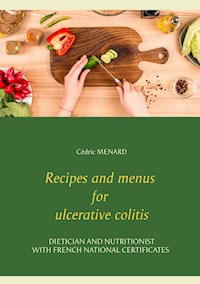
This book is for each individual suffering from ulcerative colitis. It contains numerous recipes to help you better deal with your specific diet associated with your inflammatory crisis. The goal of this book is to quickly learn and perfectly modify all your traditional recipes to efficiently fight against your diarrheal crisis during your inflammatory crisis. The author also gives you three weeks of menus completely adapted to your diarrheal crisis to complete your nutritional learning.
Sie lesen das E-Book in den Legimi-Apps auf:
Seitenzahl: 107
Veröffentlichungsjahr: 2020
Das E-Book (TTS) können Sie hören im Abo „Legimi Premium” in Legimi-Apps auf:
Ähnliche




Hello and thanks a lot for your trust.
You have bought this book to solve your diarrhea problems due to ulcerative colitis you are suffering from. Know that I have done everything I could in the writing of it to bring you as much well-being and comfort as possible on a nutrition side, but also satisfaction. Read this book and carefully follow the advice I give to obtain satisfaction. I wrote these books to help you as much as I could. Thank you.
My website: www.cedricmenarddieteticien.com
Note: this book does not give you advice to loose weight. It has been written to bring you an answer concerning nutrition appropriate for each and everyone of you during your inflammatory crisis due to ulcerative colitis you are suffering from. Nevertheless, this book is not adapted to any intolerance or food allergy: you then have to be careful when choosing your recipes and to choose the appropriate food, especially if you are lactose or gluten intolerant for instance.
Summary
Ulcerative colitis
Préssenting groups of foods
Fats
Some vinaigrettes
Meats, fish, eggs
Some recipes ideas
Essential cooking advice
Beef on a string
Diet blanquette
Beef à la mode
Meunière turkey breasts
Poached fish fillet
Cod steak en papillote
Baked bass
Fish fillets with fromage blanc
Fish filets with carrots
Seafood salad
Light quiche
Duck legs in sauce
Shirred egg with clams
Carbohydrates
Essential cooking advice
Pasta cake
Fish lasagna
Gnocchi à la romaine
Semolina with chicken
Rice pilaf
Semolina with fruits covered with meringue
Riz à l’impératrice with fruits
Rice pudding with rice milk
Light crepes with Mornay sauce
Quiche with tapioca
Tapioca flan
Semolina gratin with cheese
Green vegetables
Essential cooking advice
Braised endives
Endive rolls
Vichy carrots
Purée Crécy
Carrot cream soup
Zuchini gratin
Carrots soufflé
Green végétables flan
Green végétables stock with tapioca
Carrots with bechamel sauce
Bell peppers stuffed with rice
Carrot cake
Carrot flan
Dairy products
Essential cooking advice
Entremet with quince compote
Banana semolina pudding
Apple and fromage blanc parfait
Watermelon iced mousse
Light sugar-free crème aux oeufs
Apple Bavarian cream
Œufs au lait
Lactose-free fromage blanc flan
Sugar-free chocolate flan
Sugar-free chestnut milk cream
Lactose-free petits suisses with caramelized quinces
Fruits
Essential cooking advice
Jellied grated apples
Light quince/banana compote
Light apple cream
Lychees with fromage blanc
Diet quince pie
Apples with diet creme patissiere
Fruits awith lactose-free fromage blanc
Fresh fruits velouté
Nut cake
Dairy quince compote
Three weeks of suggested menus
Ulcerative colitis
Ulcerative colitis is a chronic and idiopathic inflammatory bowel disease which consists in crisis broken by remissions. Ulcerative colitis (UC) is a long-term condition that results in inflammation and ulcers of the colon and rectum.
Nutrition is important during periods of inflammatory crisis to:
Slow the digestive process because the individual suffering from this disease experiences diarrhea.
If
the individual is going under corticosteroid therapy (a therapy based on cortisone), sharply
limit
sodium (salt) and sugar intakes while
increasing
calcium intakes.
Fight against an
iron-deficiency anemia
(iron deficiency) from which individuals suffering from ulcerative colitis are always collateral victims.
Outside of the inflammatory crisis periods, there are two possibilities. Either your gastroenterologist thinks a normal and balanced diet can be followed or they think a strict diet associated to inflammatory crisis must be followed for ever.
Nutrition and diarrhea
Nutrition is fundamentally important when treating diarrhea by limiting or even removing vegetable fibers intake which improve digestive process for instance.
Basic health and dietary rules for treating diarrhea are very simple to implement:
The decrease of feces by removing vegetable dietary fibers as much as possible (exclusively eat
refined
grains and
very little or even no
green vegetables nor fruits at all, while wisely choosing them).
The rehydration by drinking
a lot
of water. Keep in mind that diarrhea triggers big water losses which increase dehydration.
Corticosteroid therapy
Nutrition is as fundamentally important if your doctor uses corticosteroid therapy to treat your inflammatory crisis. You then have to greatly decrease your sodium and sugar intakes and increase your calcium, vitamin D and protein intakes.
Please note that corticosteroid therapy is not systematically prescribed. In this case, it is useless to follow the nutritional advice given in this paragraph. However, the recipes and menus in this book are all suitable for corticosteroid therapy.
Basic health and dietary rules are to be followed if you are going under corticosteroid therapy:
1- Do not eat the following foods which are part of the richest foods in sodium (salt):
Table salt.
All cold meats.
All crustacea, shellfish, fish eggs including caviar.
Sauerkraut (fermented cabbage).
Condiments, mustard, caper, pickle, celery salt.
Olives, crackers, oleaginous (peanut, pistachio…).
Salted butter and salted vegetable.
All
smoked
meats and all
smoked
fish.
All
salted
meats and fish.
All hams (cooked, braised…).
Potato chips.
Standard bread and standard crispbreads.
Frozen vegetables
if you eat them with the spices
they come with.
All vegetable juices.
All carton, packet or frozen soups.
All meals coming from the caterer, whether fresh or frozen.
All ready industrial meals, frozen or not.
All sauces commercially available.
Baking powder.
Meat or vegetable stocks in cube (like KUB).
Candies, Vichy Pastilles.
Any preserve
that does not
mention "no added salt".
Industrial tomato juice.
Pastries commercially available.
Some sparkling waters (we will detail this further in the book).
The majority of aged cheese.
Why? These are common foods containing the biggest quantities of sodium. Removing all these foods from your diet corresponds to the "large" low-sodium diet (the less strict and the most common one. In general, following this diet is enough).
Note: you can find "diet" salt (with less or even no sodium at all) in supermarkets or in drugstores. If you struggle to eat meals without salt, feel free to use this salt. NOTE: it is strictly forbidden to use this diet salt if you are suffering from kidney failure because it can lead to death. Indeed, in the diet salt, sodium (sodium chloride) is replaced with potassium (potassium chloride) and if you are suffering from kidney failure, you absolutely have to reduce your potassium intakes as much as possible in addition to your sodium intakes (among other things).
2- Limit as much as possible the consumption of any food containing big quantities of sugar: white sugar, jam, honey, chocolate, cakes, pastries, candies, salted cookies...
Note: sweeteners as aspartame, sucralose, Stevia extracts... are not sugar-based products but they give you the taste of sugar when you eat them. You can absolutely eat them if you are going under corticosteroid therapy.
3- Follow a diet rich enough in animal-based proteins: meats, fish, eggs, dairy products...
4- Follow a diet rich enough in calcium and vitamin D. The best food sources of calcium are all dairy products, especially those which are animal-based. They have what is called an excellent bioavailability of calcium from dairy sources due to animal-based proteins and vitamin D. But you can also find calcium in meats, fish (especially those with fishbones), eggs, green vegetables, fruits (especially those that are oleaginous), some seeds (sesame seeds are the biggest food sources of calcium known to this day), lime waters (tap waters or some mineral waters: Talians, Courmayeur, Contrex...) as well as in plant milks such as soy milk, almond milk, nut milk...
Note: magnesium and calcium are competing to be absorbed by the intestine. If they are absorbed at the same time, magnesium is assimilated first and foremost compared to calcium, which then makes your calcium intake clearly less interesting and less efficient. If you have to use magnesium supplements in your diet, do not take them at the same time as your calcium intakes. Moreover, try not to drink waters that are rich in magnesium, especially while eating.
Iron-deficiency anemia and iron
Iron is an essential component of red blood cells in which it is responsible for conveying the oxygen from the lungs to the organs. Iron then releases the CO2 from red blood cells, conveying it to the lungs so that they can get rid of it thanks to the exhalation.
The daily requirements in iron under normal circumstances are of 20mg/day for adult women. During pregnancy, they are increased to 28mg/day. For adult men, they are 10mg/day. This explains why the risk of suffering from iron-deficiency anemia (iron deficiency) is much higher with women than with men. Moreover, the more abundant a woman periods, the higher her requirements in iron.
Iron is a mineral salt that can be found in animal-based foods as well as in plant-based foods. Indeed, there are two forms of dietary iron:
"Haem" iron which is only animal-based
and which you can find in meats, fish, eggs , dairy products, cooked meats, crustacean, mollusks, dishes containing meat(s) and/or fish and/or eggs such as quiches, fish terrines, ham and cheese escalopes, breaded fish, brewer’s yeast… This iron is
strictly animal-based
and
very well absorbed
by our metabolism because the intestine absorbs it
as about 80% of its food intakes
.
"Non haem" iron which is only plant-based
and which you can find in green vegetables, whole grains, fruits, cocoa… This iron is
strictly plant-based
and
badly absorbed
by our metabolism because the intestine absorbs it
as about 15% of its food intakes
.
Thanks to these nutrition facts, it is simple to understand that animal-based foods are by far the most interesting sources of iron and so the most important to eat in case of iron-deficiency anemia (deficiency in iron). On the other hand, vegetables, even if some of them contain iron, sometimes in good amounts, will always be less interesting for treating iron-deficiency anemia.
Food-based iron is absorbed in the small intestine. When the iron reserves (in the liver) are too low, your organism increases the capability of the intestine to absorb food-based iron.
The iron deficiency is called iron-deficiency anemia.
Note: vitamin C greatly improves the absorption of food-based iron by the intestine (alcohol too). Calcium, wheat bran, rhubarb, sorrel, celery (celery stick or celeriac), cocoa, tea, coffee and calcium, on the contrary, limit its absorption by the intestine.
Ultimately...
The most difficult times are the inflammatory crisis periods, especially if they are treated with cortisone. In this case, you have to stick to a diet that is quite hard to follow for inexperienced people. But do not worry, this book is designed to bring you as much essential information as possible so that you can get good automatic reflexes concerning food.
PRESENTING GROUPS OF FOODS
Fats
Fats consist in animal-based fats, which are the source of saturated fats, cholesterol and for some vitamin D, and plant-based fats, which are the source of unsaturated fats (omega 3, 6 and 9), vitamins A, K and E. However, palm oils and copra oils (which we can now find almost everywhere) contain "saturated" fats known for being very atherogenic (which obstructs the arteries). This is why they have this well-deserved bad nutritional reputation. Within animal-based fats, we can mention: butter (salted or unsalted) containing 82% of fats or light butter, lard, duck fat, goose fat, but also the famous cod liver oil... and within the plant-based fats, we can mention: vegetable oil, blocs of vegetable fat shortening and vegetable margarines (some are salted, others are not). There are "fat blends" made from a blend of animal-based fats and plant-based fats. Crème fraîche will be considered as part of dairy products. Plant-based fats are very important for the nutritional balance (except for palm oil and copra oil). However, you must eat them in moderate quantities. About ½ oz of butter is the daily recommended quantity (a microbloc), but you can also eat the same quantity of quality vegetable margarine (St Hubert oméga 3 without palm oil for instance), if you wish.
Concerning your diet associated with the treatment of anemia (promoted by the ulcerative colitis you are suffering from), fats almost do not give your organism iron at all. They then take an extremely small part in nutritional treatment of an iron-deficiency anemia, if not at all.
However, do not neglect their big nutritional significance.
Concerning your diet associated with the treatment of diarrhea




