


37,99 €
Mehr erfahren.
- Herausgeber: John Wiley & Sons
- Kategorie: Fachliteratur
- Sprache: Englisch
With a uniquely perspective on the key factors in recovery from eating disorders, this practical guide for patients and clinicians draws from relevant, real-life case studies.
- Focuses on real-life recovery strategies that involve motivational factors, physical and psychological health, and issues such as self-esteem, body attitude, emotion regulation and social relationships.
- Draws on extensive qualitative research with more than 80 former sufferers
- Offers experience-based guidance for professionals assisting clients in their recovery process
Sie lesen das E-Book in den Legimi-Apps auf:
Seitenzahl: 305
Veröffentlichungsjahr: 2013
Ähnliche



















Contents
About the Author
Foreword
Acknowledgements
Introduction
When have Eating Disorder Patients Recovered?
Can All Patients Recover from their Eating Disorder?
Recovered Patients as Guides and Role Models
Content of the Book
A Book for Both Clinicians and Clients
How Therapists and other Professionals may Use this Book
How Eating Disorder Patients may Use this Book
How Parents, Partners and Friends may Use this Book
1 Problems in the Period before the Eating Disorder
Introduction
Lack of Self-Esteem and Negative Self-Evaluation
Compliant and Pleasing Behaviour
Hiding Real Thoughts and Opinions from others
Sensitivity to the Needs of others
Perfectionism and Fear of Failure
Inner Criticism and Negative Self-Evaluation
Impaired Identity Development
Negative Body Attitude
Summary
2 First Stage: Extreme Dieting
Introduction
How does an Eating Disorder Start?
Differences Between Healthy and Extreme Dieters
From Healthy to Extreme Dieting
Why Continue Dieting?
Eating Disorder or Identity Disorder?
Control over Food and Body
Denial of Problems
Summary
3 Negative Consequences of Eating Disorders
Introduction
Losing Control over Eating Habits
The Trap of Extreme Dieting
Eating Disorder: From Friend to Enemy
Rigid Rules and Obsessive-Compulsive Behaviour
Indoctrination and Brainwashing
Inner Criticism and Critical Voices
The Toxic Effects of Starvation
Depression and Suicidal Thoughts
Isolation
Physical Consequences
Summary
4 Turning Point and Motivation for Recovery
Introduction
The Deep Pit
Turning Point
Ambivalent Motivation for Change
Fear of Asking for Help
Questionnaires to Improve Motivation for Treatment
Motivation for Physical Recovery
Motivation for More Self-Esteem
Motivation for a more Positive Body Attitude
Motivation for Better Emotion Regulation
Motivation for Better Social Relationships
Motivation for Reducing Financial Problems
Summary
5 Normalizing Eating Habits
Introduction
Overcoming the Fear of Increasing Food Intake
Changing Cognitions about Food
Three Regular Meals a Day
Regular Mealtimes
Reduction of Binges
Reduction of Purging
Healthy and Sufficient Food
Reduction of Laxatives, Diuretics and Slimming Pills
Drinking Water and other Liquids
No Extreme Exercising
Treatment of Comorbidity
Summary
6 A Positive Body Attitude
Introduction
Not Feeling Fat
No Longer Obsessed by Food and Weight
Being Able to Listen to Feelings of Hunger and Satiety
Developing a Positive Body Attitude
Learning Defence Strategies against Teasing
Losing the Urge to Diet
Summary
7 Physical Recovery
Introduction
Normal and Stable Weight
Regular Periods
Normal Body Temperature
Normal Heartbeat and Pulse
No Anaemia
No Constipation
No Problems with Bowels and Stomach
No more Swollen Salivary Glands and Sore Throat
Healthy Skin
Healthy Teeth
Enough Sleep
Enough Energy
Reduction of Osteoporosis
Summary
8 Developing More Self-Esteem
Introduction
More Self-Esteem
Empowering Yourself
Become More Assertive
Less Emphasis on Pleasing others
Having Less Fear of Rejection
Showing Less Compliant Behaviour
Having Less Perfectionism and Fear of Failure
Summary
9 Expressing Emotions
Introduction
No Longer Avoiding Negative Emotions
Reduction of Critical Thoughts and Inner Voices
Recognizing and Expressing Emotions
Dare to Express Different Opinions
No Longer Feeling Depressed
Summary
10 Improving Social Relations
Introduction
Learning to Trust other People
Participating in Social Activities
Education and Career
Intimate Relations
Pregnancy and Children
Summary
11 The Most Important Questions and Answers about Recovery
Introduction
When have Eating Disorder Patients Recovered?
How many Patients Recover from their Eating Disorder?
Why do Not All Patients not Recover?
How can the Recovery Rate Increase?
Do All Patients have a Relapse?
How long does it Take to Recover from an Eating Disorder?
What are the Important Goals for Treatment?
Which Treatments are Most Effective?
What Makes a Good Therapist?
Summary
12 Checklist for Full Recovery
Introduction
Conclusion
References
Index
This edition first published 2013© 2013 John Wiley & Sons, Ltd
Wiley-Blackwell is an imprint of John Wiley & Sons, formed by the merger of Wiley’s global Scientific, Technical and Medical business with Blackwell Publishing.
Registered OfficeJohn Wiley & Sons, Ltd, The Atrium, Southern Gate, Chichester, West Sussex, PO19 8SQ, UK
Editorial Offices350 Main Street, Malden, MA 02148-5020, USA9600 Garsington Road, Oxford, OX4 2DQ, UKThe Atrium, Southern Gate, Chichester, West Sussex, PO19 8SQ, UK
For details of our global editorial offices, for customer services, and for information about how to apply for permission to reuse the copyright material in this book please see our website at www.wiley.com/wiley-blackwell.
The right of Greta Noordenbos to be identified as the author of this work has been asserted in accordance with the UK Copyright, Designs and Patents Act 1988.
All rights reserved. No part of this publication may be reproduced, stored in a retrieval system, or transmitted, in any form or by any means, electronic, mechanical, photocopying, recording or otherwise, except as permitted by the UK Copyright, Designs and Patents Act 1988, without the prior permission of the publisher.
Wiley also publishes its books in a variety of electronic formats. Some content that appears in print may not be available in electronic books.
Designations used by companies to distinguish their products are often claimed as trademarks. All brand names and product names used in this book are trade names, service marks, trademarks or registered trademarks of their respective owners. The publisher is not associated with any product or vendor mentioned in this book. This publication is designed to provide accurate and authoritative information in regard to the subject matter covered. It is sold on the understanding that the publisher is not engaged in rendering professional services. If professional advice or other expert assistance is required, the services of a competent professional should be sought.
Library of Congress Cataloging-in-Publication Data
Noordenbos, Greta.Recovery from eating disorders : a guide for clinicians and their clients / Greta Noordenbos.pages cmIncludes bibliographical references and index.
ISBN 978-1-118-46920-0 (cloth) – ISBN 978-1-118-46919-4 (pbk.) 1. Eating disorders–Risk factors. 2. Eating disorders–Treatment. I. Title. RC552.E18N64 2013616.85′2606–dc23
2012036588
A catalogue record for this book is available from the British Library.
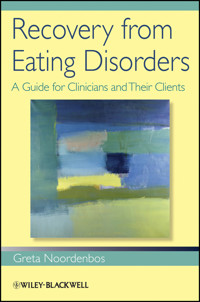
Cover image: Diana Ong, Abstract #10, 1965. Private collection. © Diana Ong/SuperStock.Cover design by Nicki Averill Design & Illustration.
About the Author
Dr. Greta Noordenbos is a senior researcher in the Department of Clinical Psychology, Leiden University, the Netherlands. She completed her doctoral thesis on cultural and gender factors in the development of anorexia nervosa in 1987. She then conducted research on several topics in the field of eating disorders: risk factors and prevention, long-lasting and chronic patients, criteria for recovery, quality of treatment, emotion regulation and alexithymia, inner criticism and self-esteem. In 1994, she founded the Dutch Committee for Prevention of Eating Disorders and participated in the Specialized Interest Group for Prevention of the Academy of Eating Disorders. She has written several books and articles on eating disorders. Together with Professor Walter Vandereycken from Leuven University in Belgium, she edited the Dutch version of the Handbook of Eating Disorders. She was also a member of the Task Group of the Dutch Guidelines for Eating Disorders and became an honorary member of the Dutch Academy of Eating Disorders in 2010.
Address for correspondence:Dr. Greta Noordenbos: Department of Clinical Psychology, Leiden University. Wassenaarseweg 522333 AK, Leiden, The [email protected]
Foreword
This book describes in a unique way the conditions necessary to recover from an eating disorder. Greta Noordenbos is one of the few experts in this field who has done research into these aspects. This book reflects the knowledge and insights she developed about the recovery process of eating disorder patients. What makes this book unique is that she writes from the perspective of the patients and the way they think and feel. The stories of many such patients are given in detail here. The author makes very clear how important it is to listen to eating disorder patients carefully and with respect, and try to understand what is going on in their minds.
The information provided in this book will be very useful not only for patients, but also for their families and the therapists involved in the process of recovery from the eating disorder. It becomes clear that recovery is much more than ensuring enough food intake, weight recovery and reducing binging and purging. Although they are necessary conditions for recovery, it is also important that eating disorder patients gain insight into their own feelings, needs and wishes and learn to express their emotions. They also have to improve their body image and develop more self-esteem and empower their identity. Moreover, they have to improve emotion regulation and social relationships. Many quotations from former patients illustrate which factors helped them to recover. This book will certainly motivate eating disorder patients to ask for help and so take the first steps towards recovery. For that reason, I would advise every patient, parent and therapist to read this book.
Dr. Johan VanderlindenPsychologist-psychotherapistUniversity Psychiatric Centre of Catholic University in Leuven,Psychological Faculty of Leuven University,Belgium
Acknowledgements
I would first like to thank all the eating disorder patients I interviewed. This book could not have been written without their inputs about their process of recovery. They inspired me to write this book, because they are the best guides to inform clinicians, professionals, parents and friends what it means to develop an eating disorder and to recover from it. They have shown that full recovery is indeed possible. Recovered patients are also important role models for all those who continue to suffer from eating disorders.
The first edition of this book, entitled Gids voor herstel van Eetstoornissen, was published in 2007 in the Netherlands by De Tijdstroom, Utrecht. Many readers stimulated me to publish an English version of this book. I would like to thank Joanna Kortink, Liesbeth Libbers, Carmen Netten, Ellen Spanjers, Johan Vanderlinden and many other professionals for their support and De Tijdstroom for their permission to publish an English version of this book.
The English version, entitled Recovery from Eating Disorders: A Guide for Clinicians and Their Clients, has been completely rewritten and updated with new assignments and questionnaires. I am very grateful for all the useful comments of my international colleagues to improve this book: Tabita Björk, Runi Börreson and Rachel Bryant-Waugh. Darren Reed was very helpful in getting this book published. Many thanks also to Ineke Smit who carefully corrected my English. Without their support and valuable suggestions, I would never have been able to publish this book.
Greta NoordenbosLeiden University,The Netherlands
Introduction
Can eating disorder patients recover? What changes should they make in order to recover? For a long time, the most important goals for recovery were normalizing their eating habits and weight. Although these goals are necessary steps in the process of recovery, they are not enough. Eating disorder patients struggle not only with food and weight, but also with very negative thoughts about their bodies and themselves. They are often very critical about themselves, and if they are not able to cope with their own high standards, they think they have failed and blame themselves. They also have problems with emotion regulation and social relationships. In order to recover from their eating disorder, they have to change many aspects of their lives: not only their eating habits and weight, but also their self-evaluation and body attitude, their feelings and emotions, and their relations with others.
Lesen Sie weiter in der vollständigen Ausgabe!
Lesen Sie weiter in der vollständigen Ausgabe!
Lesen Sie weiter in der vollständigen Ausgabe!
Lesen Sie weiter in der vollständigen Ausgabe!
Lesen Sie weiter in der vollständigen Ausgabe!
Lesen Sie weiter in der vollständigen Ausgabe!
Lesen Sie weiter in der vollständigen Ausgabe!
Lesen Sie weiter in der vollständigen Ausgabe!
Lesen Sie weiter in der vollständigen Ausgabe!
Lesen Sie weiter in der vollständigen Ausgabe!
Lesen Sie weiter in der vollständigen Ausgabe!
Lesen Sie weiter in der vollständigen Ausgabe!
Lesen Sie weiter in der vollständigen Ausgabe!
Lesen Sie weiter in der vollständigen Ausgabe!




