


17,99 €
Mehr erfahren.
- Herausgeber: John Wiley & Sons
- Kategorie: Fachliteratur
- Sprache: Englisch
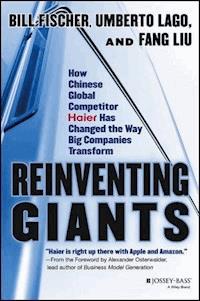
A compelling profile of an emerging Chinese competitor Chinese firms are reinventing their business models, their corporate cultures, and themselves, becoming global competitors who increasingly offer knowledge rather than cheap labour in their quest to join the ranks of the "world's best" companies. This book offers a compelling profile of the most ambitious of these emerging Chinese competitors, the Haier Corporation (the world's largest manufacturer of home appliances), and shares insights on how one organization has repeatedly reinvented its business model and corporate culture in an effort to sustain its success. Reinventing Giants provides an exclusive look within the Haier Corporation and shows how managerial accountability and responsibility have been repositioned at every level of the organization, with the core value of market-centricity, while aligning strategy on each level of management. It includes actual work reports that show this process in detail from the ground up. The authors emphasize how a belief in the liberation of employee talent has consistently been the driving force underlying Haier's success. * Includes the remarkable story of Haier's turnaround and how these lessons can be applied to other organizations * Contains information for any company grappling with competition in the global marketplace * Shows how to liberate employees' talent to drive business success * Written by Bill Fischer, Professor of Innovation Management at IMD in Switzerland, Umberto Lago, Professor of Management at Bologna University, Italy, and Fang Liu, Research Associate of IMD Reinventing Giants helps global managers rethink their own business models and accompanying corporate cultures in order to be able to apply Haier's lessons directly to their own organizations.
Sie lesen das E-Book in den Legimi-Apps auf:
Seitenzahl: 384
Veröffentlichungsjahr: 2013
Ähnliche



















Contents
Foreword
Chapter 1: Moving a Company with the Times
Haier Group
Transformational Change in an Emerging Market
Strategy Is Choice and Execution
Anticipating What We Will Learn from Haier
What You Will Learn in Each Chapter
Chapter 2: The Battlefield
The Global Battlefield Emerges in the 1980s
The U.S. Market in the 1980s and 1990s
The Chinese Market
The Challenge of Globalization: Key Lessons of Western Brands in China
Home Appliance Manufacturers’ Approaches to the Chinese Market
China’s Major Home Appliance Manufacturers
The Global Major Home Appliance Industry
The Essence of Success
Chapter 3: The Story of Haier and the Evolution of Its Corporate Culture
The Origins of Haier’s Business Model and Corporate Culture
Qingdao General Refrigerator Factory
Stage 1, 1984–1991: Brand Building Through Focusing on Quality and Manufacturing Excellence
Stage 2, 1991–1998: Diversification—Eating the Stunned Fish
Stage 3, 1998–2005: Business Process Reengineering and Market Chains
Stage 4, 2005–2012: Zero Distance to the Customer—The ZZJYT
Thirty Years of Reinventing Haier Culture
Chapter 4: Liberating Talent
Theme: Haier Thinks of Itself as a Service Company
Theme: Service Is Best Achieved with Zero Distance Between Haier and Its Customers
Theme: The Entrepreneurial Energies of Its Workforce Are Haier’s Best Means of Achieving Its Service Goals
Theme: Freedom Requires Control
Theme: Responsiveness Can Be Facilitated by Preset Conversations
Theme: Value Creation Should Be Linked Among Customers, the Organization, and Employees
Haier Today
Chapter 5: Building a Corporate Culture for the Twenty-First Century
Joining Haier’s Three-Door Module ZZJYT
Market ZZJYTs
Manufacturing ZZJYTs
Second- and Third-Tier ZZJYTs
Preliminary Conclusions Regarding the ZZJYT Model
Looking Forward and Looking Back
Chapter 6: Haier as a High Performer
The Mythology of High-Performing Organizations
Creating the High-Performing Organization of the Future
Benchmarking Against Trailblazing Talent-Liberating Experiences
Markets, Hierarchies, and the Future of Management
Comparison with Haier
Chapter 7: A True Hybrid
Haier’s Business Model and the Governance Structures of Economic Activity
Interfirm Networks, Partnerships, and Alliances in the Market-Hierarchy Debate
Transaction Cost Economics and Interfirm Networks
Trust and Interfirm Networks
Some Preliminary Comments
From Interfirm Networks to Intrafirm Networks
From the ABB Model to the Haier Model
Combining Incentives with Control
Chapter 8: A True Disrupter
The Main Attributes of Haier’s Story
What Can We Learn?
Applicability of the Lessons Learned
Postscript: While We Were Writing . . .
Appendix: How ZZJYTs Work
Acknowledgments
The Authors
Index
More praise forReinventing Giants
“Finally! The best of both worlds—the best case study I’ve seen describing a Chinese company’s global success, integrated with proven managerial frameworks and concepts. The result is practical examples, valuable tools, and useful ideas that you can put to use today to help your firm achieve competitive success.”
—Andy Boynton, dean, Carroll School of Management, Boston College
“Reinventing Giants shows that corporate revival requires both hunting for new ideas as well as implementing the right ones, and renewing your company, even transforming it in an ever-changing world. These key elements are all addressed in this book and essential for all companies to remain agile.”
—Feike Sijbesma, CEO, Royal DSM
“Reinventing Giants not only provides a great illustration of how a leading Chinese company has actively developed and renewed itself over the past several decades and as a result has become the global leader in its industry but it also gives valuable and inspiring new insights to all of us who compete in global markets.”
—Matti Alahuhta, president and CEO, Kone Corporation
“As we assess the potential impact of Chinese companies on the future thrust of international competition, the authors have provided us with a series of rich insights into the evolving trajectory of one key firm, Haier. Their provocative research regarding Haier’s organizational transformation strongly suggests that we may be witnessing one of the most innovative adaptations of a once primarily domestic player into a truly distinctive new global competitor.”
—Denis Simon, vice-provost for international strategic initiatives, Arizona State University; member of the Experts Group, US-China Innovation Dialogue
“For all of us who want to understand Chinese competition, Reinventing Giants makes an invaluable contribution: explaining success by focusing on the ability of one of the great Chinese companies to create and re-create an innovative corporate culture. It’s all right here, spelled out in Haier’s own language: ZZJYTs, strategic income statements, zero distance from the customer and . . . catfish! Read it now. Or else you’ll be left behind!”
—Dan Denison, professor at IMD; author of Leading Culture Change in Global Organizations: Aligning Culture and Strategy
Copyright © 2013 by Bill Fischer, Umberto Lago, and Fang Liu. All rights reserved.
Cover design by Adrian Morgan
Cover photograph: Copyright © Dominik Pabis | Vetta | Getty
Published by Jossey-Bass
A Wiley Imprint
One Montgomery Street, Suite 1200, San Francisco, CA 94104-4594—www.josseybass.com
No part of this publication may be reproduced, stored in a retrieval system, or transmitted in any form or by any means, electronic, mechanical, photocopying, recording, scanning, or otherwise, except as permitted under Section 107 or 108 of the 1976 United States Copyright Act, without either the prior written permission of the publisher, or authorization through payment of the appropriate per-copy fee to the Copyright Clearance Center, Inc., 222 Rosewood Drive, Danvers, MA 01923, 978-750-8400, fax 978-646-8600, or on the Web at www.copyright.com. Requests to the publisher for permission should be addressed to the Permissions Department, John Wiley & Sons, Inc., 111 River Street, Hoboken, NJ 07030, 201-748-6011, fax 201-748-6008, or online at www.wiley.com/go/permissions.
Limit of Liability/Disclaimer of Warranty: While the publisher and author have used their best efforts in preparing this book, they make no representations or warranties with respect to the accuracy or completeness of the contents of this book and specifically disclaim any implied warranties of merchantability or fitness for a particular purpose. No warranty may be created or extended by sales representatives or written sales materials. The advice and strategies contained herein may not be suitable for your situation. You should consult with a professional where appropriate. Neither the publisher nor author shall be liable for any loss of profit or any other commercial damages, including but not limited to special, incidental, consequential, or other damages. Readers should be aware that Internet Web sites offered as citations and/or sources for further information may have changed or disappeared between the time this was written and when it is read.
Jossey-Bass books and products are available through most bookstores. To contact Jossey-Bass directly call our Customer Care Department within the U.S. at 800-956-7739, outside the U.S. at 317-572-3986, or fax 317-572-4002.
Wiley publishes in a variety of print and electronic formats and by print-on-demand. Some material included with standard print versions of this book may not be included in e-books or in print-on-demand. If this book refers to media such as a CD or DVD that is not included in the version you purchased, you may download this material at http://booksupport.wiley.com. For more information about Wiley products, visit www.wiley.com.
Library of Congress Cataloging-in-Publication Data
Fischer, Bill.
Reinventing giants: how Chinese global competitor Haier has changed the way big companies transform / Bill Fischer, Umberto Lago, and Fang Liu; foreword by Alexander Osterwalder.—First edition.
pages cm
Includes bibliographical references and index.
ISBN 978-1-118-60223-2 (cloth); ISBN 978-1-118-60224-9 (ebk.); ISBN 978-1-118-60228-7 (ebk.); ISBN 978-1-118-60229-4 (ebk.)
1. Haier (Corporation) 2. Household appliances industry—China—Management— Case studies. 3. International business enterprises—China—Management. I. Lago, Umberto, 1964– II. Liu, Fang, 1984– III. Title.
HD9971.5.E544H3594 2013
338.7’68380951—dc23
2012048779
Bill:
To that intrepid band of adventurers who moved to Dalian in 1980 to begin the National Institute for Industrial Science and Technology Development, on behalf of the Chinese and American governments; and to my best friend and partner in everything I’ve ever done, Marie Annette, who not only encouraged me to be a part of the Dalian adventure but brought along Kimberly, Amy, and Billy and changed all our lives. Without her, my life would have been so much poorer!
To Jack N. Behrman, who took me under his wing and taught me to think beyond traditional borders when I was a young neophyte at the University of North Carolina, Chapel Hill.
Umberto:
To Roberta, Giovanni, Francesco: my very special ZZJYT!
Fang:
To Thierry, my partner and best friend, who changed my life, allowing me to look at China from a new and deeper perspective.
To Willem, who brought me to IMD and sparked my passion for research, and whose support and encouragement have been invaluable in every initiative I have undertaken.
To Bill, who offered me the opportunity to work on this project, and always showed enormous trust in me.
And, to my beloved family and my homeland.
Foreword
Competitive analysis is dead. I have believed this to be true for quite a while, but my very last doubts disappeared when I listened to Zhang Ruimin, chairman and CEO of Haier, give a talk at IMD business school. In his presentation, Zhang stressed that the failure of a company typically comes not from its competitors but from itself. He went on to outline the organizational culture that Haier has put in place to resist such failure by challenging itself—all the time.
It is no coincidence that many of today’s leading companies, including Haier, share two characteristics. First, they have built value propositions that customers love, combined with business models that offer superior returns. Second, they have demonstrated the ability to do this through continuous reinvention. It is this second characteristic that truly separates the great from the merely good. Haier is such a great company, right up there with organizations like Apple and Amazon.
To achieve such greatness, these companies are not content to rely on executing and improving the known and proven business models that have led them to past success. Instead, they increasingly are investigating new organizational forms that allow them to experiment with bold, daring, and imaginative business models for the future while simultaneously excelling at executing and improving their own successful models. What makes Haier a particularly interesting case is that by choosing to follow the same sort of experimental approach to reinvention, it has come to illustrate the ascent of a new breed of Chinese corporation characterized more by organizational innovation and business model renewal than by a reliance on cheap manufacturing and economies of scale.
Zhang has led Haier from a bankrupt refrigerator factory in Qingdao to become a global home appliance brand. He has been extremely thoughtful in the path he has chosen for the firm, first applying Western and Japanese business practices and management techniques and then later extending these approaches with his own Chinese-based vision of how a twenty-first-century corporation should be organized.
Haier offers interesting insights into three skills that I believe will distinguish future leading organizations that master them from all others that don’t. The first skill is the ability to design and build great value propositions that customers really want. This sounds trivial, but it isn’t. Great value propositions require a thorough understanding of the lives and dreams of customers. Rare are the companies that are organized in a manner that allows them to deeply investigate customer motivations and then act on the knowledge they have gained. Only the best among them truly understand the “jobs” that customers are trying to get done using the goods and services that they purchase, and rarer still are organizations sufficiently sensitive to the pains and gains that their customers encounter related to such searches. These organizations understand what legendary Harvard professor Theodore Levitt meant when he taught us that people don’t want to buy a quarter-inch drill; what they want is a quarter-inch hole. Haier has demonstrated the desire to achieve such a deep customer understanding by relentlessly reorganizing itself to focus on the jobs that its customers need to get done in their lives and then acting on that knowledge by decentralizing its decision making.
The second skill characterizing great organizations is the ability to design superior business models. Whereas it is a great customer value proposition that attracts customers, it is a great business model that brings in the profits to sustain an ongoing business. Nespresso, a daughter company of Nestlé, built a thriving business by introducing an innovative business model for the direct sales of espresso pods in the 1990s. It turned the transactional business of selling coffee through retail into a business that locks in customers with proprietary delivery systems that allow the customer to enjoy a great coffee at home and still produces recurring revenues through high-margin pod sales. This is a great example of how superior business model mechanics can mean both wildly delighted customers and substantially higher profits. In the same way, Haier has substantially reinvented its business model and adjusted its resources and activities in order to produce better-quality products that have led to a better brand associated with that quality and improved its profitability in the process.
The third skill differentiating outstanding organizations from others is their ability to reinvent themselves while they are successful and to do so over and over again. Success so often leads to complacency, and that usually leads organizations to live off a successful business model way past its expiration date. Even Nespresso failed to easily reinvent its business model when its patents on its machines and pods expired. Business models are like yogurt: they inevitably run out of shelf life and expire. Unfortunately, the expiration date of business models seems to be getting shorter by the decade. It is unthinkable today that a CEO can manage his or her company based on the same unchanged business model for an entire career. Companies that fail to continuously renew themselves or even self-disrupt are prone to disruption by others and risk decline and irrelevancy.
Few companies have succeeded in building organizational structures that enable the simultaneous execution of existing successful business models while also inventing new ones for tomorrow. This is where Haier has shown its most impressive performance. Through a culture of continuous organizational innovation, Haier seems to be well prepared for the challenges of the future.
February 2013
Alexander Osterwalder
CHAPTER 1
MOVING A COMPANY WITH THE TIMES
What Makes Haier Unique?
Change is the only constant in the brave new world of global competition. Organizations that do it well flourish; those that do not can find themselves looking at their possible demise. Either way, change is inevitable: change in offerings, change in locations, change in strategy, and ultimately change in the organization itself. None of this is easy or natural. Jack Welch of GE was famous for saying, “When the rate of change outside [an organization] exceeds the rate of change inside, the end is in sight,” and IBM’s former CEO, Sam Palmisano, observed, “Organizational culture thrives only to the extent that it is open to being re-created.”1 But change, especially big change, is difficult, and frequently it is something that all too many organizational actors hope can be avoided, or at least minimized, at all costs. Not surprisingly, those who succeed in orchestrating big change are regarded with admiration by students of business; those who do it more than once are considered exceptional.
This book is about transformational change—the reinvention of a corporate business model and culture not once but at least three times within thirty years. Since change for change’s sake is never a good idea, and certainly not noteworthy enough to merit book-length attention, this book is also about the context in which big strategic change takes place: the whys and wherefores that mandate and shape change. And it is about change leadership as well—the hows—because big change is never easy to accomplish, and when it is successful, it is inevitably the result of leaders’ ability to create a vision and mobilize the workforce to take this vision seriously and move determinedly toward the desired objectives.
Lesen Sie weiter in der vollständigen Ausgabe!
Lesen Sie weiter in der vollständigen Ausgabe!
Lesen Sie weiter in der vollständigen Ausgabe!
Lesen Sie weiter in der vollständigen Ausgabe!
Lesen Sie weiter in der vollständigen Ausgabe!
Lesen Sie weiter in der vollständigen Ausgabe!
Lesen Sie weiter in der vollständigen Ausgabe!
Lesen Sie weiter in der vollständigen Ausgabe!
Lesen Sie weiter in der vollständigen Ausgabe!
Lesen Sie weiter in der vollständigen Ausgabe!
Lesen Sie weiter in der vollständigen Ausgabe!
Lesen Sie weiter in der vollständigen Ausgabe!




