


6,49 €
Mehr erfahren.
- Herausgeber: Peal Academy
- Kategorie: Ratgeber
- Sprache: Englisch
Introducing: The Must-Read Book for All Relationships - Relationships? Which Brain is Talking?
Are you trying to crack the code for happier relationships with family, friends, colleagues, your boss or your special someone?
Let's be honest; relationships can be tricky. For ages, people have been trying to figure out how to get along. But why is it so darn hard sometimes?
😕 Why do we fall for the bad guys or gals?
🤷 Why do we feel like we need to fix them?
💔 Why is opening up and sharing our feelings like climbing the highest mountain?
😓 Why is it so hard to just be ourselves and let our guard down?
🙊 Why do we hold back from saying what’s really on our mind?
💘 How come our emotions sometimes feel stronger than any logical thought?
Well, here’s something fantastic! This book is like a treasure map that helps you uncover why we act and communicate as we do. Plus, it’s got secrets to building strong, loving relationships.
Meet the Three Brains Theory - Head, Heart, and Gut! It's not as weird as it sounds. We have three “brains” that look out for us, but here's the catch, they don’t really get along all the time. Imagine your ‘Head Brain’ as the analytical thinker, your ‘Heart Brain’ as the passionate feeler, and your ‘Gut Brain’ as the protector and guardian.
Can you imagine if your best friends didn’t speak the same language? That’s like our three brains. They each remember stuff that’s happened to us and make decisions – but they don’t always agree.
So, how do we get them to play nice together? This book is like the new BFF that guides you through it.
When you read Relationships? Which Brain is Talking? You’ll:
🧠 Get the lowdown on how your three brains work.
❤️ Figure out how they shape your relationships.
🔍 Find out if you’re more of a Head, Heart, or Gut gal – and what that means for finding your perfect match.
💪 Learn how to make the best of each brain's good side and deal with the not-so-good side.
👶 Find out how to help your kids grow up emotionally strong.
🗨️ Pick up super practical tips for better communication, whether you’re talking to a Head, Heart, or Gut kind of person.
... and there’s loads more!
So, if you want to build rock-solid relationships and just be happier in life, this book is like your golden ticket.
Grab your comfy blanket, a cup of tea, and dive into Relationships? Which Brain is Talking? Trust us; it’s a game-changer.
Das E-Book können Sie in Legimi-Apps oder einer beliebigen App lesen, die das folgende Format unterstützen:
Seitenzahl: 390
Veröffentlichungsjahr: 2023
Ähnliche


















Relationships? Which Brain is Talking?
Copyright © 2023 Christoffel Sneijders.
All rights reserved under the International Copyright Act and by the Copyright Act 1968 in Australia.
© Copyright 2023 Christoffel G. Sneijders, All Rights Reserved. Protected with www.protectmywork.com, Reference Number: 16337131221S021
By payment of the required fees, you have been granted the nonexclusive, nontransferable right to access and read the text of this e-book on-screen.
No part of this text may be reproduced, transmitted, downloaded, decompiled, reverse-engineered, or stored in or introduced into any information storage and retrieval system, in any form or by any means, whether electronic or mechanical, now known or hereafter invented, without the express written permission of Christoffel Sneijders.
Digital version (full) e-book July 2023 ISBN 978-0-6485934-5-4
Print version (full) July 2023 ISBN 978-0-6485934-3-0
For more information on training, development, and coaching for Three Brains Leadership whole leadership go to Christoffel Sneijders website at 3brainsacademy.com
Get your personal Three Brains Preference Assessment at 3BrainsAssesment.com
Email Christoffel Sneijders at [email protected]
Introduction: Love and relationships are better using your Three Brains
I have had it with you and us, I would rather be alone than with someone like you. Those words kept ringing in his ears.
He did not see this coming; he knew that she had been acting less enthusiastically and affectionate towards him but he thought this was the result of all their recent promotions and increased work commitments. Working from home is hard as the work/life balance becomes really fuzzy. The constant challenge is how to establish the boundaries? He was paying attention to his health and fitness. He had a great well paid job which afforded them an affluent lifestyle with frequent holidays and a beautiful car
The more he thought about it, the more he could not understand what had gone wrong?
She could still feel the sensations in her heart and the crispy feeling in her gut when she thought about her last words to him:
“I need to be with someone who I can connect with on an emotional level and not only on a transactional level.”
It was hard and she felt she deserved more than being together with the typical alpha male guy. Although he was good looking, had a good job, and was intelligent, she never really knew how he felt as he always hid his true feelings.
I wonder, how many times have you been in a situation or conversation with a partner or loved one, and felt that you just couldn’t get through to them? You both understood the words, but neither of you were hearing the other? Like you were both communicating on different wave lengths. It’s frustrating and disappointing but it happens all the time.
How many times, after a conflict, disagreement or a break-up would you have loved to have known what was happening and why, earlier? Why you stayed in that relationship although there were signs that you did not pick up on? Why did you not communicate better?
Why is it so hard to have happy relationships? You would think that cutting-edge science would not be needed to address this question. After millions of years of evolution you’d think we’d have worked out by now how to understand, get along with one another, and connect or fall in love with the right partner.
So many guru’s, philosophers and poets have shared many insights, but none of them give real answers to this question. As a therapist, coach, and associate professor of the science of behavioral organizational leadership and communication, I have always wondered what we have unlearned over the years, or what have we learned that is not actually true?
Why do we fall for the bad boy or girl, why do we want to rescue them? Why is it hard to share our emotions? Why is it sometimes so hard to be vulnerable and why do people say the things they do?
What is the connection between that gut-wrenching or passionate feeling in our heart, and our communications and interactions? And how can science have proven we react to stimuli seconds before we are consciously aware of them? Who is in charge inside us?1
When you talk to someone — even your partner — do you really understand their intended meaning? Is it clear to you what they want to get out of the conversation? Is it actually really clear what you want? Moreover, is there a shared understanding of where this interaction fits in the context of your relationship?
When you look at the science, you realize that human beings, the greatest thinking machines that have ever existed on this planet, don’t have much insight into how their own thinking processes work, how emotions are made and that they run the show.
In the absence of a real grasp of what makes ourselves and others tick, we have been treated to one ‘theory of the mind’ after another. Some theories claim to be scientific — based on observations and case studies. Others are metaphysical or philosophical — based on thinking deeply about people and humanity. Still more have been made up by well-meaning people or by charlatans out to make a quick buck. The shelves of bookstore self-help sections groan under their weight with each peddling one vapid insight after another.
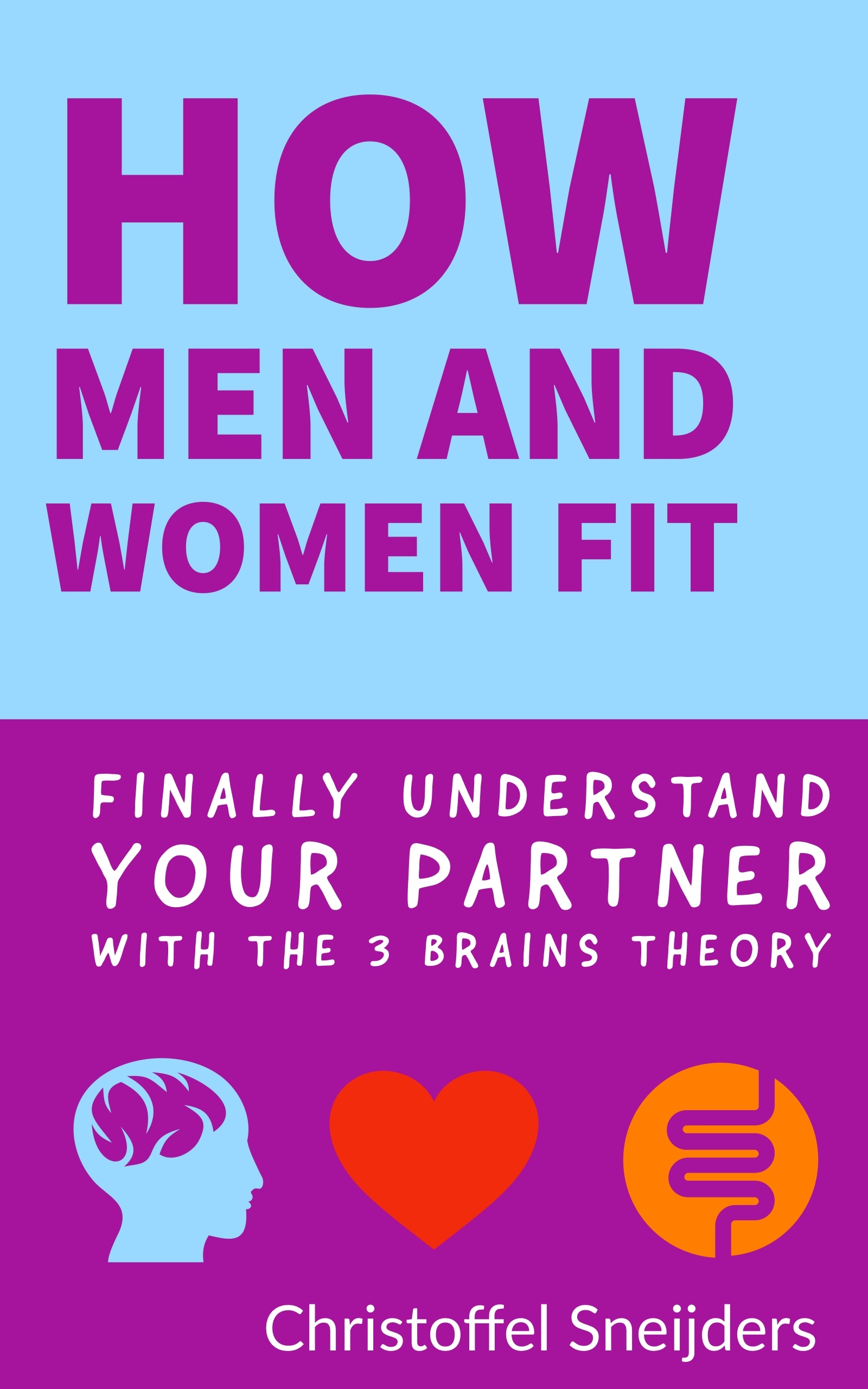
This book, which is a revised and updated version of my previous book “how men and women fit, finally understand you partner with the Three Brains theory” is built around crucial new insights into the science of human thinking and feeling. Current research has upended the notion that we have in our heads a single powerful mind that is home to our thoughts, emotions, and reactions. In fact, science now tells us that we have not one, but three centers of thought, memory and decision-making! Although we all perceive, interpret, and react to the world in a distinctly different way, those 3 centers of wisdom have the same base drivers.
It is “just” the combination that makes it difficult and the fact that we actually do not know that we have these 3 centers of wisdom. Up to now we shared this as: we have conscious awareness (or mind) and an unconscious awareness (or mind) and that unconsciousness mind is responsible for 90% of our behaviors and actions. As it is unconscious, we try our best to influence it with our conscious mind. Like a blind person trying to find his way in unknown city.
In addition to our well-known ‘thinking’ brain (which I will call the ‘Head Brain’), we have a ‘relationship’ brain (which I will call our ‘Heart Brain’) and a third brain — at our core — whose job it is to keep us safe. I will call this ‘self-preservation’ brain the ‘Gut Brain’.
When we get angry or upset, what triggers those feelings and emotions?
If the Head Brain (or the limbic, or cerebellum brain) was truly the only home to our thoughts and feelings, why is it so hard to talk ourselves out of feelings and emotions?
When we feel bad, where do we feel bad? In our Head, in our Heart or in our Gut?
When our hearts are broken or our guts are churning with anxiety, why is it that the dispassionately rational thoughts in our heads don’t make a dent in our emotions?
When we’re inclined to blurt out things, we know we shouldn’t say, what compels us to do it anyway?
My clients, my coachees, or the people I meet, often try to explain that any shared understanding with their partner, children, parents or colleagues is next to impossible; especially when that interaction is with someone with a different gender. They tell me “You know men are from Mars and women are from Venus” meaning that it is obvious we speak different emotional languages.
We have come, in part thanks to that popular book of John Gray and its ubiquitous metaphor that many took too literally, to take as a revealed truth that such misunderstandings are a natural result of ingrained gender differences. Nonsense. Or let me put it more clearly: NONSENSE! That was never what John wanted as the main take away. Yes, we are biologically different and that not does not mean we are have to be different.
Men, women or whatever your gender is, do not come from different planets. We are all human. But being human is a complicated thing. It’s hard enough to understand what drives our own thinking and ways of communicating, much less interpret what someone who was raised and socialized differently is really meaning or thinking, when they may not even know themselves. The fact that men and women have a tough time fitting in with one another is no surprise when you broaden the picture to understand that people have trouble fitting in with other people! Gender is only one factor, there are many, many others. In this book, the gender of you or your partner doesn’t matter. The insights and skills we develop will enhance each one of our relationships.
Now is the time to use that knowledge to solve the problems of our own relationships, and find happiness.
Why is it so hard to understand the other… from divorce(s) to inspiration
The longer I worked as a therapist and coach, the more I felt that something was missing — I didn’t know what — in my understanding of how people were applying the insights I was helping them towards. Were the solutions we found to people’s problems in my office leading to better lives in the real world? Sometimes, it seemed not. Making an intellectual breakthrough was one thing. But true emotional healing and personal change were altogether different. Understanding did not always lead to healing.
The less I followed my logical thoughts in working with someone, and the more I followed my ‘instinct’, the more success I had. It did not make logical sense, even though the results showed it was the right path.
Sometimes, I observed that the behavioral changes I expected to flow from intellectual and emotional understandings were not happening. Other times, people who seemed immune to insight suddenly improved anyway.
It is a crisis of purpose and practice faced by many people in my field. You do the demanding work of verbalizing an issue or emotional malfunction and then… Nothing much changes. Unhealthy or destructive patterns persist. As the French would put it, “Plus ça change, plus c’est la même chose”. For many of my patients, it was painfully true that “the more things changed, the more they stayed the same”.
My life is no exception. Many people have an incident in their life that inspires them to do things that they had never thought possible. In my case, writing this book was not something I would ever have envisioned. Finding that I had something to say came to me gradually over time, after hitting a brick wall after my third divorce.
I forced myself to REthink and REfeel everything I knew and experienced regarding relationships and personal heartbreak. The shock, depression, grief, and self-blame did not grow easier to bear with the experience of having failed again and again. I was repeatedly doing the same thing, hoping for a different result.
So, I took a deep dive to understand why I messed up in my own divorces (yes plural) and relationships–was it because I was bullied at school and carried for a long time trust issues with me, or were there other hidden factors playing a role?–and did my best to distinguish between the reasons we make the decisions we do, and why we communicate (or not) the way we do.
I came to feel and understand that there was much more going on than could be explained by my traditional training. It took me a long time to piece together what was really happening inside my own mind and that of my patients and coachees. I spent a lot of time thinking, observing, and pouring through the scientific literature in my field and many others. I came to understand that the part of the brain that we are educated to work with, was only part of a much larger picture. That picture has been forming for millions of years, as human beings have evolved the cognitive structures required to survive in the world, to understand it, and to make decisions.
I went back to my 30 years of work experience and searched for new learnings from a different angle. I analyzed my therapy/coaching clients even more than usual.
I started to experiment with connecting concepts and creating new ones in my neuro-linguistic programming (NLP) and clinical hypnotherapy training, and especially in the workshops, ‘Awaken and Live your Potential’ and ‘Connect, Coach and Lead from the Head, Heart and Gut’. This gave me the insights to connect the dots. I built on them and discovered a whole new approach to understanding how people communicate — and fail to communicate and connect — in relationships.
The human brain (the one in our head) is an amazing thing. It’s the one reading this page and understanding the words and language, it is an amazing success story in evolutionary history. But it is only the servant of our Heart Brain and Gut Brain. Whatever insecurities you might have, know this: You are evolution’s triumph.
How could mere words flitting across the surfaces of our minds ever change anything, when what was really going on was far below the surface?
Before we begin, a couple of notes…
Do we really have Three Brains, a Head Brain, a Heart Brain and a Gut Brain?
Let’s be clear at this point: I am not talking in metaphors. This book is not built around some intellectual concept to help us think about how that one brain inside our skull works, that is still described as Three Brains (reptilian, emotional and mammal) as that is the biggest scientifically hoax you can imagine. But about one in our Head, one in our Heart and one in our Gut.
Our Three Brains – Head, Heart and Gut – are real.
There is a great deal of scientific research on the distinct roles, locations, and functions of the three very distinct cognitive structures we carry around in our head and body.
Before now, if Heart and Gut Brains were thought to exist at all, they were considered separate entities that existed and reacted independently and were not capable of communicating or collaborating with one another. We have come to know differently.
If you are interested in the science, I will go into some detail about the science in the closing section of this book. Until then, the important thing is to understand what the Three Brains are, and how they work. We can then apply the insights resulting from the research in practical ways to help us manage (and sometimes control) our own Brains and how we interact with others. Throughout this book, we move forward from scientific fact — that the Head, Heart and Gut Brains exist — to explore the ways we can use that knowledge to improve our Brains’ health, our relationships and our lives.
In the past, the Heart and Gut Brains have been neglected (or dismissed) by Western scientific researchers. In therapy and coaching they are often referred to as the ‘unconscious mind’; you may have seen those pictures of icebergs, one tiny part above the water (our conscious mind) and 90% beneath the water (the sub- or unconscious). From this moment on, the subconscious is tangible and has a name: Heart and Gut Brain.
Really important is to know that they don’t speak the same language as the Head Brain and they have different objectives. Therefore, their decisions can seem illogical. They can be stubborn and, especially to people whose own Head Brains are dominant, like scientific researchers, what the other Brains contribute can be irritating and seem downright stupid.
But know this before you go one step further: Your Heart and Gut Brains are not stupid. Not one bit. Often, they are much more insightful and attuned to our needs than the Head Brain, which can be distracted and beguiled by shiny objects, bad information, and bogus comparisons. The Heart and Gut Brains experience and interpret our internal and external environments in their own ways. They analyze, remember, and make decisions about what we should do, even when it’s hard to put those reasons into words. Words are the Head Brain’s domain, and if it doesn’t understand something, it can’t articulate it. But, if we can screw on our Head Brain correctly, and educate it a bit, we can learn to listen to all Three Brains and become wiser and happier in the process.
Our Three Brains run normally on eco mode and it simplifies everything we do
Our Brains love to generalize, place things into categories and based on those generalizations and categories make snap decisions and they do this by default.
Why?
It saves time and energy, and that is rather important as our Three Brains use approximately 35%2 of our daily energy consumption! Categories are useful when thinking about some things. Look at a restaurant menu, divided into meat, fish, and vegetarian dishes. This makes it easy to see what is on offer. Categories are worse than useless when we are lumping people into categories — be they ‘men’ and ‘women’, LGBTQIA+, or some other way of dividing people into subsets of humanity — it is just wrong. It’s avoiding the effort of using our head brain to the full by thinking it through and stepping out of our own survival comfort zone.
Yes, it makes it easy to have a general view of a person but it has the same accuracy as saying that lions, puma’s, tigers and cats are all cats and have the same behavior, hence we should act in the same way when we encounter by them. .
So, it boggles the mind to see how many relationship guides, including ones that sell millions of copies, fall into using stereotypes — especially ones that ascribe certain ways of thinking or acting to men and women. It is easy to do — not because male Brains and female Brains are fundamentally different — but because, in most parts of the world, boys and girls are socialized differently and taught to value different aspects of themselves. The famous boys should be boys and girls should be girls idea, and the subsequent socialization leads to them later identifying as the stereotypes. When they grow up to become men and women, they often continue to think of themselves as being defined (or constrained) by culturally defined traits supposed to be characteristic of their gender. This is not a good thing, but it is true. When even the people who are the target of a stereotype start to believe it, you have a real problem. This is one reason stereotypes are so hard to eradicate.
One of my hopes for this book is that we can start to break out of stereotypical thinking. I hope the insights we discuss here will help people re-socialize themselves, so that those who have been encouraged to let their Head and Gut Brains dominate, learn to listen to their Heart Brain, while people who have been trained to prioritize what their Heart Brain advises, open up their hearts to some of the wisdom that they have been ignoring in their Head Brain and even more so in their Gut Brain.
However, your own Brains are configured and which is the most dominant in you–more about that in section 2: Who is your Boss, your Heart your Head, or your Gut?–I hope to help you understand more about them, how they work for you and for the people around you and to provide you with techniques to deal with the people in your life. If I (we) succeed, you will become a more centered, happier person, and a better partner in both your personal and professional life.
To achieve this, we must acknowledge that sometimes only one Brain is in charge, while at other times, a combination of two or all Three Brains are involved in decision-making.
With this knowledge, you will be capable of understanding your own mindset and that of your partner, friends, and colleagues. With such a powerful tool at your disposal, you will be able to break free of stereotypes and say goodbye to many misunderstandings in your life.
Client examples
To illustrate the theory and how our Three Brains work and influence our relationships, I use many client cases to illustrate a point. To protect their identity and secondly, to really Illustrate the essence of what is happening with our Three Brains, all of the examples are a construction of two or more similar client cases.
Section 1: Why your Three Brains are both the solution and problem for every great relationship?
1. Harmony: Three happy Brains is our default programming
The fundamental purpose of this book is to give you insights into how you can have happy, healthy relationships! For that you will learn essential insights Into how our Three Brains work, what your preferred ways of acting are, and how to identify that in others!
Finding harmony will bring us closer to our goal. This will result in better and more fully considered decisions and communications that will become the foundation of more harmonious relationships and greater personal happiness.
At the beginning of our lives, that balance and happiness came naturally…
Happiness
We are born with happy and healthy Head, Heart and Gut Brains. They are not fully developed, but they are in sync with one another.
If you do not believe me, just watch little babies. They smile, laugh at us, and do their best to connect; they only cry when they need something. And when babies play, they play together, they don’t compete with each other.
Now, remember a time when you were simply happy, calm, and relaxed. You may not have understood it at the time, but that was a moment when your Three Brains were in total agreement. Sadly, for most of us, such moments don’t come along every day. What was it that created that inner harmony?
So the question is: “Do you need just one of your Brains to be content, or all of them?”
Surprisingly, material success (this is the domain of the Gut Brain)–beyond what is required for a stable, healthy life–is not a significant factor in happiness. According to the World Happiness Report 2018, the USA, the world’s most prosperous nation, only ranks 18th out of 156 countries — below most highly-developed nations.3
So why is that?
if it’s not wealth or material goods, what is the root of personal happiness?
The USA performs poorly on social measures, which is a Heart Brain activity: life expectancy is going down; inequality is up and confidence in the government has fallen. As a result, Americans take more antidepressants than the people of any other nation.4
This is a classic example of only one Brain making the decisions. Yes, material success is important as it satisfies the needs of the Gut Brain but it does not fulfil the needs of the Heart Brain, hence a misbalance.
What are we missing?
In his book Happiness and Flourishing, writer Martin Seligman cites five essentials for a flourishing and happy life:5 and it provides an insight into why we need our Three Brains and not only one
Positive emotions, these are a result of your Heart Brain with a satisfied Gut BrainEngagement is the field of your Heart Brain and Head BrainRelationships again this is your Heart Brain competenceMeaning in life for this we need all 3, our Head, Gut and Heart BrainAchievements this is where your Gut Brain is the driving forceHappiness, in essence, is the feeling of being safe in the world and in your relationships. In Brain language, it means our Gut Brain isn’t feeling endangered, which frees our Heart Brain to make satisfying emotional connections. Happiness is your natural state when you are safe, and when your basic needs such as food and physical comfort are met. Hence, cared-for babies can be literal ‘bundles of joy’. Until they are hungry, uncomfortable, or scared — then they become bundles of something else entirely.
When we look at research worldwide, the people who are most serene live in Panama, Costa Rica, Denmark, Austria, Brazil, Uruguay, Sweden, El Salvador, Sweden, Guatemala, and Canada. So, six of the top ten happiest countries are not even close to being the world’s wealthiest.6
Can we, as adults, achieve the happiness we felt as children? Of course, we can! And we can do it without reverting to our childhood.
When all Three Brains are aligned and balanced, and there is no domination of one over the other — a state of mindfulness can be achieved — it is the natural state of childhood and adulthood. But to get there, we sometimes need to clear out the things that get in our way.
When your Brains agree…happiness is in your reach
When everything, cerebrally-speaking, is working as it should, our Brains are cooperating — thinking and acting in harmony. Humans are an amazingly complex system that has evolved to work together to keep us alive and healthy. Our Three Brains, with their 100 billion cells and 100 trillion connections, have evolved to work together to keep us safe, secure, and happy. So, when your Three Brains agree, and they are working with each other as one mind, things feel normal. If we are not under stress or facing a big decision, this is the most common state.
When you are working or doing a hobby and having that feeling of flow, when hours seem like minutes, this is also one of those times when your Three Brains are totally aligned in supporting the action, behavior, or communication.
Another example is when you are in a café with a friend (Gut Brain is happy and feels safe), we have something to satisfy our Gut Brain, a coffee/tea and maybe a snack (Gut Brain is happy) and on the Heart level it feels good to be with a friend.
And why is a friend a friend? Because on the connection level (Heart Brain), we share many of the same values. We find support for our issues, no disagreement and someone who is an ally (that is truly satisfying for our Gut Brain).
When you think about those moments when you sit with your partner in a restaurant or at the dinner table, you are comfortably at ease the Gut Brain is feeling safe, and is being nurtured with food and drink. When you look at your partner you feel at the Heart Brain level that connection, your support and love for each other. The logical Head Brain is sharing about work, about the things that happened during the day, and they are all acknowledged without any judgment. Is that not what we are all looking for?
It is the goal of this book to help you make such moments more and more common, until they become the normal fabric of your everyday life.
When our Three Brains disagree… all relationships go downhill
For us to make decisions that reflect what we genuinely want and need, it is essential that all our Brains are part of the discussion. Otherwise, it is like playing soccer with only a defence lined up or only the strikers; you do not have to be a world-renowned coach to understand that no good can come of it.
It is part of our ‘biological design’ that each Brain has its strengths, and each has characteristic blind spots for which the others compensate. It naturally follows that ignoring or suppressing the input of one of our Brains will lead to flawed decisions.
When it’s our Gut Brain that takes control, we will make a decision that is (like the Gut Brain itself) selfish, short-sighted and all for our own good, with a positive intention only for ‘Me’. Your Gut Brain will view other people either as supporters or allies, rivals, or neutral. It will ask, “Which of them is kindly disposed to ‘me’? Who has the power to help ‘me’ advance or succeed? Who is a rival? Who is a backstabber? Who is neither a threat nor an ally?” We can easily create conflicts and hurt feelings, making future problems for ourselves that a Gut Brain does not envisage. Who cares about paying the bills or even being late with paying your bills when you are running to escape a hungry bear?
If it’s the Heart Brain making our decisions, we can easily fall into the trap of making decisions that are good for other people — but not the right one for us. Your Heart Brain will perceive it from the perspective of friendship and teamwork. Who can I connect to? Who do I like? With whom can I cooperate on a task? Or share a lunch? The Heart Brain will always try to steer us to a decision that will be applauded by the people we want to please, regardless of whether we should be attempting to please them at that moment, and with that decision. A Heart Brain, untampered by a Gut Brain’s “is this right for me?” filter can turn people into doormats, the pleasers.
A Head Brain making decisions is another matter altogether. Head Brains care little about people — including ourselves. The Head Brain will contribute its own analysis. With whom could you have an in-depth discussion about your work and how you, the team or company, could do it better? What is the best way to approach the job to be done? What skills or knowledge will be required to do it? How long will it take? This works fine if the discussion is limited to engineering, science, or accounting. But making a decision based entirely on what seems logical or reasonable, oblivious to any consideration of what is the right decision for us or the people we care about, can put us on the road to heartbreak just as quickly as a Gut Brain’s selfishness.
You could ask the same questions about your friends. Which of your friends really has your best interests at heart and do you feel safe with? (Gut Brain) Which of your friends do you feel connected to? (Heart Brain) And with which of them could you really have an interesting and productive conversation? (Head Brain)
Can you see how each of our Three Brains connect in different ways, even to the people closest to us?
Why would your Head Brain keep you awake during the night, rethinking the argument, finding reasons to explain why it happened? It knows you need to sleep, yet still overrules the signals of falling asleep.
The Head Brain can only do that if it is supported by the Gut Brain or Heart Brain. The Gut Brain is not satisfied with the conflict and the solution, furthermore it does not feel safe, or still feels angry, and likes to have a smart way to deal with it. So, it activates the sympathetic nerve (fight or flight) and keeps you awake.
Even when your Heart is broken, the Gut will get activated, even if it is slight (“Why does the Heart feel pain?” it will ask, “Is safety at risk?”). It is up to the Head to find solutions. If your Heart feels disconnected from another person, it could, and most likely will, activate the Gut Brain (“I am left alone.”), just like with grief, or when we lose someone or something.
That is why our Brains are meant to interact and to make decisions that respect the perspective of each. It’s important to note here that we are not talking about giving any one Brain veto power over a decision — that would just be a different version of One-Brain decision-making. But each of our different viewpoints need to be understood and respected, regardless of what decision is arrived at. The making of such considered decisions is our goal here, and the ticket to continued intra-cranial harmony.
Your Gut Brain in action: having a coffee at the café with a friend
You are sitting in a café with a friend. There are no other people in the café. You feel at ease. Your Gut Brain relaxes and allows the Heart Brain to connect. You start talking about a personal and sensitive work topic. This is something you’ve been thinking about, so your Head Brain supplies the details and analysis.
Then an unknown person enters the almost empty café. He settles at the table next and close to you.
For at least a second, your Gut Brain will step in and disconnect from your friend. It needs to know whether it is safe to have this discussion within earshot of someone else.
Only when the Gut Brain (after checking the Head Brain to see if it recognizes the person) gives the go-ahead, can we can reconnect and continue with the conversation.
2. What are the Five reasons we don’t have our Three Brains aligned?
There are two fundamental things that form the bedrock of all approaches to improving our lives and our relationships.
One is understanding how we think and feel.
The second is observing and empathizing with others, so that we can understand how they think and feel.
Unless we can grasp the processes within ourselves that are blocking us from thinking/feeling clearly and making good decisions, we cannot change them. With luck and patience, we can sometimes also use our insights to help others or provide a model for them to follow.
Understanding how our Three Brains work is the most important part of any quest for emotional connection and happiness. Until recently, the way we thought about thinking was misguided. We focused almost entirely on the talkative, intelligent, and reasoning parts of our thinking process: our ‘Talking Head’. We have ignored, or misunderstood, what goes on beneath the surface. We have overlooked the true power of the parts of our Three Brains that (mostly wordlessly) feel, remember, think, react and, yes, control our decisions and our actions. We have not understood how our Three Brains work. We know, often to our sorrow, that without this understanding, finding happiness, and creating satisfying relationships is much more difficult.
Reading this book and understanding the cutting-edge science behind the insights and techniques introduced cannot, of course, magically solve anyone’s relationship issues. But it will equip you with a new understanding that will make you much more likely to succeed.
In short, I aim to make you a happier person and help you create more stable and satisfying emotional relationships.
So why have therapies and self-help gurus gone wrong up to now? There are five main reasons.
Reason one: We misunderstand how our mind (one vs Three Brains) really works
In modern times, we have come to view the human mind as a singular thing. We tend to believe that all our thoughts, feelings and reactions to the world are controlled by a powerful computer in our heads. It is easy to understand how this has happened. It looks like a combined brain, the big blob of gray matter, the limbic mammal emotional brain and the reptilian cerebellum lodged inside our skulls. But, just as your lungs, heart, kidneys, liver, pancreas, and a constellation of other organs, are all crammed into the same abdominal cavity, so, too, your cranium houses three distinct thinking machines, two of which are operated by the Brains downstairs. As a matter of scientific fact, the ‘one brain’ theory is fundamentally wrong.
In one way, it is another example of how we have ignored or forgotten insights from the past. A few thousand years ago, the Egyptians believed that the heart, rather than the head, was the source of human wisdom. The heart was, in their view, the center of our emotions, memory, soul, and personality.
In Hinduism the heart has a great significance both as a place where the soul rests and as a representative location of the abode of Brahman. It is the hub and the center of life.
In Buddhism, it is explicit that the heart is the center of wisdom.
In the Bible, we can find many references to the Heart Brain or the lust part of the Gut Brain: Matthew 12:34 “You brood of vipers, how can you who are evil say anything good? For out of the overflow of the heart the mouth speaks.” Or in Ephesians 4:17-19 (17) “So I tell you this, and insist on it in the Lord, that you must no longer live as the Gentiles do, in the futility of their thinking.”(18) “They are darkened in their understanding and separated from the life of God because of the ignorance that is in them due to the hardening of their hearts.”
In fact, as mentioned above, we have three distinct thinking centers (for simplicity’s sake, we will call them ‘Brains’, collectively we will call them your ‘Mind’. Each of our Three Brains evolved at different times for different reasons and each perceives, understands, and reacts to the world in its own unique way.
How our Three Brains combination thinks and interacts differs dramatically from one person to another. Your setup, background, and experience are different from mine in profound and important ways, although our three distinct Brains have the same basic functions from one person to the next. Just as we are all born with lungs that breathe, legs that walk, noses that run and other bits of anatomical equipment with specific biological jobs, our Three Brains evolved to perform distinct cognitive tasks:
The Gut Brain is our oldest brain (500 million years old). It is in charge of our survival and lust for life. It’s an amazingly beautiful and egocentric brain, I like to call it the ‘Me’ brain. It’s something we share with every living creature on the planet.
The Heart Brain, which we share with all warm blooded animals, is the seat of relationships. Love, compassion, hate — anything we feel for or about other people or things around us flows from the Heart, it is the true ‘Us’ brain.
The Head Brain was the most recent to evolve in its current size and shape. It is unique to (or, at least, uniquely powerful in) human beings. The Head Brain is not what makes us human — that’s something that requires all Three Brains — but it is what makes humans unique. The Head Brain is the home of logic, language and learning. It is an enormous database stuffed with all the facts we have learned and things we have experienced. Its job is not to keep us safe, nor to connect us to others — those jobs were already being done quite well by the two Brains we had already. In us humans it has evolved with primarily one objective: to use the past to predict the future! And therefore, become creative and expressive, to plan, to build, to use tools and language.
Reason two: Our Gut and Heart Brains disagree about ‘Me’ and ‘Us’ when making decisions
Can you remember that internal discussion: what do I want and how do I please the other? That is when your Heart and Gut Brain disagree.
And whatever you chose you felt guilty, selfish or “shitty” that you did not take care of yourself.
We all have from time to time that internal feeling that can only be explained by knowing that our Heart and Gut Brain have different priorities and objectives.
Actually, all our 3 Bains have different objective and authorities to keep us happy, healthy and safe.
The Gut Brain: This is the most primitive and forceful of our Brains. It is the home of our survival instinct and lust for life. Our Gut is driven by fundamental primal feelings like desire, lust, fear, hunger, disgust, and rage. When the Gut Brain is making decisions, our communication and behavior is rooted in those feelings and desires. It is always focused on ‘Me’, and it only thinks about the here and now. What do I want now? What I need now? When do I need it? Now! Don’t expect beautiful cause and effect analysis for your Gut Brain.
The Heart Brain: This warm-blooded beating amazingness is the primary home of our relationship drivers. Our feelings of love, guilt, happiness, hope, joy, shame, sorrow, hate and sadness are all rooted here. Because they are all based on connecting, belonging and are all about ‘Us’, these feelings are essential to forming and sustaining relationships. This Brain can contribute best to our decisions when we feel safe enough to let our guard down and put the Gut Brain at rest.
The Head Brain: This level is solely focused on making reasoned decisions for the future, based on acquired knowledge. It deals with intellectual insights such as understanding, anticipation, interest, surprise, and wonder. All those things can influence our decisions. We can only use this Brain when we are feeling safe enough or when it is consulted by the Gut or Heart Brain. It cannot override the Gut Brain in situations that provoke fear. And, as we mentioned above, it has an almost impossible task trying to convince a Heart Brain to change an emotional decision. Did your Head ever succeed in convincing your Heart not to love somebody?
Reason three: Most societies and cultures cultivate Gut Brain behavior
Most of us were raised to conform to rules that govern how people of our gender, educational and economic background and, sometimes, our ethnic or religious background, “should” act and behave.
Most of our schools promote competition, which means training people’s Gut Brains to seek to dominate and defeat. The ultimate focus is on ‘Me’. It is the rare institution, indeed, that pays attention to the focus of their students’ Heart Brain on cooperation, attachment and harmony. And almost every educational institution is proudest of the intellectual power of the Head Brains it turns out — without regard to whether the people who have them can succeed outside of the academy walls — in the world, in business or in their personal relationships.
The world is ruled by the idea that we must have economic growth to survive, and to compete with other countries, any top 20 list of blockbuster movies is dominated with stories about good and bad people, and how we fight and kill others in order to win and conquer.7
Think back to your time at school and university. Where was the greatest emphasis placed, and how was your progress graded?
Why do we have a pass-or-fail system, with grading divisions from A to F, or from 10 to 1? Does it really matter if you pass with a 6 or with a 10?
How many times are you asked at work, “What were your scores at school or university?” Do your managers and colleagues care whether you graduated with the highest honors, or just passed by the smallest margin?
With all the sales people, managers and executive-board members I have trained, this topic never came up when we discussed colleagues and their performance. It was always about how they dealt with clients or colleagues. When a sales person gets an order, it is not important if it is done with the most beautifully, eloquently written and illustrated proposal. The question that is asked is, “Did we get it or not?” Pass or Fail!
Side note on this: Some companies rank their salespeople according to the number of sales, awarding them with bonuses, and creating ‘salesperson of the week/month’ titles. This is an example of Gut Brain leadership. This is not wrong per se, more that it is telling of the style of leadership.
However, during our time at school or university, our performance is too often compared with that of our fellow students with one-tenth of a difference.
I think we can agree that we are educated to compete and to judge; schools are masters in training our Gut Brain.
The number of children and students who feel hesitant in showing their exam results to their parents is significantly large. It causes them stress when they receive a 6, 7 or 8, instead of 9 or 10, and realize that they have moved to the lower end of the class. My son, who is a primary school teacher, told me that one of his students, an eight-year-old girl, was very upset and worried about the government test she had to take the following week. She was afraid of not doing well. She informed my son that her parents would make her study at length for every test. If she did not do well enough, she had to repeat the exercise until she got a perfect score. How will this make her happy later in life? As a therapist and a parent, it makes me want to cry when I picture her as a future client, who suffers with perfectionism and a fear of failure.
The number of children who now have mental issues is severe and shocking.
An estimated 31.9% of adolescents will experience an anxiety disorder in their life.8
The workplace as an arena of combat has been accepted as a guiding principle in the corporate world. In most companies, the focus is not only on external competition; internal competition is also seen as a crucial component of overall corporate success. Following this organizational philosophy has led to many offices and commercial establishments becoming miniature versions of Game of Thrones.
Italian political philosopher, Niccolò Machiavelli, captured this view of the world in the advice he put down for the political leaders of his time:
“Whether it be better to be loved than feared or feared than loved? It may be answered that one should wish to be both, but, because it is difficult to unite them in one person, it is much safer to be feared than loved, when, of the two, either must be dispensed with … for love is preserved by the link of obligation which, owing to the baseness of men, is broken at every opportunity for their advantage; but fear preserves you by a dread of punishment which never fails.”9
In recent decades, however, the notion that workplaces are most effective when people in them compete with one another has been debunked. Most coaching and training for today’s managers and corporate leaders is solely focused on developing teamwork, collaboration, and creativity — all things you can only get by convincing the Gut Brain that it is safe and doesn’t need to defeat anyone. The most effective managers, we now know, are the ones who care for and nurture their teams, and who have developed Heart Brains.
That same point is brought home in the book, Trillion Dollar Coach, about Bill Campbell, who helped guide the growth of Google, Apple, and Intuit, amongst many other successful companies. Campbell saw that the formation of trusting relationships, built on teams that felt safe to be creative, was the key to the success of those enterprises. When you foster personal growth and inspire courage (Heart Brain), difficult problems get solved.10
Still, it is a sad fact that, even in what we like to think of as a more enlightened time, men are still encouraged to constantly compete, while women feel unrelenting pressure to sacrifice their own goals in order to smooth the troubled waters of the fractious world. Such social pressures are impossible to ignore, difficult to escape and create minefields of miscommunication for people who want to both be themselves and harmonize with others.




