


0,00 €
Mehr erfahren.
- Herausgeber: Open Book Publishers
- Kategorie: Geisteswissenschaft
- Sprache: Englisch
This is a must-read how-to guide if you are planning to embark on a scholarly digitisation project. Tailored to the specifications of the British Library’s EAP (Endangered Archives Programme) projects, it is full of sound, practical advice about planning and carrying out a successful digitisation project in potentially challenging conditions.From establishing the scope of the project, via practical considerations about equipment, work routines, staffing, and negotiating local politics, to backing up your data and successfully completing your work, Remote Capture walks you through every stage. Bursting with helpful hints, advice and experiences from people who have completed projects everywhere around the globe from Latin America to Africa to Asia, this book offers a taste of the challenges you might encounter and the best ways to find solutions.With a particular focus on the process of digitisation, whether using a camera or a scanner, Remote Capture is invaluable reading for anybody considering such a project. It will be particularly useful to those who apply for an EAP grant, but the advice in these pages is necessary for anyone wondering how to go about digitising an archive.
Das E-Book können Sie in Legimi-Apps oder einer beliebigen App lesen, die das folgende Format unterstützen:
Veröffentlichungsjahr: 2018
Ähnliche




















Remote Capture
Remote Capture
Digitising Documentary Heritage in Challenging Locations
Edited by Jody Butterworth, Andrew Pearson, Patrick Sutherland and Adam Farquhar
http://www.openbookpublishers.com
© 2018 Jody Butterworth, Andrew Pearson, Patrick Sutherland and Adam Farquhar.
Copyright of individual chapters is maintained by the chapter’s author
This work is licensed under a Creative Commons Attribution 4.0 International license (CC BY 4.0). This license allows you to share, copy, distribute and transmit the work; to adapt the work and to make commercial use of the work providing attribution is made to the authors (but not in any way that suggests that they endorse you or your use of the work). Attribution should include the following information:
Jody Butterworth, Andrew Pearson, Patrick Sutherland and Adam Farquhar (eds.), Remote Capture: Digitising Documentary Heritage in Challenging Locations. Cambridge, UK: Open Book Publishers, 2018. https://doi.org/10.11647/OBP.0138
In order to access detailed and updated information on the license, please visit https://www.openbookpublishers.com/product/747#copyright
Further details about CC BY licenses are available at http://creativecommons.org/licenses/by/4.0/
All external links were active at the time of publication otherwise stated and have been archived via the Internet Archive Wayback Machine at https://archive.org/web
Every effort has been made to identify and contact copyright holders and any omission or error will be corrected if notification is made to the publisher.
Digital material and resources associated with this volume are available at https://www.openbookpublishers.com/product/747#resources
Open Field Guides Series, vol. 1 | ISSN: 2514-2496 (Print); 2514 250X (Online)
ISBN Paperback: 978-1-78374-473-2
ISBN Hardback: 978-1-78374-474-9
ISBN Digital (PDF): 978-1-78374-475-6
ISBN Digital ebook (epub): 978-1-78374-476-3
ISBN Digital ebook (mobi): 978-1-78374-477-0
DOI: 10.11647/OBP.0138
The OBP team involved in the production of this book: Alessandra Tosi (managing editor), Lucy Barnes (editing and copyediting), Bianca Gualandi (layout and digital production) and Heidi Coburn (cover design).
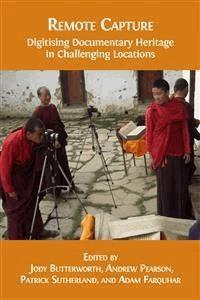
Cover image: Monks digitising Buddhist manuscripts in a courtyard at Gangtey Monastery, Bhutan (2006). Photo by Karma Phuntsho, CC-BY 4.0.
All paper used by Open Book Publishers is SFI (Sustainable Forestry Initiative), and PEFC (Programme for the endorsement of Forest Certification Schemes) Certified.
Printed in the United Kingdom, United States and Australia by Lightning Source for Open Book Publishers (Cambridge, UK).
Contents
List of figures
1
List of tables
5
Contributors
7
Foreword
9
Acknowledgements
11
A note on the text boxes
13
Brands and manufacturers
13
Digital resources
14
Introduction
15
1.
Planning the project
19
Project design
19
Calculating the budget
25
2.
Equipment and skills for digitising in the field
41
Cameras and scanners
41
The Digital SLR camera: a general introduction
45
DSLRs: principles and settings
47
Tripods, copy stands and remote controls
64
Lighting and flash
73
Copying glass plate negatives and transparencies
78
Essential equipment and skills
81
Practical advice for photography in the field
82
Hard drives and data management
86
Scanners
87
3.
Image standards
93
Introduction
93
Considerations
95
Examples of good and bad images
98
4.
Collection care and document handling
113
General considerations for safe handling of library material
113
Dirty and dusty material
115
Pictures and glass plate negatives
116
Loose-leaf items
116
Bound items
117
Housing
119
5.
A workflow for digitisation
121
Preparation
122
Creation of the digital images
126
Renaming and organising the digital images
128
Developing and exporting the digital images
129
Backing up
130
Virus checking
136
Cataloguing/creation of metadata
136
6.
On the ground
139
Before departure
141
Politics
148
Local liaison and partnerships
154
Managing expectations
154
Communication
159
Staff and their management
160
Money
164
Outreach and publicity
167
Conclusion
171
Further resources
175
Useful downloads
175
Other reading
175
Glossary
176
Index
179
Digital Appendices Available online at https://doi.org/10.11647/OBP.0138.11
Digital Appendix 1. Practical Methods for Digitisation
Digital Appendix 2. Using Electronic Flash
Digital Appendix 3. Digitisation Process Notes
Digital Appendix 4. Costed Equipment List
List of figures
The copyright for the images reproduced in this book belongs to the individual EAP grant holders. However, as part of the Endangered Archives Programme conditions of award, grant holders give consent that EAP can share information submitted as part of a project. We would nevertheless like to thank all the EAP grant holders who have provided these photographs as part of their project archive. Drawn illustrations were produced by Anne Leaver.
1.
EAP650, Archiving Afro-Colombian history in Caloto Viejo, Colombia. Photo © Thomas Desch Obi, CC BY 4.0.
10
2.
EAP704, En route to Marawe Krestos, Ethiopia. Photo © Michael Gervers, CC BY 4.0.
12
3.
EAP700, Preserving the manuscripts of the Jaffna Bishop’s House, Sri Lanka. Photo © Appasamy Murugaiyan, CC BY 4.0.
14
4.
EAP329, A peripatetic project digitising Acehnese manuscripts in rudimentary circumstances, Indonesia. Photo © Fakhriati Thahir, CC BY 4.0.
22
5.
EAP039, Photographing Buddhist manuscripts in Bhutan. Photo © Karma Phuntsho, CC BY 4.0.
24
6.
EAP524, The St Helena Government Archives, Jamestown. Photo © Andrew Pearson, CC BY 4.0.
29
7.
EAP627, A fragile manuscript from Paraíba, Brazil. Photo © Courtney Campbell, CC BY 4.0.
31
8.
EAP643, Manuscripts prepared for digitisation, Bengal. Photo © Abhijit Bhattacharya, CC BY 4.0.
34
9.
EAP488, An EAP team in action, Mali. Photo © Sophie Sarin, CC BY 4.0.
35
10.
EAP644, Camera and scanner used in parallel, Beirut. Photo © Yasmine Chemali, CC BY 4.0.
42
11.
Example histograms. Photos © Patrick Sutherland, CC BY 4.0.
56
12.
Greyscale and colour checker. Photo © Patrick Sutherland, CC BY 4.0.
58
13.
EAP704 Däbrä Abbay and EAP526 May Wäyni, Ethiopia. Photo © Michael Gervers, CC BY 4.0.
58
14.
Electronic grids assist with the alignment of objects when copying. Photo © Patrick Sutherland, CC BY 4.0.
63
15.
EOS Utility. Photo © Patrick Sutherland, CC BY 4.0.
66
16.
Copy stand with angled lights. Illustration © Anne Leaver, CC BY 4.0.
68
17.
EAP524, Camera and copy stand in situ in the St Helena Government Archives. Photo © Andrew Pearson, CC BY 4.0.
68
18.
Diagram of copy stand in reversed position. Illustration © Anne Leaver, CC BY 4.0.
69
19.
EAP769, Digitising using a tripod with a central column in Montserrat. Photo © Nigel Sadler, CC BY 4.0.
70
20.
Tripod with horizontal copy arm. Illustration © Anne Leaver, CC BY 4.0.
71
21.
EAP698, Digitising Cham manuscripts in Vietnam. Photo © Hao Phan, CC BY 4.0.
72
22.
Finding a solution when your copy stand breaks: EAP569, Using a weaving loom to digitise Nzema cultural material from Ghana. Photo © Samuel Nobah, CC BY 4.0.
73
23.
EAP454, Relying on basic desk lamps as the field workers move around the remote area of Mizoram, India. Photo © Kyle Jackson, CC BY 4.0.
75
24.
EAP764, Blocking out sunlight when digitising material from Bandiagara, Mali. Photo © Fabrizio Magnani, CC BY 4.0.
76
25.
Drawn illustration showing the flashgun/umbrella set-up angled at 45 degrees to the copy surface. Illustration © Anne Leaver, CC BY 4.0.
77
26.
Equipment set-up for digitising glass plate negatives using a copy stand and a light box. Illustration © Anne Leaver, CC BY 4.0.
79
27.
EAP563, Scanning photographs from the Hume family collection, Argentina. Photo © Silvana Lucia Piga, CC BY 4.0.
88
28.
EAP086, A temporary scanning set-up while digitising photographs in a monastery in Laos. Photo © Martin Jürgens, CC BY 4.0.
91
29.
Preventing light appearing in an image. Photos © Elizabeth Hunter, CC BY 4.0.
105
30.
Building up foam beneath a bound book with a tight spine. Photos © Elizabeth Hunter, CC BY 4.0.
109
31.
Step-by-step method for opening and supporting a folded map that is included within a bound book. Photos © Elizabeth Hunter, CC BY 4.0.
111
32.
Diagram showing the correct brushing direction for a bound volume. Illustration © Anne Leaver, CC BY 4.0.
115
33.
Book diagram and book binding terminology. Illustrations © Anne Leaver, CC BY 4.0.
118
34.
EAP703, Digitising notary books in Bahia, Brazil. Photo © João Reis, CC BY 4.0.
122
35.
Example document tracking form. Photo © Andrew Pearson, CC BY 4.0.
124
36.
Example digitisation tracking form. Illustration © Andrew Pearson, CC BY 4.0.
124
37.
A field-based system for backup. Illustration © Andrew Pearson, CC BY 4.0.
135
38.
EAP256, Listing taking place alongside photography in Tamale, Ghana. Photo © Ismail Montana, CC BY 4.0.
137
39.
EAP526, Theory meets practical realities in Ethiopia. Photo © Michael Gervers, CC BY 4.0.
139
40.
EAP688, Fragile subjects. Photo © Kenneth Morgan, CC BY 4.0.
140
41.
EAP061, A custom-made copy stand, Indonesia. Photo © Amiq Ahyad, CC BY 4.0.
145
42.
EAP698, On the road in Vietnam. Photo © Hao Phan, CC BY 4.0.
146
43.
EAP334, Digital preservation of Wolof Ajami manuscripts of Senegal. Photo © Fallou Ngom, CC BY 4.0.
155
44.
EAP627, Staff training in Paraíba, Brazil. Photo © Courtney Campbell, CC BY 4.0.
161
45.
EAP524, Historic doodles. Photo © Andrew Pearson, CC BY 4.0.
163
46.
EAP051, BBC World Service radio programme on the importance of Bamum manuscripts, Cameroon. Photo © Konrad Tuchscherer, CC BY 4.0.
167
47.
EAP596, Newspaper cuttings photographed as part of the Anguilla EAP’s ‘Digitisation Day’. Photo © Andrew Pearson, CC BY 4.0.
169
48.
EAP177, Delivering the goods: hard drives ready for postage from Laos. Photo © Martin Jürgens, CC BY 4.0.
172
List of tables
1.
Example quantifications, estimated by page counting and shelf length
28
2.
Sample data and labour quantification
33
3.
EAP standards for digital material
97
4.
Summary of backup rules
133
Contributors
Jody Butterworth attended the International School of Geneva with students from 80 different countries and it is very probably this happy experience that has shaped her interests. She has spent seven years living and working across Asia and whilst in Mongolia she became inspired to pursue a career in cultural heritage. Jody became EAP Curator in 2012 and she considers it an incredibly rewarding job.
Adam Farquhar directs the Endangered Archives Programme. He is also Head of Digital Scholarship at the British Library, where he and his team focus on establishing services for researchers that take full advantage of the possibilities presented by digital collections and data across all formats and subjects. Adam has led several major research efforts and established the digital preservation and data programmes at the British Library. He was a founding member of the International Image Interoperability (IIIF) Consortium executive committee; founding President of DataCite; and founding President of the Open Preservation Foundation. He has been responsible for the Library’s maps, newspaper, photographic, audio and moving image collections. Before joining the Library, he was the knowledge management architect for Schlumberger and research scientist at the Stanford University Knowledge Systems Laboratory.
Elizabeth Hunter joined the British Library Photographic Studio in 1988, which at the time was based at the British Museum and involved studio and location photography as well as black-and-white film processing. When the British Library moved to its current location in 1998, Elizabeth used the Library’s first DSLR camera to photograph the Queen officially open the new building. Elizabeth keeps up to date with the latest developments and is currently working on 360VR and 3D photography.
Flavio Marzo was born in Susa near Turin in Italy. He now lives in London where he has been working for the British Library since 2005 and became an ICON accredited conservator in 2012. He previously worked in prominent institutions such as the Vatican Library and the libraries of The Queen’s and Magdalen Colleges in Oxford, and also as private conservator/restorer in the Benedictine Monastery of Novalesa in Italy. He has also been involved in several conservation projects in Italy, Greece and Egypt as conservator, consultant and teacher. In 2012, Flavio was appointed Conservation Studio Manager for the Qatar Digitisation Project within the British Library/Qatar Foundation partnership. He is also the author of a number of articles published in conservation journals.
Andrew Pearson is a Senior Heritage Consultant with AECOM. He also holds Research Associate status at Brunel University. His doctoral and early-career research focused on Roman Britain, while his current research addresses the historical archaeology of the Atlantic slave trade, with particular reference to the island of St Helena and the Anglophone Caribbean. His projects for the Endangered Archives Programme comprise EAP524 (St Helena), EAP596 (Anguilla), EAP688 and EAP1013 (both St Vincent) and EAP794 (Nevis).
Patrick Sutherland is an independent photographer and former Professor of Documentary Photography at the University of the Arts London. For over two decades Patrick has been documenting the culturally Tibetan communities of the Spiti Valley in North India. The project has led to numerous exhibitions and two books: Spiti and Disciples of a Crazy Saint. The latter concerns the Buchen, travelling lay religious theatre performers, exorcists, musicians and healers unique to Spiti, whose material culture is the focus of Sutherland’s two Endangered Archive Programme grants, EAP548 and EAP749.
Foreword
Adam Farquhar
© Adam Farquhar, CC BY 4.0 https://doi.org/10.11647/OBP.0138.08
From the blistering heat to the freezing cold. From desert sand to salty ocean air. From high mountains to humid jungles. From the open air under direct sun to cramped and shadowy huts. The project teams that we have supported under the Endangered Archives Programme (EAP) have worked in all of these environments and more as they digitise the world’s at-risk documentary heritage, preserve it, and make it available for research.
As Director of the EAP, I have been inspired by these project teams. The more I learned about their day-to-day experiences and the different challenges they faced compared to the digitisation projects we manage in London, the more I realised how useful it would be to compile their knowledge and experience in book form. To accomplish this, we assembled an excellent team with in-depth experience of field digitisation projects, studio digitisation, and material handling. Working together, they have created this book. While we have written it with Endangered Archives projects in mind, it has much broader applicability.
We hope that this book will help anyone who takes part in field digitisation projects. It provides clear practical advice that should help you if you are trying to plan, manage and deliver such a project, with topics ranging from the organisation and listing of contents, the digitisation of delicate materials, and the use of metadata to describe the results accurately.
The EAP is funded by Arcadia, a charitable fund of Lisbet Rausing and Peter Baldwin, which supports the preservation of cultural heritage and promotes open access. It is through the generosity of Arcadia that we have been able to create this volume and make it available to all on an open access basis.
We have created and published this book together with Open Book Publishers to ensure that neither cost nor access would be a barrier to a potential reader anywhere in the world. In addition to the book itself – which can be a handy reference in the field and does not require a reliable electrical supply to read – we have also provided a set of online appendices that will be updated as equipment or recommendations change. We also welcome feedback from readers so that future editions reflect the best available practices.
We hope that this volume helps you and many others to digitise and preserve the world’s endangered documentary heritage – including the piece of it that is important to you, your family, and your community.
Figure 1. EAP650, Archiving Afro-Colombian history in Caloto Viejo, Colombia. Photo © Thomas Desch Obi, CC BY 4.0.




