


30,99 €
Mehr erfahren.
- Herausgeber: John Wiley & Sons
- Kategorie: Fachliteratur
- Sprache: Englisch
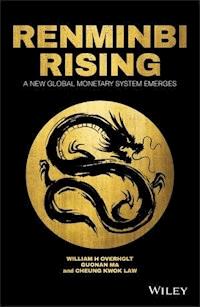
Critical analysis of RMB internationalization and the coming global currency shift Renminbi Rising charts the emergence of China's internationalizing currency and provides an in-depth analysis of the global repercussions. Written by a team of renown economics researchers, this book describes the pressures that enabled the emergence of a new global monetary system and why China's Renminbi (RMB) became the default 'second in line' as the U.S. receded from leadership. Policy makers and regulators will appreciate the examination of the motivations behind those driving the shift, and financial professionals will find valuable guidance in the discussion surrounding business opportunities that the RMB brings to the table. Coverage includes the emergence of new Chinese-sponsored financial institutions, the scale of various RMB businesses and the coming transformation of the global financial system. Effective management of international monetary affairs has never been more fundamental to the global economic recovery. The rapid emergence of China's RMB is a transformative event of global significance, and this book provides the context you need to understand the depth and breadth of changes on the horizon. * Understand why a new global monetary system is needed * Consider the outcomes as China emerges and the U.S. recedes * Learn the context and motivations behind principal players' strategies * Discover the scale of opportunities presented by the rise of the RMB It is essential for finance professionals and economic policy makers to understand the drivers, progress and likely trajectory of the RMB internationalization and to fully grasp the implications for the global financial system, international business and supporting financial products and services. Renminbi Rising offers detailed analysis of the key opportunities and threats inherent in this major economic shift.
Sie lesen das E-Book in den Legimi-Apps auf:
Seitenzahl: 372
Veröffentlichungsjahr: 2015
Ähnliche



















CONTENTS
Cover
Title Page
Copyright
Dedication
List of Figures
List of Tables
Foreword
Acknowledgments
About the Authors
Chapter 1: Internationalizing the RMB
The Conditions for Becoming a Global Currency
Business and RMB
RMB-Product Markets
Reserve Currency
The Emerging Monetary Order
Chapter 2: The Rise and Fall of Currencies – Historical Lessons for the RMB
Risks in International Monetary System Transitions
The Role of Eurodollars in the 2008 Global Financial Crisis
2008: Year Zero for a New International Monetary System?
Conditions for Currency Internationalization: Market Demand and Institutional Supply
Institutional Inertia and Disruptive Events
Offshore Currencies and International Liquidity
Current International Reactions to the RMB's Rise
RMB Internationalization
Conclusion
References
Chapter 3: Economic and Institutional Foundations for the Rise of the RMB
Economic Foundation
Surprises
New Growth Engines
Capital-Account Liberalization
Institutional Quality
Conclusion
References
Chapter 4: Can the Chinese Bond Market Support a Potential Global Renminbi?
Overview of the Chinese Bond Market
Chinese Treasury Market in International Perspective
A Dilemma and a Bold Public-Debt Consolidation Scheme
Government-Backed Debt Securities
Conclusion
References
Chapter 5: Waxing and Waning of the Chinese Stock and Banking Markets
Chinese Stock Market: Growing Despite Immaturity Flaws
A Massive Chinese Banking Market Opening
Conclusion
References
Chapter 6: Rising Fx Turnover of the RMB
Could the Market Accommodate More Global Currencies?
What Determines the FX Liquidity of the RMB?
Potential for Rising RMB Turnover by Market Segment
Conclusion
References
Chapter 7: A Spreading Global Network for RMB Trade
The RMB's International Position
Hong Kong Still the Dominant Offshore RMB Center
More Offshore Centers Catch Up to Spread A Global Network
Prospects for Offshore RMB Centers
Conclusion
References
Chapter 8: Brief Examples of Business Use of the Internationalizing RMB
Samsung's Use of RMB to Reduce Foreign Exchange Conversion Costs
Alstom's Use of RMB as Corporate Treasury Currency
Chinese Importers' Profit Incentives from use of RMB Trade Settlement: Changhong
Conclusion
Reference
Chapter 9: The RMB as a Reserve Currency
Global Perspectives
Scale of RMB Holdings
Drivers of Change
Exchanging RMB in a Crisis
Onshore and Offshore Access
Offshore Alternatives
Conservatives Change Course
Roadblocks Ahead?
RMB Inclusion in SDR
Capital-Account Reform
Conclusion
References
Chapter 10: Concluding Reflections
Appendix A: China RMB Financial Statistics and Forecasts by Other Institutions
Glossary
Index
End User License Agreement
List of Tables
Table 3.1
Table 3.2
Table 3.3
Table 4.1
Table 4.2
Table 4.3
Table 4.4
Table 4.5
Table 4.6
Table 4.7
Table 4.8
Table 5.1
Table 5.2
Table 5.3
Table 5.4
Table 5.5
Table 5.6
Table 5.7
Table 5.8
Table 6.1
Table 6.2
Table 6.3
Table 6.4
Table 6.5
Table 6.6
Table 7.1
Table 7.2
Table 7.3
Table 7.4
Table 7.5
Table 9.1
Table 9.2
Table A.1
List of Illustrations
Figure 3.1
Figure 3.2
Figure 3.3
Figure 3.4
Figure 4.1
Figure 4.2
Figure 4.3
Figure 4.4
Figure 4.5
Figure 5.1
Figure 5.2
Figure 5.3
Figure 5.4
Figure 6.1
Figure 6.2
Figure 6.3
Figure 6.4
Figure 6.5
Figure 7.1
Figure 7.2
Figure 7.3
Figure 7.4
Figure 7.5
Figure 7.6
Figure 7.7
Figure 8.1
Figure 8.2
Figure 8.3
Figure 8.4
Guide
Cover
Table of Contents
Begin Reading
Chapter 1
Pages
iii
iv
v
xi
xii
xiii
xiv
xv
xvi
xvii
xviii
xix
xx
1
2
3
4
5
6
7
8
9
10
11
12
13
14
15
16
17
18
19
20
21
22
23
24
25
26
27
28
29
30
31
32
33
34
35
36
37
38
39
40
41
42
43
44
45
46
47
48
49
50
51
52
53
54
55
56
57
58
59
60
61
62
63
64
65
66
67
68
69
70
71
72
73
74
75
76
77
78
79
80
81
82
83
84
85
86
87
88
89
90
91
92
93
94
95
96
97
98
99
100
101
102
103
104
105
106
107
108
109
110
111
112
113
114
115
116
117
118
119
120
121
122
123
124
125
126
127
128
129
130
131
132
133
134
135
136
137
138
139
140
141
142
143
144
145
146
147
148
149
150
151
152
153
154
155
156
157
158
159
160
161
162
163
164
165
166
167
168
169
170
171
172
173
174
175
176
177
178
179
180
181
182
183
184
185
186
187
188
189
190
191
192
193
194
195
196
197
198
199
200
201
202
203
204
205
206
207
208
209
210
211
212
213
214
215
216
217
218
219
220
221
222
223
224
225
226
227
228
Renminbi Rising
A New Global Monetary System Emerges
William H. Overholt
Guonan MA
Cheung Kwok Law
This edition first published 2016
© 2016 Fung Global Institute Limited
The right ofWilliam H. Overholt, Guonan MaandCheung Kwok Lawto be identified as the authors of this work has been asserted in accordance with the Copyright, Designs and Patents Act 1988.
Registered office
John Wiley & Sons Ltd, The Atrium, Southern Gate, Chichester, West Sussex, PO19 8SQ, United Kingdom
For details of our global editorial offices, for customer services and for information about how to apply for permission to reuse the copyright material in this book please see our website at www.wiley.com.
All rights reserved. No part of this publication may be reproduced, stored in a retrieval system, or transmitted, in any form or by any means, electronic, mechanical, photocopying, recording or otherwise, except as permitted by the UK Copyright, Designs and Patents Act 1988, without the prior permission of the publisher.
Wiley publishes in a variety of print and electronic formats and by print-on-demand. Some material included with standard print versions of this book may not be included in e-books or in print-on-demand. If this book refers to media such as a CD or DVD that is not included in the version you purchased, you may download this material at http://booksupport.wiley.com. For more information about Wiley products, visit www.wiley.com.
Designations used by companies to distinguish their products are often claimed as trademarks. All brand names and product names used in this book are trade names, service marks, trademarks or registered trademarks of their respective owners. The publisher is not associated with any product or vendor mentioned in this book.
Limit of Liability/Disclaimer of Warranty: While the publisher and authors have used their best efforts in preparing this book, they make no representations or warranties with respect to the accuracy or completeness of the contents of this book and specifically disclaim any implied warranties of merchantability or fitness for a particular purpose. It is sold on the understanding that the publisher is not engaged in rendering professional services and neither the publisher nor the authors shall be liable for damages arising herefrom. If professional advice or other expert assistance is required, the services of a competent professional should be sought.
Library of Congress Cataloging-in-Publication Data
Names: Overholt, William H., author.
Title: Renminbi rising : a new global monetary system emerges / William H. Overholt, Guonan Ma, Cheung Kwok Law.
Description: Chichester, West Sussex, United Kingdom : John Wiley & Sons, Inc., 2016. | Includes bibliographical references and index.
Identifiers: LCCN 2015038330 | ISBN 978-1-119-21896-8 (cloth)
Subjects: LCSH: Renminbi. | Finance—China. | China—Foreign economic relations.
Classification: LCC HG1285 .O94 2016 | DDC 332.4/50951—dc23 LC record available at http://lccn.loc.gov/2015038330
A catalogue record for this book is available from the British Library.
ISBN 978-1-119-21896-8 (hardback) ISBN 978-1-119-21898-2 (ePDF)
ISBN 978-1-119-21897-5 (ePub) ISBN 978-1-119-21899-9 (obk)
Cover design: Wiley
Cover images: Dragon image © ly86/iStockphoto; Gold image © mexrix/Shutterstock
Dedication
To LIU Ming Kang. His reformist integrity inspires us.
List of Figures
Figure 3.1 China's age dependency ratios: young and old
Figure 3.2 Composition of gross industry output and current account surplus
Figure 3.3 China's inflation and exchange rate record
Figure 3.4 Real effective exchange rates, 2010 = 100
Figure 4.1 Top ten bond markets in the world, 2014
Figure 4.2 Top ten government-bond markets in the world, 2014
Figure 4.3 Main euro sovereign-bond markets, 2014
Figure 4.4 Ten-year sovereign-bond yield spreads over the bund (bps)
Figure 4.5 Top ten government-bond markets: 2014 vs 2020 (USD bn)
Figure 5.1 Top ten exchanges and stock markets in the world (by 2014 market capitalization, USD trn)
Figure 5.2 Stock markets by market cap to GDP and global share, 2014
Figure 5.3 Quotas outstanding for QFII, RQFII and QDII (USD bn)
Figure 5.4 Stock index and PE of different stock market boards
Figure 6.1 Top ten most-traded currencies globally, 2013
Figure 6.2 Top ten traded emerging-market currencies
Figure 6.3 China's shares of world total
Figure 6.4 Ratio of foreign-exchange turnover to trade and GDP
Figure 6.5 Top ten traded currencies (daily turnover, USD bn)
Figure 7.1 SWIFT global payment flow by share: top ten currencies
Figure 7.2 RMB as a trade finance currency (October 2013)
Figure 7.3 CNH bond issuance (2007–2014) (RMB bn)
Figure 7.4 RMB trade settlements
Figure 7.5 Global RMB SWIFT payments (2012–2014) (%)
Figure 7.6 Channels of interactions onshore and offshore
Figure 7.7 Daily forward rates and onshore/offshore CGB yields
Figure 8.1 Samsung cash flow using USD as its treasury currency in China
Figure 8.2 Samsung treasury management using RMB settlement netting service
Figure 8.3 Changhong case: an importer's RMB LC + offshore USD loan
Figure 8.4 FX spot rate spread between onshore and offshore markets
List of Tables
Table 3.1 Three GDP-growth scenarios (2015–2020 and 2021–2030)
Table 3.2 Selected capital market openings
Table 3.3 Contributions to changes in REER from NEER and CPI by percentage
Table 4.1 Composition of domestic financing (percentage of total domestic financing, December 2013)
Table 4.2 Chinese domestic bond market by issuer (RMB bn, year-end)
Table 4.3 Chinese bond market by investor (RMB bn, year-end)
Table 4.4 Turnover ratio of major government-bond markets
Table 4.5 A possible scheme to consolidate public-sector liabilities in China
Table 4.6 Foreign holdings of domestic government bonds (percentage of total outstanding, year-end)
Table 4.7 Projections of the Chinese bond market and foreign holdings, 2020 (RMB billion (USD billion), year-end)
Table 4.8 Comparison of CGB, China's policy-bank bond, UST and US MBS (amount outstanding, USD bn, year-end)
Table 5.1 Key indicators for the SSE and SZSE (2004–2014) (RMB bn)
Table 5.2 China's stock market: key indicators (2004–2014)
Table 5.3 Indicators for the SME and ChiNext boards at SZSE
Table 5.4 Investor profile at SSE (as a share of SSE total, 2013)
Table 5.5 Stock market turnover in China (2004–2014)
Table 5.6 The Chinese banking sector by assets (2005–2014)
Table 5.7 Deposits and loans of domestic and foreign banks in China
Table 5.8 Domestic and foreign banking deposits in Japan
Table 6.1 Emerging-market currency OTC FX turnover, by currency
Table 6.2 Daily FX turnover of top ten currencies
Table 6.3 OTC FX market turnover in emerging markets, by instrument
Table 6.4 Offshore trading of emerging-market currencies
Table 6.5 RMB FX turnover by market (average daily turnover, April 2013)
Table 6.6 RMB forwards: deliverables vs non-deliverables, 2013 (USD mn, daily turnover)
Table 7.1 RMB cross-border payments (2014) (RMB bn)
Table 7.2 Share of RMB cross-border settlements (%)
Table 7.3 RMB offshore centers' clearing banks and RQFII programs (RMB bn)
Table 7.4 Shares of RMB deposits in major Asian offshore centers (percentage of the total of four markets)
Table 7.5 Imports and exports of China to and from other regions
Table 9.1 Reserve currencies (as a share of total allocated reserves, %)
Table 9.2 China's bilateral local currency swap agreements
Table A.1 Forecast China RMB financial statistics and forecasts by other institutions (for reference)
Foreword
At a time when effective management of international monetary affairs is fundamental to global economic recovery, the rapid emergence of a new major currency – China's internationalizing renminbi (RMB) – is a transformative event of global significance.
This book analyzes the drivers, progress and likely trajectory of the RMB internationalization. It also looks at what the dawning of the RMB era potentially means for the global financial system, international business and for supporting financial services and products. Overwhelmingly, we see opportunities more than threats.
In tackling this challenging subject Fung Global Institute has, I believe, gone deeper and wider than previous studies on this subject. We have addressed it objectively with a balanced view of different interests and of the welfare of the global financial system as a whole.
True to Fung Global Institute's mission to provide Asian perspectives on global issues, we have taken as our starting point the inner workings and changing needs of China's economy. As China manages its complex transition to a growth model emphasizing domestic consumption and services over investment and export manufacturing, these needs are necessarily expressing themselves through domestic financial reform, with RMB internationalization as an important focal point. We look deeply into these domestic reasons behind the RMB's arrival on the global stage.
A specific example of domestic reform is the Chinese bond markets. We look in detail at how China needs to integrate its bond markets, expand their use and gradually open them to the world, and then how these domestic imperatives support the internationalization of the currency. We also examine China's expanding global network, with Hong Kong as the cornerstone of offshore settlement centers for RMB trade.
We have gone wider by setting the rise of the RMB in a historical context. A century ago, the US dollar overtook sterling in little over a decade to become the leading international currency. While the dollar looks set to remain the principal reserve currency of the world for years to come, its own historical journey is a reminder of how rapidly currencies rise (and fall). In this report, we foresee the RMB possibly challenging in little more than a decade the euro's role as the world's second most important reserve currency. China has already surpassed the euro as a trade-settlement currency.
For some, the speed of this anticipated reordering is surprising, even unsettling. But global businesses have quickly discovered that they can save costs and raise profits by using the internationalized RMB. Provision by the Chinese government of the necessary hard and soft infrastructure has made internationalization of the RMB possible; business profits are making it successful. We have studies of companies in this book illustrating how the RMB's rise is a major opportunity for business to benefit from dealing in RMB.
Having said that, there are inevitable uncertainties as to how fast China can press ahead with domestic economic transformation and RMB internationalization. With these in mind, we offer alternative policy scenarios outlining different outcomes.
Just as the internationalization of the RMB is a moving target, we present this book as a work in progress. Our hope is that it will stimulate debate from economists and professionals in the financial services and industry generally.
Under the project leadership of William Overholt, the authors of this book have taken on one of the hottest topics in international finance with new depth and freshness. I look forward to seeing more such reports from the Asia Global Institute, which, from July 1, 2015, will carry forward the Fung Global Institute's mission to address major global economic issues from Asian perspectives.
Victor K. Fung Chairman, Fung Global Institute June 2015
Lesen Sie weiter in der vollständigen Ausgabe!
Lesen Sie weiter in der vollständigen Ausgabe!
Lesen Sie weiter in der vollständigen Ausgabe!
Lesen Sie weiter in der vollständigen Ausgabe!
Lesen Sie weiter in der vollständigen Ausgabe!
Lesen Sie weiter in der vollständigen Ausgabe!
Lesen Sie weiter in der vollständigen Ausgabe!
Lesen Sie weiter in der vollständigen Ausgabe!
Lesen Sie weiter in der vollständigen Ausgabe!
Lesen Sie weiter in der vollständigen Ausgabe!
Lesen Sie weiter in der vollständigen Ausgabe!
Lesen Sie weiter in der vollständigen Ausgabe!
Lesen Sie weiter in der vollständigen Ausgabe!
Lesen Sie weiter in der vollständigen Ausgabe!
Lesen Sie weiter in der vollständigen Ausgabe!
Lesen Sie weiter in der vollständigen Ausgabe!




