


104,99 €
Mehr erfahren.
- Herausgeber: John Wiley & Sons
- Kategorie: Geisteswissenschaft
- Sprache: Englisch
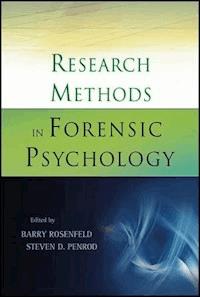
The only professional resource to focus exclusively on research methods in forensic psychology
With specific advice on topics of particular importance to forensic specialists, Research Methods in Forensic Psychology presents state-of-the-discipline summaries of the issues that relate to psychology and law research.
Edited by renowned experts in the field, this resource features contributions by leading scholars in forensic psychology and law, with discussion of relevant topics such as:
- Meta-analysis
- Jury decision making
- Internet-based data collection
- Legal research techniques for the social scientist
- Offender treatment
- Competence to stand trial
- Criminal profiling
- False confessions and interrogations
- Trial-related psycho-legal issues
- Accuracy of eyewitnesses and children
- Violence risk assessment
Sie lesen das E-Book in den Legimi-Apps auf:
Seitenzahl: 1194
Veröffentlichungsjahr: 2011
Ähnliche




















Contents
Cover
Title Page
Copyright
Contributors
Acknowledgments
Introduction: The Importance of Appropriate Research Methods
An Overview of This Book
Part I: General Issues in Forensic Research
Chapter 1: Legal Research Techniques for Social Scientists
Introduction
Knowledge of the Law
Finding and Understanding the Law
Jurisdiction, Stare Decisis, and Types of Authority
Conclusion
Resources for Legal Research
References
Chapter 2: Measure Development in Forensic Psychology
Assessing “Forensic” Constructs
The Importance of Theory
Normative Data
Reliability and Validity Are Different
Data-Analytic Approaches
Summary
References
Chapter 3: Meta-Analysis
Goals of Meta-Analyses and Types of Research Questions Addressed by Quantitative Reviews
Steps in Conducting a Meta-Analysis
Calculating Effect-Size Measures
Preliminary Analyses and Detecting Outliers
Meta-Analytic Synthesis: Integrating Studies
Reporting and Interpretation of Meta-Analyses
Conclusions
References
Chapter 4: Forensic Psychological Research and the Internet
Validity of Internet Research
Methodological Suggestions in Conducting Web-Based Research in Forensic Psychology
Examples of Web-Based Studies in Forensic Psychology
Experimental Research
Conclusion
References
Chapter 5: Statistical Principles in Forensic Research
Some Data Issues to Consider Prior to Analysis
Hypothesis Testing
Basic Bivariate Statistics
Multivariate Statistics
A Note on Reporting Your Results
Statistics: The Bottom Line
References
Part II: Criminal Law—Pretrial Issues: Criminal Investigations and Pretrial Forensic Assessment
Chapter 6: Research Methods for Psychophysiological Deception Detection
The Comparison Question Test
Methods: Basic Issues
Characteristics of a High-Quality Laboratory PDD Study
Characteristics of a High-Quality Field PDD Study
Data Reduction
Useful Data Presentation
Summary and Closing Comments
References
Chapter 7: Criminal Profiling
Introduction
Individual Differentiation
Individual Discrimination
Behavioral Consistency
Conclusion
References
Chapter 8: Methods in Deception Detection Research
Misclassifications of Innocent Suspects
Research Questions in the Study of Deception
Self-Report and Survey Studies on Deception and Its Detection
Laboratory Research on Deception
Criticism of Laboratory Research
Eliciting Cues to Deception
Conclusions and Future Directions
References
Chapter 9: Competency to Stand Trial and Criminal Responsibility Research
History and Legal Background
Methodological Issues
Future Directions
References
Chapter 10: Research Methods for the Assessment of Malingering
Malingering Domains and Detection Strategies
Study Designs
Elements of Simulation Designs
Conclusions
References
Part III: Criminal Law—Trial Issues
Chapter 11: Jury Research Methods
Early Jury Research
Early Jury Research Topics
Methodological Critiques of Jury Research
Why Would Research Methods Not Change?
Do Research Methods Matter?
What Does Research Reveal about Method Effects?
Are Juror Characteristics Related to Juror Verdicts?
Other Aspects of Jury Research Generalizability
Alternative Research Methods
Some Final Notes
References
Chapter 12: Trial Consulting in High-Publicity Cases
Introduction and History of the Trial-Consulting Industry
How Does One Become a Trial Consultant?
How Does PTP Influence Jurors' Decision Making?
How Do Trial Consultants Conduct Community Attitude Surveys?
How Do Trial Consultants Conduct Media Content Analyses?
Using Multi-Method Research Procedures
References
Chapter 13: Eyewitness Identification Research: Strengths and Weaknesses of Alternative Methods
Eyewitness Identification Laboratory Experimental Methods
Reporting and Analyzing the Data
Archival Research and Field Experiments
Generalizing Research Findings
Concluding Remarks
References
Chapter 14: Children's Eyewitness Memory: Methodological Issues
Case Law
The Beginnings of the Scientific Study of Child Witnesses
Internal and External Validity and Ethical Issues
Child Eyewitness Memory Research
Conclusions
References
Chapter 15: Procedural Justice: Theory and Method
Theory as Method
Procedural Justice Theory and Research: The Fair Process Effect
Methodological Considerations
Construct Validity (of the Independent and Dependent Variables)
Concluding Remarks
References
Part IV: Criminal Law—Post-Trial Issues and Special Populations
Chapter 16: Conducting Psychotherapy Outcome Research in Forensic Settings
Treatment Development and Adherence
Operationalizing and Measuring Relevant Variables
Experimental Design and Data Analysis
Ethical and Legal Issues
Conclusion
References
Chapter 17: Research Methods in Violence Risk Assessment
Legal Context
The Role of Test Standards
Developing Risk-Assessment Instruments
Research Designs
Issues of Reliability
Issues of Validity
Generalizability
Criterion-Related Issues
Statistical Analysis
Sources of Data Collection
Conclusion
References
Chapter 18: Psychopathy in Forensic Psychology: Assessment and Methodology
Psychopathy: Differing Conceptualizations
Measurement of Psychopathy
Psychopathy and Outcomes Relevant to the Legal System
Psychopathy and the Law
Improving Research on Psychopathy
Suggestions for Future Research
Conclusions
References
Chapter 19: Sex Offender Research in a Forensic Context
Classification and Diagnosis
Etiology
Risk Assessment
Remediation and Management
Community Management
Conclusion
References
Chapter 20: Special Populations: Juvenile Offenders
Introduction
The Juvenile Justice System and Sample Selection Issues
Informed Consent
Assessment and Prediction Research
Juvenile Offender Treatment Research
Additional Ethical Considerations
Conclusions
References
Chapter 21: Research With Offenders With Intellectual Disability
Introduction
What Is Intellectual Disability?
Using Appropriate Definitions
Conclusions
References
Part V: Civil and Family Law Issues
Chapter 22: Decisional Competence to Consent to or Refuse Mental Health Treatment
Sample Population and Decisional Competence
Measurement of Decisional Competence
Construct Validity of Decisional Competence Tools
Interventions to Improve Decisional Competence
Descriptive Research on Clinical Practice of Decisional Competence Assessment
Qualitative Analysis of Mental Health Treatment Decision Making
Summary
References
Chapter 23: Methodological Issues in Divorce Mediation Research
Independent Variables
Independent Variables Studied in Research to Date: A Limited Domain
Dependent Variables
Linking Independent and Dependent Variables: Process Research
Summary and Recommendations
References
Chapter 24: Research on Intimate Partner Violence in Forensically Relevant Contexts: Methodological Challenges and Controversies
Forensically Relevant IPV Topics
Summary/Conclusions
References
Chapter 25: Research on Child Abuse and Neglect
Introduction
A Brief Historical Review of Child Protection Laws
Methodological Issues
Ethical Issues in Child Maltreatment Research
Conclusions
References
Author Index
Subject Index
This book is printed on acid-free paper.
Copyright © 2011 by John Wiley & Sons, Inc. All rights reserved.
Published by John Wiley & Sons, Inc., Hoboken, New Jersey.
Published simultaneously in Canada.
No part of this publication may be reproduced, stored in a retrieval system, or transmitted in any form or by any means, electronic, mechanical, photocopying, recording, scanning, or otherwise, except as permitted under Section 107 or 108 of the 1976 United States Copyright Act, without either the prior written permission of the Publisher, or authorization through payment of the appropriate per-copy fee to the Copyright Clearance Center, Inc., 222 Rosewood Drive, Danvers, MA 01923, (978) 750-8400, fax (978) 646-8600, or on the web at www.copyright.com. Requests to the Publisher for permission should be addressed to the Permissions Department, John Wiley & Sons, Inc., 111 River Street, Hoboken, NJ 07030, (201) 748-6011, fax (201) 748-6008.
Limit of Liability/Disclaimer of Warranty: While the publisher and author have used their best efforts in preparing this book, they make no representations or warranties with respect to the accuracy or completeness of the contents of this book and specifically disclaim any implied warranties of merchantability or fitness for a particular purpose. No warranty may be created or extended by sales representatives or written sales materials. The advice and strategies contained herein may not be suitable for your situation. You should consult with a professional where appropriate. Neither the publisher nor author shall be liable for any loss of profit or any other commercial damages, including but not limited to special, incidental, consequential, or other damages.
This publication is designed to provide accurate and authoritative information in regard to the subject matter covered. It is sold with the understanding that the publisher is not engaged in rendering professional services. If legal, accounting, medical, psychological or any other expert assistance is required, the services of a competent professional person should be sought.
Designations used by companies to distinguish their products are often claimed as trademarks. In all instances where John Wiley & Sons, Inc. is aware of a claim, the product names appear in initial capital or all capital letters. Readers, however, should contact the appropriate companies for more complete information regarding trademarks and registration.
For general information on our other products and services please contact our Customer Care Department within the U.S. at (800) 762-2974, outside the United States at (317) 572-3993 or fax (317) 572-4002.
Wiley also publishes its books in a variety of electronic formats. Some content that appears in print may not be available in electronic books. For more information about Wiley products, visit our Web site at www.wiley.com.
Library of Congress Cataloging-in-Publication Data:
Research Methods in Forensic Psychology/Edited by Barry Rosenfeld, Steven D. Penrod.
p. cm.
Includes index.
ISBNs 978-0-470-24982-6; 978-0-470-93338-1; 978-0-470-93340-4; 978-0-470-93339-8
1. Forensic psychology. I. Rosenfeld, Barry, editor of compilation. II. Penrod, Steven D., editor of compilation. III. Rosenfeld, Barry. Overview of forensic research.
RA1148.R47 2011
614'.15—dc22
2010045677
Contributors
Kathryn Byars, MA
John Jay College of Criminal Justice
Debra Chen, BS
The University of Alabama
Lawrence D. Cohn, PhD
University of Texas, El Paso
Anna Coward, MA
Fairleigh Dickinson University
Keith R. Cruise, PhD
Fordham University
Tarika Daftary-Kapur, PhD
Vera Institute of Justice
Stephanie Davidson, JD, MLS
University of Illinois
Kevin S. Douglas PhD, LLB
Simon Fraser University
John Edens, PhD
Texas A&M University
Eric B. Elbogen, PhD
University of North Carolina
Robert E. Emery, PhD
University of Virginia
Solomon M. Fulero, PhD, JD
Sinclair College
Michele Galietta, PhD
John Jay College of Criminal Justice
Nathan D. Gillard, MS
University of North Texas
Gail S. Goodman, PhD
University of California, Davis
Sarah Greathouse, PhD
Iowa State University
Debbie Green, PhD
Fairleigh Dickinson University
Ross D. Grimes, MA
The University of Alabama
Jennifer Groscup, JD, PhD
Scripps College
Maria Hartwig, PhD
John Jay College of Criminal Justice
Larry Heuer PhD
Barnard College, Columbia University
Charles R. Honts, PhD
Boise State University
John C. Kircher, PhD
University of Utah
Margaret Bull Kovera, PhD
John Jay College of Criminal Justice
Raina Lamade, MA
Fairleigh Dickinson University
Elise C. Landry, JD, MA
John Jay College of Criminal Justice
Zina Lee, PhD
University of the Fraser Valley
Sara Lowmaster, MA
Texas A&M University
Kelly McWilliams, MA
University of California, Davis
Mindy B. Mechanic, PhD
California State University, Fullerton
Elizabeth Nicholson MA
Simon Fraser University
J. Gregory Olley, PhD
University of North Carolina at Chapel Hill
Steven D. Penrod JD, PhD
John Jay College of Criminal Justice
Margaret-Ellen Pipe,PhD
Brooklyn College
Ekaterina Pivovarova, MA
Fordham University
Robert A. Prentky,PhD
Fairleigh Dickinson University
Jennifer K. Robbennolt JD, PhD
University of Illinois
Richard Rogers PhD
University of North Texas
Barry Rosenfeld, PhD
Fordham University
Karen Salekin, PhD
The University of Alabama
Randall T. Salekin,PhD
The University of Alabama
C. Gabrielle Salfati, PhD
John Jay College of Criminal Justice
David A. Sbarra, PhD
University of Arizona
Diane Sivasubramaniam, PhD
University of Ontario Institute of Technology
Jennifer L. Skeem, PhD
University of California, Irvine
Lisa Spano, PhD
PhaseOne Communications
Siegfried L. Sporer, PhD
University of Giessen, Germany
Gary L. Wells Ph.D.
Iowa State University
Cathy Spatz Widom, PhD
John Jay College of Criminal Justice
Patricia Zapf, PhD
John Jay College of Criminal Justice
Acknowledgments
Barry Rosenfeld:
For Cara, Jane, Kate, and Anna, who put up with far too many nights when I'm at the computer.
Steve Penrod:
To Joan
The Importance of Appropriate Research Methods
Barry Rosenfeld and Steven D. Penrod
For more than a century, since the publication of Hugo Munsterberg's seminal book On the Witness Stand, psychologists have been actively engaged in research aimed at addressing and informing legal questions. Although Munsterberg's work was largely ignored in his lifetime, important developments in legally relevant aspects of psychology have continued to emerge in the decades that followed. In 1917, William Marston published the first of many papers (as part of his dissertation research) examining the utility of autonomic nervous system arousal as a measure of deception. This work eventually culminated in the modern-day polygraph test, but also formed the basis for the U.S. Supreme Court's decision in Frye v. U.S. (1923), which defined the “general acceptance” standard for admissibility of scientific testimony—a standard that still plays a part in admissibility decisions in almost all jurisdictions. But without question, the “breakthrough” application of psychological research to legal proceedings occurred in the landmark case of Brown v. Board of Education (1954), in which the research of Kenneth and Mamie Clark was cited in support of the argument that racially segregated educational systems were inherently unequal.
However, much of this seminal research, like Munsterberg's early writings, has been ignored by the legal community. For example, Marston's precursor to the polygraph test was deemed inadmissible in Frye because it was not “generally accepted” by scholars in the field. Many such examples exist, including Supreme Court decisions in Barefoot v. Estelle (1983) and Lockhart v. McCree (1986), both of which effectively ignored decades of published research (regarding the accuracy of predictions of violence and the impact of death qualification on jury verdicts, respectively). In some cases, judicial fact-finders and policymakers have cited limitations in the published research, noting that the published research does not directly answer the specific legal issue at hand; in other instances, however, concerns relate to the study methodology used. Indeed, the rigor of psycholegal research methodology is a critical element underlying legal and policy decisions about the relevance and implications of published research.
The importance of a rigorous research methodology grew exponentially with the Supreme Court's decision in Daubert v. Merrill Dow Pharmaceutical (1993). In outlining the factors that should be considered in deciding whether scientific testimony should be admissible, the Court, in Daubert, focused on the quality of the scientific research that underlies expert opinions. Although no specific prescription exists for determining when a research study is “good enough,” there is little doubt that stronger research is more likely to yield data upon which policymakers can rely. Indeed, Daubert called on judges to make determinations about whether research is sufficiently reliable as to warrant admissibility under the label of “scientific” or “expert” testimony.
The benefits of rigorous and systematic research are perhaps best exemplified by the widespread acceptance, by the U.S. Department of Justice, of the findings from eyewitness researchers. Based on the large and rigorous body of research demonstrating the problems associated with traditional eyewitness lineup procedures, as well as the existence of multiple procedures for reducing inaccurate lineup identifications, the Department of Justice (DOJ) recommended a number of modifications to traditional police procedures. Although changes to existing practice are no doubt slow to achieve, the DOJ's acceptance of the input of psychology researchers was clearly based on the respect for, and indisputable quality of the scholarship that underlay the recommendations.
In short, during the past century the potential impact of psycholegal research in guiding policy and practice has been repeatedly demonstrated. Yet these advances could not have been possible without the application of rigorous research methods. For many scholars, learning these “tricks of the trade” is simply a part of the graduate school experience, with mentors educating their students in the nuances of research in their area of expertise. But not all learning follows this prototypical approach. Particularly given the rapid expansion of forensic psychology graduate programs and journals, the need for guidance in developing methodologically rigorous research studies has far outstripped the resources of the profession. Quite simply, not all budding research scholars can have the opportunity to learn from a well-established and widely recognized authority. Hence, the impetus for the present book: to fill this void in mentorship and guidance by providing concise summaries of the principal methodological issues that pervade psychology/law research.
An Overview of This Book
When we initiated this project, a number of people asked why such a book was needed. Who is the intended audience? Aren't there already enough resources out there for anyone who is interested in learning research methodology? Of course, a knee-jerk reaction might be to reply “because there isn't a book like it” or “everyone who conducts psychology/law research could benefit from this book.” But the reality may be slightly more humble. We hoped that this book would serve as a comprehensive resource for a wide range of scholars, ranging from novice researchers who have relatively limited guidance to draw upon within their own institutions, to established researchers who are expanding their research focus and seek to avoid the pitfalls that might jeopardize their initial forays. Almost every researcher, no matter how well established, has had the experience of conducting a research study and writing up the results, only to discover that the journal reviewers have identified “fatal flaws” that limit its utility—perhaps even to the point of it's being unpublishable. Our hope is that a book such as this one will help avoid the wasted time, money, and energy that go into research projects that ultimately fall short because of methodological naiveté.
Attorneys, too, may find this book useful, particularly when they struggle to understand the research that an expert might draw on in forming an expert opinion. Experts routinely testify about published research, yet few attorneys have sufficient familiarity with research methodology to understand, let alone cross-examine, psychologists on their work or the work they reference. At present, there is little by way of guidance for attorneys or policy-makers who need to differentiate between rigorous scholarship and the “junk science” that occasionally makes its way into the courtroom.
To provide the most comprehensive overview of research methodology, we invited leading scholars in each of the primary psychology/law arenas to contribute chapters. Authors were charged with a simple task: to summarize the primary methodological issues and common problems encountered in their respective areas of study. The result is a succinct overview of the field of psychology/law, as viewed by some of the world's leading experts.
As evident from the Table of Contents, the topics encompassed by these chapters are diverse and represent the breadth of the field. Although many chapters address topics related to the criminal law, there are also a number of chapters that demonstrate the application of psychology/law research to civil law, family law, and unique subgroups of the population. Part I addresses broad methodological topics, including how to conduct legal research, a basic primer on statistics, and more detailed coverage of important topics such as meta-analysis, measure development, and Internet-based data collection. These topics represent more general issues that are often applied to the more specific content areas addressed in subsequent chapters.
Part II of this volume addresses a range of pre-trial issues in the criminal law arena, including the polygraph, competence to stand trial, malingering, criminal profiling, and false confessions and interrogations. Trial-related psycholegal issues comprise Part III, including jury decision making and litigation consultation, the accuracy of eyewitnesses and children, and procedural justice research. Part IV addresses post-trial issues and special populations, including violence risk assessment and psychopathy research, as well as sex offenders, juvenile offenders, and mentally retarded offenders. Each of these populations presents unique challenges that are often overlooked by novice researchers. The final set of chapters addresses topics primarily related to civil and family law, including informed consent and decisional competence, child custody and divorce mediation, intimate partner violence, and child abuse. In short, this volume is intended to provide guidance for researchers who seek to study virtually any conceivable topic in the field of psychology/law.
This book is not, however, intended to replace a more general research methodology textbook. Readers will be far better able to digest and use the information in this volume if they already have a working knowledge of the “basics” of research methodology. Clearly, outlining all aspects of research design, sampling, and statistical methods is beyond the scope of this text. Rather, we have attempted to provide a comprehensive supplement that will enable the psychology/law researcher to apply the principles gleaned from a more general text or course on research methodology to the nuances of law/psychology research. Of course, these nuances differ depending on the nature of the psycholegal questions being investigated, and hence, the large volume of chapters, each of which covers distinct research areas and provides the insights and guidance of leading researchers.
There is little doubt that psychology and law has grown exponentially during the past few decades. Since the initial development of the American Psychology-Law Society in 1978, and the subsequent emergence of Law and Human Behavior as the flagship journal of the Society, research scholarship around issues related to legal and policy issues has exploded. From a small society with a single journal, psychologists today have numerous scholarly outlets for their work and multiple professional organizations that address issues of relevance to psychology/law researchers. Yet the variability of scholarship continues to be wide, indicating an ever-growing need for expert guidance. We hope that this book can represent one step toward filling this void and improving the quality of scholarship that will be produced by the next generation of researchers.
Part I
General Issues in Forensic Research
Chapter 1
Legal Research Techniques for Social Scientists
Jennifer K. Robbennolt and Stephanie Davidson
Introduction
The range of legal topics into which psychology can offer insight is enormous. Similarly, psychologists can occupy a variety of roles as they contribute to the analysis of these legal questions. However, whether a psychologist is conducting research, working as a practitioner, or serving as an expert, a detailed knowledge of the substantive law, the operation of the legal system and its processes, and the content of legal policy debates is critical. Indeed, knowledge of the law has been identified as one of the core competencies of psycholegal scholars, with basic competence including knowledge of “the basic tools of law (e.g., legal processes, evidence), sources of law (e.g., common law, statutory law, constitutional law, administrative law), and the core substance of law itself (e.g., civil, criminal)” (Bersoff et al., 1997, p. 1305).
Skill in performing legal research is central to gaining this requisite legal knowledge. As Grisso and his colleagues (1982) have argued, proficiency with legal research is of particular importance for those
who will be performing psychological research on legal issues, since the relevance of their research will often depend on the care with which their studies are grounded conceptually in matters of law and legal precedent. Similarly, it is unlikely that professionals will stay abreast of the law that controls their practice unless they know where to “find” the law, how to interpret it, and how to keep abreast of any amendments to it. (p. 272)
To help legal psychologists attain this necessary competence with the law and legal materials, this chapter provides an introduction to the sources of law and the processes of legal research. Before probing the particulars of the structure of the law and how to do legal research, we describe in more detail the importance of legal research for legal psychologists.
Knowledge of the Law
Across legal issues, areas of psychology, and professional roles, a working knowledge of the law that is relevant to one's area of research or practice is indispensable.
While it may not be essential for every legal psychologist to have extensive training in law, it is important that psychologists who work in the legal psychology area have an in-depth understanding of the law that pertains to their own areas of work.(Ogloff, 2001, p. 11)
Without such an understanding of the relevant law, legal psychologists cannot be effective. In order to acquire this meaningful understanding of the law, researchers, practitioners, and experts all need to be able to conduct legal research. Effective legal research enables psychologists to design research programs that will be relevant to law and legal decision making, to frame and disseminate the results of psycholegal research in ways that will have meaning for legal actors, to identify broader questions that are of interest to the law and into which psychology can offer important insights, and to comply with ethical guidelines that call for an understanding of the law related to the relevant research or practice area.
Designing Research With Relevance to Law
A primary reason why psychologists working on legal topics must be familiar with the sources of law and how to do legal research is that it is difficult to design research that will be of relevance to legal doctrine, legal process, or policy debates in law without a grounding in the relevant law and practice. In order to design sophisticated research that addresses important legal questions in ways that are attuned to nuances in the law, researchers need to be aware of the relevant law and how it operates.
Lesen Sie weiter in der vollständigen Ausgabe!
Lesen Sie weiter in der vollständigen Ausgabe!
Lesen Sie weiter in der vollständigen Ausgabe!
Lesen Sie weiter in der vollständigen Ausgabe!
Lesen Sie weiter in der vollständigen Ausgabe!
Lesen Sie weiter in der vollständigen Ausgabe!
Lesen Sie weiter in der vollständigen Ausgabe!
Lesen Sie weiter in der vollständigen Ausgabe!
Lesen Sie weiter in der vollständigen Ausgabe!
Lesen Sie weiter in der vollständigen Ausgabe!
Lesen Sie weiter in der vollständigen Ausgabe!
Lesen Sie weiter in der vollständigen Ausgabe!
Lesen Sie weiter in der vollständigen Ausgabe!
Lesen Sie weiter in der vollständigen Ausgabe!
Lesen Sie weiter in der vollständigen Ausgabe!
Lesen Sie weiter in der vollständigen Ausgabe!
Lesen Sie weiter in der vollständigen Ausgabe!
Lesen Sie weiter in der vollständigen Ausgabe!
Lesen Sie weiter in der vollständigen Ausgabe!
Lesen Sie weiter in der vollständigen Ausgabe!
Lesen Sie weiter in der vollständigen Ausgabe!
Lesen Sie weiter in der vollständigen Ausgabe!
Lesen Sie weiter in der vollständigen Ausgabe!
Lesen Sie weiter in der vollständigen Ausgabe!
Lesen Sie weiter in der vollständigen Ausgabe!
Lesen Sie weiter in der vollständigen Ausgabe!
Lesen Sie weiter in der vollständigen Ausgabe!
Lesen Sie weiter in der vollständigen Ausgabe!
Lesen Sie weiter in der vollständigen Ausgabe!
Lesen Sie weiter in der vollständigen Ausgabe!




