


25,99 €
Mehr erfahren.
- Herausgeber: John Wiley & Sons
- Kategorie: Fachliteratur
- Sprache: Englisch
The modern retail system has worked to dazzling effect. From the 19th century, store owners emerged from small beginnings to set in train an industry that has seen some operators become nationally, even globally, dominant. Along the way, they turned retailing into an art, and then a science. Now retailers in emerging markets appear to be repeating the story all over again, except on a scale and at a speed beyond anything we have seen before.
Given all of this, it can be hard for those who work in retailing to accept that the industry as we know it is living on borrowed time, on the brink of transformation. There is now an urgency with which conventional store-based retailers must now act and the extent of the challenges this change represents in strategic, organizational, and above all, technological terms.
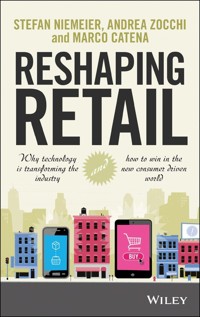
Reshaping Retail sets out the driving causes, current trends and consequences of a transformation in retail triggered by technology. The changes go far beyond making items available for sale on the internet. Starting by briefly setting the historical and business system contexts for retail and describe the role that technology has played in the creation of modern retail it then explains the underlying technological drivers behind the current revolution – radical changes in the capacity of both hardware and software, mobile telecommunications changes and the advances of the Internet.
Ultimately, success will hinge on more than competence; it will come down to a way of thinking. Customer-centricity will need to be valued not just by the store owner, as in the past, but also by all employees in the organization. It will need to become embedded in their daily tasks. The same applies to technology, which must be at the center of the organization and recognized as such by everyone.
With a combination of extensive desk and field research, interviews with leading retailers and technologists, together with the real world experience of practitioners in this area, Reshaping Retail will inspire and help store retailers to make the necessary transformation now to win in the new consumer driven world.
Sie lesen das E-Book in den Legimi-Apps auf:
Seitenzahl: 245
Veröffentlichungsjahr: 2013
Ähnliche



















Table of Contents
Web page
Title page
Copyright page
Foreword
Introduction
Chapter 1: A Brief History of Retailing
The mercantile era
The modern era
The digital era
Chapter 2: Technology: The Crucial Retail Enabler
How retailers add value
Connecting the chain
Knowing what you know
A succession of evolutions
Chapter 3: Game-Changing Technologies
Revolution
The next era of technology change
What it means for consumers
Chapter 4: Consumer Empowerment
The consumer decision journey
Customer empowerment tools
Retailers' response to consumers' changing behavior
Chapter 5: Toward A New Retailing Paradigm
The changing role of the physical store
New contenders
The power of information productivity
Chapter 6: The Future of Retail
Stand-alone archetypes
Building on the stand-alone models
Chapter 7: A Call to Action
Leapfrogging
The way forward
Making it happen
Acknowledgments
About the Authors
Index
For more information about this book please visit http://reshaping-retail-book.mckinsey.com
Cover design: Andrew Ward
© 2013 John Wiley and Sons Ltd
Registered office
John Wiley and Sons Ltd, The Atrium, Southern Gate, Chichester, West Sussex, PO19 8SQ, United Kingdom
For details of our global editorial offices, for customer services and for information about how to apply for permission to reuse the copyright material in this book please see our website at www.wiley.com.
All rights reserved. No part of this publication may be reproduced, stored in a retrieval system, or transmitted, in any form or by any means, electronic, mechanical, photocopying, recording or otherwise, except as permitted by the UK Copyright, Designs and Patents Act 1988, without the prior permission of the publisher.
Wiley publishes in a variety of print and electronic formats and by print-on-demand. Some material included with standard print versions of this book may not be included in e-books or in print-on-demand. If this book refers to media such as a CD or DVD that is not included in the version you purchased, you may download this material at http://booksupport.wiley.com. For more information about Wiley products, visit www.wiley.com.
Designations used by companies to distinguish their products are often claimed as trademarks. All brand names and product names used in this book and on its cover are trade names, service marks, trademark or registered trademarks of their respective owners. The publisher and the book are not associated with any product or vendor mentioned in this book. None of the companies referenced within the book have endorsed the book.
Limit of Liability/Disclaimer of Warranty: While the publisher and author have used their best efforts in preparing this book, they make no representations or warranties with respect to the accuracy or completeness of the contents of this book and specifically disclaim any implied warranties of merchantability or fitness for a particular purpose. It is sold on the understanding that the publisher is not engaged in rendering professional services and neither the publisher nor the author shall be liable for damages arising herefrom. If professional advice or other expert assistance is required, the services of a competent professional should be sought.
Library of Congress Cataloging-in-Publication Data is available
A catalogue record for this book is available from the British Library.
ISBN 978-1-118-65666-2 (hbk) ISBN 978-1-118-69882-2 (ebk)
ISBN 978-1-118-69883-9 (ebk) ISBN 978-1-118-69888-4 (ebk)
Foreword
Mobile Internet access is growing at 20 percent annually. Seventy-five percent of all shoppers research purchase-related information online. The world's top five social networks have a combined total of 2.5 billion members, and millions are joining their ranks every day. Why should retailers care about these trends?
Because they put powerful technology in the hands of shoppers—to compare prices, place orders, and post reviews—anywhere and anytime. In effect, the power balance between those who sell and those who buy is shifting. Even seasoned retail executives are in awe of the fundamental nature of this change. Their questions go to the very core of the retail industry: What is the future role of the physical store? Which of today's retail formats will survive? What will set the winners apart from the losers? How can retailers benefit from evolving technology and changing shopper behavior? In short: How, if at all, can retailers survive the technological revolution we are witnessing?
In this book, five of our most distinguished retail experts from around the world consolidate McKinsey's perspective on those pressing questions. James Naylor of London, Stefan Niemeier of Hamburg, Roger Roberts of Palo Alto and Marco Catena and Andrea Zocchi, both of Milan, have joined forces to compile our latest thinking regarding, for example, constant connectivity, the next big data frontier, cloud computing, channel convergence, and the emergence of an “internet of things.” To challenge and expand their own observations and conclusions, the authors have also invited leading practitioners to provide their perspectives on how technology is changing the face of the industry, from big box retail and online pure play to content aggregation and search.
In 2011, Retail Marketing and Branding: A Definitive Guide to Maximizing ROI, now in its second edition, launched our book series Perspectives on Consumer Industries and Retail to great acclaim. It is my privilege to present the second book in the series, Reshaping Retail. Like the best of its kind, this book is rooted in a profound understanding of technological trends, but it truly stands out by examining their impact from the perspective of the CEO. I hope you share my excitement about this compendium—and will be encouraged to seek out future volumes in the series.
Klaus Behrenbeck
Director, McKinsey & Company, Inc.
Leader of the European Consumer Sector
Introduction
The modern retail system has worked to dazzling effect. From the 19th century, store owners emerged from small beginnings to set in train an industry that has seen some operators become nationally, even globally, dominant. Along the way, they turned retailing into an art, and then a science. Their development was assisted by the lowering of tariff borders and the multiplication many times over of international trade in consumer goods. Efficiency gains enabled by improved production techniques, communications, and information technology reinforced a virtuous cycle of lower real costs and thus prices. Now retailers in emerging markets appear to be repeating the story all over again, except on a scale and at a speed beyond anything we have seen before.
Given all of this, it is hard for those of us who work in retailing to accept that the industry as we know it is living on borrowed time, on the brink of transformation. But that is the view that prompted us to write this book, a view that has been sharpened and reinforced as we researched it. We have spoken to many of our clients and colleagues who are engaged directly in this intense period of transition. What they told us further confirmed both the urgency with which conventional store-based retailers must now act and the extent of the challenges this change represents in strategic, organizational, and above all technological terms. For the industry is in the grip of a revolution powered by digital technology. This will be as big in its effects as the mercantile revolution that saw the birth of retailing as we know it, and the Industrial Revolution that kicked off the modern era.
Retailers' operations have long been underpinned by technology—telecommunications, bar codes, electronic data interchange—so why the commotion now? From our perspective, there are two reasons for it. First, technological innovation hitherto has served primarily to help retailers do what they have always done, but better. They have become ever more powerful intermediaries between suppliers and customers, able to operate at ever-greater scales. Paradoxically, today's technology threatens that power and hence the entire business model. Second, many traditional, store-based retailers still do not understand today's technologies, let alone tomorrow's—they are retailers, not technology companies—and so are unprepared for the speed of change that is about to hit. That is why the subject merits a book that puts the developments into context and describes the driving forces behind them, the nature of the change, and what store-based retailers must do to transform their strategies and operations to thrive.
To begin the book, we pull the camera back a long way, showing how deep are the historical roots of today's business model. Since the Middle Ages, retailers have relied on what is largely a push system of stock movements. The retailer, be it a merchant with a horse or the operator of a nationwide supermarket chain, anticipated future demand, selected the goods to meet it, and then organized delivery in a place where people would buy—first the marketplace, then dedicated stores. Technology did not interfere with this process. It just made the process more efficient.
To understand why this is changing, it is, we believe, important to grasp the underlying technological drivers of change at a reasonable level of detail and to learn how a particular combination of separate innovations has been so powerful. So we describe the ways in which advances in computing power, storage capacity, and network connectivity are driving three preeminent, parallel, and mutually reinforcing trends that will define the digital era of retailing. The first, mobility, will be powered by the availability of technology everywhere: in stores, at home, on the go. The second, measurability, will see far more activities in the value chain, not least consumers' behavior, being measured more accurately. And the third, agility, will come from the development of cloud computing, which enables companies to develop systems (often the roadblock that slows progress in improving business processes or pioneering new business models) with speed and ease.
The technology generating these trends will help retailers improve their processes and contrive new experiences for consumers to a degree previously unimaginable. But it is also ushering in new competitors and empowering customers. And it is customers who are the focus of much of this book, for retailers of every hue will have to contend with the power that now lies in customers' hands. Individuals can browse, select, pay, and take possession, all without entering a store. But this is only a small aspect of what has changed. Far more significantly, new technologies have put an end to the information asymmetry between retailers and consumers. In short, customers have been empowered at the expense of swaths of retailers.
It is not all bad news—far from it. Consumers will still want to visit certain stores for many of the same reasons they already do: convenience, sociability, and even the ability to buy cheap goods (yes, we believe that some store operators will be able to match online rivals on some goods in a digital world). And the measurability that technology delivers will make information productivity as important as capital and labor productivity have been to the industry, helping to drive retailers' efficiency and their ability to serve their customers well to new heights. But at the center of the business model will be the customer. This is not customer care. It is customer-centricity. Absolutely everything in the operating system—pricing, promotions, assortment—will be touched by customers' needs recorded in real time, requiring a degree of responsiveness most commercial directors would find impossible today. In some respects, customer-centricity means returning to the kind of thinking that prevailed when owners of small stores bought the merchandise they knew individual customers would like. Retailers sacrificed this intimacy in favor of scale, as technology emerged to help them manage more complex operations more efficiently. Now they have to manage both.
This will place extraordinary pressure on retailers, because all sorts of skills and practices and ways of making decisions, in some ways unchanged for a century or more, are fast becoming redundant or are only partly sufficient for profitable success. Perhaps toughest of all for many of today's store-based operators will be the technology requirements. Organization-wide fluency in and with technology will be a critical success factor for retailers everywhere, and the robustness and flexibility of their IT systems and the transparency and ease of use of their digital interfaces will be as important as the aspects of physical retailing that are familiar to us today: location, store format, size and layout, point-of-sale design and capacity, in-store promotions, and more.
Ultimately, success will hinge on more than competence; it will come down to a way of thinking. Customer-centricity will need to be valued not just by the store owner, as in the past, but also by all employees in the organization. It will need to become embedded in their daily tasks. The same applies to technology, which must be at the center of the organization and recognized as such by everyone. As one senior executive of a global online retailer told us, “If I were forced to choose, I'd say we were a technology company rather than a retailer.” Store retailers will, in essence, need to change their DNA. We hope this book helps them understand why—and inspires them to make the transformation now.
Chapter 1
A Brief History of Retailing
Co-authored with James Naylor
Today's senior retailers have endured a series of profound shocks and changes. During their careers, they have witnessed the dot-com bubble of the late 1990s, been swept along by a credit-fueled consumer boom, felt the pressure of financial markets' expectations of cross-border retailing, and been blasted by the macroeconomic consequences of a capital market crash and its aftermath. Those who struggle for economic survival day by day and week by week may feel they have had enough history already. Nevertheless, although these words may be of little comfort, the events have been merely the birth pains of a new era in retailing in which the retail landscape will change completely.
To understand this assertion, it helps to consider the nature of today's changes in the context of the history of retailing. We can organize our thinking by dividing the time line of retailing into three eras: the mercantile, the modern, and the digital. The era of medieval mercantilism was born of an embryonic banking system that made capital funding available for the first time and steadily increased the scale and scope of trade over centuries. The modern era, from the Industrial Revolution to the turn of the 21st century, ushered in mass production and the consumer society. In the present era, which got under way 15 or so years ago, another revolution is taking place: the conventional ways of retailing laid down and consolidated over the course of centuries are being thrown over in favor of a new order founded on three technological pillars—computing power, networking, and data storage capacity. We refer to this as retailing's digital era.
Lesen Sie weiter in der vollständigen Ausgabe!
Lesen Sie weiter in der vollständigen Ausgabe!
Lesen Sie weiter in der vollständigen Ausgabe!
Lesen Sie weiter in der vollständigen Ausgabe!
Lesen Sie weiter in der vollständigen Ausgabe!
Lesen Sie weiter in der vollständigen Ausgabe!
Lesen Sie weiter in der vollständigen Ausgabe!
Lesen Sie weiter in der vollständigen Ausgabe!
Lesen Sie weiter in der vollständigen Ausgabe!




