


Erhalten Sie Zugang zu diesem und mehr als 300000 Büchern ab EUR 5,99 monatlich.
- Herausgeber: Crown House Publishing
- Kategorie: Fachliteratur
- Sprache: Englisch
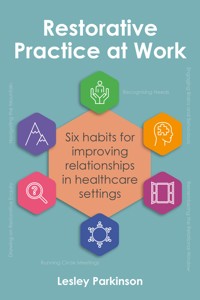
Restorative practice is emerging in healthcare settings and systems as a highly effective means of improving relationships and enabling positive change. It consists of a set of theories, principles, skills and processes that shape our thinking around the way we interact with others. When restorative practice is adopted consistently within and between teams, it becomes 'the way we do things round here', a set of restorative practice 'habits' that we all recognise, use and refer to. Restorative Practice at Workidentifies a set of six complementary habits which will help to change and improve everyday communications, conversations and accountability in healthcare. These habits demonstrate how restorative practice can help toimprove day-to-day communications, in the form of behaviour, language and conversations, ease some of the daily challenges faced in healthcare and foster more effective working relationships, potentially leading to improvements in patient care and patient safety.They are: - Navigating the Mountain: Looking beyond challenging behaviour - Recognising Needs: Noticing, and responding to, needs and unmet needs - Engaging Brains and Behaviours: Informing our responses to outward behaviours - Remembering the Relational Window: Solving problems together - Running Circle Meetings: An alternative meeting process - Drawing on Restorative Enquiry: Processing incidents and problems Lesley firmly believes that restorative practice habits can ease the current pressures on the health service by enabling better relationships, improved communication and a focus on positive mental health. It can also be part of key solutions: staff engagement and retention, team cohesion, patient safety and care, culture change and improvement. The book offers practical and engaging takeaways to helpyou get started with restorative practice and includes reflective learning opportunities and transferrable lessons supported by evidence from case studies and contributions from experienced healthcare professionals. The aim ofRestorative Practice at Workis to make a notable, positive difference to your daily workplace experience, whether you are a public-facing receptionist, member of a clinical team, administrator, manager, senior leader, cleaner or consultant, or, indeed if you have any other role in healthcare.This book will challenge and support your knowledge, understanding and thinking around restorative practice as a workplace philosophy in healthcare. Suitable for NHS leaders, managers, clinicians and staff and those in other healthcare settings such as researchers, academics, HR professionals and educators.
Sie lesen das E-Book in den Legimi-Apps auf:
Seitenzahl: 215
Veröffentlichungsjahr: 2023
Das E-Book (TTS) können Sie hören im Abo „Legimi Premium” in Legimi-Apps auf:
Ähnliche



















Praise for Restorative Practice at Work
Restorative Practice at Work is a thoughtful, reflective and highly practical guide to facilitating contentedness and effectiveness in the workplace. Drawing on insights from a range of theories and ideas, Lesley Parkinson provides an evidence-based set of six practices to be explored by individuals and teams. Complete with tools and real-life examples, the practices facilitate working through the nature of problems at work (for example, exploring thoughts, feelings and relationships), and finding solutions of benefit all round. The book will be of particular interest to those working in health and social care, but the foundations apply to all workplace settings.
Professor Anthony Kessel, Clinical Director, NHS England and author of the middle-grade Don’t Doubt the Rainbow series
A much-needed insight into restorative practice in the world of healthcare, and how interactions in our teams every day make a tangible difference to the care and safety of patients. The tried-and-tested practical focus of this workbook will give readers the power to enact change themselves, and start to create real, lasting psychological safety with diverse teams, in every sense of the word.
In a post-COVID-19 world where healthcare staff are experiencing high pressure and chronic burnout, Lesley’s people-centred approach could revolutionise the way that we approach patient safety in the NHS. I thoroughly enjoyed reading this book and have no doubt that it will deliver huge impact to teams across the healthcare sector.
Hannah Chandisingh, Head of Equality, Diversity and Inclusion at Pennine Care NHS Foundation Trust and anti-racism consultant
This book is a refreshing and important addition to the field of restorative practice because it has been written with a clear understanding that restorative practice does not exist on the page or in a training room but in the real-life context of professionals, practitioners, young people and families.
Many books do not make that transition possible and the result is individuals, having been inspired by what they have read, cannot then put the theory into practice. The metaphor of habits (here, six restorative habits) offers a scaffolding to explore theory and, more importantly, apply it to the individual’s context.
Alongside the theoretical inputs, there are activities within each section of the book that will enable the reader to not only self-reflect, but also reflect about self within the organisation in which they might work. The use of supportive Banecdotes, provided by a wide range of health staff, will also enable readers to get a feel for what developing and living with these habits is like.
Parkinson says, ‘I want this book to make a notable, positive difference to your daily workplace experience … [regardless of your] role in healthcare.’ I think this book can and will do that for those who read and apply its six restorative habits to their daily personal and professional lives.
Chris Straker, Director of Restorative Thinking Ltd, consultant and trainer in restorative practice
I was delighted to read this book. I think it is particularly apt that this practice has been shared within our trust, and especially now, when we have all recently had the most isolation, mentally and physically, from family and colleagues that many of us have ever experienced, due to the pandemic.
The six habits are set out succinctly and clearly, and compassionately assess situations that may occur – with a clear aim for supportive resolution and improved healthcare.
The circle meetings are a very welcome initiative after the necessity of endless TEAM meetings – a very practical way to break down barriers and work towards a psychologically safe and good culture.
Here is a reference guide that any team member, whatever their role, would be glad to have nearby, and one that they can dip into for reminders and guidance.
I think this publication is particularly relevant to the work we do as freedom to speak up guardians, where we can be faced with difficult and highly emotionally charged conversations that will benefit from a measured structure of restorative enquiry to ensure the psychological safety that is needed to make speaking up everyday practice.
Heather Bruce, Freedom to Speak up Guardian, University Hospitals of Morcambe Bay NHS Foundation Trust
As always, and as I have found out over many years of local government work, building and nurturing meaningful and sound relationships is the key to success and productivity – breaking down those behavioural barriers that colleagues build up at all levels of the organisation, through knowledge and the skilful application of sound restorative approaches. Sounds easy, but it takes some time to understand your own barriers, the impact upon the self of the work you undertake and how that impacts on others.
This book, written in simple plain language for what is a vast psychological and behavioural minefield at times, helps the reader understand what a restorative approach is and how it can be applied to everyday occurrences Cand events, including in the workplace. Lesley deals mainly with NHS scenarios in this book, but this approach can be used in all workplace settings, at all levels, including working with children. When used and applied, the restorative principles (or habits) do change mindsets, reduce stressful and potentially harmful situations, and make working in a team or organisation happier and healthier for all – as well as ensure the best outcomes for a child and their family. It’s seeing the behaviour or response and not applying it to the person as being wrong or deceitful, and always looking for the solution, that really counts – and works, as time has shown us!
In local authorities, most will have a practice model that is strengths-based and family focused, as well as using a trauma-informed approach when working with children and their families – a restorative practice approach fits well with these models and applying the restorative principles creatively only enhances what are already tried, tested and research-rich ways of working.
Irene Livingstone, DipSW, independent consultant and practice improvement specialist
I applaud Lesley Parkinson for wanting to help teams and individuals find a positive way to face the future. It can sometimes be a difficult task to inspire a jaded and overworked team to try something different. Working in a team, there is nothing more dispiriting or disheartening than when presenting an idea or concern, if it is not then followed up or is treated with distain.
The book provides great background research which proves that putting the work into providing the tools to develop restorative practice is worth the effort. Once a team has gelled together, sharing the same motivations and responsibilities, they will work better and look out for each other more. l like the moments set aside to think and add personal insights into the narrative.
The mountain illustration gives a helpful insight, cleverly highlighting that if you are feeling good or bad, you act differently towards the people you are in contact with at any time – and them with you. This in turn defines how your interactions and relationships can be good or bad.
The relational window makes each person think about the way they deal with everyday things with a better perspective, which helps managers work with the team better and makes the team members more amenable to assisting each other with any issues.
In my opinion, the improvements that could be made by following these six habits – in a workplace setting and taken outside work into a personal setting – mean that this book is well worth your time.
Janet Yeadon, retired Clerical Admin Manager, Primary Care Support Services, NHS D
Those who work in the broad fields of restorative practice know that its applicability is limited only by our imaginations and opportunities. Lesley Parkinson has written a compelling, practical, easily digestible book about the application of restorative practice in healthcare. This book reflects her deep understanding of issues like voice, psychological safety and trust in workplace relationships, and implementation and support of this philosophy across teams. She has done the careful research needed to support her arguments, and offers the gift of naming, describing and using the six restorative habits (with examples from the field) so they can be embedded into unconscious competence, used daily in both professional and personal settings – moving the explicit into the implicit – to become ‘how we do things around here’. The themes in this book have much greater application and would be helpful for anyone in any workplace.
Margaret Thorsborne, author, trainer, consultant and pioneer of restorative practice in education and workplaces
Organisational leaders seeking better performance outcomes are increasingly paying attention to the social and relational aspects of change. Put simply, relationships matter. Lesley Parkinson’s Restorative Practice at Work offers a timely and accessible guide to the why and how of developing better work-based relationships via six habits of restorative practice that ultimately foster better performance outcomes. Essential reading for anyone interested in leadership, culture, innovation and improvement.
Nicola Burgess, Reader and Associate Professor of Operations Management, Warwick Business School
This is an excellent read. It documents really well the improvement journeys and real experiences of the colleagues who have taken part and benefited from the restorative practice pathway.
Sarah Jones, Communications Manager, University Hospitals of Morecambe Bay NHS Foundation Trust
E
FG
This book is dedicated to my late dad, and to the staff at Royal Preston Hospital who looked after him so well.H
Foreword
When I first talked with Lesley, I was struck by her deep desire to make work satisfying on a human level. Many interventions focus on extrinsic factors; restorative practice gives you the opportunity to make yourself your own improvement project.
Restorative practice requires each of us to really consider our part in enabling healthy, open, supportive cultures. Whilst reading, you will be introduced to the essential elements of restorative practice as well as practical exercises to enhance your awareness and purposeful intent to change how you interact with your environment; it allowed me to consider how, as an experienced leader, I can inadvertently stop being curious and the danger in making assumptions. We often find that time pressures curtail our ability to be truly present. Restorative Practice at Work assists us in focusing on the habits that will make a genuine difference to our own well-being and self-belief as well as that of our colleagues and patients.
Don’t be deceived by what appears to be simple. The beauty of this way of ‘being’ is that it can impact on all our relationships and enable us to move to a place where we can be our authentic selves every day. I recommend this book not only as a guide to an individual exploration of ‘how we do things around here’ but also to develop a new language in how we work with our team.
Lesley and her colleagues at Restorative Thinking have been on a journey in understanding if and how restorative practice principles can be translated and integrated into a healthcare setting. The NHS is particularly challenged in creating healthy workplaces and giving staff a sense of value. Restorative practice provides a solid foundation to reset how we can all take responsibility for providing the environment and interactions that magnify our best offer.
We can easily become deflated or dispirited when trying to change habits that have taken years to evolve. However, we can practise the six habits in whatever situation we find ourselves in and can build a sense of confidence that we are intentionally impacting on our relationships in the most positive way, both personally and professionally. The text explores why we acquire certain habits and the unintended consequences of iiallowing ourselves to become stuck in responding in a set way to certain challenges. In developing a selection of different habits, we can enhance our working and personal relationships. The language is simple to understand, thus making our part in developing a deeper understanding of productive relationships more accessible, easy to recognise and modify.
Changing a habit is hard work and takes time. The personal experiences Lesley shares give a real insight into the achievement we can experience when we do things differently and with purpose to deliver better outcomes. This book has been written to make it easy for readers to benefit from the experiences of others. You can dip in and out, and work on your own or as part of a group. Rarely do I read something that has immediate resonance in the way that this book does.
Sue Holden, CEO, Aqua
Preface
I want this book to make a notable, positive difference to your daily workplace experience, whether you are a public-facing receptionist, member of a clinical team, administrator, manager, senior leader, cleaner or consultant – any and every role in healthcare.
For the past thirteen years, alongside the team at Restorative Thinking, I have been introducing restorative practice habits with staff at every level across public services. Each team I have worked with has presented different strengths and needs, and together we have collaborated to meet those needs, fill gaps and improve thinking and doing in the workplace. Often, elements of the six restorative practice habits introduced in this book are partly familiar to individuals and teams; I have still to find anyone who knows about all of them before we start!
I have rigorously tested the restorative practice habits to see how and when they help teams to change and improve, both inwardly – how people work together and what can be done differently to improve team cohesion and better overcome challenges together – and outwardly – how we engage with colleagues from other departments, patients, partners, children, young people, adults and families. There are countless examples of success stories, and I am confident about presenting the six restorative practice habits to you, both as a means of developing self-awareness (improving your own relationships and experiences) and engaging with others (those with whom you come into contact, especially colleagues, patients and families).
I don’t present myself as a healthcare professional. I am a former teacher and school leader who has navigated multiple public service settings and systems: children’s and adult services; early help; primary, secondary and special schools; youth offending services; and prison and probation services. Most recently, I have been working closely with clinical and other teams at University Hospitals of Morecambe Bay NHS Foundation Trust (UHMBT), kindly invited in by Sally Comber and Janette Thorpe from the organisational development team.
I have observed clinical teams in action and worked with leaders across multiple teams. We have collaborated to explore how relevant and useful restorative practice habits are in the context of the NHS. We have ivlearned that these habits are relevant and do add value in multiple teams and scenarios – and I think we are on to something!
Whilst I read daily in the news, medical journals and social media about the huge pressures on NHS staff and systems in healthcare settings (e.g. hospitals, nursing homes, GP surgeries, dentistry), it is my firm belief that restorative practice habits can both ease the current demands by enabling better relationships, positive mental health, improved communication and team cohesion, and can be part of key solutions in areas such as staff engagement and retention, patient safety and care, culture change and improvement, and civility and respect.
I want to be part of this onward journey; my work at UHMBT is ongoing, and I am keen to test how far we can use restorative practice habits to continue to innovate within healthcare.
I am eager to hear from readers of this book, of course, especially if you can describe how restorative practice habits are making a difference for you and your colleagues, so please don’t be shy. I am looking forward to spotting your e-mail in my inbox: [email protected].
I hope you find these habits a useful way into restorative practice, and that they stay with you for life.
Acknowledgements
This book began in 2013 with a meeting in a coffee shop with Chris Straker. Chris has worked alongside me for ten years; he’s an amazing teacher, mentor and human being.
My colleagues Gail Porter, Jackie Potter and Christine Savage-McMahon frequently share their expertise and insights with me, and they are also captured in this book. I truly appreciate their professionalism and friendship.
Sally Comber and Janette Thorpe from the UHMBT had the vision and experience to invite Gail and me to share our brand of restorative practice with clinical managers and the People and Organisational Development Directorate. This has led to an exciting and fulfilling experiment – the start of a journey and this book.
Friends who have inspired and helped to shape this book are Matt Burney, Hayley Caine, Irene Pearse, Anne Shaw and Gill Tavner and my sister Helen Haythornthwaite.
The Crown House Publishing family have together turned a rough manuscript into a coherent story, and I’m really grateful for our book. Thank you to David, Louise, Emma, Amy, Beverley, Tom and the wider team.
I would also like to thank:
Professor Colin Davidson (University of Central Lancashire) and Sarah Smith (University of Cumbria) for sense-checking Chapter 7.
Mum and dad for setting me up with brilliant relationship modelling.
Marc and Stan for letting me test out restorative practice via our marriage and motherhood. vi
Contents
xi
So, I think it’s having the habits sort of ingrained in my brain now so that I can think about them each day.
Claire Rawes, matron for theatres and surgery, UHMBT
Restorative practice is about developing our own individual practice, for which each of us has a responsibility. This is at odds with the usual development practices of being trained and off you go … The question is: what are people up for doing differently?
Sally Comber, organisation development lead, UHMBTxii
Introduction
Habits
A habit is a learned or routine behaviour, something that we repeat regularly to the point that we give it little or no thought. For example, we might start each day with a cup of tea or coffee, gravitate towards a particular brand of toothpaste in the supermarket or make the bed at the same time every day.
Habits are difficult but not impossible to change, and we can start new habits at any time. It isn’t my intention to dive into your own personal habits, but I do want to invite you to consider adopting six restorative practice habits both at work and at home. It is a big ask, so I am relying on the habits themselves to convince you that they are relevant and worthwhile – and, who knows, you may already be using some of them.
The six restorative practice habits explored in this book are:
1 Navigating the mountain.
2 Recognising needs.
3 Engaging brains and behaviours.
4 Remembering the relational window.
5 Running circle meetings.
6 Drawing on restorative enquiry.
Whilst the current, popular emphasis in healthcare is to draw on restorative practice as a means of resolving harm or conflict within teams and with patients, this book focuses on restorative practice as a set of six proactive habits to change and improve day-to-day communications 2(behaviour, language, conversations), to ease some of the daily challenges we face and foster more effective working relationships, potentially leading to improvements in patient care and patient safety.
Restorative Practice at Work develops the restorative practice narrative within the NHS. Readers will find out what it is and how it can help to improve communication, conversations and accountability within clinical teams and with supporting teams. I offer suggestions for getting started with restorative practice. I also consider how we can take restorative practice habits home to feed into our parenting style or relationships with our spouse, partner, parents, wider family members and friends.
In June 2021, with my colleague Gail Porter from the Restorative Thinking team, we began a restorative practice pathway with UHMBT. I have included the learning from this pathway, insights from NHS professionals (clinical leaders, managers, teams) about their experiences of engaging with restorative practice: what happened and what changed. I also share practical suggestions for getting started with restorative practice, using case studies from UHMBT and our wider work with public services to illustrate what this looks like.
Transforming our workplace culture is a massive endeavour. In order to change culture, we need to focus on the relationship habits of all staff within an organisation and consider how these habits bring our workplace culture to life. Recent studies, especially post-COVID-19, tell us about the importance of positive relationships and the benefits of psychological safety when changing or revisiting workplace culture.1Restorative Practice at Work explores the ‘how to’, digging into the detail of workplace relationships and focusing on how to foster better relationships and psychological safety – what this looks like and how to do it.
Restorative practice habits create the context for meaningful dialogue; they bind individuals and groups, irrespective of race, religion, national 3origin or creed. When the six restorative habits are adopted within and between teams, everyone develops the knowledge, skills and understanding to draw on the practice daily, and this then guides all our language, behaviours and communication. We connect better on a human level, which becomes the starting point for everything else that happens during our shift, including how we engage with patients.
The following chapters will develop your knowledge and understanding of restorative practice and support your thinking around its application as a workplace philosophy. Part I explores the evidence base for restorative practice and its potential in healthcare settings, and Part II introduces the six habits that together make up the restorative practice framework.
We will dive deeper into the nature of the habits, and I will encourage you to think about being more deliberate about using them. The book also includes supporting resources to encourage your own use (personal and professional) and your team’s use of restorative practice. The images in Chapters 5–8 (behaviour, thoughts and feelings mountain (habit 1), Maslow’s hierarchy of needs (habit 2), primitive brain (habit 3) and relational window (habit 4) are available to download at: www.crownhouse.co.uk/rp-at-work.
I invite you to log your thinking and ideas in a notebook as you read; I have indicated where you may wish to pause and take notes to record your thoughts and insights. I hope they find their way off the page and into your working and personal life! 4
1 See, for example, A. Trimble, ‘The Impact of Covid-19 on Working Relationships’, The King’s Fund (21 May 2020). Available at: https://www.kingsfund.org.uk/blog/2020/05/impact-covid-19-working-relationships; F. Zhao, F. Ahmed and N. A. Faraz, ‘Caring for the Caregiver During COVID-19 Outbreak: Does Inclusive Leadership Improve Psychological Safety and Curb Psychological Distress? A Cross-Sectional Study’, International Journal of Nursing Studies, 110 (2020): 103725. https://doi.org/10.1016/j.ijnurstu.2020.103725; M. F. Dollard and T. Bailey, ‘Building Psychosocial Safety Climate in Turbulent Times: The Case of COVID-19’, Journal of Applied Psychology, 106(7) (2021), 951–964. https://doi.org/10.1037/apl0000939; J. Lunt, S. Hemming, J. Ellander, A. Baraniak, K. Burton and D. Ellington, ‘Experiences of Workers with Post-COVID-19 Symptoms Can Signpost Suitable Workplace Accommodations’, International Journal of Workplace Health Management, 15(3) (2022), 359–374. https://doi.org/10.1108/IJWHM-03-2021-0075.
Part I
Background
Chapter 1




