


3,99 €
Mehr erfahren.
- Herausgeber: Greg Krojac
- Kategorie: Fantasy und Science-Fiction
- Sprache: Englisch
Some things about the world appear to be different, but that’s only to be expected when one has been away for a hundred years or so. Coppélia’s robotic memory is supposed to be infallible but the additional differences she perceives are so slight that she dismisses them as within reasonable limits of variance.
Today is the most important day since her return, as she has been asked to receive a posthumous Nobel Peace Prize on behalf of her late friend, Karen Chambers, for her tireless work in integrating sophonts into society. The android takes the stage at the Oslo City Hall.
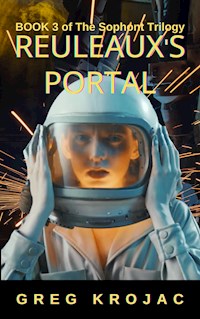
In this third and final instalment of the Sophont trilogy, Karen’s granddaughter, Holly Bryson, also notices discrepancies between Coppélia’s anecdotal stories and the visual records that form part of her grandmother’s memoirs, but the inconsistencies she notices are not so easy to dismiss. The burning question at the fore of Holly’s mind is whether or not the android onstage is the same android that was her grandmother’s best friend.
To find the answer to that question, Holly finds herself on a journey that, as yet, only exists in astrophysicist’s minds and calculations.
Das E-Book können Sie in Legimi-Apps oder einer beliebigen App lesen, die das folgende Format unterstützen:
Veröffentlichungsjahr: 2021
Ähnliche










Reuleaux s Portal
––––––––
Greg Krojac
This book or any portion thereof may not be reproduced or used in any manner whatsoever without the express permission of the author except for the use of brief quotations in a book review.
Please note that this book is a work of fiction and any resemblance to persons, living or dead, or places, events or locales is purely coincidental. The characters are productions of the author’s imagination and used fictitiously.
Copyright © 2019 Greg Krojac
All rights reserved
Language: UK English
Table of Contents
Title Page
Copyright Page
Reuleaux's Portal (The Sophont Trilogy, #3)
1
2
3
4
5
6
7
8
9
10
11
12
13
14
15
16
17
18
19
20
21
22
23
24
25
26
27
28
29
30
31
32
THANK YOU
ABOUT THE AUTHOR
NOVELS BY GREG KROJAC
NOVELLAS BY GREG KROJAC
FREE SHORT STORIES BY GREG KROJAC
‘...our universe is one slice of bread in a big cosmic loaf. The other slices would be displaced from ours in some extra dimension of space.’
Brian Greene
(American Physicist)
1
It was almost a year since the Sir Isaac Newton had returned to Earth with Coppélia, and everything on her home planet seemed pretty much the same as she remembered it. Some things had changed of course – almost one hundred years had passed since the android had left Earth – but the world was still more or less the same, just newer and, of course, more hi-tech.
Sophonts were new to her and Coppélia could have been forgiven for feeling a little inadequate compared to this new breed of androids. Progress had marched onwards and the newer androids were stronger and had more advanced Artificial Intelligence capabilities than she did, but her own specifications were still formidable when compared to the organic limitations of humans. Nonetheless, everybody – both human and sophont – treated her with nothing less than the greatest respect, recognising her importance.
Holly really enjoyed spending time with Coppélia, for it felt almost as if she were spending time with her grandmother. The bond that had been created between Karen and the android was obviously something very special and Coppélia clearly relished sharing stories of the experiences that she and Karen had shared together. The anecdotes that Coppélia told didn’t always align completely with what her grandmother had said, but that was perhaps to be expected; people always had their own version of events, although it must be said that Coppélia’s tales were drawn directly from recordings made at the time and, as such, were infallible. However, Holly found her grandmother’s occasional inconsistencies rather charming and thought they simply highlighted a quaint difference between the human and the android psyche.
And so, one chilly December evening, Holly and Coppélia could be found sharing the stage of the Oslo City Hall, with the Norwegian Royal Family, the Mayor of Oslo, and the Head of the Norwegian Parliament.
In a unique one-off diversion from Nobel Foundation policy, a special Nobel Peace Prize was to be awarded posthumously to Karen Chambers for her tireless work in integrating sophonts into society. It had not always been an easy task – humans had been fed a steady diet of doomsday AI scenarios, and the complexity of sophont technology had, at first, served to magnify fear and suspicion, but, with patience and a lot of hard work, she and her team from the Syber Industries Robotic Integration Foundation were able to win over most of the planet’s population to accept that humans and sophonts could live in harmony together. There were still those who opposed the integration and would never accept that sophonts should ever be anything but mechanical slaves to their human masters, but history had eventually taught most people to embrace diversity and look for the benefits. And those benefits were manifold. Sophont astronauts explored worlds and environments that were fatally inhospitable to humans. Sophont rescue teams had saved hundreds of thousands of human lives, and the field of medicine had advanced at a rate never before seen – thanks to integrated human-sophont research teams.
Sophonts and their expanding use in all areas of the workplace could have been a recipe for disaster, but Karen had skilfully guided the integration process through several stormy seas and had been a major contributor to the peaceful state that society now found itself in. She certainly deserved the award.
Facing Holly and Coppélia, down in the main floor area, sat representatives from the three major sophont manufacturers, the directors and assistant directors of various space agencies, representatives of various international rescue agencies that could not operate so effectively without sophonts, and a group of people who were only alive because of sophont rescues. Scattered among them were fifty sophonts who had been involved in those rescues.
Many foreign dignitaries were seated on the right, and the left was occupied by the Norwegian Prime Minister and her wife, the Head of the Norwegian Supreme Court and many other Norwegian politicians.
The ceremony began with a traditional Viking song, a cappella by a top Norwegian female vocalist, Tonetta Breivik. This was followed by an introductory speech given by the Leader of the Nobel Committee, Ragnar Aarskog, during which he described the part that Karen had played in the successful transition to human-sophont co-existence.
This was followed by another musical interlude during which a holographically remastered vintage video of an early 21st-century band Jaga Jassist played, before Holly gave the gathered audience a potted history of what life had been like with such an amazing grandmother.
It seemed only natural that Coppélia should receive the award on Karen’s behalf. In fact, Holly herself had suggested it. Holly was Karen’s granddaughter, but she felt that Coppélia had known her grandmother better than anyone else. Holly felt that this would be the best tribute to Karen – the relationship between Karen and Coppélia was the epitome of what her grandmother had stood for.
Finally, it was time for Coppélia’s speech. Wearing a figure-hugging emerald green dress, she stood up and slowly walked over to the lectern. She thought of clearing her throat (she had seen many others do this before making speeches) but everybody knew that she was an android so there was little point in mimicking this human characteristic. She started her speech without further ado.
“Your Majesty, your Royal Highnesses, distinguished representatives of the Nobel Peace Prize Laureate, your Excellencies, distinguished guests, ladies and gentlemen. Thank you for inviting me to receive this wonderful award on behalf of my best friend, Karen Chambers.
“When Karen and I first met, I was wary of her – after all, she was a police officer and I was an android that had broken the Three Laws of Robotics. But, as I got to know her, I was able to see past the authority figure and discovered the wonderful person behind the badge. Somehow, Karen could see beyond my synthetic skin and integrated artificial neural circuits to the person – yes, the person – that I was and still am today. She never saw me as ‘just a robot’ and treated me with nothing but compassion. She was a biological being and I was not, but that was never a barrier between us. She treated me as an equal.”
Coppélia continued with anecdotal stories of their time together, of the fun and the occasional sad times that they had experienced together up until the day that the android left Earth for the exoplanet Proxima b.
“I didn’t know when I left Earth that there were no plans to bring me back home, but I couldn’t imagine that Karen would abandon me – it’s not who she was. It was the hope that she would somehow come and find me that helped me cope with the ordeal. I could have de-activated myself – I would have found a way to do so – but I always believed that Karen wouldn’t have willingly left me on a remote planet, 4.24 light-years from Earth.
She moved towards the side of the stage.
“I’d like to show you a couple of holo-recordings downloaded from my internal memory. The first recording is of our first Space-Earth interaction. The unavoidable time-lag between our responses has been removed for brevity; otherwise, we’d be here all night.”
Gentle laughter rippled around the room as two holograms materialised on stage, seated opposite each other. The hall became so quiet that a dropped pin would have seemed like a cymbal crash.
“Hi, Karen. Over.”
The audience watched as the Karen hologram stood up and approached Coppélia’s hologram. Some of them even jumped along with her as her hand went right through her friend’s body.
“It really looked like I would be able to touch you. Over.”
Coppélia’s hologram responded.
“I’m approximately two hundred and fifty-nine million, twenty thousand, six hundred and seventy-two kilometres away. You’d need very long arms to give me a hug. Over.”
Some of the audience members chuckled as Karen’s hologram enjoyed the joke.
“That’s a bloody long way. Over.”
“And we’ve hardly got started. When the VASIMR unit kicks in fully I’ll be going really fast, accelerating to 30% light-speed. Over.”
Holly found watching such conversations between her grandmother and Coppélia enjoyable, although sometimes she felt like an eavesdropper intruding on a shared intimate moment. The conversation continued, enthralling the audience, for whom this was their first time of watching. Holly was looking forward to the playing of the second holo-recording where Coppélia performs a dance extract from the ballet ‘Coppélia’ for her grandmother. That was her favourite recording of them all.
The first holo-recording disappeared and the real Coppélia stood up again.
“To finish, I would like to show you a holo-recording that I sent to Karen as a gift to coincide with my landing on Proxima b. At the time, I had no idea if it would even reach her, but – if it did – I knew that it would make her happy, even though we were light-years apart.”
A new holo-recording materialised.
“Hi, Karen. Hi, Felipe and Lucas, and baby Carolina. I hope you are well.
“Hello everybody. If everything has gone according to plan – you’ll have received this message on the day that I’ll have landed on Proxima b. I’m probably on the planet right now. Anyway, I have a gift for you Karen – a very special gift – something that I hope will bring back some fond memories.”
The audience gasped as Coppélia’s hologram dissolved away but returned just as quickly.
“Sorry about that, everybody. I had to get changed.”
Coppélia was wearing a burgundy leotard and a pair of ballet shoes.
“I hope you like the colour, Karen. It’s Hex #800020.”
Holly had seen her grandmother’s copy of the holo-recording dozens of times before. It had been Karen’s favourite and was always played on her birthday. In fact, the family still played it on each anniversary of Karen’s birth, even though she was no longer with them.
However, the rest of the dance performance was lost on Holly this time. She was distracted by three words that kept being repeated in her mind, playing in a never-ending loop.
“This isn’t right.”
2
Holly sat in the large conservatory that backed onto her surprisingly modest detached house. She could have afforded a much larger and ostentatious home, but neither she nor her husband, Simon, felt a need for a larger property yet; they had married on her return from rescuing Coppélia but – as yet – had no children (nor planned to have any for a few years), so they were perfectly satisfied with their home as it was.
Simon set up a portable holographic projector and switched it on. Holly wanted to confirm what she had seen at the Nobel Awards ceremony.
“Load up our copy of the holo-recording that we’ve been watching on Nan’s birthday for the last umpteen years, please.”
Simon started playing the holo-cast, which soon arrived at the point where Coppélia had changed her clothing.
“Sorry about that, everybody. I had to get changed.”
Coppélia was wearing a deep blue leotard and a pair of matching ballet shoes. Holly pointed at the image.
“What colour is Coppélia’s leotard?”
Simon thought it a silly question.
“Deep blue, of course.”
“Correct. Remember that. Now move the holocast forward a little.”
Simon did as she asked. The hologram of Coppélia continued speaking.
“I hope you like the colour, Karen. It’s Hex #4F5A77”
Holly was now certain that her suspicions were correct.
“Play it again and make a note of the Hex code.”
Simon replayed that part of the recording and noted down the Hex Code on a digital notepad. Without being asked, he then played a recording from the Nobel ceremony.
Coppélia returned from changing her clothing.
“Sorry about that, everybody. I had to get changed.”
Coppélia was wearing a burgundy leotard and a pair of ballet shoes.
“What colour is Coppélia’s leotard, Simon?”
Simon could now see what was making his wife so agitated.
“Burgundy.”
“But in our – Nan’s version – the leotard’s blue.”
“Maybe Coppélia’s copy has been corrupted and distorted the colouring?”
“I don’t believe so. And the next thing Coppélia says will prove it. Listen carefully to the next bit.”
“I hope you like the colour, Karen. It’s Hex #800020.”
Holly stood up abruptly.
“Play that sentence again.”
Simon did so, and Holly squealed with delight. She hadn’t been seeing and hearing things.
“Well, Simon?”
Her husband had to admit that Holly was correct. She pointed excitedly at the holographic images, feeling vindicated.
“In our copy, Coppélia says that the colour is Hex #4F5A77 but in Coppélia’s copy she says it’s Hex #800020. How can that be?”
Simon shrugged his shoulders.
“I have no idea. I mean, your grandmother’s holo-cast and the one that Coppélia played at the award ceremony are identical – as far as I can tell – apart from the leotard’s colour.”
There was no denying what they had just seen. File corruption could possibly have explained visual contradictions in colour, but there was no denying that Coppélia had said two distinctly different Hex codes on each recording. They couldn’t explain it. Simon clutched at a straw.
“Maybe she’s an imposter.”
Holly shook her head.
“How can she be an imposter, Simon? We brought her back from Proxima b ourselves. You were with me. We went down to the planet’s surface together, both of us, and we brought her back to Earth on the Sir Isaac Newton. Both of us. How can she possibly not be Coppélia?”
Simon was perplexed,
“OK. Let’s take both holo-cast copies to my cousin Rory. You remember him from our wedding? He’s a Robotics Forensic Officer, an RFO. If anyone can throw some light on this mystery, he can.”
At Rory’s laboratory, Holly and Simon paced up and down like a pair of expectant fathers. After what seemed like hours, but was actually only forty-five minutes, the door to the staff recreation room opened and Simon’s cousin entered, holding not a new-born baby but a digital tablet containing his evaluation. Both Simon and Holly stopped their pacing and looked at Rory, who suggested that they sit down. Once they were both seated, he spoke.
“I’ve performed all the tests I know – twice, in fact – and there’s nothing to suggest that either of these holo-casts has been tampered with. Both holo-casts are authentic. There’s no evidence of deepfake.”
Holly thought back to a story that her grandmother had told her.
“Simon, do you remember that Nan told us about her friend Rachel, who quickly confirmed that Coppélia was an android?”
“Yes. What about it?”
“I think that maybe we should follow her example.”
The next day, Holly and Simon met up with Coppélia at a local coffee shop. The android had no need to take on organic sustenance but enjoyed meetings such as this from a social context. After some unnecessary small-talk, Holly got to the reason for her invitation.
“Coppélia, you know that you have a Catalogue Identification Code?”
Coppélia nodded.
“Yes, of course.”
“Do you know what it is?”
“Of course. It’s SAI-0046.”
Simon interrupted.
“Are you sure, Coppélia? SAI-0046?”
“Of course, Simon. The alpha-numeric is etched onto my Central Processing Unit.”
Holly repeated the code.
“SAI-0046. No margin of error?”
Coppélia wondered why Holly and Simon insisted on repeating the same question.
“No margin of error. SAI-0046. Why do you want to know?”
Holly took a deep breath.
“It’s just that Coppélia’s CIC was – is – SAI-0047.”
This was certainly a curiosity. Coppélia performed a few self-diagnostic tests. She looked at her friends.
“I’ve checked my systems. I am definitely a prototype that was being tested in the field. SAI-0046. There is no mistake. Could you be mistaken?”
Holly was certain that Coppélia’s code should have been SAI-0047. There was plenty of documentary evidence that supported that fact. There was also the question of the leotard’s colour, which Holly now introduced to the conversation.
“Coppélia, what colour was your leotard in the holographic message that you sent to my grandmother? The one where you performed a dance from the ballet Coppélia?”
“It was burgundy. Hex #800020. Why?”
“I have the original holo-cast copy of the same episode, my grandmother’s copy, where your leotard was deep blue and you state very clearly that the colour is Hex #4F5A77.”
Coppélia was confused.
“This is very strange.”
“Very.”
Simon leaned forward in his chair.
“Do you have any idea what might be causing the discrepancies, Coppélia? Holly and I have no idea.”
The android thought for a few seconds.
“There is only one explanation as far as I can see.”
Holly was eager to hear what it could be. Coppélia smiled at the couple, in an attempt to reduce any shock that might follow her conclusion.
“There are two of me.”
3
Holly and Simon found Coppélia’s deduction difficult to accept but even more difficult to refute. The difference in the colour of the leotard on the two holo-recordings wasn’t sufficient proof on its own that the Coppélia sitting before them wasn’t the same Coppélia that had left Earth to explore Proxima b, but the differing CIC designations couldn’t be ignored.
If two inconsistencies existed then perhaps there were more. Holly and Simon agreed that further investigation was warranted. Holly poured herself a coffee and prepared herself for the marathon task of comparing the videos. Fortunately, it was the weekend and she had no other pressing commitments that could pull her away from the chore. She touched a couple of icons on the universal remote control, the URC band, that she wore on her left wrist and a holographic monitor appeared in the middle of the room. Although Holly and Simon were seated on a sofa, and Coppélia was in an armchair, facing them, all three had a perfect view of the screen. The holo-monitor was state-of-the-art and possessed the latest refracto-visual technology, a collection of digital prisms that distributed the image directly ahead of the viewer’s gaze, no matter where in the room they were. Holly took a sip of her coffee.
“Fortunately, my grandmother was an obsessive record-keeper. She recorded many events in her life, in the form of a personal log. Some of the entries are anecdotal, made post-event, but some are video-logs, recorded as they happened. We can compare my grandmother’s log with what’s in your memory banks.”
Coppélia agreed but had a better suggestion.
“It will be more efficient for me to study the log alone and highlight any differences. You’re restricted in your processing abilities whereas I am able to view, process, and compare at a rate that is far beyond your capability.”
Holly had to admit that this was a good idea. Coppélia could make the comparisons in a fraction of the time that Holly or Simon could. There were years of Karen’s entries to study but, seven seconds later, Coppélia was ready with her results.
“I was able to identify another couple of major discrepancies, along with many minor differences which exist but are not so obvious.”
Holly was impatient.
“What are the big differences, Coppélia?”
Coppélia knew that what she was about to say would confirm her own thoughts.
“The spacecraft on which I travelled to the exoplanet was called the Galileo, whereas the spacecraft recorded in Karen’s logs was the Carl Sagan.”
“Yes, I remember Nan thinking that the name was a fitting tribute to the great astrophysicist and visionary. What’s the second?”
“According to Karen’s logs, she was married to Raef Ulfursson.”
“Of course. My grandfather – your creator –was Raef Ulfursson.”
Coppélia shook her head.




