


136,99 €
Mehr erfahren.
- Herausgeber: John Wiley & Sons
- Kategorie: Fachliteratur
- Sprache: Englisch
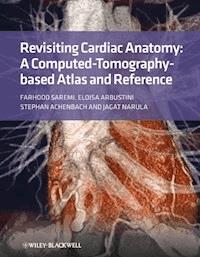
This new atlas represents a fresh fresh approach to cardiac anatomy, providing images of unparalleled quality, along with explanatory text, to show in vivo heart anatomy and explain the clinically relevant underlying anatomic concepts. In spite of amazing proliferation of information on the Internet and multiple websites filled with up-to-date information, there is no similarly detailed and systematic compilation of morphological imaging with CT. Organized for both systematic learning and to serve as a quick, yet detailed reference for specific clinical questions, this book is an invaluable resource for medical students and residents, cardiologists, and especially surgeons, interventionalists and electrophysiologists, who depend on ever more detailed imaging support in order to successfully perform increasingly complex coronary and noncoronary structural interventions and other procedures.
Sie lesen das E-Book in den Legimi-Apps auf:
Seitenzahl: 571
Veröffentlichungsjahr: 2011
Ähnliche

















Contents
List of Contributors
Preface
1 Anatomy of the Heart for a Dissector
Farhood Saremi & Damián Sánchez-Quintana
Introduction
Heart Orientation within the Thorax
The Right Atrium
The Left Atrium
Components of the Interatrial Septum
Septal Components of the AV Junction
The Right Ventricle
The Left Ventricle
The Pericardium
References
2 Anatomical and Pathophysiological Classification of Congenital Heart Disease
Carla Frescura, Emanuela Valsangiacomo Büchel, Siew Yen Ho & Gaetano Thiene
Introduction
Sequential Chamber Localization
Atrioventricular Connections
Ventriculoarterial Connections
Pathophysiological Classification of Congenital Heart Disease
CHD with Increased Pulmonary Blood Flow
CHD with Decreased Pulmonary Blood Flow
CHD with Obstruction to Blood Progression and No Septal Defect (No Shunt)
CHD Incompatible with Postnatal Blood Circulation
CHD Silent Until Adult Age
References
3 CT in Pediatric Heart Disease
Hyun Woo Goo
Introduction
Cardiac Segments
Connections of Cardiac Segments
Relationships of the Great Arteries
Septum of the Heart
Coronary Arteries
Typical Congenital Cardiac Defects
References
4 Mitral and Aortic Valves Anatomy for Surgeons and Interventionalists
Horia Muresian
The Position of the Valves
The Collective Description of the Mitral and Aortic Valves
The Mitral Valvar Complex
The Mitral Valve Leaflets
The Left Atrioventricular Orifice: The Mitral “Annulus”
The Mitral Subvalvar Apparatus: Cords and Papillary Muscles
Particular Elements of the Mitral Valve: Commissures and Mitral-aortic Curtain
The Normal Asymmetry of the Mitral Valve
The Vascularization of the Mitral Valve
The Aortic Root
The Vascularization of the Aortic Root
The Normal Functioning of the Mitral and Aortic Valves
References
5 Clinical Applications of CT Imaging of the Aortic and Mitral Valves
Hatem Alkadhi, Lotus Desbiolles & Sebastian Leschka
Introduction
CT Study of the Aortic Valve
CT Anatomy of the Bicuspid Aortic Valve
CT Anatomy of the Mitral Valve
References
6 Computed Tomography for Percutaneous Aortic Valve Replacement
Hursh Naik, Niraj Doctor, Gregory P. Fontana & Raj R. Makkar
Introduction
Iliac and femoral Assessment
Aortic Assessment
Ventricular Wall Thickness, Sinotubular Junction, Aortic Valve, and Aortic Annulus
References
7 Mitral Valve Disease Imaging
Javier G. Castillo, David H. Adams & Mario J. Garcia
Introduction
Normal Anatomy
Miral Valve Regurgitation
Mitral Valve Stenosis
References
8 The Aortic Root
Fabiana Isabella Gambarin, Massimo Massetti, Roberto Dore, Eric Saloux, Valentina Favalli & Eloisa Arbustini
Definition of the Aortic Root
Anatomy
Functional Anatomy
Pathophysiology of Aortic Root Dysfunction
Contribution of the Different Imaging Tools for the Evaluation of the Aortic Root
Surgical Implications
Conclusions
References
9 Coronary Anatomy for Interventionalists
Stephan Achenbach
Introduction
Normal Coronary Anatomy
Coronary Dominance
Coronary Artery Segments
Origin of the Coronary Arteries from the Aortic Root
Details of Coronary Anatomy
Myocardial Bridging
Anomalous Coronary Arteries
Coronary Atherosclerosis
Coronary Artery Bypass Grafts
Coronary Veins
References
10 Coronary Anatomy for Surgeons
Farhood Saremi, Amir Abolhoda & Gustavo Abuin
Introduction
Normal Coronary Arteries
Anatomic Variants of the Coronary Arteries
CT Imaging of Coronary Bypass Grafts
References
11 Anatomy for Electrophysiologic Interventions
Farhood Saremi &Damián Sánchez-Quintana
Introduction
Catheter-Based Ablations
Tachycardias and Anatomic Considerations for Treatment
Cardiac Conduction System
Anatomic Landmarks of the Right Atrium
Interatrial Septum
Anatomic Landmarks of the LA
Important Related Structures of the LA
Excess Fat Around the RA and within the IAG
Imaging of Bachmann Bundle
Anomalous Pulmonary and Systemic Connections
Cardiac Venous System
References
12 Coronary Atherosclerosis: CT Imaging for the Preventive Cardiologist
Stephan Achenbach & Jagat Narula
Histopathology of Acute Coronary Syndromes
CT Imaging of Plaque
Summary
References
13 Nomograms for Coronary Computed Tomographic Angiography
Leslee J. Shaw, James K. Min & Daniel S. Berman
Normative Values for CT Measurements
Diagnosis of Obstructive CAD
Prognostic Accuracy of CCTA
Cost-Efficient Testing Algorithms Using CCTA
Future of CCTA
Conclusions
References
Appendix
Body planes: axial, coronal, sagital
Index
This edition first published 2011 © 2011 by Blackwell Publishing Ltd.
Blackwell Publishing was acquired by John Wiley & Sons in February 2007. Blackwell’s publishing program has been merged with Wiley’s global Scientific, Technical and Medical business to form Wiley-Blackwell.
Registered office:
John Wiley & Sons Ltd, The Atrium, Southern Gate, Chichester, West Sussex, PO19 8SQ, UK
Editorial offices:
9600 Garsington Road, Oxford, OX4 2DQ, UKThe Atrium, Southern Gate, Chichester, West Sussex, PO19 8SQ, UK111 River Street, Hoboken, NJ 07030-5774, USA
For details of our global editorial offices, for customer services and for information about how to apply for permission to reuse the copyright material in this book please see our website at www.wiley.com/wiley-blackwell
The right of the author to be identified as the author of this work has been asserted in accordance with the UK Copyright, Designs and Patents Act 1988.
All rights reserved. No part of this publication may be reproduced, stored in a retrieval system, or transmitted, in any form or by any means, electronic, mechanical, photocopying, recording or otherwise, except as permitted by the UK Copyright, Designs and Patents Act 1988, without the prior permission of the publisher.
Designations used by companies to distinguish their products are often claimed as trademarks. All brand names and product names used in this book are trade names, service marks, trademarks or registered trademarks of their respective owners. The publisher is not associated with any product or vendor mentioned in this book. This publication is designed to provide accurate and authoritative information in regard to the subject matter covered. It is sold on the understanding that the publisher is not engaged in rendering professional services. If professional advice or other expert assistance is required, the services of a competent professional should be sought.
The contents of this work are intended to further general scientific research, understanding, and discussion only and are not intended and should not be relied upon as recommending or promoting a specific method, diagnosis, or treatment by physicians for any particular patient. The publisher and the author make no representations or warranties with respect to the accuracy or completeness of the contents of this work and specifically disclaim all warranties, including without limitation any implied warranties of fitness for a particular purpose. In view of ongoing research, equipment modifications, changes in governmental regulations, and the constant flow of information relating to the use of medicines, equipment, and devices, the reader is urged to review and evaluate the information provided in the package insert or instructions for each medicine, equipment, or device for, among other things, any changes in the instructions or indication of usage and for added warnings and precautions. Readers should consult with a specialist where appropriate. The fact that an organization or Website is referred to in this work as a citation and/or a potential source of further information does not mean that the author or the publisher endorses the information the organization or Website may provide or recommendations it may make. Further, readers should be aware that Internet Websites listed in this work may have changed or disappeared between when this work was written and when it is read. No warranty may be created or extended by any promotional statements for this work. Neither the publisher nor the author shall be liable for any damages arising herefrom.
Library of Congress Cataloging-in-Publication DataRevisiting cardiac anatomy: a computed-tomography-based reference and atlas/edited by Farhood Saremi … [et al.].p.; cm.Includes bibliographical references.ISBN 978-1-4051-9469-3 (hardback)1. Heart–Anatomy–Atlases 2. Heart–Tomography–Atlases I. Saremi, Farhood.[DNLM: 1. Heart–anatomy & histology. 2. Tomography, X-Ray Computed. WG 201 R454 2011]QM181.R48 2011611’.12–dc222010023428
List of Contributors
Amir Abolhoda, MDAssociate Professor of SurgeryDivision of Cardiothoracic SurgeryDepartment of SurgeryUniversity of CaliforniaIrvine, CA, USA
Gustavo Abuin, MDChief, Cardiovascular SurgeryInstituto Cardiovascular Rawson;Director of the Cardioanatomy Research LaboratoryInstituto de NeurobiologíaBuenos Aires, Argentina
David H. Adams, MDProfessor and ChairmanDepartment of Cardiothoracic SurgeryThe Mount Sinai School of MedicineLos Angeles, CA, USA
Hatem Alkadhi, MDAssociate ProfessorInstitute of Diagnostic RadiologyUniversity Hospital ZurichZurich, Switzerland
Daniel S. Berman, MDProfessor of MedicineDirector, Cardiac ImagingCedars-Sinai Medical CenterLos Angeles, CA, USA
Emanuela V. Büchel, MDDivision of Pediatric CardiologyUniversity Children’s HospitalZurich, Switzerland
Javier G. Castillo, MDResearch FellowDepartment of Cardiothoracic SurgeryThe Mount Sinai School of MedicineLos Angeles, CA, USA
Lotus Desbiolles, MDInstitute of Diagnostic RadiologyUniversity Hospital ZurichZurich, Switzerland
Niraj Doctor, MBBSResearch FellowCedars-Sinai Medical CenterLos Angeles, CA, USARoberto Dore, MDChief, Chest Radiology Section Radiology DepartmentIRCCS Foundation Policlinico San MatteoPavia, Italy
Valentina Favalli, BMEResearch FellowTelethon Centre for Inherited Cardiovascular DiseasesIRCCS Foundation, Policlinico San MatteoPavia, Italy
Gregory P. Fontana, MDVice Chairman of SurgeryAttending Cardiac SurgeonCedars-Sinai Medical CenterLos Angeles, CA, USA
Carla Frescura, MDDepartment of Medico-Diagnostic SciencesUniversity of Padua Medical SchoolPadua, Italy
Mario J. Garcia, MDProfessor and Director of Noninvasive CardiologyThe Zena and Michael A. Wiener Cardiovascular InstituteThe Mount Sinai School of MedicineLos Angeles, CA, USA
Fabiana Isabella Gambarin, MDCardiologist, Echo-Lab Centre for Inherited Cardiovascular DiseasesIRCCS Foundation Policlinico San MatteoPavia, Italy
Siew Yen Ho, PhDRoyal Brompton Hospital and Imperial College LondonLondon, UK
Sebastian Leschka, MDInstitute of Diagnostic RadiologyUniversity Hospital ZurichZurich, Switzerland
Raj R. Makkar, MDDirector, Interventional Cardiology and Cardiac Catheterization LaboratoryCedars-Sinai Medical Center;Associate ProfessorUCLA School of MedicineLos Angeles, CA, USA
Massimo Massetti, MDProfessor of Thoracic and Cardiovascular SurgeryChief, Division of Cardiac SurgeryUniversity Hospital of CaenCaen, France
James K. Min, MDAssistant Professor of MedicineThe Department of Medicine and RadiologyWeill Medical College of Cornell UniversityThe New York Presbyterian HospitalNew York, NY, USA
Horia Muresian, MD, PhDSan Donato MilanItalyandThe University Hospital of BucharestBucharest, Romania
Hursh Naik, MDInterventional CardiologistCardiovascular Intervention CenterCedars-Sinai Medical CenterLos Angeles, CA, USA
Eric Saloux, MDChief, Echo-Lab Division of CardiologyUniversity Hospital of CaenCaen, France
Damián Sánchez-Quintana, MDProfessor of Anatomy and Human EmbryologyDepartment of Anatomy and Cell BiologySchool of Medicine of BadajozUniversity of ExtremaduraBadajoz, Spain
Leslee J. Shaw, PhDProfessor of MedicineEmory University School of MedicineAtlanta, GA, USA
Gaetano Thiene, MD, FRCPProfessorDepartment of Medical-Diagnostic Sciences andSpecial TherapiesUniversity of Padua Medical SchoolPadua, Italy
Hyun Woo Goo, MDAssociate ProfessorDepartment of RadiologyAsan Medical CenterUniversity of UlsanSeoul, Korea
Preface
The past two decades have witnessed a revolution not only in management but also in the diagnostic approach to cardiovascular disease. Modern imaging tools provide invasive and noninvasive strategies that allow increasingly accurate characterization of morphology and function of the heart. Nuclear medicine, echocardiography (including transesophageal, intravascular, and intracardiac imaging) as well as cardiac magnetic resonance have all immensely contributed to the ability to provide accurate diagnostic and prognostic information. At the same time, modern surgical and interventional treatment requires accurate anatomic information and guidance. The success of increasingly complex coronary and noncoronary structural interventions as well as electrophysiological procedures depends on ever more detailed imaging support. The interface between imaging, diagnosis, and treatment is of tremendous importance and at the same time needs to face increasingly challenging requirements.
In addition to the more established techniques, highresolution multidetector CT imaging of the heart and cardiovascular system has recently entered the stage. Modern hardware allows truly isotropic imaging with high temporal resolution and a spatial resolution of 0.5 mm or better. Two-dimensional and three-dimensional reconstructions allow to perform “virtual dissection” of complex cardiac anatomy with phenomenal image quality. In fact, in vivo imaging will often provide a more realistic depiction of true anatomic relationships than postmortem analysis.
However, while modern imaging provides new possibilities, it also creates new needs and challenges. To fully realize the potential inherent to the large, detailed datasets, a new type of “imager,” needs to fulfill many roles—from teaching medical students and residents to helping the cardiologist better define and the interventionalist or surgeon better correct cardiovascular defects by fully understanding the underlying anatomy.
Hence, as we embarked on this atlas, we set ambitious goals for our project. We resolved to provide a valuable resource and useful companion to a broad spectrum of readership, from medical students starting their career in a dissection hall to cardiologists and cardiothoracic surgeons who rely on ever more accurate imaging for diagnosis and treatment. This atlas is a fresh approach to cardiac anatomy that provides high-quality in vivo anatomy through carefully rendered images with explanatory texts of the clinically relevant underlying anatomic concepts. In spite of amazing proliferation of information on the Internet and multiple Web sites filled with up-to-date information, there is no similarly detailed and systematic compilation of morphological imaging with CT to demonstrate normal in vivo anatomy of the heart and its variants. For good understanding of health and disease, a good anatomy book is irreplaceable and will allow both for systematic learning and as a quick, yet detailed reference for specific clinical questions.
The fantastic imaging quality that can be achieved with state-of-the-art CT imaging hardware and protocols in the hands of experts has deeply impressed and convinced us. We are confident that it will also convince our readership: imaging is a virtual reality.
1
Anatomy of the Heart for a Dissector
Farhood Saremi1 & Damián Sánchez-Quintana2
1University of California Irvine, CA, USA
2University of Extremadura, Badajoz, Spain
Introduction
This chapter provides a general description of the heart anatomy and offers an outline of the relevant clinical information. Images are produced using state of the art multidetector scanner on living subjects and by meticulous dissection techniques on cadaveric specimens. Detailed discussions on specific anatomic locations are presented in the subsequent chapters.
Heart Orientation within the Thorax
Generally, cross-sectional imaging study of the heart requires reconstruction of two groups of imaging planes including body and heart planes. Standard body planes include three orthogonal cuts in axial (transverse), coronal, and sagittal orientations. Heart planes also include three orthogonal planes in relation to the heart axes [1, 2]. Short-axis images, which correspond to the plane of the atrioventricular (AV) groove, are oblique and are oriented closer to the vertical than to the horizontal plane. Horizontal long-axis (four-chamber) views are double oblique planes perpendicular to both the interventricular septum and the AV plane of the heart. Vertical long-axis (two-chamber) views of the heart are parallel to the interventricular septum (Figure 1.1).
Everyone must be familiar with radiographic borders of the heart in different projections (Figure 1.2). On anterior projection, the right cardiac border is formed by the right atrium (RA), while the left cardiac border is formed by the left ventricle (LV). The right ventricle (RV) and the left atrium (LA) are superimposed structures and are not border-forming, and additional projections are required to review them. Diaphragmatic surface is formed by the RV. On the lateral projection, the anterior cardiac border is the RV, while the posterior cardiac border is composed of both the LV and the LA.
Anteriorly, the heart is covered by the sternum and the costal cartilages. The heart has an extensive diaphragmatic surface inferiorly (Figure 1.3). Posteriorly, the heart lies on the esophagus and the tracheal bifurcation, and bronchi that extend into the lung. The sternum lies anteriorly and provides rigid protection to the heart during blunt trauma.
The true posterior surface of the heart is commonly termed the base of the heart, which is formed largely by the LA. The term “base of the heart” is not frequently used and is restricted to the “origin of the great vessels.” The inferior surface of the heart is also closely related to the diaphragm and should not be entirely called posterior. In supine position, along with elevation of the diaphragm, the lower surface of the heart largely faces inferiorly; however, in upright position, with full inspiration, the heart stands vertically and these walls face posteroinferiorly [1]. Because of the obliquity of the surfaces of the ventricles, the diaphragmatic surface of the RV is truly inferior and the diaphragmatic wall of the LV faces posteroinferiorly (Figures 1.3–1.5).
The heart is a three-sided pyramid located in the middle mediastinum. When viewed from its apex, the three sides of the ventricular mass are readily seen (Figure 1.5). Two of the edges are named. The acute margin lies inferiorly and describes a sharp angle between the sternocostal and diaphragmatic surfaces. The obtuse margin lies superiorly and is much more diffuse. The posterior margin is unnamed but is also diffuse in its transition.
The Right Atrium
The RA is the chamber of the heart that receives systemic venous blood return from the superior vena cava (SVC) and inferior vena cava (IVC) and coronary venous return from the coronary sinus. Looking at three-dimensional images of the heart from the top, RA is positioned to the right and anteriorly, while the LA is situated to the left and mainly posteriorly [3] ()
Lesen Sie weiter in der vollständigen Ausgabe!
Lesen Sie weiter in der vollständigen Ausgabe!
Lesen Sie weiter in der vollständigen Ausgabe!
Lesen Sie weiter in der vollständigen Ausgabe!
Lesen Sie weiter in der vollständigen Ausgabe!
Lesen Sie weiter in der vollständigen Ausgabe!
Lesen Sie weiter in der vollständigen Ausgabe!
Lesen Sie weiter in der vollständigen Ausgabe!
Lesen Sie weiter in der vollständigen Ausgabe!
Lesen Sie weiter in der vollständigen Ausgabe!
Lesen Sie weiter in der vollständigen Ausgabe!
Lesen Sie weiter in der vollständigen Ausgabe!
Lesen Sie weiter in der vollständigen Ausgabe!
Lesen Sie weiter in der vollständigen Ausgabe!




