


14,99 €
Mehr erfahren.
- Herausgeber: John Wiley & Sons
- Kategorie: Fachliteratur
- Sprache: Englisch
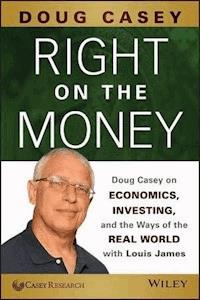
Your favorite financial contrarian spreads the wealth in interviews on forty separate topics Investment guru Doug Casey made headlines with the financial approach he advocated in Totally Incorrect. Casey believes that the best returns come from going against the grain, and taking a closer look at what everyone else is leaving behind. This rational approach to speculation struck a chord with the investing public, inspiring the follow-up book Right on the Money: Doug Casey on Economics, Investing, and the Ways of the Real World with Louis James. In Right on the Money, Casey expands upon the basic ideas presented in Totally Incorrect, and translates them into actionable steps to take today to ensure a secure financial future. In a series of forty interviews, Casey presents his views on various topics, including investments, assets, real estate, and ethics. With his usual candor, he advocates for immediate action and lays down the path from idea to investment. Regardless of your position on each topic, you'll be forced to consider a perspective you've never before considered on topics such as: * Protecting your assets with educated speculation * The pros and cons of gold, cattle, and real estate * Ethics of investing and the morality of money * The impact of the EU, Africa, Egypt, and North Korea No matter what topic he focuses on, Casey's primary message is always clear: act now. Stop paralysis by analysis and take the leap. You only get one financial future, and it's up to you to make it as secure and comfortable as possible. In Right on the Money: Doug Casey on Economics, Investing, and the Ways of the Real World with Louis James, Casey presents the case for investing against the grain, and reaping the rewards others have passed over.
Sie lesen das E-Book in den Legimi-Apps auf:
Seitenzahl: 639
Veröffentlichungsjahr: 2013
Ähnliche



















Contents
Preface
Acknowledgments
Part One: An Economy in Trouble
Chapter 1: Doug Casey on Bernanke: Be Afraid, Be Very Afraid (Part One)
Chapter 2: Doug Casey on Bernanke: Be Afraid, Be Very Afraid (Part Two)
Chapter 3: Doug Casey on the Collapse of the Euro and the EU
Chapter 4: Doug Casey on Labor Unions
Chapter 5: Doug Casey on the Tightening Noose
Part Two: The Art of Investing
Chapter 6: Doug Casey on the Education of a Speculator (Part One)
Chapter 7: Doug Casey on the Education of a Speculator (Part Two)
Chapter 8: Doug Casey on Winning Speculations
Chapter 9: Doug Casey on the Biggest Danger to Your Wealth
Chapter 10: Doug Casey on Protecting Your Assets
Chapter 11: Doug Casey on Gold
Chapter 12: Doug Casey on Nuts and Bolts: Handling Bullion
Chapter 13: Doug Casey on Buying Physical Gold and Silver
Chapter 14: Doug Casey on Gold Stocks
Chapter 15: Doug Casey on Protecting Your Cash
Chapter 16: Doug Casey on Cattle
Chapter 17: Doug Casey on Real Estate
Chapter 18: Doug Casey on Africa
Part Three: A Moral Minority
Chapter 19: Doug Casey on Ethics (Part One)
Chapter 20: Doug Casey on Ethics (Part Two)
Chapter 21: Doug Casey on Ethics: The Ethical Investor (Part Three)
Chapter 22: Doug Casey on the Morality of Money
Chapter 23: Doug Casey: Bah! Humbug!
Chapter 24: Doug Casey on Art (Part One)
Chapter 25: Doug Casey on Art (Part Two)
Chapter 26: Doug Casey on Second Passports
Chapter 27: Doug Casey on Fresh Starts
Chapter 28: Doug Casey on Getting Out of Dodge
Part Four: You and Me and the Other 8 Billion
Chapter 29: Doug Casey on the Royal Wedding
Chapter 30: Doug Casey on Gay Marriage
Chapter 31: Doug Casey on Self-Immolation—Individual and National
Chapter 32: Doug Casey on Cashless Societies
Part Five: Wrestling for Countries
Chapter 33: Doug Casey on the U.S. Constitution
Chapter 34: Doug Casey on Immigration
Chapter 35: Doug Casey: War Is Coming
Chapter 36: Doug Casey on Revolution in Egypt and Beyond
Chapter 37: Doug Casey: Something Wicked This Way Comes
Chapter 38: Doug Casey on North Korea’s New Kim
Chapter 39: Doug Casey on Obama’s War and Your Survival
Chapter 40: Doug Casey on the Fourth of July
Afterword
About the Authors
Index
Other Books by Doug Casey
Cover Design: Wiley
Cover Image: Casey Research
Copyright © 2014 by Doug Casey. All rights reserved.
Published by John Wiley & Sons, Inc., Hoboken, New Jersey.
Published simultaneously in Canada.
No part of this publication may be reproduced, stored in a retrieval system, or transmitted in any form or by any means, electronic, mechanical, photocopying, recording, scanning, or otherwise, except as permitted under Section 107 or 108 of the 1976 United States Copyright Act, without either the prior written permission of the Publisher, or authorization through payment of the appropriate per-copy fee to the Copyright Clearance Center, Inc., 222 Rosewood Drive, Danvers, MA 01923, (978) 750-8400, fax (978) 646-8600, or on the Web at www.copyright.com. Requests to the Publisher for permission should be addressed to the Permissions Department, John Wiley & Sons, Inc., 111 River Street, Hoboken, NJ 07030, (201) 748-6011, fax (201) 748-6008, or online at http://www.wiley.com/go/permissions.
Limit of Liability/Disclaimer of Warranty: While the publisher and author have used their best efforts in preparing this book, they make no representations or warranties with respect to the accuracy or completeness of the contents of this book and specifically disclaim any implied warranties of merchantability or fitness for a particular purpose. No warranty may be created or extended by sales representatives or written sales materials. The advice and strategies contained herein may not be suitable for your situation. You should consult with a professional where appropriate. Neither the publisher nor author shall be liable for any loss of profit or any other commercial damages, including but not limited to special, incidental, consequential, or other damages.
For general information on our other products and services or for technical support, please contact our Customer Care Department within the United States at (800) 762-2974, outside the United States at (317) 572-3993 or fax (317) 572-4002.
Wiley publishes in a variety of print and electronic formats and by print-on-demand. Some material included with standard print versions of this book may not be included in e-books or in print-on-demand. If this book refers to media such as a CD or DVD that is not included in the version you purchased, you may download this material at http://booksupport.wiley.com. For more information about Wiley products, visit www.wiley.com.
ISBN 978-1-118-85622-2 (Paperback)
ISBN 978-1-118-85620-8 (ePDF)
ISBN 978-1-118-85618-5 (ePub)
Preface
Dear Reader:
This book may look like a sequel, or perhaps a punch line, but it’s much, much more than that. What you hold in your hands is a set of keys to a potential fortune available to contrarians who are brave enough to use them during a time of unprecedented chaos and volatility gripping our world. These key concepts, set out and elaborated in these pages, will enable you to turn Doug Casey’s essential philosophical (if unabashedly irreverent) views of economics, politics, and life itself into actionable investment ideas. This book is nothing less than a speculator’s guide to profiting from the Greater Depression.
Many readers have commented on how brash, amusing, and refreshing Totally Incorrect is. That’s great; Doug and I are pleased to have gotten so many people thinking about important things. But in Right on the Money, we want to show readers the path from basic ideas to actionable steps that can make a huge difference in one’s finances, and life itself. This is the “so what” to our last book.
We hope readers will take it seriously and act upon what Doug says in these pages, because it could make all the difference in the shape of those lives in the years ahead.
The following conversations were originally published online and were peppered with hyperlinks to additional material we believed readers would want to read. In this print edition of Right on the Money, we’ve retained the hyperlinks in ghost fashion. Don’t try clicking on your book; it won’t work. But you can follow any link that interests you by visiting www.rightonthemoneybook.com. There you’ll find all the online links that the book refers to, laid out conversation by conversation, in the same order as they appear in the book.
Sincerely,
Terry Coxon
Acknowledgments
There are always more people to thank at the birth of a new book than can be named, so let me start with a blanket thank you to everyone who contributed.
Special thanks go to my wife, Ancha Casey, for suggesting, guiding, correcting, prodding, and motivating me on these conversations, throughout the years of their creation. My partners, David Galland and Olivier Garret, also deserve special thanks for their work and support making it happen.
Terry Coxon, economist and editor extraordinaire—also former editor of Harry Browne, whose books contributed so much to my development as a person and as an investor—I thank profusely for jumping on this project and getting it done so quickly and completely. The production staff at Casey Research deserves great thanks as well, for all their work proofing, tweaking, posting, fixing, etc., these conversations over the years.
Finally, I’m not sure how to thank my friend and brother in arms, Lobo Tiggre (Louis James), whose uncanny ability to almost read my mind made these conversations what they are. It is he, the indefatigable “L,” who saddles up with me every week for our intellectual excursions and makes sure they get published on time for our readers.
I do hope you enjoy reading about the ideas as much as we enjoyed conversing about them.
Sincerely,
DRC
PART ONE
AN ECONOMY IN TROUBLE
Chapter 1
Doug Casey on Bernanke: Be Afraid, Be Very Afraid (Part One)
December 8, 2010
Louis: Thanks for the link to the “historic” Ben Bernanke interviewa. It was breathtaking to hear the man who didn’t see the crash of 2008 coming say he’s “100 percent confident” he can control the U.S. economy. What do you make of that—is it hubris or stupidity?
Doug: As 60 Minutes pointed out, it’s rare for a Fed chairman to give an interview; this was only Bernanke’s second—here’s a link to his first. It’s such an unusual thing that I think it’s a sign that the Powers That Be are really quite worried. As they should be. His last interview was at the height of the crisis in early 2009.
L: Bernanke himself looked worried. I was amazed, actually, watching the interview, by just how nervous and stressed he appeared. He stuttered, his lip quivered continuously, and that pulsing vein on his forehead really stood out throughout the interview. He looked like he was flat-out lying and doubted anyone would believe him, but had no choice but to keep lying. It was almost like a cartoon of a liar caught red-handed. It’s a shocker that the Powers That Be would let such an interview be aired—it would seem to be the opposite of reassuring, to me.
D: I know. It’d be nice to run that interview through a voice stress analyzer and see what it says. It’s a question of whether he’s a knave or a fool—neither answer is bullish for the U.S. economy. He’d be wonderful to play poker against.
L: Well, that was the reason given for the interview. He says the critics of his latest $600 billion shot in the economy’s arm don’t understand how serious things are, how dangerous the high unemployment rate is.
D: Yes, of course he’d say that. You know my argument is that “doing something” is a mistake, if it’s based on incorrect economics. Everything they are doing is not just the wrong thing, it’s the opposite of the right thing.
L: So, do you believe Bernanke was actually lying? Or was he just highly stressed, because he’s the one in the hot seat, and he knows that just because the Titanic didn’t sink the moment it hit the iceberg, that doesn’t mean it’s out of danger?
D: Perhaps it’s a bit like Hitler in the bunker, who was under great stress, and really wasn’t lying when he insisted that the Third Reich could still win the war. In fact, I can’t wait to see if someone does one of those “Hitler in the bunker” spoofs, based on this interview.
L: I wouldn’t be surprised to see one posted on YouTube tomorrow. Meantime, Jon Stewart skewers Bernanke admirably in a recent skit on his show.
D: Actually, someone just did one of those “Hitler in the bunker” spoofs on manipulation of the silver market—which, incidentally, I don’t believe is a reality. But it mentions our redoubt at La Estancia de Cafayate. There’s a lot of very rich and colorful language, which some people won’t like, but it’s very funny.
L: Warning to readers: That video is not family-friendly. So, lying aside, let’s look at some of the things he said. The first and foremost thing that jumps out at me is that he says the Fed is “not printing money” and that the Fed’s actions have no significant impact on money supply. How can he imagine they can inject liquidity into the economy, and that it won’t have any impact on money supply?
D: I think he knows better than that. Look, what the Fed has been doing is buying securities. And the way they do that is to credit the account of the seller with dollars. So, of course it creates money. That’s why they call it “quantitative easing”—because they’re increasing the number of Federal Reserve units in circulation. I really love that term, QE, because it’s so cynically dishonest, like the whole monetary system itself. And it’s amazing that nobody even challenges it. They just accept it instead of calling it what it is—printing money. It’s Orwellian.
L: Agreed. In spite of what Bernanke says, whatever the sellers of the securities do with the new dollars deposited to their accounts—even if they leave them on deposit with the Fed because the Fed is now paying interest for excess reserves—it still frees up other money the sellers can now use for other purposes. And because of the fractional reserve system, there’s a multiplier effect on the added liquidity. Bernanke says that all he’s doing is keeping interest rates down to stimulate the economy, but the way he’s doing it adds to the money supply.
D: Exactly. We’re beyond the time when you have to cut down trees to print up hundred dollar bills. It’s just a keystroke, now. But playing with the amount of currency doesn’t create new wealth—it actually makes real wealth creation much harder.
L: Scary. Does it mean anything for Bernanke to say that the $600 billion came from the Fed’s “own reserves”? Where would the Fed’s reserves come from, if not from electronic dollars newly created at the stroke of a computer key?
D: No. That’s a cynical lie. I think what he was trying to stress was that the money was not coming directly from taxes. The Federal Reserve is a misnomer. There is no reserve, as there was in the days when the gold at Fort Knox backed the dollar. Now, the dollar isn’t backed by anything, so there’s nothing to reserve—they can and do create as many dollars as they want, as ledger entries, which they can and do use to pay banks and others, who can and do use them to pay others, and so forth.
L: Deluge indeed. You can see the out of control growth of what they are doing in any M2 money supply chart.
Ancha Casey [Doug’s wife]: Mfmmmf mmmfmf.
L: Hi Ancha—I didn’t catch that.
Ancha [Leaning closer to Doug’s mic]: Hi Lobo. That growth of money supply erodes purchasing power. One peso here in Argentina today is worth one trillionth—literally—of its value at the beginning of the twentieth century.
D: Yes. It really amounts to an indirect form of taxation: As more dollars are created, they dilute the purchasing power of the dollars already in existence—though we call it inflation. The first organizations and people to get those dollars are able to spend them at their old value. And, of course, the government—which is not the country or the people, but a group with its own identity and interests—gets to spend as many as it wants on what it wants. And now the numbers are moving into the trillions. Obama may soon have to ask his science advisor what comes after “trillion.” It’s all a charade.
L: Inflation is taxation through dilution. But most modern economists don’t think inflation is the result of excess at the printing press, so whether Bernanke is lying, or just doesn’t see the danger of what he’s doing, it doesn’t look good.
D: That’s right. Most economists blame inflation on the butcher, the baker, or the candlestick maker raising their prices for other reasons than the loss of purchasing power of the currency. They attribute inflation to “greed” on the part of producers and workers.
L: Maybe we could buy one of the thousands of mirrors in Mugabe’s house in Zimbabwe and send it to Bernanke, as a gift. To look at himself, and perhaps see where the problem lies.
D: It won’t help. The fundamental problem we have is an unsound money system, and no amount of fiddling with it will make it work well over any extended period of time. All fiat currencies follow one of two paths. One is when they keep printing more money to keep the ball rolling, which is what Bernanke’s doing. Or they stop printing money, in which case banks go bust, insurance companies go bust, and all sorts of corporations go bust, throwing the economy into a catastrophic deflation. The latter is the better alternative, sad to say.
L: Bernanke did specifically say in his interview that the Fed had to take action because there was a serious threat of deflation, which was the problem with the Great Depression.
D: Bernanke is afraid of deflation, because at this late stage, it would be extremely dramatic and immediate. In a free-market economy, neither monetary inflation or deflation are realistic problems, because gold is used as money, and the supply typically rises by only a small amount every year—and it almost never declines. But deflation is actually a good thing. Deflation may cause some wealth to change ownership, as any change can, but deflation does not destroy wealth, as inflation does. And deflation can be a very good thing because when dollars are worth more over time, it encourages people to save—and one of our big problems is that nobody’s saving. People don’t save because today’s artificially low interest rates are beneath the actual inflation rate, so of course nobody wants to save. But the only way to become wealthy is to produce more than you consume and save the difference. Banks can’t make loans unless, first, there are savings. This makes deflation’s reward to savers a very important positive.
L: Bernanke says that falling prices would lead to lower wages, which would send the whole economy into decline.
D: That’s an old fallacy. If all prices fall, including the price of labor, so does the cost of living, and no one is worse off. The price of labor would have to fall faster than the price of food, rent, et cetera for people to be hurt, and it does not follow automatically that this would be the case. If the butcher doesn’t have to spend so much for bread, maybe he doesn’t have to charge the baker so much, and both might be able to put aside a little more to save up for new goods from the candlestick maker, or to invest, or to create new businesses, and hire more people, which could actually drive wages up.
L: Wages may be influenced by inflation or deflation, but are not really set by them. What determines wages is productivity; how much value does the laborer create, and what can he or she trade for that value?
D: Exactly. And you get increases in productivity from capital creation, which arises from saving and investment. What this all boils down to is that you can’t create wealth by printing money. That just debases wealth and distorts the economy.
L: Seems hard to believe Bernanke can’t understand such a simple thing.
D: Well, the whole system is so precarious at this point that it may be quite accurate to label the Fed’s actions as “panic.” [Bernanke] said several times in the interview that he had to act—“aggressively” and “proactively”—to save the system. But you can’t save a system that’s built on quicksand—a fiat currency. The whole thing ought to be flushed away, along with the whole crazy-quilt work of Keynsian economics that most students are educated in. It’s strange. It took the catastrophic collapse of the USSR and other socialist states to prove to all but the most dogmatic ideologues that Marxism was a sociopathic scam. It may take the collapse of the United States and the Western world to put the lie to Keynes. If so, then the sooner the better.
L: A lot of people would go down with that ship.
D: Yes. The whole business of the United States, its “consumer economy,” has really become banking and finance. Everyone is buying and selling and trading electronic ghosts in between institutions, derivatives piled on derivatives, all magnified by the fractional reserve system. Or they provide services to those who do, paid for with meaningless accounting fictions that go back to the banks to pay for maxed-out credit cards. Nobody’s thinking of actually producing things of value. The whole thing is a completely ridiculous house of financial cards.
L: So you’re not buying Bernanke’s line that they are simply lowering interest rates to stimulate economic growth?
D: No. Aside from the fact that paying for this stimulation increases the money supply, stimulating growth through artificially low interest rates is the opposite of what they should be doing. It encourages debt and spending—living beyond your means, which is what the whole country has been doing for decades. They shouldn’t be in a position to do anything—the Fed should be abolished. But, if anything, they should be raising interest rates to encourage savings. That’s how wealth is accumulated, and wealth is what’s needed to invest in new businesses and technologies, not to mention keeping yourself alive.
L: And unfortunately, in lowering rates to stimulate the economy, Bernanke is simply following the recipes of mainstream economists, so there seems to be little chance that he or anyone in power will realize the disastrous course they are on.
D: The chances are Slim and None, and Slim’s out of town. The trouble with mainstream economics, the way it’s taught in most colleges today, is that it’s like sociology, or English literature, or gender studies: It’s based on theoretical castles built in the air—no reality whatsoever. And [this is] of negative value in the real world. But, fortunately, the education system we suffer with today will also likely be washed away in the deluge.
L: That reminds me of the part of the interview in which Bernanke was asked if the Fed would be able to rein inflation in, should it appear. It was one of two questions he jumped on without hesitation, saying that inflation was not a problem. He could raise interest rates in 15 minutes, if necessary, and that would quash inflation. Made me wonder what planet he was living on, to imagine that after he’s gone down the path of Mugabe, simply raising interest rates would restore purchasing power to the dollar. Even in recent memory in the United States, we’ve had high inflation and high interest rates—we call it stagflation. How could he not know this?
D: It just goes to show what a bad economist Bernanke is. The whole science of economics is not about seeing the immediate, direct, and obvious effects of any given economic policy—a smart six-year-old can do that. It’s about seeing the indirect, hidden, and long-term effects of that policy. If the Fed goes into the bond market and buys a trillion dollars’ worth of bonds, the short-term and fairly straightforward effect will be for bond prices to go up and interest rates to go down. But the indirect and delayed effects from the creation of a trillion more currency units are inflationary, and eventually it will force even the interest rates back up again, because people won’t lend unless they can charge a rate that will more than make up for the lost purchasing power of the inflated currency.
L: The seen and the unseen. Is it possible that Professor Bernanke has never read Bastiat?
D: [Laughs] Don’t make me laugh. That’s old-fashioned stuff, Lobo. The Great Depression disproved classical economics, don’t you know? Now we have new economics—all built on quicksand, as I say, and that means the whole house of cards is doomed.
a The following conversations were originally published online and were peppered with hyperlinks to additional material we believed readers would want to reach. In this print edition of Right on the Money, we’ve retained the hyperlinks in ghost fashion. You can follow any link that interests you by visiting www.rightonthemoneybook.com. There you’ll find all the online links that the book refers to, laid out conversation by conversation, just as they appear in the book.
Chapter 2
Doug Casey on Bernanke: Be Afraid, Be Very Afraid (Part Two)
December 15, 2010
Louis: Quicksand, if not lies. That Jon Stewart link I provided last time shows that Bernanke himself called quantitative easing “printing money” in his previous 60 Minutes interview, even though he denied the very same thing in this new one. Throughout the whole interview, aside from the quivering lip and the quavering voice, he seemed to be speaking out of both sides of his mouth, in terms of content. On one hand, he repeatedly sounded his warning that the economy is not out of the woods, and that’s why printing more money was necessary; but on the other, he said the risk of a double-dip recession was very low.
Doug: I find it amazing that anyone pays any attention at all to what the man says. Except for a brief time waiting tables in school, he has zero experience in the real world. His whole life has been reading abstruse books written by people like himself, and doing complicated math formulas that are supposed to describe economic phenomena, but have absolutely nothing to do with the study of human action. He’s a character who should appear in Alice in Wonderland, or Through the Looking Glass.
L: He actually said they couldn’t get much weaker!
D: He’s either a knave or a fool—possibly both. But the odds are he’s just an educated fool, an archetypical, clinical example of one. Either way, it’s bad news for the U.S. and global economies. Of course, there’s really nothing that anyone could do, at this point, to avoid a huge amount of economic, political, and social turmoil. There are only two choices for a central bank: One is to keep printing money, and hope that magic happens; two is stop printing money, and let the existing structure collapse. Neither is a pleasant prospect, and there’s no third alternative, in my view. It might have been possible to negotiate a relatively soft landing some years ago, but I believe that time has passed.
L: Spending money they don’t have.
D: Right. I keep coming back to basics: to accumulate wealth, you have to produce more than you consume and save the difference. In time, that savings can be invested in new ventures and new technologies that create prosperity. You simply cannot spend and consume your way into prosperity, either as an individual or as a society. Worse, all the debt in the world is an indication that many people are, in effect, living out of future production. This is why I keep saying that what they are doing is not only the wrong thing, but the exact opposite of the right thing. I’m not just being rhetorical—it’s the literal truth. Real, sustainable economic recovery and growth depend on abandoning the old, uneconomic patterns of production and consumption that punish saving.
L: Brings to mind the strongly negative association most people have to the words “I’m from the government, and I’m here to help.” And yet people seem willing to let the government do just about anything, from printing massive amounts of money to trampling the Constitution in the name of the War on Terror. How can people be so foolish as to trust an institution they know is untrustworthy?
D: Just goes to show how degraded society has become. This is a primary reason why I believe things must and will get worse before they get better. The average person in the United States doesn’t much believe in the virtue of productive work, or saving. Instead, they believe they have a natural right to spend and consume with virtually no limit. Americans have come to believe they should maintain a higher standard of living than the rest of the world. They don’t understand that the world is full of people willing to work harder and longer, doing equivalent work or better, for less pay. Things have changed. The old model is broken, and things are not going back to the status quo ante, no matter how hard they try to “stimulate” economic activity by printing up money.
L: “All the king’s horses and all the king’s men couldn’t put Humpty Dumpty back together again.”
D: No. But, frankly, Humpty had it coming. An egg had no business trying to balance on top of a wall. Anyone living in what is now called a first-world economy should be afraid—very afraid.
L: Hm. Well, does Bernanke get any brownie points for saying that the United States is going to have to tackle its budget deficit? He said that in 15 to 20 years, almost all of the government’s budget would be taken up just by Medicare, Medicaid, Social Security, and interest on the national debt, leaving none for even the military.
D: No, no credit at all, unless you get points for mouthing idiotic platitudes. He said that while reining in spending is important, it should not be done now. He said the United States should not take any actions that would cut spending this year, and slow the so-called recovery. This is exactly how you set your feet on the path to Zimbabwe. Good theoretical intentions for some indefinite but faraway future.
L: What about Bernanke’s call to simplify the tax code and lower tax rates? That sounds like a push in the right direction.
D: Sure. But it’s way too little, too late. Cutting taxes is always good for any economy, and so is minimizing red tape, with the U.S. tax code being among the worst masses of red tape in existence. But the kind of seismic shifts needed—like eliminating capital gains taxes entirely, and income taxes as well—are not politically viable. It does no good to make marginal improvements to a system that is fundamentally flawed and broken. Bernanke is proposing a band-aid where amputation is needed.
L: How do you know Bernanke doesn’t mean really deep tax cuts?
D: He’s not a closet anarcho-capitalist secretly out to reform the entire system. He’s a mainstream academic economist, and a bureaucrat who believes he can fiddle with the economy and control it. Remember what he said about being able to stop inflation, simply by raising interest rates, in 15 minutes? And remember his evasive answer to the question about how the Fed missed the impending crisis? He said that “large parts of the financial system were not adequately covered by the regulatory oversight.”
L: He specifically cites AIG and Lehman Brothers as being examples of financial institutions that were essentially unregulated. That’s total nonsense, of course; they may not have been regulated by the Fed, but they sure as heck were regulated by other federal agencies. And it’s a misdirection. The Fed’s theoretical responsibility is the economy, not individual banks and insurance companies that might be taking excessive risks. To say that he and his colleagues at the Fed didn’t see the crisis coming because of lack of regulation shows a complete lack of understanding of what their task is. Besides, any observer with any sense could see what was happening then. We certainly did.
D: He may just have a complete lack of honesty. And absolutely a complete lack of understanding of economics, finance, history, and monetary theory—a shameful but perhaps predictable state for someone who’s lived his whole life in an ivory tower. The man has been wrong about everything he’s ever said about the U.S. economy.
L: Another sign of his worldview being a problem was his answer to the question about the “income gap” between the rich and the poor in the United States being a product of education. He cited as evidence in support of this idea that unemployment for college grads is half that of high school grads.
D: Of course, as a professor, he’d see it that way. And that was true 50 years ago, maybe even 25 years ago. But he’s out of touch. Even if it were true today, it has nothing to do with the fact that college grads have stupidly misallocated four years and $200,000 having their heads filled with politically correct nostrums, getting worthless degrees in stuff like English, psychology, sociology, art history, education, and gender studies. But education is not the problem. The great income disparity between Mugabe and his cronies and poor Zimbabweans isn’t due to the superior education of the Zimbabwe rich. American history is full of examples of people with little education making it big. What’s needed is an entrepreneurial spirit and the freedom to pursue it, not a college degree. (For more on this, readers should see our conversation on education.)
L: We’ve talked before about diversifying to protect your assets, diversifying to minimize political risk, where you think it’s best to do so, and how to invest during the crisis. I’d guess that as far as protecting your assets goes, especially with currency controls already ramping up, you’d say that’s gone beyond urgent. If any readers have not taken action yet, they need to do so immediately. What about physical security? I can imagine angry mobs on Main Street at some point, but probably not tomorrow. How much time do you think we have to set up alternative residency in safer jurisdictions?
D: A society can fall from grace with amazing speed. Yugoslavia was a relatively rich European country that went from peace to chaos and violence in a matter of weeks. I suppose that in terms of actual social disorder, there will be increasingly obvious signs, and even in the event of a breakdown in social order, some days of transition. But at that point, it’s too late to set anything up—if the borders are even still open.
L: And the way various U.S. authorities have taken the term “lockdown” from prison use and applied it to airports and even schools, it’s not hard to imagine the entire country being put on lockdown for the duration.
D: Indeed. It’s high time to set up residences in places where you’d like to weather the storm, and see to the legalities of extended stays.
L: What about those who can’t leave, because of family members who refuse to move, or because they have jobs they can’t work from afar?
D: Better start educating those family members and looking for work not tied to a specific office or place. If you’re really stuck, at least getting out of the big cities and setting up base in a rural community, even if it means long commutes, is probably a good idea.
L: Pretty grim, Doug.
D: That’s the way I see it. I don’t make the rules, I just play the game. But just because it’s going to be tough for most people doesn’t mean it has to be tough for you. Most of the real wealth in the world is still going to be here; it’s just going to change ownership. And since there are more scientists and engineers alive now than have ever lived before in all of history, new wealth will continue to be created. There’s plenty of cause for optimism, long term.
L: What about an investment update: What’s your guru sense telling you today?
D: Nothing new to regular readers, but I am feeling that the mania phase of the current bull market for precious metals is coming closer. Gold is not cheap, compared to 10 years ago, but it’s definitely the one asset most certain to retain value throughout the unfolding crisis. Putting a significant amount of your savings or net worth into gold is no speculation at this stage, but positively the safest thing you can do with your money. It’s what I’m doing.
L: Well, I’m not going to argue with that, but I’d add silver to the mix. Anything else?
D: Agriculture, in certain areas, is good. Energy, in certain areas, is good. Betting on rising interest rates is as close to a sure thing as I can see in mainstream investments today. But the main thing is to take seriously our calls to diversify political risk. The crisis is not over; we’re just in the eye of the storm. It is going to get worse, and those caught unprepared are really going to regret it.
L: And if people do buy gold, speculate in great stocks, set up second residences in Argentina, Panama, or wherever . . . that won’t hurt them if the old world order does not come to an end, as you’re predicting. Those investments and allocations can always be unwound. Better to prepare for the worst and hope for the best.
D: Just so.
L: Thanks, Doug. ’Til next time.
D: My pleasure. We’ll talk soon; the passing parade is getting more interesting, day by day.
Chapter 3
Doug Casey on the Collapse of the Euro and the EU
January 25, 2012
Louis: So Doug, a lot of readers are concerned about what’s going on in Europe. Is this the beginning of the proverbial “it”? Or can the Eurozone be saved?
Doug: In brief, the answers are “yes,” then “no,” and a “good riddance” to both the Eurozone and the euro. But most people think the old order should be maintained at almost any cost. That would include George Soros, who recently penned an article called “”
Lesen Sie weiter in der vollständigen Ausgabe!
Lesen Sie weiter in der vollständigen Ausgabe!
Lesen Sie weiter in der vollständigen Ausgabe!
Lesen Sie weiter in der vollständigen Ausgabe!
Lesen Sie weiter in der vollständigen Ausgabe!
Lesen Sie weiter in der vollständigen Ausgabe!
Lesen Sie weiter in der vollständigen Ausgabe!
Lesen Sie weiter in der vollständigen Ausgabe!
Lesen Sie weiter in der vollständigen Ausgabe!
Lesen Sie weiter in der vollständigen Ausgabe!
Lesen Sie weiter in der vollständigen Ausgabe!
Lesen Sie weiter in der vollständigen Ausgabe!
Lesen Sie weiter in der vollständigen Ausgabe!
Lesen Sie weiter in der vollständigen Ausgabe!
Lesen Sie weiter in der vollständigen Ausgabe!
Lesen Sie weiter in der vollständigen Ausgabe!
Lesen Sie weiter in der vollständigen Ausgabe!
Lesen Sie weiter in der vollständigen Ausgabe!
Lesen Sie weiter in der vollständigen Ausgabe!
Lesen Sie weiter in der vollständigen Ausgabe!
Lesen Sie weiter in der vollständigen Ausgabe!
Lesen Sie weiter in der vollständigen Ausgabe!
Lesen Sie weiter in der vollständigen Ausgabe!
Lesen Sie weiter in der vollständigen Ausgabe!
Lesen Sie weiter in der vollständigen Ausgabe!
Lesen Sie weiter in der vollständigen Ausgabe!
Lesen Sie weiter in der vollständigen Ausgabe!
Lesen Sie weiter in der vollständigen Ausgabe!
Lesen Sie weiter in der vollständigen Ausgabe!
Lesen Sie weiter in der vollständigen Ausgabe!
Lesen Sie weiter in der vollständigen Ausgabe!
Lesen Sie weiter in der vollständigen Ausgabe!
Lesen Sie weiter in der vollständigen Ausgabe!
Lesen Sie weiter in der vollständigen Ausgabe!
Lesen Sie weiter in der vollständigen Ausgabe!
Lesen Sie weiter in der vollständigen Ausgabe!
Lesen Sie weiter in der vollständigen Ausgabe!
Lesen Sie weiter in der vollständigen Ausgabe!
Lesen Sie weiter in der vollständigen Ausgabe!
Lesen Sie weiter in der vollständigen Ausgabe!
Lesen Sie weiter in der vollständigen Ausgabe!
Lesen Sie weiter in der vollständigen Ausgabe!
Lesen Sie weiter in der vollständigen Ausgabe!
Lesen Sie weiter in der vollständigen Ausgabe!




