


Erhalten Sie Zugang zu diesem und mehr als 300000 Büchern ab EUR 5,99 monatlich.
- Herausgeber: Notting Hill Editions
- Kategorie: Geisteswissenschaft
- Sprache: Englisch
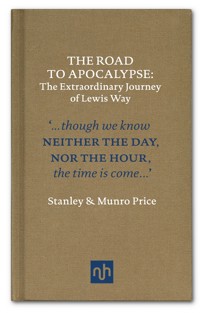
In the winter of 1811, Lewis Way had an epiphany on the road to Exmouth. From that moment the eccentric millionaire devoted himself to one goal: the return of the Jews to the Holy Land. This essay uncovers a forgotten life story, and reveals the strange roots of the American Christian Right's current support for the state of Israel.
Sie lesen das E-Book in den Legimi-Apps auf:
Seitenzahl: 164
Veröffentlichungsjahr: 2016
Das E-Book (TTS) können Sie hören im Abo „Legimi Premium” in Legimi-Apps auf:
Ähnliche



















Stanley Price was born in London, educated there and in Dublin, and read History at Caius College, Cambridge. He has been a journalist in New York and London, and has written four novels. For the past forty years he has written mainly for the stage and television. Four of his plays have been produced in the West End and are performed internationally. His television films have won numerous awards in Europe and the US. His last book, in 2004, was the memoir Somewhere to Hang My Hat.
Munro Price was born and educated in London and read History at Caius College, Cambridge. He is currently Professor of Modern European History at Bradford University. He specialises in eighteenth- and nineteenth-century French history, particularly the French Revolution. He has written several books on the period, including most recently The Perilous Crown: France Between Revolutions, 1814–1848 (2007) and The Fall of the French Monarchy (2002), which won the Franco-British Society’s Literary Prize.
Stanley and Munro Price
—
THE ROAD TO APOCALYPSE
—
The Extraordinary Journey of Lewis Way
To Judy – referee
– Acknowledgements –
We would like to thank Lieutenant-Colonel Jeremy Metcalfe, OBE, for his kind help and cooperation in giving us access to the papers and pictures of his forebear Lewis Way. Mrs Mary David and Anne David were also most helpful in letting us see Lewis Way’s Tracts and the story books and drawings of the Way children on their Grand Tour. We very much appreciated the help and cooperation of Dr C. M. Woolgar, Head of Special Collections at the Hartley Library at University of Southampton, Julia Walworth, Fellow Librarian of Merton College, Oxford, Sue Stafford of the Gloucester Genealogical Society, Roger Bettridge, Buckinghamshire County Archivist, our fine editor Lucasta Miller, and Simon Cox and his camera.
For Zion’s sake,
I will not rest.
I will not hold my peace,
Until Jerusalem be blessed
And Judah dwell at ease.
Hymn written by Lewis Way
(after Isaiah LXII)
Lewis Way painted by James Leakey on the eve of his journey to Russia, 1817
Contents
– Introduction –
For more than sixty years, Israel and its conflicts with its neighbours have formed one of the world’s most intractable problems. When the state was founded in 1948, the aim of the Zionist movement was fulfilled. A homeland for the Jewish people had finally been secured, but it was never to ‘dwell at ease’. Since its inception the state has either been at war with its Arab neighbours or defending itself against terrorist groups or freedom fighters, a description dependent on what side you take. The ideals of Zionism have become contentious even in Israel itself, not just between Arab and Jew, but between Right and Left, secular and religious, conflicts which are reflected in the Diaspora, which has 8.3 million Jews to Israel’s 5 million.
Yet the original ideology of Zionism, with its call for an independent Jewish state in Palestine, was simple and straightforward. It was a late-nineteenth-century nationalist movement, made urgent by outbreaks of resurgent anti-Semitism across Europe. The pogroms and persecutions in the 1880s in Russia led to a huge wave of Jewish emigration westward, mostly to America. But the dramatic moment of Zionism’s birth was in Paris on 18 January 1895. Theodor Herzl, a Viennese journalist and playwright, was pressed against the railings of the Ecole Militaire listening to the anti-Semitic shouts of the crowd as they watched Alfred Dreyfus, a Jewish officer in the French army, being publicly humiliated after a false accusation of treason. Dreyfus was to spend four years on Devil’s Island before being re-tried and eventually exonerated. In that time Herzl had written Der Judenstaat, gained international attention for the idea of a Jewish state in Palestine and held the first Zionist Congress in Basel. Herzl then proceeded personally to plead the Zionist cause with world leaders, the Czar, the Kaiser and the Sultan. He received offers of land for the Jewish people from the Sultan – Mesopotamia (if they paid off the Turkish National Debt); and from the British Colonial Secretary – El Arish in Egypt; the offer was later changed to Uganda. Herzl and the Zionists refused anything but Palestine. Exhausted by his work, Herzl died at the age of forty-four and was accorded virtually a state funeral in Vienna.
With the idea of a Jewish homeland at least established, the progress of political Zionism continued. As Herzl had realised, this could only be achieved with the backing of a great power. In the closing years of World War I, it was the British who became the inheritors of this historic burden. Chaim Weizmann, Herzl’s successor, had gained the ear of Arthur Balfour, the British foreign minister, and persuaded him of the righteousness of the Zionist cause. In his turn Balfour persuaded the prime minister, Lloyd George, and in November 1917 the British government issued the Balfour Declaration which gave its slightly ambiguous promise of ‘the establishment in Palestine of a national home for the Jewish people’. In 1918, at the head of a British army which had defeated the Turks, General Allenby marched into Jerusalem. In the wake of the war, the Ottoman empire was finally divided up and Britain given the Mandate for Palestine. It was to take another thirty years, another World War and a Holocaust for a ‘national home’ to become an independent state.
If the backing of one great power in the form of Britain was essential to the establishment of the Jewish homeland, the support of another, the United States, has remained crucial to its survival ever since. After thirty stormy years of administering the Mandate, the British were more than happy to get rid of it. America then became the protector of the new State of Israel for a variety of reasons – humanitarian sympathy for the Jews after the Holocaust, support for a strategically placed ally during the Cold War, and most recently the dictates of the War on Terror. Yet alongside these diplomatic and military motivations stood an important religious factor – not Jewish, but Christian Zionism.
Christian Zionism has been a core belief of millions of Americans since the late nineteenth century. Its political influence, however, dates from the late 1970s, when the television evangelist the Rev. Jerry Falwell founded the conservative Christian campaigning organisation, the Moral Majority.1 While its main purpose was domestic – to combat liberalism and permissiveness within America itself – the Moral Majority was also passionately Zionist, supporting the Israeli right wing’s claim to a Greater Israel within its biblical boundaries. The roots of this conviction, central to the Moral Majority and to its successor organisations, lie in a particular interpretation of the Bible. In the Old Testament there are references to the Chosen People being returned to the Holy Land and the coming of the Messiah, but in the New Testament it is the Book of Revelation that forms the basis of Christian Zionist belief. This contains the prophecy that the Millennium and the Second Coming will happen when the Jews are not merely restored to the Holy Land but converted to Christianity and accept Christ as their Messiah. In other words, the Jews, not known for their enthusiasm for conversion, have literally to see the light, to accept a Second Coming to make up for their rejection of the first one.
From 1977, an alliance between the American religious right and the Israeli nationalist right began to form and it has endured to the present day.2 On the face of it, it may seem bizarre that Israeli Jews should accept the friendship of those whose greatest hope is their conversion to Christianity. Yet the link has proved too important to both sides for them to let even this obstacle stand in its way. For the American religious right, a Jewish state in the biblical Holy Land, even if it has not yet become Christian, is a major step along the path set out in the Book of Revelation. For the Israeli right, the support of a grouping with such influence and voting power across the USA is far too useful to be sacrificed for a point of theology. The unspoken compromise appears to be that as long as the US Evangelicals leave the conversion of the Jews to God rather than man, the Israeli right is prepared to overlook its allies’ ultimate goal. There could be no better proof of this unlikely pact than the words of Binyamin Netanyahu to a Washington Evangelical prayer breakfast in 1985:
I suggest that for those who know the history of Christian involvement in Zionism, there is nothing either surprising or new about the steadfast support given to Israel by believing Christians all over the world. For what after all is Zionism but the fulfilment of ancient prophecies? … And this dream, smouldering through two millennia, first burst forth in the Christian Zionism of the nineteenth century – a movement that paralleled and reinforced modern Jewish Zionism … Thus it was the impact of Christian Zionism on Western statesmen that helped modern Jewish Zionism achieve the rebirth of Israel.3
In the Moral Majority and its evangelical successor, the Christian Coalition, the Israeli right has had very powerful friends. The Protestant Evangelical churches form the largest religious grouping in America, and many of them hold firmly Christian Zionist beliefs. This helps explain the remarkable level of support these views enjoy among the American population as a whole. According to a poll carried out in 2006 by the respected Pew Forum on Religion and Public Life, 42 per cent of Americans believe that Israel was given by God to the Jewish people, and fully 35 per cent that Israel is part of the fulfilment of biblical prophecy about the Second Coming of Christ. These figures help explain the solidly pro-Israeli stance of US public opinion: the same Pew Forum survey found that 52 per cent of Americans sympathise more with Israel than with the Palestinians, while only 11 per cent thought the contrary. It has been calculated that biblical prophecy leads 33 million Americans to support Israel, a fact which explains why Israeli politicians are so eager to cultivate them. (Overall the Protestant faiths account for 51.3 per cent of the population, the Catholics for 23.9 per cent, and the Jews 1.7 per cent. These figures put the supposed wealth and power of the ‘Jewish lobby’ into some perspective.)4
Yet Christian Zionism is not an indigenous American plant. In this book we hope to examine how the movement flowered first in Britain in the Evangelical Revival of the late eighteenth and early nineteenth centuries and was exported to America as it was fading at home. Yet it did survive sufficiently in Britain to influence a certain section of the ruling class who, whether for religious or political reasons, always played with the idea of a Jewish state on the shores of the Eastern Mediterranean.
Extraordinarily, the genesis of this movement can be traced to a single fascinating and unlikely figure, the Reverend Lewis Way (1772–1840), whose influence still reverberates today and whose story is the subject of this book. Educated at Eton and Oxford, Way was socially a polished and witty man. Paradoxically, he also believed passionately in Armageddon and the Apocalypse. However, his aim was not only to convert the Jews to speed the Second Coming, but, in preparation for this, to alleviate their oppressed condition throughout Europe.
Lewis Way did not realise his dream in his lifetime. Yet he left an important, if highly ambivalent, legacy. On the one hand, his determination to remind Christians of the debt they owed the Jews, which had been repaid only by persecution, touched a chord in the highest levels of government. In England, it helped create a philo-Semitic current, quickened by religious guilt, that led to the Balfour Declaration. On the other hand, his fundamentalist theology, carried to America after his death, became the direct inspiration for the apocalyptic Zionism of the Moral Majority. Which facet of Way’s legacy – the moderate, humane one, or the fanatical, sectarian one – will ultimately prevail remains an unanswered question.
Lewis Way’s work and travels shed a fascinating light on the contemporary Church, the condition of the Jews in Europe, and the politics of his time and our own. He devoted his great energies, his considerable fortune and ultimately his health to Christian Zionism. What grew from his work was to take over a century to reach fruition. ‘Mighty oaks from small acorns grow’ is an apt adage for Way’s story in which trees were to play such an important and poignant part.
Notes
1 For the American religious right and the Moral Majority, the best introductions are W. H. Capps, The New Religious Right: Piety, Patriotism and Politics (Columbia, SC, 1990); D. D’Sousa, Falwell: Before the Millennium (Chicago, 1984); J. C. Green, M. J. Rozell and C. Wilcox, The Christian Right in American Politics: Marching to the Millennium (Washington, DC, 2003); S. F. Harding, The Book of Jerry Falwell: Fundamentalist Language and Politics (Princeton, NJ, 2000); and E. Kaplan, With God on their Side: George W. Bush and the Christian Right (New York, 2004).
2 See, inter alia, V. Clark, Allies for Armageddon: The Rise of Christian Zionism (New Haven and London, 2007), pp.190–2, and S. Spector, Evangelicals and Israel: The Story of American Christian Zionism (Oxford, 2009), pp.142–4, 147–8.
3 Cited in P. R. Wilkinson, For Zion’s Sake: Christian Zionism and the Role of John Nelson Darby (Milton Keynes, 2007), p.221.
4 These statistics can be found at http://pewforum.org/docs/index.php?DocID=153.
– One –
Though he did not know it at the time, the extraordinary journey of Lewis Way began in early October 1799, when he was twenty-seven years old and working as a barrister in chambers in the Inner Temple. On that particular October day, a man called John Way happened to walk through the courtyard with his solicitor, Mr Edge, when his attention was struck by the name ‘Lewis Way’ painted on one of the doors. As he was not aware of any such relative, he sent the solicitor off to make inquiries about his namesake. Edge duly reported back that the young barrister was known as a man of probity and ability, and came of a well-connected, if not wealthy, family from Denham in Buckinghamshire. Later that month, John Way paid a call on Lewis Way in his chambers. The two men discovered they were not, even remotely, related, but, despite their age difference, they got on extremely well and found they had more than their surname in common.
John Way was sixty-seven years old. Now retired, he had been a confidential clerk and agent to the Lord Chief Justice, Lord Mansfield, and worked for him at Kenwood, the mansion he had built for himself on Hampstead Heath. By shrewd investment, no doubt advised by his employer, Way had acquired a considerable fortune. He was married but had no children and was very concerned about who or what cause should inherit his substantial legacy. In fact the reason for his being with his solicitor in the Inner Temple that day was to change his will to exclude a beneficiary whose behaviour he now considered unsuitable. Later it must have seemed to him as though the hand of God had brought the two Ways together. John Way was a deeply religious man and the hand of God was very important to him.1
Soon Lewis Way was regularly visiting John Way and his wife in their country house in Acton, a village he had frequently passed on his way home to Denham. Both men were devout Christians, John a Methodist and Lewis an Anglican with Evangelical sympathies. They were avid Bible-readers and found much to discuss and agree on. Originally Lewis Way had wanted to go into the Church but his father had been strongly against it. Though his maternal grandfather was the Rector of Denham and the living was in his gift, it had been decided that this should go to Lewis’s not-so-bright younger brother. His father decreed that Lewis was ‘too clever’ for the Church and would find a more profitable living at the Bar. So, after his ten years at Eton, Lewis went up to Merton College, Oxford, in 1789 to read law. As an undergraduate his firm Evangelical beliefs did not inhibit him from enjoying himself socially, nor did his continuing biblical studies prevent him from writing and publishing comic verse. By all accounts he was, and remained, a charming and popular person. When he graduated he was made a Fellow of the College and duly called to the Bar.2
Lewis Way had never enjoyed studying the law or practising it. Eventually it might provide a profitable living, but for a young barrister with very limited private means life was hard. Lewis’s discontent was further fuelled by the fact that in 1798 on a visit to the Drewes, family friends in Devon, he had met and fallen in love with Mary Drewe. She was eighteen at the time and he was twenty-five. The Drewes were wealthy landed gentry and Lewis felt he could not propose marriage to their daughter in his present very limited circumstances.
Lewis’s predicament with his professional and private life came to John Way’s attention early in their relationship. Initially only aware of the professional problem, John Way suggested that he would subsidise Lewis to stand as Member of Parliament for Bridport in Dorset. John Way had been born and brought up there and had once had the ambition to stand there himself. Lewis, though grateful, had to tell his potential sponsor that he did not want a career in politics. John Way’s next solution for his young protégé was marriage to a wealthy heiress. The one he had in mind was only a stone’s throw away, the daughter of a wealthy and titled neighbour. Again Lewis had to decline gratefully, and admitted he was in love with Mary Drewe, but unable to propose till his prospects were much improved. This problem was resolved by John Way writing him a cheque for £1,000 (approx £75,000 at today’s value). The marriage took place on 31 December 1801 at Totnes in Devon.
The couple bought and lived in a small house in Westminster. Their first child, a son, was born in 1803 (subsequently three of their nine children were to die before the age of two). Lewis continued to try and make his way at the Bar. In a letter to his favourite aunt, he wrote:
… my friend Pell is really the only young lawyer I have heard of who could marry on his profession at 35, and he, poor fellow, has always been crossed in the attempt … He has made a fortune and wants a wife, I have got a wife and a fortune to make. I am learning economy and expect in time to become a miser.3




