


18,99 €
Mehr erfahren.
- Herausgeber: TrendONE
- Kategorie: Geisteswissenschaft
- Sprache: Englisch
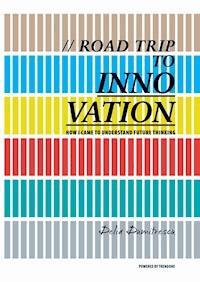
Road Trip to Innovation - How I came to understand Future Thinking is an investigative tale about a friendly and curious mind that sets-off on a road trip to find out what innovation is truly made of. Highlighting expert interviews and companies that are heralded for their know-how in the fields of future studies, innovation and trend research, the book offers an introduction to the theory and methodology behind these complicated notions in easy and refreshing language. Road Trip to Innovation is recommended to anyone who wants to deal with the origin and significance of trends and innovations.
Sie lesen das E-Book in den Legimi-Apps auf:
Seitenzahl: 368
Veröffentlichungsjahr: 2012
Ähnliche




















Road Trip to Innovation – How I came to understand Future Thinking is an investigative tale about a friendly and curious mind that sets-off on a road trip to find out what innovation is truly made of. Highlighting expert interviews and companies that are heralded for their know-how in the fields of future studies, innovation and trend research, the book offers an introduction to the theory and methodology behind these complicated notions in easy and refreshing language.
// WHAT CAN THIS BOOK DO?
Road Trip to Innovation– How I came to understand Future Thinking is a book about understanding ways of approaching and building innovation. The road trip itself is part of the narrative of the book as I travel from city to city, interviewing people in order to find out, together with you dear reader, the following: what does innovation encompass, how to spot trends, how to use trends for creating innovative products, services and strategies, how companies approach innovation in terms of method (e.g.: design thinking, trend consulting) and how are trends transformed in a strategic asset inside companies (e.g.: strategic foresight, strategic planning, forecasting).
The book will offer an introduction into the field of future studies and targets to raise awareness of the innovation and trend research industry. It will explain complicated notions in easy language and with a friendly approach. Road Trip to Innovation– How I came to understand Future Thinking also has educational purposes for students and trainees; it offers a holistic view on methods and tools for building innovation to young managers setting up innovation strategy in their companies and furthermore, it is a good introduction to the trends and innovations industry for anybody who is interested in the topic.
My findings are based on literature review and data drawn from interviews and case studies of companies in Europe and the United States. The interviews were conducted with companies that encompass a broad spectrum of approaches and with people of varied backgrounds, as I believe in the power of poly-social groups.
Why all these companies and why these people? There is no financial reason. They were either found by natural research (a.k.a. appeared first in the Google search engine) or recommended by Nils Müller, as he is the engine behind this book, mentoring me and connecting me with people from the industry. There is no advertising reason; they are just some examples out of several interesting companies that are out there.
The Future Navigator that stands for all the contents of this book with methods, tools and applications of the innovation process was created and inserted in this book at the end. It started as a plain piece of paper with two arrows that cross each other. It was gradually filled with the approaches presented in this book in order to start a conversation regarding their meaning and purpose. It can be looked at as a chess table. Anybody who has additional information and strong motivations can modify it.
Road Trip to Innovation– How I came to understand Future Thinking is the fruit of my thinking on all the aforementioned subjects: It is based on the literature that I’ve read and the fascinating and intelligent people that I’ve spoken with. As we are all different, special and unique persons, anyone could write this book in their own way and interpret things according to their own dimensions. This is a first published wave from the sea of opinions.
VISUAL ELEMENTS
Visualization is very important when it comes to understanding complex things; therefore, every chapter is sketched by Anna Luise Sulimma who invented a visualization method for the trend industry called trendsketching. You can find her on TrendSketcher.de.
Here is the legend of the visual elements we are using in the following illustrations, mind maps and icons.
ALL ON BOARD? The Basics
What is innovation?
The future thinking mindset
Trends
The Diffusion Theory
I AM A WALLFLOWER
I didn’t quite realize it until my Coolhunting instructor at Instituto Europeo di Design Barcelona and dear friend, Christina Bifano, pointed it out to me. It’s true; I am that shy soul sitting in the corner of the ballroom, waiting for somebody to invite me for a dance. However, being a wallflower has certain advantages. From where I stand I can observe closely the goings on around me and ponder the behaviors and appearances of others. I am naturally curious. I want to know why and what lies behind the obvious exteriors. Don’t you?
People ask me:
> So what do you do for a living?
> I am a trend researcher.
> Excuse me? Can you repeat that?!?!?
> Ok, I am a trend researcher working in the field of innovation.
> A what – working in the field of what? I don’t understand: What is it exactly that you do?
This conversation is probably very familiar to people working in the field of trend research and to students or professionals from the fields of innovation. Meeting for a beer and talking about professions has a whole new dimension. We are like a new breed of civilization: we ourselves and people we come in contact with are constantly amazed with the existence of our job description. Always on, always wondering about what comes next, we can’t escape, not even for a second, our future thinking. While I was studying coolhunting at IED Barcelona, I often ran into difficulties trying to explain to others what I was studying. This is one of the reasons why this book was born.
Long story short, after my studies I had the opportune chance to meet Nils Müller, CEO and Founder of TrendONE Germany. It was a rainy September day in Berlin. I was looking for a job in trend research and funnily enough, my previous boss from Lowe PR Bucharest, Hortensia Nastase, had just seen a TrendONE keynote speech and said: “These guys are great! You should contact them”. Luckily, they accepted my invitation to meet at their office in Berlin.
A few hours before the meeting, TrendONE called me and asked if I could come to The Ritz instead. Yeah, right, I always go to the Ritz. I was just testing the waters seeing if this could lead to a possible job interview and suddenly the whole meeting took on a whole new meaning for me. It’s always about contexts, isn’t it? And the context here was, well…The Ritz. After some minutes of racking my brain, figuring out what to wear, I decided to play it cool. Classic black with a handmade necklace that I bought at a small craft fair in Bucharest. I entered the hotel, politely greeted the bellhop and took a seat in the extravagant lobby. A few minutes later, Nils Müller made his appearance wearing an impeccable suit, a chic scarf and pulling a small metallic luggage case. He says sorry for being late; he was 2 minutes late! As I was coming from Spain, where I lived for one year, being late had a totally different meaning for me. There, they haven’t decided yet if showing up a half hour after the proposed meeting time is late or not. In an attempt to lighten up the atmosphere I comment about Spanish people and punctuality and all I get is a straight answer: “Oh, no, we don’t do that here”. Ok, noted.
From there we went to eat at Vapiano, an Italian restaurant nearby where pasta is cooked in front of you in an open kitchen. I was nervous so I couldn’t eat. I just ordered a Coke. Since Nils was eating, I had to do the talking first. Among other things, I said: “You know, while I was studying coolhunting I couldn’t find a book that explained what the trends and innovation industry is all about, like a holistic approach to methods and processes. There are hundreds of terminologies out there that confuse me. I wonder how clients can deal with this.” With time, I learned how proactive and full of brilliant spontaneous ideas Nils is, but back then, I was surprised by his answer: “Ok, I got you. Then why don’t we work together on this project? Why don’t you write it?” A few minutes later I went out of the restaurant with the sensation that my life was about to change completely. I was going to write a book.
// WHAT IS INNOVATION?
[ĭn’ -vā’sh n]
1 THE INTRODUCTION OF SOMETHING NEW;
2 A NEW IDEA, METHOD, OR DEVICE: NOVELTY.
Innovation is a change; it is “new stuff that is made useful”as Max McKeon writes in his book The Truth About Innovation. Therefore, the innovation process, in this book, refers to the journey one has to make in order to obtain a new, cool, innovative idea and how to manage it. In a nutshell, it is about how to get the idea and what you can do with it to make it valuable.
The Organization for Economic Cooperation and Development (OECD) report on the New Nature of Innovation states that a new nature of innovation is emerging. How? “Innovation is no longer mainly about science and technology. Firms can innovate in other ways. Co-creation, user involvement, environmental and societal challenges increasingly drive innovation today. Collaborative, global networking and new public private partnerships are becoming crucial elements in companies’ innovation process.”
In the early 1990s innovation equaled product development; this approach was actually much too narrow. But the modern approach is also problematic
because the plasticity of this term turned the meaning of innovation into a catch phrase.
Nowadays, everything that is providing value for a company is being referred to as an innovation. For some companies it may be as simple as gathering around for a pizza on a Friday night at the office in order to create a better organizational climate thus internally providing a better basis for innovation and creativity. As for others, it cannot be called innovation until the brilliant idea that provides value is marketed – like creating an app that tells you the ingredients of the pizza just by scanning the barcode of the box. So, it all depends on how deep you go into the term of innovation, if just about anything can be interpreted as an innovation. But it shouldn’t be this way. In my opinion, the prior example dilutes its powers.
THE FIRST AIRPLANE
These days it seems that innovation as a noun has been thrown into so many contexts that it has become hype. This makes it difficult for its meaning to be securely locked in a box. For this reason, it becomes subjective and highly interpretative. The good thing is the popularity of the word can only do well to the world. Innovation turns out to be the source and, in the same time, the target for more and more strategies. Martin Kruse, futurist at the Copenhagen Institute for Future Studies (CIFS), states that “research into innovation offers insights that can benefit everyone working with organizational development, management, finance or product development.”
Defining what innovation means was giving me a hard time. Every answer I got was competing in being more poetic than the one before. Here is one particularly poetic definition coming from the Future Driven Innovation paper from CIFS: “Shakespeare calls Man the ‘paragon of animals’, the greatest work in the history of evolution. This is because we have a brain with 100 billion cells and so the ability to change the world around us to give ourselves a better chance of survival. We develop ourselves through creative production, a process that, since the dawn of financial markets, has been known as innovation.”
From the same source, here comes the practical definition: “Innovation has historically been regarded as inventing a new product, producing it and putting it on the market. It is the result of a creative process with emphasis on value creation. Today, innovation can happen anywhere in the company. The value created can be internal, as is the case with human resources, or directed out to the customer as a product on the shelf. The point is that value is created and reaches the customer in some way.”
What is important to understand from the start is that there is a difference between innovation and having a creative idea. Both processes can be innovative in their own way but we shouldn’t confuse them. Kruse told me a little story that helps to keep in mind the difference between the two processes.
The first airplane was actually visualized by Leonardo da Vinci in the 1480s. That was just a creative idea. The idea became an invention when the Wright brothers made a plane out of it, which lifted from the ground in 1903. But the airplane, at that point, was still not an innovation because it was not yet marketed.
Twenty-one years later, Continental Dusters (which subsequently became part of Delta Airlines) gave the airplane its first commercial use, dusting crops. This is the point in history when the airplane became an innovation.
Similar points of view to Kruse’s are those of Richard Florida and Martin Kenney, in their book from 1990, The Breakthrough Illusion: Corporate America’s failure to move from innovation to mass production, consider invention as a breakthrough and innovation as an actualization.
// THE FUTURE THINKING MINDSET
Magnus Lindkvist
What drives somebody to become a trendspotter? How does somebody arrive at such a profession? Some people have a clear picture and follow a more or less standard trajectory towards this title while others fall into it seemingly just by happy coincidence. Magnus Lindkvist belongs to the latter category and he has one of the most interesting stories I have heard so far.
He is an expert on present and future trends, a futurologist and lecturer focusing on business intelligence and trends. Before founding his company, Pattern Recognition, he worked as a brand strategist and then as a planner and management group member at the brand strategy agency Grow. He is the author of the book Everything We Know is Wrong: The Trendspotter’s Handbook and was voted Sweden’s Business Speaker of the Year in 2009. Lindkvist is also an active member of TED, a hub of brilliant minds based in California.
It was one of those mornings when nothing seemed to work. I didn’t hear my alarm clock, missed the bus and when I finally arrived at the office I noticed that my laptop cable was missing and I was running very low on battery (somebody at my office switched it with his own and took it home!) I arranged with Lindkvist a telephone interview. As I didn’t want to miss anything of what he was about to tell me, I planned to record it with my computer’s software – hoping my battery would hang on in there for the duration. And it did. (Thanks Lenovo!) It was a fascinating 45 minute conversation.
THE BEGINNINGS
“It was just one of those fortunate accidents”,Lindkvist says, regarding Pattern Recognition, which was founded in 2005. Back then trend spotting was his hobby and he had been giving trend lectures for free, for whoever wanted to listen. He has always been interested in storytelling and he even wanted to make movies but ended up just writing a novel which was also just for fun. “I always wanted to form a narrative, to try to describe events and what is happening”, says Lindkvist.
Prior to August 2005, Lindkvist had been working for advertising companies and he was quite miserable so he decided to change things: “I was booked to fly with my boss to a meeting in Finland – I woke up in the middle of the night and I felt I’m not going to do this anymore. That’s when I decided to found my own company”.
He was asked to write a trend newspaper for a media company a few months earlier and he suggested the name “pattern recognition” but they didn’t like it, they said it sounded too academic. So, Lindkvist took the name and started his own company. “I had no idea what I wanted to do. I felt trends were somewhat interesting”.A former boss of his had said that one can’t have a business by giving speeches, it just doesn’t work. So, Lindkvist said, “Ok, I’ll see what I can do”. He didn’t see an actual need for this kind of service; instead he tried to explore what the needs were. He wanted to find a model.
He started by selling reports to advertising agencies and then moved on to doing full day seminars for companies but then again, he says, “corporate meetings are boring. I found out that I really enjoyed the 45 minute keynotes speech when you can really deliver a flash of energy like an energy drink, like a Red Bull. So I gave many, many bad speeches. It was painful but I felt like somehow they were developing me as a speaker. Since then it was a long positive spiral. My speeches got better and better”.
In fact his speeches got so good that he is now writing his second book and is traveling around the world giving his power-infused keynote presentations.
SNEAKING IN
But still, where does this inspiration come from? I asked myself, “but where does he look for it?” Like anybody else, he reads books and magazines, hears podcasts. That’s what we all do but each of us sees things differently. “What I search for is the idea which will resonate with people. Showing somebody an example and saying look at this gadget, this machine, this Chinese artist won’t necessarily resonate. What will resonate will become a virus. You adapt yourself to the immune system of the host so you can sneak in. You take something twisted and make it familiar or you make something familiar twisted,” says Lindkvist.
What about companies and brands? Can it be that brands fail because they are scared to take risks and see themselves as being too ’traditional’ to innovate?
For example, in the case of the Greek crisis he always brings into speeches the Uncertainty Avoidance Index of Professor Geert Hofstede, which measures different countries’ relationship to risk taking, familiarity with the unexpected and comfort in trying new things. Greece is one of the worst countries in the world when it comes to this topic. They have one of the highest Uncertainty Avoidance Index. Could the fact that they seem to hate trying new things possibly be responsible for the country’s crisis?
Lindkvist makes these kinds of connections: “Many companies are really bad at trying out new things. So, my job is to take the information that we all have access to and decode it. I want to leave people with some hooks in their brain”, he says in his consummate energetic voice.
BETTER FUTURE THINKING
Lindkvist says he works for better future thinking. I was quite curious what future thinking referred to. I have to admit, it sounded quite provocative. I found out that Daniel Gilbert, in Stumbling on Happiness does a great job in describing how we think about the future in the wrong way. We tend to be overconfident or too vague or oversize things in the present. Lindkvist was heavily inspired by Gilbert’s book. In terms of what better future thinking means, for Lindkvist it is about being more imaginative and tangible as it inspires other futures: “If you ask people about the future these days they seem to be very pessimistic: the recession, climate change etc. You have to look beyond the present because we all know the recession will end, we know it’s all going to pass. We know climate change is about an innovation or two away from making CO2 redundant. Sweden has cut the carbon emissions in half since the 1970s so it can be done and quite easily. So, let’s look beyond today and really start using the imagination for what is possible tomorrow. That’s one part of better future thinking.”
When people think about the future they have some random thoughts and then, instead of sharing their ideas and finding ideas that can move others, they just stop and don’t think about it anymore. “You should ask yourself: what is the future scenario which will inspire your employees to innovate, your colleagues to do better things and your company to function in better ways. These are the main ingredients of better future thinking and this is what drives me to go out there and speak, give inspiration and energy,” says Lindkvist.
“Will the need be there for a PowerPoint-making speaker or a trend research agency with scouts around the world in the future? Of course not! We will have a completely new tool for it. That could be an algorithm crunching all data in a millisecond that replaces the scouts. It could be something that we haven’t seen yet,” adds Lindkvist.
THE 78 YEAR OLD AND THE PINNACLE OF INNOVATION
“Bin Gordon said that if you want to be innovative don’t hire 35 year olds. I found that to be a very interesting quote. What it means is that the 35 year olds have a young family, a big mortgage and don’t want to take risks. [Lindkvist starts empathizing with the thought]: I am 36 so I completely relate to that. We want to earn easy money; we don’t want to try new things. The 18 year olds are obviously full of risk taking but they become 35 and will still face that problem. The 78 year olds paid off their mortgage, have failed several times in life, and are not necessarily scared of it. They would be magnificent innovators and pioneers. That is a thought”.
Of course, there has been said for quite some time now that people need to work longer; we can’t retire at age 40. Even the system where people retire at age 65 is unsustainable. But we need to give retired people something to do. “What if the peak of people’s imagination and innovation comes at age 78? Not at age 35. Look at how many companies were founded and how many insights were come across when people turned 60 and older. This really turns society and the work place upside down. It changes how we work and how society functions, and quite frankly, it gives me hope for the future”, says Lindkvist.
// MAKING SENSE OF IT ALL
With all this being said, the innovation industry is still somehow at its beginnings and it lacks structure. A lot of terms are overlapping. I started asking myself, “What is the difference between all the cool terminologies that describe innovation? What is the role of trends in innovation management? What are the research methods? What does strategic foresight or future insight, future thinking or strategic planning and forecasting mean? Does the term future management relate to all of them? And how to decide upon the relevancy of the information?” All these questions made my head spin. This book tries to sort things out and reduce the complexity of the processes to a brief and understandable framework.
My encounters show that trends, taking different shapes, are the basis for most innovation thinking process. Trend research is where it all starts when it comes to the future. I am not talking here about “red is the new green” but about trends that shape social, cultural, economic, technological and political behaviors.
“ In a world that is constantly changing, there is no one subject or set of subjects that will serve you for the foreseeable future, let alone for the rest of your life. The most important skill to acquire now is learning how to learn. / John Naisbitt „
Nils Müller always compares the fragmentation of the innovation industry to that of the consultancy world in the 1960s, when the concept of consultancy was at the beginning of its existence. The funny thing now, when we look back, is that the term and profession had a generic meaning. Consultancy firms offered their services in any domain. With time, the industry developed and different types of consultancy started to appear. Now we have consultancy for legal, financial, IT and so on. The trend research and innovation industry, if we can call it an industry yet, offers a forward thinking type of service and it is as known and structured as consultancy was in the 1960s. The lack of structure is certainly another reason why this book has to be written.
We are living in a new media society. A decade ago this book couldn’t be published for several reasons: a) I was still in school. b) you couldn’t publish a book unless you had a doctoral thesis, some distinction or award. c) it was much too expensive. Now, even if we live in the digital world we print more books than ever. Of course that doesn’t mean that everybody can do it right. While Condé Nast closed down over 10 magazines in the last 2 years, cutting edge magazines such as Metal, Apartamento and Monocle are thriving. Because they offer (and I am paraphrasing their own words here) cutting edge content and they refuse everything that is ordinary. Why do they work? Because they are offering something innovative.
Browsing the Internet to find new insights, I stumbled upon a citation that suddenly revealed how things stand in the new media society: “Growing up assuming you can publish whatever you want to say, to whomever you want to say it, is going to make people different”. Great quote, slightly paraphrased, from an article Russell Davies wrote about Clay Shirky’s book Here Comes Everybody.
I am on a difficult mission, to find out, understand and put in order the concepts from a huge heap of information. Our road trip starts with a few basic theories delivered by some smart people. It is necessary to grasp the meaning of these theories so we can hop onto the next train.
// TRENDS
“No matter whether we speak of open-plan kitchens or technological innovation, the innovation is a response to a trend”, says CIFS’ paper on Future Driven Innovation. This statement is completely relevant for our journey here – the fact that trends and innovation are interdependent. Over the past years, the word ‘trend’ has been associated with many things in different contexts. The most popular situation in which trend is ‘at home’ is fashion. When people hear the word trend they already start thinking of the next season’s style. Actually, a trend is about more than this. Fashion is only a short-term look into what is going to happen in the future. Clearly, a trend means different things for different people. But most of the time it is associated with something cool. A trend is something cool. Even saying the word trend is cool. You are a trend researcher? Wow! Cool! See what I mean?
But what is cool? Malcolm Gladwell said in 1997 in his article The Coolhunt from The New Yorker that “there is no coherent philosophy of cool”. What we know for sure is that cool sells products and services and companies are already aware of the immense power of it.Cool is ever changing; it evolves according to its place in time and space. It can receive different names; therefore there is no definition of cool aside from something funny, nice, and different. I will not spend much time on explaining what cool means as this is the subject of already too many books. I think we are all aware of its meaning, both colloquially and commercially. If the desirability of cool is so widely felt, businesses need to continue to track what cool means right here, right now and tomorrow as well.
Cool is tracked and spotted in trends. People have the tendency to ask “what’s the current trend”? A proper answer to this question stands in the fact that trends are declined in various forms: society, culture, area, time and period. Also, trends vary in terms of intensity and duration. So we have to deal with micro, macro or megatrends. There is no such thing as THE trend.
Trends come in different sizes! The growth of a trend is also in direct connection with the area where it is present and the number of people it affects. The more we go from micro to macro or mega, the more the trend grows from a concrete example to one that covers a wider distance and affects a larger amount of the population. Don’t panic! Clarifications and examples will follow in the next chapters as we continue our journey.
Henrik Vejlgaard says in his book Anatomy of a Trend that a trend sociologist will talk about a trend moving from the trendsetters to mainstream and in this case, trend refers to a process of change. In popular magazines we see headlines like New Furniture Trends. In this case, trend means product news. Someone who is working in design can talk about the trend in car manufacturing. In this case, trend will mean product development.
All trends are categorized here by their size in reference to time span. I will just give you a quick example of what I mean. A megatrend is definitely a global trend as it touches many people. Megatrends last decades, they affect many different aspects of society, and they involve a complex process that often includes politics, economy and technology. ‘Healthstyle’ is something that matches the description and it is one of the megatrends presented in the Trendbook 2012 published by TrendONE. Health is increasingly becoming a consumer item and used for self-expression. A whole new life-philosophy is built around this core which consists of health awareness, body, spirit and soul and which promotes prevention as opposed to intervention. Foreseeing is the name of the game. Health no longer means the absence of illness, as it is increasingly becoming a consumer good, a form of self-perception and a source of strength. ‘Healthstyle’ will have a dramatic impact on the consumer and service markets, as well as on the forces at play in the entire health industry. Consuming organic products is a sub trend of ‘healthstyle’ and namely a macrotrend. A macrotrend has a shorter time span of 2 to 5 years and it can possibly grow into a megatrend if it starts affecting more people, covering a bigger area.
A microtrend lasts from 6 months to 2 years. In relation to ‘Healthstyle’, a microtrend would be manufacturers creating intuitive technologies such as the iPhone app ‘GoodGuide’, which helps shoppers to find safe, healthy and green products. Trend research and analysis involves observing (spotting) and synthesizing numerous small signs, to determine if they follow any patterns or if they have linking characteristics. Observing people, monitoring a wide range of media and sorting information into what will be announced as a trend are some of the methods used, according to Henrik Vejlgaard in Anatomy of a Trend.
Why do we need all this? Because spotting trends can give us a better understanding on what is going on around us. Slowly, this became a marketing tool. Eric Pfanner’s 2006 article in the New York Times entitled Agencies Look Beyond Focus Groups to Spot Trends, states: “Trend spotting has grown in importance as marketers have become frustrated with some of the traditional tools of market research”. Trend spotting is about getting advanced knowledge of what will happen in the market, thus a useful tool for creating a competitive edge in businesses. Most new product developments take a considerable amount of time (in the car industry up to 8 years), and the better you adapt to the market in a short period of time the more successful you are likely to be. If a business can count on a new trend to grow, it can align its product development with that trend. “As more and more industries become aware of trends, there is a growing need to understand trends better and there are several kinds of experts with a variety of functions and roles who are ready to give advice”, says Vejlgaard.
// FADS AND HYPES
We must distinguish trends from fads and hypes. Ultimately all fads have the same characteristics: they are very short stories that revolve around some new, innovative products. But they never go further than this.
According to Wikipedia, a fad is said to ‘catch on’ when the number of people adopting it begins to increase rapidly. The behavior will normally fade quickly once the perception of novelty is gone. Very often, fashion is associated with fads. If we come to think of it, besides the little black dress, a T-shirt and jeans there are not so many constants in fashion.
Distinguishing between trends and fads might be difficult because fads are much more visible. This is why you have to go one step backwards so fads don’t block your view. Naisbitt mentions an interesting aspect about the fact that the fads of one trend can change, while the core information of the trend doesn’t. What we do is a trend and how we do it is a fad. Take for example the concern for our body shape. It has been there for years but how we take care of it has changed from just jogging to complex fitness & diet programs, yoga and massages.
Fads are embedded into trends and are manifestations of trends./ John Naisbitt in Mind Set!
Richard Watson, author and publisher of What’s Next future blog, said in an interview given to Giselle Weiss for the Global Investor in April 2010 that “a fad is a pattern of attitudes or a behavior that is short lived or only involves a small number of people. A trend is a pattern of attitudes or behaviors, too, but it has more rigor and resilience. It could last decades as opposed to six months or a year. And trends are larger”.
The text book definition of hype is similar to a fad as it refers to the over enthusiasm and subsequent disappointment that typically happens with the introduction of new technologies. Now, hype doesn’t refer only to stuff related to technology but to anything. Seems like, the innovation and trend research industry borrowed terms from the ‘scientific’ fields instead of inventing new ones and had started using them with new meanings. Probably this is one reason why my head spins when I read all these terms that are familiar to me in other contexts.
“Yes, this makes me crazy. For me, hype is the buzz created around anything, anyone or any circumstance”, says Christina Bifano. “Remember that song Don’t Believe The Hype by Public Enemy? They’re not talking about a new technology”. Wait a second, does that mean that the hype is a meme?
// THE MEME
Do we look smarter if we use complicated words that nobody understands? Hmm...
This concept is so simple and therefore so attractive to people. Roughly, the meme is about imitating behaviors. The definition of a meme according to Wikipedia is“a unit of cultural ideas, symbols or practices, which can be transmitted from one mind to another through writing, speech, gestures, rituals or other imitable phenomena.”
Princeton University’s online dictionary refers to a meme as being “a cultural unit (an idea or value or pattern of behavior) that is passed from one person to another by non-genetic means (as by imitation); memes are the cultural counterpart of genes”.
According to Oxford dictionary online, “When Richard Dawkins coined the word meme in his 1976 book The Selfish Gene, he wanted a word like gene that conveyed the way in which ideas and behaviour spread within society by non-genetic means. Since then the word has been picked up to describe a piece of information spread by email or via blogs and social networking sites.”
To put it in simpler words, memetics is the discipline that studies how memes or elements of cultures and trends evolve and spread between people over time. “Memes are the basic building blocks of our minds and culture, in the same way that genes are the basic building blocks of biological life”, says a report from InSites Consulting, Forward Thinking series on Teen-memes.
A meme can be a simple idea, or a complex idea. The most important point about a meme is that it propagates. Memes are like gold for brands. They spread like epidemics especially among young people. Language memes are sayings or phrases that are typical, like the word ‘Ok’ together with its hand sign. These both could be considered memes due to their wide spread, international use and street origin. Fashion memes are the items youths wear to express their belonging to a certain group, their haircut, their type of make-up, piercings, etc.
But how do memes apply to brands? Some people call it memetic branding. As memes are things that spread fast and uncontrollable, brands wish to actually become a meme in itself. “Looking at teen-memes, [says the same report from InSites Consulting], is valuable for brands for a number of reasons. First, brands can act as references, personalities or icons. On the other hand, memes invade our minds, change perceptions, attitudes as well as behavioral patterns and get passed on by imitation. Memes are therefore excellent communication vehicles”.
The best way to understand all this is looking at youth, as they are the most exposed and active group of people. They create their identity by collecting and clustering an individual set of memes. If the difference between the memes they adopted and certain mainstream behaviors are very different than those people who are ’memeing’, they will be perceived as being part of a subculture.
There are still more articles based on the theory of memetics, but I decided to continue the road trip now with the acknowledgement that the meme is about imitating simple behaviors which relate more to language and fashion than to perceptions, emotional states and experiences in general.
// THE TIPPING POINT
Malcolm Gladwell developed the tipping point theory and wrote the book with the same name aiming to explain the emergence of trends. He advises that the best way to understand trends is to think of them as epidemics. When some people think of shoes, rubber may not be the first material they associate with comfort or style but this didn’t stop Havaianas from spreading like a virus. They started as the first inexpensive cloth shoe made with Brazilian coffee farmers in mind in the year 1907 and then transformed into a very affordable rubber sandal available anywhere from gas stations to specialty stores in Brazil. Havaianas have become, in the past 8 years, a fashion necessity all over the world. Outside of Brazil, fashion conscious New Yorkers started wearing them in the 1990s, shortly thereafter Argentinean Rolinga subcultures adapted them as their own and well traveled Europeans were quick to follow. A brand of national pride, Havaianas are still infecting people today with new styles and marketing strategies.
Ideas, products, messages and behaviors spread just like viruses do.
At the center of the tipping point theory there is the possibility of sudden change. The tipping point is the moment of critical mass, the boiling point. Gladwell continues to describe the phenomena in the book by setting up some rules called “laws of the tipping point” and I advise you to read it. There is not enough space here to tell the whole story and it is a must for the trends industry.
What you have to keep in mind now is that the tipping point of any product or service might come (it’s not always happening) and this is the point when producers lose control of the sales, masses start using the product.
// THE DIFFUSION THEORY
Diffusion is very well linked with the tipping point theory. You’ll see why. Academics call the process by which new ideas or products are accepted by groups of people, The Diffusion of Innovation. The term is coined in 1962 by Everett Rogers, professor at University of Mexico. He set up five steps of the diffusion process and he also tried to build some criteria by which innovations spread out faster. He explores how the social environment influences the way a new innovation spreads. This is what it looks like:
STEP NO 1 THE INNOVATORS
2.5% of the users. What motivates them to try out an innovation? They simply become interested and curious in the idea.
STEP NO 2 THE EARLY ADOPTERS OR THE FOLLOWERS
The next 13.5% of the users. Are integrated in the local society, are leaders of opinion in their social surrounding, they are respected and serve as role models.
STEP NO 3 THE EARLY MAJORITY
The next 34% of the users. They are the close friends of the early adopters, have their own opinions and think before adopting a new idea.
STEP NO 4 THE LATE MAJORITY
The next 34% of the users. In contrast, they adopt innovations only because of peer pressure and economic necessity. They are skeptical and cautious.
STEP NO 5 THE LAGGARDS
The last 16% of the users. They don’t have any opinion.
They are isolated, have the past as a point of reference and are suspicious about the ‘new’.
So, once innovation occurs, it may be spread from the innovator to other individuals and groups. Adoption and diffusion of a new innovation follows an S curve, like the one from the tipping point theory. After a slow initial acceptance by early adopters, adoption reaches a tipping point where usage explodes.
I read about Everett Rogers’s theory in the book called Coolhunting. Chasing Down the Next Big Thing by Peter Gloor & Scott Cooper. It is funny how they tell the story there so I will paraphrase them: a lonely genius guy creates the innovation. But as he is lonely, it takes some time until other people find out about the innovation and convert it into a trend. Trendsetters (see definiton below) come into the game and help the trend spread using their social skills. Pretty soon, adopters want to jump on the bandwagon and take part in this. Next, they release the trend into the outside world, to the people who will carry it to the tipping point. This phase starts with the early adopters again. That’s when the innovation starts to tip, grow in popularity very fast.
Peter A. Gloor’s COIN theory (Collaborative Innovation Network), presented in the aforementioned book of Gloor & Cooper is also interesting. Gloor is a Research Scientist at the Center for Collective Intelligence at MIT’s Sloan School of Management and his theory refers to groups of people that act as a beehive, likeminded people that produce winning ideas from a coolhunted idea, by sharing information and work. They say that, if we want to find cool trends, we have to look for “COINs working together in swarm creativity’.” The trendsetters are here referred to as the ‘COIN’. Trendsetters are the ones who convince others that it’s time to adopt an innovation. They are the ones smoothing the path from step no. 1 to step no. 2 of the diffusion theory. Trendsetters are potential-spotters; they can identify cool things in an incipient form. They are those people with a vision.
Trendsetters are very busy people. “They focus on styles and tastes that are completely new and have never been seen before, [that are outside of mainstream], that are in continuous style development, not overhyped by the media as a trend”, as Vejlgaard mentions in Anatomy of a Trend. They not only identify the latest cool things but also tell the story further by being an example to the others. As soon as the others get it, the trendsetter has to go out there and search for more. Because when something hits mass market, that something is no longer cool for them. What follows? In most of the cases the change is sudden and 180 degrees wide. If we think of it, almost all big cultural movements have a counter movement. Every action has a reaction. See the curvilinear art nouveau style from the turn of the 20th century being followed by the geometric art deco movement in the early 1920s.
Cool people disseminate cool trends. They are looked at like carriers of innovations. We will notice during our road trip that opinions here differ in relation to the source of innovation. Some look at trendsetters (which is mainly related to the coolhunting term), some of them look at technology and innovations (trend research), some at products and consumers (consumer insights and trends).
So, are trend researchers and coolhunters both looking for changes? What is the difference between them? The timeframe. Coolhunters look at things that will happen within a small timeframe, a nearby time horizon.
Malcolm Gladwell argues in Consumer Tribes




