


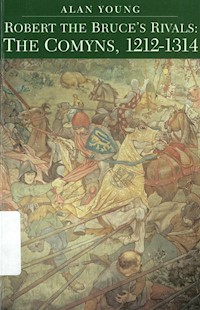
24,00 €
Mehr erfahren.
- Herausgeber: John Donald
- Kategorie: Geisteswissenschaft
- Sprache: Englisch
This volume aims to critically examine the bad reputation gained by the Comyns in post-Bruce Scotland. The name "Comyn" has long been associated in Scottish tradition with treachery: the family were involved in the infamous kidnapping of the young Alexaner III in 1257, were accused of treachery against William Wallace at the Battle of Falkirk in 1298, and of betraying Robert Bruce to Edward I of England 1306. This reappraisal of the Comyns' role concludes that the period 1212 to 1314 should be regarded as the "Comyn century" in Scottish history. The book highlights the Comyns' role as pillars of the Scottish monarchy and leaders of the political community of the realm in this formative century. The family's interests and influence extended into every corner of Scotland and their castles controlled key lines of communication, especially in Northern Scotland. It is against this background that Bruce's political ambitions in Scotland and Edward I's attempts to influence Scottish affairs in the late-13th century are set. Comyn dominance of the Scottish political scene adds a new twist to the murder of John Comyn by Robert Bruce in the Greyfriars' Church at Dumfries in 1306, and to the impact of the Battle of Bannockburn (1314) on the power struggle within Scotland. This study of the Comyns intends to help establish the strength of opposition to Robert Bruce at the end of the 13th century. A non-Bruce view of the 13th-century Scottish history.The issue of power politics within Scotland, and between England and Scotland, is a constant central theme.
Das E-Book können Sie in Legimi-Apps oder einer beliebigen App lesen, die das folgende Format unterstützen:
Veröffentlichungsjahr: 2001
Ähnliche



















Robert the Bruce’s Rivals:THE COMYNS, 1212—1314
First published in 1997 byTuckwell Press LtdThe Mill HousePhantassieEast LintonEast Lothian EH40 3DGScotland
Reprinted 1998
Copyright © Alan Young 1997
All rights reservedISBN 1 86232 017 9 (cased)ISBN 1 86232 053 5 (paperback)
British LibraryCataloguing-in-Publication DataA Catalogue record for this book is available on request from the British Library
The right of Alan Young to be identified as the author of this work has been asserted in accordance with the Copyright, Design and Patent Act 1988
Typeset by Hewer Text Composition Services, Edinburgh Printed and bound by Biddles Ltd, Guildford, Surrey
CONTENTS
Acknowledgements
Illustrations
Maps and Plans
Family Tree
1. Bruce, Wallace, Balliol and Comyn: Heroes and Villains in Scottish Tradition
2. The Foundation for the ‘Comyn Century’
3. A Testing Time: Comyns, Bissets, Durwards and the English, 1230–1260
4. A Responsible, Aristocratic Governing Community, c.1260–1286
5. Balliol, Bruce and Comyn: Guardians, Competitors and Constitutional Crisis, 1286–1292
6. The Comyns and the Kingship of John Balliol, 1292–1296
7. War and the Challenge to the Comyns, 1296–1304
8. The Comyn Murder, Bruce Kingship and the Battle of Bannockburn, 1304–1314
Bibliography
Index
ACKNOWLEDGEMENTS
As my research on the Comyn family started in 1970, it is a daunting, if not impossible, task to try to acknowledge all those who have assisted me since that date. The final push towards publication was helped immensely by a sabbatical semester. I am most grateful to the University College of Ripon and York St John for this opportunity to reflect on past research, explore some new avenues and finally complete the study. I would like to express my thanks to friends, colleagues and students in the Department of Historical Studies at the University College for their support and interest. In particular, I owe a great debt to my friend and colleague, Dr John Addy, whose infectious enthusiasm for research has constantly, over twenty years, provided stimulation and encouragement for my own research in medieval history.
Over many years, I have benefited from the advice, help and support of colleagues working in the field of Scottish and northern English medieval history. The Scottish Medievalists’ Conference and B.A.R.G. (the Baronial Research Group) have consistently provided stimulating forums for the discussion of research on medieval Scottish and baronial history. In particular, I have appreciated the help and advice of Dr Grant Simpson, Dr Keith Stringer, Dr Alexander Grant and Mr Geoffrey Stell. Anyone involved in research on medieval Scottish history must acknowledge a debt to the immense work of Professor A.A.M. Duncan and Professor G.W.S. Barrow. I am, personally, greatly indebted to Professor Geoffrey Barrow who first encouraged me to undertake research on the Comyn family and who has always been willing to give me the benefit of his vast knowledge of Scottish history and geography. His guidance has been invaluable. He has also read all of this book in draft and I have benefited greatly from his many helpful suggestions as well as being saved from numerous errors. The opinions and errors which remain are my sole responsibility.
A number of libraries and record offices have given me tremendous assistance in my research. I owe thanks to the staff of the Scottish Record Office, the National Library of Scotland, the Public Record Office and the British Museum for their help. I am particularly grateful for the assistance of Mrs G.C.W. Roads and the Court of the Lord Lyon and Dr N. Mills of the Historical Search Room, Scottish Record Office for help in research on Comyn seals; and to Mr Joseph White of Historic Scotland and to staff of the architectural section of the National Monuments Record of Scotland (RCAHMS) for help in research on Comyn castle and abbey sites. Without the efficient support of the Inter Library Loan Service at the University College of Ripon and York St John, research could not have been as extensive and I am grateful for the help provided by Christie Edwards. I am also grateful for the speedy, efficient and cheerful way in which the final draft was put on disk principally by Mrs Hilary Hunt, with assistance from Mrs Janet Olsen. An author is fortunate to have such a patient and supportive publisher as John Tuckwell and I am most thankful for both his encouragement and patience.
My wife, Heather, has been a source of much encouragement and support throughout my research and writing and especially in the final stages of the work. Without the help and encouragement of my parents, it is unlikely that the research would have started. I owe them a tremendous amount for their support over many years and I am therefore dedicating this book to the memory of my mother and father.
ILLUSTRATIONS
PLATE SECTION
1. The Guardians’ Seal
2. Deer Abbey
3. Inchmahome Priory
4. Ruthven Castle
5. Blair Atholl
6. Seal of Alexander Comyn, Earl of Buchan, 1244–1289
7. Balvenie Castle
8. The Comyn Charter
9. Cruggleton Castle
10. Seals of John Comyn, son of Alexander, and of his brother Alexander
11. Inverlochy Castle
12. Seal of John Comyn II, lord of Badenoch, the Competitor, 1292
13. Lochindorb Castle
MAPS AND PLANS
1. The Architectural Lordship of the Comyns
2. The Earldom of Buchan
3. Comyns versus Durwards, 1220s–1250s
4. Earldoms and Main Lordships of the Comyns and Bruces
Plans of Comyn Castles
CHAPTER ONE
Bruce, Wallace, Balliol and Comyn: Heroes and Villains in Scottish Tradition
The century of Scottish history culminating in the battle of Bannockburn (1314) was a dramatic one. The period – and especially the years 1290 to 1314 – produced heroes and villains now long established in Scottish tradition and legend. The names of Robert Bruce and William Wallace have emerged in this tradition as heroes and champions of Scotland in a time of need. William Wallace is seen as the first popular leader of Scottish nationalism, the tragic conclusion to his patriotic resistance making him also a martyr for that cause. Robert Bruce is viewed as Scotland’s saviour following his dramatic seizure of the Scottish kingship and successful resistance to English imperialism. The names of Wallace and Bruce have captured popular imagination and hold a unique place in Scottish history. By contrast, the name of John Balliol has entered Scottish consciousness as ‘Toom Tabard’,1 a Scottish king who abjectly surrendered his kingdom to Edward I in 1296. Similarly, the name of Comyn has long been associated in Scottish tradition with treachery – the family being involved in the infamous kidnapping of young Alexander III in 1257 and treachery against both Scottish heroes, Wallace at the battle of Falkirk in 1298 and Bruce in 1306.
The foundation for these traditions was firmly laid by Scottish writers of the fourteenth and fifteenth centuries. John of Fordun2 wrote The Chronicle of the Scots Nation in the 1380s and this work has formed the main strand in the standard narrative account of Scottish medieval history. Fordun is increasingly acknowledged as an invaluable source of information for the century before Bannockburn because of his use of original thirteenth-century material not found elsewhere. His reporting of facts may be reliable but it should be emphasised that his information was set in a framework strictly governed by his chief themes: the growth of the Scottish nation, the need to keep it independent and the importance of monarchy in attaining these two objectives. Events were carefully selected – the extension and definition of the Scottish kingdom, the suppression of revolts and the fight against England for independence. The minority of Alexander III, 1249–1260, was used by Fordun to demonstrate the importance of having a king. The death of Alexander III was lamented all the more because the absence of strong kingship led to ‘the evils of after times’.3
Fordun’s framework was followed by Walter Bower,4 abbot of Inchcolm (writing c.1440) and Andrew of Wyntoun,5 prior of Lochleven (writing c.1420). The emphasis of all three on patriotism, the cause of Scottish independence and hostility to the tyranny of England is hardly surprising given the political instability of the fourteenth and fifteenth centuries.6 After Robert I’s death in 1329, Scotland suffered from another minority period as well as civil war; Edward III’s support of Edward Balliol’s attempt to gain the Scottish crown was a strong reminder of Edward I’s earlier interference; Scottish government was further weakened following David II’s capture by the English at Neville’s Cross (1346) and his subsequent long captivity. Bower’s elaboration of Fordun’s work took place against the background of further political instability in Scotland, the country being once again divided following the murder of James I and another minority period.
Despite the sound reputations of Fordun and Bower as historians, fourteenth- and fifteenth-century anxieties and preoccupations naturally affected their interpretations of Scottish history in the century before Bannockburn. The century was viewed in a strongly monarchocentric way. Fordun in hindsight boosted the image of Alexander III and laid the foundation for the myth of the ‘Golden Age’ of Alexander III. His reign was used to create an ideal for the kind of kingship to be aimed at, a strong independent Scotland. The heartfelt laments on the death of Alexander III in Fordun, Bower and Wyntoun emphasise the point:
O Scotland, truly unhappy, when bereft of so great a leader and pilot.7
… at all times after the king had reached the age of discretion, his subjects lived in constant tranquillity and peace, and in agreeable and secure freedom.8
Scotland, how sweet it is to remember your glory while your king was alive.9
The role of the nobility in the century before Bannockburn was inevitably viewed by Fordun, Bower and Wyntoun from their monarchocentric standpoint. Emphasis was placed on the threat posed to the monarchy by the faction and lawlessness of the nobility and their role as over-mighty subjects. These factors were particularly stressed in the minority of Alexander III and in the period after Alexander III’s death as they laid Scotland open to interference from England. In this context, the roles of Bruce, Wallace, Balliol and Comyn were judged and heroes and villains created. Thus Robert Bruce became the hero of the entire narratives of both Fordun and Bower as he restored the ideals of kingship embodied in the ‘Golden Age’ of Alexander III. William Wallace was portrayed as a champion of Scottish nationalism resisting English imperialism. The reputations of Robert Bruce and William Wallace were further enhanced by works specifically dedicated to them. The poem, The Bruce, written in 1375 by John Barbour,10 archdeacon of Aberdeen, was a very full account of Robert Bruce’s life, written in the form of an epic with Bruce as the chivalric hero. The vernacular poem, The Wallace,11 written in the 1470s by Henry the Minstrel, better known as ‘Blind Hary’, fulfilled a similar purpose for William Wallace.
By contrast the Comyns were usually portrayed as overmighty subjects posing a threat to the Scottish kingdom and Alexander III’s kingship. As rivals to both Robert Bruce and William Wallace, the Comyns were also seen as endangering the achievements of both heroes. John Balliol was also judged as a rival to Bruce and condemned as a weak, ineffectual leader opening Scotland to English hegemony.
That propaganda was an important concern of Fordun, Bower, Wyntoun, Barbour and ‘Blind Hary’ can be detected in their descriptions of their heroes and villains. Adulation of Wallace first occurred in Fordun:
From that time there flocked to him all who were in bitterness of spirit and were weighed down beneath the burden of bondage under the unbearable domination of English despotism, and he became their leader. He was wondrously brave and bold, of goodly mien, and boundless liberality … and by dint of his prowess, brought all the magnates of Scotland under his sway, whether they would or not.12
Bower added praise for Wallace:
… rightly striving until his death for faithfulness and his native land, a man who never submitted to the English.13
Perhaps the most memorable assessment of Wallace was given by Andrew Wyntoun:
In all England there was not then
As William Wallace so true a man
Whatever he did against their nation
They made him ample provocation
Nor to them sworn never was he
To fellowship, faith or loyalty.14
This viewpoint received elaboration from ‘Blind Hary’ who seems to have added to Wallace’s achievements some of his own creation. The vilification of Wallace in English chronicles and songs15 where he is portrayed as ‘leader of these savages’, ‘a robber’ and ‘an unworthy man’, and Wallace’s savage death in London have served to heighten Wallace’s reputation in Scotland as a hero and a martyr.
Whereas Wallace was a hero in defeat, to fourteenth- and fifteenth-century Scottish writers, Robert Bruce was undoubtedly the hero of these narratives from Fordun onwards. Fordun’s attitude to Bruce is summed up in the following description:
… the English nation lorded it in all parts of the kingdom of Scotland ruthlessly harrying the Scots in sundry and manifold ways … But God in His mercy, as is the wont of His fatherly goodness, had compassion …; so He raised up a saviour and champion unto them – one of their own fellows to wit, named Robert Bruce. The man … putting forth his hand unto force, underwent the countless and unbearable toils of the heat of the day … for the sake of freeing his brethren.16
The tone was followed by Bower:
… whoever has learned to recount his individual conflicts and particular triumphs – the victories and battles in which with the help of the Lord, by his own strength and his energetic valour as a man, he forced his way through the ranks of the enemy without fear, now powerfully laying them low, now powerfully turning them aside as he avoided the penalty of death – he will find, I think, that he will judge none in the regions of the world to be his equals in his own times in the art of fighting and in physical strength.17
Bower himself acknowledged the role of John Barbour’s The Bruce in chronicling Bruce’s achievement in more detail ‘with eloquence and brilliance, and with elegance’.18 Indeed The Bruce, which is the most comprehensive life of any medieval king in the west, portrayed Robert Bruce as the hero of an epic poem.
The fourteenth- and fifteenth-century Scottish propagandists regarded the battle of Bannockburn as a fitting climax of a just, indeed a holy, war. Their narratives were heightened by frequent biblical references with the books of the Maccabees holding special relevance to Scotland in the late thirteenth and early fourteenth centuries.19 The plight of Scotland at the hands of English imperialism was easily compared to that of Israel threatened by its more powerful neighbour, Syria. Thus Walter Bower compared Wallace to Mattathias who initiated the revolt in Israel as dramatically as Wallace led the fight for Scotland’s liberty in 1297. Robert Bruce was seen as ‘another Maccabeus’, i.e. a great captain, by the author of the Declaration of Arbroath (1320).20
It is hardly surprising that the language used by fourteenth- and fifteenth-century Scottish chroniclers to describe the rivals or enemies of Bruce and Wallace is appropriate to their heightened views of their heroes. John Balliol, according to Fordun:
… did homage to Edward I, king of England, for the kingdom of Scotland, as he had before promised in his ear, submitting to thraldom unto him for ever.21
And
… upon the king of England coming to the aforesaid castle of Montrose, King John, stripped of his kingly ornaments, and holding a white wand in his hand, surrendered up, with staff and baton and resigned into the hands of the king of England all right which he himself had, or might have, to the kingdom of Scotland.22
Bower was more forthright, describing the Scottish kingdom as:
… abnormal in the time of this disastrous King John, and after his deposition, severely shaken and torn apart by very great instability and destruction for ten years on end.23
Bower details the abject nature of Balliol’s surrender in Balliol’s letter24 to the king of England in which Balliol apologised for having ‘grievously offended’ and admitted that Edward:
… as superior lord duly enfeoffed … could freely and of right undertake invasion and hostile suppression in this manner since we have denied his homage together with loyalty and fealty.
Again Andrew Wyntoun, perhaps more memorably, echoes Fordun and Bower:
This Johun the Balliol dispoyilyeide he
Off al his robis and royalte,
The pellour that tuk out his tabart,
Tuyme Tabart he was callit efftirwart
Amd all othir insignyis
That fel to kynge on ony wise,
Bathe septure suerde, crowne and rynge,
Fra this Johun, that he made Kynge,
Hallely fra hym, he tuk thar
And mad hym of his Kynrick bare.25
In Fordun and Bower, the criticisms of the Comyns as overmighty subjects start with the first Comyn government during Alexander III’s minority:
But these councillors were so many kings. For he who saw the poor crushed down in those days, the nobles ousted from their inheritance, the drudgery forced upon citizens, the violence done to churches, might with good reason say ‘Woe unto the kingdom where the king is a boy.’26
The Comyn’s leading role in the kidnapping of young Alexander III in 1257 was particularly emphasised:
Walter Comyn, earl of Menteith and his accomplices, were more than once summoned before the king and his councillors, upon many grave charges; but they did not appear. But as they durst not await their trial according to the statutes of the kingdom, they took counsel together, and with one accord, seized the king, by night, while he was asleep in bed at Kinross, and before dawn, carried him off with them to Stirling.27
The Comyn government was:
… disaffected men who did as they pleased and naught as was lawful and reigned over the people right or wrong.28
Bower added his own moral indignation:
… the Comyns were in the lead among those who rose against the king: as a consequence their name is now, so to speak, obliterated in the land, despite the fact that at the time they were multiplied beyond numbers in the ranks of the magnates of the kingdom … Therefore knights and magnates ought to pay greater attention to the words of the apostle: ‘Honour the king’.29
At the battle of Falkirk in 1298, the Comyns were blamed by Fordun for the defeat of Wallace through their desertion:
William was put to flight … For, on account of the ill-will, begotten of the spring of envy which the Comyns had conceived towards the said William, they with their accomplices forsook the field and escaped unhurt …
… after the aforesaid victory which was vouchsafed to the enemy through the treachery of Scots, the aforesaid William Wallace, perceiving by these and other strong proofs, the glaring wickedness of the Comyns and their abettors …30
Both Fordun31 and Bower accused John Comyn of betraying Robert Bruce to Edward I after an ‘indissoluble treaty of friendship and peace’ had been made between Robert Bruce and Comyn in or shortly after 1304 in order to secure the ‘deliverance of the Scottish nation from the house of bondage and unworthy thraldom’. Instead of co-operation with Bruce, John Comyn ‘talked over Robert’s death in earnest – and shortly determined that he would deprive him of life in the morrow’. According to Bower, John Comyn had:
… such a strong sense of greed and such a great and culpable intensity of ambition that he broke his agreement and made null his oath, meditating how to attack his faithful ally (who suspected no ill) …
… Once Bruce had been thoroughly destroyed by the tyranny of the king of England, he would occupy his position and take over the kingdom which by rights belonged to Bruce and no-one else. Behold a second Naboth, whose death was engineered so that a wicked man might gain his vineyard.32
Comyn’s murder in 1306 by Robert the Bruce in the church of the friars at Dumfries was seen from a Bruce standpoint by both Fordun and Bower:
… a day is appointed for him and the aforesaid John to meet at Dumfries … John is twitted with his treachery and belied troth. The lie is at once given. The evil speaker is stabbed, and wounded unto death, in the church of the Friars …33
Bower added that by Comyn’s death, ‘Edward, king of England, it is believed, was cheated of his desire both marvellously and wonderfully’.34 Comyn’s reputation was thus further tarred by emphasising his key role in Edward I’s ambitions in Scotland.
It is recognised by historians that Fordun’s and Bower’s works were charged with patriotic fervour and nationalism and that the reputation of Robert Bruce, also Fordun’s hero, ‘will always depend on how much credence we give to Barbour … we need to remember that for him Bruce was the hero of a work of art … His terms of reference forbade him to write of shortcomings’.35 The dramatic tale of Bruce’s coup of 1306, as told by the fourteenth- and fifteenth-century writers, is acknowledged as a ‘literary product, the final satisfying version of an originally much simpler, at least less romantic story’.36 It is also recognised that Bruce’s chief political rivals in Scotland, the Comyns, have suffered particularly at the hands of Fordun and others, from ‘the necessity of giving the Comyns a bad name in post-Bruce Scotland’.37
It is certainly understandable that the history of the century before Bannockburn was written from the perspective of the winners rather than the losers. For all the recognition and acknowledgement of bias in the fourteenth- and fifteenth-century histories, however, it remains true that the figures of Balliol and Comyn still remain firmly in the shadows of the traditional heroes Bruce and Wallace. Fordun and Bower, in fact, echo the official Bruce government attitude to the years 1290 to 1306. It has been remarked that the absence of references to King John in the ‘Acta’ of Robert I suggests that ‘there seems to have been a pretence that the Balliol kingship had never existed’.38 The official Scottish attitude is further developed in the negotiations with the English at Bamburgh in 1321 when ‘the whole Balliol episode is thus reduced to the level of malicious English fiction’.39 It is recognised as misleading that John Balliol ‘has gone down in history as Toom Tabard rather than as King John’,40 and a view from the Balliol perspective has at least helped to give more balance to the Bruce-oriented version of the Great Cause of 1291–2. The Bruce version of events, reinforced by later historians, has tended to emphasise the confrontation between Bruce and Balliol as the ‘culmination of an ancient rivalry of heroic proportions’.41 A view from the Balliol standpoint has revealed this as a misleading misrepresentation of the Balliols as there is no evidence to suggest that the Balliols had adopted any stance against the Bruces before 1286. A Balliol perspective also served to highlight their dependence on the political power of the Comyns.42
If it is misleading that the history of medieval Scotland has been written from a Bruce perspective rather than a Balliol perspective,43 it is perhaps an even greater distortion of that history that a Comyn perspective is lacking for the century before Bannockburn. The Comyn family were the most powerful and influential noble family in thirteenth-century Scotland, through both extensive landholding and political office holding. This power was fully apparent by 1240 and was consistently revealed from that date until the murder of John Comyn of Badenoch, the head of the senior line of the family, by Robert Bruce in the church of the Greyfriars, Dumfries in 1306.44 From a baronial standpoint, the Comyns rather than the English were the biggest losers at Bannockburn in 1314. Bruce’s actions led to the demise of the Comyn family in Scottish politics between 1306 and 1314; the Bruce-oriented version of the century before Bannockburn has almost succeeded in writing them out of Scottish history. It has certainly given the family a one-dimensional character as traitorous rivals to the Bruces. According to Bower, the Comyns fell from power because of their actions against Scottish kingship, especially as leaders in the kidnapping of Alexander III in 1257, and ‘as a consequence their name is now, so to speak, obliterated in the land’.45 In fact, Bower and other proponents of the Bruce version of Scottish history have contributed significantly to the demise of the Comyn name.
The Comyns have suffered more than others from the problems and prejudices militating against a balanced view of the nobility in the century before Bannockburn. They have suffered from the monarchocentric writings of the fourteenth and fifteenth centuries which have placed them in the shadow both of Alexander III’s ‘Golden Age’ and also of the Bruce and Wallace traditions. A monarchocentric viewpoint serves to highlight the role of the nobility as unprincipled aggressors and overmighty subjects in political crisis periods. The Comyns played a prominent part in both the minority of Alexander III, 1249–1260, and the long political crisis following Alexander III’s death in 1286. The fact that both crises led to English intervention and indeed to the outbreak of war with England in the latter case has led to nationalist sentiments clouding commentary on the century before Bannockburn in general and the years 1290 to 1314 in particular.
A baronial standpoint is needed to balance the monarchocentric writings of Fordun, Bower, Barbour and Wyntoun; a Comyn perspective is needed to balance the Bruce-oriented version of the century before Bannockburn; a viewpoint from the thirteenth century is needed to counteract the political bias and nationalism of fourteenth- and fifteenth-century commentaries.
The inadequacy and inconsistency of the monarchocentric approach to Scottish politics is revealed in Fordun’s attitude to Walter Comyn in 1249 and 1257. In 1249, Walter Comyn, earl of Menteith is portrayed as ‘a man of foresight and shrewdness of counsel’46 and praised for his strong support of Alexander III’s kingship:
… he went on to say that a country without a king was, beyond doubt, like a ship amid the waves of the sea, without rower or steersman … he moved that this boy be raised to the throne as quickly as possible.47
Yet in 1257, Walter Comyn and his accomplices in the kidnapping of Alexander were ‘disaffected men, who did all as they pleased and nought as was lawful, and reigned over the people, right or wrong’.48 Traditional accounts of the century before Bannockburn leave a lot of questions to be answered about the role of the nobility, but a view from the standpoint of the most powerful thirteenth-century baronial family, the Comyns, should contribute substantially to the debate. What was the relationship between the Comyns and William Wallace in their support of John Balliol’s kingship? What was the Comyn perspective on the rise of the Bruces in the late thirteenth century and when did their rivalry start? What was the relationship between the Comyns and the Scottish kings in the century before Bannockburn? What was the relationship between the Comyns and the English kings in the same period? The Comyns did not have the equivalent of John Barbour for Robert Bruce and Blind Hary for William Wallace to praise their actions. Yet some chronicles did take a more favourable view of Comyn activities than Fordun, Bower and their fourteenth- and fifteenth-century contemporaries. Thus the pro-Comyn Melrose Chronicle can help to balance anti-Comyn writings for Alexander III’s reign; the Chronicles of Lanercost and Guisborough as well as Thomas Gray’s Scalacronica give some balance to the period 1286 to 1314.
The century before Bannockburn saw very significant political developments in Scotland – the definition of the kingdom, the development of kingship and the constitution, the growth of national consciousness and the idea of the community of the realm. Yet the Comyn family’s political power in this period was such that the thirteenth century has been called the ‘Comyn century’.49 An investigation into the Comyns’ contribution to this most formative period is long overdue. A Comyn perspective is necessary to test the Bruce-oriented version of thirteenth-century Scottish history and the Comyns’ traditional role in it as traitorous rivals to Robert Bruce.
NOTES
1. G.G. Simpson, ‘Why was John Balliol called ‘Toom Tabard?’, Scottish Historical Review (hence S.H.R.) XLVII (1968), pp.196–9.
2. John of Fordun, Chronica Gentis Scotorum, ed. W.F. Skene (Edinburgh, 1871–2) (henceforth Chron. Fordun).
3.Chron. Fordun I p.309 (II p.304).
4.Scotichronicon by Walter Bower (General Editor D.E.R. Watt) (henceforth Chron. Bower (Watt), Vol. V, ed. Simon Taylor, D.E.R. Watt and Brian Scott (Aberdeen, 1990). Vol. VI, ed. Norman F. Shead, Wendy Stevenson and D.E.R. Watt with Alan Borthwick, R.E. Latham, J.R.S. Phillips and the late Martin S. Smith (Aberdeen, 1991).
5.The Oryginale Cronykil of Scotland by Andrew of Wyntoun, ed. D. Laing (Edinburgh, 1879) (henceforth Chron. Wyntoun (Laing).
6. A useful survey of these writers is contained in Norman H. Reid, ‘Alexander III: The Historiography of a Myth’, in Scotland in the Reign of Alexander III 1249–1286, ed. Norman H. Reid (Edinburgh 1990), pp.186–94.
7.Chron. Fordun I p.310 (II p.304).
8.Chron. Bower (Watt), V p.423.
9.Ibid. p.427.
10. J. Barbour, The Bruce, ed. W.M. Mackenzie (London, 1909).
11. Blind Hary, The Wallace, ed. M.P. McDiarmid (2 vols.) (Edinburgh, 1968).
12.Chron. Fordun I p.328 (II p.321).
13.Chron. Bower (Watt), VI p.317.
14. Cited in A. Fisher, William Wallace (1986), p.132.
15. Peter Coss (ed.), Thomas Wright’s Political Songs of England (1996), pp.160–180.
16.Chron. Fordun I p.137 (II P.330). The italics are my own.
17.Chron. Bower (Watt), VI p.319.
18.Ibid.
19. G.W.S. Barrow, ‘The Idea of Freedom in Late Medieval Scotland’, in Scotland and its Neighbours (1992), p.19.
20. A.A.M. Duncan, The Nation of Scots and the Declaration of Arbroath (1320), Historical Association, General Series no. 75 (1970), p.35; also Chron. Bower (Watt), VI p.301.
21.Chron. Fordun I p.321 (II p.315).
22.Ibid. I pp.32, 6–7 (II p.320).
23.Chron. Bower (Watt), VI p.53.
24.Ibid. VI P.79.
25.Chron. Wyntoun (Laing), II p.337.
26.Chron. Fordun I p.297 (II p.292.)
27.Ibid. I p.298 (293).
28.Ibid.
29.Chron. Bower (Watt), V p.323.
30.Chron. Fordun I p.330 (II p.323.
31.Ibid. I p. 338–9 (II pp.330–1).
32.Chron. Bower (Watt), VI p.305.
33.Chron. Fordun I p.340 (II p.333).
34.Chron. Bower (Watt), VI p.313.
35. G.W.S. Barrow, Robert Bruce (3rd edition, Edinburgh 1988), pp. 312–13 (henceforth Barrow, Bruce).
36.Ibid. p.140.
37.Ibid. (my italics), p.140.
38. N.H. Reid, ‘Crown and Community under Robert I’, in Medieval Scotland, Crown, Lordship and Community (Essays Presented to G.W.S. Barrow), eds. Alexander Grant and Keith J. Stringer (Edinburgh, 1993), p. 204.
39.Ibid. p.205.
40. R. Nicholson, Scotland, the Later Middle Ages (1974), p.44.
41. G. Stell, ‘The Balliol Family and the Great Cause of 1291–2’, in Essays on the Nobility of Medieval Scotland, ed. K.J. Stringer (Edinburgh, 1985), p.151; Barrow, Bruce Ch.3, ‘Bruce versus Balliol’; G. Neilson, ‘Bruce versus Balliol 1291–2), S.H.R. XVI (1919), pp.1–14.
42. G. Stell, ‘The Balliol Family and the Great Cause of 1291–2, p.151.
43. R. Nicholson, Scotland, the Later Middle Ages, p.44.
44. A. Young, ‘The Political Role of Walter Comyn, Earl of Menteith, During the Minority of Alexander III of Scotland’, in Essays on the Nobility of Medieval Scotland, ed. K.J. Stringer, p.132; A. Young, ‘Noble Families and Political Factions’, in Scotland in the Reign of Alexander III 1249–1286, ed. N.H. Reid, pp.8–10, 23–4; A. Young, ‘The Earls and Earldom of Buchan in the Thirteenth Century’, in Medieval Scotland: Crown, Lordship and Community, eds. Alexander Grant and Keith J. Stringer, pp.174, 198.
45.Chron. Bower (Watt), V p.323.
46.Chron. Fordun I p.293 (II p.289).
47.Ibid.
48.Ibid. I p.298 (II p.293). The discrepancy may be caused by Fordun taking material from a pro-Comyn source as well as an anti-Comyn one.
49. Grant G. Simpson, ‘Kingship in Miniature: A Seal of Minority of Alexander III, 1249–1257, in Medieval Scotland: Crown, Lordship and Community, eds. Alexander Grant and Keith J. Stringer, p.131.
CHAPTER TWO
The Foundation for the ‘Comyn Century’
The depth of the rivalry between Comyns and Bruces can be gauged by the severity of Bruce’s ‘herschip’ or harrying of the Comyn base of Buchan in 1308.1 Without the destruction of this power base in the north, Robert Bruce’s kingship over Scotland as a whole could not be a reality. The ‘herschip’ of Buchan and the still impressive visible symbols of Comyn lordship in Badenoch and Lochaber, especially the castles of Inverlochy and Lochindorb, might give the impression that the Comyns were an exclusively Highland and northern Scottish power in the late thirteenth and early fourteenth centuries. Yet Robert Bruce’s infamous murder in 1306 of his great rival, John Comyn, head of the senior Badenoch branch of the family, took place in the Greyfriars’ church, Dumfries, close to the important southern Comyn base at Dalswinton in Nithsdale. This hints at a rather broader basis to Comyn power. The process of dismemberment and redistribution of Comyn estates in the years after 1308 amply confirms that, while the greatest concentration of Comyn landed power was in the north, their territorial strength and influence was, indeed, wide-ranging, extending into almost every part of Scotland.
The foundation for this pervasive power had been laid by 1212 with significant further consolidation occurring in the 1220s and 1230s. To understand not only the full extent of Comyn power but also its nature and why it led to a ‘Comyn century’ of influence in Scottish history from c.1212 to 1314, it is necessary to analyse the establishment of the Comyn power base.
In the first half of the twelfth century, the Comyns were in the vanguard of the Anglo-Norman ‘invasion’ of the Scottish royal household. This process was actively encouraged by David I, a ‘Scot by birth, a Norman by adoption’,2 throughout his reign, 1124 to 1153. William Cumin (Comyn), the first member of the family to make an impact in Scotland,3 was chancellor of Scotland from c.1136. He had been a clerk in the English chancery of Henry I from c.1121, being a protégé and pupil of Geoffrey Rufus who became chancellor of England in 1123. Rufus became bishop of Durham in 1133 and it is possible that Cumin followed his mentor to Durham though he was already by this time archdeacon of Worcester. The Comyns, unlike the Bruces, Morevilles and other members of the ‘new aristocracy’ in Scotland, were not noble families in origin with substantial estates in Normandy or northern France. It is probable, in fact, that William Cumin belonged to one of the families of clerks which originated from cathedral towns such as Bayeux and Rouen.4 From this relatively obscure clerical and ecclesiastical base, William Cumin sought to secure the family’s secular fortunes in Scotland through his nephews who were already well established in the Scottish royal court by 1140.5 The alliance of mutual self-interest between William Cumin and the Scottish monarchy was to become a typical feature in the rise of the Comyns. William Cumin participated in David I’s invasion of northern England in 1138 and was captured when the Scottish army was defeated at the battle of the Standard near Northallerton.6 On his part, David I gave full support initially when William Cumin attempted to gain the bishopric of Durham following the death of his mentor, Geoffrey Rufus, in 1141.7
In 1144, Cumin was forced to relinquish his claim to the bishopric of Durham after three years of hard fighting during which Cumin’s favourite nephew, another William, died. Cumin’s loyalty to the Angevin cause in the English civil war enabled him to return to southern England and regain the archdeaconry of Worcester by 1155.8 Yet the family’s social climbing in Scotland continued after 1144 through William’s remaining nephew Richard who benefited from the patronage of King David and especially his son, Earl Henry, to become the real founder of the Comyn family’s landed fortunes. Between 1144 and 1152 David and Earl Henry, acknowledged at this time as exercising general control over England north of the Tees, granted to Richard Cumin the important lands of Walwick, Thornton, Staincroft and Henshaw in Tynedale (south-west Northumberland, west of Hexham) on marriage to Hextilda, daughter to Uhtred, Waltheof’s son.9 These lands, the first secular base of the Comyn family, were confirmed in Comyn possession by Henry II and Henry III10 and remained in Comyn hands until their political eclipse in the early fourteenth century. The lands were not simply a direct grant from the Scottish king but a gift on marriage to Hextilda, from a leading Northumbrian landowning family. This marriage, the first of many ‘good’ marriages in the family’s rise to power, was ultimately of more significance than the Tynedale land initially gained. It not only provided Richard Cumin with a valuable alliance with an important Northumbrian family but gained for that family, through Hextilda, a connection with Scottish landholding and the old Scottish princes. Hextilda was the daughter of Uhtred of Tynedale and Bethoc, only daughter of Donald Ban, brother of Malcolm Canmore and son of Duncan I, king of Scots.11 The fact that Hextilda was Donald Ban’s granddaughter gave Richard Cumin’s descendants a legitimate, if not the strongest possible, claim to the Scottish throne. Richard was, therefore, not only the founder of the secular fortunes of the Comyn family but also of the claim of his great-great-grandson, John Comyn the Competitor, to the Scottish throne during the ‘Great Cause’ 1291–1292.
Just as his uncle, William Cumin, had been in the vanguard of the Anglo-Norman invasion of the Scottish royal household, Richard Cumin (d.1179) became a leading member of the ‘new’ Scottish aristocracy as he was at the forefront of the Anglo-Norman social invasion of Scottish landholding. The first Scottish lands on record as being granted to Richard Cumin by the Scottish royal house were those of West Linton in Peeblesshire, granted sometime before 1152 by David’s son, Earl Henry.12 Subsequent grants define Richard’s lands more thoroughly,13 indicating that by 1152 he possessed a substantial area of land in north-west Peeblesshire. Richard’s marriage with Hextilda also led to the family possessing the important lordship of Bedrule (Roxburghshire) which was certainly in the possession of the Comyn family before 1280.14 The land of Bedrule or Rulebethoc derived its name from ‘the lands on the river Rule of Bethoc’ wife of Radulf, the son of Dunegall lord of Nithsdale. This Bethoc was the mother of Hextilda, wife of Richard Cumin. The lands on the River Rule were Bethoc’s rather than Radulf’s and it seems that Radulf was Bethoc’s second husband. Bethoc predeceased Radulf (d. c.1185) – there is no evidence of Radulf succeeding to Bedrule – and Richard Cumin, through his wife Hextilda, seems to have succeeded to Bedrule on Bethoc’s death, probably between c.1150 and 1170.
Another lordship in Roxburghshire, Scraesburgh (alias Hunthill), was in Comyn possession in the late thirteenth century15 but in this case there is no evidence linking Scraesburgh with Richard Cumin and it seems probable that Scraesburgh passed into Comyn hands some time later, perhaps in the early thirteenth century. There is plenty of indirect evidence showing Richard Cumin’s significance as a landowner in Roxburghshire. The witness lists to his charters were dominated by either churchmen or other landowners from Roxburghshire.16 It is also significant that Richard’s son John, and his lord, Earl Henry, were buried at Kelso abbey before 1152.17 Richard Cumin’s marriage to Hextilda was most significant for the expansion of the Comyn family’s landholding in Roxburghshire and it seems probable that the family’s possession of Dalswinton in Nithsdale – certainly held by Richard’s descendants before 125018 – may also have derived from this source.19 Radulf son of Dunegal (second husband of Bethoc, mother of Hextilda) had been lord of Nithsdale and probably at the same time lord of Dumfries. He died c.1185, however, and if his land did pass to the Comyn family, it was after Richard Cumin had died.
By the 1160s Richard Cumin was a landowner of importance in northern England and, perhaps more significantly for the future of the Comyn family, had a firm footing in southern Scotland. His landed wealth and priorities are well represented in endowments to religious houses in both northern England and southern Scotland.20 Hexham priory and the abbeys of Rievaulx, Kelso and Holyrood all received gifts but it is clear that Hexham priory and Kelso abbey held special favour. The fact that Richard’s son John was buried at Kelso abbey along with Richard’s lord, Earl Henry, signifies both the importance of his southern Scottish holding and also the significance of Scottish royal patronage. Complementary to this patronage was royal service. Richard Cumin was, by his death c.1179, a counsellor of long experience to the Scottish monarchy. He is known to have witnessed at least six charters of Malcolm IV,21 the earliest one being 1159, and thirty-three charters of William the Lion.22
The frequency and prominence of Richard’s appearances at the royal court demonstrated his increasing importance to the Scottish monarchy. This was more tangibly demonstrated by William the Lion’s bestowal of the office of justiciar of Lothian on Richard Cumin in the 1170s.23 The office was an important one, the justiciar being the leading judicial officer of the crown in his area and an increasingly significant administrative adviser to the king.24 The role of justiciar before 1200 was probably similar to that described in the treatise on the Scottish king’s household c.1292: the justiciar was to dispense justice evenly to all the king’s subjects and to determine all crown pleas except the most solemn or difficult ones, and there were to be three justiciars, i.e. for Scotia, Lothian and Galloway. Richard Cumin appeared in witness lists as justiciar between 1173 and 1178 but it is impossible to be precise about his period of office as charter clerks often failed to give the title of ‘justiciar’ to a man holding office. It is difficult to say whether he held the office for a brief term or shared the duties of justiciar with Robert de Quinci, Robert Avenel, Walter Olifard and Geoffrey de Melville between 1173 and 1178.25 However, as four men – Richard Cumin, Robert de Quinci, Robert Avenel and Geoffrey de Melville – witnessed a number of royal acts dealing with Scotland south of the forth between c.1170 and c.1178, it seems at least possible to assign to them, either in succession or simultaneously, the justiciarship of Lothian.
Richard Cumin’s position as justiciar can be seen as both a cause and result of his importance in southern Scotland. It was usual for justiciars to be either important barons or at least important landowners before gaining office26 – Richard Cumin, with his lands in Peeblesshire and Roxburghshire, easily came into the latter category. The office can also be seen as increasing the prestige of Richard Cumin and linking his family more firmly to Scottish royal interests. In 1174, for example, Richard Cumin was in close attendance on William the Lion when the Scottish king furthered his claim to the English northern counties. Richard was prominent in the list of attendant knights with the king when he was surprised and captured while besieging Alnwick.27 He was, indeed, regarded as of sufficient importance to be one of the hostages for the performance of the Treaty of Falaise (December 1174) whereby William the Lion became Henry II’s liegeman for Scotland and for all his other lands.28 Richard Cumin closely identified himself with the Scottish king’s interests in 1174 in much the same way as his uncle, William Cumin, the king’s chancellor, had in actively supporting David I’s invasion of northern England in 1138. A further link between the Comyns and the Scottish Crown can perhaps be seen in the reference in 1179 to Richard Cumin having a hunting station in Selkirkshire. It seems possible that Richard held the office of keeper of the royal forest.29
Both Comyns and Bruces were part of the new aristocracy ‘of royal service’ in twelfth-century Scotland. The Bruces, through Robert I de Bruce, were granted the lordship of Annandale by David I as early as 1124 but the family had already become established as lords of Cleveland in north Yorkshire and had served Henry I as justice, i.e. chief royal agent, in northern England.30 The problem of personal allegiance to competing kings was exposed in 1138 at the Battle of the Standard, near Northallerton, when Robert de Bruce, lord of Cleveland, fought on the side of Thurstan archbishop of York against a Scottish invasion force led by David I and including Bruce’s son, Robert de Bruce of Annandale.31 The Comyns, by contrast, did not receive their first landed grants in Scotland until between 1144 and 1152. Although part of the same ‘new’ aristocracy in Scotland, Comyns were very dependent on the Scottish monarchy for their empire-building whereas the Bruces, because of their fairly well developed links in England, were perhaps the least dependent of the new knightly families in Scotland. This was shown in 1173–74 when Robert de Bruce II of Annandale supported Henry II against William the Lion’s invasion of northern England.32




