


80,99 €
Mehr erfahren.
- Herausgeber: John Wiley & Sons
- Kategorie: Fachliteratur
- Serie: Frank J. Fabozzi Series
- Sprache: Englisch
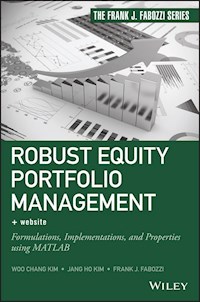
A comprehensive portfolio optimization guide, with provided MATLAB code Robust Equity Portfolio Management + Website offers the most comprehensive coverage available in this burgeoning field. Beginning with the fundamentals before moving into advanced techniques, this book provides useful coverage for both beginners and advanced readers. MATLAB code is provided to allow readers of all levels to begin implementing robust models immediately, with detailed explanations and applications in the equity market included to help you grasp the real-world use of each technique. The discussion includes the most up-to-date thinking and cutting-edge methods, including a much-needed alternative to the traditional Markowitz mean-variance model. Unparalleled in depth and breadth, this book is an invaluable reference for all risk managers, portfolio managers, and analysts. Portfolio construction models originating from the standard Markowitz mean-variance model have a high input sensitivity that threatens optimization, spawning a flurry of research into new analytic techniques. This book covers the latest developments along with the basics, to give you a truly comprehensive understanding backed by a robust, practical skill set. * Get up to speed on the latest developments in portfolio optimization * Implement robust models using provided MATLAB code * Learn advanced optimization methods with equity portfolio applications * Understand the formulations, performances, and properties of robust portfolios The Markowitz mean-variance model remains the standard framework for portfolio optimization, but the interest in--and need for--an alternative is rapidly increasing. Resolving the sensitivity issue and dramatically reducing portfolio risk is a major focus of today's portfolio manager. Robust Equity Portfolio Management + Website provides a viable alternative framework, and the hard skills to implement any optimization method.
Sie lesen das E-Book in den Legimi-Apps auf:
Seitenzahl: 320
Veröffentlichungsjahr: 2015
Ähnliche



















Table of Contents
The Frank J. Fabozzi Series
Title Page
Copyright
Dedication
Preface
Chapter 1: Introduction
1.1 Overview of the Chapters
1.2 Use of MATLAB
Notes
Chapter 2: Mean-Variance Portfolio Selection
2.1 Return of Portfolios
2.2 Risk of Portfolios
2.3 Diversification
2.4 Mean-Variance Analysis
2.5 Factor Models
2.6 Example
Key Points
Notes
Chapter 3: Shortcomings of Mean-Variance Analysis
3.1 Limitations on the Use of Variance
3.2 Difficulty in Estimating the Inputs
3.3 Sensitivity of Mean-Variance Portfolios
3.4 Improvements on Mean-Variance Analysis
Key Points
Notes
Chapter 4: Robust Approaches for Portfolio Selection
4.1 Robustness
4.2 Robust statistics
4.3 Shrinkage Estimation
4.4 Monte Carlo Simulation
4.5 Constraining Portfolio Weights
4.6 Bayesian Approach
4.7 Stochastic Programming
4.8 Additional Approaches
Key Points
Notes
Chapter 5: Robust Optimization
5.1 Worst-Case Decision Making
5.2 Convex Optimization
5.3 Robust Counterparts
5.4 Interior Point Methods
Key Points
Notes
Chapter 6: Robust Portfolio Construction
6.1 Some Preliminaries
6.2 Mean-Variance Portfolios
6.3 Constructing Robust Portfolios
6.4 Robust Portfolios with Box Uncertainty
6.5 Robust Portfolios with Ellipsoidal Uncertainty
6.6 Closing Remarks
Key Points
Notes
Chapter 7: Controlling Third and Fourth Moments of Portfolio Returns via Robust Mean-Variance Approach
7.1 Controlling Higher Moments of Portfolio Return
7.2 Why Robust Formulation Controls Higher Moments
7.3 Empirical Tests
Key Points
Notes
Chapter 8: Higher Factor Exposures of Robust Equity Portfolios
8.1 Importance of Portfolio Factor Exposure
8.2 Fundamental Factor Models in the Equity Market
8.3 Factor Dependency of Robust Portfolios: Theoretical Arguments
8.4 Factor Dependency of Robust Portfolios: Empirical Findings
8.5 Factor Movements and Robust Portfolios
8.6 Robust Formulations That Control Factor Exposure
Key Points
Notes
Chapter 9: Composition of Robust Portfolios
9.1 Overview of Analyses
9.2 Composition Based on Investment Styles
9.3 Composition Based on Additional Factors
9.4 Composition Based on Stock Betas
9.5 Robust Portfolio Construction Based on Stock Beta Attributes
Key Points
Notes
Chapter 10: Robust Portfolio Performance
10.1 Portfolio Performance Measures
10.2 Historical Performance of Robust Portfolios
10.3 Measuring Robustness
Key Points
Notes
Chapter 11: Robust Optimization Software
11.1 YALMIP
11.2 ROME (Robust Optimization Made Easy)
11.3 AIMMS
Key Points
Notes
About the Authors
About the Companion Website
Index
End User License Agreement
Pages
ii
iii
iv
vi
vii
xi
1
2
3
4
5
6
7
8
9
10
11
12
13
14
15
16
17
18
19
20
21
22
23
24
25
26
27
28
29
30
31
32
33
34
35
36
37
38
39
40
41
42
43
44
45
46
47
48
49
50
51
52
53
66
67
68
69
70
71
72
73
74
75
76
77
78
79
80
81
82
83
84
85
86
87
88
89
90
91
92
93
94
95
96
97
98
99
100
101
102
103
104
105
106
107
108
109
110
111
112
113
114
115
116
117
118
119
120
121
122
123
124
125
126
127
128
129
130
131
132
133
134
135
136
137
138
139
140
141
142
143
144
145
146
147
148
149
150
151
152
153
154
155
156
157
158
159
160
161
162
163
164
165
166
167
168
169
170
171
172
173
174
175
176
177
178
179
180
181
182
183
184
185
186
187
188
189
190
191
192
193
194
195
196
197
198
199
200
201
202
203
204
205
206
207
208
209
210
211
212
213
214
215
216
217
218
219
220
221
222
223
224
225
226
227
228
229
231
233
235
236
237
238
239
240
241
242
243
244
Guide
Cover
Table of Contents
Begin Reading
List of Illustrations
Chapter 2: Mean-Variance Portfolio Selection
Exhibit 2.1 Daily stock price of Twitter and Tesla Motors from January to June 2014
Exhibit 2.2 Portfolio with 50-50 allocation in Twitter and Tesla Motors
Exhibit 2.3 Risk of the 50-50 portfolio for three correlation levels
Exhibit 2.4 Portfolio return and risk for various proportions
Exhibit 2.5 Minimum-variance set and the efficient frontier
Exhibit 2.6 Mean-variance efficient portfolios
Chapter 3: Shortcomings of Mean-Variance Analysis
Exhibit 3.1 Histogram of S&P 500 returns from 1995 to 2013 and estimated normal distribution
Exhibit 3.2 Histogram of weekly returns from 1995 to 2013 and estimated normal distribution
Exhibit 3.3 Two efficient frontiers from different sets of data
Exhibit 3.4 Estimated, actual, and true frontiers for investing in 10 stocks
Exhibit 3.5 Expected return of 10 stocks
Exhibit 3.6 Portfolio weights given to each stock when expected return of a single stock is shifted (horizontal-axis: index of stock with change in expected return; 0: no change)
Exhibit 3.7 Histograms of portfolio returns with the same VaR at 5% level
Chapter 4: Robust Approaches for Portfolio Selection
Exhibit 4.1 Daily returns of a stock for 20 trading days
Exhibit 4.2 Comparison between portfolio selection from estimators and simulations
Exhibit 4.3 Weights of mean-variance portfolios with various conditions on weights
Chapter 5: Robust Optimization
Exhibit 5.1 Probability of loss for a normal distribution
Exhibit 5.2 Uncertainty Sets That Form Tractable Robust Counterparts
Chapter 7: Controlling Third and Fourth Moments of Portfolio Returns via Robust Mean-Variance Approach
Exhibit 7.1 PDFs for skew normal distribution (
α
= 5, 0, and –5)
Exhibit 7.2 Sample mean and sample variance from three skew normal distributions Panel A. From positively skewed distribution Panel B. From symmetric distribution Panel C. From negatively skewed distribution
Exhibit 7.3 Sample paths of log-prices (dark lines) and realized volatilities (grey lines) generated from skew normal distributions (Panel A: skewness = 0.995; Panel B: skewness = -0.995) Panel A. Sample log-price and realized volatility paths from positively skew normal distribution Panel B. Sample log-price and realized volatility paths from negatively skew normal distribution
Exhibit 7.4 Dow-Jones Industrial Average Index (DJIA) log-price with implied and realized volatilities from 1997 to 2005 Panel A. Log-price (dark line) and implied volatility (grey line) of DJIA Panel B. Log-price (dark line) and 60-day realized volatility (grey line) of DJIA
Exhibit 7.5 Sample means and sample variances of skew normal random variables
Exhibit 7.6 Summary statistics of 10 industry portfolios with market portfolio based on daily returns
Exhibit 7.7 Test results for base case (, , and )
Exhibit 7.8 Test results when
β
is varied Panel A. Robust portfolio dominates mean-variance optimal portfolio in both third and fourth central moments. Panel B. Robust portfolio dominates mean-variance optimal portfolio in third central moment. Panel C. Robust portfolio dominates mean-variance optimal portfolio in fourth central moment. Panel D. Robust portfolio is dominated by mean-variance portfolio in both third and fourth central moments.
Exhibit 7.9 Test results when
I
is varied Panel A. Robust portfolio dominates mean-variance optimal portfolio in both third and fourth central moments. Panel B. Robust portfolio dominates mean-variance optimal portfolio in third central moment. Panel C. Robust portfolio dominates mean-variance optimal portfolio in fourth central moment. Panel D. Robust portfolio is dominated by mean-variance portfolio in both third and fourth central moments.
Exhibit 7.10 Test results when
J
is varied Panel A. Robust portfolio dominates mean-variance optimal portfolio in both third and fourth central moments. Panel B. Robust portfolio dominates mean-variance optimal portfolio in third central moment. Panel C. Robust portfolio dominates mean-variance optimal portfolio in fourth central moment. Panel D. Robust portfolio is dominated by mean-variance portfolio in both third and fourth central moments.
Chapter 8: Higher Factor Exposures of Robust Equity Portfolios
Exhibit 8.1 Monthly returns of U.S. large-cap stocks and five industries
Exhibit 8.2 Monthly returns of a portfolio and the Fama-French three factors
Exhibit 8.3 Factors included in the Northfield U.S. Fundamental Equity Risk Model and MSCI Barra U.S. Total Market Equity Models
Exhibit 8.4 Framework of the empirical analysis
Exhibit 8.5
R
2
values for mean-variance and robust portfolios
Exhibit 8.6
R
2
values for robust portfolios with various confidence levels
Exhibit 8.7
R
2
values for mean-variance and robust portfolios (box uncertainty)
Exhibit 8.8
R
2
values for robust portfolios (box uncertainty) with various confidence levels
Exhibit 8.9
R
2
values for mean-variance and robust portfolios (1-year estimation period)
Exhibit 8.10
R
2
values for robust portfolios (ellipsoid uncertainty) with various confidence levels for a 1-year estimation period
Exhibit 8.11
R
2
values for robust portfolios (box uncertainty) with various confidence levels for a 1-year estimation period
Exhibit 8.12
R
2
values for mean-variance and robust portfolios (five factors and three-year estimation)
Exhibit 8.13
R
2
values for robust portfolios (ellipsoid uncertainty) with various confidence levels (five factors and three-year estimation)
Exhibit 8.14
R
2
values for robust portfolios (box uncertainty) with various confidence levels (five factors and three-year estimation)
Exhibit 8.15
R
2
values for mean-variance and robust portfolios (five factors and two-year estimation)
Exhibit 8.16
R
2
values for robust portfolios (ellipsoid uncertainty) with various confidence levels (five factors and two-year estimation)
Exhibit 8.17
R
2
values for robust portfolios (box uncertainty) with various confidence levels (five factors and two-year estimation)
Exhibit 8.18 Graphical representation of constraint based on portfolio variance
Chapter 9: Composition of Robust Portfolios
Exhibit 9.1 Average allocation in 100 funds (
λ
= 0.01)
Exhibit 9.2 Average allocation in 100 funds (
λ
= 0.05)
Exhibit 9.3 Details on average weights allocated in 100 funds
Exhibit 9.4 Allocation in small-cap growth, small-cap value, large-cap growth, and large-cap value
Exhibit 9.5 Allocation in small-cap growth, small-cap value, large-cap growth, and large-cap value (
λ
= 0.01)
Exhibit 9.6 Correlation among the 10 momentum funds
Exhibit 9.7 Descriptive statistics of the 10 momentum funds
Exhibit 9.8 Average allocation in 10 momentum funds (
λ
= 0.01)
Exhibit 9.9 Average allocation in 10 momentum funds (
λ
= 0.1)
Exhibit 9.10 List of 49 industries
Exhibit 9.11 Details on average weights allocated in 49 industry funds
Exhibit 9.12 Average allocations in 100 funds sorted by beta (primary axis: weight, secondary axis: beta)
Exhibit 9.13 Allocation and beta of 100 funds
Exhibit 9.14 Allocation and beta of 49 industry funds
Exhibit 9.15 Rule-based robust portfolio algorithm
Exhibit 9.16 Investment performance with various estimation periods from 1973 to 2011
Exhibit 9.17 Log wealth of portfolios from 1976 to 2011 (wealth starting from one)
Chapter 10: Robust Portfolio Performance
Exhibit 10.1 Stock price of Twitter, Inc. (TWTR) during December 2013 (positive drawdown shown as black bars)
Exhibit 10.2 Description of conventional portfolios
Exhibit 10.3 Description of robust portfolio strategies
Exhibit 10.4 Wealth of investment in major stock market indices (in logarithm)
Exhibit 10.5 Summary of monthly performance from 1981 to 2013 with three-month estimation
Exhibit 10.6 Summary of monthly performance from 1981 to 2013 with six-month estimation
Exhibit 10.7 Summary of monthly performance from 1981 to 2013 with 12-month estimation
Exhibit 10.8 Wealth from investment from 1981 to 2013 (in logarithm)
Exhibit 10.9 The 49 industry classifications
Exhibit 10.10 Summary of weekly performance from 2007 to 2012 with six-month estimation
Exhibit 10.11 Summary of weekly performance from 2007 to 2012 with 12-month estimation
Exhibit 10.12 Wealth from investment from 2007 to 2012 (in logarithm)
Chapter 11: Robust Optimization Software
Exhibit 11.1 Comparison of optimal robust allocations for box uncertainty
The Frank J. Fabozzi Series
Fixed Income Securities, Second Edition by Frank J. Fabozzi
Focus on Value: A Corporate and Investor Guide to Wealth Creation
by James L. Grant and James A. Abate
Handbook of Global Fixed Income Calculations
by Dragomir Krgin
Managing a Corporate Bond Portfolio
by Leland E. Crabbe and Frank J. Fabozzi
Real Options and Option-Embedded Securities
by William T. Moore
Capital Budgeting: Theory and Practice
by Pamela P. Peterson and Frank J. Fabozzi
The Exchange-Traded Funds Manual
by Gary L. Gastineau
Professional Perspectives on Fixed Income Portfolio Management, Volume 3
edited by Frank J. Fabozzi
Investing in Emerging Fixed Income Markets
edited by Frank J. Fabozzi and Efstathia Pilarinu
Handbook of Alternative Assets
by Mark J. P. Anson
The Global Money Markets
by Frank J. Fabozzi, Steven V. Mann, and Moorad Choudhry
The Handbook of Financial Instruments
edited by Frank J. Fabozzi
Interest Rate, Term Structure, and Valuation Modeling
edited by Frank J. Fabozzi
Investment Performance Measurement
by Bruce J. Feibel
The Handbook of Equity Style Management
edited by T. Daniel Coggin and Frank J. Fabozzi
The Theory and Practice of Investment Management
edited by Frank J. Fabozzi and Harry M. Markowitz
Foundations of Economic Value Added, Second Edition
by James L. Grant
Financial Management and Analysis, Second Edition
by Frank J. Fabozzi and Pamela P. Peterson
Measuring and Controlling Interest Rate and Credit Risk, Second Edition
by Frank J. Fabozzi, Steven V. Mann, and Moorad Choudhry
Professional Perspectives on Fixed Income Portfolio Management, Volume 4
edited by Frank J. Fabozzi
The Handbook of European Fixed Income Securities
edited by Frank J. Fabozzi and Moorad Choudhry
The Handbook of European Structured Financial Products
edited by Frank J. Fabozzi and Moorad Choudhry
The Mathematics of Financial Modeling and Investment Management
by Sergio M. Focardi and Frank J. Fabozzi
Short Selling: Strategies, Risks, and Rewards
edited by Frank J. Fabozzi
The Real Estate Investment Handbook
by G. Timothy Haight and Daniel Singer
Market Neutral Strategies
edited by Bruce I. Jacobs and Kenneth N. Levy
Securities Finance: Securities Lending and Repurchase Agreements
edited by Frank J. Fabozzi and Steven V. Mann
Fat-Tailed and Skewed Asset Return Distributions
by Svetlozar T. Rachev, Christian Menn, and Frank J. Fabozzi
Financial Modeling of the Equity Market: From CAPM to Cointegration
by Frank J. Fabozzi, Sergio M. Focardi, and Petter N. Kolm
Advanced Bond Portfolio Management: Best Practices in Modeling and Strategies
edited by Frank J. Fabozzi, Lionel Martellini, and Philippe Priaulet
Analysis of Financial Statements, Second Edition
by Pamela P. Peterson and Frank J. Fabozzi
Collateralized Debt Obligations: Structures and Analysis, Second Edition
by Douglas J. Lucas, Laurie S. Goodman, and Frank J. Fabozzi
Handbook of Alternative Assets, Second Edition
by Mark J. P. Anson
Introduction to Structured Finance
by Frank J. Fabozzi, Henry A. Davis, and Moorad Choudhry
Financial Econometrics
by Svetlozar T. Rachev, Stefan Mittnik, Frank J. Fabozzi, Sergio M. Focardi, and Teo Jasic
Developments in Collateralized Debt Obligations: New Products and Insights
by Douglas J. Lucas, Laurie S. Goodman, Frank J. Fabozzi, and Rebecca J. Manning
Robust Portfolio Optimization and Management
by Frank J. Fabozzi, Peter N. Kolm, Dessislava A. Pachamanova, and Sergio M. Focardi
Advanced Stochastic Models, Risk Assessment, and Portfolio Optimizations
by Svetlozar T. Rachev, Stogan V. Stoyanov, and Frank J. Fabozzi
How to Select Investment Managers and Evaluate Performance
by G. Timothy Haight, Stephen O. Morrell, and Glenn E. Ross
Bayesian Methods in Finance
by Svetlozar T. Rachev, John S. J. Hsu, Biliana S. Bagasheva, and Frank J. Fabozzi
The Handbook of Municipal Bonds
edited by Sylvan G. Feldstein and Frank J. Fabozzi
Subprime Mortgage Credit Derivatives
by Laurie S. Goodman, Shumin Li, Douglas J. Lucas, Thomas A Zimmerman, and Frank J. Fabozzi
Introduction to Securitization
by Frank J. Fabozzi and Vinod Kothari
Structured Products and Related Credit Derivatives
edited by Brian P. Lancaster, Glenn M. Schultz, and Frank J. Fabozzi
Handbook of Finance: Volume I: Financial Markets and Instruments
edited by Frank J. Fabozzi
Handbook of Finance: Volume II: Financial Management and Asset Management
edited by Frank J. Fabozzi
Handbook of Finance: Volume III: Valuation, Financial Modeling, and Quantitative Tools
edited by Frank J. Fabozzi
Finance: Capital Markets, Financial Management, and Investment Management
by Frank J. Fabozzi and Pamela Peterson-Drake
Active Private Equity Real Estate Strategy
edited by David J. Lynn
Foundations and Applications of the Time Value of Money
by Pamela Peterson-Drake and Frank J. Fabozzi
Leveraged Finance: Concepts, Methods, and Trading of High-Yield Bonds, Loans, and Derivatives
by Stephen Antczak, Douglas Lucas, and Frank J. Fabozzi
Modern Financial Systems: Theory and Applications
by Edwin Neave
Institutional Investment Management: Equity and Bond Portfolio Strategies and Applications
by Frank J. Fabozzi
Robust Equity Portfolio Management + Website
Formulations, Implementations, and Properties Using MATLAB
WOO CHANG KIM JANG HO KIM FRANK J. FABOZZI
Copyright © 2016 by Woo Chang Kim, Jang Ho Kim, and Frank J. Fabozzi. All rights reserved.
Published by John Wiley & Sons, Inc., Hoboken, New Jersey.
Published simultaneously in Canada.
No part of this publication may be reproduced, stored in a retrieval system, or transmitted in any form or by any means, electronic, mechanical, photocopying, recording, scanning, or otherwise, except as permitted under Section 107 or 108 of the 1976 United States Copyright Act, without either the prior written permission of the Publisher, or authorization through payment of the appropriate per-copy fee to the Copyright Clearance Center, Inc., 222 Rosewood Drive, Danvers, MA 01923, (978) 750-8400, fax (978) 646-8600, or on the Web at www.copyright.com. Requests to the Publisher for permission should be addressed to the Permissions Department, John Wiley & Sons, Inc., 111 River Street, Hoboken, NJ 07030, (201) 748-6011, fax (201) 748-6008, or online at http://www.wiley.com/go/permissions.
Limit of Liability/Disclaimer of Warranty: While the publisher and author have used their best efforts in preparing this book, they make no representations or warranties with respect to the accuracy or completeness of the contents of this book and specifically disclaim any implied warranties of merchantability or fitness for a particular purpose. No warranty may be created or extended by sales representatives or written sales materials. The advice and strategies contained herein may not be suitable for your situation. You should consult with a professional where appropriate. Neither the publisher nor author shall be liable for any loss of profit or any other commercial damages, including but not limited to special, incidental, consequential, or other damages.
For general information on our other products and services or for technical support, please contact our Customer Care Department within the United States at (800) 762-2974, outside the United States at (317) 572-3993 or fax (317) 572-4002.
Wiley publishes in a variety of print and electronic formats and by print-on-demand. Some material included with standard print versions of this book may not be included in e-books or in print-on-demand. If this book refers to media such as a CD or DVD that is not included in the version you purchased, you may download this material at http://booksupport.wiley.com. For more information about Wiley products, visit www.wiley.com.
Library of Congress Cataloging-in-Publication Data
Names: Kim, Woo Chang. | Kim, Jang-Ho. | Fabozzi, Frank J.
Title: Robust equity portfolio management + website : formulations, implementations, and properties using MATLAB / Woo Chang Kim, Jang Ho Kim, Frank J. Fabozzi.
Description: Hoboken : Wiley, 2015. | Series: Frank J. Fabozzi series | Includes index.
Identifiers: LCCN 2015030347 | ISBN 9781118797266 (hardback) | ISBN 9781118797303 (epdf) | ISBN 9781118797372 (epub)
Subjects: LCSH: Porffolio management. | Investments--Mathematical models. | Investment analysis--Mathematical models. | BISAC: BUSINESS & ECONOMICS / Investments & Securities.
Classification: LCC HG4529.5 .K556 2015 | DDC 332.60285/53--dc23 LC record available at http://lccn.loc.gov/2015030347
Cover Design: Wiley
Cover Image: © Danil Melekhin/Getty Images, Inc.
WCK
To my daughter, Joohyung
JHK
To my wife, Insun Jung
FJF
To my sister, Lucy
Preface
The mean-variance model for constructing portfolios, introduced by Harry Markowitz, changed how portfolio managers analyze portfolios, especially for managing equity portfolios. The model provides a strong foundation for quantifying the return and risk attributes of a portfolio, as well as mathematically forming optimal portfolios. Following the 1952 publication of Markowitz's mean-variance model, there have been numerous extensions of the original model, particularly starting in the 1990s, that have sought to overcome criticisms of the original model. In this book, we focus on one of these extensions, the construction of robust portfolios for equity portfolio management within the mean-variance framework. We refer to this approach as robust equity portfolio management.
The book will be most helpful for readers who are interested in learning about the quantitative side of equity portfolio management, mainly portfolio optimization and risk analysis. Mean-variance portfolio optimization is covered in detail, leading to an extensive discussion on robust portfolio optimization. Nonetheless, readers without prior knowledge of portfolio management or mathematical modeling should be able to follow the presentation, as basic concepts are covered in each chapter. Furthermore, the main quantitative approaches are presented with MATLAB examples, allowing readers to easily implement portfolio problems in MATLAB or similar modeling software. An online appendix provides the MATLAB codes presented in the chapter boxes (www.wiley.com/go/robustequitypm).
Although this is not the only book on robust portfolio management, it distinguishes itself from other books by focusing solely on quantitative robust equity portfolio management, including step-by-step implementations. Other books, such as Robust Portfolio Optimization and Management by Frank J. Fabozzi, Petter N. Kolm, Dessislava Pachamanova, and Sergio M. Focardi, also introduce robust approaches, but we believe that readers seeking to learn the formulations, implementations, and properties of robust equity portfolios will benefit considerably by studying the chapters in the current book.
Woo Chang KimJang Ho KimFrank J. Fabozzi
Chapter 1Introduction
The foundations of what is popularly referred to as “modern portfolio theory” is attributable to the seminal work of Harry Markowitz, published more than a half a century ago.1 Markowitz provided a framework for the selection of securities for portfolio construction to obtain an optimal portfolio. To do so, Markowitz suggested that for all assets that are candidates for inclusion in a portfolio, one should measure an asset's return by its mean return and risk by an asset's variance of returns. In the selection of assets to include in a portfolio, the Markowitz framework takes into account the co-movement of asset returns by using the covariance between all pairs of assets. The portfolio's expected return and risk as measured by the portfolio variance are then determined by the weights of each asset included in the portfolio. For this reason, the Markowitz framework is commonly referred to as mean-variance portfolio analysis. Markowitz argued that the optimal portfolio should be selected based on the trade-off between a portfolio's return and risk. While these concepts are considered the basis of portfolio construction these days, the development of the mean-variance model shaped how investment managers analyze portfolios and sparked an overwhelming volume of research on the theory of portfolio selection.
Once the fundamentals of modern portfolio theory were established, studies addressing the limitations of mean-variance analysis appeared, seeking to improve the effectiveness of the original model under practical situations. Some research efforts concentrated on reducing the sensitivity of portfolios formed from mean-variance analysis. Portfolio sensitivity means that the resulting portfolio constructed using mean-variance analysis and its performance is heavily dependent on the inputs of the model. Hence, if the estimated input values were even slightly different from their true values, the estimated optimal portfolio will actually be far from the best choice. This is especially a drawback when managing equity portfolios because the equity market is one of the more volatile markets, making it difficult to estimate values such as expected returns.
In equity portfolio management, there has been increased interest in the construction of portfolios that offer the potential for more robust performance even during more volatile equity market periods. One common approach for doing so is to increase the robustness of the input values of mean-variance analysis by adopting estimators that are more robust to outliers. It is also possible to achieve higher robustness by focusing on the outputs of the mean-variance model by performing simulations for collecting many possible portfolios and then finally arriving at one optimal portfolio based on all the possible ones. There are other methods that are based on the equilibrium of the equity market for gaining robustness.2
Although various techniques have been applied to improve the stability of portfolios, one of the approaches that has received much attention is robust portfolio optimization. Robust optimization is a method that incorporates parameter uncertainty by defining a set of possible values, referred to as an uncertainty set. The optimal solution represents the best choice when considering all possibilities from the uncertainty set. Robust optimization was developed for addressing optimization problems where the true values of the model's parameters are not known with certainty, but the bounds are assumed to be known. In 1973, Allen Soyster discussed inexact linear programming; in the 1990s, the initial approach expanded to incorporate a number of ways for defining uncertainty sets and addressing more complex optimization problems. When robust optimization is extended to portfolio selection, the inputs used in mean-variance analysis—the vector of mean returns and the covariance matrix of returns—become the uncertain parameters for finding the optimal portfolio. Since the turn of the century, there have been numerous proposals for formulating robust portfolio optimization problems. Much of the focus has been on mathematical theories behind uncertainty set construction and reformulations resulting in optimization problems that can be solved efficiently; and, as a result, there are many formulations that can be used to build robust equity portfolios.
Even though there has been considerable development on robust portfolio management, most approaches require skills far beyond perfecting mean-variance analysis. For example, it is not an easy task for a portfolio manager without extensive background knowledge in optimization and mathematics to understand robust portfolio optimization formulations. More importantly, being able to interpret robust formulations is only the first step. The second step requires solving the optimization problem to arrive at the optimal decision. Programming expertise, in addition to optimization and mathematics, is necessary in the second step because most robust formulations require complex computations. Thus, while the need and the value of robust portfolio management are apparent, only those with appropriate training will be equipped to explore the advanced methods for improving portfolio robustness.
This book is aimed at providing a step-by-step guide for using robust models for optimal portfolio construction. It is not assumed that the reader has prior knowledge in portfolio management and optimization. In this book, the basics of portfolio theory and optimization, along with programming examples, will allow the reader to gain familiarity with portfolio optimization. Once the fundamentals of portfolio management are outlined, robust approaches for managing portfolios are explained with an emphasis on robust portfolio optimization. Details on robust formulations, implementation of robust portfolio optimization, attributes of robust portfolios, and robust portfolio performance will prepare the reader to utilize robust portfolio optimization for managing portfolios. In this book, we not only review theoretical developments but provide numerous programming examples to demonstrate their use in practice. The programming examples that appear throughout the book illustrate the details of implementing various techniques including methods for constructing robust equity portfolios.
1.1 Overview of the Chapters
The book is divided into three parts. The first part, Chapters 2 through 4, introduces the mean-variance model, discusses its shortcomings, and explains common approaches for increasing the robustness of portfolios. The second part, Chapters 5 and 6, contains an overview of optimization and details the steps involved in formulating a robust portfolio optimization problem. The third part, Chapters 7 through 10, focuses on analyzing robust portfolios constructed from robust portfolio optimization by identifying attributes and summarizing performances.
Chapter 2 begins by describing how portfolio return and risk are measured, which leads to formulating the mean-variance portfolio problem. Mean-variance analysis finds the optimal portfolio from the trade-off between return and risk, and the framework also explains the benefits of diversification. Chapter 3 investigates shortcomings of the mean-variance model, which limit its use as a strategy for managing equity portfolios; improvements can be made with respect to measuring risk, estimating the input variables, and reducing the sensitivity of portfolio weights. In particular, the combination of estimation errors in the input values and high sensitivity of the resulting portfolio is a major issue with the mean-variance model. Therefore, in Chapter 4, practices for reducing the sensitivity of portfolios are demonstrated, including robust statistics, simulation methods, and stochastic programming.
Chapter 5 presents a comprehensive overview of optimization, including definitions of linear programming, quadratic programming, and conic optimization. The chapter also discusses how robust optimization transforms basic optimization problems so as to incorporate parameter uncertainty. The discussion is extended to applying robust optimization to portfolio selection in Chapter 6. While concentrating on the uncertainty caused by estimating expected returns of stocks, two robust formulations are shown with specific instructions provided as to their implementation.
Chapters 7, 8, and 9 analyze portfolio attributes that are revealed when portfolios are formed from robust portfolio optimization. In Chapter 7, we provide empirical evidence that indicates that some uncertainty sets lead to portfolios that favor skewness but penalize kurtosis. The high factor exposure of robust portfolios at the portfolio level is addressed in Chapter 8, and Chapter 9 examines portfolio weights allocated to individual stocks for comparing the composition of robust portfolios with mean-variance portfolios that assume no uncertainty. Chapter 10 illustrates the robustness of robust portfolios by observing their historical performance.
The final chapter, Chapter 11, discusses software packages that can help solve robust portfolio optimization and provides examples for finding robust portfolios.
1.2 Use of MATLAB
Financial modeling often requires computer programs for solving complex computations. The use of powerful computing tools is inevitable in portfolio management because portfolio selection problems are mathematically expressed as optimization problems. Thus, tools that efficiently solve optimization problems give portfolio managers a great advantage; the tools are more valuable for robust portfolio management because approaches such as robust portfolio optimization involve more intense computations.
Therefore, in this book we discuss various aspects of robust portfolio management with examples on how to implement models in MATLAB, which is a programming language and interactive environment primarily for numerical computations.3 MATLAB is widely used in academic studies as well as research in the financial industry, especially for computations that involve matrices such as portfolio optimization. The examples presented use MATLAB mainly because the language provides a straightforward approach for executing portfolio optimization. This high-level language with an extensive list of built-in functions allows beginners to easily perform various computations and visualize their results. Furthermore, the syntax for writing a script or a function is so intuitive that the reader can quickly become familiar with MATLAB even without prior experience. Hence, the MATLAB examples throughout the book will not only supplement understanding the theoretical concepts but will also let the reader apply the examples to construct optimal portfolios that reflect their investment goals.
While MATLAB features an add-on toolbox for financial computations, the examples in this book use built-in functions for solving optimization and not the functions in the financial toolbox that are customized for certain types of financial decision problems. For example, the quadprog function in MATLAB is used for implementing portfolio problems that are formulated as quadratic programming. This gives the reader flexibility since the examples will show how the function parameters can be modified based on different investment assumptions and portfolio constraints. Becoming familiar with the built-in optimization functions is also crucial because robust formulations are not included in the financial toolbox and therefore must be solved with the optimization functions. We also include examples that use CVX, which is a modeling system for convex optimization that runs in the MATLAB environment.4 CVX enhances MATLAB, making it more expressive and powerful for solving optimizations like the mean-variance portfolio problems that are formulated as convex optimization problems. Many examples in this book present MATLAB codes that use the built-in functions of MATLAB as well as CVX in order to demonstrate two approaches for obtaining robust portfolios for a given problem. Since CVX is MATLAB-based, the reader will gain exposure to an additional tool without having to learn a new programming environment.
Notes
1.
Harry M. Markowitz, “Portfolio Selection,”
Journal of Finance
7, 1 (1952), pp. 77–91.
2.
An example of improving the robustness of inputs is to use shrinkage estimators, introduced in Philippe Jorion, “Bayes-Stein Estimation for Portfolio Analysis,”
Journal of Financial and Quantitative Analysis
21, 3 (1986), pp. 279–292. Using simulation to gain robustness is illustrated in Richard Michaud and Robert Michaud, “Estimation Error and Portfolio Optimization: A Resampling Solution,”
Journal of Investment Management
6, 1 (2008), pp. 8–28. The Black–Litterman model is an equilibrium-based approach that incorporates an investor's views; it was proposed in Fischer Black and Robert Litterman, “Asset Allocation: Combining Investor Views with Market Equilibrium,”
Goldman, Sachs & Co., Fixed Income Research
(1990). Various robust approaches including the ones mentioned here are detailed in
Chapter 4
.
3.
MATLAB documentations and a list of functions with examples are available at
http://www.mathworks.com/products/matlab/
4.
A CVX user's guide and download details can be found at
http://cvxr.com/cvx/
Chapter 2Mean-Variance Portfolio Selection
Before we begin our discussion on robust portfolio management, we briefly review portfolio theory as formulated by Harry Markowitz in 1952. Portfolio theory explains how to construct portfolios based on the correlation of the mean, variance, and covariance of asset returns. The framework is commonly referred to as mean-variance. Despite its appearance more than half a century ago, it is also referred to as modern portfolio theory. The theory has been applied in asset management in two ways: The first is in allocating funds across major asset classes. The second application has been to the selection of securities within an asset class. Throughout this book, we apply mean-variance analysis to the construction of equity portfolios.
Mean-variance analysis not only provides a framework for selecting portfolios, it also explains how portfolio risk is reduced by diversifying a portfolio. Robust portfolio optimization builds on the idea of mean-variance optimization. Thus, the topics introduced in this chapter provide an introduction to the advanced robust methods to be explained in the chapters to follow. Specifically, in this chapter we describe how to:
Lesen Sie weiter in der vollständigen Ausgabe!
Lesen Sie weiter in der vollständigen Ausgabe!
Lesen Sie weiter in der vollständigen Ausgabe!
Lesen Sie weiter in der vollständigen Ausgabe!
Lesen Sie weiter in der vollständigen Ausgabe!
Lesen Sie weiter in der vollständigen Ausgabe!
Lesen Sie weiter in der vollständigen Ausgabe!
Lesen Sie weiter in der vollständigen Ausgabe!
Lesen Sie weiter in der vollständigen Ausgabe!
Lesen Sie weiter in der vollständigen Ausgabe!
Lesen Sie weiter in der vollständigen Ausgabe!
Lesen Sie weiter in der vollständigen Ausgabe!
Lesen Sie weiter in der vollständigen Ausgabe!




