


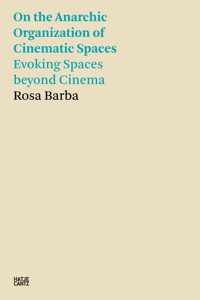
21,99 €
Mehr erfahren.
- Herausgeber: Hatje Cantz Verlag
- Kategorie: Geisteswissenschaft
- Serie: Hatje Cantz Text
- Sprache: Englisch
This publication engages with a futuristic progressive vision on the condition of cinema. By questioning and analyzing cinema's past and present industry with respect to various forms of staging from the perspective of artistic practice and research, a new space beyond is formulated. The author takes on a journey to reveal an imaginary—astronomical—political trope on and through what can be called the cinema of the present.
Das E-Book können Sie in Legimi-Apps oder einer beliebigen App lesen, die das folgende Format unterstützen:
Seitenzahl: 209
Veröffentlichungsjahr: 2021
Ähnliche




















On the Anarchic Organization of Cinematic Spaces
On the Anarchic Organization of Cinematic Spaces
Evoking Spaces beyond Cinema
Rosa Barba
Colophon
Author
Rosa Barba
Project management
Richard Viktor Hagemann
Copyediting
Aaron Bogart
Graphic design
Neil Holt
Typeface
Arnhem
Production and reproductions
Vinzenz Geppert
Printing
GRASPO CZ, A.S.
© 2021 Hatje Cantz Verlag, Berlin, and the author
© 2021 for the reproduced works by Rosa Barba and Yves Klein: The Estate of Yves Klein / VG Bild-Kunst, Bonn
© 2021 for the reproduced works by Yves Klein: VG Bild-Kunst, Bonn
© 2021 for the reproduced works by Maya Deren: The Estate of Maya Deren
Published by
Hatje Cantz Verlag GmbH
Mommsenstraße 27
10629 Berlin
www.hatjecantz.com
A Ganske Publishing Group Company
isbn 978-3-7757-5027-1 (Print)
isbn 978-3-7757-5028-8 (e-Book)
Printed in the Czech Republic
Co-funded by the Hochschule für Künste | University of the Arts, Bremen
Special Acknowledgments
PhD Program at Malmö Art
Academy, Lunds University 2013–2018
Sarat Maharaj, Gertrud Sandquist
Marion von Osten, Andrea Ray, Imogen Stidworthy and Alejandro Cesarco, Verina Gfader, Lindsay C. Smith, Center of Land Use Interpretation, Josiah McElheny, Jaclyn R. Arndt
Ben Borthwick, Mark Leahy, Ann Reynolds, Jonathan Smit, Franck Bordese, the Family
Image Credits
19 NASA, ESA, and G. Bacon (STScI)
27, 30 Harvard University Archives
31 Smithsonian Institution Archives
32, 34 Courtesy of Harvard College Observatory
42 Photo: Peter Harris
44, 60, 63 (bottom) Photo: Kris Qua
54–55, 57, 67 (bottom) François Doury
58 (top), 130, 139 Photo: Jenny Ekholm
62, 63 (top) Photo: Liz Ligon
63 (bottom) Photo: Kris Qua
66 Photo: Filip Vanzieleghem
73 (bottom) Courtesy of Sandra Gering Inc, New York
74 (top) Photo: Bernd Borchardt
94 bpk / CNAC-MNAM / Georges Meguerditchian; © Galerie de France
135 Photo: Caroline Fuchs
138 Photo: Mizuki Kin
142, 143 Photo: Blaine Campbell
144 Photo: Marios Stylianou
145, 156 (top, middle) Photo: Andrea Rossetti
Table of Contents
Introduction
Chapter 1: Speculating on Astronomy and Cinema
Overexposure
Henrietta Swan Leavitt: The “Cinematic” Discovery of Cepheids—The Flicker of the Stars—A Digression
The Color Out of Space (2015)
On Darkness—Cinematic and Telescopic Observations
White Museum (2010–): Reordering Cinematic Space
Instruments In and Out
Chapter 2: The Immatrial Medium That Articulates Space—The Camera as a Drawing Instrument
Camera-as-Instrument Drawings
Drawing to Trace the Physicality of Time
Expanded Spatial Multiplicity / La Durée / Internal Thought / Accessing Memory
Landscape as Document
Flicker and Algorithm
Landscape as Ruins
History Is Like a Sculpture: Islands as Monuments of Transformation
Chapter 3: Collective Performance as Embarkation: Activating the Subconscious
Flicker as Leap
Involuntary Memory
Non-actors as Documents
Fact and Fiction in the Public
Chapter 4: Materiality and Machine: Looping and Fragmenting to Create a New Auditorium
The New Machine
The Autonomy of the Material
What do I mean by the activity of “play”?
Hyperspace—Referring to another Hyperspace—A New Auditorium
Conclusion
Bibliography
Works
Colophon
Introduction
This book engages with the space beyond cinema and comprises a futuristic vision of its conditions.
As an artist and filmmaker, I explore film and its capacity to simultaneously be an immaterial medium that carries information and a physical material with sculptural properties. The category of film is expanded and abstracted beyond the literal components of the celluloid strip, the projector through which it passes, and the image projected onto a screen or beyond—where the landscape itself forms the screen. Each component becomes a starting point for artworks that expand the idea of film while exploring its intrinsic attributes.
By disregarding and overturning the conventional spatial relationships between those components, my aim is to create a new space that is defined by an uncertainty regarding how those relationships define the experience of cinema.
My work takes a conceptual approach that considers cinema in an architectural sense and as an instrument, where the environment, the screen, and the projection can be combined and pushed forward to create another spatiotemporal dimension that is concurrent with and beyond the context of the interior and exterior space. Uncertainty and speculation exist within that expanded space. It is an anarchic dimension and offers a new foundation for thinking and acting through destabilizing the old hierarchy of the components of cinema, by freeing them from their original use and letting them interact in new and unforeseen ways.
I propose four different modes of inquiry into how this “space beyond” can be achieved, which create anarchic organizations of cinematic spaces:
— Through speculating on astronomy and cinema.
— Through the immaterial medium that articulates a new space or auditorium.
— Through collective performances as embarkation.
— Through the fragmentation of material and machine.
The book is structured as a “Fictional Library,” which is not meant to be a self-contained system of chapters, but rather an ever-evolving arrangement of suspended words and themes, which dissolve and reappear in different functions. These are keywords with modulating meaning, and through my artistic practice they activate and connect different bodies of work as interlinked themes of an emerging understanding of a space beyond cinema. This space transcends real space, imagined spaces, and virtual and augmented spaces, which collapse into each other with their inscribed histories.
I use the diagram as a key apparatus in my analytical tool kit for this research and not as a mere extension. It is an analytical device used to articulate different dimensions and to represent them in the Fictional Library.
In my artwork, cinema becomes an instrument to interrogate the qualities of space. I often manipulate the apparatuses of cinema such that projectors are transformed into new mechanical objects that generate information in real time, and that turn on themselves and bend the conventions of cinema to the requirements, possibilities, or limitations of their new forms. My aim is to create spaces that are not limited by the convention of two-dimensional projection, but that open narrative possibilities by dissolving the barriers between the space of the projection and the space of the spectator as well as the space beyond.
My intention with this research is to propose a journey from cinema to another kind of film, through an objectification of a filmic ontology into a hyperspace whose nature and limits have not been defined. This space beyond consists of spaces stacked on top of each other and is reached through the concept of “embarkation,” that is, a journey from A to B, with a change of gear to create new mental places of experience and consciousness.
The notion of space as architecture relates to the community that shares those spaces, geographically and mentally.
How do we create a performative setting where fact and fiction can be intertwined?
The Fictional Library can be considered as a definition of the space where work titles (expanded experiments on projection, both finalized and in progress) and key words or phrases (expanded definitions and thoughts on the immaterial medium created through light) meet, according to a specific arrangement within, acting as caesuras and dashes within and through the argument. The Fictional Library has thus become rhythmical, somewhat anarchic, speculative, and subjective.
By reconfiguring the physical terms of cinematic space, my aim is to also expand and destabilize the conceptual terms of cinematic space, so that the formal terms by which we understand that space are extended to engage with and incorporate spaces that are not conventionally associated with cinema. This could occur, for example, by expanding the works into public spaces or landscapes. The goal is to explore the implications of how those terms coincide with the terms of disciplines and areas of inquiry that exist beyond the scope of what we conceive of as cinema but that share some of its foundational components and terms.
We live in an environment that is increasingly dominated by visual information. Screens push imagery at us for our consumption at every turn: phones, laptops, TVs, and ever bigger screens dominating public and commercial spaces have created a climate of intense visualization. A host of new technologies reinforces a constant visual euphoria—high-definition television, digital video, cell phone photography, virtual reality. In this current context, scale has reemerged as one of the primary markers of cinematic specificity (along with the collective theatrical experience). The cinema has reasserted itself as being “larger-than-life,” a performance of bare magnification, surrounding and absorbing the spectator.
Is this everyday visual culture an extension of the cinematic experience, or do the classical elements of cinema make it something fundamentally different? What aspects of cinematic culture should I zoom in on to expose its possibilities as an anarchic force, rather than it being considered simply one more outlet of visual data?
Even as far back as the mid-1990s, when I first began to work with film in my artistic studies, I had doubts about the cinematic apparatus that was given to me. I was overwhelmed by the overproduction and rigidity of all the elements that went into film, as well as by the overstimulation of the senses: the simultaneous overloading of both the audio and visual, according to a predetermined set of elements that exist for presenting and consuming film in the cinema. Straight away, I developed a need to reduce those elements down to single tracks, giving each component much greater space—each gaining its own independent narrative layer—by playing around with and fragmenting them. This is evident in works like Spacelength Thought (2012), Stating the Real Sublime (2009), Boundaries of Consumption (2012), and One Way Out (2009), which will be discussed in chapter 4.
As time went on and I continued to produce film-based work, new technologies developed, and with them a continual intensification. The environment became ever more cinematic, with each new technology leaving less and less room for people to construct the world around them for themselves. Eventually, there were no gaps left, with everything set and “seen” for us. People were being given the tools and technology to create more images more easily, but, paradoxically, the possibilities were being limited. The experience of different options, of spaces of ambiguity, was taken away from the perceiver, resulting in a closing down of cognitive potentials and desires.
My response was to intensify my strategies of fragmentation, by dismantling the status quo of cinema, and to focus on certain possibilities that arose from playing around with its components: turning them inside out, upending and altering them, and redistributing them until they opened new, anarchic spaces.
The concept of the “anarchic” is key here. It is a way of halting the development of cinema as merely an extension of our current visual-data overload and opening it up to an alternative direction, one that can take an investigative course and that can be in dialogue. “Anarchic” is used in this context not to signify “chaotic.” A cinematic experience in anarchic space doesn’t follow a precise order; rather, it is created through specific situations, arrangements, and methodologies.
I believe that disrupting the status quo of cinema opens novel cognitive spaces that give access to new kinds of thinking and ways of experiencing. Why is that significant to do? What is to be gained from such an experiment? The importance of this action is that it breaks with the perceptual habits of the status quo and makes us think in different directions. Thus, this anarchic dimension offers a new foundation for thinking and acting by destabilizing the old hierarchy of the components of cinema and freeing them from their original uses and letting them interact in new and unforeseen ways.
Another important dimension of my work in this context is that of staging and performance, revolving around the question of how a performative setting can be created where fact and fiction can be intertwined. I interrogate the industry of cinema with respect to various forms of staging, such as gesture, genre, information, and documentation, taking them out of their conventional contexts and reshaping and representing them anew. In this way, I experiment with and expand time-based forms into sculptural objects or speculations, that is, into spaces that are self-organized; it is an ever-changing, shifting process.
The aim of this process is to create a new form of auditorium, one that allows for an expansion of our thinking. Such an auditorium is not fixed; each project produces its own theater, to unpredictable effect. This space, however, is not intended to be a “hall” in the traditional sense of a cinema auditorium, but rather it is an arrangement of the faculties, which hold different “sensoria.” Here, the transmitter and receiver are fluent in both directions.
These different approaches to—and forms of—space are therefore at the core of my research, which takes a conceptual approach that regards cinema in an architectural sense but also as a tool. Here, the environment, the screen, and the projection can be combined or pushed forward to create another spatiotemporal dimension that is concurrent with and beyond the context of interior or exterior space. Uncertainty and speculation exist within this expanded space.
My research therefore represents four different modes of inquiry into how this “space beyond” can be reached or achieved—mentioned above—with each of these four modes creating different anarchic organizations of cinematic spaces.
The four core chapters of this book explore the concepts of this conceptual practice and methodologies of how to reach the space beyond. In the first chapter, I investigate how the coincidence of terms common to both cinema and astronomy can simultaneously effect a reconfiguration of cinema’s conceptual space and propose ways of making cinema that embody and exploit the expanded dimensions of that reconfigured conceptual space. This concept is discussed through the idea of the instability of vision as an astronomical and a cinematic mode.
In chapter 2, I focus on the idea and possibility of using flicker as a method to capture landscape, and I map out the way the camera is used as a drawing instrument. Flicker is treated differently here than in cinema studies. It has been thrown into question by looking at astronomical concerns. In chapter 3, I examine the possibility of activating the collective’s subconscious as an artistic method in order to embark with it into an oscillating environment. Embarking is meant as sort of “release and reaching” through experiencing and thinking. It is an abstract space—a mode. In chapter 4, the components and uses of materiality and machine are pulled apart and abstracted to reach other experiences through play and conceptual practice. The conclusion discusses the need to rewire established cinematic spaces through speculation and play and how doing so offers a new dimension of visual and cognitive experience.
This research project and book arrives at this model by looking closely at a number of my own artworks and contextualizing them within the wider fields of philosophy and art theory. Several key terms are explored and expanded to give a clearer sense of the decisions and processes involved in making my work, and these key terms form the basis for a new way of thinking about cinematic spaces.
This is a project that reflects on and interrogates my practice and opens the outcome to broader reflection for other practitioners and thinkers. The project is not an attempt to write everything possible about my work, and neither does it set out to rewrite the history of art cinema. It retains a focus on my practice and on a particular body of works, the examination of which gives me ways to articulate my wider ideas on cinematic space, on the experience of participants in artworks, and on possibilities for artworks to remain open and in potential rather than serving up closed situations of spectacle or entertainment.
For the purposes of this book I have chosen to group my works around ideas and themes and not to present them chronologically. This allows me to examine the thematic and methodological links between them without depending on a model of sequential development or direct influence. For example, my 2018 encounter with the materials at the Harvard College Observatory in the United States formed new connections to an earlier project and gave me a new sense of some of my other earlier works. Time is one of the materials I work with in this book.
A methodological tool I have used for this research project is the diagram. The diagram allows for lines of methods that go across and through thinking and that are not connected chronologically. The diagrams function as concept maps, and they describe the correlation between the works, ideas, concepts, and methods. After nearly two decades of making work, I can experience this new resonance and perspective and see the relevance of it within my practice. The diagrams also function as maps of sections of the Fictional Library.
The subheadings listed below each chapter title present a list of works the chapter will deal with and an indication of the topics or sections within the chapter. I also use epigraphs in some chapters to underline a theme or topic. They create a kind of hum.
The notes that appear on the right or left side of some pages introduce a new structural element to the space of the page. They remind the reader that the page is also a space and that this book (as a document) is working to disrupt that space; these notes deliberately present this disruption as part of the organization of the project. The notes also operate as a flickering element on the edge of the page. Their content offers working definitions for key terms for my practice and contain material that comes from a variety of sources, including my own word definitions and those of dictionaries, which I view as suggestive existing explanations culled from public knowledge. The definitions are not all of the same kind.
Within the chapters, I have inserted some extended quotations parallel to the text, like an independent layer that functions as a cross-understanding or as another voice that organizes the thinking with a particular rhythm or tone from another point of view. They have not been woven fully into the argument under discussion, but act as an accent or layer that adds information without being integrated.
The section headers within each chapter act as rhythm and disturb the hierarchy of the sections, and therefore also represent the structure of disruption within some of my work. The temporal chronology and the page sequence do not simply map each other: we read something now that makes sense later, or we read something at a later point that connects to something said earlier.
This book is structured as a “Fictional Library,” a model that itself is a methodology and also functions as a mode of presentation.
In using the term “library” I suggest the model of a collection of sources, and the adjective “fictional” operates theoretically close to the idea of “fabricated,” meaning assembled parts or sections of knowledge and experiences.
The Fictional Library is used as a methodology to express the inability of the language available to us to deal with some concepts or possibilities. This points to a “before” or “beyond language,” a realm that is captured through cinematic experiences. The materials of this Library are paraverbal words. They function around the word, below and beyond. We feel sometimes that we come close with language, but not close enough. We cannot grasp the unwordable, what is inexpressible in words, but we can get a sense of it. It’s a sort of vibration.
Introducing the notion of “fiction” is meant to add a three-dimensional view, allowing for different angles of perspective on how different inventions come together. It is a method to create questions about knowledge. The Fictional Library is a shelf-less library; it exists with no rigid classification system, but is rather in constant development. It is unclassifiable, “genreless” in its fluidity of connection.
In this book, the term “anarchism” represents a set of self-organizing principles that are gathered together by a knowledge that occupies an as-yet-undefined space beyond cinema. This space is reached by many different disciplinary fields (a sort of ever-changing collective) and techniques that touch and activate each other, not under the direction of an autocratic artist-as-master-planner, but rather through explorations in each part of the Library, which evolve over time and through the continuous organizing of their own relationships and shades of meanings.
Developed by the educator and scientist Joseph Novak, concept mapping is unique in its philosophical basis, whereby “concepts,” as well as propositions composed of concepts, are the central elements in the structure of knowledge and the construction of meaning. While a mind map is fixed on a single two-centered approach, a concept map is freer in form. Although often personalized and idiosyncratic, concept maps can be used to communicate complex ideas.
Concept maps are graphical tools for organizing and representing knowledge. They include concepts, usually enclosed in circles or boxes of some type, and relationships between concepts indicated by a connecting line linking two concepts. Words on the line, referred to as linking words or linking phrases, specify the relationship between the two concepts. We define concept as a perceived regularity in events or objects, or records of events or objects, designated by a label. The label for most concepts is a word, although sometimes we use symbols such as + or %, and sometimes more than one word is used.1
Using these methodologies to flesh out the argument allows the spatial to be brought into the frame. This is seen, for example, with the work White Museum, South Saskatchewan River (2018), for which a 70 mm film projector projected onto the South Saskatchewan River from the Remai Modern and put light onto the landscape, which carries a hidden, historical narrative. Everything is condensed into each other: the sonic, which is composed of the surrounding sounds, and the visual experience. (See further discussion in chapter 4.)
The approach of the Fictional Library opens up the possibility to think about the world and its real spaces, as well as the sonic level of experience, in a different way. Our whole perceptual being is kept alert and open to new possibilities, and we are not completely indoctrinated into viewing and listening in only one way. By contrast, this is what cinematic culture does: it rooms and schools you in certain tracks and ways of thinking. I want to analyze and open up vision and experience to see the potentials of visual representation in its many forms, since multiple versions exist at cinema’s core. This involves going beyond cinema, looking at its components, and seeing the possibilities.
In this way, physical and dimensional space is collapsed with mental and conceptual space. The importance of creating these cinematic spaces is that it allows for an alternative discourse and an alternative mode of communication. Our full senses are activated. Both the transmitter and the receiver are fluent. The “space beyond” is a new space of thinking and acting.
Speculation on Astronomy and Cinema
Overexposure / Henrietta Swan Leavitt: The “Cinematic” Discovery of Cepheids—The Flicker of the Stars—A Digression / Send Me Sky, Henrietta (2018) / The Color Out of Space (2015) / On Darkness—Cinematic and Telescopic Observations / White Museum (2010–): Reordering Cinematic Space / Instruments In and Out
My art practice has long reflected an intense interest in a conceptual approach toward film. I tend to regard cinema in an architectural sense, whereby the environment (the space), the screen, and the projection can be combined or pushed forward to create another space “beyond.” I imagine this as existing in both interior and exterior space at the same time. It is a space shot through with a sense of uncertainty and speculation.
In recent years, I have been further struck by affinities between astronomy and cinema. On one level, both engage with concepts of light, time, and distance; indeed, it might be argued that both astronomy and cinema are essentially composed of only these elements. On yet another level, both can be understood as sharing, in different ways, fundamental aspects of uncertainty and speculation. The universe is made out of dark matter and only a very small part of our understanding of dark matter is based in factual knowledge. That is to say, an astronomy student can acquire all their factual knowledge around this in a very short time, as it forms only around four percent of their studies. Everything that follows moves beyond fact into a space of research and observation, into a space of, for lack of a better word, speculation.
When I refer to speculation, I mean a zone of reflection and discussion where hypotheses can be built up. A speculation zone exists to bridge real gaps in knowledge through imagining and inventing possible explanations for baffling phenomena based on scientifically informed research. One notable scholar who embraced the idea of mixing fact, confirmed knowledge, and speculation was philosopher and mathematician Imre Lakatos. His Proofs and Refutations




