


Erhalten Sie Zugang zu diesem und mehr als 300000 Büchern ab EUR 5,99 monatlich.
- Herausgeber: The History Press
- Kategorie: Geisteswissenschaft
- Sprache: Englisch
This fascinating volume explores all aspects of life in that dread institution, the workhouse. From the staff who lived and worked here to the lunatics who were kept - sometimes unsuccessfully - in the medical wing, the babies and mothers whose lives began - and sometimes ended - in the maternity ward, and the tramps, families and destitute persons who passed through the doors every day, it reveals a side of Rotherham that has long since been forgotten. This book also contains something that will delight all family historians - an extensive list of workhouse inmates in Rotherham. With more than fifty illustrations, this book will amaze locals, residents and historians alike.
Sie lesen das E-Book in den Legimi-Apps auf:
Seitenzahl: 225
Veröffentlichungsjahr: 2009
Das E-Book (TTS) können Sie hören im Abo „Legimi Premium” in Legimi-Apps auf:
Ähnliche


















Rotherham Workhouse
Rotherham Workhouse
MARGARET DRINKALL
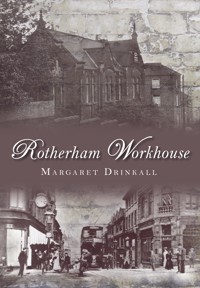
Front cover, top The walls of Rotherham workhouse (courtesy of RALS).
Front cover, bottom High Street, 1905-09 (courtesy of RALS).
Back cover Women and babies, Aston, 1901-20 (courtesy of RALS).
First published 2009
The History Press
The Mill, Brimscombe Port
Stroud, Gloucestershire, GL5 2QG
www.thehistorypress.co.uk
This ebook edition first published in 2013
All rights reserved
©Margaret Drinkall, 2009, 2013
The right of Margaret Drinkall to be identified as the Author of this work has been asserted in accordance with the Copyright, Designs and Patents Act 1988.
This ebook is copyright material and must not be copied, reproduced, transferred, distributed, leased, licensed or publicly performed or used in any way except as specifically permitted in writing by the publishers, as allowed under the terms and conditions under which it was purchased or as strictly permitted by applicable copyright law. Any unauthorised distribution or use of this text may be a direct infringement of the author’s and publisher’s rights, and those responsible may be liable in law accordingly.
EPUB ISBN 978 0 7509 5268 2
Original typesetting by The History Press
Contents
Acknowledgements
Preface
one
The Old Poor Laws and Life in the Rotherham Workhouse
two
The Board of Guardians
three
The Medical Officers of Health
four
The Workhouse Chaplain
five
The Master and Matron
six
Teachers and Education in the Workhouse
seven
Giving Birth and Children in the Workhouse
eight
Lunatics and Imbeciles
nine
Mismanagement and Allegations at the Workhouse
Appendix: Some of the Workhouse Paupers Mentioned in the Guardians’ Minutes
Bibliography
Acknowledgements
Many people have been instrumental in helping me write this book and to them I extend my grateful thanks. Firstly, for the patience and forbearing of my two sons, Steve and Chris: as always, with my love. I would also like to thank the staff of the Rotherham Archives and Local Studies (RALS) Department for all their help, which has been invaluable. I would also like to extend my grateful thanks to Geoff and Sue Booker (Rotherham Web), David Speck (Hull in Print), Tom de Wit (Westbury Manor Museum), George P. Landow (Victorian Web), Chris Hobbs (Sheffield Star) and Geoffrey Rivett (NHS History) for permission to use extracts in the book.
I also want to make special mention of friends Chris and Fiona Ruane, Julie Darrington and Ruth Peattie, all of whom offered encouragement and spurred me on. But most of all to Cate Ludlow at The History Press whose unfailing support has been instrumental in the production of this book. Also from The History Press, my sincere thanks to Nicola Guy, David Lewis and Helen Bradbury.
For anyone who wishes to learn more about my experience of the publishing process or information about future books, see the website at margaretdrinkall.co.uk.
Almost last, but not least, I want to thank the Rotherham Board of Guardians, who took the time to ensure that their decision making was recorded, and the several clerks to the Guardians who painstakingly copied these decisions of the Guardians’ meetings into the minute book. But I am most grateful of all to the inhabitants of the Rotherham workhouse, of whom very little is known. Their lives within the workhouse and their reasons for entering it remain unrecorded. All that is certain is that despite the Guardians’ and the Poor Law Commissioners’ view that most people who entered the Rotherham workhouse were generally idle and shiftless, reality proves that people would only enter the workhouse as a last resort when everything else had been tried and tested. People would, and did, starve to death before entering its walls. It is to these people that I extend my grateful thanks; hopefully I am able to shine a small light onto their existences within that terrible place.
Preface
The introduction of the Poor Law Act of 1834, followed closely by the Poor Law Amendment Act of the same year, was a revolution in the way that legislation looked at the needs of the poor. The intention was that with the introduction of these Acts no able-bodied pauper would be given outdoor relief; therefore they would be forced to enter the workhouse. The Poor Law Commissioners thought this would simultaneously reduce the amount of relief paid out and as a bonus remove the poor out of sight. There is plenty of evidence within the Rotherham Board of Guardians’ minutes to illustrate that the workhouse system did not work, not because of the Guardians themselves as administrators of relief, but simply because of the large number of inmates who were unable to work or move on. Inmates such as children, people with physical and learning disabilities and the elderly men and women resulted in the workhouse gradually filling up with paupers and the costs of relief becoming astronomical.
The records of Rotherham workhouse were kept by a variety of clerks and the handwriting differs throughout the records. The writing is sometimes very hard to decipher and the lack of punctuation occasionally makes reading difficult, but any mistakes which are made here are my own. In reference to money I have used the old system of pounds, shillings and pence (i.e. 20s refers to twenty shillings, and £1 5s 6d refers to one pound, five shillings and sixpence). I have used as many names as I am able to under the Freedom of Information Act and urge anyone who feels that I am discussing a relative of theirs to remember that the stigma of poverty was endemic in Victorian society and the fact that at least a record of their relatives’ lives remains. It should not be seen as a disgrace. Written before the days of political correctness, the terms used in the minutes are thankfully not acceptable today. However, for accuracy I will use the terms as written, with many apologies if I offend readers, which is not my intention.
I decided to close my study in 1902 as this was the year where the Rotherham workhouse began to take hospital status, reducing the fear for many poor of the town. Nevertheless, the alarm of going into the hospital replaced the fear of the workhouse for many years to come, due in some part to the original use of many of these buildings in the West Riding of Yorkshire. The lives of the paupers were so different to those of the people on the Board of Guardians who made the laws, but I do believe that the Rotherham Guardians were honestly trying to make the lives of their charges easier; they truly felt themselves to be the ‘Guardians’ of Rotherham’s poor and needy.
one
The Old Poor Laws and Life in the Rotherham Workhouse
The old Poor Laws were developed out of a growing sense of a parish’s responsibility towards its poor. Prior to the Reformation, monasteries and abbeys had mainly dealt charitably with the elderly and sick of the parish. They also gave relief to tramps and vagrants passing through the towns who had no visible means of support. Since the closure of the monasteries by Henry VIII in 1536, townships such as Rotherham took responsibility for their own poor and sick. Overseers of the parish would undertake this task by drawing up lists of ratepayers within the town, collecting taxes from their properties and distributing it to the poor and sick in the form of relief. These overseers would be ratepayers and respectable men of the town such as vicars or churchwardens, who would give up their time freely to undertake such tasks. Rotherham also had a group of town trustees who administered relief to the poor, known as the Feoffees of the Common Lands. They bought and sold land, and the revenues so raised were used to provide relief to the poor of the town.
After the plague years, when labour was short, men would go to other parts of the country to find work and support their families. But if they became sick or unemployed and had to claim relief, this would lead to the problem of ‘settlement’ (where the pauper had to prove that they had a claim to live or be ‘settled’ within that parish). Naturally, overseers, and later Guardians, were reluctant to pay for paupers that were not of their own parish, and throughout the Board of Guardians’ minutes there are many queries about settlement. People could only claim this by rights of property, having lived in the area for more than a year – or, if they were female, by settling in their husband’s parish. Without any of these rights, newcomers to the town could be brought before the local Bench if they deemed them ‘likely to be chargeable to the parish poor rates’. Any person wishing to move out of their own area would need a letter from the Justice of the Peace or risk punishment in the stocks as a vagabond.
Parish paupers who were able to prove their ‘settlement’ and were given relief were often required to wear something to distinguish them from the more ‘respectable poor’ who were not on relief. As John Guest shows in his Historic Notices of Rotherham, stigmatisation towards the poor in Rotherham resulted in them being forced to wear a particular badge indicating their status, which was a legal procedure resulting from the William III Act which stated that ‘every person receiving parish relief shall wear upon the right shoulder of the outer garments a badge either in red or blue cloth consisting of a large Roman P preceded with the first letter of the name of the place where the person lives’ (i.e. paupers in Rotherham would have RP inscribed on the badge).
The Poor Law Amendment Act came into force in 1834. It encouraged parishes to join together to build large union workhouses to replace the many scattered small workhouses throughout the parishes. These small workhouses were found in the small townships of Kimberworth, Greasbrough, Rawmarsh Laughton and Rotherham. But most importantly, the Act ensured that no relief would be supplied to able-bodied paupers outside of the large union workhouse. It was felt that by building these larger workhouses the administrative tasks of relieving the poor would be simplified. The reality, however, was that bigger workhouses simply meant bigger costs of relief.
The model guidelines were developed by the Poor Law Commissioners, a group of people responsible to the government to oversee the Board of Guardians. These Commissioners were later called the Poor Law Board (and later still, the Local Government Board). The guidelines specified that a group of respectable townspeople be elected onto the Board of Guardians yearly, to meet on a regular basis and take on the responsibility for the relief of the poor of Rotherham. The Guardians were empowered to elect workhouse officials to aid them in their task. This board would be led by local landowners – in Rotherham’s case, the Earl Fitzwilliam and the Earl of Effingham.
The Rotherham Guardians and the Poor Law Commissioners believed that strict reductions of the lists of paupers and controlling the payment of rates would inevitably result in savings for the ratepayers. However, periods of escalating unemployment, frequent epidemics and increases in the numbers of paupers who were termed ‘imbeciles’ and ‘lunatics’ led to massive overcrowding in the house. This resulted in estimated costs rising to unprecedented levels. Prior to the new Act, elderly or sick paupers would be helped out by neighbours in their community, who well understood the cyclical nature of poverty. Often only a few shillings would be needed. However, the huge numbers of paupers in these institutions meant significant outlays in relief. All this was yet to happen when, in July 1837, the Rotherham Guardians drew up their lists of paupers and decided what was to be done until the union workhouse could be built in the town.
The Poor Law Commissioners had developed the Consolidated General Order of 1847 which laid down the way in which Guardians would be elected and the roles of the workhouse officers. It became a Bible with which many of the local Board of Guardians would develop their role. The order indicated the classification of the paupers into seven categories upon admittance to the union workhouses. They were:
Men infirm through age or any other cause
Able-bodied males over fifteen
Boys between the ages of seven and fifteen
Women infirm through age or any other cause
Able-bodied females over fifteen
Girls between seven and fifteen
Children under seven
The cost of the relief of the poor and the cost of building the union workhouse was to be paid for by the ratepayers of the town of Rotherham. Many of the houses of the town were in a poor condition and were of no rateable value, and so the relief would have to be paid by people with rateable property of over £5 per year. Property valuation lists were drawn up with the help of the overseers of the poor, and relieving officers were to be appointed. Calls (or rates) would be made on the value of properties within each parish, some being wealthier than others. On 24 July 1837, the Guardians resolved to ‘provide the union with the funds estimated to be required to defray the current expenses of the union’. They resolved that the calls on the several parishes shall be 10 per cent on the declared averages of each, and demanded that the ‘several accounts shall be paid to the treasurer on or before the 7th August next’. Orders were accordingly signed directing the parish officers of the several parishes to pay the following sums which were listed in the minutes:
Parish
10 per cent of call
Total call
Rotherham
£103 16s
£1,038
Brinsworth
£9 4s
£92
Catcliffe
£4 18s
£49
Dalton
£8 14s
£87
Greasbrough
£53
£530
Kimberworth
£79 2s
£791
Orgreave
£4 4s
£42
Tinsley
£17 18s
£179
Aston cum Oughton
£18 8s
£184
Bramley
£10 8s
£104
Brampton En Le Morthern
£5 16s
£58
Treeton
£19 18s
£199
Ulley
£4 16s
£48
Brampton Bierlow
£39 12s
£396
Swinton
£32 4s
£322
Wath upon Dearne
£38 16s
£388
Wentworth
£39 4s
£392
Hooton Levitt
£6
£60
Maltby
£25 16s
£258
Hooton Roberts
£12 10s
£125
Laughton En Le Morthern
£28 18s
£289
Ravenfield
£10 12s
£106
Rawmarsh
£50
£500
Thrybergh
£11 12s
£116
Whiston
£39 2s
£391
Wickersley
£15 12s
£156
Beighton
£29 8s
£294
Total
£719 8s
£7,194
There was much resentment from the parishes at having to pay these calls, but with the backing of the Poor Law Commissioners the Guardians’ demands were very clear. They gave specific dates by which these amounts had to be paid, and districts that did not fulfil their obligations were prosecuted. There are many instances quoted in the minutes of the different parishes requesting extra time to pay these calls. In September 1837 the Guardians were told by the clerk that several parishes had not paid to the treasurer the amounts due to them: they were told that ‘unless payments were paid in full on or before the 17th instant, legal proceedings would be taken against them’.
Once the large union workhouse at Rotherham had opened (in around June 1838), the able-bodied poor of the town were not given relief but instead issued with tickets of entry to the workhouse. These tickets would be given by the relieving officers who were stationed in the different districts. Later these tickets would also be given by police constables. Many of the instructions of the Poor Law Commissioners held the view that poverty amongst able-bodied men and women was a direct result of their own idleness. The Sixth Report of the Poor Law Commissioners 1840, England and Wales plus Ireland (which you may read for yourself at www.institutions.org.uk/poor_law_unions/unmarried_mothers.htm) shows that their view of the purpose of the workhouses was very clear:
The sole object of the workhouses is to give relief to the destitute poor in such a manner as shall satisfy their necessary wants, without making pauperism attractive, or otherwise injuring the industrious classes. The workhouse is not intended to serve any penal or remuneratory purpose: and it ought not to be used for punishing the dissolute.
Nevertheless, the main function of the workhouse was as a deterrent to the idle poor, and in this it succeeded. Some of the newspaper reports indicate the dire poverty to which people of Rotherham and other towns were subject – and reveal how many of the paupers would rather starve than approach the relieving officers for help. Such a case was reported in the Rotherham Advertiser on the 6 February 1897, under the by-line ‘How the Poor Live’; it involved the death of a widow, Mary Anne Branch, aged fifty-one, at the workhouse. The medical officer, Dr Alfred Robinson, had attended to her when she was admitted on the 22 February, and found that she was in a state of collapse and unable to give an account of herself. He treated her for starvation and neglect. It was reported that she earned her living by singing and begging and had lived in the many lodging houses of the town. These houses were notorious slums, as were the houses of the poor, and there were many dark courts where sunlight could rarely be seen for any length of time. In the summer, Mary Anne would stay out all night rather than pay even the smallest lodging-house fees, and by the time she was admitted she was much emaciated. She died on the 29th. The jury returned a verdict of death from natural causes accelerated by privation and neglect. The coroner stated that if she had gone to the workhouse earlier she would have been in a better state than she had been prior to her death. He added that, ‘people of that class rather than submit to a bit of control and confinement in the workhouse will for the sake of liberty go out, having no where to live and nothing to live upon. Hundreds do this sort of thing’.
From now on even the entry process into the workhouse was seen as demeaning, and paupers were treated as a lower form of life. Immediately upon admission, the new inmates were separated from their families, men from wives and children from their parents. Their clothing was removed, disinfected and stored until they left the workhouse. Paupers were admitted into the receiving wards where they were searched and washed and were required to put on workhouse clothing. This was institutionalised clothing which was functional and basic. Studying the lists of provision for clothing, which changed very little over the years, the standard wear seemed to consist of ‘men’s and boy’s worsted jackets’, ‘trowsers’ and shirts. For women, materials such as gingham and checks were bought, possibly worn as aprons over dresses of unbleached calico. The usual footwear for men and boys were hob-nailed boots; women and girls wore shoes. On admission to the workhouse the pauper’s hair would be cropped by the workhouse barber, the same haircut given to men and women. Men would also be shaved by the barber on a regular basis as no sharp implements such as scissors or razors were allowed in the workhouse. Applications for tenders for the barber were advertised in the local newspaper. The paupers would then be examined by the medical officer of health. If they showed any sign of illness they would be admitted into the hospital; otherwise they would be directed into the segregated day rooms and given work to do. This completed the hated initiation into the walls of Rotherham workhouse.
The regime in the workhouse was purposely hard and meant to daunt even the toughest pauper. The usual timetable show that the inmates would rise at 6 a.m. from March to September (7 a.m. from September to March), have half an hour for breakfast from 6.30-7 a.m. before going to work (which would start at 7 a.m. and finish at 6 p.m. with an hour’s break for lunch). Supper would be from 6-7 p.m. and bedtime was 8 p.m. No talking was allowed during mealtimes and any bad behaviour was entered into the master’s punishment book. Naturally, able-bodied inmates of the workhouse were expected to work in return for their accommodation or maintenance, and a stone yard was provided for this purpose. The Guardians of Rotherham received advice from the Poor Law Commission on the amount of hours which these paupers would work in return for being maintained in the workhouse. The amount of scales of relief would vary throughout the minutes and many discussions took place on this subject. In January 1854 the Guardians resolved that the scale for ‘all poor applying for relief on the grounds of want of employment should be set to work at the workhouse for 9-10 hours per day’. The work for an able-bodied man would consist of breaking stones or cinders and chopping up railway sleepers for firewood. Older inmates and children would pick oakum. The work for able-bodied females would be more of the domestic variety such as working in the workhouse laundry, cooking in the kitchens, cleaning or sewing.
The cost of each inmate’s relief was expected to be paid by family members out of the workhouse. The costs could be enforced by law, and wages were attached when necessary. Many of the inmates were deserted wives and their cases were heard in the local courthouse in College Square. In July 1880 Thomas Blackburn, described as a nail maker of Rotherham, was accused of leaving his wife and three children chargeable to the union to the sum of 5s 4d. He was found in Leicester and brought back to Rotherham. It was reported in the local newspaper that this was the third time he had deserted his wife and family to look for work. The Guardians suggested that if he had been unable to find work he would have been given work at the workhouse. The prisoner said the he wanted ‘better paying work than would be paid at the workhouse’. For the crime of deserting his family in order to obtain employment for them all resulted in his being committed to the House of Correction for one month. The work at the workhouse was very unpopular and many inmates would refuse to do the tasks assigned to them. Such a case was that of John Burns, who refused to do the work and threatened the master in August 1887. He was taken before the magistrate and sentenced to fourteen days; the magistrate added that if he came before him again for the same crime he would be sentenced to one month’s imprisonment.
Sometimes the Guardians were empowered by law to seize bequests which could be used for the maintenance of a pauper who had been sent to the local asylum and who was the responsibility of the Rotherham Guardians. In February 1893, the clerk informed the Guardians that he had been corresponding with solicitors Messrs Saunders, Nicholson and Reedes in reference to the claim for maintenance of Betsy Jane Sayles, a pauper lunatic from Rotherham who was now an inmate at the asylum at Wadsley. The clerk informed the Guardians that she had inherited £56 6s 9d under the will of Mrs Harriett Sayles, deceased, which the Guardians felt should be used for her maintenance. The clerk was ordered to receive the money and hand it over to the relieving officer for payment into the bank to defray the cost of her relief.
The administration of the workhouse and the developing system of relief demanded by the Poor Law Acts was a massive task for anyone to take on. The people who would take on this responsibility were a group of local businessmen and the two earls. They had to find and buy the land for the workhouse, arrange a loan for the building, develop the system of calls on the parishes and administer the cost of relief. This group of businessmen were the Rotherham Board of Guardians.
two
The Board of Guardians
On Monday 3 July 1837 a group of people met in the imposing courthouse in Rotherham town centre, a building which no longer exists, to elect a Board of Guardians of the Poor. Unanimously elected as ex officio Guardian was the local landowner Earl Fitzwilliam; as chairman of the board and to deputise in his absence, John Fullerton Esquire; and as vice chair, the Reverend Doctor Milner. These ex officio Guardians were people who were automatically elected due to their status and position in the town. In Rotherham the Guardians included two Earl Fitzwilliams: the 5th Earl served until his death in October 1857, followed by his son, William Thomas Spencer, the 6th Earl, from 1857 to his death in 1902.
The board’s first task was to decide how many Guardians would be needed, and it was agreed that one Guardian would be appointed for each of the twenty-seven parishes (apart from Rotherham and Kimberworth, whose population was larger; it was therefore more appropriate that two Guardians would be appointed for those districts). The very first Rotherham Board of Guardians were:
Guardians name
Parish
Guardians name
Parish
John Aldred
Rotherham
John Jackson
Brampton Bierlow
Edward Pagden
Rotherham
Thomas Bingley
Swinton
Francis Parker
Brinsworth
William Carr
Wath
William Rawling
Catcliffe
Benjamin Buyram
Wentworth
John Didsbury
Dalton
Revd William
Henry Downes
Laughton En Le Morthern
Edward Jackson
Greasbrough
Roger Heywood
Hooton Levitt
Jonathon Bray
Kimberworth
John Horncastle
Maltby
William Glossop
Kimberworth
William Frith
Hooton Robert
John Oxley
Orgreave
Thomas Bosville
Ravenfield
Henry Dyson
Tinsley
James White
Rawmarsh
Francis Moss
Aston
William Whitaker
Thrybergh
Joseph Roberts
Bramley
Revd Walter Shirley
Whiston
John J. Glossop
B. En Le Mor.
Revd John Foster
Wickersley
John Jubb
Beighton
Robert Taylor
Treeton
William Moss
Ulley
The Guardians agreed at this first meeting that they would meet weekly, on Mondays at 10 a.m., at the old Town Hall, still in existence on Effingham Street. It was further agreed that as soon as the new union workhouse was completed, the Guardians would meet on the first Monday of every month at the union workhouse in the specially build board room. The Guardians resolved that:
a workhouse for the accommodation of 350 individuals [was] to be built within the union and that the following Gentlemen be appointed a committee to look out for an eligible site and report the same to the board viz: John Fullerton Esq, Revd John Foster, Revd William Henry Downes, John Aldred, Edward Pagden, Francis Parker and Robert Taylor and that such committee meet at 12 o’clock Wednesday next.




