


153,99 €
Mehr erfahren.
- Herausgeber: John Wiley & Sons
- Kategorie: Fachliteratur
- Serie: Wiley-Scrivener
- Sprache: Englisch
First book on rubber used as a construction material dedicated to the chemical process industry
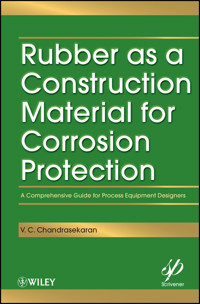
Despite the long history of rubber as a construction material, this book is a unique publication as it comprehensively looks at the material with respect to the anti-corrosion requirements of the multitude of industries where rubber is used, both on land and offshore. This guide documents how rubber reliably meets the threats of corrosion and contributes to the longevity of the equipment. Chapters on ebonite, natural, and synthetic rubbers, examine their relevant properties and chemical resistance.
The book details the practical aspects and handling of rubber lined equipment: thin-walled structures, vacuum vessels, ducts, large diameter tanks, agitators, and fully lined pipes (both inside and outside). Molded and fabricated products of ebonite and soft rubber as well as hand-made rubber products are shown along with vulcanization technology, testing and inspections, measurements and standards. Several case studies are included demonstrating the preferential choice of rubber as a construction material as well as practical applications and techniques of its usage in the chlor-alkali, fertilizer, mineral processing and other core chemical processing industries, which are the largest consumers of rubber as a material of construction. The volume ends with a section on aging and prediction of service life.
Rubber as a Construction Material for Corrosion Protection will be used by chemical engineers, rubber technologists, students, research workers worldwide in the rubber industry and process industries such as fertilizer, mining and ore, oil & gas, paper and pulp, steel plants, as well as people engaged in corrosion protection. The book will also be very useful to the construction industry.
Sie lesen das E-Book in den Legimi-Apps auf:
Seitenzahl: 417
Veröffentlichungsjahr: 2010
Ähnliche



















Scrivener Publishing3 Winter Street, Suite 3Salem, MA 01970
Scrivener Publishing Collections Editors
Publishers at ScrivenerMartin Scrivener ([email protected])Phillip Carmical ([email protected])
Copyright © 2010 by Scrivener Publishing LLC. All rights reserved.
Co-published by John Wiley & Sons, Inc. Hoboken, New Jersey, and Scrivener Publishing LLC, Salem, Massachusetts.Published simultaneously in Canada.
No part of this publication may be reproduced, stored in a retrieval system, or transmitted in any form or by any means, electronic, mechanical, photocopying, recording, scanning, or otherwise, except as permitted under Section 107 or 108 of the 1976 United States Copyright Act, without either the prior written permission of the Publisher, or authorization through payment of the appropriate per-copy fee to the Copyright Clearance Center, Inc., 222 Rosewood Drive, Danvers, MA 01923, (978) 750-8400, fax (978) 750-4470, or on the web at www.copyright.com. Requests to the Publisher for permission should be addressed to the Permissions Department, John Wiley & Sons, Inc., 111 River Street, Hoboken, NJ 07030, (201) 748-6011, fax (201) 748-6008, or online at http://www.wiley.com/go/permission.
Limit of Liability/Disclaimer of Warranty: While the publisher and author have used their best efforts in preparing this book, they make no representations or warranties with respect to the accuracy or completeness of the contents of this book and specifically disclaim any implied warranties of merchantability or fitness for a particular purpose. No warranty may be created or extended by sales representatives or written sales materials. The advice and strategies contained herein may not be suitable for your situation. You should consult with a professional where appropriate. Neither the publisher nor author shall be liable for any loss of profit or any other commercial damages, including but not limited to special, incidental, consequential, or other damages.
For general information on our other products and services or for technical support, please contact our Customer Care Department within the United States at (800) 762-2974, outside the United States at (317) 572-3993 or fax (317) 572-4002.
Wiley also publishes its books in a variety of electronic formats. Some content that appears in print may not be available in electronic formats. For more information about Wiley products, visit our web site at www.wiley.com.
For more information about Scrivener products please visit www.scrivenerpublishing.com.
Cover design by Russell Richardson.
Library of Congress Cataloging-in-Publication Data:
ISBN 978-0-470-62594-1
Printed in the United States of America
10 9 8 7 6 5 4 3 2 1
Dedicated to Esther Shine Peter, Jessica Peter, Abigail Arun and Christa Victor, my granddaughters, and Arputha Mary my wife.
Contents
Acknowledgements
Preface
1. Introduction – Background and Reasons for Using Rubber as a Construction Material
1.1 Background
1.2 Elastomer
1.3 Polymer
1.4 Rubber
1.5 Rubber Dampens
1.6 Rubber Seals
1.7 Rubber Protects Corrosion Effects
1.8 Rubber Gives Thermal Insulation
1.9 Rubber Gives Passive Fire Protection
1.10 Rubber is Ablative
1.11 Rubber wears
1.12 Rubber Bonds with Metal
1.13 Rubber is Impermeable
References
2. Rubber Compounding
2.1 Background
2.2 Compounding
2.3 Scope of Compounding
2.4 Basic Compounding Formulation
2.5 Property Requirements of Un-vulcanized Rubber 12
2.6 Property Requirements of Vulcanized Rubber
2.7 Basic Changes in Properties
2.8 Compounding Ingredients
Reference
3. Ebonite-Problems and Solutions
3.1 Liquid Ebonite
3.2 Rubber-sulphur Reaction
3.3 Retarding Accelerators
3.4 Coefficient of Vulcanization
3.5 Synthetic Rubbers Which Can Be Converted into Ebonite
3.6 Technological Aspects of Ebonites
3.7 Uses of Ebonites
3.8 Main Properties Exhibited by Ebonites
3.9 Processing of Ebonite
3.10 Vulcanization in Relation to Properties
3.11 Rubber-sulphur Ratio and Cure Time
3.12 Curing Temperature
3.13 Method of Cure
3.14 Shrinkage During Cure
3.15 Shape Reduction During Cure
References
4. Rubber Lining – Types and Application Procedures
4.1 What is Rubber Lining?
4.2 Types of Corrosion
4.3 Materials Selection
4.4 Performance Tests
4.5 Maintenance Requirements
4.6 Control of Operating Conditions
4.7 Corrosive Chemicals
4.8 Codes of Practice Relating to Corrosion
4.9 Types of Rubber Lining
4.10 Application Procedures for Rubber Lining
4.11 Role of Impurities
4.12 Working Temperature
4.13 Lining Thickness
4.14 Adhesive Coating
4.15 Application of Calendered Sheet
4.16 Inspection of Rubber Lining
4.17 Sheet Dimensions
4.18 Sheet Laying and Rolling
4.19 Lining Procedure for Pipes
4.20 Storage of Rubber Lined Pipes
4.21 Design and Fabrication of Lining Supports for Handling Lined Equipment
4.22 Surface Preparation for Rubber Lining
4.23 Methods of Surface Preparation
4.24 On Site Rubber Lining
5. Rubbers and Their Relevant Properties for the Chemical and Mineral Processing Industries
5.1 Historical Aspects
5.2 Elastomer Types According to American Society of Testing Materials-ASTM D2000
5.3 Mullins Effect
5.4 Payne Effect
5.5 The Reversibility
5.6 Resistance to Wear and Tear
5.7 Chemical Compatibility
5.8 Glass Transition Temperature
5.9 High Temperature Behaviour
5.10 Fluid Resistance
5.11 Incompressibility
5.12 Natural Rubber
5.13 Synthetic Polyisoprene (IR)
5.14 Styrene Butadiene Rubber (SBR)
5.15 Butadiene Rubber
5.16 Butyl Rubber (IIR)
5.17 Chlorobutyl (CIIR) and Bromobutyl (BIIR)
5.18 Ethylene Propylene Rubbers (EPM and EPDM)
5.19 Polychloroprene (CR)
5.20 Nitrile Rubbers
5.21 Chlorosulphonated Polyethylene (CSM)
5.22 Silicone Rubber
5.23 Thiokol or Polysulphide Rubbers (T)
5.24 Polyurethane (AU or EU)
5.25 Fluoroelastomers (FKM)
References
6. Design Considerations for Fabrication of Equipment Suitable for Rubber Lining
6.1 Mild Steel Vessels
6.2 Pipes and Fittings
6.3 Metal Defects Detrimental to Rubber Lining
7. Chemical Process Plants and Equipment
7.1 The Chemical Process
7.2 Flue Gas Desulphurization Systems (FGD)
7.3 Water and Waste Water Treatment Equipment
7.4 Nuclear Power Water Treatment Plant
7.5 Radiation Units
7.6 Phosphoric Acid Equipment
7.7 Hydrochloric Acid Handling Equipment
7.8 Sodium Hypochlorite and other Bleach Equipment
7.9 Gold Ore Processing Equipment
7.10 Equipment for Evaporation
7.11 Crystallizer
7.12 Dryers
7.13 Cyclone Separators
7.14 Thickeners
7.15 Perforated Plates
7.16 Industry Equipment and Components
References
8. Processibility and Vulcanization Tests
8.1 Critical Properties of Rubber
8.2 Scorch
8.3 Rate of Cure
8.4 State of Cure
8.5 Cure Time
8.6 Over Cure
8.7 Processibility
8.8 Plasticity
8.9 Plasticity Tests
8.10 Plasticity and Viscosity Test Methods
8.11 Residual Scorch
8.12 Vulcanization Studies
8.13 Vulcanization Test
8.14 Density of Solids
8.15 Hardness
8.16 Spark Testing
8.17 Immersion Test
8.18 Specifications and Codes of Practice
9. Rubber to Metal Bonding
9.1 The Rubber Bonding Process
9.2 The Bonding Layer
9.3 Selection of Bonding Agents
9.4 Choice of Substrate
9.5 The Bonding Process
9.6 Application of Bonding Agents
9.7 Adhesive Manufacture for Ebonite Bonding
9.8 Moulding of Rubber-Metal Bonded Product
9.9 Compounding of Rubber for Metal-Rubber Bonding
References
10. Vulcanization Technology
10.1 Principles of Vulcanization
10.2 Sulphur and Sulphurless Vulcanization
10.3 Peroxide Vulcanization
10.4 Vulcanization Conditions
10.5 Techniques of Vulcanization
10.6 Control of Production Cures
10.7 Vulcanization Time
10.8 Common Defects in Vulcanizates
References
11. Rubber in Seawater Systems
11.1 Seawater
11.2 Design Considerations in Seawater Corrosion Protecting System
11.3 Epoxy Resin
11.4 Elastomeric Polyurethane Coating
11.5 Surface Preparation Methods
11.6 Specific Corrosion Protection Measures
11.7 Intake Water Tunnels
11.8 Trash Rack and Traveling Water Screens
11.9 Condenser Water Boxes
11.10 Condenser Tubes and Tube Sheets
11.11 Piping, Pumps and Heat Exchangers
11.12 Field Observations
11.13 Material of Construction for Seawater Based Systems in Nuclear Power Plants [1]
References
12. Rubber in Oil Field Environment
12.1 Well Fluid
12.2 Completion Fluid
12.3 Stimulation Fluid
12.4 Explosive Decompression
12.5 Effect of Increasing Molecular Weight
References
13. Calendering of Rubber and Coated Rubber Sheets
13.1 Calendering Machine
13.2 Calender Design Features
13.3 Fabric Coating-Topping
13.4 Frictioning
13.5 Rubber Sheets
13.6 The Art of Calendering
14. Moulding Technology
14.1 Factors in Moulding
14.2 Types of Moulding Process
14.3 Press Curing
14.4 Moulding of Hollow Parts
14.5 Moulding Shrinkage
14.6 Mould Lubricants
14.7 Moulding Defects
15. Service Life of Rubber-lined Chemical Equipment
15.1 Materials that Improve the Ageing of Vulcanizates
15.2 Oxidation
15.3 Heat
15.4 Flexing
15.5 Ozone
15.6 Light
15.7 Sulphur
15.8 Metals
15.9 Fluids
15.10 Predicting Life of Lining
15.11 Hydrochloric Acid Tank Lining Life
15.12 Residual Life of Natural Rubber Lining in a Phosphoric Acid Storage Tank
15.13 Immersion in Fluids
References
16. Case Studies
16.1 Case Study: Space Shuttle Challenger Disaster
16.2 Case Study: Hinkle Reservoir
16.3 Case Study: Ammonium Nitrate Explosion
16.4 Case Study: “O” Ring Failure
16.5 Case Study: Pebble Mill
16.6 Case Study: Rubber and Ceramic Liners
16.7 Case Study: Hue Gas Desulphurizing
16.8 Case Study: Wrong Selection of Curing Method
References
Glossary of Terms
Appendix 1. ASTM Elastomer/Rubber Designations
Appendix 2. Properties of Specialty Rubbers
Appendix 3. Temperature-Pressure Equivalents of Saturated Steam
Appendix 4. List of Suppliers Who Publish Technical Literature on Rubbers and Chemicals
Bibiliography
About the Author
Index
Acknowledgements
While writing this book, the author remembers with gratitude the technical assistance received by him from Peter Prem Kumar a mechanical engineer, Arun Kumar Chellappa an information technologist, Victor Sam Veda a business management graduate and computer specialist, and Priya Victor, Malathy Peter and Eswari Arun all of whom are electronics and computer engineers and were aggressive in motivating me and updating my office infrastructure as a result. The valuable suggestions and criticisms especially from Peter Prem Kumar and Victor Sam Veda provoked me and enabled me to approach each topic with vigilance and clarity as far as possible.
I will be failing in my duties if I do not make specific mention of the editors at Scrivener Publishing who were involved in this project right from the title stage with periodic updates and suggestions and constructive criticisms.
Lastly, Venkatakrishnan Ranganathan who spent several days with me in front of the computer during the preparation of the manuscript is in my mind always and I thank to him too.
Preface
It is a well-known fact that most of the properties of rubber are complex due to its great deformability, i.e., when a piece of rubber is stretched or compressed in one direction it is compressed or stretched in another direction respectively. Rubber in fact behaves like a solid in one direction and like a liquid in another two directions. Two samples of rubber of the same composition and vulcanized side by side may give different test results due to variations in the early treatment of the rubber such as mastication and mixing or milling.
During the past two or three centuries there were only a few chemical engineering professionals who had an elementary understanding of rubber’s properties and its processing with respect to its use as a material of construction, the relevance of this knowledge to the constructional design of, and the application to, chemical process equipment for protection against corrosion, as well as the implications of its elasticity, elastic recovery, and permanent set in chemical plant design. As these professionals rose in their careers most of them have made substantial contributions to the more successful and effective use of rubber in the process industries with the main focus on corrosion protection.
The main challenges presented by the chemical engineers as well as the several national and worldwide seminars and discussion forums conducted by associations of chemical engineers on the corrosion protection of their plant and equipment with rubber as a material of construction, and its longevity, contributed effectively to the expansion of the use of rubber within the rubber and the rubber-using industries.
The author observes that the industrial scenario is changing on a continuous basis although the knowledge of the chemical plant engineer in the usage of rubber remains stagnant. Though this book can be viewed as a standard text reference book on this specialized area of anticorrosive and sacrificial nature of rubber as a material of construction for corrosion protection in chemical plants and equipment, its scope is certainly wider and provides basic descriptions of corrosion protected plant and equipment in various process industries, their design, and fabrication. Extensive and detailed case studies of the application of rubber in the chlor-alkali, mining, paper and pulp, fertilizer and other core chemical processing industries are also documented.
Though rubber technology is not exclusively included as a branch in the chemical engineering curriculum, this work, the author hopes, will be an often-used reference book by the chemical and mechanical engineering professionals when selecting a material of construction from amongst a variety of materials, or when engaged in equipment design. At the same time, the book provides important rubber literacy and will be stimulating and fruitful to their profession. To the best knowledge of the author, there is currently no work exclusively dealing with rubber as a construction material to protect against corrosion even though rubber is used widely in chemical process industries as a economically viable and dependable material of construction.
Of necessity, this book contains basic details of fabrication of process plant and equipment in various chemical industries. Repetition here and there is unavoidable as the sole objective of this guide is to make sure the reader has the knowledge immediately at hand.
The author would be delighted if this book becomes a sought after book for the chemical engineers, industries and corporations, students, and entrepreneurs. It is also hoped that students, engineers, technologists, and chemists of all levels of understanding and knowledge, will find in this book the precise information they seek about the corrosion resistance of rubber and rubber’s uniqueness in serving as a material of construction for the process industry. It was assumed while preparing the book that the readers possess basic knowledge and understanding in physics, chemistry, and engineering.
The author wishes to underscore the point that rubber technology is a vast field of study, and no single rubber chemist or technologist has been able to write authoritatively, comprehensively, and critically on all aspects of this discipline starting, perhaps, from Harry Baron to Naunton through Davis and Blake, Whitby, Le Bras, and others. The knowledge in rubber technology is accumulating day by day through new innovations and discoveries in raw materials, process and application technologies. Most of the literature or books in rubber technology are compilations of different topics written by different authors. Therefore, it is unavoidable and inevitable that some topics are more up-to-date than others. Obviously, this book is not intended to be a full text on rubber technology but gives a body of information on this unique topic pertaining to rubber fields that cannot be found in many other books in the world of rubber literature.
The suppliers of rubbers and other raw materials have been releasing technical brochures and bulletins pertaining to the suitability of various rubbers and the rubber chemicals of various kinds and various application details based on their laboratory test data and field trials. These publications are extremely useful resources for understanding rubber technology and its diversified facets. For this reason the addresses of a few references of technical literature considered as valuable sources of information are given in the appendix.
Because of the competitive nature prevailing in the chemical process industries, I have been to a greater extent unsuccessful in collecting proprietary information from individual designers and manufacturers of chemical plant and equipment. For this reason some of the information may be either inadequate or may not be too detailed. I am happy, therefore, to welcome any constructive criticisms or suggestions for improvement in the present or distant future.
V.C. ChandrasekaranChennai, IndiaFebruary 2010
1
Introduction – Background and Reasons for Using Rubber as a Construction Material
Lesen Sie weiter in der vollständigen Ausgabe!
Lesen Sie weiter in der vollständigen Ausgabe!
Lesen Sie weiter in der vollständigen Ausgabe!
Lesen Sie weiter in der vollständigen Ausgabe!
Lesen Sie weiter in der vollständigen Ausgabe!
Lesen Sie weiter in der vollständigen Ausgabe!
Lesen Sie weiter in der vollständigen Ausgabe!
Lesen Sie weiter in der vollständigen Ausgabe!
Lesen Sie weiter in der vollständigen Ausgabe!
Lesen Sie weiter in der vollständigen Ausgabe!
Lesen Sie weiter in der vollständigen Ausgabe!
Lesen Sie weiter in der vollständigen Ausgabe!
Lesen Sie weiter in der vollständigen Ausgabe!
Lesen Sie weiter in der vollständigen Ausgabe!
Lesen Sie weiter in der vollständigen Ausgabe!
Lesen Sie weiter in der vollständigen Ausgabe!
Lesen Sie weiter in der vollständigen Ausgabe!
Lesen Sie weiter in der vollständigen Ausgabe!
Lesen Sie weiter in der vollständigen Ausgabe!
Lesen Sie weiter in der vollständigen Ausgabe!
Lesen Sie weiter in der vollständigen Ausgabe!
Lesen Sie weiter in der vollständigen Ausgabe!
Lesen Sie weiter in der vollständigen Ausgabe!
Lesen Sie weiter in der vollständigen Ausgabe!




