


1,99 €
Mehr erfahren.
- Herausgeber: Olga Novikoff
- Kategorie: Geisteswissenschaft
- Sprache: Englisch
It is perhaps a little superfluous for one of my years to write an introduction for one so well known and so much esteemed and admired as Madame Novikoff. And yet it may seem just, if it does not seem vain, that a full-hearted tribute should come to her from this generation which profits by the result of her life and her work—the great new friendship between England and Russia.
Das E-Book können Sie in Legimi-Apps oder einer beliebigen App lesen, die das folgende Format unterstützen:
Veröffentlichungsjahr: 2017
Ähnliche




















Olga Novikoff
Russian memories
Table of contents
Russian Memories
INTRODUCTION
EDITOR'S PREFACE
CHAPTER I. THE RUSSIAN SPIRIT
CHAPTER II. THE AWAKENING OF RUSSIA
CHAPTER III. MR. GLADSTONE AND I STRIVE FOR PEACE
CHAPTER IV. MR. GLADSTONE
CHAPTER V. SOME SOCIAL MEMORIES
CHAPTER VI. THE EMPEROR NICHOLAS I
CHAPTER VII. "AS OTHERS SEE US"
CHAPTER VIII. JEWISH RUSSOPHOBIA
CHAPTER IX. ENGLAND AND THE GREAT FAMINE IN RUSSIA
CHAPTER X. MUSICAL MEMORIES
CHAPTER XI. THE ARMENIAN QUESTION
CHAPTER XII. THE SOBERING OF RUSSIA
CHAPTER XIII. MISCELLANEOUS MEMORIES
CHAPTER XIV. THE PHANTOM OF NIHILISM
CHAPTER XV. RUSSIAN PRISONS AND PRISONERS
CHAPTER XVI. POLITICAL PRISONERS
CHAPTER XVII. THE GRAND DUKE CONSTANTINE AND PRINCE OLEG
CHAPTER XVIII. BULGARIA'S DEFECTION AND PRISONERS OF WAR
CHAPTER XIX. THE RUSSIAN PARISH
CHAPTER XX. RUSSIA AND ENGLAND
CONCLUSION
Russian Memories
By
Olga Novikoff
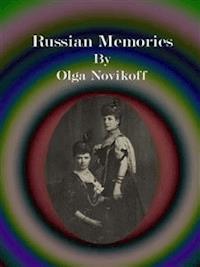
The Empress of Russia and Queen Alexandra
INTRODUCTION
BY STEPHEN GRAHAM
It is perhaps a little superfluous for one of my years to write an introduction for one so well known and so much esteemed and admired as Madame Novikoff. And yet it may seem just, if it does not seem vain, that a full-hearted tribute should come to her from this generation which profits by the result of her life and her work—the great new friendship between England and Russia.
She is one of the most interesting women in European diplomatic circles. She is a picturesque personality, but more than that she is one who has really done a great deal in her life. You cannot say of her, as of so many brilliant women, "She was born, she was admired, she passed!" Destiny used her to accomplish great ends.
For many in our society life, she stood for Russia, was Russia. For the poor people of England Russia was represented by the filth of the Ghetto and the crimes of the so-called "political" refugees; for the middle classes who read Seton Merriman, Russia was a fantastic country of revolutionaries and bloodthirsty police; but fortunately the ruling and upper classes always have had some better vision, they have had the means of travel, they have seen real representative Russians in their midst."They are barbarians, these Russians!" says someone to his friend. But the friend turns a deaf ear. "I happen to know one of them," says he.
A beautiful and clever woman always charms, whatever her nationality may be, and it is possible for her to make conquests that predicate nothing of the nation to which she belongs. That is true, and therein lay the true grace and genius of Madame Novikoff. She was not merely a clever and charming woman, she was Russia herself. Russia lent her charm. Thus her friends were drawn from serious and vital England.
Gladstone learned from her what Russia was. The great Liberal, the man who, whatever his virtues, and despite his high religious fervour, yet committed Liberalism to anti-clericalism and secularism, learned from her to pronounce the phrase, "Holy Russia." He esteemed her. With his whole spiritual nature he exalted her. She was his Beatrice, and to her more than to anyone in his life he brought flowers. Morley has somehow omitted this in his biography of Gladstone. Like so many intellectual Radicals he is afraid of idealism. But in truth the key to the more beautiful side of Gladstone's character might have been found in his relationship to Madame Novikoff. And possibly that friendship laid the real foundation of the understanding between the two nations.
Incidentally let me remark the growing friendliness towards Russia which is noticeable in the work of Carlyle at that time. A tendency towards friendship came thus into the air far back in the Victorian era.
Another most intimate friendship was that of Kinglake and Madame Novikoff, where again was real appreciation of a fine woman. Anthony Froude worshipped at the same shrine, and W. T. Stead with many another in whose heart and hand was the making of modern England.
A marvellously generous and unselfish nature, incapacity to be dull or feel dull or think that life is dull—a delicious sense of the humorous, an ingenious mind, a courtliness, and with all this something of the goddess. She had a presence into which people came. And then she had a visible Russian soul. There was in her features that unfamiliar gleam which we are all pursuing now, through opera, literature and art—the Russian genius.
Madame Novikoff was useful to Russia, it has been reproachfully said. Yes, she was useful in promoting peace between the two Empires, she was worth an army in the field to Russia. Yes, and now it may be said she has been worth an army in the field to us.
When Stead went down on theTitanicone of the last of the great men who worshipped at her shrine had died. Be it remarked how great was Stead's faith in Russia, and especially in the Russia of the Tsar and the Church. And it is well to remember that Madame Novikoff belongs to orthodox Russia and has never had any sympathy whatever with revolutionary Russia. This has obtained for her not a few enemies. There are many Russians with strong political views, estimable but misguided men, who have issued in the past such harmful rubbish asDarkest Russia, journals and pamphlets whereinsystematically everything to the discredit of the Tsar and his Government, every ugly scandal or enigmatical happening in Russian contemporary life was written up and then sent post free to our clergy, etc. To them Madame Novikoff is naturally distasteful. But as English people we ask, who has helped us to understand "Brightest Russia"—the Russia in arms to-day? And the praise and the thanks are to her.
STEPHEN GRAHAM.
Moscow, 27th August, 1916.
EDITOR'S PREFACE
The late W. T. Stead in saying to Madame Novikoff, "When you die, what an obituary I will write of you," was paying her a great compliment; just as was Disraeli, although unconsciously, in referring to her as "the M.P. for Russia in England." With that consummate tact which never fails her, Madame Novikoff has evaded the compliment and justified the sarcasm. Disraeli might with justice have added that she was also "M.P. for England in Russia"; for if she has appeared pro-Russian in England, she has many times been reproached in Russia as pro-English.
Of few women have such contradictory things been said and written, things that clearly show the gradual change in the political barometer; but her most severe critics indirectly paid tribute to her remarkable personality by fearing the influence she possessed. In the dark days when Great Britain and Russia were thinking of each other only as potential antagonists, she was regarded in this country as a Russian agent, whose every action was a subject for suspicious speculation, a national danger, a syren whose object it was to entice Britishpoliticians from their allegiance. Wherever she went it was, according to public opinion, with some fell purpose in view. If she came to London for the simple purpose of improving her English, it meant to a certain section of the Press Russian "diplomatic activity." The Tsar was told by an English journalist that he ought to "be very proud of her," as she succeeded where "Russian papers, Ambassadors and Envoys failed"; another said that she was "worth an army of 100,000 men to her country"; a third that she was a "stormy petrel." She was, in fact, everything from a Russian agent to a national danger, everything in short but the one thing she professed to be, a Russian woman anxious for her country's peace and progress.
In Serbia there is a little village whose name commemorates the death of a Russian hero, Nicolas Kiréef, Madame Novikoff's brother. In his death lay the seed of the Anglo-Russian Alliance. Distraught with grief, Madame Novikoff blamed Great Britain for her loss. She argued that, had this country refused to countenance the unspeakableness of the Turk in 1876, there would have been no atrocities, no Russian Volunteers, and no war. From that date she determined to do everything that lay in her power to bring about a better understanding between Great Britain and Russia. For years she has never relaxed her efforts, and she has lived to see what is perhaps the greatest monument ever erected by a sister to a brother's memory—the Anglo-Russian Alliance.
Nothing discouraged her, and at times, when war seemed inevitable, she redoubled her efforts. In all her work, she had chiefly to depend on her own ardour and sincerity. It was this sincerity, and a deep conviction as to the rightness of her object, that caused Gladstone to become her fearless ally. Politically he compromised himself by his frank support of her pleadings for peace and understanding.
For many years feeling ran too high in this country for a reasoned consideration of Madame Novikoff's appeals. "Peace with honour" talk became a meaningless catch phrase, otherwise it would have been seen that it was "peace with honour" that she advocated, and has never ceased to advocate, peace with honour, not to one, but to two great peoples.
Slowly the eyes of empire shifted from one continent to another, and gradually Madame Novikoff found her voice commanding more and more attention, until at last the Anglo-Russian Agreement paved the way for the present Alliance.
Her success is largely due to the methods she adopted. She gave and received hard knocks, and she never fell back upon her sex as an argument or a defence. She was fighting with men, and she fought with men's weapons, and this gained for her respect as an honourable and worthy antagonist. Even at the time when feeling was most strongly against her work, there appeared in the newspapers many spontaneous tributes to her ability and personality.The very suspicion with which she was regarded was in itself a tribute.
Later when Russia and Great Britain had drawn closer together, there appeared in the Press some of the most remarkable tributes ever paid to a woman, from which in justice to her and the Press I venture to quote a few of the many that appeared.
"If we were writing at a date which we hope is a good many years distant of the career of Madame Olga Novikoff, we should begin by saying that she was one of the most remarkable women of her time."—Daily Graphic.
"Whatever the reader's political predilections may be, he is unlikely to dispute the claim of Madame Novikoff to rank as one of the most remarkable women of her generation."—Daily Telegraph.
"No one will deny the right of Madame Novikoff to a record in history: ... For nearly ten years her influence was probably greater than any other woman's upon the course of national politics."—Daily News.
Madame Novikoff, "who for so many years held a social and political position in London which few women, and no ambassador, have ever equalled."—Observer.
"From beginning to end Madame Novikoff's record is clear and honourable. There is not the slightest evidence of any intrigue on her part, of any effort to use the statesman she influenced for underhand purposes, or to work for or against anyparticular individual in her own country."—Westminster Gazette.
"It is seldom that anyone sees such a fruition of his labours as does this marvellous lady, who has worked all her life for one thing and almost one thing only—an Anglo-Russian understanding."—Daily Mail.
And now in the autumn of her life (it is impossible to associate the word winter with so vital a personality) Madame Novikoff has seen her years of work crowned with success. To-day she is as keen in regard to public affairs, especially where her beloved Russia is concerned, as she was in the days when her life was one continuous fight with the war-spirit. In the preparation of these Memories I have seen something of her application, her industry and her personality. In the past I have often asked myself what was the secret of Madame Novikoff's remarkable success. But now I know. Time after time when we have seen things from a different angle, I have found myself accepting her point of view before I was even conscious of weakening.
Of all the compliments ever paid to Madame Novikoff, the one that probably pleases her most is that which recently appeared in a London daily written by a famous writer upon Russian life, who described her as "a true Russian."
This is not an autobiography; for Madame Novikoff has always refused to undertake such a responsibility. In the first place she thinks itwould be too long, and in the second too personal. "I have been talked about quite enough," she will say, "without starting to talk about myself." In 1909 there appearedThe M.P. for Russia, edited by the late W. T. Stead, which told much of her association with her distinguished friends, Gladstone, Kinglake, Villiers, Clarendon, Carlyle, Tyndall, Froude and others. "These have been taken," she says, "and I am left." But she has continued her work, and many of her friends have told her that at this time, above all others, she should tell personally something of her Russian memories. As she phrases it, "For forty years I have been wandering in the Wilderness, and now I have been permitted the happiness of entering the Promised Land. At last the gates have been opened. We are now brothers-in-arms."
THE EDITOR.
CHAPTER I. THE RUSSIAN SPIRIT
July 1914—Enthusiasm at Moscow—My Ambition Realised—England and Russia Allies—A War of Right—Wounded Heroes—Russia's Faith in Victory—Our Emperor's Call—England's Greatness—I am Introduced to Mr. Gladstone and Mr. Disraeli—"The M.P. for Russia in England"—Mr. Gladstone's Championship—An Unpopular Cause
I was in Moscow when our Monarch's mighty voice sounded in defence of little Serbia. I was driving near the Tverskoi Boulevard, when a shouting crowd rushed past me, and burst into a neighbouring restaurant.
"What does it all mean?" I exclaimed. "Is it a riot? Do they want drink?"
"Oh no," said the bystanders. "They only want to call out the orchestra and make them play the national hymn."
I stopped my carriage.
The orchestra appeared, and played our God save the Tzar, while the whole crowd, wild with enthusiasm, joined in.
Delighted and touched, I followed them. Most were singing and shouting "Hurrah," some praying and making the sign of the cross, while the throng continually increased.
Similar scenes occurred daily in various quarters of the town. One evening, an idle crowd had assembled near St. Saviour's Church. A priest appeared with a cross. The whole crowd fell on their knees and prayed. Such moments one cannot forget—indeed one can only thank God for them.
Lesen Sie weiter in der vollständigen Ausgabe!
Lesen Sie weiter in der vollständigen Ausgabe!
Lesen Sie weiter in der vollständigen Ausgabe!
Lesen Sie weiter in der vollständigen Ausgabe!
Lesen Sie weiter in der vollständigen Ausgabe!
Lesen Sie weiter in der vollständigen Ausgabe!
Lesen Sie weiter in der vollständigen Ausgabe!
Lesen Sie weiter in der vollständigen Ausgabe!
Lesen Sie weiter in der vollständigen Ausgabe!
Lesen Sie weiter in der vollständigen Ausgabe!
Lesen Sie weiter in der vollständigen Ausgabe!
Lesen Sie weiter in der vollständigen Ausgabe!
Lesen Sie weiter in der vollständigen Ausgabe!
Lesen Sie weiter in der vollständigen Ausgabe!
Lesen Sie weiter in der vollständigen Ausgabe!
Lesen Sie weiter in der vollständigen Ausgabe!
Lesen Sie weiter in der vollständigen Ausgabe!
Lesen Sie weiter in der vollständigen Ausgabe!
Lesen Sie weiter in der vollständigen Ausgabe!
Lesen Sie weiter in der vollständigen Ausgabe!




