


9,49 €
Mehr erfahren.
- Herausgeber: Identity Publications
- Kategorie: Geisteswissenschaft
- Sprache: Englisch
In Sadistic Pleasures, an independent journalist documents the true stories of torture, pain, and merciless psychological abuse endured by 14 Armenian soldiers and civilians who became prisoners of war in Azerbaijan during the Forty-Four Day War in 2020 for control of the autonomous Republic of Artsakh. This book contains their first-hand memoirs of what goes on behind enemy lines, hidden from the scrutiny of the United Nations and international human rights organizations.
The testimonies of these brave POWs reveal the mindsets of the perpetrators of heinous war crimes during the Second Nagorno-Karabakh War—ordinary people who are motivated by generations of political indoctrination of hatred for Armenians. They expose an international epidemic of racism and bigotry behind this humanitarian crisis in the Turkic world that must be overcome through free journalism and public reporting before peace can ever return to this disputed territory.
Additionally, these historic interviews are framed by a historical overview of how the dispute over Artsakh arose. Included here is the region's ancient past, Stalin's reassignment of the region to Azerbaijan during the Soviet Union, the near-unanimous declaration of independence in 1991, the First Nagorno-Karabakh War that followed, and the 26 years of frozen conflict with Armenia since.
Das E-Book können Sie in Legimi-Apps oder einer beliebigen App lesen, die das folgende Format unterstützen:
Seitenzahl: 257
Veröffentlichungsjahr: 2024
Ähnliche




















Copyright © 2022 Ashkhen Arakelyan
All rights reserved. No part of this publication may be reproduced, distributed, or transmitted in any form or by any means, including photocopying, recording, or other electronic or mechanical methods, without the prior written permission of the publisher, except in the case of brief quotations embodied in critical reviews and certain other noncommercial uses permitted by copyright law. Any perceived slight against any individual is purely unintentional.
Although the author and publisher have made every effort to ensure that the information in this book was correct at press time, the author and publisher do not assume and hereby disclaim any liability to any party for any loss, damage, or disruption caused by errors or omissions, whether such errors or omissions result from negligence, accident, or any other cause.
For permission requests, write to the publisher at [email protected].
For media inquiries, write to the author at [email protected].
Library of Congress Control Number: 2022900770
Ordering Information:
Quantity sales. Special discounts are available on quantity purchases by corporations, associations, and others. For details, contact the publisher at the address above.
Orders by U.S. trade bookstores and wholesalers. Please contact Identity Publications: Tel: (805) 259-3724 or visit www.IdentityPublications.com.
ISBN-13: 978-1-945884-55-9 (ebook)
ISBN-13: 978-1-945884-56-6 (paperback)
ISBN-13: 978-1-945884-57-3 (hardcover)
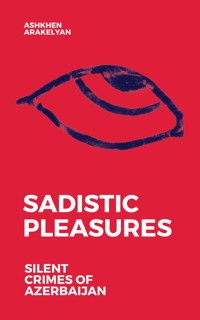
Cover designed by David Vardanyan. The cover depicts a human eye rolled up and back toward the skull. The two most common times this exaggerated expression occurs are during death and orgasm. Hence, appropriate to the title and theme of this book, it is a potentially profound symbol of both sadism and pleasure.
First published by GevorgVirats in Georgia.
Second Edition
Publishing by Identity Publications.
www.IdentityPublications.com
Praise for Sadistic Pleasures
The Forty-Four Day War over the Nagorno-Karabakh/Artsakh region in 2020 marks the latest outbreak of manifest violence in a history of the conflict that goes back more than a hundred years. Its current starting point began with the end of the USSR, with the brutally waged armed conflicts between 1992 and 1994 and the declaration of independence of Nagorno-Karabakh. With the ceasefire of November 20, 2020, the fighting ended. Unfortunately, the suffering of the people affected by that war, marked by excessive violence, did not. The physical and psychological injuries and the losses of family members and friends will forever accompany those who lived through the violence.
Sadistic Pleasures makes such experiences accessible to us. It offers devastating insights into the dynamics of violence defined by a national hatred handed down over many generations, by distrust of one’s neighbor, driven by the need for revenge.
Ashkhen Arakelyan has conducted interviews with Armenians who fell captive to the Azerbaijani militias and military forces in the last Karabakh war: sometimes as soldiers but often as civilians who found themselves between or behind the lines by mere chance. Fourteen of these stories are included in this book: haunting accounts of the experience of physical and psychological torture, of fear and uncertainty in the face of impending death, of pain, loss of direction, humiliation, and degradation. Ashkhen Arakelyan has carefully edited the interviews while preserving the character of the immediacy of the accounts. With short insertions and commentaries, she succeeds in conveying the narrative situation, the peculiar atmosphere of the conversations in which the interviewees reported on their experiences of violence.
Reading this book highlights the chasms of violence to which nationalism leads and invites us to empathize with the victims. It also demonstrates the helplessness of human rights organizations in the face of perpetrators who are determined to dehumanize those at their mercy, to cause them lasting physical and psychological harm. This book prompts us to make an emphatic commitment to humanity and sincere adherence to the principles of international humanitarian law. Sadistic Pleasures is an indispensable source, valuable documentation from which to draw a sense of the inexplicable.
—Dr. Mihran Dabag, The Institute for Diaspora and Genocide Studies
Starting with the Nuremberg Trials in 1945, the international community agreed to punish international crimes, including war crimes, crimes against humanity, and genocide. Behind these gruesome crimes are hundreds of lives, numbers of victims, numerous pains, and a wealth of individual stories. Very often, when journalists, politicians, lawyers talk about the international crimes that were committed during conflicts, they talk about “victims” in abstract. What is forgotten, however, is that every victim of large-scale crimes is a person who has a name and who has suffered individual harm as a result of international wrongdoing. Ashkhen Arakelyan shows in her well-documented publication the individual victims behind international crimes.
Arakelyan portrays the victims who were targeted because of their identity and not because of their personality: targeted because they were Armenians. These individual stories tell the reader about hatred of the Armenian ethnicity, that the victims were victimized not because of their goodness or malice but because they belonged to a certain group of people. They tell of the physical and psychological damage the victims suffered during their captivity.
This publication is not only an important documentation of individual fates but also a source of evidence of international crimes committed before, during, and after the Forty-Four Day War in Artsakh in 2020.
—Dr. Gurgen Petrossian, LLM (Heidelberg), Senior Researcher, Head of International Criminal Law Research Group at Friedrich-Alexander Erlangen-Nuremberg University; Chairman of German-Armenian Lawyers’ Association
TABLE OF CONTENTS
Foreword from the Publisher
Brief Historical Overview
01. The Cruelty No One Could Measure
02. Through Thick and Thin
03. The Birthday “Gift” She Will Never Forget
04. A Story of Two Friends
05. The Honest Woman and Her Little Heart
06. The Horror of Realizing You Are an Animal
07. Injustice: The Bitch the World Can’t Shake Off
08. The Bitter Price of Freedom
09. The Worst Scars Will Stay in the Mind
10. On Volunteering
11. All in Exchange for All
12. The New Life We Can Build out of This Story
13. Fortunately, It Only Lasted Forty-Five Days!
14. Opening the Bible for the First Time
Conclusion
FOREWORD FROM THE PUBLISHER
Sadistic Pleasures was first published in late 2021 in Armenia and Georgia, almost exactly one year after the Second Nagorno-Karabakh war began. It became clear then how important it was that these stories be made accessible to the rest of the world in the interest of fair and open journalism about a sensitive and important issue that the powers that be go to great lengths to keep hidden.
I am an American of partial-Armenian descent from California who became repatriated in Armenia in 2019. Thus, it was particularly important to me that Armenians and their descendants in the Western world get a sense of the firsthand experience of what has been going on in this part of the world that they are emotionally and culturally connected to but physically insulated from.
In September 2020, I was living a peaceful life in my village home in Kalavan in the Gegharkunik province of Armenia when news of the war with Azerbaijan over Artsakh reached my neighbors. For a month and a half, we waited each day to hear developing news of the potential for escalation and whether our village, being only an hour or so from the border with Azerbaijan, would be under threat from bombing or military invasion.
The reality of life for Armenians living so close to neighbors with ambitions of territorial expansion fully hit me when my teenage neighbor stopped by my house to urge me to keep all my lights off at night in case drones operated by the army of Azerbaijan would be patrolling the area at night looking for populated areas to strike for the purposes of inducing terror and demoralization among Armenians. The fact that this request did not seem strange or terrifying to him made me wonder how my American friends back home might react to what would be an unthinkable situation to residents of a politically and militarily secure nation like the USA.
During those awful six weeks and in the year since, I have been witness to endless state-sponsored internet propaganda put out by those who control the official political narrative in Azerbaijan. Those Armenians who attempt to call attention to what is really going on have been attacked by ordinary Azerbaijani people for daring to even call into question whatever the government tells them is the truth. However, the fate of independent journalists attempting to report the truth within Azerbaijan has been far worse.
There was and continues to be an information war raging around the world about exactly what happened and who is at fault for countless crimes committed in the name of political agendas. During the war, Azerbaijan’s internet access quickly became heavily censored by its own government.1 Even now, Reporters Without Borders (RSF) ranks Azerbaijan quite low at number 167 out of 180 in their press freedom index2 and condemns the country for its rampant jailing of journalists who dare speak out against their sanctioned version of history and their present actions. It should be no surprise then that what really goes on during times of military conflict and how POWs are treated remains hidden from public knowledge both domestically and abroad.
For any citizens of Azerbaijan or their descendants who read these accounts of the inhumane actions sanctioned by their military and political leaders, there may be great emotional resistance to accepting them at face value. I urge you to try to avoid interpreting these accounts as attacks upon your personal identity and values. It should be clear that there are individual people responsible for these crimes and that no reasonable person blames a collective for the orders and acts of men who operate above reproach. To take pride in your national identity is to demand the best from those people in power who represent your nation to the world, just as, hopefully, Armenians will continue to demand the truth and upstanding moral action from their leaders too as this situation unfolds.
Anyone who is forced to form their worldview under conditions of strict informational control and take violent actions at the behest of politicians is, ultimately, as much a victim as the innocent people hurt by these actions. National pride and cultural ideology, therefore, can be dangerous things when evaluating the truth during tense and conflicted situations. It is only by bringing uncomfortable facts to light that we can eliminate inhumanity and raise everyone to a higher standard in chaotic times. As individuals of any nation, creed, or religion are capable of great evil, it is our duty to call out perpetrators, no matter how we might identify with or against them, with the complete journalistic integrity made possible by freedom of the press and media. That is what Ashkhen Arakelyan has accomplished in this collection of suppressed real-life accounts of great evil going on in our modern world.
Freedom of expression is an essential part of how we form reasonable and accurate opinions about what is going on in the world. Those who probe into hidden issues, ask difficult questions, and dismantle barriers to honest communication further this endeavor for the global human populace. Though I am no journalist by profession, I value free inquiry and investigation as one of the highest societal goods. Indeed, that is the reason I started Identity Publications in 2016: to enable unknown authors to share their important messages. I have made it a personal mission to make Ashkhen’s important efforts more widely available to the global public (and particularly to those who care back in my home country) so that these barbaric practices may be tolerated no longer, wherever they may occur.
It is my perception from living here these last three years that Armenia is a nation that has long struggled to have a proper voice upon the stage of the world. I hope you read these stories and choose to do something small but meaningful toward raising awareness outside yourself about what is happening in this ancient but important land.
Gregory V. Diehl, Identity Publications
Kalavan, Armenia
__________________
1https://tvrain.ru/news/vlasti_azerbajdzhana_ogranichili_dostup_k_internetu_posle_obstrelov_v_karabahe-516731/
2https://rsf.org/en/azerbaijan
BRIEF HISTORICAL OVERVIEW
The area known as Nagorno-Karabakh (called “Artsakh” in Armenian) was inhabited by the people of the Early Transcaucasian Culture in prehistoric times. Strabo mentions the area as “Orchistene.” In the sixth century BC, the area came under the rule of various Iranian empires (the Medes and Persians). By the second century BC, Artsakh (Karabakh) had become a part of the neighboring Kingdom of Armenia. From that time on, the fate of Artsakh was closely bound up with that of Armenia. It is, however, possible—albeit disputed—that its native inhabitants were originally Caucasian Albanians (entirely unrelated to the Balkan Albanians), although they mainly lived further north in Caucasian Albania.
At any rate, both Armenia and Artsakh were mostly associated with the Iranian empires in one way or another during much of antiquity, be it as a satrapy of Persia or as a vassal state. From the first century BC onwards, the area frequently changed hands when the Romans and Iranians (Parthians and Persians) fought over it, interspersed with periods of relative Armenian self-sovereignty.
An important event was the adoption of Christianity as the state religion of both Armenia and Artsakh (the first official national conversion to Christianity in world history) in the early fourth century, from that time onwards, particularly after the invention of the Armenian alphabet and the considerable geographical spread of Armenian culture in the fifth century, the inhabitants of Artsakh were gradually Armenianized. Notably, the church of Caucasian Albania was a subordinate entity within the Armenian Apostolic Church, which further illustrates the Armenian influence in the wider area. Later, the whole Caucasus, including Artsakh, was incorporated into the Arab Caliphate—but remained Christian.
Eventually, the Turkic Seljuks conquered the area in the mid-11th century. Thus, it was only a thousand years ago that Turkic people(s) started gradually to migrate into the Southern Caucasus over the following centuries. The Turks called Artsakh “Karabagh” (a mixed Turco-Persian word meaning “black garden;” the later Russian prefix “Nagorno” means “mountainous” and the spelling “Karabakh” is a Russification of “Karabagh”) from the 14th century onwards. Like the rest of the Middle East, Armenia and Artsakh were dominated by the Turks and Mongols until 1501, when Persia took over again. Karabakh remained under Persian rule until Persia was obliged to cede its land north of the River Araxes—including both Armenia and Karabakh—to the Russian Empire in the treaties of Gulistan (1813) and Turkmenchay (1828).
The demographics of the South Caucasus slowly began changing during the centuries following the Turkic conquest, with Turkic Tatars spreading their language all over the area and Turkic rulers redrawing administrative borders. The region, which later became the Republic of Azerbaijan, became the most heavily Turkified part of the South Caucasus—with the notable exception of Karabakh, which always retained a significant Armenian majority, and the Caspian coast, where Iranian ethnicities remained. In the Tsarist maps of the 19th century, the (often nomadic) Turkic tribes living in the Caucasus were still called “Caucasian Tatars.”
However, in the wake of the nationalist awakenings of the late 19th century, Turkic intellectuals in Baku began to propagate the idea of a common Turkic national identity for the people of the South Caucasus, and they chose the term “Azerbaijan” for their envisioned nation. This choice was politically motivated: Azerbaijan (a Persian name) had always exclusively denoted a north-western region of Iran/Persia (as it does still today), which was and is an entirely separate entity than the areas north of the river Araxes, the area of the later-to-be-established Republic of Azerbaijan. Since large swaths of north-western Iran had also become Turkic-speaking by this time, the greater vision behind the appropriation of this name was to conquer north-western Iran and form a greater Turkic nation-state and the local Turkic “Azeri” identity.
The early 20th century saw the decline of the Russian Empire, the Bolshevik Revolution, and, hot on its heels, the establishment of the Soviet Union. With the Russian authorities losing power in the South Caucasus during these upheavals, Armenians and Tatars began to clash in Karabakh. In 1918, the Azerbaijan Democratic Republic (the name chosen for political reasons) was proclaimed to exist alongside the Armenian Democratic Republic, and there were soon clashes between Armenians and Tatars (henceforth officially called “Azeris”) in the border region that was Karabakh, culminating in the massacre of Shushi (or Shusha), where about 20,000 Armenians were massacred by Tatars (Azeris) in a most brutal manner.
Soon afterward, the entire Caucasus was incorporated into the Soviet Union. When, in 1921, Karabakh was assigned to the Armenian Soviet Socialist Republic (since its inhabitants were mainly Armenians), Stalin intervened one day after that decision and reassigned Karabakh to Azerbaijan—again for political reasons (divide and conquer). This awarding of the territory to Azerbaijan in the initial throes of the Soviet Union laid the foundation for the Karabakh War at the time of the USSR’s dissolution in the early 1990s. Although Armenians and Azeris coexisted (relatively) peacefully during the seven decades of Soviet rule, the 20th century did see several episodes of ethnic cleansing through deportations by both sides. As regards Karabakh, the Azerbaijani Soviet Socialist Republic pursued a policy of increasing the Azeri population in Karabakh in order to change the demographic balance in its favor. The Armenians, on the other hand—being well aware of the many atrocities recently committed against them by Turkic peoples, most notably the Armenian Genocide of 1915 by the Turks (whom the Azeris consider their brothers), and conscious of often having been made a minority in their own lands—resisted the Azerbaijani SSR’s policy of Turkifying Karabakh by degrees.
During the final years of the Soviet Union, ethnic conflict flared up again, and soon a series of pogroms were carried out against Armenians in Azerbaijan proper, the most significant and brutal episode being the Sumgait pogrom near Baku. Soon, the Armenian population of Azerbaijan was expelled or fled to Armenia and vice versa: all Azeris in Armenia were deported to Azerbaijan. Finally, the First Karabakh War in 1988–1994 resulted in the loss of the area by the Republic of Azerbaijan and territorial control of Karabakh by Armenia. The outcome was a “frozen conflict:” for 26 years, Karabakh was internationally recognized (de jure) as part of Azerbaijan, but (along with the immediate area around it) a de facto independent republic whose security was guaranteed by Armenia.
On September 27, 2020, Azerbaijan, heavily assisted by Turkey and by imported members of Syrian jihadist terrorist groups and unprecedentedly using advanced drones of Israeli manufacture as well as availing itself of army supplies and élite troop training from various Muslim nations, began a unilateral offensive military campaign, resisted largely not by the Armenian army but by local militias of Artsakh and volunteers from Armenia. The 44 days of fighting resulted in an agreement on November 9, 2020 between Armenia, Azerbaijan, and Russia as broker, in which Armenia agreed to cede not only those areas that had just been lost during the military campaign but also other territories of Nagorno-Karabagh proper, as well as all newly-conquered areas (including the strategically and symbolically vital hilltop city of Shushi) to Azerbaijan, with Russian peacekeepers to be stationed henceforth in Karabakh.
At the time of this publication in early 2022, the Azeris continue their military campaign (in breach of the agreement) and have intruded into the border regions of Armenia proper, their apparent (and stated) goal being the conquest of the Zangezur corridor: the very slender southern Armenian province of Syunik that represents the only non-Turkic territory in a contiguous band between Greece and China.
CHAPTER 1
The Cruelty No One Could Measure
My brother drove me to meet Narek (S.). I was a bit nervous. I’d known Narek since childhood. Although I had believed that my connection with the people of my village had weakened during the many years since I had left, when I heard the news that the Azeris had captured Narek, I lost my peace until he returned. His story was larger than life, hard to swallow.
It was rather cold at Narek’s place. In the bed on the corner, there was his dad, suffering from cancer. The kids were the reason the house was still breathing. Everyone looked radically old. Everyone seemed exhausted: from sufferings, from never-ending problems, from each other. At some point, I asked to be alone with Narek.
I farm for a living. This year we decided to breed the cattle in a different area. Before starting the day, I thought I’d call my family first. The network was bad in that area, so I had to climb up the mountains to get a signal. I could see a military base around 300 meters away from where I was standing. I thought it must be an Armenian base, as did other farmers around me. I couldn’t get through to my wife, so I started back down again.
Narek was 30 years old. All his life, he was renowned for his farming—and he enjoyed it. He had a wife, two kids, and enough money to get on with life in an abandoned village.
Before I could even take a few steps back down the hill, someone called to me. I turned around; I realized a soldier was talking to me in Russian. I thought at first that he was an Armenian soldier, probably drunk and trying to make fun of me. I ignored him and continued walking. I’d almost reached my horse and was about to mount it when I realized four fully-armed soldiers were approaching me. They crossed the trench and came up to me. I kept standing there, still thinking they were Armenians. In my head, I was calculating what I would tell them if they asked me my reason for being up there. The closer they got, the more clearly I heard them speaking Russian. For a moment, I thought they must be Russian peacekeepers, but never did I imagine they were Azeris. The moment came when they were so close that I could see their boots and the flag on their military uniforms. I was frozen stiff. I realized they were our enemies. Never had I this feeling in my life, the feeling of going numb. I lost my ability to do anything. I just stood there, fixated on their eyes.
I hoped I’d be able to talk to them. I hoped to negotiate. For the first two minutes we spoke, I told them I would never go back there again and that I’d just been trying to get a phone signal. It was in vain. They blindfolded me, and I had to go with them. Two held my arms, one was leveling a weapon at me from behind, and off we went. I begged them; I tried to find some arrangement with them. However, we had already crossed the trench, and I had left the Armenian border behind. I had still not fully realized I was a captive. On the other side, as they talked in Azeri, the reality changed. I couldn’t accept what a life-changing mistake I’d made. I was only 30, and my life was over while I was still in my prime.
Narek was lowering his voice to make sure the occupants of the next room were not upset. He didn’t look into my eyes as he started sharing his story. Maybe it was shameful for him to share his story with a girl, especially when that girl had known him since childhood. However, after a while, he started getting used to my questions, and the conversation became less tense, more back-and-forth.
They opened my eyes, and I was devastated to see an enormous Azeri flag hang on the building in front of my eyes. Quick as a flash, they put a bag over my head and led me to a dark room. The interrogation started right away. They confiscated my phone, took the bag off my head, and then started beating me up. As they were likely to claim some military angle to any picture found on my phone, I knew they were going to torture me. I couldn’t speak their language, nor could I speak Russian well. I could barely explain anything or communicate with them. After a while, they blindfolded me again, tied my hands, and took me on a three- or four-hour drive. I couldn’t eat, although they offered me some food. I was scared they would try to kill me by lacing the food with something. I hoped it would only be a matter of hours before I was home again. I hoped the Armenians would help me get back within a couple of days.
Instead, I landed in Nakhichevan Prison. Here, the nightmares started. The cell had no bed, no windows, literally nothing. The whole building was dark green. On the second floor, there was President Aliyev on the wall, a huge portrait. His father’s portrait was hanging beside it. The first cell I occupied, until November 23rd, had no windows; it was very damp and smelt of apples. There were also some sugar sacks on the floor; I thought it was an old warehouse. Only for the last 20 days was I in a proper room.
After around ten days, the Azeri officials started driving me from one place to another for interrogation. They always blindfolded me; even when they took me to the toilet, I had to be led all the way around it three or four times to disorient me. I had around 150 contacts stored on my phone, and during interrogation, they would go through each number, asking every last detail about that person.
They used an interpreter, as I had zero ability in any other language but Armenian. The interpreter told me that his neighbor was an Armenian and had helped him learn the language. During the first war in the 1990s, he had gone to the Azeri exclave of Nakhichevan, converted to Islam, and had never returned to Armenia again. After interpreting for me, he suggested that I should stay there as well. I told him I wanted to go back to my kids. That was the day when it got through to them that I had no intentions of staying there.
As Narek was my first interviewee, everything he would tell me shocked me. I couldn’t have imagined that inducing Armenians to stay in Azerbaijan and proselytizing them to change their religion was one of the scenarios that would come up again in other interviews I conducted. Perhaps preparing questions in advance was the silliest thing I could have done for this project; each of the interviewees had a unique story to share, and as soon as we struck up a conversation, the questions would flow naturally. I was floored by Narek’s next detail, which was the most compelling one to me.
The next day, the Azeri officers wrote a report saying that reason I’d had to travel 100 kilometers to find good pasture for the animals was that the Mayor of Goris had taken all the fertile lands for himself and given me the most useless tract to breed my cattle on. They also made me say that the Armenian Government was brutal to me, that the police discriminated against me, and many other such accusations. And they were going to make a video of me reading out that text and spread it on the internet. I had no choice but to say it; otherwise, the torture would have become more severe.
I had only half an hour to learn the text by heart. I couldn’t manage in such a short time, and I would utter three to four sentences, then forget the rest. At that, they would start beating me, torturing me, accusing me of not wanting to say my lines. But somehow, I was able to make them understand that I needed more time to learn the script. Next, they poured petrol on my feet and told me they would set fire to them if I refused to talk in the video. Then, I intentionally refused to record the text for two days because I wanted them to kill me, so the torture would end. But it dawned on me that if the video was released, my family would see I was alive and could try to help me. Thus, because of this video, the International Committee of the Red Cross (ICRC)3 visited me after 29 days of captivity.
Narek was captured on July 8, 2020, before Azerbaijan launched its war against Armenia on September 27th. What I witnessed through Narek terrified me and will do for the rest of my life. The Azeris were extremely brutal; perhaps the severe hatred they bore against Narek (and against Armenians, generally) had been there before they won the war. Narek was and would always remain the “best” example of the extent of the Azeris’ cruelty.
It was August 5th. The guards took me to a cozy cell where I had a table, a TV, and even a bed for the first time in a month. I waited there to meet the Red Cross. One of the visitors asked if it was my cell, and I had to say yes because as soon as they left, the Azeris would kill me if I’d told the truth. The representative opened his bag and took out some documents; I noticed two photos of my younger son. I thought maybe he had it from Facebook. I didn’t dare to look up, but out of the corner of my eye, I could see two letters. I was transfixed to see that they were written in Armenian. I read my wife’s name on them, and at that moment, I had my whole strength back again.
I went for the letters like a madman and opened them to read. When I read “Dear Narek.” I fainted—not that I realized that at the time. After 20 minutes, when I had regained consciousness, I realized everyone was in a panic. Doctors and officials were running in different directions. The Red Cross officer had broken out in a sweat, and he was clearly distraught and terrified. I grabbed the letters and continued reading them. Receiving those letters was the only light I had during these six months of captivity. Before I read the letter, I had thought of ending my life—but I had no idea how I would accomplish that, as around five men were posted in front of my cell and would open the door every 15 minutes.
The kids returned from kindergarten. Narek’s face brightened as the children entered the room. It was because of these tiny creatures that Narek, the captive, had found strength within him. A second earlier, he had been talking about suicide; now, he was hugging his children and exuding positivity.
It was snowing outside, and I had only one T-shirt and a very light pair of trousers. Whenever someone was on the way to see me from the Red Cross, they would bring warm clothes and take me to the nice cell again. I couldn’t say anything to the Red Cross. They had a list full of questions about my conditions of captivity to run through in Armenian. The representative would ask if the Azeris were giving me water to drink, and I would say yes; he would write down the answer. He would then ask if anyone had tortured me and if I could show them any marks; I would say no. Then, whether I needed a doctor. I would say no, and so the list of questions went on. There was no way I could tell them the truth.




