


Erhalten Sie Zugang zu diesem und mehr als 300000 Büchern ab EUR 5,99 monatlich.
- Herausgeber: Papillote Press
- Kategorie: Geisteswissenschaft
- Sprache: Englisch
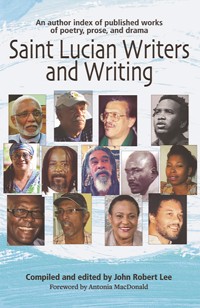
International giants, regional stars, local heroes and self-published unknowns all have their place in this masterful author index from the eastern Caribbean island of Saint Lucia. It also includes those who have written about Saint Lucia and Caribbean writers whose work has influenced the development of Saint Lucian life and literature. It's a bibliography which, in its all-embracing reach (It includes funeral programmes and recipe books), reflects the creative, cultural, political and economic world of this small island. In bringing Saint Lucia to life, it is a magnificent resource for discovery and research, beyond its most famous son, the Nobel Laureate writer Derek Walcott.
Sie lesen das E-Book in den Legimi-Apps auf:
Seitenzahl: 140
Veröffentlichungsjahr: 2019
Das E-Book (TTS) können Sie hören im Abo „Legimi Premium” in Legimi-Apps auf:
Ähnliche



















In praise of Saint Lucian Writers and Writing
John Robert Lee’s bibliographical work is a magnificent act of scholarship that brings the rich and long history of Saint Lucian literary culture to life. Both record and tribute, this inclusive and educative bibliographical study includes an important introduction on the publication history and print culture of Saint Lucia. A work of literary heritage in itself, this study also actively engages publishers and researchers with an eye on the future as well as the past.
— Professor Alison Donnell, University of East Anglia, UK
Here you can see everything — the things that didn’t last, the things that did, the things that should have but didn’t. Here is the heft of a fierce and devoted memory of all of our literature. And of what value is it? Well, it is a record of trials and failures, a record of what time kept and what it didn’t, though memory lunges back to claim it with an almost filial affection. Just as we all want to lunge after the things we lose or have lost, not always because it was good, or upright or stellar, but simply because of our belief in its right to exist, if not in time, then in memory, in a record, in our literature’s, and thus our nation’s book of life.
— Vladimir Lucien, poet, Saint Lucia
All the world has heard of the late Sir Derek Walcott. But there have been many other Saint Lucian writers of note, some of them with a regional reputation in the Caribbean, others still little read outside of — or even within — Saint Lucia itself. John Robert Lee’s Saint Lucian Writers and Writing offers the first comprehensive bibliography of Saint Lucian literature. It will be useful to anyone interested in Saint Lucian literature in particular, but also to anyone exploring Saint Lucia's contribution to Caribbean literature in general, which is disproportionately large given the island's small population. This bibliography, invaluable to scholars, will also point general readers toward some good writing they would not have discovered without it. As both scholar and general reader, I am grateful to John Robert Lee for this comprehensive guide.
— Paul Breslin, Professor of English, Emeritus, Northwestern University, United States, and author of Nobody's Nation: Reading Derek Walcott
Always, I am in awe of the industry, the monk-like devotion that John Robert Lee brings to the self-chosen obligation of chronicling aspects of our artistic history. This updated bibliography is another example of this — and a reminder of how completely crucial this kind of work is. There has been a steady stream of publishing of Saint Lucian writing — and some significant publications — since 2013. And this bibliography, thankfully, records this for present and future generations. In what seems like a season of neglect — and indeed destruction — of our artistic and cultural heritage, this bibliography is an ark. And gratitude is joyfully rendered to its builder.
— Kendel Hippolyte, poet/playwright, Saint Lucia
John Robert Lee has produced this voluminous social reference document for the world. For the past five decades he has embedded himself into the various Saint Lucian landscapes — home and abroad, and in recent times on the worldwide web — and has somehow geo-mapped these communities of thought and theatre. His work makes it easier for students of Saint Lucian history and literature to answer the questions: Who? What? When? Where? And Why? This is a virtual and valuable living monument. A great gift to Saint Lucia. Give thanks!
— Embert Charles, communications specialist/cultural administrator, Saint Lucia
Compiled with the sensitivity of the poet he is and the scrupulousness of the archivist many know him to be, John Robert Lee’s Saint Lucian Writers and Writing is vital work. Indexes, bibliographies and directories like these are essential guides to Caribbean literature. Too often, our readers (and writers!) aren’t aware of who we are or what we’ve created in this region. This is a great start to discovering what the storytellers of one country have been busy building with words — and we’re talking beyond the usual suspects.
— Robert Edison Sandiford, author of the novel And Sometimes They Fly, and editor (with Linda M. Deane) of Shouts from the Outfield: The ArtsEtc Cricket Anthology, Barbados
First published in Great Britain by Papillote Press in 2019
© John Robert Lee 2019
The moral right of John Robert Lee to be identified as the author of this work has been asserted by him in accordance with the Copyright, Designs and Patents Act, 1988
All rights reserved
No part of this publication may be reproduced, stored in a retrieval system or transmitted in any form or by any means, electronic or mechanical, including photocopying, recording or any information storage or retrieval system without the prior permission of the copyright owner.
A CIP catalogue record for this book is available from the British Library
Typeset in Minion
Printed by Imprint Digital, Devon, UK
Book cover and design by Andy Dark
Photo credits: © Francis Tobias Estate; Veronica Lee; J R Lee photo archives.
Illustration credits: Nahdila Bailey; Stanley French estate; Jolien Harmsen; Konte magazine; Oxford University Press; Peepal Tree Press; UWI Press
ISBN: 978-0-9957263-1-4
Papillote Press
23 Rozel Road
London SW4 0EY
United Kingdom,
and Trafalgar, Dominica
www.papillotepress.co.uk
@papillotepress
In Memoriam
Garth St. Omer, 1931–2018
Gandolph St. Clair, 1951–2018
Marie Francess Doreen Niles, librarian, 1926–2018
Greta Bondieumaitre, Allan Weekes, Earl Long, Michael Aubertin, John Robert Lee, Derek Walcott, Roderick Walcott, Vladimir Lucien
Garth St. Omer, Modeste Downes, Hayden Forde, Stanley French, Patricia Turnbull, George Alphonse, Kendel Hippolyte, Anderson Reynolds, Gemma Weekes
Robert Devaux, Adrian Augier, George Goddard, Jane King, Gandolph St. Clair, McDonald Dixon, Hazel Simmons-McDonald, Rick Wayne
CONTENTS
Foreword by Antonia MacDonald
Introduction by John Robert Lee
Poetry
Prose fiction: short stories
Novellas/Novels
Prose non-fiction
Drama
Literary periodicals
Selected international anthologies which include Saint Lucian writers
Selected readings
FOREWORD
Antonia MacDonald
It is a well-known fact that, in his late teens, the Saint Lucian-born Nobel Laureate Derek Walcott self-published his first chapbook in 1948 — 25 Poems. The precociousness and confidence that had prompted the eighteen-year-old Walcott to borrow money from his mother so that his poems could be immortalised in print, lives on in the Saint Lucian artistic character. John Robert Lee’s Saint Lucian Writers and Writing: An Author Index documents with impressive thoroughness the continuation of that Walcottian impulse to leave a tangible literary record. The publications of a multi-faceted range of authors are illuminated in this study. Lee records the works of the cadre of internationally published Saint Lucian authors who have garnered both literary awards and scholarly attention. He also documents the publications of homegrown writers who, while they have not cut as wide a swath, have become authors of note. Additionally, Lee’s author index lists those who, committed to producing material on Saint Lucia, have dedicated their meagre resources to the financing of that dream. Common to all — the international giants, the regionally acclaimed, the locally recognised and small self-published — is the undaunted zeal to find myriad ways of publishing and disseminating their creative writing on an island that is both muse and metaphor.
In Saint Lucian Writers and Writing: An Author Index, Lee’s curatorial effort is not limited to the publication productivity of Saint Lucian authors. Also documented are selections from those who have written on Saint Lucia, and Caribbean scholars whose works have been major influences on Saint Lucian belle lettres. Ultimately, in his archiving of the publications of Saint Lucian authors, and of scholars who have written on Saint Lucia or on Saint Lucian writers, Lee is helping to preserve this heritage for future scholars interested in exploring the literary landscape of a small Caribbean island that has galvanised itself into literary excellence.
Close analysis of Lee’s Saint Lucian Writers and Writing: An Author Index will reveal that the authors listed therein emerge from all walks of life and are producing in diverse genres — they are creative writers, or essayists; they are scholars or public figures; they are populists, specialists or generalists. Many have taken advantage of a variety of publishing platforms: print and online. Some, mainly dramatists, are yet unpublished, but given the ongoing under-representation of this genre, Lee has strategically included them in the index. Significantly, many of the authors are making creative use of Saint Lucia’s Creole vernaculars. This particular democratising of Lee’s author index is especially important to researchers interested in exploring how the kwéyòl language informs artistic production in Saint Lucia — a field of enquiry that is ripe for engagement.
Saint Lucian Writers and Writing: An Author Index is a groundbreaking work that is produced from a perspective informed by Lee’s multiple locations: poet, literary activist, journalist, and librarian. But by no means is it only the literary that is catalogued. Alongside the record of published poems, plays, novels, autobiographies, life stories and monographs, Lee provides a space for works that deal with the socio-political, the cultural and the economic life of Saint Lucia. Additionally, his inclusion of ephemera such as funeral booklets and recipe books have critical and historical value because of their potential to offer new directions for research on Saint Lucian cultural studies. Published material, however small and insignificant it may seem in the now, can reverberate meaningfully in the future.
In essence, Lee’s Saint Lucian Writers and Writing: An Author Index is an important resource that, in its scope, brings Saint Lucia to life. Undoubtedly, this author index can provide a gateway to the creation of a Saint Lucian literary canon. At the same time, this work offers young scholars and new researchers the opportunity to discover hitherto unknown writers and novel areas of scholarship. As a general introduction to Saint Lucian studies, Saint Lucian Writers and Writing: An Author Index will become a first stop for both scholarly and non-academic communities of readers.
Antonia MacDonald, Professor, Department of Humanities and Social Sciences, St George’s University, Grenada. Editor of The Fiction of Garth St. Omer: A Casebook (2018).
INTRODUCTION
John Robert Lee, compiler and editor
This author index is a supplement to my earlier bibliography, St Lucian Creative Writing: Poetry, Prose, Drama by St Lucian Writers 1948-2013, published in 2013. It is conceived as a contribution to Saint Lucia’s 40th anniversary of independence to mark the literary activity of Saint Lucian writers. With Nobel Laureate Derek Walcott as the cornerstone, Saint Lucia, through its writers and persistent local publishing, has developed a significant and strong literary tradition, well-known and respected beyond its 238 square-mile shores. The index also recognises and pays honour to the 70th anniversary of the University of the West Indies. Many of our authors, including Derek Walcott, attended; I, too, was there in the early 1970s and early 1980s.
This supplement updates the bibliography and includes essentially an author index, and lists mainly published works, in a variety of formats such as books, booklets, pamphlets, chapbooks. (The earlier bibliography, a comprehensive one at 211 pages, had included unpublished manuscripts.) Poetry, prose fiction and non-fiction, and drama are listed separately. Also indexed are selected supporting materials (dissertations, theses, critical works, papers) which offer studies of the works of our writers by Saint Lucians and others. Many of these remain unpublished. I have also re-included a comprehensive indexing of the main Saint Lucian literary periodicals that appeared from 1963 to the mid-eighties.
The final section lists selected critical works on Saint Lucian and related literature with readings that give background information on the history and culture of Saint Lucia. Included are important Caribbean classic literary works which have influenced our writers. There are also citations to work by writers like Kamau Brathwaite, Gordon Rohlehr, C.L.R. James, Aimé Césaire, Frantz Fanon, Kwame Dawes, Olive Senior, Alison Donnell, Dionne Brand, Laurence Breiner and others whose work on Caribbean literature, history, culture and society enable a better understanding of the wider regional and international context of Saint Lucian writing. It seemed useful to provide references that would point researchers and readers in directions that would broaden perspectives and analyses.
The work of Kwame Dawes on reggae, of Gordon Rohlehr on calypso, of Jocelyne Guilbault on zouk and calypso (“Trinidad musics”) give us a look at and listen to the musical soundtrack of the culture behind our literature.
To cite works on Derek Walcott would entail a bibliography of its own. I have selected critical work on the Nobel Laureate which seemed to relate most closely to Saint Lucia and the Caribbean. The works of authors such as Robert D. Hamner carry bibliographies of Walcott’s oeuvre.
So few plays are published that I have noted unpublished manuscripts and have recorded performance dates of both published and unpublished plays wherever possible.
The earliest book by a Saint Lucian cited here is My Memoirs: with a collection of interesting data on Saint Lucia by William Peter, printed in Barbados in 1933. The William Peter Boulevard at the centre of downtown Castries is named after him. Peter was a well-known businessman whose stores existed until very recently. He was a member of the Legislative Council and one of the pioneers of the coaling industry which was a major activity from the early twentieth century to the mid-forties. A slim 1941/2 booklet titled My life’s experience by Francis G. Charles, is also listed. Charles recounted his experiences in Guatemala and was well-known in Saint Lucia later as “Gwatee”.
Colonial Slavery: Four Essays (1831) by Sir John Jeremie appears in the section on selected readings. Jeremie, a well-known British abolitionist, served as Chief Justice in Saint Lucia from 1824 for six years. Jeremie Street, a major Castries thoroughfare, is named after him. His essays reference Saint Lucia throughout. Other British colonial writers, such as Henry H. Breen, who wrote on Saint Lucia, are also listed.
Derek Walcott, Hunter Francois and Howick Elcock were among the earliest to self-publish slim volumes of verse. Walcott’s 25 poems (published in 1948) is recognised as one of the most important first collections of a prodigy who later gained international recognition. Following McDonald Dixon’s debut publication of his Pebbles in 1973, a steady stream of poetry began to appear. More poetry than prose or drama was published. The books (chapbooks, pamphlets) were printed locally with sponsor support, and were self-published. Parallel to these publications (admittedly of varying literary quality) regular reviews appeared in local newspapers. Many of these reviews have been collected in Saint Lucian Literature and Theatre: an anthology of reviews (Lee and Hippolyte, 2006).
The 1970s to about the mid-1990s was a very vibrant and prolific period for the arts in Saint Lucia, across all genres. Since then, in my opinion, things have become less focused. While publications of various kinds continue to appear, many are self-published with popular US publishers like AuthorHouse, Xlibris, iUniverse etc. There has been a significant increase in the publication of non-fiction. Established writers are now published overseas (several with Peepal Tree Press in the UK) and less reviewing occurs. Social media and websites do provide space today for work of all kinds to be presented locally and internationally, but this only adds to the seeming disparate nature of the contemporary situation.
Bookshops are almost non-existent, with the closure of the popular and very supportive Sunshine Bookshop in 2013. Libraries are generally neglected and the problems of mould have been affecting them, including the main Central Library in Castries and the Hunter J. Francois Library of the Sir Arthur Lewis Community College.
Literary magazines are also non-existent, where once there were several. The last of these, The Jako, appeared briefly in 2005 with three issues. These are indexed here.
Substantial anthologies have appeared on a fairly regular basis. The disappointment is that the education system and its policy-makers have not seen it important to place the best-produced of these anthologies on students’ reading lists so that Saint Lucian literature would become familiar to our young. The long-standing challenges of marketing and distribution also means that these anthologies, edited and contributed to by well-known Saint Lucian writers, are hardly ever seen beyond our shores.
Among local printers used by writers are the Voice Publishing, the Government Printery, Unique Printers, Mayers Printing, Star Publishing and Speed Printing. The Lithographic Press, housed in the old Walcott home on Chaussée Road no longer exists. Similarly, Dunesville Enterprises is also closed. These last two printed for many authors in those early years. While these printers were never book publishers in a formal sense, they provided a unique avenue for the production of a growing, significant national literature.




