


9,99 €
Mehr erfahren.
- Herausgeber: Simon the Monk
- Kategorie: Religion und Spiritualität
- Sprache: Englisch
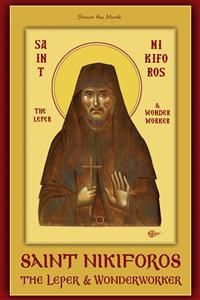
Saint Nikiforos (1887-1964) is a saint of our time. He suffered from Hansen's Disease, leprosy, in a time when little was known about the disease or potential cures. Lepers were forced to live in Leper colonies. Some lepers gave in to despair but others like Saint Nikiforos became leaders in the Orthodox Christian faith, true saints who suffered in love for Christ and his fellow man. He encouraged many people in his life and many miracles surround his life. Come, read about joy and love in suffering...
Das E-Book können Sie in Legimi-Apps oder einer beliebigen App lesen, die das folgende Format unterstützen:
Veröffentlichungsjahr: 2019
Ähnliche














SAINT NIKIFOROS
the leper & wonderworker
by Simon the monk
digital edition
Translated and edited by the Sisters of the Monastery of the Theotokos The Life Giving Spring
greek orthodox monastery of the theotokos the life giving spring
Ο ΑΓΙΟΣ ΝΙΚΗΦΟΡΟΣ Ο ΛΕΠΡΟΣ - Ο ΘΑΥΜΑΤΟΥΡΓΟΣ
Copyright © 2017 Σίμων Μοναχός (Simon the Monk)
Κυρίλλου Λουκάρεως 6, 114 71 ΑΘΗΝΑ
Τηλ: 210-6449.300, Fax: 210-6424.266
www.athoniki-politeia.gr
www.agiosnikiforos.gr
ΙΕΡΑ ΚΑΛΥΒΗ ΚΟΙΜΗΣΕΩΣ ΤΗΣ ΘΕΟΤΟΚΟΥ
ΣΚΗΤΗ ΚΟΥΤΛΟΥΜΟΥΣΙΟΥ, 630 86 ΚΑΡΥΑΙ, ΑΓΙΟΝ ΟΡΟΣ
All rights reserved.
No part of this book may be reproduced, published or transmitted in any form or by any means, electronic or mechanical, including photocopying, scanning, recording, or by any information storage or retrieval system, without permission in writing from the publisher.
First English Physical Book Edition Copyright 2016 © Greek Orthodox Monastery of the Theotokos The Life Giving Spring
P.O. Box 549 Dunlap, California 93621 USA ph: (559) 338-3110 fax: (559) 338-3101
English book rights for publication and distribution in the USA and Canada are exclusively assigned to the Greek Orthodox Monastery of the Theotokos the Life Giving Spring.
CONTENTS
PREFACE TO THE ENGLISH EDITION
INTRODUCTION
THE RIGHTEOUS LIVE FOREVER
ALife Well-pleasing to God
Testimonies
Miracles
The encyclical from the Church of Greece officially announcing the canonization of Saint Nikiforos the Leper.
Apolytikion. 1st Tone. The stone that had been sealed.
All the angels were awestruck by the courage and fortitude of Saint Nikiforos the Leper in ascetic deeds and contests, for like another Job he suffered pains with patience, ever glorifying God, who has crowned him now with glory, granting him grace to work great, wondrous miracles.
Rejoice, O guide of monastics and their aid,
Rejoice, O shining beacon of light,
Rejoice, for your relics now exude a fragrance bringing joy to all.
Kontakion. Plagal 4th Tone. O Champion General.
The valiant athlete of endurance and of fortitude, the steadfast diamond of great patience and longsuffering who was tried by the affliction and pains of illness, and who in this way did glorify the Most High God, let us praise and laud the leper Nikiforos, saying unto him:
Rejoice, true namesake of victory.
Megalynarion
Opious assembly, lovers of Christ, now with hymns and praises, as is fitting, let us extol the true friend of Christ God, the leper Nikiforos, as a most wondrous athlete of holy fortitude.
Preface to the English Edition
In July of 2008, our close acquaintance, the pious priest Father Evangelos Xenitakis from Crete, visited our Monastery of the Life Giving Spring in California. He brought a small laminated icon of Saint Nikiforos the Leper that had a few tiny fragments of his holy relics sealed in the corner.
This is how I met the saint for the first time. His icon made a deep impression on me and I placed it inside the Holy Altar where we keep holy relics. Every Saturday when we would bring out the holy relics for the faithful to venerate, my desire grew for our monastery to obtain a more substantial portion of Saint Nikiforos’ relics. At last, in the year 2013 I contacted Father Evangelos and he told me to communicate with Father Simon, the monk who had them in his possession. When I called Father Simon, he asked that we send an official letter stating the monastery’s request for the saint’s holy relics. I wrote it without delay, and he kindly responded.
In Father Simon’s attempt to cut a piece of Saint Nikiforos’ relics, he realized that they could only be cut in the way the saint himself wanted his relics to be given to us. They were placed in a special reliquary box and we received them at our monastery with all due honor. It is especially noteworthy that the saint arrived just before the building permit for the extension of our monastery —after many delays— was finally issued. His presence granted us new strength and encouragement. Since then, we bring out his holy relics every Saturday for the faithful to venerate. However, our communication and relationship with Saint Nikiforos did not stop at this.
When we began construction, I took the saint’s icon and tied it to a branch of a tree next to the site. At the same time, I prayed and made a “contract” with him saying, “My saint, I have no idea how this building is going to be completed, neither from a technical nor from a financial standpoint. So listen, I’m putting you in charge —you are going to be the foreman. During your life you were not able to walk but now I want you to walk around and oversee the construction, making sure that everything proceeds correctly.” From that time, my brethren, the icon of the saint remains on the branch and the construction proceeds —slowly but surely— with his supervision and through his intercessions. Now that we have painted our own icon of him, I take it outside every Monday and make the sign of the Cross with it over the construction site and over the workers for their safety. Great is the grace of the saint!
According to monastic tradition, a reading takes place during the common meal for spiritual benefit. Inspired by the presence of the saint we had chosen to read his biography, written by Father Simon, which we had received along with the relics. I was deeply moved by the saint’s life, and thought, “Wouldn’t it be wonderful if this book were translated into English, the language spoken by the people here?” Once again I took courage and called Father Simon —not for relics this time, but for his blessing to translate the book. When he told me that he had already made other arrangements, I accepted it as the will of God. However, I did not completely give up hope.
Many months had passed when I received an unexpected phone call from Father Simon inquiring if we were still interested in translating the book. I immediately responded that it would be our great joy. This is how we began and with the grace of God, and of the saint, we have now finished. We thank Saint Nikiforos for strengthening and inspiring the sisters throughout the work of translation. I believe it will touch the souls of English speakers just as it spoke to our own hearts —that they, too, might come to know the saint and develop a relationship with him, calling upon him in every necessity, for health, assistance and salvation.
I would like to express my deepest gratitude to Father Simon who gave us this honor, blessing and opportunity. May God and Saint Nikiforos grant him long life and salvation. In closing, we pray that the saint might always continue to intercede on behalf of the sisterhood of the Holy Monastery of the Life Giving Spring.
With many prayers and blessings, the lowly Abbess Markella together with the sisters, Monastery of the Theotokos the Life Giving Spring Dunlap, California
Introduction
Many years ago, I began visiting the Leprosy Treatment Center of Athens, spending as much time as I could with the pained and suffering people who lived there. I came to know them well and a close bond developed between us. They were people marked by the torments of illness and abandonment, but also by the blessed virtue of humility. Through their faith and hope in God, and through their great patience (many of them were maimed and disabled), they had been purified and filled with God’s grace.
It was there that I came to know the most holy elder Evmenios, who later became my much respected and very beloved spiritual father, a man “full of grace and the Holy Spirit” (cf. Acts 6:5), with great virtues and spiritual gifts.
My Pappouli1 had as his spiritual guide a great yet hidden saint, Father Nikiforos. He too was a leper, but full of divine fragrance; blind, but beholding the noetic light and heavenly revelations; paralyzed, but unceasingly watchful and praying. That is why his holy relics are fragrant.
I felt it was my sacred duty to present and make known to the whole body of the Church this glorious vessel of grace, this bright star of all virtues and especially of patience, this earthly angel and heavenly man. Relying on the prayers of the saint and having received a blessing from my spiritual father, I began this endeavor. The undertaking was quite a difficult one. And yet, from the very outset, I witnessed the assistance of the holy Father.
Father Nikiforos was born in 1890 and reposed in 1964. Immediate relatives, siblings and cousins, who would have been able to provide invaluable information about him, were no longer alive. Likewise, most of those who knew him at the Leper Communities of Chios and of Athens had also passed on. Those remaining were scattered throughout all of Greece, the Holy Mountain, and abroad. I searched and found a few people who had known him personally. One person led me to the next like the links of a chain, as if the saint’s own holy hand was directing me. Although my mission was small, it was quite difficult —involving great distances and requiring much time and toil. But may glory be given to God, for with the help of our Panagia2 and of our holy Father, all went well.
I owe much gratitude to my reverend spiritual father for the support and encouragement he provided during the writing and completion of the present work. I also warmly thank His Eminence Metropolitan Efthymios of Acheloos, His Eminence Metropolitan Nikiforos of Lefkas and Ithaca, His Eminence Metropolitan Neophytos ofMorphou,theVeryReverendArchimandriteNikodemos Giannakopoulos, the reverend monk Justus, and the most respected John Spyropoulos, all of whom sent their written testimonies with great eagerness.
I express the same thanks likewise to all the venerable and beloved fathers and brethren who toiled and helped with the collection and cross-checking of the elements of this work, and who in various ways contributed to its publication.
May the Lord God remember the love and eagerness with which all of these people offered their contributions.
I close with the humble and heartfelt wish that our God-bearing Father might always intercede to the Lord on behalf of all who reverently read his sacred life.
Written in the Holy Skete of Saint Panteleimon, Mount Athos, following the feast of our Panagia,3in the month of August, the year of our Lord 2003, by the least among monks, Simon
1 “Pappouli” in Greek is an endearing name for a priest or monk.
2 “Panagia” is a Greek word meaning “all-holy one” and is used to refer to the Virgin Mary.
3 The feast of Panagia’s Dormition is celebrated on the 15th of August.




