


9,99 €
Mehr erfahren.
- Herausgeber: 50Minutes.com
- Kategorie: Religion und Spiritualität
- Serie: History
- Sprache: Englisch
Keen to learn but short on time? Get to grips with the life of Saint Thomas Aquinas in next to no time with this concise guide.
50Minutes.com provides a clear and engaging analysis of the life, work and ideas of the medieval philosopher Thomas Aquinas. Unlike many of his influential predecessors, Aquinas believed that reason and faith are not separate and incompatible, but rather are two ways of attaining knowledge of God. He was a prolific commentator on the Bible and the writings of Aristotle, and some of his works, including in particular his masterpiece the
Summa theologiae, continue to form the basis of Catholic doctrine over 700 years after his death. In many ways, Aquinas was far ahead of his time: his views on personal and political morality emphasised the importance of individual freedom, and even paved the way for later democratic and secular ideas. He was canonised in 1323 and made a Doctor of the Church in 1567.
In just 50 minutes you will:
• Learn about the intellectual context in which Aquinas was working and the earlier philosophers who influenced his writings
• Discover Aquinas’s main works, including the
Summa theologiae and the
Summa contra gentiles, and the key ideas of Thomist thought
• Understand the continuing influence of Aquinas’s work within the Catholic Church
ABOUT 50MINUTES.COM | History & Culture
50MINUTES.COM will enable you to quickly understand the main events, people, conflicts and discoveries from world history that have shaped the world we live in today. Our publications present the key information on a wide variety of topics in a quick and accessible way that is guaranteed to save you time on your journey of discovery.
Das E-Book können Sie in Legimi-Apps oder einer beliebigen App lesen, die das folgende Format unterstützen:
Seitenzahl: 35
Veröffentlichungsjahr: 2018
Ähnliche









SAINT THOMAS AQUINAS
KEY INFORMATION
Born: 1225 in the castle of Roccasecca, Kingdom of Sicily.Died: March 1274 in Fossanova Abbey, Papal States.Impact: the development of Thomism, which reconciled Catholic dogma and Aristotelian thought, and was adopted as the official doctrine of the Catholic Church.INTRODUCTION
We tend to think of the Middle Ages as a dark period of human history, characterised by obscurantism, in contrast to the Renaissance, which saw the emergence of humanism and important scientific advances. However, this does not do the medieval era justice, as it was actually a time of considerable intellectual activity.
Thinkers from the three major monotheistic religions (Christianity, Judaism and Islam) sought greater knowledge of God during this period, and Muslim and then Western scholars began rediscovering the philosophical writings of antiquity from the 9th century onwards. In the 12th century, European thinkers in the continent’s newly founded universities participated in lively intellectual discussions, and their debates influenced theology and philosophy for centuries to come. One of the best-known of these thinkers was Thomas Aquinas, a physically imposing Doctor of the Church who taught at universities in Paris, Rome and Naples and left behind a vast body of work combining philosophy and theology. He was a prolific commentator on the Bible and the writings of Aristotle, as well as a firm believer in the importance of of and contemplation, and used his writings to show that, far from being incompatible, reason and faith are in fact two valid ways of attaining knowledge of God. He also wrote texts that paved the way for democratic and even secular thought and promoted the ideal of happiness, and his thinking plays a key role in Catholic intellectual debates even today.
BIOGRAPHY
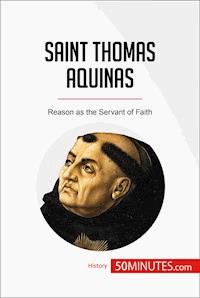
Portrait of Thomas Aquinas.
JOINING THE DOMINICAN ORDER
Thomas Aquinas was born to a noble family in the castle of Roccasecca, near the village of Aquino from which he takes his name, in 1225. On his father’s side, he was a great-nephew of Frederick I, (Holy Roman Emperor, 1122-1190). His family intended him to embark on an ecclesiastical career, so he was sent to the first Benedictine monastery at Monte Cassino to study Latin literature. During his time there, he discovered prayer and contemplation, which would be constant companions for him throughout his life and a major influence on his work. In 1240, he went to Naples to undertake more advanced studies in grammar, science, theology and above all philosophy. He also discovered the recently founded Dominican Order, which he joined as a novice after the death of his father in 1243. This displeased his mother, Theodora of Teano, who set out to look for him in Naples and then Rome in order to bring him back to the family castle and force him to pursue the career that had been chosen for him. Theodora’s initial attempts to track down her son were unsuccessful, but he was eventually captured and brought home. He was kept at Roccasecca for almost a year, but refused to renounce his Dominican vows.
A LIFE DEDICATED TO TEACHING
He continued his studies in Paris after his release in 1245, and went on to study in Cologne in 1248. He was taught by Albertus Magnus (German theologian and philosopher, c. 1200-1280), one of the first theologians to base their ideas on the rediscovered works of Aristotle (Greek philosopher, 384-322 BCE). After completing his studies, Aquinas also became a teacher, initially in one of the two Dominican schools incorporated in the University of Paris. In 1259, he was recalled to Italy by Pope Alexander IV (1199-1261) and appointed theological advisor and lecturer to the papal Curia. Although he had been nicknamed “the dumb ox” by his fellow students because of his size and reserved nature, his renown and influence were by now such that Pope Urban IV (1200-1264), Alexander IV’s successor, asked him to write a text challenging Aristotelian philosophy as it was taught by the Averroists at the Sorbonne.
Albertus Magnus




