


43,99 €
Mehr erfahren.
- Herausgeber: John Wiley & Sons
- Kategorie: Fachliteratur
- Sprache: Englisch
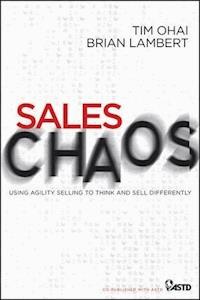
What if chaos is good? What if random complexity is not the enemy, but a competitive asset instead? Could it be possible to thrive in the chaos, to actually harness it during your sales conversations? Sales Chaos is a groundbreaking book that outlines a new paradigm that applies the latest research and the scientific principles of chaos theory to the challenges facing today's sales professional. The result of this philosophy creates a whole new approach to business, one in which sales conversations are driven by relevance, not simple activity. It's called Agility Selling. Agility Selling is not a sales technique. Nor is it a sales process. While techniques and processes have value, Agility Selling is bigger than that. It is a genuinely fresh approach to selling, birthed by chaos and grounded in science. Agility Selling is a methodology designed to help you identify repeatable and predictable patterns in the complex world of selling so that you can consistently be more relevant than your competition and create more value for your clients. It doesn't matter if you are new to sales or a seasoned professional; Sales Chaos provides the key information any seller should know to turn the scientific theory of Agility Selling into more relevant sales conversations and bottom-line sales results. Learn more about the practices behind the book at href="https://naemail.wiley.com/owa/[email protected]/redir.aspx?C=d91e3d5629a94f6ca44cf7ececac3266&URL=http%3a%2f%2fwww.saleschaos.com" target="_blank">www.saleschaos.com
Sie lesen das E-Book in den Legimi-Apps auf:
Seitenzahl: 376
Veröffentlichungsjahr: 2011
Ähnliche



















About This Book
Why is this topic important?
In stark contrast to most sales books published today, this book is organized around many ideas that haven't been applied to professional selling before. You will not find a repackaged version of yester-year's sales philosophy or the “do it like me” testimonials of successful salespeople who were in environments that are completely different than your own. The applicability of such content is at best limited and at worst expired. Instead, we are bringing you legitimately new selling principles that have consistently driven sales success in today's reality.
What can you achieve with this book?
Sales Chaos is the first book to apply the scientific principles of chaos theory and complex systems to the sales profession so that you can have better sales conversations with your customers. It is written to provide a no-holds-barred explanation of what professional selling has become and to help you learn how to identify patterns you can use to overcome the challenges you are facing in this new reality. No matter whether you are new to sales or a seasoned professional, Sales Chaos provides the key information an individual seller should know to turn scientific theory into sales results.
How is this book organized?
The book is divided into core themes for learning a new approach to professional selling:
Section 1: Thinking Differently
Chapter 1: Chaos ReignsChapter 2: Fundamentals of Sales Chaos: ButterfliesChapter 3: Fundamentals of Sales Chaos: Anchor PointsChapter 4: Fundamentals of Sales Chaos: SnowflakesChapter 5: A Recap of Thinking DifferentlySection 2: Selling Differently, Part One
Section 3: Selling Differently, Part Two
Section 4: Agility Selling in Action
To help you accelerate your understanding of these two themes, the end of each chapter also provides worksheets, tools, and self-assessments to help you build on your own current knowledge and skills.
About the American Society for Training & Development
The American Society for Training & Development (ASTD) is the world's largest professional association dedicated to the training and development field. In more than one hundred countries, ASTD's members work in organizations of all sizes, in the private and public sectors, as independent consultants, and as suppliers. Members connect locally in 130 U.S. chapters and with thirty international partners.
ASTD started in 1943 and in recent years has widened the profession's focus to align learning and performance to organizational results and is a sought-after voice on critical public policy issues. For more information, visit www.astd.org.
Copyright © 2011 by John Wiley and Sons, Inc. All Rights Reserved.
Published by Pfeiffer
An Imprint of Wiley
989 Market Street, San Francisco, CA 94103-1741
www.pfeiffer.com
No part of this publication may be reproduced, stored in a retrieval system, or transmitted in any form or by any means, electronic, mechanical, photocopying, recording, scanning, or otherwise, except as permitted under Section 107 or 108 of the 1976 United States Copyright Act, without either the prior written permission of the Publisher, or authorization through payment of the appropriate per-copy fee to the Copyright Clearance Center, Inc., 222 Rosewood Drive, Danvers, MA 01923, 978-750-8400, fax 978-646-8600, or on the web at www.copyright.com. Requests to the Publisher for permission should be addressed to the Permissions Department, John Wiley & Sons, Inc., 111 River Street, Hoboken, NJ 07030, 201-748-6011, fax 201-748-6008, or online at http://www.wiley.com/go/permissions.
Limit of Liability/Disclaimer of Warranty: While the publisher and author have used their best efforts in preparing this book, they make no representations or warranties with respect to the accuracy or completeness of the contents of this book and specifically disclaim any implied warranties of merchantability or fitness for a particular purpose. No warranty may be created or extended by sales representatives or written sales materials. The advice and strategies contained herein may not be suitable for your situation. You should consult with a professional where appropriate. Neither the publisher nor author shall be liable for any loss of profit or any other commercial damages, including but not limited to special, incidental, consequential, or other damages.
Readers should be aware that Internet websites offered as citations and/or sources for further information may have changed or disappeared between the time this was written and when it is read.
For additional copies/bulk purchases of this book in the U.S. please contact 800-274-4434.
Pfeiffer books and products are available through most bookstores. To contact Pfeiffer directly call our Customer Care Department within the U.S. at 800-274-4434, outside the U.S. at 317-572-3985, fax 317-572-4002, or visit www.pfeiffer.com.
Library of Congress Cataloging-in-Publication Data
Ohai, Tim, 1971-
Sales chaos : using agility selling to think and sell differently / Tim Ohai,
Brian Lambert.
p. cm.
Includes bibliographical references and index.
ISBN 978-0-470-88601-4 (pbk.); 978-1-118-06427-6 (ebk);
978-1-118-06428-3 (ebk); 978-1-118-06429-0 (ebk)
1. Selling. 2. Chaotic behavior in systems. I. Lambert, Brian. II. Title.
HF5438.25.O36 2011
658.85—dc22
2011008888
Pfeiffer also publishes its books in a variety of electronic formats. Some content that appears in print may not be available in electronic books.
Acquiring Editor: Matthew Davis Director of Development: Kathleen Dolan Davies
Production Editor: Michael Kay Manufacturing Supervisor: Becky Morgan
Editorial Assistant: Michael Zelenko Graphics: Kulana Grafix
Editor: Rebecca Taff
Preface
“Fools ignore complexity. Pragmatists suffer it. Some can avoid it. Geniuses [overcome] it.”
Alan Perlis
This section is for those of you who are curious about the science behind our theories. If you just want to learn how to think and sell differently, run ahead to Chapter 1. Obviously, this book is about chaos. Or more specifically, how to harness it. And that will require agility. We haven't run into a senior executive yet who hasn't agreed that agility is important in business. Agility just sounds good, doesn't it? It implies speed, adaptation, decisiveness, alignment, and readiness, even when things are chaotic. But to become agile, you have to understand that agility is more than just a business philosophy or a selling strategy.
Agility Means Increased Responsibility for the Salesperson
Buyers are demanding more. Higher expectations for attaining business results are being placed on sales professionals by buyers who are expected to make the correct purchase decision. As buyers push for increased cost savings with more scrutiny on spending, procurement functions are growing in scope and scale and will play an expanded role in the buying process moving forward. As a result, salespeople are under increased pressure to attain the goals of both the selling organization and the buying organization. This translates into the need for salespeople to not only accept initial responsibility for the goals, but to maintain that responsibility to ensure the success of both buyer and seller, as defined by each side. The agility selling methodology makes it possible for sales professionals to embrace this responsibility.
Agility Means Increased Emphasis on Consultative Selling
Unfortunately, executive buyers don't believe salespeople really understand their business. To be blunt about it, salespeople need to do a better job in transitioning from product-pushers to problem-solvers. And this requires a true partnership mentality. In response, some salespeople are focusing on developing deeper relationships and personal networks inside their target companies as well within the specific industry. Sales leaders must begin to take more steps to ensure that customers are getting value, not just product.
To differentiate themselves, many sellers have focused on listening, analyzing, problem solving, and questioning to help buyers navigate the complexity of the solution and the plethora of available information. Communication skills such as active listening can help sellers identify root problems and hidden obstacles that affect the buyer's business success. Building rapport, demonstrating patience, and exercising astute timing contribute to building the foundation for a trusting buyer–seller relationship. These higher-level skills are included in the Agility Selling methodology and re-cast the role of learning to the point where learning is mandatory for success.
Agility Means Faster and More Effective Seller Responsiveness
In today's competitive landscape, sales teams must focus on maintaining professionalism with buyers who may not have the same timeframe in mind or who may have strong negotiating skills. Often, these buyers do not even operate within a linear definition of process. This is especially important since buyer decision-making is becoming increasingly more collaborative. Today's seller must stay focused on communicating value to the buyer based on mutually agreed-on goals and objectives, regardless of the state of the interaction process. This requires taking the client's best interest into account while providing a relevant solution to the business issues at hand. Executives don't want to participate in a meeting with irrelevant goals or no clear purpose. The higher the level of the executive, the more customized the message needs to be to resonate, taxing traditional create-once-publish-many-times marketing techniques. The ability to gain access to decision-makers and also have the right conversation is a result of appropriately following the Agility Selling methodology.
Agility Increases Emphasis on Profitability
Many sales managers are compensated on gross margin or profitability as well as top-line revenue. This coincides with more firms examining the profitability and productivity of salesperson activity, rather than frequency or volume. As a result, organizations are working hard to ensure their sales team members use time appropriately and productively. Whatever qualifications and experience you possess, the issues you face can best be defined as: becoming a more effective and efficient trusted advisor who can communicate and demonstrate value at every customer interaction. If this is the challenge you seek to address, it can be addressed with the concepts found within Agility Selling.
Look for These Icons
We have tried to make it easy for you to understand and apply lessons from this book. The following icons used throughout the book will help you zoom in on key points.
Pay Attention!
This icon indicates callouts for our key points from the text that you don't want to overlook. Fail to grasp these key points, and you run the risk of being less effective than you would probably like to be. Make sure you take note of each of these comments, and refer to them frequently. The more you study them, the more you will realize they apply to many situations.
Consider This
This icon indicates comments and extra thinking that cuts to the chase. They point out condensed important concepts and assumptions that form the foundation for harnessing the chaotic randomness around you. You can revisit these ideas to further your thinking in order to continuously improve.
Mirror Moment
This icon indicates you have an opportunity to “look in the mirror”. By stopping and reflecting on the content, you are able to take stock of important concepts and determine how your own abilities can be stretched.
Building on the Foundation
This icon indicates ancillary information about the topics covered in the chapter. This icon also provides key definitions of important people who contributed these concepts to professional selling.
Making It Stick
This icon indicates actionable worksheets, job aids, and tools. These are helpful tips and bonus tools found at the end of every key chapter. These help reinforce the important concepts, knowledge, and techniques found in the chapter. They are presented in a way that helps you sell with agility.
Here's to butterflies, anchor points, and snowflakes—and here's to the ability to harness them.
Tim Ohai
Brian Lambert
Acknowledgments
When you sit down to write a book, you know it will be a lot of work. But you never truly appreciate how much work it will be, nor how much you will rely on the help of others. We would like to thank a few of them now.
From Tim:
I have to start with my wife and family. Diana, words cannot begin to express my gratitude for your encouragement, support, and all those pots of coffee I drank by myself. Connor and Caelan, you don't know how helpful those Nintendo breaks were.
While the list of salespeople I have worked with over the years is massive, I must single out two people. Jim Hayes, my first sales manager. Who would've thought the new kid would eventually figure things out, eh? You did. Thank you. And Owen McManamon. What can I say? It's not often people get to work with company presidents who live and breathe professional selling. I cannot say enough how much your friendship both shaped my philosophy and inspired me to step out on my own. Thank you.
From Brian:
I, too, have to start with my wife and family. Donna, thanks for supporting me and always being there. Thanks also for your understanding of the long hours and constant, sales-related conversations. I am sure you still don't have a clue what we wrote about, and that's ok. Thanks to Caitlin, Maleah, and Matthew for helping me take a break and have some fun amidst all the chaos in my job and at home. Thanks to my mom, who taught me the importance of books and knowledge, and to my dad, the consummate sales professional.
From both of us:
While we were constantly bouncing our theory off of other people, we must specifically point out Steve Thompson and Tim Caito, two genuine experts in the world of professional selling. You guys took our idea of agile conversations and gave them the structure they needed in the form of fifteen questions.
We also want to acknowledge the growing number of people who treat sales as a science and not just an art, such as Eric Kerkhoff, Tony Cross, Marcel Brunel, and Scott Barghaan. Let's keep moving the profession of sales forward.
Finally, we would also like to thank the staff of ASTD and Pfeiffer. Professionals like Dean Smith and Matt Davis, who did an amazing job of getting this project off the ground and keeping it from crashing back down to earth.
Lesen Sie weiter in der vollständigen Ausgabe!
Lesen Sie weiter in der vollständigen Ausgabe!
Lesen Sie weiter in der vollständigen Ausgabe!
Lesen Sie weiter in der vollständigen Ausgabe!
Lesen Sie weiter in der vollständigen Ausgabe!
Lesen Sie weiter in der vollständigen Ausgabe!
Lesen Sie weiter in der vollständigen Ausgabe!
Lesen Sie weiter in der vollständigen Ausgabe!
Lesen Sie weiter in der vollständigen Ausgabe!
Lesen Sie weiter in der vollständigen Ausgabe!
Lesen Sie weiter in der vollständigen Ausgabe!
Lesen Sie weiter in der vollständigen Ausgabe!
Lesen Sie weiter in der vollständigen Ausgabe!
Lesen Sie weiter in der vollständigen Ausgabe!
Lesen Sie weiter in der vollständigen Ausgabe!
Lesen Sie weiter in der vollständigen Ausgabe!
Lesen Sie weiter in der vollständigen Ausgabe!
Lesen Sie weiter in der vollständigen Ausgabe!
Lesen Sie weiter in der vollständigen Ausgabe!
Lesen Sie weiter in der vollständigen Ausgabe!
Lesen Sie weiter in der vollständigen Ausgabe!
Lesen Sie weiter in der vollständigen Ausgabe!
Lesen Sie weiter in der vollständigen Ausgabe!
Lesen Sie weiter in der vollständigen Ausgabe!
Lesen Sie weiter in der vollständigen Ausgabe!
Lesen Sie weiter in der vollständigen Ausgabe!




