


Erhalten Sie Zugang zu diesem und mehr als 300000 Büchern ab EUR 5,99 monatlich.
- Herausgeber: Pitkin
- Kategorie: Geisteswissenschaft
- Sprache: Englisch
This beautifully-presented book chronicles the coming and going of these peoples, their kings, heroes and saints, and way of life. Look out for more Pitkin Guides on the very best of British history, heritage and travel.
Sie lesen das E-Book in den Legimi-Apps auf:
Seitenzahl: 30
Veröffentlichungsjahr: 2021
Das E-Book (TTS) können Sie hören im Abo „Legimi Premium” in Legimi-Apps auf:
Ähnliche


















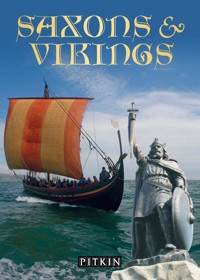
The Sea Stallion from Glendalough, a replica Viking longship constructed in Denmark, under sail on a journey to Dublin.
The Saxon king Alfred the Great ruled Wessex from 871 to 899. This statue stands in Winchester, Hampshire, his capital and burial place.
Armed with spear, sword, shield and axe, this helmeted warrior wears his knife Viking-style across the waist. The carving, on a 10th-century cross from Middleton, Yorkshire, is characteristic of the Viking kingdom of York.
Contents
Hail and Farewell
Kings and Heroes
Saints Among The Saxons
Raiders from the Sea
From Fury to Farming
Forging the Kingdom
Divided and United
Viking King
Last of the Earls
Places to Visit
Hail and Farewell
In the year 406, Roman Britain faced crisis. Most of its troops had been pulled out to fight on the continent, and for the first time since their arrival in AD 43, there were no Roman legions to defend its shores. After three and a half centuries of prosperity under Roman administration, southern Britain lay open to invasion from barbarian tribes. Picts attacked from the north and Scots from Ireland harried the western coasts, while Saxon pirates raided the east and south, defying the high-walled coastal forts built to repel them.
Rome recruited soldiers even from tribes that attacked its territory. Left to their own defence in 410, British leaders followed this example by hiring Germanic mercenaries to fight off incursions. Of the same stock as the invaders – Saxons, Angles, Jutes, Franks and Frisians – these men soon realised their strength, and turned on their paymasters. They overthrew or enslaved many of the British, seized their possessions, and sent word home of a land that was ripe for the taking.
From the 430s onwards, invaders by the boatload rowed across the North Sea. Warriors and seafarers, they included Angles from south Denmark and the Saxons who lived to their west on the North Sea coastal plain up to the River Weser. This arrival of the ‘English’ was recounted in 731 by the historian Bede, who named Angles as settling in East Anglia, the East Midlands and Northumbria; Saxons in Essex, Sussex, Middlesex and Wessex; and Jutes in East Kent, the Isle of Wight and Hampshire. The settlers left no written records, but the evidence of archaeological finds from their graves broadly bears out Bede’s claims.
A British monk, Gildas, wrote in the 540s of a ‘proud tyrant’ hiring Saxons. Bede names the tyrant as Vortigern, and the Saxon leaders as Hengist and Horsa, brothers who landed around 450 and founded the kingdom of Kent. Gildas also highlights a British victory around 500, at Mons Badonicus (perhaps Badbury Rings in Dorset), possibly won by the Roman-British war leader who lives in legend as King Arthur. But Saxon spread proved irresistible. By the end of the 6th century the invaders controlled half of Britain, driving the dispossessed Britons westwards and into the hills. Some fled to Brittany rather than endure slavery.
A few British kingdoms survived, however; their main stronghold was Wales, while Cornwall held out until 838.
Combs, made from animal bone or ivory, were important for hygiene, as long hair was favoured by both sexes. Combs were also placed in burials, for use in the afterlife.
This bronze belt fitting, about 410–20, was found at Mucking in Essex. It is of a type worn by Roman auxiliary soldiers, but decorated in Germanic style.




