


24,99 €
Mehr erfahren.
- Herausgeber: John Wiley & Sons
- Kategorie: Fachliteratur
- Sprache: Englisch
You've built a great product—now what?
The brutal truth: most startups and scale-ups don't fail because of bad products. They fail because they never figure out how to grow fast—and profitably. Some chase market share at all costs, burning cash on customers who won't pay enough to sustain the business. Others over-monetize too soon, pushing away the customers they need to reach scale. Still others obsess over customer loyalty, missing larger markets and monetization potential. And then there are those who assume a great product will sell itself, only to realize too late that pricing, packaging, positioning and value selling matter just as much.
The true winners take a different approach. They adopt a Profitable Growth Mindset, refusing to choose between market expansion and monetization—instead, they dominate both. Instead of relying on instinct or momentum, they architect growth with precision, making every move count towards building enduring value.
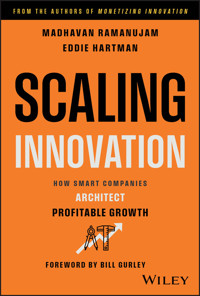
In this highly-anticipated sequel to Monetizing Innovation, Madhavan Ramanujam and Eddie Hartman unveil a battle-tested playbook for architecting profitable growth. Drawing from their experience advising over 400 companies—including 50+ unicorns—the authors dissect both legendary successes and costly failures. Packed with real-world case studies, hard-hitting insights, and nine breakthrough strategies, Scaling Innovation reveals how founders, executives, and investors need to navigate the critical transition from product-market fit to building an enduring, high-value business.
If you want to scale smartly, outmaneuver competition, and unlock exponential revenue, this book will show you how.
Inside, You'll Learn:
- Why the “single-engine strategy” dooms so many businesses—and how to avoid it
- How to create outcome and usage-based monetization models
- The secrets to mastering value messaging—and getting customers to pay what you're worth
- Mastering sales negotiations—“give and get” strategies to close faster, better and more often
- How to stop churn before it happens, maximize upsells, and handle price increases with confidence
- The essential tactics for balancing market share and wallet share—without losing momentum
If Monetizing Innovation taught you how to build a great product, Scaling Innovation will teach you how to build a great business—one that thrives, scales, and creates real enterprise value.
Read it. Apply it. Build something that lasts.
Sie lesen das E-Book in den Legimi-Apps auf:
Seitenzahl: 451
Veröffentlichungsjahr: 2025
Ähnliche


















Praise for Scaling Innovation
“Like most new technologies before it, AI will upend old business models. This book is an essential read for successful AI founders.”
—Clay Bavor, Cofounder, Sierra
“Scaling Innovation shares the strategic frameworks and practical insights every leader needs to turn a great early idea into a scaling success story. The book brilliantly captures the strategies and principles behind how companies like Canva scaled effectively. For any entrepreneur or leader seeking a clear path to navigate the complexities of profitable growth, this book is a fantastic blueprint.”
—David Burson, Global Head of Revenue and Growth, Canva
“At Superhuman, we've lived the principles in this book—like beautifully simple pricing—and seen firsthand how they drive explosive growth. Not reading this book isn't just a mistake; it's a competitive disadvantage.”
—Rahul Vohra, Founder and CEO, Superhuman
“Brilliantly structured and deeply insightful. Ramanujam and Hartman expose the traps of one‐dimensional scaling and provide practical strategies for turning great products into great businesses.”
—Sridhar Narayanan, Professor of Marketing, Stanford Graduate School of Business
“A great product isn't enough—you need to prove its value. This book gives early‐stage startups the tools to build value‐based selling into their DNA, navigate tough negotiations, and confidently hold the line on price.”
—Devin Bhushan, CEO, Squint
“I've been a huge fan of Monetizing Innovation—I have handed a copy to every founder I met. Scaling Innovation takes it to the next level, showing how to turn great products into scalable, profitable businesses. I couldn't be more excited about this book and the impact it will have on founders everywhere.”
—Zach Coelius, Managing Partner, Coelius Capital
“An important lesson learned during the startup and growth phase at Segment was how much rigor you can apply to monetize and scale your innovation. It blew my mind that there was an entire field dedicated to pricing strategy, and we learned a lot from working with Madhavan and Simon‐Kucher. This book encapsulates all those learnings and is a must read for founders.”
—Peter Reinhardt, CEO and Cofounder at Charm Industrial; Former CEO and Cofounder of Segment
“Forget the growth hacks and feel‐good frameworks. This is the real guide to building an enduring business.”
—Naomi Ionita, Venture Partner, Menlo Ventures, Growth and Monetization Advisor
“The book's actionable frameworks and insights on monetization and scaling align closely with what drove Grailed's success and eventual acquisition by GOAT. It's a practical, no‐nonsense toolkit for founders and leaders aiming to achieve impactful growth and transformative exits.”
—Arun Gupta, CEO and Founder, Grailed
“This book should be required reading for any founder in the early days of product‐market fit—it will change how you think about pricing, packaging, and architecting growth.”
—Leo Polovets, General Partner, Susa Ventures and Humba Ventures
“Pricing and packaging have always been team sports, and if you have a viral product, there is unbelievable upside in optimizing it across the life cycle—but in the age of AI, the stakes are higher, the upside is bigger, and the decisions more complex. This book is essential for getting it right.”
—Chris Farinacci, Advisor, Investor, ex‐Asana COO, ex‐Google Cloud CMO
FROM THE AUTHORS OF MONETIZING INNOVATION
MADHAVAN RAMANUJAM
EDDIE HARTMAN
SCALING INNOVATION
HOW SMART COMPANIES ARCHITECTPROFITABLE GROWTH
FOREWORD BY BILL GURLEY
Copyright © 2025 by Simon, Kucher, & Partners Strategy and Marketing Consultants LLC. All rights reserved.
Published by John Wiley & Sons, Inc., Hoboken, New Jersey.
Published simultaneously in Canada.
No part of this publication may be reproduced, stored in a retrieval system, or transmitted in any form or by any means, electronic, mechanical, photocopying, recording, scanning, or otherwise, except as permitted under Section 107 or 108 of the 1976 United States Copyright Act, without either the prior written permission of the Publisher, or authorization through payment of the appropriate per‐copy fee to the Copyright Clearance Center, Inc., 222 Rosewood Drive, Danvers, MA 01923, (978) 750‐8400, fax (978) 750‐4470, or on the web at www.copyright.com. Requests to the Publisher for permission should be addressed to the Permissions Department, John Wiley & Sons, Inc., 111 River Street, Hoboken, NJ 07030, (201) 748‐6011, fax (201) 748‐6008, or online at http://www.wiley.com/go/permission.
The manufacturer's authorized representative according to the EU General Product Safety Regulation is Wiley‐VCH GmbH, Boschstr. 12, 69469 Weinheim, Germany, e‐mail: [email protected].
Trademarks: Wiley and the Wiley logo are trademarks or registered trademarks of John Wiley & Sons, Inc. and/or its affiliates in the United States and other countries and may not be used without written permission. All other trademarks are the property of their respective owners. John Wiley & Sons, Inc. is not associated with any product or vendor mentioned in this book.
Limit of Liability/Disclaimer of Warranty: While the publisher and author have used their best efforts in preparing this book, they make no representations or warranties with respect to the accuracy or completeness of the contents of this book and specifically disclaim any implied warranties of merchantability or fitness for a particular purpose. No warranty may be created or extended by sales representatives or written sales materials. The advice and strategies contained herein may not be suitable for your situation. You should consult with a professional where appropriate. Further, readers should be aware that websites listed in this work may have changed or disappeared between when this work was written and when it is read. Neither the publisher nor authors shall be liable for any loss of profit or any other commercial damages, including but not limited to special, incidental, consequential, or other damages.
For general information on our other products and services or for technical support, please contact our Customer Care Department within the United States at (800) 762‐2974, outside the United States at (317) 572‐3993 or fax (317) 572‐4002.
Wiley also publishes its books in a variety of electronic formats. Some content that appears in print may not be available in electronic formats. For more information about Wiley products, visit our web site at www.wiley.com.
Library of Congress Cataloging‐in‐Publication Data is Available:
ISBN 9781119633068 (Cloth)
ISBN 9781119633136 (ePub)
ISBN 9781119633105 (ePDF)
Cover Design: Wiley
Cover Image: © nuengrutai / stock.adobe.com
For Hema, Risha, Aarush, Ben, Darrow, Langston, and Natalie
Foreword
The journey from an ambitious idea to a transformative business is never easy. It's filled with highs and lows, tough decisions, and moments of self‐doubt. What separates those who succeed from those who don't isn't just hard work or luck; it's the ability to ask the right questions and make the right decisions at pivotal moments. Scaling Innovation is a guide for those moments, written for leaders who are determined to turn great ideas into enduring businesses.
At Benchmark, I've had the privilege of working with some of the most visionary founders in the world—people who dreamed big, took bold risks, and built businesses that reshaped their industries. Along the way, I've seen one consistent truth: Achieving real, sustained growth requires more than a great product. It takes a deep understanding of how to connect with your customers, deliver value, and build a scalable foundation for long‐term success. This book captures that truth with a rare clarity and depth.
What makes Scaling Innovation stand out is its dual focus on the startup and scale‐up phases—two stages that demand entirely different strategies. In the early days, it's all about landing and expanding, creating a pricing model that feels intuitive, communicating value in a way that resonates, and building the foundation for monetization that grows with your customers. Later, as you scale, the challenges shift. You might need to rethink your packaging, learn how to negotiate for fair value, navigate the inevitability of price increases, and prevent churn before it becomes a problem. The authors lay out these strategies in a way that's both practical and inspiring, offering insights that feel immediately actionable.
What I love most about this book is how it never loses sight of the human element of leadership. Growing a business is hard—it can feel lonely, overwhelming, and at times impossible. But this book feels like a trusted companion, reminding you that every tough decision has a framework, every challenge has a solution, and every step forward is an opportunity to learn and grow.
If you're a founder, an executive, or a leader at any stage of your journey, Scaling Innovation will equip you with the tools and mindset to achieve both market share and wallet share, not just for today, but for years to come. It's more than a guide—it's a roadmap for building something truly extraordinary.
—Bill Gurley
General Partner, Benchmark
Acknowledgments
Writing a book is never a solo endeavor, and this one is no exception. We are incredibly grateful to the remarkable individuals who helped bring this project to life through their insights, support, and dedication.
First, our heartfelt thanks to Bill Gurley, who graciously wrote the foreword and has been a steadfast supporter over the years. Your belief in this work means the world to us.
Our deepest gratitude to Mark Billige for his insights, guidance, and support, which were pivotal in laying the foundation of this book.
To Josh Bloom, our invaluable sparring partner, content collaborator, and meticulous proofreader—thank you for your sharp insights, endless patience, and unwavering commitment to improving this book.
A heartfelt thank—you to Clay Bavor for his invaluable feedback in sharpening the ideas and elevating the clarity of this book. A special shoutout for his insight to name each axiom individually—what started as 42 generic “Scaling Innovation Axioms” became a far more memorable and actionable set of ideas thanks to that simple but powerful suggestion. Grateful for his thoughtfulness and creative push.
A special thank—you to Advait Halve, who served as our internal editor and also contributed valuable content to key sections of the book. His thoughtful feedback and dedication were essential in refining the manuscript. Also thanks to Sara Yamase, Michelle Verwest, Jan Haemer, Adam Echter, Peter Kuo, and Michael Einstein for help drafting key sections and case studies.
We're deeply grateful to Shikha Jain for her thoughtful contributions to the chapter on promotions—her expertise helped elevate the content significantly.
We deeply appreciate Matt Johnson for helping us brainstorm the concept for this book and for his thoughtful feedback on key themes throughout the process.
We also want to express our gratitude to those who helped craft the compelling case studies:
Peter Reinhardt, Joe Morrissey, and Tido Carriero:
Thank you for your invaluable help in telling the Segment story and contributing to the writing.
David Burson and Cliff Obrecht:
Your contributions to the Canva story added richness and authenticity—thank you.
Tom Buiocchi:
Thank you for helping us tell the ServiceChannel story with such clarity and impact.
Jake Heller and Pablo Arredondo:
We're deeply grateful for your help with the CoCounsel story.
Laura Rillos and Drew Branden:
We're grateful for your time and insight in refining the Airbnb story.
Chris Farinacci and Dustin Moskovitz:
Thank you for sharing your time and expertise to help tell the Asana story.
Rahul Vora:
Your insights were instrumental in telling the Superhuman story and crafting the beautifully simple pricing chapter—thank you.
Arun Gupta:
Thank you for your thoughtful contributions to the Grailed story.
Hilary Schneider:
We're so grateful for your help in bringing the LifeLock story to life.
We were truly blessed to have an all‐star team of reviewers. To all the reviewers of this book, thank you for your time, perspective, and honest feedback (in alphabetical order): Alex Osterwalder, Ali Ghodsi, Aparna Chennapragada, Arun Gupta, Chris Farinacci, Clay Bavor, Dara Ladjevardian, David Burson, Devin Bhushan, Hilarie Koplow‐McAdams, Leo Polovets, Lenny Rachitsky, Naomi Ionita, Peter Reinhardt, Rahul Vohra, Sridhar Narayanan, Zach Coelius.
Finally, to all the friends, colleagues, and family members who supported this journey in ways big and small—thank you for your encouragement, patience, and belief in this project.
This book is a testament to your collective efforts, and we are profoundly grateful.
Madhavan and Eddie
Introduction: From a Great Product to a Great Business
What's the most important thing you have to do as a leader?
This is not a question with an obvious answer. Whether you are running a startup or leading a scale‐up, you have a huge set of daily concerns. There might be a burning problem in HR or legal that needs your attention right now. You might go to sleep (or lie awake all night trying to sleep) sweating about a fight brewing with a competitor. You might be worried about making payroll. Then there is the crucial hire, the can't‐miss launch date, the tricky investor meeting. Every fast‐moving company has its pivotal moments. You may be thinking to yourself that one of these, maybe more than one of these, could make or break your company.
But you also know you have to prioritize. Your to‐do list never gets any shorter. You are already operating on little sleep, working straight through the weekend, skipping holidays. You have to triage, you have to manage the time available to you. So what matters most?
One way to look at this question is to ask: What are the leaders of fast‐growing companies you admire known for? Maybe it's the founder of a software company that started out solving one simple problem and grew the product into an essential workflow tool for an entire industry. Or a founder who turned a niche consumer product into a household name through smart positioning and relentless customer focus.
What sets successful founders apart isn't just that they had a big idea; it's that they architected growth around it and scaled without losing their edge. They built strong teams. They took on risk when it mattered. When their bets didn't pay off, they made hard calls—cutting projects or shifting resources without flinching. And when they saw something working, they doubled down.
But no one ever cut their way to greatness. What the best are known for—what truly sets them apart—is creating sustained, profitable growth that didn't just move the needle. It redefined their space.
If achieving profitable growth were easy, everyone would be doing it—and clearly, this is not the case. Very smart, capable people build companies that fail to achieve liftoff or that sputter and crash back to the ground far too soon. Why?
We wrote our first book, Monetizing Innovation, to help you build a great product. That term means something very specific to us. By our definition, “great” is not the same thing as flashy, cutting edge, or even exciting. (Boring can be beautiful.) For us, a product is great if and only if it does one thing: unlocks your customers' willingness to pay. It cannot just be something people want. It must be something people want to pay for. This is the elusive quality we defined called “product‐market‐price fit.”
If you have succeeded in creating a product people want to pay for, great news. You are in a tremendously advantaged position, with the potential for real success. But as we all know, “potential” isn't the same thing as actual achievement. The list of promising ideas that never turned into powerful companies is a long one. You can be a visionary with a good team, a strong culture, and a large addressable market yet still fail to build a successful business if you are not thinking about profitable growth in the right way.
We, the authors, want to help you achieve your dream. If you see yourself building an organization that grows steadily larger and more significant, that expands year on year, that is known and respected, that makes an impact in your part of the globe—or around the world—we're right there with you. As two people who have devoted our careers to advising leaders of companies big and small, nothing gives us greater satisfaction than helping people take that journey.
And make no mistake: It is a journey. There is a tough road between “great fit” and “screaming market success.” To climb that hill, you need a plan. That's where this book comes in.
This book is for founders. It's also for the brave people who pick up the reins from a founder: Sometimes the best person to continue a journey is not the one who started it. But mainly, it is for leaders, those with the courage to run divisions, departments, startups, and scale‐ups. You are looked up to, and looked on as a rock star, but most people will never know how hard it is to succeed at what you do.
This book is about how to really grow—profitably. It is the result of studying hundreds of companies that qualify as true long‐term successes. These businesses not only achieved their goals in the short run but sustained success for years or decades. When we lined them up and dug into them, a particular type of approach emerged over and over again. We call this pattern “architecting for profitable growth.”
We've written this book to be a very specific outline of the profitable growth battle plan, split into two parts: one for your company as you are launching off the block and another for when you are truly out in open water. This approach is needed because you must take very different steps as a startup versus those you should pursue when you are scaling up. In fact, some scale‐up tactics simply aren't available to a startup. For example, in your early days, you won't have the customer history required to optimize retention (discussed in Chapter 11)—and you certainly won't need to blow up your packaging (covered in Chapter 8) in response to shifts in the makeup of your target customers. All things have their time and place.
It's easy to be seduced by the notion that your product or service is so good that you can just wing it, that you can build a strong and growing base of customers by blind feel, improvising as you go. A lot of people do that, right? If you build a better mousetrap, they say, the world will beat a path to your door. And what about that phrase “a product so good, it sells itself”?
Well, no, it won't. These phrases come from survivor bias. We hear about the times this approach worked out, the few ships that made it back to shore, but not from the wrecks lining the ocean floor. Putting such grim matters aside, there's another reason to spend time getting your profitable growth strategy right: the better your offering, the more it deserves a truly high‐performance growth engine. If you truly have captured lightning in a bottle, you had better be sure to realize its full potential. A fantastic product will make it much easier to win customers once you're in front of them, but first you must get there. That means you must create a powerful mechanism to attract the interest of prospects, convert them into paying customers, and make sure they keep coming back.
Sadly, that growth engine won't build itself. And if it did, what fun would that be? No: Even if you created the most compelling product in the world, even if you found the Fountain of Youth (and got the rights), you still have to conquer your market and develop a strategy for scaling your growth.
That's the job. Let's get to work.
The Build‐Fail Axiom
Even the best product won't sell itself; architecting profitable growth is what defines the winners.
Part IBeating the Barriers to Scaling
Chapter 1A Tale of Three Companies
Putting your time, sweat, and money into a new venture always comes with risk. When a company clicks and you find yourself in that moment when a startup becomes a scale‐up, or when a scale‐up achieves truly sustainable, profitable growth, it can feel like more than just a bet that paid off. It can feel like magic. In that spirit, this chapter recounts three astounding fables, fairytales of the business world, that illustrate the fundamental truth about profitable growth.
Unfortunately for the subjects of these stories, these are not happily‐ever‐after stories. Collectively, these businesses lost more than $50 billion and they left thousands upon thousands unemployed.
Yet the stories those founders told to investors and their excited armies of recruits were extremely convincing. Listening to the founding teams describe their vision and the opportunity ahead, you would have heard arguments delivered with passion, been shown evidence of success in the market, and been walked through numbers that seemed to make sense.
Would you have spotted the fatal flaw in each company? And let's reverse the roles for a second. Say it was your business, with your name on the cover of the pitch deck. Imagine that it was your startup or scale‐up headed toward disaster. Is there a single factor that, if identified and addressed, would have saved your company?
We believe there is. And it's surprisingly simple.
That single factor is this: Many leaders try to grow with what we term a “single‐engine strategy.” They found one source of power for their company and leaned in hard.
In this chapter, we see how this approach plays out. We consider three companies that exemplify single‐engine thinking. By examining how each one took flight and ultimately fell to earth, we believe the “fatal flaw” in this approach—both its seductive promise and its fundamental problems—will become clear.
The First Fable: Acquisition at All Costs!
At almost the exact midpoint of the real estate–driven disaster economists call the Great Recession, two New Yorkers in their 20s, Adam and Miguel, had a meeting with their landlord about a lease.
They were both entrepreneurs, but they had never worked with each other before. On the surface, they were very different from one another. Miguel, a college graduate, founded an online language‐instruction company that employed 25 people before he moved on. Adam, a college drop‐out, had started a line of padded baby outfits that he originally called “Krawlers” (later “Egg Baby”) and employed no one at all.
But after the two met at a party, they discovered a shared passion: creating a community. What they wanted from their landlord was permission to lease a vacant warehouse on Water Street, where they planned to provide a communal working space for young entrepreneurs like themselves. The name for their new venture would be Green Desk.
The idea was a hit. The warehouse became an office space. The office space was filled with thriving, young businesses. Other warehouse locations were interested, and the sky seemed the limit. And yet, this story ends with the two men losing $47 billion.
If you think you know everything about WeWork, the company Adam Neumann and Miguel McKelvey built out of their stake in Green Desk, you are not alone. When you lose that kind of money, it is bound to draw attention. Books have been written and movies have been made.
Yet the question of exactly why the business failed is still a subject of debate. Some claim that their business model was unviable. However, its fundamentals are no different from those of IWG plc, the well‐regarded owner of brands such as Regus and Spaces. IWG is in its fourth decade of continuous operation and generated nearly ₤3 billion in revenue last period. Others will point to Neumann's shocking acts of self‐dealing, some of which border on the comical: that he gave relatives high‐paid jobs with titles like Chief Nurturer; that he made personal use of the company's $60 million Gulfstream G650 private jet; that he forced WeWork to give him zero‐interest loans so that he could personally invest in property—and that he leased those same buildings back to the company. Yet in aggregate, these amounted to a fraction of 1% of the company's enterprise value. Deplorable? Yes. Capable of sinking a business worth nearly $50 billion? It does not seem likely.
We have an explanation that is both simple and supported by data: When your “single engine” of growth is adding new customers, at any cost, eventually you will run out of fuel.
Consider the facts: In 2010, WeWork occupied a single building. In 2015, it took on 50 locations; by 2017, it was 300, and two years later, 850. The company projected that in the next year, it would have 745,000 tenants. This is a shocking rate of expansion. In one target city, Seattle, there literally wasn't enough vacant office space to satisfy WeWork's goals.
To fuel his engine, which was sputtering under the strain, Neumann burned cash. He was already providing many tenants free beer, bottomless coffee, and complimentary Wi‐Fi. What if he began handing out rent money as well?
And so, in many geographies, the company began paying tenants to occupy WeWork's own offices. This was not just a free taste. These were actual pinch‐me‐I‐can't‐believe‐it deals that often spanned a year or more.
Yet there was a limit to the number of companies that needed office space, even if it was free. In 2017, an analyst showed that there weren't enough startups in existence to occupy all the real estate WeWork had taken on. But Neumann had an answer for this, too, proclaiming that the business had outgrown the confines of both its customer base and its name.
Shedding its skin, WeWork would now be “The We Company”—and its new market was, in a word, everyone. Fit adults would love the boxing, yoga, and mineral pools at Rise by We. Lonely adults would find companionship in the dorm‐inspired living spaces at WeLive. Young children could enroll in Montessori schools called WeGrow, and older kids could matriculate at “college alternative” MissonU.
The music stopped during the leadup to the company's 2019 initial public offering. Among other things, the company's prospectus revealed that the firm had $4 billion of revenue against $47 billion in committed debt. Worth nearly $50 billion in January, the company's enterprise value would drop to $10 billion by October, the month it was scheduled to have its public debut. And this was before COVID‐19; shares dropped from $527 in 2021 to 84 cents two years later, just before the company filed for bankruptcy.1
This was not the end of WeWork. The company tried to rebound under new management. But it was the end for Adam and Miguel. Neumann was forced out in the autumn of 2019, shortly after the company's prospectus revealed his unsustainable plans. McKelvey followed the year after. Neumann once said, in essence, that if you reach for the stars, “the money tends to follow.” Reality requires more of a plan.
The Second Fable: Monetization Is Everything!
Another type of business that is flirting with trouble is one that makes a different mistake. Rather than pursuing customer acquisition exclusively as WeWork did, this sort of company focuses purely on building wallet share, monetizing the customers it has. Its dreams are all about how to charge customers as much as possible. It's another single‐engine strategy that can be just as deadly.
To see what this looks like in motion, consider entrepreneur and vegan health enthusiast Doug Evans. He had found success in the extremely difficult and cutthroat area of retail food sales, starting the chain Organic Avenue in 2002. A decade in, he was ready for his next challenge. In 2013, he launched a company built around a single product and related services. The product was the Juicero Press, a Wi‐Fi–connected device that would squeeze presliced servings of fruits and vegetables—purchased in packets also sold by the Juicero company—to make drinks that were supposed to be delicious and nutritious. The device was designed by “celebrity designer” Yves Béhar and was supposed to exert an impressive 4 tons of force during the squeezing process, thereby extracting the maximum amount of tasty goodness from the produce. Evans boasted that the power of the Juicero was “enough to lift two Teslas,” and he compared his own obsession with producing quality juice drinks to Steve Jobs's obsession with the design of Apple computers.
As for the related services—well, those were less clear. Juicero's internet connection was supposedly designed to allow the machine to read the QR codes on the fruit and vegetable packets to make sure the produce hadn't passed its freshness date. Perhaps a secondary purpose was to make sure that the San Francisco–based company was viewed by investors and others in the business world as being a high‐tech startup.
Juicero got off to a promising start. Doug Evans promised investors that he would be able to sell not just the juice‐making machine but also delivery subscriptions for packets of fruits and vegetables. The idea was that Juicero customers would create a long‐lasting stream of revenue that would take the innovation to scale, thereby making Evans and those who bought into his concept very wealthy. The premise was attractive enough to enable Evans to raise $120 million in venture capital funding. Flush with investor cash, Juicero built what was described as “a 111,000‐square‐foot food‐processing factory, staffed by dozens of hourly workers, washing and slicing up fruits and vegetables in Los Angeles.”2 The company quickly reached several hundred millions in valuation—not quite unicorn territory, but within shouting distance of it.
Unfortunately, the investment concept turned out to be a lot more appealing than the business itself.
The Juicero Press was launched into the market with a steep price of $699. This was supposed to be a premium price for early adopters only, which the company expected to reduce two to three years later. However, sluggish sales forced Juicero to reduce the price to $399 only nine months after launch.
That was just the first problem. More serious was a tidal wave of bad publicity. A year after Juicero launched, Bloomberg News ran a story in which it reported that “after the product hit the market, some investors were surprised to discover a much cheaper alternative: You can squeeze the Juicero bags with your bare hands.” Two backers said the final device was bulkier than what was originally pitched and that they were puzzled to find that customers could achieve similar results without it.3
One reviewer of electronic gadgetry posted an online video in which he confirmed that the juice packets could easily be squeezed by hand, showing that the machine was absurdly overdesigned for its intended purpose.4 Other critics pointed out that the value of a Wi‐Fi connection so that the freshness of the produce packets could be verified was undercut by the fact that the packets already had expiration dates printed on them.
In short, Juicero was an absurdly expensive solution to a consumer problem that didn't really exist—a case of pursuing monetization without a sound rationale. Evans believed he could monetize customers through his high‐priced machine and high‐priced juice packets, all in the name of “democratizing juice.”
Sadly, the company did not pay attention to what people wanted, let alone to what they wanted to pay for. As a result, it could never attract sufficient customers to its scheme—drawing instead critics who had a field day mocking Juicero as a product that only wealthy, out‐of‐touch denizens of Silicon Valley could love. Eighteen months after launch, the company announced that it was suspending the sale of its machines as well as the produce packets.
If WeWork's growth plan was unbalanced because it focused solely on customer acquisition, Juicero's plan was toppled by its single‐engine focus on deep monetization. When that failed, Evans's company simply collapsed.
The Third Fable: Loyalty Above All Else!
A third type of company that is headed for trouble is a company led by executives who believe the path to scale comes only through deeply devoted customers.
In such cases, leaders often latch on to the supposed centrality of net promoter score (NPS). If you're not familiar with NPS, it's a business metric originally devised by Fred Reichheld, a director of the consulting firm of Bain & Company, and launched in a now‐famous Harvard Business Review article in December 2003.5 It's a way to measure a company's customer loyalty by using a single survey question: “How likely is it that you would recommend [company X] to a friend or colleague?” Customers are asked to respond on a scale of zero to 10. Those who are most enthusiastic about recommending the company, who choose a score of 9 or 10, are dubbed “promoters,” Those who choose a score from zero to 6 are called “detractors.” Subtract the percentage of detractors from the percentage of promoters and you have your net promoter score. Your NPS can be compared with NPS's from similar businesses, or with your own company's NPS as it changes over time, to determine the relative loyalty of your customers—and the health of your business.
NPS is an interesting business tool, and it has its uses. The problem lies in treating NPS as the one number you need to grow.
Don't misunderstand; we're not saying that customer loyalty isn't important. We consider retention very important to scaling innovation, and we devote significant space in this book to explaining how to measure it and increase it. We'll show how to connect it strategically to acquisition and monetization, and that is the point here: It's a mistake to focus on retention to the exclusion of everything else. Life, and business, is not that simple. Like acquisition and monetization, retention is just one of the things you need to enjoy sustainable growth.
The subject of our third tale, Shyp, illustrates what can happen when you mistakenly assume that retention is the one and only factor that determines your ability to scale innovation.
Shyp was founded by three partners—Joshua Scott, Jack Smith, and CEO Kevin Gibbon—and it was based on a simple business concept. In any city where Shyp operated, you could contact the company using its mobile app whenever you had something you wanted delivered. Upload a photo of the item to be shipped and the From and To addresses, and Shyp would pick it up, package it, and deliver it to a shipping company—all for a single fixed price.
Shyp got started in San Francisco in 2013, charging just $5 for its service. Customers liked its convenience and simplicity; thanks to Shyp, they no longer had to find a box of the right size for their item, figure out how to pack it, drive it to the nearest FedEx or post office, and wait in line. The fixed $5 charge was a reasonable price to pay for eliminating those hassles from their busy lives. Shyp became a hit. Investors bought into the concept, providing some $62 million in funding, and the company began to expand into other cities, including New York, Miami, Los Angeles, Chicago, and Philadelphia. Shyp boasted an estimated value of $250 million, seemingly well on its way to unicorn status.
So far, so good. But a convenient, affordable service that customers love doesn't automatically scale. That's what Shyp quickly discovered.
The single, low price point was one problem. As you can imagine, $5 might be a profitable price to charge for shipping a paperback book in 2013. But for any large, bulky, or unwieldy item—say, a set of golf clubs—the same price would probably be way too low to cover Shyp's own costs. And those costs would go up over time.
Another problem was Shyp's initial customer base, which was made up of individual consumers rather than businesses. This was a deliberate strategy based in part on the fact that Shyp wasn't yet equipped to handle large volumes of packages. “Starting with consumers not only allowed us to build a lot of operational systems but also gave people a chance to check out that early product,” Gibbon says.6 But since most ordinary people ship packages only occasionally, marketing to them didn't yield the consistent stream of repeat business that Shyp needed for long‐term success.
Shyp's leadership team saw the company was in trouble and tried to pivot to a more realistic scaling plan. They introduced variable pricing that factored in the size and weight of the item—which improved their profit margins but alienated some customers who'd been attracted to Shyp by the promise of one‐price‐fits‐all. They also shifted their marketing to focus on small businesses that had a steady flow of packages to ship. This was a smart change. But both adjustments ultimately proved to be too little, too late. In 2017, Shyp retrenched, abandoning operations in New York, Los Angeles, and Chicago. By March 2018, Kevin Gibbon had to announce that Shyp was closing down and laying off all its remaining employees.
What did Shyp do wrong? Like the other two companies we've looked at, Shyp made the mistake of focusing on just one element of business scaling. For Shyp, customer retention was viewed as the golden ticket to success. As CEO Gibbon proudly declared, “Consumers loved it. Small businesses loved it.”7 Once people tried Shyp, its convenience and affordability won them over. In other words, customer satisfaction—the characteristic measured by NPS—was high.
But retention alone is not enough to create scale. Shyp was focused on pleasing the customer in a way that was not economically feasible. It was, in effect, a company that simply couldn't or wouldn't say no to its customers. It committed itself to a fixed price that was unrealistically low, and it targeted individual customers who simply did not have the profit potential of business customers. Eventually Gibbon and his team recognized their mistake and tried to monetize. But the changes they made cost them the customers they'd already attracted, and, rather than saving the business, they accelerated the spiral of decline.
As Gibbon himself ruefully concluded, “What we didn't do is focus on having a sustainable business from day one.”8
The One‐Engine Trap Axiom
The single‐engine strategy traps companies in narrow focus—on growth, monetization, or loyalty—at the expense of the balance needed for profitable growth.
CEO Questions
In designing and executing your company's plan for scaling, have you knowingly or unknowingly pursued a
single‐engine strategy
?
Consider the way you've approached the challenge of customer acquisition. Have you treated it as one important component of an overarching strategic growth plan, or have you (consciously or unconsciously) behaved as if it is an end in itself, to be pursued at all costs?
How have you tackled the challenge of monetization? To what extent have you examined what your potential customers really need, want, and will pay for? How does your monetization model fit into your overall plan for profitable growth?
What is your company's approach to customer retention? Have you, perhaps unwittingly, become so focused on retention that you have lost sight of the need to ensure that your business model needs to be profitable and sustainable for the long term?
Notes
1.
Felix Richter, “WeWork's Share Price Drops More than 99% in Two Years,” Statista, November 5, 2023;
https://www.statista.com/chart/30583/share-price-of-wework/
.
2.
David Gelles, “A $700 Juicer for the Kitchen That Caught Silicon Valley's Eye,”
New York Times,
March 31, 2016.
3.
“Silicon Valley's $400 Juicer May Be Feeling the Squeeze,”
Bloomberg News,
April 19, 2017.
4.
AvE, “BOLTR: Juicero, Cold Press Juicer for Rich Weirdos,”
https://www.youtube.com/watch?v=_Cp-BGQfpHQ&list=LLFLi6zngEFmmrWgAuwBOjdw&index=1239
.
5.
Frederick F. Reichheld, “The One Number You Need to Grow,”
Harvard Business Review,
December 2003.
6.
Stephanie Schomer, “How This Startup Succeeded by Ignoring Its Most Important Customers,”
Entrepreneur,
June 21, 2017.
7.
Harry McCracken, “How Shyp Sank: The Rise and Fall of an On‐Demand Startup,”
Fast Company,
March 27, 2018.
8.
Ibid.
Chapter 2Becoming a Profitable Growth Architect
Let's take a closer look at what we saw with the stories of the founders who led WeWork, Juicero, and Shyp.
Make no mistake: These were exceptional individuals. Some of them had prior success starting businesses. It's clear that each had a kind of magic to them.
But another thing they had in common was an unsustainable approach to growth, a single‐engine strategy that failed their organizations in the long run. Adam Neumann and Miguel McKelvey saw new customer acquisition as WeWork's engine. From their perspective, growth was synonymous with rapid increases in the number of tenants. For Doug Evans, the engine was monetization. He did not want to catch every fish in the sea; instead, he wanted customers willing to pay a high price and readily accept additional charges. Finally, the Shyp founders believed their engine to be loyalty, trusting that word of mouth and fierce devotion from customers would drive growth.
In each case, this single‐engine approach led to disaster. One wonders what would have happened if these founders had identified and corrected their bias of relying on a one‐track growth approach before it was too late.
Identifying the Three Leadership Failure Archetypes
The founders we learned about may remind you of people you know. Their stories may call to mind strategies you contemplated or even adopted. Companies like the ones in the last chapter are very common. Having studied hundreds of failed companies, we have seen these doomed approaches to growth over and over again.
What we have found is that single‐engine strategies spring from certain types of leaders. The good news is that there are only three common types—what we term the three “leadership failure archetypes.” They each have their defining characteristics. Their pattern of behavior can be seen clearly in their approach to scale: the metrics they track, how they build their organization—where they double down and what they neglect—and the “traps” they accidentally fall into. Over time, such individuals will kill the company they are trying to lead, unless they correct their approach. These three leadership failure archetypes are particularly dangerous because they seem sensible at first, with strategies that initially pay off. The initial success allows leaders to pursue their agendas for a long time before the damage becomes evident.
Leadership Failure Archetype #1: The Disruptor
The first type of leader believes that dominating their market is the clearest path to success. They want a land grab—to seize territory, wrest attention away from competitors, and become the go‐to brand in their category. In this pursuit, no discount is too steep, no promotion too generous, and no cost of acquisition too high if it helps them capture a larger piece of the pie. We call this kind of leader “the Disruptor.” Disruptors can generate impressive growth numbers in the short term and drive strong brand recognition. The downside is that these leaders may inadvertently undervalue their product, leading to a cycle of high churn and low margins as they focus on attracting new customers while neglecting existing ones.
In terms of key performance indicators (KPIs), Disruptors live and die by customer count, so if they are doing their job, the volume of new sales in each period will be high. However, this leadership archetype is prone to making product claims that do not pan out and other promises they cannot keep. This approach creates attrition, meaning gross dollar retention may be low. Net dollar retention may be low as well, particularly if there isn't sufficient attention to postsale monetization, which would otherwise have counterbalanced customer loss.




