


1,49 €
Mehr erfahren.
- Herausgeber: The History Press
- Kategorie: Geisteswissenschaft
- Sprache: Englisch
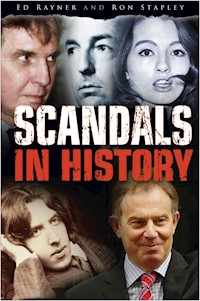
Notions of what is scandalous vary from age to age, but our fascination with all things outrageous remains the same. Whether the sexual disgraces of the Victorian era or the political outrages of modern times, the shocking and the immoral never cease to cause a stir among the masses. Bestselling partnership Ed Rayner and Ron Stapley return with their latest collection of fascinating historical facts, this time about weird and wonderful scandals throughout the ages. From the sexual scandals of the Victorian music halls, the trial of Oscar Wilde and the adventures of Ned Kelly to the hanging of Ruth Ellis and even the shooting of Tony Martin, this book is a must for all those interested in the history of scandal.
Das E-Book können Sie in Legimi-Apps oder einer beliebigen App lesen, die das folgende Format unterstützen:
Veröffentlichungsjahr: 2008
Ähnliche




















SCANDALS
IN HISTORY
SCANDALS
IN HISTORY
ED RAYNER AND RON STAPLEY
First published 2008
The History Press
The Mill, Brimscombe Port
Stroud, Gloucestershire, GL5 2QG
www.thehistorypress.co.uk
This ebook edition first published in 2013
All rights reserved
© Ed Rayner and Ron Stapley, 2008, 2013
The right of Ed Rayner and Ron Stapley to be identified as the Authors of this work has been asserted in accordance with the Copyrights, Designs and Patents Act 1988.
This ebook is copyright material and must not be copied, reproduced, transferred, distributed, leased, licensed or publicly performed or used in any way except as specifically permitted in writing by the publishers, as allowed under the terms and conditions under which it was purchased or as strictly permitted by applicable copyright law. Any unauthorised distribution or use of this text may be a direct infringement of the author’s and publisher’s rights, and those responsible may be liable in law accordingly.
EPUB ISBN 978 0 7524 9628 3
Original typesetting by The History Press
Cover images courtesy of EMPICS, Mary Evans Picture Library and Topfoto
Contents
Preface
Sex Scandals
Was W.E. Gladstone a whited sepulchre?
Why were Victorian music-halls the battleground between prudes and prostitutes?
What was the truth about Skittles, the last Victorian courtesan?
Oscar Wilde: victim or villain?
The Reverend Harold Davidson: innocent or sex maniac?
The Profumo scandal: the original ‘Tory sleaze’?
Scandals involving Murder and Violence
The scandalous execution of Derek Bentley
Was the 10 Rillington Place affair another official cover-up?
Was the hanging of Ruth Ellis justified?
Tony Martin and the Norfolk farmhouse shootings
Financial and Associated Scandals
John Law: fraudster or honest banker?
The Highland Clearances: development or genocide?
The scandalous adventures of Edward ‘Ned’ Kelly
Who made a killing out of the Marconi scandal?
Horatio Bottomley: patriot or con man?
How did the ‘Ohio Gang’ pull off the Teapot Dome scandal?
Political Scandals
How did Titus Oates try to save England from the Popish Plot?
Did John Wilkes deserve Parliament’s treatment of him?
Why did two ex-Cabinet ministers fight a duel?
President Andrew Jackson: colossus or crook?
Did Sir Hari Singh bring about the Kashmir question?
Did the leader of the Liberal Party employ a contract killer?
Jonathan Aitken and the simple sword of truth
Was Prime Minister Blair naïve or dishonest over his war against Iraq?
Royal Scandals
Was Essex responsible for his own ruin?
Was there a baby in the warming pan?
Did George III give up his true love?
How were diamonds not a queen’s best friend?
Queen Caroline: heroine or whore?
Did Queen Victoria have an affair with John Brown?
Religious Scandals
Was Sir Thomas More a rebel or a saint?
How innocent was Lady Jane Grey?
How great a danger was the Babington Plot?
Were there witches in Salem?
Could the Gordon Riots have been prevented?
Did Captain Boycott deserve to be boycotted?
The ‘abode of love’: a refuge or a racket?
War Scandals
Did Captain Jenkins lose his ear?
Who was responsible for the fate of Admiral Byng?
The case of Helen Duncan: another casualty of war?
What was the secret of Slapton Sands?
Were the Nuremberg Trials an international scandal?
Who was the ‘unknown warrior’?
Scientific Scandals
What was the truth behind the missing eleven days?
Dr Heinrich Schliemann: pioneer or poseur?
Did Annie Besant merit her disgrace?
Why was Joseph Crabtree so underrated?
Further Reading
Preface
Notions of what is scandalous vary from age to age. What would seem quite shocking to the modern mind would conspicuously fail to shock someone living in the seventeenth century. In that century, matters of religious faith, much of it close to superstition and magic, were much more in evidence than they are in our own age. That age’s sensitivity, on the other hand, to violence, poverty, pain and to sudden death, was much less. In much the same way, the strictness of the Victorian code of morals is markedly in contrast with the lax standards of our own ‘permissive age’. For example, the Victorians have the reputation of being reticent and prudish about sex. They did not, however, swear off sex simply because they were building an empire: indeed, the merest glance at the population statistics will show that they did not swear off sex at all. Likewise, even a glance at Victorian pornography will reveal it to be of the most explicit and carnal variety, and quite repulsive to the modern reader.
It is not that the Victorians were more strict, or the Tudors less strict, than us. It is rather that in both cases the strictness was about different things. Today we tend to reserve our strictness for matters to do with political and economic equality, the humane treatment of the handicapped and the disadvantaged, consideration and equality for women, and – that bugbear of modern social manners – political correctness, whilst they aimed at different targets. All the same, people of every generation know a scandal when they see one, and get their teeth into it with a fair relish.
The scandals dealt with in this book are divided into eight broad categories:
1.Scandals relating to sex. These perhaps come first in many people’s minds when they are considering scandals.
2.Scandals involving murder or similar violence. These, because they are gruesome, run sexual scandals a close second.
3.Financial and associated scandals. A popular third, since wealth is almost as fascinating as death. They are not confined, however, to run-of-the-mill dishonesty over financial matters.
4.Political scandals. Because there are public figures involved in them, these seem to have a perpetual fascination for ordinary people.
5.Royal scandals. Likewise, even when less than salacious, these have a lively and never-ending appeal.
6.Religious scandals. Like sex, religion seems all the more interesting when it is on the smutty side.
7.War scandals. There have always been cover-ups relating to wars, and here are some of them.
8.Scientific scandals. Even technical and scientific matters have not always been exempt from popular rumour and sleaze.
The authors apologise for any omissions of what you may consider equally obvious scandalous examples, but considerations of the space available have required us to limit the number of entries this book contains.
Ed Rayner Ron Stapley
SEX SCANDALS
Was W.E. Gladstone a whited sepulchre?
The curious story of the frequent encounters between one of the greatest of Britain’s elder statesmen of the nineteenth century, William Ewart Gladstone, and the common prostitutes of London in the middle years of the nineteenth century, though successfully hushed up then and afterwards, was one of the strangest scandals of Victorian and of modern times. Or perhaps ‘non-scandal’ would be a better term for it, since the greatest of his admirers Mr (later Viscount) John Morley in his multivolume biography of the great man, completely ignored it, and later biographers, such as Philip Magnus and Roy Jenkins, presented it in such a sanitized version that not even the tenderest of susceptibilities could be disturbed. Yet Gladstone’s own diaries, fourteen vast volumes each dealing with a few years or less of his long and eventful career, contain ruthlessly honest (if not entirely explicit) details of the whole scandal. There the facts of his dealings with these street-women, if not his motives, are set out in full, and his own guilty feelings amply illustrated, not only in the tone of self-reproach in which repeated episodes are described, but by his frequent use of a symbol in the margin (ζ) bearing a striking resemblance to a whip, which has suggested to many that the great man practised self-flagellation to control his carnal urges. Do these facts reveal a new and entirely unexpected side to the statesman’s character?
There is no doubt that Gladstone was a highly intelligent man, of wide and cultivated interests, deeply committed not only to politics and religious affairs, but to philosophical and artistic matters as well. He took a brilliant double first at Oxford. When he entered politics, he worked sometimes sixteen hours a day, doing twice as much as any other man, keeping extensive written records of his progress and achievements, as well as writing innumerable letters in his own hand. He read voraciously everything he could get hold of, reading upwards of a dozen books at the same time. He never wasted a moment, but filled in his time writing even during his lengthy train journeys. Like many gifted people he had a tremendous energy, and this perhaps helps to explain his sexual as well as his intellectual drive.
At the same time he was often uncomfortable in the company of women, though there is no suggestion that he was anything other than undeviatingly faithful to his wife Catherine, whom he married in 1839. The pair of them were high-principled, religious and rather uncommunicative people who baulked at close intimacy. At the same time he believed he had powerful sexual urges, and suffered severe pangs of moral guilt as the result of them. Before his marriage he had already undertaken a number of liaisons with possible spouses: one of them a pleasant and well-connected young lady called Caroline Farquhar, whose family did not consider him enough of a gentleman (her mother also, strangely, objected to the way ‘he carried his bag’ – though whether it was because of the way he carried it, or whether because he carried it at all, she never made clear); another was with Lady Frances Morton, the pretty eighteen-year-old daughter of the Earl of Morton, who remained friendly with Gladstone for the rest of her life, though her family did not think enough of him to agree to the match. At the same time, Gladstone remained rather stuffy and off-hand with the wives chosen by two of his brothers (one of them on the grounds that she was a Unitarian). It appeared to the rest of the world as if Gladstone was over-choosy and difficult to please, yet he always reproached himself for having what he thought were lustful and improper longings after females, and passed through a phase at about the same period in which he considered himself deserving of punishment because of his unhealthy interest in printed pornography – in one case French and English verse which to any normal observer was not even marginally salacious. It seems likely from his sensitivity to such matters that his highly developed religious sentiments had created what was not unusual in a man of his time and class – feelings of moral guilt.
At the same time he showed another and even more remarkable tendency: that of showing concern for what were known at the time as ‘fallen women’. He first evinced this when at Oxford in 1827, and developed it in 1846 when he took an interest in the society that dealt with these unfortunates operating from the Margaret Street Chapel north of Oxford Circus, later beautifully rebuilt by William Butterfield as All Saints, Margaret Street. After 1849 Gladstone took to the practice of seeking these women out in the course of the late-night walks which he maintained were so beneficial to his health, engaging them in conversation and even taking them back to their rooms for a sustaining cup of cocoa. He made no attempt to keep these meetings secret, though the practice did raise eyebrows among those who knew about it, and led to ribald speculation about whether his motives were as moral as he pretended, or whether perhaps he simply ‘liked his bit of rough’.
Some of these women he sought out many times, developing close relations with them, though what their opinions were of the unusual civility he bestowed on them history does not relate. Some remain anonymous and appear in the diaries only fleetingly. Others appear over a period stretching into months. One such was Elizabeth Collins, regarded by Gladstone not as a mere whore, but astonishingly as ‘a most lovely statue, beautiful beyond measure’ (a judgment he chose to couch in Italian). Another was a woman called Emma Clifton, about whom he wrote rather cryptically: ‘I made I hope some way – but, alas, my unworthiness!’ A third was a young woman called Lightfoot (his diaries call her P. Lightfoot, but Gladstone never tells us her first name). Of her he observes that she ‘did him more harm than good’ and that ‘my trysts are carnal, otherwise the withdrawing of them would not leave such a void’. All these episodes were in the period from 1849–52, but others continued later – with a Marion Summerhays in 1859, and at least one other young woman whilst he was holidaying in Naples. In the 1870s, too, he became acquainted with the famous Victorian adventuress Catherine Walters1 with whom he corresponded regularly and to whom he gave occasional presents. None of this involved even the slightest effort at secrecy or concealment; indeed, one of his regular ‘beats’ was outside the Argyll Rooms in great Windmill Street, off Piccadilly Circus – a place which even more in Victorian times was synonymous with being thronged with people (he was a public figure, and could have been easily recognized). His political friends seem to have been perfectly aware of his odd habits, though practically all of them knew him well enough to avoid putting any lewd construction on his behaviour.
But they also knew that this behaviour could be interpreted less generously, and from time to time tried to persuade him to desist. Indeed, in 1882, when they were his cabinet colleagues in his second ministry, Lord Rosebery and Lord Granville tossed a coin to decide which was to tackle him about his unacceptable conduct: Rosebery lost, and bearded the Grand Old Man with his complaint. Gladstone was quite obdurate. He had a clear conscience, he said, and could not accept that anyone should think he had done anything to be ashamed of; he insisted (in the face of prevailing medical opinion) that night walks were good for him; he had taken them for many years and was not going to change his habits now. So Rosebery was sent off with a flea in his ear, and Gladstone’s ‘rescue work’ went on.
His critics’ only effort to dish the dirt on Gladstone came only after his death, when one Captain Peter Wright, in 1927, published a book containing scurrilous insinuations against him over his dealings with London prostitutes. Gladstone’s two sons, Henry and Herbert, reacted with predictable ferocity in defence of their father’s monumental reputation: Henry got Wright drummed out of his club. He took recourse to the law to get himself reinstated (he was successful, and was awarded £125 damages for the inconvenience). Later he sued Herbert for damages. This second suit failed, and, after a savagely hostile summing-up from Mr Justice Avory, Wright’s case was dismissed and the Gladstone brothers were cheered on their emergence from the Law Courts for the work they had done in maintaining ‘the high moral character of the late Mr Gladstone’. This was unusual, if not unique, as an occasion when the law courts were used to preserve the reputation of a man who had been dead for twenty-nine years.
1 See also the entry on What was the truth about Skittles, the last Victorian courtesan?
Why were Victorian music-halls the battleground between prudes and prostitutes?
The years at the end of the nineteenth century witnessed one of the most heated controversies of the ‘Naughty Nineties’ over the use of music-hall ‘promenades’ as places of assignation between the sexes, and, in straight-laced Victorian England, as places where gentlemen about town could arrange a discreet meeting with the ladies of the night.
These promenades, like that of the Empire Theatre, were sometimes very large and luxurious, and there it was possible for sweetly-smelling, over-dressed young women to organize the emptying of the pocket books of the raffish male clientele. The ‘ladies’ were bought fizzy light wine masquerading as champagne, and given boxes of chocolates which many of them subsequently sold back to the barmen behind the counter. R.C.K. Ensor, in his book of the period, England, 1870–1914, solemnly declared:
Immorality paraded itself as never before during the Queen’s reign, especially in the music-halls. At their head figured the Empire Theatre, whose promenade, then a very large one was, from 1889–1894, regarded universally and quite openly as the regular market for the more expensive class of loose women.
It was a time of curiously double standards, perhaps best characterized by the conventional gentleman who, discovering that the young lady of his dalliance had never received church confirmation, arranged to have that omission rectified before continuing his affair with her. Prostitution was generally regarded as a means of canalizing vice away from healthy homes. Yet, while efforts were still being made to regulate this vice, the campaign by Josephine Butler, the Victorian campaigner for female rights, to repeal the Contagious Diseases Act (which required the licensing of brothels and the periodic medical testing of the women who worked there) had just been successful in 1886. The age of consent for females was no more than thirteen, and the publisher W.T. Stead had just shocked London by revealing that he had been able to buy a girl of that age, virtually as a slave, for just a few pounds. There were many people who were scandalized by the ‘promenades’, and who saw no real difference between the elegantly-dressed prostitutes paying their five-shilling entrance fees to these ‘lounges’ and their more bedraggled sisters swarming gratuitously in the streets of theatreland. Such critics regarded the Empire as a den of vice, since, after having been opened in 1884, it steadily slid downhill afterwards from opera to comic opera and then to burlesque before it found itself a music-hall, presenting lascivious displays of ‘can-can’ dancing and even suggestive of living ‘tableaux’ (which were perfectly all right as long as they didn’t move). The theatre owners riposted that their ‘lounges’ were perfectly orderly; they were even, indeed, a sort of ‘club’ known to Englishmen all over the world as one of the decent comforts of home.
The leader of the campaign against the ‘promenades’ was a Mrs Laura Ormiston Chant, a kind of Victorian Mary Whitehouse who took it upon herself to speak up for decency and clean living. She visited the Empire herself and found that she was stared at. She noted grimly that the dancing was suggestive, the garments of the visiting ladies flashy and vulgar, their language coarse, and that there was too much ‘pulling and jostling’ between them and the men. When her protests to the theatre manager, George Edwardes, were unavailing, she took it upon herself to oppose the renewal of the theatre’s licence before the LCC Watch Committee. At the committee hearing she easily outshone the barrister representing the Empire. It was her view that the theatre promenade was the ‘habitual resort of prostitutes in pursuit of their traffic’, and, in succession, her battery of equally determined witnesses also testified that it was a ‘place of procurement’; it was a place of dancing, ‘calculated to incite impure thought and passion’; it was a place where the ‘moral character of the women there could be inferred from their dress’; it was a place where ‘accosting’ was common; and that it was ‘the worst place in Europe’. Here English hypocrisy was on display at its most rampant, and in spite of a stout defence by the applicants offering healthy common-sense as the remedy for all this prurient concern, the committee refused the renewal on the grounds that the place was used ‘for purposes such as the Council could not properly recognize by its licence’.
Immediately a furious counter-attack was launched by the habitués of the music-halls against the intolerable female busybodies who had deprived them of their social life and of their entertainment. Both the Morning Post and the Daily Telegraph produced columns of letters (sometimes six or seven columns daily) protesting at their intolerance and working up a fine lather of indignation against what one writer called ‘Prudes on the Prowl’, a fine phrase which soon became the title of a popular song. One of the letters, signed by ‘Puritan’ with his tongue in his cheek, complained bitterly about disgusting dress, and said he had counted no fewer than twelve so-called ladies at the Empire, where not one was wearing gloves.
Mrs Chant, nevertheless, had what could only be called a field day. She wrote and spoke repeatedly on the subject; she wrote pamphlets, the most famous rather unpatriotically entitled Why We Attacked the Empire, in which she made mincemeat of her detractors. She was constantly being interviewed by the press, and had there been any television programmes she would certainly have figured largely in them. To the Pall Mall Gazette she confided that she was not hostile to the music halls ‘as such’; that she was ‘passionately fond’ of dancing; that her French friends, though accustomed to the performances at the Moulin Rouge, nevertheless walked out of the Empire with the comment ‘C’est trop fort!’ She called the Empire ‘the moral dustbin of the Metropolis’. Her contention that she knew theatre girls who regularly made £20 or £30 a week from prostitution drew the thoughtful reply from G.B. Shaw that ‘the problem for Mrs Chant is to make it better worth an attractive girl’s while to be a respectable worker than to be a prostitute’. A certain Alderman Routledge suggested that Mrs Chant would better have employed her time working on behalf of the prostitutes on the streets, or even, astonishingly, ‘investigating what went on in the galleries of some churches on Sunday nights’. Even Punch joined in the attacks on her, and produced a full-page cartoon depicting ‘Mrs Prowlina Pry’ surveying the Empire theatre, placarded with ‘3,000 Employees Will Be Thrown Out of Work’.
Meanwhile, the Prince of Wales theatre was the venue of a large indignation meeting arranged by the Theatrical and Music Hall Operatives and by other associated trade unions even including the Amalgamated Society of Railway Servants, and George Edwardes was pursuing legal opponents, real and imagined, through the courts. Nevertheless, in the autumn of 1894 the LCC confirmed the earlier decision and the Empire was forced to close for alterations to its notorious promenade. Popular indignation raged against the ‘Establishment’: even the Stock Exchange hooted out one of its members, and members of the LCC were booed in the streets. The manager of Toole’s Theatre offered his premises for benefit performances for former Empire employees, and they were put on half pay for a week.
In fact, however, the alterations took only a few days and the theatre returned to business in November with a modified licence after a slight reduction of the promenade area and the erection of canvas screens to separate the auditorium from the bars. A young Sandhurst cadet called W.S. Churchill, who had never seen anything objectionable at the Empire, spent some time polishing a speech which he intended to give to the executive committee of the recently established Entertainments Protection Committee, but found he was the only member of the public present – so he gave up his quest and went to the theatre instead. He, and other young gentlemen like him, soon found that the canvas screens were as flimsy as they looked, and made short work of them with their walking sticks on Saturday night, crying ‘Long live Edwardes!’ while simultaneously wrecking his theatre. Edwardes magnanimously forgave them for the high spirits of their youth and in 1895 resumed his activities with an unconditional licence. The Palace and the Alhambra speedily followed suit and established promenades of their own. Thus the scandal of the music-hall promenades became one of the main features of Edwardian England, and continued during the First World War, when General Smith-Dorrien complained that his young officers, visiting them on leave from the trenches, were deprived both of their money and their clean bill of health. The Bishop of London agreed with him, calling what happened on the promenades ‘licensed prostitution’.
In 1916 Alfred Butt announced his intention to do voluntarily what the LCC had failed to make him do; he was closing his promenade in response to the change in public feeling. He was followed by Sir Oswald Stoll, who had newly acquired control of the Alhambra. It did not sound the death-knell of the music-hall, as many had predicted; this was brought about by the coming of the talking pictures in the 1920s.
What was the truth about Skittles, the last Victorian courtesan?
Skittles was the last great courtesan, her name synonymous with scandal. By profession she was a prostitute; the Victorians, broad-mindedly raffish as many of them were, would have called her a ‘whore’, while the effete twentieth century would have applied to her the much paler and more euphemistic term ‘call-girl’. Whatever the name by which she went, she led a colourful and glamorous life in London and Paris which lasted through the whole of the Second Empire in France and for most of the later Victorian and Edwardian periods in England. She was in France at first the protégée of the elderly Achille Fould, finance minister of Emperor Napoleon III, while in England she counted among her many acquaintances the Marquis of Hartington and numerous other members of the Cavendish family, and Edward VII himself (whom she referred to rather disrespectfully as ‘Tum-tum’). She was honest and directly spoken, remaining fresh-faced and curiously unsophisticated in a florid and over-dressed age. Parisians loved, and even cultivated, her English accent, Englishmen loved her northern dialect with its hint of Liverpudlian, a local touch she was proud to maintain. She remained for most of her life a celebrated, and sometimes notorious, figure in both countries.
She was born Catherine Walters in 1839 in the back streets of Toxteth, Liverpool, close to the docks. Her father, Edward Walters, a retired sailor, was by trade a ‘tide-waiter’, i.e. he was one of the many casual labourers who waited for ships to come up the Mersey on the high tide and then helped to unload them; in more modern times he would have been called a stevedore. He and his numerous family later moved to the Wirral when Catherine was only eleven, and with the help of a small pension from his seafaring work set himself up as an ale-house keeper. The sailors she met with there were rough and hard-swearing with money in their pockets from their last voyage and willing to spend it on anything female that crossed their paths. Catherine knew very early on about the effects of drunkenness and coarse and violent language, and, as a slum-child, knew all about shared bedrooms, shared beds and communal lavatories; her father beat her regularly and her step-mother (her real mother had died and been buried in Toxteth) was cowed and bullied just as she was herself. But she remained independent and self-reliant, and in spite of the dirt and poverty with which she was surrounded, retained her intelligence and her pert elfin charm. By the time she was a teenager she left home and went to live with her grandmother back in Toxteth, where she got herself a job in the Black Jack Tavern close to the docks, working in the skittle alley and earning herself the nickname that was to accompany her for the rest of her life. Her vivacity, allure and quickness in repartee made her name locally, and she was soon working successfully as a prostitute much sought after by the inn’s clientele. The age of consent for females at that time was 13, but Catherine had probably lost her virginity whilst she was still a child. The family moved again, this time to the Cheshire Hunt area near Tarporley, where she learned to ride. She already had acquired the rudiments of riding, either because she had access to livery stables, or else because as a child she had been fond of going to the circus; now she became a very accomplished horsewoman and was allowed to ride with the country folk. When she was twenty, however, she decided to seek her fortune in London, perhaps as the companion of a young man of means who had persuaded her to run away with him.
In London Catherine soon became an habituée of the fashionable West End. She came to patronize Kate Hamilton’s brothel in Prince’s Street, off Leicester Square, where she used her visits (though she was never regularly employed there) to meet well-connected young army officers and other gentlemen-about-town. She made the acquaintance of the proprietor of a successful livery stables in Bruton Mews, adjacent to Berkeley Square, who employed her to advertise his services by riding one of his handsomest horses on Rotten Row in Hyde Park or along ‘Ladies’ Mile’ on the north side of the Serpentine. She was soon attracting crowds of admirers in the Park, and was even painted by Sir Edwin Landseer as The Pretty Horsebreaker. She made the acquaintance first of William Frederick Windham (known from his days at Eton as ‘Mad’ Windham on account of his madcap behaviour), the dissolute and irresponsible son of General Windham of Felbrigg Hall in Norfolk, and later, in 1862, of Spencer Compton Cavendish, Lord Hartington, eldest son and heir to the seventh Duke of Devonshire.
With Hartington she had a protracted and torrid affair (insofar as it was possible to be torrid with one so lumpish), driving him from the side of the beautiful Louise (‘Lottie’), Duchess of Manchester, until family pressure forced him to take panicky refuge in the USA, while Skittles emigrated in the opposite direction to the spa town of Ems in the Rhineland. Here she found herself pursued by another lover, Aubrey de Vere Beauclerk, a rather lurid young nobleman from Northern Ireland who was already married. He insisted in leaving his long-suffering young wife and fleeing with Skittles to New York, where she found herself in the middle of the American civil war with two discarded lovers, both temperamentally totally opposed to each other. Beauclerk eventually returned to his wife with his tail between his legs, whilst Hartington came back to patch things up with his family and with the glamorous Lottie.
Catherine spent the rest of the ‘Gay Sixties’ in Paris. At the time the city, elaborately improved by the Imperial minister Haussmann, attracted the attention of much of fashionable Europe, its dazzling and gilded surroundings providing the setting for a social life profligate to the point of degeneracy. Since she knew little French, Catherine gravitated towards the English colony there, one of whose fashionable cocottes (known disrespectfully to Parisians as ‘les horizontales’), Cora Pearl, once tried to shock by having herself served to her dinner-guests out of a silver platter wearing nothing but a string of pearls and a few sprigs of parsley, and then doing a few high kicks on top of the table. Another of the demi-mondaines, known as La Barucci, renowned for her habitual lateness and reproached for it by the Duc de Grammont-Caderousse when she appeared before him in a daringly low-cut gown, turned her back on him, flipped up her voluminous skirts and presented him with her white-clad buttocks. It was in Paris that Catherine accepted the protection of Achille Fould, Napoleon’s bearded and elderly minister of finance. He installed her in a sumptuous apartment in the Avenue des Champs Elysées and allowed her to make her daily excursions to the Bois de Boulogne, where she outshone on horseback many other fashionable équestriennes. She even made the acquaintance of the Emperor himself, when she was introduced to him at dinner. He said he had never heard of the game of skittles, but sportingly agreed to a competition in an adjacent room, where footmen set up nine champagne bottles to be used for the purpose: he bowled at them and knocked over two to sycophantic applause, while Catherine, who had not lost her skills, knocked over the remaining seven with a single shot.
Fould, shrewd and kindly, lavished much time and money on Catherine, improving her halting French and taking her to concerts and galleries, whilst asking for little in return. He introduced her to the fashionable balls at the British Embassy, where she met Lord Hubert de Burgh (later Earl of Clanricard) and met also a young man, very junior in the Embassy and slightly younger than herself, called Wilfrid Blunt. He was a writer of sentimental poetry and fell madly in love with her, inveigling her to spend three days and nights of passion with him in the Rue Jacob, where she – unusually for one so level-headed – also fell in love with him. Both agreed, however, that a marriage between them was impracticable, and though they remained thereafter in each other’s thoughts, they met only briefly and occasionally thereafter. Blunt was posted to Lisbon, to Frankfurt and finally to Buenos Aires (he eventually returned to England and married Lady Anne King-Noel, grand-daughter of Lord Byron), whilst Catherine remained in Paris. But she was growing bored with her life there, and was spending an increasing amount of time in England, where every season she indulged her passion for fox hunting, chiefly in Leicestershire with the Quorn or the Billesdon (‘South Quorn’) hunts. After the death of Fould in 1867 and the fall of Paris in 1871 during the Franco-Prussian War, she never lived in France again.
She had met Edward, Prince of Wales, before, whilst she was still in Paris, and now took up with him once more. Like him, Catherine had the common touch, sharing also his enthusiasm for fox hunting. Finally she became his lover. She also got to know Squire Tailby, Sir Arthur Hazelrigg and Harry, the young Marquis of Hastings, together with the whole group of other great Leicestershire hunting figures. At this time she incurred the lasting enmity of Lady Stamford, the wife of the Master of the Quorn, who never rode to hounds again after a quarrel with her husband in which she presented him with the choice of herself or Catherine in the hunt (unfortunately he chose wrongly).
Catherine also spent a good deal of time in London, taking a house in Chesterfield Street. Here for the first time she was introduced to W.E. Gladstone, the Leader of the House of Commons (known to other members of Catherine’s profession as ‘Old Glad-eye’ because of his reputed fondness for trawling the city streets to save fallen women and then taking them home with him for a cup of cocoa).1 Gladstone talked to Catherine in a courtly fashion and brought her a pound of tea as a present. Oddly, they found they had a lot in common. Their background circumstances were quite different, but both were born in Liverpool and remained fond of it; thereafter Catherine always had a letter from him on her birthday. In 1872 she moved to South Street, which was closer to the Park and to Piccadilly.




