


Erhalten Sie Zugang zu diesem und mehr als 300000 Büchern ab EUR 5,99 monatlich.
- Herausgeber: Birlinn
- Kategorie: Geisteswissenschaft
- Sprache: Englisch
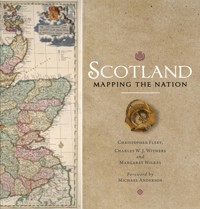
Winner of the Saltire Society Research Book of the Year Whilst documents and other written material are obvious resources that help shape our view of the past, maps too can say much about a nation's history. This is the first book to take maps seriously as a form of history, from the earliest representations of Scotland by Ptolemy in the second century AD to the most recent form of Scotland's mapping and geographical representation in GIS, satellite imagery and SATNAV. Compiled by three experts who have spent their lives working with maps, Scotland: Mapping the Nation offers a fascinating and thought-provoking perspective on Scottish history which is beautifully illustrated with complete facsimiles and details of hundreds of the most significant manuscript and printed maps from the National Library of Scotland and other institutions, including those by Timothy Pont, Joan Blaeu and William Roy, amongst many others.
Sie lesen das E-Book in den Legimi-Apps auf:
Seitenzahl: 493
Veröffentlichungsjahr: 2012
Das E-Book (TTS) können Sie hören im Abo „Legimi Premium” in Legimi-Apps auf:
Ähnliche




















SCOTLAND:
MAPPING THE NATION
CHRISTOPHER FLEET studied Geography at the University of Durham. He is Senior Map Curator in the National Library of Scotland. In 2010, he was awarded the Fellowship of The Royal Scottish Geographical Society.
MARGARET WILKES is a Member of the Steering Committee of the Scottish Maps Forum, a Director of The Royal Scottish Geographical Society, Convenor of its Collections & Information Committee and Joint Chairman of its Edinburgh Centre.
CHARLES W.J. WITHERS is Professor of Historical Geography at the University of Edinburgh. He is a Fellow of the British Academy, the Royal Society of Edinburgh and The Royal Scottish Geographical Society.
This eBook edition published in 2013 by Birlinn Limited West Newington House Newington Road Edinburgh EH9 1QS
www.birlinn.co.uk
Copyright © Christopher Fleet, Margaret Wilkes and Charles W.J. Withers 2011 Foreword © Michael Anderson 2011
All rights reserved. No part of this publication may be reproduced, stored or transmitted in any form without the express written permission of the publisher..
eBook ISBN: 978-0-85790-239-9 Print ISBN: 978-1-78027-091-3
Version 1.0
British Library Cataloguing-in-Publication Data
CONTENTS
Foreword by Professor Michael Anderson
Preface and acknowledgements
Timeline of Scottish map history
CHAPTER 1 Putting Scotland on the map
CHAPTER 2 Maps of Scotland before c.1595
CHAPTER 3 A kingdom and a nation depicted, c.1583–1700
CHAPTER 4 Scotland occupied and defended
CHAPTER 5 Towns and urban life
CHAPTER 6 The changing countryside
CHAPTER 7 Islands and island life
CHAPTER 8 Seas and waters
CHAPTER 9 Travel and communications
CHAPTER 10 Mapping science
CHAPTER 11 Open spaces – recreation and leisure
CHAPTER 12 Popular culture
CHAPTER 13 Maps at work – working with maps
Guide to further reading
Index
FOREWORD
I have the enormous privilege of chairing the Board of Trustees of the National Library of Scotland and the pleasure here of writing a Foreword to this fascinating and beautifully produced book. Scotland: Mapping the Nation charts the development of maps and the mapping of and in Scotland over the past two millennia, describing the maps’ changing purposes, languages and makers. It is the work of three enthusiast–experts, self-confessedly ‘enthralled by maps’, all with huge experience of revealing the secrets of maps to users of all kinds, and it is illustrated with an amazing range of images, mostly drawn from the collections of the National Library of Scotland. Much of the content was a real revelation to me, and I know it will be also to many other readers.
As I write this in 2010, we live in a world where developments in digital mapping technology are opening up multiple new ways of presenting maps for an ever-expanding range of users. Almost weekly, we are offered new kinds of overlays, new online maps, some of which present a series of successive images to show changes over time, or offer the ability to map variables selected by the user. But the old limitations still remain: the user is restricted to those elements of the ‘real world’ that the map-maker wants the map reader to see, largely within the map frameworks and range of scales that the maker has provided. Mappable information is never absolutely up to date. And, if we are to understand the result, we still need to know the symbolic conventions that are part of our own but not of other cultures: contour lines, orientation of maps with north at the top, today’s colours for different kinds of roads, for example, are all comparatively recent inventions.
We can all speak from experience of working with maps. A few months ago, I was driving in broad daylight on the main road approaching the motorway outside Stirling. I did not need a map to access the motorway because I had driven this route dozens of times before. But the driver in front of me clearly did not know the road, and he was relying on his satellite navigation system to help him to understand the unknown. As he approached a new roundabout, he paused slightly as if puzzled, then followed his system’s instructions and ‘took the first exit’ – and suddenly ground to a halt and did a rapid U-turn, as he realised he was entering the Auction Mart.
He, no doubt, cursed one perennial feature of his ‘modern technology’: it was ‘out of date’. But had he been using a similarly out-of-date Ordnance Survey map he should have noticed that he had to cross a small river, and pass a garden centre, before reaching the motorway roundabout. His focus, and that of his rolling map, was on roads; most other details were deliberately omitted. Even if there had been a blue line on his picture, he might well not have realised its significance. His experience, compared with mine, nicely illustrates, for the modern world, some of the perennial features of maps and map use that are drawn out so wonderfully in this book. It is a work to read, with reward, and to savour.
Professor Michael Anderson, OBE, MA, PhD, Dr HC, FBA, FRSE, FRHistS, Hon FFA
PREFACE AND ACKNOWLEDGEMENTS
Maps are everywhere. On walls; hand held; as colourful city plans designed for tourists; on our TV screens as weather forecasts and location guides; in our vehicles; bound together as atlases and used in classrooms; stored and looked at in computer and satellite devices; and, even, of course, stored in our heads as mental maps, uninscribed and almost innate ways of living in and dealing with space as we walk in our local neighbourhood or journey to work. Maps are commonplace objects, even taken-for-granted things. So are map-related metaphors: peace talks often refer to ‘the road map’ for the future, for example, to ‘charting’ the way forward.
Maps show the world, or portions of it. Even at a most basic level, however, maps do not straightforwardly correspond to the world, or even to the parts of it, that they purport to show. Things are missed out – they have to be – in order to simplify the map and make it clear to read. Those items that are included are, often, shown out of proportion – again, for the ease of the map user – but in ways that distort the real geography of places: motorways are shown on most travel maps as proportionally much larger than they are in reality. And because the geography of places may have changed since the map was made, maps can become out of date. Nor do maps always behave as we, the users, would want them to. J. M. Barrie, the Kirriemuir-born author best known for his Peter Pan, had clearly experienced what countless others have in working with maps when he wrote ‘Shutting the map’, part of his An Auld Licht Manse and other Sketches, in 1893. ‘Prominent among the curses of civilisation’, wrote Barrie, ‘is the map that folds up “convenient for the pocket”. There are men who can do almost anything except shut a map. It is calculated that the energy wasted yearly in denouncing these maps to their face would build the Eiffel Tower in thirteen weeks.’ There will be few people who will not at one time or another have had their ‘Barrie moment’ with a map.
All these things are true. They are the basis to the commonplace nature of maps and in one way or another they speak, like Barrie’s heartfelt complaint, to our experience of maps today. Because maps date and places change, there is a flourishing industry in making new maps, updating road atlases on paper or as electronic data. But it is also true that these are modern questions, modern experiences born of the place of the map, paper or electronic, in contemporary society. Such issues simply do not hold for the nature of maps in the past, or for the place of maps in society at different times. Today, for example, we use the commonest types of maps, road maps and route planners, most often to navigate the route from place A to place B, thinking of the geographical distance between those places either in terms of linear distance or as time. In the past, most maps were simply not used this way. There are exceptions, of course, but in general terms route maps as guides to travel were not invented until the end of the seventeenth century.
In the past, maps had different functions: these included being statements of political authority; or expressions not of accuracy and certainty regarding the shape of a nation but of symbolic representations of it. Maps, far from being commonplace and comprehensible to everyone, were relatively few in number, were the preserve of a literate minority, and, on occasion, came to be regarded as state secrets, so important and valuable was the information they contained – about such things as the location of ports and forts, the true extent of a country, or the line of a border. We now know, on the whole, how to ‘read’ a map and what a contour does, and that black shading is used to symbolise towns. But contour lines are modern inventions – partly by the French but also by map-makers in Scotland, towards the end of the eighteenth century – and symbols for urban places are likewise part of a rich yet complex cartographic vocabulary that has changed over time.
Simply put, maps and mapping have a history – actually, many histories. Maps have to be produced, and so we can think of a history of map-making, of technical capacity and printing styles. Maps have their uses and their users, from kings and generals to tourists and school children, so a history of maps includes elements of social history, political history and the history of education. Maps are much used in local history and in finding our way, in familiar environments and in unfamiliar ones where we trust the lines and colours shown on maps.
Maps are thus vital historical and geographical objects and sources which can help reveal how people in the past viewed their nation, or show what the countryside or town looked like at a certain moment. And because maps have a language – of lines and symbols, of scale, of colours to show different height ranges for hills for instance – map history is also a history of maps’ language and of the cultural comprehension of maps, of understanding how to read them. Map history recognises that questions such as ‘What is a map?’ or ‘How does a map work?’ have neither single nor simple answers. Maps, then, are commonplace but complex objects. Precisely because they are both commonplace and complex, their interpretation requires care – and can be a source of rich reward.
This book focuses on these and other questions about maps, mapping and map history as they concern Scotland. It is the first of its kind to do so. It brings together a great many images of Scotland’s maps with an interpretation of them in historical, intellectual and geographical context. This is not to say that there has not been important work done before now on Scottish maps, on the history of Scottish mapping and on Scotland’s map-makers. The two volumes of The Early Maps of Scotland, produced by the Royal Scottish Geographical Society in 1973 and 1983 respectively, are still valuable, as, too, is The Atlas of Scottish History, published in 1996. As we show here, considerable work has been done on aspects of Scotland’s map history, and we have drawn on such scholarship in what follows. But even the most recent of the Early Maps volumes is over twenty-five years old, and the Atlas of Scottish History is difficult to find outside of major libraries and pays no attention to the history of Scotland as a mapped object. Researchers in other subjects and countries have turned to the history of Scottish book production, for instance, to highlight the place of Scotland’s first atlas in its European context, or have studied individual map-makers, map publishing forms, or simply individual maps, in ways which have greatly advanced understanding of Scotland’s cartographic heritage. In the course of the last quarter of a century, the discipline of map history as a whole has undergone major change.
Technological advances now allow interrogation of the early maps of Scotland in ways not possible even a few years ago. Advances in computing and in electronic data management mean that many new maps are available online but not in conventional printed form. Computer systems and data storage programs mean that images of paper maps and maps ‘born digital’ can be stored and manipulated for study. In building upon this work, we want to draw together studies in the last twenty-five years or so on Scotland’s map history, show how new technology can aid our understanding of maps and how it changed the nature of maps and, with reference to new ways of thinking in map history more generally, place Scotland’s map history in wider context.
This book is the first to approach the study of the maps of Scotland in ways which both illuminate Scotland’s geography and history and show how Scotland’s maps and its map history have a history – indeed, are themselves the very ‘stuff’ of Scotland’s history.
All books are collective enterprises. We owe a debt of gratitude to Hugh Andrew of Birlinn not just for his invitation to consider such a book but for his support and enthusiasm as we have tried to bring his vision of the project, and ours, into being. Our thanks also go to Andrew Simmons and the staff at Birlinn for their help. The book would not have been possible without the support of the National Library of Scotland, notably but not only the staff within the Map Division, who kindly facilitated access to the many images produced here. For their comments on earlier drafts, we owe a very great deal to Ian Cunningham, Jeff Stone and Bruce Gittings. We acknowledge the kind help of various institutions and individuals for their permission to reproduce figures here, without whose gracious support our discussion of the visual representation of Scotland’s map history would have been the poorer: they are acknowledged individually throughout the book. We acknowledge with sincere thanks Professor Michael Anderson, Chairman of the Board of Trustees of the National Library of Scotland, for graciously providing the Foreword. And we owe a collective debt to the many people whose work on Scotland’s maps, mapping and map history is incorporated here. It is our profound hope that they, and other readers, will find reward in what is intended as an accessible synthesis and interpretation of Scotland’s rich and significant cartographic legacy.
A TIMELINE OF SCOTTISH MAP HISTORY
CHAPTER 1
PUTTING SCOTLAND ON THE MAP
I am told there are people who do not care for maps, and I find it hard to believe.
ROBERT LOUIS STEVENSON
Maps are commonplace and familiar objects – found at bus stops, in newspapers, as guides to walking, in atlases, on television screens and mobile phones. Most maps are understandable as simplified pictures of the world or a part of it, and are used to find a place – ‘where in the world is that?’ – or to make our way between places. We use maps of one form or another every day. We place our trust in them because, in one way or another, maps work.
Yet, for all their currency and utility, maps are also complex and unfamiliar things. Maps work, but not because they show a complete picture. Most of us recognise that the map is a problematic device of correspondence with the world when, as map readers and users, we encounter features that the map does not show. One reason why this happens is because, in their preparation and production of maps, map-makers leave out elements of the real world. Maps have to function at a scale of less than 1:1 – how could one produce, never mind consult and revise, a map that was at the same scale as the object it represented?
Maps do more than omit. They stylise what they do show, according to certain conventions, not according to the original objects’ actual shape or real size: in everyday terms, think of churches with steeples as shown on modern Ordnance Survey maps, for example, or the symbols used for towns, or the lines and shadings employed to represent topography.
At the same time, maps, or more precisely their makers, may, and regularly do, make repeated claims to accuracy, to being ‘up to date’. We buy and consult road atlases on the grounds that they are current, even to the extent of showing projected road and transport developments. But in any map there is always a time lag between its conception, production and publication. The ‘up-to-dateness’ of maps as records of place and space is always a matter of the gap in time between the now and the then. What is also true is that, because maps show the world selectively, and because they are always the product of someone’s decision about what to show and how to show it, maps are never neutral things.
For these reasons, maps are not mirrors to the world. Maps are widespread and useful, but they are always partial. As guides to the present and as keys to the past, maps and the processes that produce them require careful interpretation. Maps are visual sources: they can picture a nation (fig. 1.1). But they are also value-laden objects, and objects always have a history: of production, of use, of an underlying purpose.
FIGURE 1.1 In this remotely sensed image of Scotland, the outline of the country is immediately recognisable: a familiar geography, made so by the many maps of Scotland that take this outline. But as other figures show – see especially fig. 1.2 – knowing and mapping Scotland’s shape with certainty has been a long and distinctly uneven historical process.
Source: Scotland from Space: Satellite
Maps/Realised by M-Sat. Slough: M-Sat Ltd (c.1997).
Copyright © PlanetObserver.
Maps today have a common cultural currency as documents, as guides, as selective pictures of the world or parts of it. Yet this state of affairs has not always existed. Once, maps were the preserve of a literate few, precious objects written as manuscript not printed on paper, and were treated as state secrets: we shall see this of sixteenth-century maps (fig. 2.7), of military maps in the early eighteenth century (fig. 4.5) and of William Roy’s military surveying in the 1750s (chapter 4). In the past, no less than today, maps would claim to be the work ‘of the best authorities’, or to be based on ‘actual survey’, or ‘astronomical observations’. In such language, map-makers could assure their customers and different users of the ‘modernity’ of their work. Yet the world has, literally and metaphorically, changed shape throughout history. That this is true of Scotland is clear from the several ‘Scotlands’ outlined in fig. 1.2. Maps also need not be paper and portable to carry meaning (fig. 1.3).
Scotland’s map history is a distinctive part of the world’s map history. World maps produced in Europe before the 1490s did not show what came to be known as the ‘New World’ for the simple reason that, to European geographers and map-makers, the Americas had not been ‘discovered’ and so did not exist. By the late eighteenth century, uncertainty still surrounded the shape of the unknown new lands revealed in the southern oceans: Terrae Australes Incognita, from which we get Australia. As continental outlines were sketched with increasing certainty, map-makers of one sort or another – individuals planning new estates, groups of military surveyors, institutional parties from Ordnance Survey or the Geological Survey – helped put territory and nations to order by way of maps. This is true of Scotland, as we shall see, in several ways: in the ‘straightening’ of the Great Glen; in the way Skye was put to shape by different map-makers (fig. 1.4, fig. 7.6). In the twentieth century, mapping was additionally undertaken using, firstly, aerial reconnaissance and, latterly, remote sensing and satellite imagery. Electronic maps now offer interactive components in representing space. At one level, any map is a technical accomplishment, and map history is a history of technical capacity.
At another level, maps always have a varied and rich content, and map history is a matter of its interpretation. Maps show things in place at a certain time. They thus reflect geographical and historical knowledge. But maps do more than reflect. They help produce such knowledge precisely because, in the absence of direct encounter with faraway lands, or the unknown nearer to home, the map becomes a powerful means of representing and imagining space, of producing geographical meaning even if the map does not conform in conventional cartographic fashion to the real world that it symbolises (fig. 1.5). Very few humans have voyaged beyond the earth’s atmosphere and gravitational field to look down upon the dimensions of its continents, the course of the world’s great rivers, the shape of its seas and oceans. But, with maps, we do not have to so escape our earthly bounds: we can hold an image of space in our hands. Someone, somewhere – the map-maker – has somehow reduced global dimensions to portability, turned immeasurable complexity to generalised simplicity, put lines and colours to good and effective use. In maps we trust.
All this is by way of stating that maps can show history in terms of changes in the geography of the world. They can show the changes over time in how places looked (fig. 1.6). They can depict past landscapes or features in it (fig. 1.7). Maps themselves have a history. And the study of maps and their production also has a history: the dissemination of maps in their different printed forms, for example, features within the history of print culture (fig. 1.8). In making sense of these inter-related issues, it is important that maps be read and understood on their own terms (fig. 1.9). What people called maps in the past may not be what we today understand by the term.
FIGURE 1.2 This map of Scotland reveals the uncertainty of maps and of map-makers as to the exact outline of the country. Its maker, John Cowley, shows these differences by depicting the outlines of Scotland mapped by Robert Gordon of Straloch (in the Blaeu Atlas of Scotland of 1654), John Adair, Herman Moll, Nicolas Sanson, John Senex and Charles Inselin all on one map.
Source: John Cowley, A Display of the Coasting Lines of Six Several Maps of North Britain [Adair, Moll, Gordon of Straloch, Senex, Inselin, Sanson] (1733). Reproduced by permission of the Trustees of the National Library of Scotland.
FIGURE 1.3 Maps are not just paper and portable objects. They can take unusual forms, as in this large concrete map, some 70 metres across, located just outside Eddleston, near Peebles. It was constructed in 1975 over seven weeks by a group of Poles working to the design of Kasimierz Trafas and intended as a permanent reminder of the hospitality given by Scotland to General Maczek’s Polish forces during the Second World War. Bartholomew Half Inch Series maps were used to help render the outline and relief features correctly.
Source: General Stanislaw Maczek, Great Polish map of Scotland constructed in concrete (c.1975). Reproduced by permission of Adam Ward.
No less than today, maps in the past came in different types, reflecting different purposes. Thematic maps, which deliberately set out to illustrate geographical variations in a particular social or physical phenomenon, for example, and to do so according to administrative boundaries, are not the same thing as topographic maps, which set out to show a greater range of the physical or other geographical features of a place or region, often in stylised form and with established colour systems for things like height variations. The word ‘cartography’ – used widely if wrongly in relation to maps and map-making for all periods – did not exist until the 1830s. Properly, the term denotes the more mathematically based production of maps from this period, given changes in the ways the natural and the social worlds were then becoming subject to detailed subject-specific scrutiny. The word ‘scientist’ with its modern connotations of professionalism, regulated methods of enquiry and social status appears at the same time for the same reasons. Map types, the status and terminology of maps and mapping have changed over time. We should recognise, too, that the meaning of maps and how they have been valued, their place in society, have been different in different ages.
FIGURE 1.4 A map of Scotland in 1714, produced by the Dutch map-maker Herman Moll and based on the outline of the country laid down in Gerard Mercator’s map of 1564. Several ‘errant’ features are notable – for example the ‘crooked’ line of the Great Glen, the blunt north end to the Island of Lewis and the orientation of Skye. Moll (like many other map-makers) based his map not upon detailed first-hand survey, which would have been expensive in time and money, but upon others’ existing work, with the result that the outline of the country remained unchanged, though names and locations of places – the content of the country – were brought up to date. The depictions of the locations are taken from John Slezer’s Theatrum Scotiae (1693)
Source: Herman Moll, The North Part of Great Britain called Scotland (1714). Reproduced by permission of the Trustees of the National Library of Scotland.
FIGURE 1.5 An example of cartography and caricature. The outline and the geographical content of Scotland in map form is secondary to the role played by the map as a space for the representation of symbols of Scottish identity: the kilted figure, the fisherwoman, the bagpipes and the fish, all designed carefully to fit the nation’s geographical space.
Source: John Bartholomew, Philp’s Comic Map of Scotland (1882). Reproduced by permission of the Trustees of the National Library of Scotland.
FIGURE 1.6 The value of maps as comparative ‘snapshots’ in time is evident in these two images of the town of Coatbridge, in a period when it was at the heart of development of Scotland’s principal mineral fields. Surrounded by collieries and with the huge ironworks at Gartsherrie (north of the town centre) and Dundyvan (immediately south of the town centre in the triangle of railway lines) on its outskirts, the map [A] shows the built form of this town in 1867. The Ordnance Gazetteer of 1885 adds a vivid description of the activity round the town: ‘Fire, smoke and soot, with the roar and rattle of machinery, are its leading characteristics’. By the date of the later map, in 1904 (fig. 1 .6B), the town has much expanded its suburbs to east and west, though by 1904 the dominance of the ironworks as a source of employment had passed its peak, and a chemical works is shown adjacent to Gartsherrie.
Source: Ordnance Survey of Scotland, One Inch to One Mile. Sheet 31, Airdrie [A] 1867 and [B] 1904. Reproduced by permission of the Trustees of the National Library of Scotland.
FIGURE 1.7 Maps do not have to show the geography of their own time, but may be used to depict former geographies and relict features in the contemporary landscape. Here, the particular focus of attention is the Antonine Wall, and the general purpose is to portray Scotland as a land of antiquities and as a land once on the extreme edge of the Roman Empire.
Source: Source: John Horsley, A general map of Antoninus Pius’s wall in Scotland (1732). Reproduced by permission of the Trustees of the National Library of Scotland.
FIGURE 1.8 Books of maps – atlases – are commonplace but recent features in the history of mapping, originating in Europe mainly from the late sixteenth century. By the late eighteenth century and into the nineteenth century and beyond, atlases became widespread, providing maps drawn usually to a standard format and size, often for particular audiences such as schoolchildren. This map of Scotland is from the work of the Edinburgh-based map-maker John Bartholomew.
Source: Bartholomew, ‘Scotland’, from Oliver and Boyd’s Handy Atlas of the World (1881). Reproduced by permission of the Trustees of the National Library of Scotland.
FIGURE 1.9 This detail from the cartouche to Ainslie’s important 1789 map of Scotland illustrates the depictive and symbolic values often contained in maps. Here, cattle, sheep and a goat are shown, and they, together with the fishermen dragging their catch ashore, are intended to personify the products of those areas shown on the map itself.
Source: John Ainslie, Scotland, Drawn and Engrav’d from a Series of Angles and Astronomical Observations . . . (1789). Reproduced by permission of the Trustees of the National Library of Scotland.
[A]
[B]
FIGURE 1.10 In comparing the two maps of the Scottish estate of Loch Rutton, in 1774 (A) and 1815 (B), we are given a clear indication of the transformation of the Scottish farming and rural landscape. Note the characteristic representation of the open-field landscape, with the strips of land often worked by different land workers, and, in contrast, the landscape of 41 years later. In part, the sense of order and improvement apparent in the later map is a consequence of the map-makers’ style, the use of more formal symbols and the portrayal of the Scottish countryside as the almost scenic locus of fruitful and efficient activity.
Source: Figure A: James Wells, A Plan of the Barony of Lochrutton (1774). Reproduced by permission of the Trustees of the National Library of Scotland. Figure B: William Mounsey, A Plan of the Lochrutton Estate Comprending the Property in Loch Rutton and Urr Parishes in the Stewarty of Kirkcudbright belonging to Marmaduke Constable Maxwell . . . (1815). Reproduced by permission of the Trustees of the National Library of Scotland.
These issues – about the production and use of maps, their commonplace nature, the fact that maps and mapping and map-makers have a history, and that maps can illuminate history and geography – lie at the heart of this book. In what follows, we show how Scotland has been depicted in maps at different times, and how Scotland has been geographically imagined through maps and mapping. Ours is an account not just of individual maps as artefacts. It is a story of the history of mapping in Scotland and of how Scotland’s history and geography can be revealed through maps, be they political documents, estate plans (for example, fig. 1.10), marine charts, military sketches or tourist guides. Before we come to tell this story, however, it is helpful to address in a little more detail the history of maps, the nature of maps and their languages and forms.
MAPS, MAPPING AND MAP HISTORY
As a form of communication, maps predate writing. What is taken to be the world’s oldest known map is a town plan of a settlement in modern-day Turkey, and dates from about 6,500 years BC. Humans have been mapping for 3,000 years before they were writing. World map history is thus almost 8,500 years old, and map history begins not on paper but on plaster. Maps printed on paper were once dominant, but computer-based mapping is now common: we cannot know what forms of delivery the future holds for maps.
It is not appropriate to think of maps as having a single and simple history. Mapping traditions and practices in one country are not necessarily the same as in another. What counts as a map often results from the interests and practices of particular persons being promoted over those of others: of colonial surveyors in the Americas over indigenous peoples, for instance, or of the instrumental plotting of European explorers over their African guides’ hand-drawn sketches, and so on. Understanding the history of maps importantly depends upon where you start from.
From a European perspective, in which context Scotland’s maps and map history must be placed, maps were important in Classical Europe and in the intellectual and practical worlds of medieval Christendom. There, as well as in the caliphates of the Islamic world, amongst India’s princely states and in the imperial courts of the Far East, maps served to delimit territory, indicate trade routes and express geographical identity.
In Europe especially, the history of the map is linked indivisibly to the power of the Christian Church and to the related rise of the nation state, including European nations’ colonialist and imperial projects. That is why, broadly speaking, many Renaissance maps and early atlases were produced in Italian city-states such as Venice with its myriad trade interests. That is why, as the world was carved in parchment and ink, the lines of Spanish and Portuguese settlement in the New World were sanctioned by Pope Alexander VI, why Iberian patrons and map-makers led the world in the sixteenth century as their navigators circumscribed the globe, extended trade routes, stretched the geographical imagination and so required that maps be drawn anew. And, as Italian and Iberian mercantile and political authority waned and that of the Low Countries grew, throughout the seventeenth century, that is why European map-making became dominated by cities like Antwerp and Amsterdam rather than Lisbon and Venice, and why mapping then became associated with the rise of the mathematical sciences promoted by men less hidebound by religious dogma. As the imperial, military and mercantile interests of the French superseded the Dutch, and, from the later eighteenth century, those of the British in turn superseded the French, so maps of the land and charts of the seas everywhere emphasised the ordering of space, the authority of map-makers and the interests of the state.
Such brevity does scant justice, of course, to complex histories, to different types of maps and to their different purposes, and it overplays the nation as the standard measuring device for the history of maps. But it serves to endorse the centrality of the map to European and other cultures and the act of mapping as an expression of political and intellectual authority – and so helps place Scotland’s mapping story.
What is surprising given this millennia-long presence of maps in world culture is how recent the historical study of maps is. Maps were studied in the past because they were useful in one way or another. Map collecting was the fashionable pursuit of a few from the later seventeenth century if not earlier, at much the same time as maps and globes began to have a status as domestic adornments for the well-to-do. But the serious study of maps – map history or the history of cartography – is less than 150 years old. As with other histories, different views have been taken by map historians at one time or another over what a map is and does. The details of these differences need not concern us but the essential features are instructive.
FIGURE 1.11 Topographic maps – for example, showing stylised colour-based conventions for changes in height of the land and depth of the waters – appear only from the mid-nineteenth century. This example is taken from the work of Bartholomew map-makers, who became internationally famous for perfecting the use of layer colours in depicting relief. Their half-inch to the mile series, first completed for Scotland in 1894, was used for a range of later maps, including this one in the Survey Atlas of Scotland of 1912.
Source: Bartholomew, Detail of Loch Fannich environs, from Bartholomew Survey Atlas of Scotland, plate 45 (1912). Reproduced by permission of the Trustees of the National Library of Scotland.
What may be called ‘traditional map history’ – that range of activity undertaken before about 1990 – tended to focus on maps produced by Europeans in the period between the Renaissance, at the end of the fifteenth century, and the Enlightenment, at the end of the eighteenth century. On the whole, emphasis was placed upon map history as a story of technical improvement over time, of maps as increasingly accurate and faithful documents and of map-making as a chronological narrative of progress. Further, as mapping became more ‘modern’, so it shed its artistic embellishments (see fig. 1.11). Mapping embraced a language of increasing plainness: ornate decorative motifs praising kings, for example, were dispensed with in favour of simple lines, scale bars and acknowledgements to government agencies. Plainness, it was felt, endorsed the language of accuracy. Map history was a narrative of the shift from artistic inaccuracy to scientific exactitude.
Within the last twenty years, these views within map history have been profoundly challenged. New theoretical and explanatory arguments have ousted descriptive enquiries. Chronological narratives of progress have been replaced by cross-cultural viewpoints. Europe’s place in map history has been complemented by the study of mapping traditions elsewhere. Less attention has been devoted to the aesthetics of maps and more to their function, away from maps’ ‘beauty’ to their ‘visual form’, so to speak. Perhaps more than anything, historians of maps have become attentive to the use and meaning of maps, to their social and political context. Discussion of what a map is, how maps work and what maps mean is now an interdisciplinary undertaking.
For these reasons, and from our perspective now, it is inappropriate to consider map history in terms of a language of betterment and improvement, to see mapping as simply a matter of technological advance, to see maps in the past as having utility only in terms of their accuracy to the modern reader. To do so is to read early maps from only a limited point of view and to attribute meaning and importance to them only in relation to our notions – of accuracy just as a matter of correct measurement, for example, or in terms of the location or dimensions of a selected feature. What if the map-maker’s purpose in the past was not about accuracy of depiction but praise for a patron (as many were)? What if the tools and procedures were different (as they were)? What if the institutions which undertook mapping in the past were different from today’s (as they were)? We cannot attribute significance to earlier and different maps by reading them with modern eyes and by using terms like ‘That’s a better map than that one’, or ‘That map is not very accurate’, without recognising that the nature and function of maps and the values contained in them have changed over time.
Because of all of this, for Scotland’s and for other countries’ maps and map history, it is not sensible to ask in the abstract ‘What is a map?’. It is better, perhaps, to ask ‘What does a map do?’ ‘How does a map work?’ or, ‘For whom does a map work?’ Just like other forms of text, maps have ‘authors’ – map-maker was a common term in the past – publishers and ‘readers’. But how do we make a map? Direct personal survey of the area of ground in question is one answer. But such was not always possible – and it is certainly not common even today where revision of maps for later editions is based on satellite imagery and inference from only a few measured locations. Maps also result from word-of-mouth information, from testimony given rather than from first-hand observation or instrumental reading. Maps may capture the lie of the land in the sense of its topography, but they often also lie about the land, by omitting things, reducing complexity to simple forms, subtle variations in the landscape to straight lines and fixed colours. Maps are powerful documents for lending false certainty.
THE POWER AND GLORY OF MAPS
Maps have a language as well as a history. Where we now understand terms like ‘scale’ and ‘symbol’, know what a contour line does, and take for granted that maps are orientated with north to the top, this has not always been the case. Each of these terms, like the word ‘map’ itself, has a history. The term ‘orientation’, for instance, derives from the fact that early medieval Christian maps of Europe centred upon Jerusalem, with the Mediterranean Sea running lengthways, top to bottom of the page so to say, which had the effect of placing East (the Orient) at the ‘top’ of the map – hence, to orientate the map.
Most of us are probably more familiar than most of our forebears with the map and with its languages and uses. But this may be because we are more familiar with what we think a map is than we are with the processes of mapping or with the precise language of maps and their production – a language of ‘projections’, ‘triangulation’, ‘graticules’ and ‘prime meridian’, to name only a few terms. And while computer-based maps on screens, satellite navigation systems in vehicles and remotely sensed images now supplement their paper counterparts, they often do so to the neglect of what might be taken as proper cartographic vocabulary – a north arrow, scale bars, and so on.
The idea that maps have a language – indeed, that maps are a kind of visual language – is one of the most important features of the modern history of mapping since the 1990s. Amongst the most important words used in the language of maps is scale. But scale, at least as it is understood today as the expression of the mathematical ratio of the size of the map to the size of that bit of the world being mapped, can be given in different ways – thus making map comparison awkward. Notions of a standard scale over time and between different countries’ mapping traditions simply do not hold. Symbol is also an important mapping term. Here, too, certain conventions have become familiar to us: ‘molehills’ in two or three dimensions signifying hilly ground, for instance, giving way to sketched lines called ‘hachures’ or ‘hachuring’, where the closeness of the lines indicated steepness as the terrain was seen in plan view, and then to that simple, subtle yet misleading device, the contour line, whose delineation as an unbroken lines hides the fact that it is based on scattered point measurements.
A further idea to emerge from modern map history is that maps express and embody power and authority. This point about maps and power can be divided, albeit not always neatly, into two. Power is internal to any map as a depiction of the world since, in certain stylised ways, the form it takes and the visual language it employs are always the result of somebody’s decision. Because they miss things out – they select and they generalise – maps also omit and silence. Power is also external to the map in the sense that, as a document or artefact, maps prompt action. Maps guide soldiers and boy scouts, tourists and travellers. But the benign power of maps has its malign parallels: maps may be deliberately deceitful, distorting relationships to make a political point.
Maps, then, have a history, a language, a content and a context. Maps and the processes of mapping are always part of wider histories – of printing, or of geographical exploration, of scientific survey, of the growth of towns and cities, of changes in the countryside and in rural life. Maps themselves are at once historical and geographical objects. In illuminating our understanding of the past, maps from an earlier time may depict a place as once it was or appeared to be. Maps are, nevertheless, essentially static pictures, even of something as dynamic as language (fig. 1.12). Maps alone seldom reveal why or precisely when that rural landscape or that city’s streets, to take just two examples, changed in their form and with what consequences. In contemporary society, maps are widely used to plot the geographical patterns of certain social phenomena: ‘hot spots’ of urban crime, the incidence of disease, even to predict flood patterns at some point in the future. In the 1850s, this sort of thematic distribution map was a major innovation. But, at any time, such maps alone do not offer explanations of the social and natural processes determining these events and patterns.
Maps are both artistic and scientific objects. They are illustrative devices which may show, for example, the symbolic significance of a geographical or other feature rather than its accurate delineation. Maps are one form of visual method used in ordering the world according to certain principles, such as the use of standardised measurement: think of graphs, statistical diagrams, even photography (fig. 1.13). It is not helpful to think of art and science as separate categories in maps and map history. Every map is a work of art and of science. Maps do not, then, simply reflect what is ‘out there’ in the world: they help frame the pictures people have of the world and help illuminate our understanding of the relationships between things and places.
FIGURE 1.12 These maps, showing the percentages of Gaelic speakers from the censuses of 1881 and 1891, are examples of thematic maps. Such maps are useful in depicting geographical variations in phenomena, but sometimes misleading since they may suggest that such variations alter sharply at administrative boundaries when, in reality, the variation is more subtle.
Source: Friedrich Bosse, ‘Scotland: Languages. 1881 and 1891’. Plate 9 of The Royal Scottish Geographical Society’s Atlas of Scotland by J. G. Bartholomew (1895). Reproduced by permission of the Trustees of the National Library of Scotland.
FIGURE 1.13 Maps can be used as part of the description and communication of scientific ideas. Here, Charles Piazzi Smyth, Regis Professor of Astronomy at the University of Edinburgh, delimits the different ‘sound geographies’ of the one o’clock gun sited at Edinburgh Castle: note the 1 second and 5 second time distances he plots, each as a concentric circle, from the point of explosion. In reality, these sound contours vary according to wind direction and air temperature.
Source: W. & A. K. Johnston, Hislop’s Time-Gun Map of Edinburgh & Leith (‘Time circles each one second, number of rings distant from Gun indicate no. of seconds for sound to travel.’) (1881). Reproduced by permission of the Trustees of the National Library of Scotland.
In these and in other ways, maps are fascinating and vital documents and that is why they play – and have played – an intrinsic part in most people’s lives.
MAPS, MAP HISTORY, MAPPING SCOTLAND
Three underlying and related themes or aims drive our concerns.
The first is with Scotland on the map. We want to show when and how Scotland has been shown on maps, at different times and in different ways. In looking at when and how Scotland was put on the map, it is our intention to record something of this changing depiction of Scotland as part of other, wider, cartographic concerns. Scotland appeared as part of maps of Britain and of Europe, for example, long before it was itself the object of a single map. Yet, by the mid-seventeenth century, Scotland was, arguably, one of the best-mapped countries in Europe. Our first aim, then, is to focus on Scotland as the subject of mapping, and to examine how and why Scotland became, and has continued to be, a mappable object.
The second aim is directed at Scotland’s map history. We want to show how maps of Scotland have a history. Rather than treat maps of Scotland simply as artefacts, we want to illuminate the context to the nation’s maps, to show something of why Scotland’s maps look as they do at different periods and for different themes. Scotland’s map history cannot be understood by reference to the maps alone (fig. 1.14). As we show, ‘behind’ the nation’s maps lie stories of political intrigue, of kingly ambition, moments of individual enterprise and institutional success, and moments of failure, of mapping plans abandoned or unevenly effected – even, for the unfortunate William Edgar, a story of death through overwork whilst working on maps to aid the Hanoverian government in the 1740s.
Our third aim is to show how maps provide illuminating and powerful documents for understanding Scotland’s history and its geography. More than just powerful: vital. Maps have been and are used in Scotland and of Scotland as political documents, as educational tools and to illustrate scientific understanding. Town maps whose initial conception was with urban sanitation now show alterations in urban form. Estate plans capture the patterns of change in Scotland’s countryside as it was transformed in the eighteenth and nineteenth centuries. There are maps of battles on Scottish soil, several, to take just one example, of Culloden, the last mainland battle in Britain. But just as this highly charged event in British history has produced different views amongst later political and social historians as to its significance, so it prompted different contemporary maps, by map-makers with Jacobite sympathies and by those keen to demonstrate their loyalty to the Hanoverians. Now and in the past, maps provide a key basis to Scotland’s civic and political administration, guides to recreational use and plans for city growth or developments in transport and communication. Maps show that the names we employ to record features and places are not constant (fig. 1.15). And, like everyone else, Scots carry maps in their heads, ‘mental maps’, and use such maps and the metaphorical language of mapping as expressive forms for meaning in art, in poetry and in novels.
FIGURE 1.14 This extract from Emanuel Bowen’s map of 1746 is one of several in this edition to have the additional imprint ‘Published Feb: 24th 1745’ – that is, the old-style dating for February 1746. Bowen here adopts a convention characteristic of the time, that of promoting his ‘new & accurate map’ on the grounds of it being drawn from surveys, and from using other ‘approved Maps & Charts’. Note, too, the hierarchy of towns in the key, the use of symbols and the text commentary which makes reference to ‘astronomical observations’ – that is, to the use of measurement – and the use of others’ earlier maps such as ‘Bryce’s Survey’ [of 1744] (see fig. 6.2).
Source: Emanuel Bowen, A New & Accurate Map of Scotland or North Britain (1746). Reproduced by permission of the Trustees of the National Library of Scotland.
FIGURE 1.15 (a) This glorious representation of Scotland by a leading Amsterdam map-maker coincided with the beginning of the joint reign in Scotland of William and Mary II. The map-maker’s clever use of colour in depicting the boundaries and areas of the different provinces of Scotland, as well as the inclusion of the symbols of kingship and nationhood – lion, unicorn, crown and royal insignia with suitably gilded embellishment – add immeasurably to the grand effect of the map. But, unlike John Knox a hundred years later (see 1.15b), despite putting place names at right angles to the coastline more in the tradition of early sea charts than maps (see chapter 8), Visscher did not include ‘The Minch’ as a name for the sea channel between the Western Isles and mainland Scotland for the reason that the term, derived from the French ‘La Manche’ (a channel), was not then in common currency for this stretch of water. By the time of Knox’s map of 1782, The Minch was so known.
Source: Nicolaes Visscher, Exactissima Regni Scotiae tabula tam in septentrionalem et meriodionalem . . . (1689). Reproduced by permission of the Trustees of the National Library of Scotland.
FIGURE 1.15 (b) Not only does John Knox include the name, ‘The Minch’, as the stretch of water separating the Isle of Skye and the mainland from the Western Isles, he also fills the open sea space with interesting ideas relating to the possible shortening of the sea voyage round the Scottish coasts. These ideas came to fruition within the next forty years in the Forth & Clyde, Caledonian and Crinan canals.
Source: John Knox, A Commercial Map of Scotland (1782). Reproduced by permission of the Trustees of the National Library of Scotland.
Our treatment of these three central aims and of the many maps and stories that illustrate them is part chronological and part thematic. Scotland’s ‘map coverage’ ranges across more than two thousand years. It begins with the earliest known representation of the country in map form, in a map of the British Isles by Claudius Ptolemaeus, known usually as Ptolemy, who lived between about AD 90 and 168. It has no end, since we make maps all the time, and maps of Scotland are widespread and varied in modern context, but we close our enquiries here with reference to maps in contemporary popular culture.
To give structure to these concerns, chapters 2 and 3 provide a chronological overview of the depiction of Scotland in maps from Ptolemy to administrative and county maps in the mid- and late eighteenth century: here, we suggest, is how Scotland has been put on the map, how the nation has been ‘shaped’ over time in maps. The idea of Scotland being made through its maps is then developed, in a series of principally thematic chapters, from chapter 4 onwards, with attention being paid to key moments in the mapping of the nation (for example, figs. 1.16 and 1.17). Each chapter addresses a particular theme in Scotland’s map history and does so largely chronologically within the theme in question. In this way, we illustrate the importance of maps as historical and geographical documents and show how maps were used, and for what purpose, by reference to key themes and processes which have shaped Scotland’s history and geography.
FIGURE 1.16 Aaron Arrowsmith’s 1807 map is a landmark work in Scottish map history. Produced in June 1807, it remained the basis to the country’s mapping for the following half century. Arrowsmith based his map on an examination of others’ earlier maps (including William Roy’s Military Survey (see chapter 4)) by accurate surveying and attention to detail. The complex county boundary between Inverness and Nairn, for example, first appeared on Arrowsmith’s map as a result of Alexander Nimmo’s survey of the boundary in 1806.
Source: Aaron Arrowsmith, Map of Scotland Constructed from Original Materials (1807). Reproduced by permission of the Trustees of the National Library of Scotland.
FIGURE 1.17 This is the title page to the Memoir which accompanied Arrowsmith’s important map of 1807. The conjunction of map and memoir – a printed discussion of the sources used, the methods employed, and thus statements about the credibility of the map and of its maker – was a common feature of map-making in the eighteenth and early nineteenth centuries.
Source: Aaron Arrowsmith, Memoir Relative to the Construction of the Map of Scotland (1809). Reproduced by permission of the Trustees of the National Library of Scotland.
We start our thematic treatment in chapter 4 by outlining something of the ways in which maps reveal the defence of Scotland and how mapping was part of Scotland’s evolving relationship with its neighbour, England. From there, since defence of courtly and urban life was part of this relationship and the resultant map work, we turn in chapter 5 to the growth of towns and the utility of maps as documents of the urban scene. Chapter 6 looks at the ways maps depict life in the countryside and in rural livelihood. One feature of the scrutiny paid to Scotland by its map-makers has been the ‘emergence’ of its islands: always there, of course, but thanks to maps more and more evident in Scotland’s geographies and sense of national identity from the later seventeenth century. Chapter 7 documents the cartography of Scotland’s islands. Chapter 8 illustrates the mapping of Scotland’s seas and waters: here, as in land-based mapping, Scotland was put to order in different ways by the demands of those for whom maps as trustworthy objects in use at sea meant the difference between life and death (fig. 1.18). As for terrestrial mapping, maps of Scottish waters sought to depict their content, not just their extent: to catch your fish or to restrict such catches, you must know where to find it.
In chapter 9, we highlight elements of the rich map evidence relating to travel and communication in Scotland. The role that maps have played in discovering and portraying Scotland as a scientific landscape is the focus of chapter 10. For subjects such as geology, maps are vital tools but not because they show what can be seen: in geological mapping, the map is an inferential guide to the invisible. Chapter 11 looks at the different ways in which maps have been and are today important with respect to patterns of recreation and leisure. What we take for granted as map accessibility – in the twin sense of the availability of maps and in the fact that they presume access to the geography they show – is a recent phenomenon. Since maps may reflect and produce different forms of meaning, chapter 12 examines their presence and prevalence in popular culture. There is no formal conclusion, but chapter 13 returns to some of the ways in which Scotland’s map history may be thought of and reiterates the connections between maps as technical and cultural objects, map history, social history and historical and geographical change (see fig. 1.19).
In being a study of the maps of Scotland and of Scotland’s map history, and a study in how maps illustrate Scotland’s history and geography, this book aims to illuminate and to explain Scotland’s rich cartographic heritage. In doing so, we have sought not just to describe and examine this vital component of Scottish culture, past and present, but also, we hope, to stretch the reader’s imagination over the idea of Scotland’s ‘mapness’ – the nation’s shaping in maps and the presence of maps in Scottish life – and to stimulate further interest in it. Full captions have been provided in order that individual maps may be understood as more than a static image and thus placed in relation to wider themes. In the guide to further reading, we indicate the main sources we have drawn upon, and the material available for more detailed study, including web addresses for online map collections and related map work.
It is possible, therefore, to read and to refer to this book in different ways. One – the most usual way in all likelihood – is to proceed from start to finish, chapter by chapter, perhaps consulting the guide to further reading, to work from text to map and back to the text. Another way might be to look only at the maps, reading their captions, and so take a ‘snapshot’ approach, bypassing the longer dynamic story outlined in the text. Yet further ways might be to look only at certain themes, or to explore related work using the guide to further reading before returning to the narrative.
However the book is read and used, it is worth noting that our coverage is incomplete. We have not set out to provide a complete record of all known maps of Scotland, nor to provide biographical details of every map-maker or map publisher who has been at one time or another concerned with Scotland. We are not, in any detailed way, concerned with the techniques of map production or with the volumes of output and the marketing of maps, except where such matters have particular relevance to given maps or certain themes.




