


Erhalten Sie Zugang zu diesem und mehr als 300000 Büchern ab EUR 5,99 monatlich.
- Herausgeber: Luath Press
- Kategorie: Geisteswissenschaft
- Sprache: Englisch
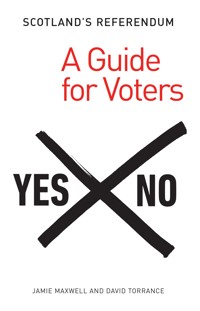
On 18 September 2014, everyone in Scotland aged 16 or over will be asked the question: 'Should Scotland Be An Independent Country? 'As the referendum approaches, the debates over whether or not Scotland should be an independent country are becoming more heated. This guide, produced by respected Scottish journalists and authors, Jamie Maxwell and David Torrance, covers everything you need to know in advance of deciding which way to vote. Maxwell and Torrance summarise the main arguments for and against before delving into the central issues at the heart of the debate, including economics, welfare and pensions, defence and foreign affairs, and culture and national identity. They outline the way that Scotland is currently governed and review where the parties stand on the debate before concluding with speculative chapters on what happens after the vote, whether YES or NO. The referendum on 18 September 2014 is the most significant democratic event in Scotland's history. Get engaged. Be informed. Whatever you do, don't NOT vote!
Sie lesen das E-Book in den Legimi-Apps auf:
Seitenzahl: 117
Veröffentlichungsjahr: 2014
Das E-Book (TTS) können Sie hören im Abo „Legimi Premium” in Legimi-Apps auf:
Ähnliche
















JAMIE MAXWELLis a Scottish political journalist. He has contributed toNew Statesman,The Sunday HeraldandThe Scotsman, and is currently on the editorial team ofBella Caledonia. Over the last two years he has been heavily involved in editing and publishing his father Stephen Maxwell’s booksArguing for IndependenceandThe Case for Left Wing Nationalism. He is currently working on a book of the collected essays of Tom Nairn.
DAVID TORRANCEis a writer, journalist and broadcaster, regularly appearing on the BBC, Sky and STV to talk about politics and the constitutional debate. He has a column inThe Heraldevery Monday and has also written or edited around a dozen books on Scottish history and politics, including an unauthorised biography of the First Minister,Salmond: Against the Odds. He is currently based in Edinburgh but has also lived in London for long periods.
LuathPress Limited
EDINBURGH
www.luath.co.uk
First published 2014
ISBN (PBK): 978-1-910021-03-3
ISBN (EBK): 978-1-910324-14-1
Designed by Tom Bee
Typeset in 10.5 point Din by 3btype.com
eBook by Luath Press
The authors’ right to be identified as author of this work under the Copyright, Designs and Patents Act 1988 has been asserted.
© Jamie Maxwell and David Torrance 2014
Contents
Preface
Five Million QuestionsUnderstanding Scotland’s Referendum
1IntroductionThe Road to 2014
2How is Scotland governed?
3Should Scotland be an independent country?The Case for YES
4Should Scotland be an independent country?The Case for NO
5Which parties and campaigning groups support independence?
6Which parties and campaigning groups oppose independence?
7The Issues: Economics
8The Issues: Welfare and Pensions
9The Issues: Defence and Foreign Affairs
10The Issues: Culture and National Identity
11What happens after YES?
12What happens after NO?
Recommended Further Reading
Preface
One inevitable side effect of the referendum debate has been the publication of a plethora of books on almost every aspect of independence: for and against, its implications in economic and cultural terms and even its spiritual dimension. This is, of course, a good thing. At the same time, however, there remains a gap in the literature – a straightforward, non-biased voters’ guide to the independence referendum.
We hope this short book fills that gap. It is deliberately concise and balanced. Our aim was to provide a primer for each of the main issues surrounding independence, as well as to accurately represent the views of those on both sides of the debate. There is of course much more that could be said about everything we address, but the ‘Recommended Further Reading’ chapter provides options for more in-depth analysis and/or polemic.
There is an understandable (yet at the same time unrealistic) desire for ‘facts’ in the referendum debate, but just as the creation of a new state produces uncertainty so too does remaining part of an older one. All that can reasonably be presented is what each side believes will happen following either aYESorNOvote; it is for each voter to work out for themselves which position is more credible and, indeed, desirable.
HopefullyScotland’s Referendum: A Guide for Voterswill make that task a little easier.
Jamie Maxwell,Journalist and Writer David Torrance,Associate Director, Five Million Questions June 2014
Five Million Questions
Understanding Scotland’s Referendum
The Five Million Questions project at the University of Dundee has been an expression of the core purpose of Scottish universities. As repositories of knowledge, analysis and, we hope, some measure of wisdom if we were not to make especial effort to engage the public in informed debate at this moment then when would we do so at all?
Since the autumn of 2012 the project has engaged many thousands of those charged with the responsibility of voting in the referendum in September 2014. We have done so through lectures, debates, seminars, exhibitions, interviews and a plethora of online activity across many, if never possibly all, the subject areas that will be touched by Scotland’s decision.
The role in this debate of academics and the universities they populate has been at times controversial. In some part that has been due to a misunderstanding of the role of academia. Funded by the taxpayer, our academics are not the journalists of the BBC (themselves too frequently accused of favour from either side – but that is not for here). Academics should abhor bias but they are not practitioners of studied neutrality. If evidence leads you to a conclusion then you have the freedom to state it. In many cases, and this may well be one given the profundity of the question at hand and the huge uncertainty surrounding us, you have a duty to state that conclusion.
We hope that our project has been something of a safe space in a debate that has, at times and by acclaim, been deemed too febrile to best serve our needs. That is how we view this book and why we have been eager to support it. Two excellent writers well versed in the case at hand bringing their personal analysis to bear. You may not agree with either perspective and you may even feel it is short on the hard fact ‘answers’ that many people are demanding of either side. Over the past two years we have become aware that the only editorial line of Five Million Questions has become the explanation that you are not going to get many of the answers you are looking for. This is a job of interpretation, analysis, synthesis and conclusion that falls to all of us. The answers you reach will vary but we do hope this book will help. The Five Million of course refers to the population of this ancient country. Not all that number have a vote or will use it. But everyone deserves to be considered and as many as possible should be heard and allowed, in some hope of an answer, to put their question.
Michael Marra, Director Five Million Questions, University of Dundee
1Introduction The Road to 2014
Referendums on Scotland’s constitutional future are no longer a novelty to Scots of a certain age. On 18 September 2014, anyone born after 1961 (more than half its current population) will be answeringYESorNOto a question about self-government for the third time.
The first, on 30 March 1979, asked if voters wanted a devolved ‘Scottish Assembly’ based in Edinburgh, and although a slim majority answeredYES, a controversial stipulation in the 1978 Scotland Act said it would only happen if more than 40 per cent of the total electorate (rather than those voting) assented. What many saw as an historical wrong was finally righted on 11 September 1997 when Scots were asked two different but related questions – did they agree there ‘should be a Scottish Parliament’ and should it have tax-varying powers? The result was ‘yes-yes’ by a significant majority.
In that context, the writer Neal Ascherson views the 2014 referendum as ‘little more than the third putting of the same question’ – should Scotland govern itself? But in fact at the third time of asking there is an important difference – whereas in 1979 and 1997 Scots were being asked about the ‘devolution’ of power from Westminster, this time they will be asked to sayYESorNOto complete (with certain qualifications) independence from the UK Parliament in London.
This is often referred to by supporters of independence as ‘self-determination’ or the ‘sovereignty of the Scottish people’, although it could be argued that both concepts have existed at least for the past 35 years. Since 1979 the UK government has accepted that constitutional change can only happen with the assent of a majority of those resident in Scotland. This choice has, to an extent, been available to Scots since the Scottish National Party (SNP) started contesting elections in 1935, and particularly so since the late 1960s when the party – the chief driver of the ‘National Movement’ for Scottish independence – first became a major force. It is just that Scots self-determined in favour of the Union.
And that, of course, is a reminder that the independence debate is not a new phenomenon. It has been around – to varying degrees – since Scotland first joined England (and Wales) to form a new state called ‘Great Britain’ following the 1707 Treaty of Union. Over the next few hundred years pro-independence sentiment came and went. When, for example, Great Britain joined Ireland to form the ‘United Kingdom’ in 1801, it is probably safe to say that most Scots were content to be part of the UK, but towards the end of that century when agitation for ‘Home Rule’ (or devolution) in both Ireland and Scotland began to gather support, the dynamic began to change.
It is important to remember that few Scots until after the Second World War actually desired full independence for Scotland, rather they argued for devolution, Home Rule or ‘Dominion status’ (like Canada or Australia) within the UK and the then British Empire. For example the ‘Scottish Covenant’, reportedly signed by two million Scots in the early 1950s, demanded a devolved Scottish Parliament sitting in Edinburgh. By the time a solicitor called Winnie Ewing won the Hamilton by-election in 1967, however, all that had changed – the SNP’s goal was very much independence.
Ewing’s victory was short-lived and she lost her seat at the 1970 general election, but in 1974, when two further elections were held in February and October, the SNP had its electoral breakthrough, winning seven and eleven seats respectively, but, more significantly, around 30 per cent of the popular vote (opinion polls at the time put support for independence at similar proportion of the Scottish electorate). The ‘Unionist’ parties – between 1974 and 1979 Labour was in government – responded by legislating for a devolved Assembly in Edinburgh and although this fell far short of what the SNP actually wanted, the party still campaigned for aYESvote in 1979.
The government of James Callaghan had not intended to hold a referendum at all, but a group of backbench MPs opposed to Scottish devolution successfully amended the relevant legislation so that voters had to be consulted before an Assembly came into being. And when, as mentioned above, the number of Scots votingYESfailed to reach 40 per cent of the electorate, the first government of Margaret Thatcher (elected in May 1979) was able to repeal the 1978 Scotland Act.
It was not a good election for the SNP, which lost 9 of its 11 MPs, and for roughly the next decade successive Conservative governments at Westminster resisted calls for devolution from various groups in Scotland, including the Campaign for a Scottish Assembly (later Parliament), the Labour Party, the SNP and others. But after the number of Conservative MPs in Scotland dropped to just ten following the 1987 general election, pressure grew much greater, even more so when the SNP gained Govan at a 1988 by-election. At this point three political parties – Labour, the Liberals (later Liberal Democrats) and the SNP – joined forces with Scotland’s churches, trade unions and other ‘civic’ organisations to form the Scottish Constitutional Convention (the SNP later withdrew on the basis that the Convention refused to consider independence).
The Scottish Constitutional Convention sat in Edinburgh for the next few years, delivering its blueprint for a Scottish Parliament – elected by proportional representation – shortly before the 1992 general election which many believed would result in a Labour government and therefore a Scottish Parliament. The SNP was also riding high, with one opinion poll even showing that a majority of Scots supported independence. Unexpectedly, the Conservatives gained a fourth term with a small majority and, although it promised to ‘take stock’ of how Scotland was governed within the UK, devolution was still ruled out as an option (the SNP had increased its vote by seven per cent but gained only three MPs). Meanwhile cross-party campaigns such as ‘Scotland United’ continued to agitate for a Scottish Parliament based in Edinburgh.
Only following the 1997 election, when Tony Blair’s New Labour party won a landslide victory over John Major’s Conservatives, did constitutional reform become a reality. Within weeks a White Paper called ‘Scotland’s Parliament’ had been published and on 18 September it was overwhelmingly endorsed in a referendum. As all the Scottish parties prepared to contest the first elections to the Scottish Parliament in May 1999 (including the Conservatives, who had lost all their MPs north of the border), several opinion polls showing rising support for independence, and although the SNP (led since 1990 by an MP called Alex Salmond) got almost 29 per cent of the vote, the first Scottish Executive (the devolved government) was a Labour-Liberal Democrat coalition.
In the mid-1990s, Labour’s then spokesman on Scotland, George Robertson, had famously predicted that devolution ‘would kill independence stone dead’ and, at least initially, that appeared to be an accurate forecast – at the 2003 Scottish Parliament election the SNP’s vote fell to just 24 per cent and in elections to the European Parliament the following year the party got less than a fifth of the popular vote. John Swinney, leader of the SNP since 2000, resigned and Alex Salmond, who had surprised everyone with his resignation four years previously, returned to the fray.
Initially, the SNP leadership team of Salmond and Nicola Sturgeon made only a modest impact (Salmond was still an MP rather than an MSP), but when Scots went to the polls for the third time in 2007 there was a perfect political storm – Labour had been in government (with the Lib Dems) for eight years and had also been damaged in Scotland by the Iraq War, while the SNP appeared to be a different party, more positive in outlook and full of ideas. The mood of many Scots was that they deserved a shot at running Scotland’s devolved government.




