


9,59 €
Mehr erfahren.
- Herausgeber: Luath Press
- Kategorie: Geisteswissenschaft
- Sprache: Englisch
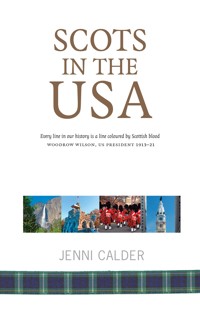
The map of the United States is peppered with Scottish place-names and America's telephone directories are filled with surnames illustrating Scottish ancestry. Increasingly, Americans of Scottish extraction are visiting Scotland in search of their family history. All over Scotland and the United States there are clues to the Scottish-American relationship, the legacy of centuries of trade and communication as well as that of departure and heritage. The experiences of Scottish settlers in the United States varied enormously, as did their attitudes to the lifestyles that they left behind and those that they began anew once they arrived in North America. Scots in the USA discusses why they left Scotland, where they went once they reached the United States, and what they did when they got there.... a valuable readable and illuminating addition to a burgeoning literature... should be required reading on the flight to New York by all those on the Tartan Week trail. - Alan Taylor, Sunday Herald
Das E-Book können Sie in Legimi-Apps oder einer beliebigen App lesen, die das folgende Format unterstützen:
Seitenzahl: 370
Veröffentlichungsjahr: 2014
Ähnliche


















JENNI CALDER was born in Chicago, educated in the United States and England, and has lived in or near Edinburgh since 1971. After several years of part-time teaching and freelance writing, including three years in Kenya, she worked at the National Museums of Scotland from 1978 to 2001, successively as education officer, Head of Publications, script editor for the Museum of Scotland, and latterly as Head of Museum of Scotland International. In the latter capacity her main interest was in emigration and the Scottish diaspora. She has written and lectured widely on Scottish, English and American literary and historical subjects, and writes fiction and poetry as Jenni Daiches. She has two daughters, a son and a dog.
By the same author:
Chronicles of Conscience: A Study of Arthur Koestler and George Orwell, Secker and Warburg, 1968
Scott (with Angus Calder), Evans, 1969
There Must be a Lone Ranger: The Myth and Reality of the American West, Hamish Hamilton, 1974
Women and Marriage in Victorian Fiction, Thames and Hudson, 1976
Brave New World and Nineteen Eighty-Four, Edward Arnold, 1976
Heroes, from Byron to Guevara, Hamish Hamilton, 1977
The Victorian Home, Batsford, 1977
The Victorian and Edwardian Home in Old Photographs, Batsford, 1979
RLS: A Life Study, Hamish Hamilton, 1980
The Enterprising Scot (ed, with contributions), National Museums of Scotland, 1986
Animal Farm and Nineteen Eighty-Four, Open University Press, 1987
The Wealth of a Nation (ed, with contributions), NMS Publishing, 1989
Scotland in Trust, Richard Drew, 1990
St Ives by RL Stevenson (new ending), Richard Drew, 1990
No Ordinary Journey: John Rae, Arctic Explorer (with Ian Bunyan, Dale Idiens and Bryce Wilson), NMS Publishing, 1993
Mediterranean (poems, as Jenni Daiches), Scottish Cultural Press, 1995
The Nine Lives of Naomi Mitchison, Virago, 1997
Museum of Scotland (guidebook), NMS Publishing, 1998
Present Poets 1 (ed, poetry anthology), NMS Publishing, 1998
Translated Kingdoms (ed, poetry anthology), NMS Publishing, 1999
Robert Louis Stevenson, (poetry, ed), Everyman, 1999
Present Poets 2 (ed, poetry anthology), nms Publishing, 2000
Scots in Canada, Luath Press, 2003
Not Nebuchadnezzar: In Search of Identities, Luath Press, 2005
Letters From the Great Wall, Luath Press, 2006
Frontier Scots: The Scots Who Won the West, Luath Press, 2010
Lost in the Backwoods: Scots and North American Wilderness, Edinburgh University Press, 2013
Scots in the USA
JENNI CALDER
LuathPress Limited
EDINBURGH
www.luath.co.uk
First published 2005
Reprinted 2008
Reprinted 2010
New edition 2013
eBook 2014
ISBN (eBook): 978-1-909912-85-4
The author’s right to be identified as author of this book under the Copyright, Designs and Patents Act 1988 has been asserted.
Maps by Jim Lewis
© Jenni Calder 2005
Contents
Preface
CHAPTER ONE I Should Like to Be an American
CHAPTER TWO Take Courage and Come to this Country
CHAPTER THREE The Most Plentiful Country in the World
CHAPTER FOUR American in my Principles
CHAPTER FIVE Ideas of Living More Comfortably
CHAPTER SIX Within Reach of All
CHAPTER SEVEN The Lure of the West
CHAPTER EIGHT Muscle and Brain
CHAPTER NINE Fire on the Mountain
Map 1: Scotland
Map 2: North America – Thirteen Colonies
Maps 3-8: USA
Picture Section
Chronology
Places to Visit
Bibliography
My Scotland, my America; oor Alba, oor Appalachia.
Tom Hubbard,
‘Charles Kerr’s Praise-Poem to the Appalachians’
Acknowledgements
This book would not have happened without the one that came before,Scots in Canada: thank you again to all those who encouraged me on the North American trail. For particular help, thanks to Hugh Cheape, David Forsyth and Geoff Swinney at the National Museums of Scotland. Thank you also to Angus Calder for the Lone Ranger, to staff at the National Library of Scotland, especially Kevin Halliwell and Diana Webster; to Jim Lewis for drawing the maps, and to all at Luath Press. Jennie Renton’s guiding editorial hand has been invaluable.
For permission to quote from ‘Charles Kerr’s Praise-Poem to the Appalachians’ my thanks to Tom Hubbard; to James Kelman and Hamish Hamilton for permission to quote from You Have to Be Careful in the Land of the Free; and to Duncan McLean and Vintage for permission to quote from Lone Star Swing.
And thanks again to AMB.
Preface
Scotland was always a seafaring nation, and it was probably inevitable that the western shores of the Atlantic Ocean attracted the interest of Scots for many different reasons. By the seventeenth century the newly established British colonies in America were identified as full of potential, for settlement, for exploitation, for trade and as a dumping ground for undesirables. Some of the first Scots to make their homes in what would become the United States of America were defeated Covenanters sold into indentured service in the colonies.
Ships sailing from Scotland, increasingly from the Clyde, had an advantage over those crossing the Atlantic from English ports as they had a shorter distance to travel. The treaty of Union in 1707 gave Scots legitimate access to trade in the colonies (although they had been trading illegally before that) and marked the beginning of serious Scottish influence on American history. From that time on, there were few major episodes and developments in colonial America and the United States in which Scots did not have a prominent role.
Scottish education and Enlightenment ideas fuelled the Declaration of Independence and the drafting of the American Constitution, and many of the earliest educational foundations. Scots were prominent in the Thirteen Colonies as teachers and doctors, merchants and lawyers. They were slave-owning plantation owners and administrators. They were soldiers fighting the French, the Spanish and Native Americans, and pioneers carving out a living from the wilderness. There were Scottish settlements in New Jersey and South Carolina in the 1680s. From the 1730s there were Highland communities in North Carolina, and a little later in New York State’s Mohawk Valley. Highlanders, with their military skills, were seen as a useful buffer against the colonies’ many enemies. Scots in general were regarded as excellent settler material.
Scots were among the first pioneers to head across the Appalachian Mountains as settlement began to expand west, and among the first to blaze trails into the Rockies. In the nineteenth century Scottish engineers, entrepreneurs, merchants and financiers were conspicuous in the USA’s commercial and industrial expansion. The Scottish imprint is found on Pennsylvania steelworks and Wyoming cattle ranches, on New York banks and Colorado copper mines, on farming in the mid-West and on conservation in California, on railroads throughout the US and on San Francisco’s cable cars.
Although many of the first Scottish settlers in America had little choice of destination or occupation, the US offered a prospect of opportunity which was responded to eagerly by thousands of Scots. Among those who crossed the Atlantic in the eighteenth, nineteenth and twentieth centuries there were many who left their homeland reluctantly, some forcibly removed from their old lives, others pressured by economic circumstances to make a new start in a new continent. But most were sustained by the hope that what awaited them was land, jobs, freedom of religious belief and a more democratic society. Those hopes were not always realised, and even modest achievement often came only after years of hard work.
There were, however, some spectacular success stories. All over Scotland are reminders of the achievements of the son of a Dunfermline handloom weaver who left Scotland in 1848 as a boy of twelve. Andrew Carnegie returned to his birthplace thirty-three years later, a very rich man thanks to oil and steel, and donated $25,000 for the building of a public swimming bath. Today the memorials to Carnegie’s philanthropy are visible everywhere in Dunfermline. Scottish success in the US left its mark in Scotland as well as in America, and perpetuated an icon of the American dream.
Some fifty years after the Carnegie family’s departure from Dunfermline, the Doig family left Dundee to make their home in Montana’s Big Belt Hills. For them, the struggle to survive as sheep farmers never ceased, yet, like Carnegie, they were tenacious, hard working and resilient. They represented exactly those qualities that many identified as contributing to Scottish success as settlers in the New World. They are unusual in that their story has been told, but we can assume that their experiences were shared by many.
Today we are very aware of the American impact on Scotland. For generations we have been watching American movies and more recently television programmes. We have absorbed many aspects of American language and culture. To an extent, this is a return to Scottish origins, as American cultural development owed much to a Scottish influence, from the impact of Scottish traditional music to the influence of Walter Scott. On the US side of the Atlantic there has in recent years been an enhancement of Scottish identity, with dozens of events that commemorate a Scottish heritage. The biggest of these is the Highland Games at Grandfather Mountain, North Carolina, which every year brings thousands together for a dazzling programme of celebration. It may not be an entirely authentic version of Scotland’s historical and cultural past, but it is full of meaning for the Scottish Americans who participate. ‘Homecoming’ events in Scotland are also reminders of the shared history of Scotland and the United States.
Scots in the USA aims to tell the story of this connection, of the extent to which the USA is part of Scotland’s history. It is a story that reveals a great range of experience, and sometimes conflicting aspirations in circumstances that for many were hugely challenging. For most Scots who emigrated in the eighteenth and nineteenth centuries there was little possibility of physically reconnecting with their homeland. They had to rely on other ways of keeping those links alive. Today the transatlantic world seems within easy reach and departures rarely mean a final farewell, but the Scottish imprint on America remains elemental and distinctive.
Jenni Calder
South Queensferry
March 2013
CHAPTER ONE
I Should Like to Be an American
If I were not a Scotsman,
I should like to be an American.
THOMAS CAMPBELL, 1840
ALL ALONG THE west coast of Scotland, from the Solway Firth in the south to Loch Inver in the north, broad firths and deeply penetrating sea lochs reach inland. In the days when Scotland was a maritime nation these were highways to the Atlantic Ocean. On the other side of the Atlantic Ocean was a continent that over the centuries changed the lives of millions of Scots.
The broadest and most far-reaching of all these highways was the Firth of Clyde and its satellite lochs. It was the Clyde more than anything else that brought America to Scotland and enabled so many Scots to voyage west to America. Two advertisements in theGlasgow Mercuryof 12 May 1784 bear witness to the relationship. The brigantineJanetis preparing to sail for Norfolk, Virginia, ‘ready to take on board goods at Greenock by the 15thof June next, and will be clear to sail by the 10thof July at farthest’. Below this a second sailing is announced for Philadelphia:
The brigantine BETTY and MATTY, ARCHD.MOOR, Master, a stout new vessel, has good accommodation for passengers, and will sail positively on or before the 20thof May instant, wind and weather permitting.
The Clyde’s direct connection with the USA has only recently come to an end, with the dismantling of the US submarine bases in the area.
There is not much remaining now to remind us of the huge numbers of ships that in the eighteenth and nineteenth centuries slipped downriver with cargoes of coal, linen, domestic goods, harness and haberdashery, tools and trade goods for the Americas, and returned with tobacco, sugar, rum, rice, indigo, timber, skins, raw cotton, to supply Scotland’s commercial and industrial endeavour. Alexander Carlyle, who was a student in Glasgow in the 1740s, referred in his memoirs to the ‘large warehouses full of manufactures of all sorts, to furnish a cargo to Virginia’. The harbours and docks have mostly vanished, as have the shipyards that responded to the voracious demand for the vessels required by the trade. But without America, the city of Glasgow would never have become a great manufacturing and merchant city. Without America, Port Glasgow downriver may never have existed at all, and Greenock a little further down would certainly never have become Scotland’s largest port. As George Blake, who wrote extensively about the Clyde valley, put it: ‘The story of the Clyde as a port is in essence the story of Glasgow’s effort to bring the Atlantic to the doors of its warehouses.’ For many decades it was an extraordinarily successful effort.
In 1700 the population of Greenock was 2,000. In other words, it was a village. By 1755 it had almost doubled. By 1801 it was over 17,000 and in another 30 years it was more than 27,000, making it one of the six largest towns in Scotland. This rapid expansion was the result of Atlantic trade, and the foundation of Atlantic trade was America. Not only did Greenock receive and send out Atlantic cargoes, it built ships and fitted them out, fostered a great range of shipping-related trades and skills, and furnished crews. John Galt, who partly grew up in Greenock and lived there in the latter period of his life, described it as ‘savory with shipping, herrings and tar’. Until the mid-twentieth century ships and the sea still dominated the lives of large numbers of men and women in Greenock, Port Glasgow and the other Clyde ports. This was the American legacy.
The impact of North America on life and work in Scotland has been immense, from the early eighteenth century when the union of the Scottish and English parliaments legalised trade between Scotland and the American colonies, to the present day. Even before that, Scots were profiting from illegal transatlantic trade. The impact of Scots on Canada, where from the early years of settlement Scots were part of the fabric of an evolving nation, is without question. The part Scots played in the evolution of the USA is harder to identify. But play a part they did, settling the first colonies, fighting imperial rivals, shaping political ideas and educational institutions, pioneering the movement west, and providing initiative, labour and finance for commerce and industry. Although the title of this book isScots in theUSA, the story begins well before the Revolutionary War brought independence to Britain’s thirteen American colonies. In fact, it is in these early decades that the Scots were most conspicuous.
In the seventeenth century Scotland’s connections with the colonies were not auspicious. Although England and Scotland were part of a single kingdom, Britain’s imperial activities were dominated by English mercantile interests. Scottish merchants were excluded by Navigation Acts from trading directly with the colonies, where products such as sugar and tobacco were becoming increasingly lucrative. This did not stop them. Even before 1664 when the Netherlands relinquished its hold on what became New York (named for Charles II’ s brother the Duke of York) Scottish traders were nibbling at New Amsterdam. By the 1640s Scots were shipping tobacco from Virginia and Maryland. The extent of their illegal trade is indicated by the fact that Port Glasgow was constructed in 1668, nearly forty years before the Act of Union, to accommodate ships involved in transatlantic commerce. Smugglers made use of less conspicuous landing places, for example along the Solway Firth.
While Scottish traders could establish only a furtive foothold, the colonial possessions were seen as a useful dumping ground for Scottish undesirables, which in the seventeenth century meant predominantly defeated Royalists and Covenanters. After Cromwell’s victory at the battle of Dunbar in 1650, over a thousand prisoners were sentenced to be transported to Virginia, with a smaller number destined for New England. Those who arrived at Boston on theUnitywere sold into indentured service. Their masters paid £30 for seven years service. Many were purchased to work in the Massachusetts ironworks which were hungry for labour. Cromwell’s success the following year at Worcester again resulted in transportation sentences for Scottish prisoners. TheJohn and Sara, sailing from Gravesend, brought around 250 of them to Boston, where they were sold.
These were the first significant numbers of Scots to settle in the American colonies, not from choice, not because they were inspired by visions of a productive and prosperous life overseas, but forced to leave Scotland. Some clearly did well. Charles Gordon from Aberdeen wrote in 1685 to a correspondent in Edinburgh that he had been ‘sent away by Cromwell to New England; a slave from Dunbar, living now in Woodbridge like a Scots laird, wishes his countrymen and his native soil well, though he never intends to see it’.
Covenanters defeated in their last-ditch attempts to resist the impositions of Charles II on religious worship were similarly dispatched overseas, and others went into voluntary exile. Some of these made their way west by way of Ulster, which had seen thesettlement of large numbers of Lowland and Border Scots from the1620s. Attracted by the prospect of religious freedom, some Scottish Quakers also chose to make new lives on the other side of the Atlantic, encouraged by William Penn’s success in settling Quakers in New Jersey and Pennsylvania. Scottish and English Quakers were in close contact. Alongside the identification of the colonies as a repository for troublemakers was a growing perception of them offering opportunities for underdogs and misfits. Some of those sold into indentured labour did better than they could ever have hoped to do at home, as Charles Gordon exemplifies.
The Act of Union of 1707 gave Scottish merchants legitimate access to transatlantic markets. They were quick to take advantage of this, particularly in the Caribbean and the Chesapeake Bay area of the American colonies. Daniel Defoe, in his book describing hisTour Thro’ the Whole Island of Great Britain(1726), commented on the transatlantic traffic:
the Union open’d the door to the Scots in our American colonies, and the Glasgow merchants presently fell in with the opportunity… I am assured that they send near fifty sail of ships every year to Virginia, New England, and other English colonies in America.
He and a later traveller in Scotland, Thomas Pennant, were both very impressed by the city. In hisA Tour of Scotland in1769(1773) Pennant noted that tobacco and sugar were the main imports and that Glasgow’s textile trade was beginning to rival Manchester’s. Glasgow, in his view, had ‘in point of the conveniency of its port, in respect to America, a great advantage over [Manchester]’. Sir Walter Scott, looking back around half a century later, in his novelRob Roy(1817) has Bailie Nichol Jarvie extol the Union as ‘the treaty that opened us a road west-awa’ yonder’.
Most of the Scots who crossed the Atlantic for commercial reasons did not intend to settle permanently. Their aspirations were generally to make enough money through planting and trade to enable them to return to Scotland and become owners of estates in a country where those not born to land ownership were very unlikely to achieve the status of lairds. This applied not only to those from landless families, but to younger sons of lairds who could not hope to inherit. The colonies proved to be promising territory for younger sons, although expectations often proved illusory. Plenty of Scots did extremely well, but those who actually went to the colonies were less likely to make their fortunes than those who directed operations from Glasgow.
The Clyde gave Scots a distinct advantage in British trade with the colonies, as Thomas Pennant pointed out. The transatlantic voyage was shorter from the northern half of the kingdom, and Clyde-based ships were able to make two trips in a season while further south normally only one was possible. As Defoe put it, Scottish ships were ‘oftentimes at the capes of Virginia before the London ships are clear of the channel’. At first Scottish merchants were using ships from elsewhere, Holland for example, or acquiring ships built in America, where an abundance of wood favoured the industry. (Scots would later participate distinctively in American shipbuilding, particularly in the nineteenth century.) But Clyde shipbuilders, who had for generations produced smaller craft, began to respond to the need for ocean-going vessels. The coming of steam in the early 1800s initiated the Clyde’s dominance in shipbuilding, which stamped its character for the best part of a century.
The demand for ships was not just in order to transport goods to lucrative markets. Increasingly, another valuable cargo was involved: people. The ship masters who in the seventeenth century took Scotland’s rejects across the Atlantic did so because it was a profitable activity. They touted for business, offering to take convicts and others off the hands of the authorities. In 1668 and ’69 James Currie, lord provost of Edinburgh, helped to finance the dispatch of undesirables to Virginia. Twelve years later Walter Gibson, a Glasgow merchant, advertised that he had a ship ‘lying in Port Glasgow bound for America and is willing to receive thieves or robbers sentenced by the Lords of Justiciary or other judges to be banished thither’. Gibson also recruited voluntary emigrants. In 1684 he announced the departure of a ship for Carolina, New Providence and the Caribbean, proposing to charge passage at £5 for adults, half that for children. The same year he shipped around 180 Covenanter prisoners across the Atlantic on thePelican. Ten years later James Montgomerie, another Glasgow merchant, petitioned Edinburgh Town Council with a proposal to transport prostitutes from the correction house to America, charging 30 shillings each to clothe and ship the women, who would then be sold into indentured service. There were opportunities at several levels for money to be made from human traffic.
Further shiploads of undesirables were disembarked in the Chesapeake area after the abortive 1715 Jacobite Rising. In the summer of 1716 four ships left Liverpool with nearly 300 Jacobite prisoners on board, destined for seven years indentured service. Many more would follow after the final defeat of the Jacobites in 1746 on Culloden Moor. But it was the 1730s that saw the real beginnings of systematic emigration. The frontier colony of Georgia needed men to hold it against the Spanish. They, with their families, were recruited from the Highlands in 1736. Another organised group of Highlanders left Argyll in 1739 to settle in North Carolina. At around the same time Captain Lachlan Campbell brought over 400 people from Islay in response to encouragement from the governor of New York, who wanted to settle the north of the colony with reliable Protestants. These migrations were harbingers of a Highland exodus to the New World which continued for over a century and a half. The reasons were various, depending on the ebb and flow of economic and social conditions, and on proselytising and pressures from landlords and agents on both sides of the Atlantic. Even before the Jacobite Rising of 1745 it was apparent that the traditional structures and relationships of Highland society were beginning to break down. New and commercially more productive ways of using the land were being introduced. Rents were going up. Clans people were realising that they could no longer depend on their chiefs when times got hard.
Similar pressures were driving another exodus of people of Scottish origin. By the 1720s Ulster Presbyterians were leaving in substantial numbers. Most of them were the descendents of Scots, mainly from the Borders and the southwest, who had migrated to Ulster in the early seventeenth century. Some of them were Scottish born, for contacts between Northern Ireland and the west coast of Scotland remained strong, with considerable traffic in both directions. The Ulster Scots had for some decades also had strong links with the American colonies, largely the consequence of the linen trade. Ulster imported flax from the colonies for its all-important linen trade, and exported linen cloth back. Like Glasgow, Belfast and Derry were accustomed to a constant transatlantic traffic; increasingly these ships were carrying people westward. Just as in Scotland, fluctuations in the economy directly affected the numbers of Ulster people who felt they had little choice but to leave. Another key factor was the marginalisation of Ulster Presbyterians. America offered freedom of worship and freedom from want. A succession of failed harvests fuelled departure. It is estimated that by 1775 more than 100,000 Ulster Scots had crossed the Atlantic.
The 1745 Rising accelerated a process that was already under way. Many Jacobites were forced into exile. Some went to America, either because they had no choice or because they already had contacts there. There were by this time established Gaelic-speaking communities where newcomers from the Highlands were likely to feel reasonably at home, even if the terrain was totally alien. The Highland connection with the colonies strengthened with the recruitment of Highland soldiers to fight in the French and Indian War which established British supremacy in eastern North America. In Edinburgh’s Museum of Scotland there is a powder horn carried by one such soldier, carved with a map of the colonies he was there to defend. It is hung on a quillwork strap made by an Iroquois or Huron woman. It is an object that vividly links individuals (although it is not known who they are) with a significant episode in the story of Scots in America.
Between 1756 and 1763 thirteen Scottish regiments were raised; only one of them was Lowland. The preference for Highland troops was only partly in recognition of their abilities as soldiers. It was also a way of ensuring that young men, of whom there were thousands dispossessed and disaffected in the aftermath of the Jacobite defeat at Culloden, were removed from the places where they might cause trouble. These regiments saw service in Europe and India as well as in North America, but the Highlanders seemed to do particularly well in frontier terrain. Indeed, there were those who considered them kin to the native allies of the French they were fighting. The campaign did not start well, however, and the 42nd Highlanders, the Black Watch, under Glasgow-born Lord James Abercrombie, suffered heavy casualties in a fruitless attempt to take Fort Ticonderoga at the foot of Lake Champlain. Further south Highland troops were also involved in suppressing Cherokee attacks which erupted in response to incursions into their hunting grounds. With British victory many Highland soldiers remained in North America, settling on land grants in New York’s Mohawk Valley as well as Upper and Lower Canada. But even if they did not remain in the Thirteen Colonies the word was out as to the nature of the country and the opportunities available. Reports from the troops coming home meant that more and more Scots were forming a picture of the New World.
The end of the war in 1763 brought a decade of relative stability. This coincided with increasing pressures on Scotland’s population, particularly in the Highlands. It has been estimated that between 1760 and 1775 around 40,000 Scots departed for North America. There was, in the words of Norman McLeod who wrote a memoir of the period, ‘a strange passion for emigrating to America’. Nearly three hundred people left McLeod’s native Skye for North Carolina in 1772. In July 1774 over 800 left from the island of Lewis alone. Highland landlords needy for cash, often to sustain lifestyles divorced from their traditional responsibilities, were raising rents. Tacksmen, the more substantial tenants, were among the first to see that the old ways were disappearing irrevocably, and some persuaded families from their communities to accompany them to America. These were people who could afford to pay their way. Their example triggered the interest of others. As McLeod put it, ‘their ideas of America were inflamed by the strongest representation and the example of the neighbouring clans’. But although many emigrants at this time were Highlanders, Lowlanders were also turning their thoughts westward. Poor harvests in the 1770s affected Lowland tenant farmers and farm workers and sent prices up. The textile trade, which had been employing increasing numbers in central Scotland and the Glasgow area, faltered and weavers found themselves out of work. It was natural that they should be tempted by the other side of the Atlantic.
For the years 1774 and 1775 records were compiled documenting the reasons for departure of emigrants from England and Scotland. Although some, like John McBeath who left Sutherland for North Carolina because crops failed and rents went up, clearly believed themselves to be on the edge of destitution, others saw America as an opportunity rather than a refuge. William Monro, a shoemaker from Tongue, departed with his wife and two servants. Aeneas Mackay, young and single, had learned ‘to read, write and cipher, and goes to Carolina in hopes of being employed as a teacher or as a clerk’, a prospect which was probably not open to him in Scotland. James McLeod yielded to temptation only because he felt he could not ‘live decently by my industry at home’. He went to Virginia with the intention of making enough in the tobacco trade to enable him to return to Scotland and live according to his aspirations: ‘you will excuse me,’ he wrote in a letter of September 1776, ‘if I think it would be more agreeable to me to live at a distance from my former acquaintances till such time as I can get something to enable me to live on a good footing with them’.
Scottish newspapers and journals took a keen interest in the other side of the Atlantic. Letters, pamphlets and advice to emigrants also spread information and a largely positive portrayal of colonial society. A pamphlet entitledInformation to Emigrantshad little doubt of the advantages: ‘Liberty and plenty has induced many of our countrymen to seek after more benign skies, and a more bountiful soil; they have found them in America…’ This kind of promotion added fuel to emigration plans born of deprivation and despair. But not everyone who set off for a new life found ‘benign skies’ and a ‘bountiful soil’. ‘We’ve turned into Indians right enough,’ mourned one Gaelic settler in the New World; ‘in the gloom of the forest none of us will be left alive, with wolves and beasts howling in every cranny.’ A correspondent from Baltimore tried to deter people from ‘abandoning their own homes to such a precarious subsistence so many thousands of miles across the Atlantic Ocean’ and asserted that there was ‘not one in a thousand of these deluded people, who, after twelve months experience do not wish themselves at home again’. There were descriptions of Highlanders arriving bewildered and destitute in New York. ‘They were in the utmost distress,’ reported theEdinburgh Advertiserin May 1775 of a group of new arrivals, ‘sorely lamenting their departure.’
In 1772 the Scots American Company of Farmers was formed, based at Inchinnan in Renfrewshire. These were tenant farmers and artisans, 139 of them at the start, who got together with the aim of making a collective purchase of land in the American colonies. They raised £1,000 and sent two of their number, James Whitelaw and David Allen, to investigate the possibilities. The two men travelled hundreds of miles through New York, New Hampshire, Pennsylvania, Maryland, Virginia and North Carolina before making their choice of land at Ryegate, New York, on the Connecticut River (now Vermont). Whitelaw reported to the company that ‘no place we have seen is better furnished with grain, flesh, fish, sugar, roots, and other garden stuffs than this’ and added ‘here can be had all the necessaries of life and several of the luxuries and we think any that hath joined this plan and comes here and settles and is industrious may have a very genteel and comfortable way of living in a few years’.
The land was duly acquired. The first task was to prepare it for settlement. Tools were purchased in New York City and with the help of a third member of the company, James Henderson, the land was surveyed and cleared, and houses were built. The first settlers arrived in May 1774, to be followed by the remainder the following year. Other groups, for example the United Company of Farmers of Perth and Stirling and the Arnprior Society for Emigrants, also Stirlingshire, settled on land along the Connecticut River. Vermont’s Caledonia County bears witness to the origins of the first settlers.
Not all emigrants showed the same care and circumspection as the Scots American Company, but the successful transplantation of such groups inevitably encouraged others. Every downturn in the economy was accompanied by a renewed interest in the other side of the Atlantic. In April 1783 theAberdeen Journalcommented that ‘a spirit of emigration is spreading fast’, adding ‘considering the extreme scarcity, even bordering upon want, that prevails in many districts, it is no wonder that emigrations should take place’. At times the level of departure was of great concern to the authorities and efforts were made to discourage emigration. Landlords saw their workforce vanishing and as those who left Scotland were often among the better off – only they could afford passage money and resources to establish themselves in a new life – there was worried comment on the fact that cash as well as labour was leaving the country. Those who could not afford to pay their own way could volunteer themselves for indenture, which meant signing up to anything from four to seven years labour in exchange for free passage and the chance of owning land at the end of the period. Unscrupulous agents did not always wait for people to volunteer. Cases of kidnapping young men and boys were not unknown. Robert Louis Stevenson was drawing on the practice when he has David Balfour, hero ofKidnapped(1886), bundled on board the brigCovenantbound for the Carolinas. The wreck of theCovenanton the Hebridean coast saves David from becoming a transatlantic commodity, sold into indenture. In 1755, the year in whichKidnappedis set, the Maryland census recorded about 7,000 indentured servants, including convicts, with around 2,000 being released each year when their period of service came to an end.
Although some indentured labourers were recruited directly by landowners and businesses, others were taken across the Atlantic as a speculative venture. ‘They arrive on board ships, entirely in the style of the sale of cattle at a fair in Scotland,’ commented a letter from New York to theCaledonian Mercuryof October 1774. The letter enclosed a notice taken from theNew-York Gazetteeradvertising the sale ‘on board the ship Commerce’ of ‘Weavers, Tailors, Blacksmiths, Nailers, Shoemakers, Butchers, Sawyers, Wheelwrights, Hatters and Spinsters, from 14 to 35 years of age’ who had just arrived from Scotland. A British army officer writing home to his father made a similar comment on this trade in human beings. ‘They sell their servants here as they do their horses, and advertise them as they do their beef and oatmeal.’ John Harrower from Shetland, who himself had a positive experience of indenture as a tutor, referred to ‘soul drivers’ who boarded newly-arrived ships to buy up groups of immigrants ‘and then drive them through the country like a parcel of sheep until they can sell them to advantage’. Some indentured servants managed to escape, before or after they reached their destination. Numbers simply vanished into the back country. Others were shackled, like slaves, as they were marched from place to place in search of a buyer.
Official attitudes to emigration fluctuated, depending on circumstances both in America and in Scotland. During the Napoleonic Wars there was a rising demand for kelp, a seaweed abundant on Scotland’s west coast, which provided alkali, an important ingredient in the burgeoning industries of linen, glass and soap production. Gathering kelp was labour intensive and west coast landowners were anxious to retain their tenants as a workforce. The government was duly lobbied and the result was the first of several Passenger Acts, passed in 1803. It introduced rigorous regulation of conditions on board ship which reduced passenger numbers. This made the Atlantic voyage less grim, but inevitably the cost of passage increased.
With the end of the war, cheaper overseas sources of alkali again became available and the demand for Hebridean kelp ceased. The men, women and children who had undertaken the backbreaking work of collecting and burning the kelp were no longer required. At the same time, discharged soldiers were returning home and looking for work, and industry’s adjustment to peacetime lessened the demand for labour. All of a sudden, the notion of offloading what was looking like a surplus population seemed attractive. When a rash of emigration societies spread particularly around the Glasgow area, government support was forthcoming to help them on their way. A combination of self-help and official encouragement, plus increasing levels of information about what life might be like in North America, spurred the departure of thousands.
Factory weaving was driving handloom weavers out of work, and many felt they had no choice but to leave Scotland. Towns such as Paisley, Lanark and Renfrew lost large numbers. In February 1774 theCaledonian Mercuryreported that 500 Paisley weavers were about to emigrate. Local factory owners, fearful that a potential workforce was disappearing, petitioned parliament to provide relief in order to stem the tide of emigration. The early decades of the nineteenth century saw an intensification of clearances in the Highlands, which had begun several decades earlier but were renewed as landlords sought to increase the productivity of their land. Many saw sheep as their salvation. They could feed on land that wasn’t much use for anything else, and minimal manpower was needed for their care. Large tracts of land were being cleared of people to make way for easy-maintenance sheep. This displacement of population did not necessarily result in departure from Scotland. Many families were moved from inland straths to newly-built coastal villages, and thousands left the Highlands to seek work in central Scotland’s mines, mills and factories. But large numbers nevertheless embarked on the voyage across the Atlantic, and many of those whose first steps took them to Glasgow’s mills or Lanarkshire’s mines later found themselves continuing their journey on a westward bound ship.
The descriptions of parishes in theOld Statistical Account(1791–99) are full of references to migration. The causes were clearly identified by the minister of Glenelg in Inverness-shire:
Emigration is thought to be owing in a great measure to the introduction of sheep, as one man often rents a farm where formerly many families lived comfortably; & if the rage for this mode of farming goes on with the same rapidity it has done for some years back, it is to be apprehended emigration will still increase. But this is not solely the cause; the high rents demanded by landlords, the increase of population, & the flattering accounts received from their friends in America, do also contribute to the evil.
He added that a more equal distribution of land would enable families to stay put. The minister for Jura and Colonsay was less sympathetic. His view was that if the islanders worked harder they could improve their circumstances without having to leave: ‘Instead of trying the effects of industry at home, they foster the notion of getting at once into a state of ease and opulence, with their relations beyond the Atlantic.’
The departure of emigrant ships became a common sight, not just from the Clyde but from ports all round Scotland’s coast, from Leith to the Solway. In his novelLawrie Todd(1830), John Galt writes of emigrants from Scotland to New York State as ‘a caravan of human cattle’. Alexander Sutherland in 1825 witnessed emigrants at Cromarty in the northeast about to leave for America, their baggage ‘piled in heaps on the quay’. They were the victims of clearance, men, women and children, ‘one and all quitting their fatherland to seek an asylum in that of a stranger… the dejected looks of those who had reached maturity declared that to suffer in crowds scarcely lessens the poignancy of misfortune’. For ships departing from the east coast the voyage was much longer and often more dangerous than for those leaving from west coast ports, because it involved negotiating the notoriously unpredictable Pentland Firth. When theBachelorleft Leith in 1772 the intention was to pick up 280 emigrants at Thurso for passage to North Carolina. The emigrants were duly embarked, but it was already half way through September, late in the season for crossing the Atlantic.
Soon after leaving Thurso storms forced theBachelorto put in at Stromness in Orkney. On a second attempt she was driven even further off course and forced to put in at Walls in Shetland. The ship needed repairs. Months passed and eventually theBachelorreturned to Leith, by which time the emigrants had exhausted their supply of money and had become dependent on the Shetlanders for help. Twenty-eight of the passengers remained in Shetland when theBachelorleft; the others were deposited in Leith, destitute. It is believed that some of the original 280 eventually made it to North Carolina, but most never did.
Many emigrants were picked up from remote west coast sea lochs and inlets by ships which then headed west. Others went first to Greenock, whose residents became accustomed to a large transitory population waiting for passage to America. Agents for ship owners and for those involved in land speculation in the New World increasingly played a part in recruiting emigrants. The usual practice was for individuals, or groups of individuals, to take up large land grants on favourable terms but with an obligation to settle them. To fulfill this obligation, and to recover their financial outlay, agents had to persuade hundreds of people to cross the ocean. Often agents and land speculators themselves never did.
Sir William Johnson, an Ulster Scot, was initially highly successful in peopling the 20,000 acres he acquired in the Mohawk Valley west of the Hudson River. He went there originally in 1738 to act as land agent for his uncle Sir Peter Warren, but was soon operating on his own behalf, acquiring land direct from Native Americans with whom he established good relations. He recruited Ulster Scots, New Englanders and Scots from the Highlands and the Borders as settlers. Whitelaw and Allen of the Scots American Company inspected his land but ultimately opted for settlement further north.
With the American Revolutionary War the pattern of settlement changed and existing settlers found their lives turned upside down. Although a few were able to maintain an uneasy neutrality, most had to make a choice between siding with the rebels who rejected government from Britain and remaining loyal to George III. There were Scots on both sides of the divide, but many, particularly those from the Highlands, joined the British forces or were compelled to leave their homes and either return to Britain or trek north into Canada. Emigration to the Thirteen Colonies drastically diminished. When it resumed after the peace of 1783, those intending to settle in the new-fledged United States of America had a changed prospect in front of them. Although part of the appeal of the colonies had always been the potential of a freer, less constrained society, where anyone might own land and do well whatever their background, now these colonies were an independent republic. Paisley-born Alexander Wilson, weaver, poet and ornithologist, left for the US in 1794 after his radicalism had landed him a spell in a Paisley jail. Four years later his belief in the US had not declined: ‘men of all nations,’ he wrote to his father, ‘and all persuasions and professions find here an asylum from the narrow-hearted illiberal persecutions of their own Governments’. AsThe Scotsmanwas to comment in 1817: ‘political feelings induce many to emigrate, who have no reason to complain of their worldly circumstances’. There were those who preferred British North America, Canada as it would become, which seemed to offer the same opportunities while retaining the authority of the British crown. But Scottish communities in the US which had survived the revolutionary war still attracted other Scots to join them, especially kith and kin. These connections were maintained, even when Scottish settlers moved west with the moving frontier. ‘The Anglo-American republic is a pole-star to guide the people in their course towards freedom and prosperity,’ announcedChambers Journal, which was consistently pro-American.
If the reasons for choosing to go to the USA were not quite the same as before, the reasons for choosing to leave Scotland remained, although they fluctuated in intensity. Most of those who left felt driven by deprivation and lack of opportunity. In John Galt’s second emigration novel,Bogle Corbet




