


Erhalten Sie Zugang zu diesem und mehr als 300000 Büchern ab EUR 5,99 monatlich.
- Herausgeber: Birlinn
- Kategorie: Geisteswissenschaft
- Sprache: Englisch
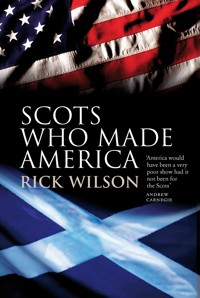
What would America have been without the Scots? Andrew Carnegie, the humble weaver's son who went there to become the world's richest man, thought it might have been 'a poor show'. This book is an unapologetic celebration of what he was proudly talking about - little Scotland's huge human contribution to the cultural identity of the Big Country. Rick Wilson profiles an intriguing selection of Scottish innovators who have projected their genius, energy and inspiration across the Atlantic. They range from the 14th-century nobleman Henry St Clair, believed to have discovered America before Columbus, through the first private eye Allan Pinkerton, to the photographer Harry Benson, who has captured no fewer than ten US presidents for posterity.Scots Who Made America also features non-residents who have contributed from afar, but whose influence has been no less potent for that - people like Sean Connery, Tony Blair, J.M. Barrie and Robert Burns.
Sie lesen das E-Book in den Legimi-Apps auf:
Seitenzahl: 380
Veröffentlichungsjahr: 2015
Das E-Book (TTS) können Sie hören im Abo „Legimi Premium” in Legimi-Apps auf:
Ähnliche















Scots Who Made America
For Joyce and David
First published in Great Britain in 2006 by
Birlinn Ltd
West Newington House
10 Newington Road
Edinburgh
EH9 1QS
www.birlinn.co.uk
Copyright © Rick Wilson 2006
All rights reserved. No part of this publication may be reproduced, stored, or transmitted in any form, or by any means, electronic, mechanical or photocopying, recording or otherwise, without the express written permission of the publisher.
ISBN10: 1 84158 485 1
ISBN13: 978 1 84158 485 0
British Library Cataloguing-in-Publication Data A catalogue record for this book is available from the British Library
Typesetting and origination by Brinnoven, Livingston Printed and bound by Cox and Wyman Ltd, Reading
Contents
Introduction
AMERICA’S GREAT SCOTS
Henry St Clair (1398)
Captain Kidd (1645–1701)
John Witherspoon (1723–94)
James Craik (1730–1814)
James Wilson (1742–98)
John Paul Jones (1747–90)
Alexander Wilson (1766–1813)
‘Uncle’ Sam Wilson (1766–1854)
Archibald Binny (?–1838) and James Ronaldson (1768–1842)
James Gordon Bennett (1795–1872)
Allan Pinkerton (1819–84)
Andrew Carnegie (1835–1919)
Andrew Smith Hallidie (1836–1900)
John Muir (1838–1914)
Robert Dollar (1844–1932)
Alexander Graham Bell (1847–1922)
David Dunbar Buick (1854–1929)
Bertie C. Forbes (1880–1954)
Tommy Armour (1895–1968)
Harry Benson (1930– )
Hugh Grant (1958– )
THE SCOTTISH INFLUENCE
Alexander Selkirk (1676–1723)
William Cullen (1710–90)
James Small (1740–93)
John McAdam (1756–1836)
Robert Burns (1759–96)
Charles Macintosh (1765–1843)
Walter Scott (1770–1832)
Johnnie Walker (1800–59)
Alexander Bain (1811–77)
James Dewar (1842–1923)
Robert Louis Stevenson (1850–94)
Arthur Conan Doyle (1859–1930)
James Matthew Barrie (1860–1937)
Harry Lauder (1870–1950)
Alexander Fleming (1881–1955)
John Logie Baird (1888–1946)
Robert Watson-Watt (1892–1973)
Sean Connery (1930– )
Jim Clark (1936–68)
Tom Farmer (1940– )
Tony Blair (1953– )
Introduction
I could try to put this modestly, but that would be simply disingenuous. While I wish to avoid the impression of ‘wha’s like us’ chest thumping, this book is an unashamed celebration of home-born Scots who have had an incalculable effect on the life and culture of the United States. Most of them ended up on those western shores, though some performed their magic from afar. Most are gone now, but a few are happily still with us.
I have not tried to be particularly objective – one person’s objectivity often being quite different from another’s – but have elected to profile especially colourful, imagination-capturing personalities in the fields of science, culture, engineering, publishing, literature, business and medicine. Neither have I felt limited by this or that period, in covering notable achievements from the (alleged) discovery of America by Scots nobleman Henry St Clair in the fourteenth century to the photographing of no fewer than ten American presidents by Harry Benson, a New York-based cameraman who often flies home to walk along his native Scottish beaches with old pals from his childhood.
I have, however, employed some criteria that have precluded our dwelling on the already much-covered impact of second, third and succeeding generations of Scottish-Americans. With that remit, the sky would have been the limit. I could have mentioned multimillionaire John D. Rockefeller, who inherited Scottish blood from his mother; James Naismith, who invented baseball; James Monroe, the US president and great-grandson of a Scots Covenanter who arrived in the USA in chains; President Lyndon Johnson, whose family came from Dumfriesshire; Neil Armstrong, the first man on the moon, also descended from a Dumfriesshire family; Davy Crockett, the legendary adventurer of Scots descent; Walter, Arthur and William A. Davidson, co-founders of the Harley Davidson motorbike group, whose family hailed from Angus; billionaire tycoon Donald Trump, whose mother was born on the Isle of Lewis; Robert Barclay of Aberdeenshire roots, who was founding governor of New Jersey; and even Elvis Presley, also rooted in Aberdeenshire via a Presley who went to America in the early 1700s. So, in visiting the shores of Britain only once – en route to America from his army unit in Germany – Elvis did so aptly at Scotland’s Prestwick Airport in 1960.
But from the McDonalds hamburger chain to the McDonnell Douglas aircraft company, Scottish blood runs through every vein of America, and the little land at the top corner of Europe can lay claim to having indirectly bred some of the most symbolic contributors to US society – sharp-suited entrepreneurs such as IBM builder Thomas Watson and Microsoft founder Bill Gates – as well as some of the more leathery and controversial Wild West figures, like Wyatt Earp, Jesse James and James Wilson Marshall, who started the Californian gold rush.
Indeed, 61 per cent of US presidents have had Scottish origins, and nine of the thirteen governors of the newly created United States of America were Scots. Everywhere you look in America there are fascinating traces of tartan – even on the dollar bill itself: the Scots typefounders Archbald Binny and James Ronaldson designed the dollar sign, while Scots-descended James Pollock became Director of the Mint at Philadelphia and was responsible for putting the phrase ‘In God We Trust’ on US money.
But it is not American-born Scots on whom I have focused this exercise, and neither have I insisted on US residency as a qualification for inclusion. Some big Scots names have impacted on America without being on the spot. Some have just spent some time there. So a fair part of the book focuses on ‘influencers from afar’, people such as movie star Sir Sean Connery, who have been much in demand, though not resident, in America. I have noted the magical effects of certain stay-at-home figures, such as Peter Pan creator J.M. Barrie and Crusoe-inspiring Scots sailor Alexander Selkirk. I have examined the life-changing temptations that emigration presented to Scotland’s famous writers like Robert Louis Stevenson and Robert Burns, who, despite their subsequent impact on American culture, never quite made the break. I have acknowledged the significant impact that Scots-resident groundbreakers in radar, penicillin, television and refrigeration made on both sides of the Atlantic. And I have noted that other developments, such as the ever-popular mac raincoat and tarmac road surfacing, have been successfully exported into US life without the accompanying presence of their Scots inventors. I have even paid due heed to the regard with which Edinburgh-born Tony Blair is held in America.
But the bulk of this volume is devoted to the men who gave not just their talents but also their whole physical selves to America; whose work made them famous after their arrival on its shores. Obvious names like Andrew Carnegie, the weaver’s son from Dunfermline who became the richest man in the world, and Alexander Graham Bell, well-named inventor of the telephone; as well as lesser-known characters like Andrew Hallidie, who invented the San Francisco cable car, or Alexander Wilson, the Paisley-born father of American ornithology.
Such human stars of the American element of the Scottish diaspora provide a clear illustration of just how actively creative immigrants can be. Indeed, Andrew Carnegie himself said: ‘Without the Scots America would have been a poor show.’ I would not go that far, but – particularly in the days of the Highland Clearances, when people were forced to make way for sheep (1790–1845) – there was a mutual enthusiasm for what each party had to offer. The Scots sought new opportunities and the Americans welcomed their industry, application and high standard of education. One American observer wrote: ‘Of all immigrants to our country, the Scotch are always the most welcome. They bring us muscle and brain and tried skill and trustworthiness in many of our great industries, of which they are managers of the most successful.’ These days, however, the tables could be turning, and Scotland may soon be tested as a host country of opportunity in much the same way that America has been.
Noting how the transfer of human ingenuity from one nation can energise another seems particularly relevant at this point in Scotland’s history. For as relative independence has been returned to it through its own parliament for the first time in 300 years, so the debate about the virtues of imported human talent has opened up with a new intensity.
With Scotland’s own five-million population static or falling simultaneously with the enlargement of the European Union, the question now is: would a brain-drain in reverse from the eastern countries be welcomed? Would immigrants and their energy be appreciated in the same way that Scots and their talents have been allowed to flourish in the land of the free?
There must be little doubt that the Scots, of all people, will record the answer ‘Yes’ to that. Time, in any case, will tell.
Women readers may be disappointed that all the personalities covered in the book are men. This is largely because at the point of the biggest explosion of Scottish emigration to the USA – after the 1707 Act of Union between Scotland and England and before female rights began being properly asserted in the late twentieth century – it was, like it or not, a man’s world. A few names of enterprising women were considered but they were so few that I suspect the charge against me then would have been ‘tokenism’. Let’s trust that, a century from now, there will be opportunities aplenty for the publishing of such a book focused on the exported achievements of Scottish women.
But for the moment, I celebrate the Tartan Titans, the Scotsmen who shaped America.
I am grateful to friends and colleagues who have helped with this project, particularly journalists Jack Webster and Jim Gilchrist, and my eagle-eyed wife Alison, who can spot an errant comma from a mile away.
America’s Great Scots
Henry St Clair (1358–1400)
He led, Columbus followed
Could it possibly be true that America was discovered by a Scots nobleman almost a century before Christopher Columbus? It is a beguiling proposition that captivates a growing number of today’s natives of Caledonia, the more familiar they become with the story and evidence of Sir Henry St Clair and his medieval meanderings.
One compelling piece of evidence is to be found on Edinburgh’s doorstep today, in a fascinating ancient place redolent of medieval intrigue and mystery just south of the city: a finely hewn building like a miniature cathedral where pagan and Christian traditions live a little uneasily side by side.
This is the well-preserved fifteenth-century Rosslyn Chapel – described by its caretakers as a ‘jewel in stone’ – whose elevated but secluded position near the rolling foothills of the Pentlands is not only beautiful but dramatically illustrative of the difference between Scotland then and now. Why? Simply and mundanely because of its proximity to the hugely popular Edinburgh outlet of the Swedish IKEA furniture group.
Only a few miles apart, both powerful symbols taken together show just how ages and ever-evolving cultures have radically changed the Scots. But they have one thing in common: they can really pull in the crowds – albeit of acutely different kinds of people. The chic-but-cheap store daily attracts hundreds of materialistic home-improvers happily absorbed into the Scandinavian furnishing trend that has flooded almost every corner of every household in the land; the chapel is a magnet for more spiritual and cerebral types like historians, students of religion and mystics . . . joined relatively recently by the Hollywood actor Tom Hanks and waves of international book and movie fans keen to take in and sense the denouement scene of Dan Brown’s blockbuster novel and film, The Da Vinci Code.
What they behold is a compact, filigreed masterpiece of the stonemason’s art that defies description – at least by some, such as a lost-for-words author called Britton who, in his 1812 Architectural Antiquities of Britain, said the chapel would be found ‘curious, elaborate and singularly interesting, impossible to designate by any given or familiar term’, its ‘variety and eccentricity not to be defined by any words of common acceptation’.
But should they start to study the detail of the elaborately carved interior, a visitor’s already dazzled eye might settle on the pattern of repeated bulbous shapes that make a sweeping lower border to the arch over one of the chapel windows. These have been identified as American maize, which should not have been known in Britain when the chapel was founded in 1446 by William Sinclair, the third earl of Orkney.
If the American continent was only found by Columbus in 1492, and even if the chapel took another forty years to complete, how did these representations manage to appear in Scotland? It is only logical to conclude that someone with a connection to Rosslyn must have made the transatlantic voyage before that date; and the common assumption is that that person was William’s grandfather, Sir Henry St Clair, sometimes described as ‘Prince’ Henry because of his royal connection. The current earl of Rosslyn, who has written an informative introductory book about the chapel for visitors, simply asks: ‘Is it possible that knowledge [of the plants] brought home by Prince Henry passed to his grandson?’
But for many Scots who look askance at the annual celebration of the Genoese navigator’s ‘discovery’ of America, there is very little doubt that, having crossed the Atlantic at the head of an impressive fleet, the Scottish knight set foot on the rugged shores of Nova Scotia, near to what is now Guysborough, on the Feast of the Trinity in 1398. And they see it as quite natural that his grandson William should have immortalised that early transatlantic voyage in stone at the chapel in the family estate of which he was the baron.
But Henry St Clair was not just the baron of Rosslyn. He was known by many other grand titles: knight, of course, and Lord Chief Justice of Scotland, Admiral of the Seas, and First Prince [or Earl] of Orkney – the last bestowed upon him by King Haakon of Norway, who endowed him with 200 strategically located Scottish islands over which he reigned all-powerful, more like a king than a prince. But he is also thought to have been the legendary figure known as ‘Glooscap’ among the Micmac Native American Indians whose folklore is said to describe his ships as ‘islands with trees growing on them’.
To begin, however, at the beginning . . .
What we know of the story is largely thanks to chronicles of a sixteenth-century Venetian, whose namesake and forebear, Nicolò Zeno, was sailing round the north coast of Scotland when, after being shipwrecked off the Faroe islands, he was rescued and befriended by a local chieftain. Was this St Clair? That point is not clear, but gratefully wishing to help the chief in his endeavours, the Italian summoned his brother Antonio from Venice and together, in 1393, the two skilled shipbuilders led a successful mapping expedition to Greenland. Nicolò died the following year, but Antonio stayed on to make another expedition in 1398, this time almost certainly with Sir Henry.
Known as the Zeno Narrative, the story of St Clair’s voyage to North America was written by the ‘new’ Nicolò Zeno a historian and prominent citizen, in 1558. His claimed sources were letters written by the original Nicolò, and his brother Antonio. Antonio’s letters (as given in the Narrative) also refer to a book he had written that described in detail the lands they visited, and they included a map of the islands and countries of the North Atlantic.
But why was such an ambitious expedition mounted? The St Clairs were linked to the once-powerful Knights Templar, some of whom had fled to Scotland after they were outlawed, and it is speculated that the journey was intended to find and found a Templar colony far from their hunters’ eyes. Formed during the Crusades, the Knights Templar were a wealthy band of warrior-monks who had become the most feared soldiers of Christendom – until, after two centuries of unrivalled power in Europe and the Holy Land, they were abruptly suppressed by King Philip IV of France and proclaimed open to arrest over most of Europe on charges of heresy, blasphemy and obscenity. Scotland was one of only two European countries – the other was Portugal – where the order was not proscribed by the Pope. It was seen as their last refuge from persecution; but was it far enough away from the rest of Europe?
In any case, some records say bluntly that Sir Henry sailed from Orkney ‘with Templar funding’, and it was certainly with a big and well-equipped force that he did so. No fewer than twelve ships set off with what seemed indeed remarkably like a colonising 300-strong company – of Templar knights, soldiers, sailmakers, armourers, carpenters and farming monks – complete with Venetian Pietro cannon.
Sailing via Shetland, they first reached Newfoundland from where, after making an unsuccessful attempt to land, they pushed on south through vicious seas – losing no fewer than five ships – to Nova Scotia. The remaining ships must have been struggling by the time they got there, and readers can surely draw their own conclusions from the fact that, in 1849, two brass Venetian naval cannon of the late fourteenth century were dredged up off the shore of Louisburg harbour on Nova Scotia’s Cape Breton Island.
In any case, perhaps in an attempt to cut his losses, it was in Nova Scotia that Sir Henry is said to have sent most of his fleet back to Orkney while he and his shore party spent more then a year exploring the new land and making the acquaintance of the Micmac Indians.
So the story goes. But what evidence is there? It is largely anecdotal, but it is intriguing nonetheless. Along with other tribes in the surrounding regions, the Micmacs have a legend of a white ‘prince’ who came from across the sea and met their people at Pictou, which has been identified as the second landfall of the expedition. Said to have been wise and kindly, he apparently showed the Indians the European styles of fishing, hunting and plant cultivation. The lore also records that the white prince travelled in ‘a great stone canoe’, also described as ‘a floating island with trees growing out of it’, which surely evokes the picture of a European sailing ship with high masts.
These and other native American peoples are also said to have referred in their folklore to the landfall of a vessel ‘like a bird with a broken wing’ and still act out the arrival of a foreign hero called ‘Glooscap’, a name reckoned by some to be the Indians’ version of Earl Sinclair. And according to Jim Gilchrist, a Scots writer who has done considerable research into the subject, ‘ethnologists say that it was around this period that the natives of the area started fishing with nets, European-style, rather than with lines, while others point to Gaelic and Norse words assimilated into the vocabulary of the Algonquin and other native peoples’.
It is also told that when Sir Henry took his leave of his new-found admirers after his mutually enriching year among them, his intention was to be heading for home. A sudden storm blew up, however, and drove him south to Massachusetts, which was the catalytic moment that meant he was to set foot in what we now know as America almost a century before Columbus. Shortly after his landing there, it is recorded in the Zeno Narrative, they climbed a hill where his close companion and cousin, the Templar Knight Sir James Gunn of Clyth, suddenly died – either from heat exhaustion or by being beaten in a fight. And it is here that further compelling evidence of the landfall begins to emerge.
There has since been discovered, roughly scratched out of a rock at Prospect Hill in Westford, Massachusetts, the unmistakable effigy of a fourteenth-century knight holding a sword – dated between 1375 and 1400 – and a shield which was identified by a former Lord Lyon, the Scottish authority on crests, as being from the Gunn family.
Sir Henry may even have reached as far south as Rhode Island, where some evidence suggests that he and his men could have built Newport Tower, a two-storey circular stone needle which, say researchers, is definitely European – rather than native American – and has architectural features that owe something to the medieval church towers of Scotland’s northern isles.
If all this is true (and it has to be said that there are many dissenters, even in Scotland), it would be touching and apt for Sir Henry to have left such an impact over the centuries; for he was undoubtedly a man of great courage, achievement and presence. Indeed, his Venetian companion Antonio Zeno is recorded as saying that ‘if ever there was a man worthy of immortal memory, it is this man’.
While the time and place of Sir Henry’s death remain a mystery – some say his remains were brought to Rosslyn Chapel to be buried among the other St Clair knights who lie there – those words would surely have made a suitable epitaph for the enterprising Scot who (probably) ‘discovered’ America for the Europeans.
Note. ‘The whole business of “discovering” countries is, of course, somewhat subjective,’ says Jim Gilchrist. ‘High-profile explorers get recorded in the history text books, others “discover” places without posterity noting the fact. Thus, ten years after his “discovery” of America, Christopher Columbus received a letter from some English merchants alleging that he knew perfectly well that they had already been there for fish.’
Captain Kidd (1645–1701)
The reluctant pirate
When we talk of pirates and their dastardly deeds, the name Captain Kidd is sure to come quickly to mind. How does the image go again? An evil-looking, lank-haired man with knife gripped between rotting teeth, a red headscarf roughly stained with skull-and-crossbones, the quick flash of evil in the one eye not covered by a patch, and a less-than-pleasant bodily odour. Those who don’t see Captain Kidd as the archetypal bad guy of the seven seas are rare, for he was so successfully demonised in a propaganda exercise that, over the three centuries since his body was trussed up to rot on the oak gibbet at Tilbury after his hanging in London, succeeding generations of readers have swallowed the story. Right up to the present day. And the story’s essence is that, in the days of mean ship-raiding swashbucklers, he was the meanest of them all.
Interesting idea, pity it’s not the truth.
There are, admittedly, many things that we don’t know about Captain William Kidd, such as his age when he was so crudely dispatched to meet his maker in 1701 – many accounts of his life say he was born in 1655, others say his birth year was 1645. All are agreed that he was born in Scotland, but there is considerable disagreement about where.
Several accounts say he came from Greenock, the west coast port near Glasgow, but others suggest that he was in fact from the east coast, and that his place of birth was actually Carnock ‘near Dundee’. It depends what is meant by ‘near’, of course, for there is no Carnock in the immediate vicinity of Dundee, though there is one very close to Dunfermline in Fife – the county south of the River Tay, on whose northern bank Dundee sits.
The distance between Carnock and Dundee is some fifty miles, and as Kidd lived much of his life in New York and often referred to Dundee as his provenance, perhaps that was just his shorthand for the convenience of others who may have heard of the city but not the village. From that faraway standpoint, they would not have considered the city-to-village distance so great.
There is more in favour of the east. At a hearing in the High Court of the Admiralty in 1695 he gave his age as forty-one and his place of birth as Dundee. The surname Kidd is popular in Fife but relatively rare on Scotland’s west coast. His father is listed as a seaman, which explains why one of the chronicles of the day (the Newgate Calendar) called him a man ‘born to sea’. The exhaustively researched book The Pirate Hunter by Richard Zacks simply calls him ‘Captain Kidd of New York City and Dundee’. But the clinching fact for this writer is that Kidd affectionately named his black cabin boy ‘Dundee’. Anyone who knows the Scots and their little geographic loyalties knows that no one from the west coast would be inclined to put sentimental store on anywhere in the east, or vice versa.
The west coast author Sandra Macdougall, who claims William Kidd for Greenock – ‘although there are no local records confirming this fact’ – in her book on famous people from Inverclyde’s past, will no doubt take issue with this conclusion, especially as my own attempts at finding evidence of his birth in pretty little Carnock also drew a blank. Neither the local church minister nor the nearest library at Oakley had heard of the link. But both were intrigued and, as you read this, might still be burrowing excitedly into their records. So might Lizz Mogg, senior teacher at Carnock School who has chronicled the village’s history. ‘Captain Kidd came from here?’ she exclaimed. ‘That really would be something to update my book with. The children would love that.’
Carnock is certainly near enough to big water – the Firth of Forth is visible four miles away – to have weaned a famous sailor. And it is old enough to feel like his cradle. A handful of simple cottage-style buildings, it nestles in the dale of the Carnock Burn three miles north-west of Dunfermline. Said to have been named after St Caranoc, a disciple of St Ninian, it has a parish church built in 1840; but nearby in the old kirkyard stand the ruins of the original twelfth-century parish church and the fine gravestone of John Row, minister of the parish and the Church of Scotland’s first historian, who died in 1646. Thus would two famous lifelines have crossed in the village – if William Kidd was indeed born in Carnock in 1645.
It can’t be denied that his early career was obscure, and all accounts of his colourful life are plain on that point. But what they all also agree on is that, however he spent his early years at sea – buccaneering or privateering – by the time he surfaced on the record in 1689 as a legitimate privateer for Great Britain against the French, he had learned how to cultivate important people and was himself something of a gentleman.
In other words, he was nothing like the clichéd wild man still pictured by so many people. Indeed, it is questionable whether William Kidd was ever a pirate at all, so much of his fate resting as it did on the sometimes-difficult distinction between that word and the word privateer (having government permission to attack enemy ships on the understanding that the spoils will be shared).
In any event, he was as much a well-to-do merchant as he was either of these. While the sea was in his blood and he always felt drawn back to it, he owned considerable property in New York, married a rich widow there, was very well connected in the city all the way up to the governor, and wore – in his only known contemporary portrait – a gentleman’s fashionable long wig.
There is, though, a decidedly sharp adventurer’s glint in his eye, and there is no doubt about the fact that he was something of a magnet for trouble. A Scot who lorded it over Dutch, English and American crew members was never going to be popular and when he captained a privateer ship, Blessed William, commissioned in 1689 to protect the English colonies in the Caribbean against French attacks, his crew mutinied and left him stranded on the island of Antigua.
Not a bad place to be stranded, some might argue, but he made his way back to New York where he could have settled quietly into an elite business life. Adventure still called, however, and by 1695 he was on his way to London to take a contract as a privateer commanding the 237-ton, 34-cannon Adventure Galley with orders to attack and loot any (then enemy) French ships.
The Adventure Galley had not gone far on her journey to New York and then on to the Red Sea – to capture any ship belonging to a country at war with England – when she was relieved of much of her crew by a Royal Navy squadron desperate to replace sailors lost to scurvy: a right that it had by law against any ship flying an English flag.
Scraping the bottom of the barrel in New York, a frustrated Captain Kidd added more crew – probably with piratical tendencies – then set sail for the Indian Ocean on his mission to clear the sea there of pirates, though there was probably an unspoken understanding between him and his scheming backers, who included Richard Coote, the earl of Bellomont and other nobles (such as the king), that he would also consider any enemy ships with valuable cargo fair game.
Mutinous muttering began again as months went by and Kidd’s failure to take a prize ship meant that, under the terms of the privateer’s contract, there would be no pay for the crew. They pressured Kidd to turn pirate and attack anything, and after he refused to plunder a becalmed Dutch ship they had sighted, a row broke out in which he killed gunner William Moore by hitting him violently over the head with a bucket.
Then, finally, in February 1698, Kidd took his most valuable prize – an Indian-owned ship, the Quedah Merchant, which carried a treasure trove of a cargo worth some £710,000 and had French papers making her a legal target under Kidd’s privateer terms. She was renamed Adventure Prize and her cargo of silk, muslins, sugar, calico, iron and saltpetre seemed set to enrich her captors and their backers. But there was a snag . . . or two.
It did not look like it, but luck was turning against Kidd just as abruptly as politics in London. He had been away from there for nearly two years and in that time there had been a dramatic change in attitude towards piracy and privateering. Officialdom now wanted to pursue only legal trading procedures. And complicating things further was the fact that the Quedah Merchant belonged to an influential Armenian merchant who demanded that the East India Company, the English trading company in the East Indies, make restitution.
Having thus offended England’s commercial establishment, William Kidd was denounced as an ‘obnoxious pirate’ and murderer. All the circumstances were crowding against him, as they had done from the moment his crew had forced him over the privateering edge. He had become very bad news, as the enemies of his backers used him to discredit the Whig party to which many of his powerful friends belonged. Soon, his friends distanced themselves from him too.
When Kidd got full appreciation of his plight, he ran for New York where he thought his influential friends, including the governor, would attest to his innocence. He made his way to Block Island, where he began negotiations through his contacts in New York to gain a pardon for his actions, claiming he had been forced into piracy by his crew. But it didn’t work. He was captured in July 1699, jailed, then sent to England aboard the frigate Advice, to stand trial and incidentally become a political pawn to bring down powerful men in the government.
The trial started on 8 May 1701, and despite his protests that he was not prepared for it and could prove, given time ‘to get my evidence ready’, that he was only a privateer, it was completed the next day. He was not a man of particular guile and his bluntness could grate in a well-oiled courtroom, but he fought hard and straightforwardly for himself. A small exchange from the trial went like this:
Kidd to character witness Colonel Hewetson: ‘Do you think I was a pirate?’
Hewetson to the court: ‘I know his men would a gone a-pirateering and he refused it, and his men seized upon his ship.’
And in a letter protesting his innocence he wrote: ‘I must be sacrificed as a pirate to salve the Hon’r of some men who employed me . . .’
William Kidd was nonetheless found guilty of multiple piracies and murder (ironically committed when trying to stamp down piracy in his crew) and sentenced to hang on the gallows on 23 May 1701. But he did not do so in total sobriety – ‘he was inflam’d with Drink’, said his attending priest – or with convenient good grace. The rope broke on the first attempt, granting him another ten minutes of life before it was replaced. At that moment, it was later reported, Kidd sobered up and asked those around him to send his love to his wife and daughter back in New York and said his greatest regret ‘was the thought of my wife’s sorrow at my shameful death’.
An accurate report? Why should he have felt shamed if he was not guilty, as he had protested? William Kidd may not have been an angel but he was a victim of heavy politics, rich men’s plotting and a set of cruel circumstances. If he was a pirate, he was probably an unwilling one. Certain items could have helped his case. But strangely, his logbook was burned and the papers that might have proved his innocence disappeared in Lord Bellomont’s hands.
During his career, at least the recorded part of it, Kidd had never seen the need to return to his native Scotland. But that he remained a proud Scot was evidenced by his disparaging reference in one letter to ‘their’ justice. Then, as now, England and Scotland had distinctly different justice systems.
Certainly, he had no reason to hold the English Establishment in high regard. All his life he had been used as a scapegoat by those more politically powerful than he, and now, even in death, there was no mercy – only humiliation. The Scottish captain’s corpse was tarred and suspended and displayed to rot in an iron cage on the dock at Thames estuary for several years as a warning to would-be pirates, and a grim welcome to seafarers arriving in England’s main port.
For him, every strategy of self-defence had failed; even the letter to the Tory speaker of the House of Commons in which he offered the government £100,000 worth of his ‘lodged goods’ if he were allowed to lead a ship to them. His offer fell foul of more pressing business that day, but it has never been forgotten since.
Captain Kidd is believed to have buried much of his treasure from the Adventure Prize in several places, and while some of it was found during his life or shortly after his death, the largest deposit is thought to be still for finding, and even today, as author Richard Zacks reminds us, that promise prompts ‘treasure hunters to dig holes all over New England, the Caribbean and Madagascar’.
Imagine if the cards had fallen more fortunately for William Kidd. He could have made his way back to his ‘lodged goods’ and bellowed out a last laugh to reverberate all the way back to Carnock. But it was not to be.
John Witherspoon (1723–94)
Princeton president, freedom fighter
Yester is not a bad name for the East Lothian parish where John Witherspoon was born, in the manse of the little towered kirk that sits neatly atop the rise of pretty Gifford village. Not a bad name – evocative as it is of ‘yesterday’ – because at first glance almost everything here seems to have stood still for centuries. Many of the venerable gravestones clustered about the white-walled church are infirm, weather-worn and leaning, adding to the general feeling that, on entering the village, you have entered another, earlier age.
Save for the occasional modern shop nestled between them, the modest sandstone houses that line the village’s few streets would seem to have changed little since the young Witherspoon grew up here, where his father preached in the early 1700s. But appearances can be deceptive. Unexpectedly elegant interiors and the occasional fine car parked outside betray a 21st-century reality: that such precious olde worlde village atmosphere now comes at a price, making this special place on the River Gifford – a tributary of the Tyne – one of the hottest property spots in the general vicinity of the hottest of them all, Edinburgh.
John Witherspoon has to be its other claim to fame.
Having learned that the church’s exterior boasted a plate to the memory of this Scots minister who found fame by becoming president of Princeton University and a signatory of America’s Declaration of Independence, this writer repeatedly circled the old churchyard getting steadily more puzzled while failing to find the tribute supposedly erected in 1955 by the St Andrew’s Society of the State of New York.
But just as I stepped into the body of the village to seek help from the locals, a reflected sun-ray sparkled into my eye, as if to say, ‘I’m here’ and, thus pulled back almost magnetically, I saw, behind a small expanse of grass, the head-high bronze plate on an old stone wall across the Haddington road from the church. And as I read the inscription, the image of the old minister seemed to look on approvingly . . .
In honoured memory of the Reverend
JOHN WITHERSPOON, D.D., LL.D.
Only clergyman to sign the American Declaration of Independence. The first Moderator of the Presbyterian General Assembly in America, and President of Princeton University. Born in the manse of Yester, Gifford, Feb 5th, 1723
‘. . . The States of America may hand down the blessings of peace and public order to many generations.’
Property values would not have much interested the self-denying Witherspoons. As minister of Yester parish, the father passed on to the son not just his piety and fluent literacy but also a love of simple tastes. Which was probably already in the genes, for they were lineally descended from the formidable ascetic reformer John Knox, whose prayers made Mary Queen of Scots – she once said – ‘more afraid than of an army of ten thousand men’.
Like that ancestor and his own father, John Witherspoon was also to become a renowned preacher whose reputation would carry his career to great heights. After initially exercising his keen mind in his schooling at Haddington, he went to Edinburgh University at fourteen and made a big impression in the theological hall before completing his studies at twenty-one and going straight into preaching in the parish of Beith, in the west of Scotland, where he was held in high regard by his congregation. From there, he went to Paisley, near Glasgow, where he won over the affections of a new and larger congregation.
By all accounts, Dr Witherspoon was a compelling preacher. But he was not just a pulpit thumper; his merits as an author were much appreciated, and an admirer said of his writings that ‘to every serious and intelligent reader, they discover an uncommon knowledge of human nature, and a deep and intimate acquaintance with the holy scriptures’.
Somehow, this tall, dignified gentleman managed to combine duties as a devoted pastor with his increasingly ambitious literary efforts – one of which really set the heather on fire in 1753. ‘Anonymous’ it may have claimed to be, but his was suspected to be the pen behind the satire, Ecclesiastical Characteristics, which stung the Church of Scotland as it identified the shortcomings of some of its ministers. It was the talk of the coffee houses – as was its follow-up, A Serious Apology [for the Characteristics] in which Dr Witherspoon admitted writing the Characteristics.
Three years later he published, from Glasgow, his acclaimed essay Connexion Between the Doctrine of Justification by the Imputed Righteousness of Christ, and Holiness of Life. This was followed by a still more celebrated work, A Serious Inquiry into the Nature and Effects of the Stage, and in 1764 he went to London to oversee publication of his Essays on Important Subjects – a three-volume collection of essays already sporadically published in Scotland.
Unsurprisingly, all this publishing activity spread his reputation far and wide, and soon he was fighting off ‘please join us’ invitations from congregations in Dublin, Dundee and even the Scottish church in Rotterdam. His attachment to Paisley was too strong to break for any of these, but – with his fame having even crossed the Atlantic – something completely different soon came along which was sufficiently appealing for him to leave not just Paisley but his beloved Scotland.
This was an invitation from the trustees of the College of Princeton, New Jersey (now Princeton University), to become their president. Sympathising with his wife’s fear of sailing and of leaving friends and family behind, he at first declined, and indeed he could well have profited from sticking to that decision, for a rich relation offered to make him his heir if the call were ignored. On rethinking things, however, Mrs Witherspoon steeled herself and Dr Witherspoon changed his mind, leaving behind not just great sadness among his Paisley people but, according to one chronicler, ‘a sphere of great respectability, comfort, and usefulness’.
He and his family – three sons and two daughters – landed safely in America in August 1768, and in the same month he was inaugurated as the sixth president of the College of Princeton. The excitement of having acquired a man of such erudite reputation to be an intellectual leader in this corner of America caused an immediate fillip not just to the number of students but to the college’s funds, which had not been overly healthy at a time when it depended upon contributions rather than state support. And as its finances began to flourish, with new contributions recorded from Virginia to Massachusetts, so did the college’s reflected reputation. And the early faith in Dr Witherspoon proved not to have been misplaced. Soon, he had wrought a total revolution in the instruction system practised before his arrival, boosting the study of mathematical science and natural philosophy, bringing in ‘all the most liberal and modern improvements of Europe’, and making changes in every department of instruction, from history to law, while personally passing on many of the principles of good taste and good writing.
Said to be ‘the most companionable of men’ with a good sense of humour, his natural facility for governing was a bonus much admired by many of his students who sought to copy, and even emulate, such leadership skills. During his administration the college achieved a national reputation that it has preserved to this day. The number of high achievers who studied under him during his twenty-six-year tenure at Princeton is impressive. They included: US President James Madison, Vice-President Aaron Burr, nine cabinet officers, twenty-one United States senators, thirty-nine members of the House of Representatives, twelve governors, six members of the Continental Congress, three Supreme Court Justices, thirty-three state and federal judges and thirteen college presidents.
But there was another, high-achieving John Witherspoon. It was when the start of the American Revolutionary War caused the college’s officers and students to be broken up and dispersed in 1776 that he appeared in a new and surprising public guise – not so much the divine philosopher as the thinking civilian. Incurring the severe displeasure of his friends back home in Scotland, where he was called a ‘rebel and a traitor’, he embraced and expounded America’s case for independence and, receiving a totally different reaction from his American friends, was sent by them as a representative of the people of New Jersey, to the Congress of the United States.
His opinion on all the great issues was valued and he was a true and outspoken champion of his new country’s right to independence. Those who opposed his viewpoint were liable to feel – at least – the sharpness of his wit. When one claimed the land was not yet ripe for independence, Dr Witherspoon replied scathingly: ‘Sir, in my judgement the country is not only ripe, but rotting.’
Another example of his quick wit was seen in the tale of the rather slow messenger sent to convey the news of the British Army’s surrender to General Gates at Saratoga. The aide took so long to reach Philadelphia to impart the vital intelligence, that when he finally arrived, he was told that it had reached the city three days before. As it was customary to offer such a messenger a gift from Congress, a fine sword was proposed – at which point Dr Witherspoon rose to amend the motion by substituting a pair of spurs.
Amusing or not, the six-foot Scot never forgot that first and foremost he was a solemn clergyman – the only one, indeed, to sign the Declaration of Independence; and a month before doing so, he preached regretfully of ‘all the disorderly passions of man’ and asserted that only God could turn conflict to good.




