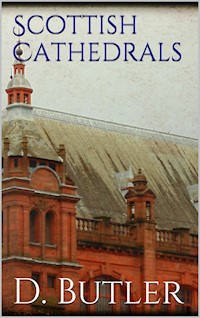
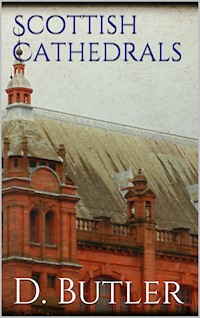
Dugald Butler
Scottish Cathedrals
UUID: 45b4d916-0b65-11e5-96fc-4fc950d1ab4a
This ebook was created with BackTypo (http://backtypo.com)by Simplicissimus Book Farm
Table of contents
PREFACE
INTRODUCTION
CHAPTER I SCOTTISH CATHEDRALS AND ABBEYS
CHAPTER II SKETCH OF SCOTTISH ARCHITECTURE
CHAPTER III
CHAPTER IV SCOTTISH COLLEGIATE CHURCHES
CHAPTER V PARISH CHURCHES ILLUSTRATING THE ARCHITECTURE OF THE NORMAN PERIOD
CHAPTER VI SCOTTISH MONASTICISM
CHAPTER VII GENERAL SURVEY OF SCOTTISH MEDIÆVAL ARCHITECTURE
APPENDIX DEFINITION OF LEADING ARCHITECTURAL TERMS[482]
FOOTNOTES:
PREFACE
In
preparation for this Guild Book I wrote an account of every
pre-Reformation structure in Scotland of which any remains now
survive, but the prescribed limits of the series necessitated a
selection. The Scottish cathedrals are all here treated, with
representative collegiate and monastic buildings. Reference is also
made to parish churches that represent the architecture of the
various periods indicated in Chapter II. A survey of Scottish
mediæval architecture will be found in pp.
194-206
that may enable readers to take a comprehensive view of the whole. A
study of those treated in particular will lead to a study of those
treated of necessity in general, and illustrate the idea that the
history of the Scottish Church is the history of the ideality and
faith of the Scottish people, and that the one cannot be separated
from the other. A healthy present must always be bound by a natural
piety to the past that has made it, or at least helped it to be what
it is, and this study may enable readers to realise more that the
Church of Scotland has a great and glorious past that begins with the
days of St. Ninian and St. Columba. The past has much to teach the
present, and the narrative of historical facts is not without
suggestiveness to the varied life and work that characterise the
Church of Scotland to-day.I
desire to express my indebtedness to the investigations of many
workers, which I have striven to recognise in the many references
throughout the work, but most of all I am indebted to Messrs.
MacGibbon and Ross in their colossal work, the
Ecclesiastical Architecture of Scotland—a
book of national importance.
INTRODUCTION
This
book is designed to render to Scottish Churchmen the special service
of presenting to them, in a brief but comprehensive survey, the
record of their ecclesiastical history which is engraved in their
ecclesiastical architecture. There is no record so authentic as that
which is built in stone. There is none so sacred as that which
attests and illustrates the religion of our forefathers. Much of that
record has perished: enough remains to engage our reverent study and
our dutiful care. Foreign war and rapine have wasted and destroyed
our heritage of sacred places. Kelso, Jedburgh, Melrose, and
Haddington fell before the English invader. Iona was ravaged by the
Dane, while yet the island formed part of a Scandinavian diocese.
Internal lawlessness and tribal fury have wrought like disasters.
Elgin, once "the fair glory of the land," stands a forlorn
monument of the savagery of a Highland chief. St. Andrews, Lindores,
Perth, Paisley, and many others bear witness to the reckless outrage
which cloaked its violence under the guise of religious zeal. Of all
our spoilers this has been the most destructive. The pretence (for it
often was nothing else) of "cleansing the sanctuary" not
only robbed the Church of many a priceless possession, but begat, in
the popular mind, a ruthless disregard of the sacred associations of
places where generation after generation had worshipped God, and a
coarse indifference to the solemnity of His ordinances, which made it
easy for those who should have been the guardians of the churches to
let them fall, unheeded, into decay.It
is not uncommon, even yet, to find people who ought to know, and
perhaps do know, better, blaming Knox and his co-reformers for the
dilapidation and desecration of our ancient fanes. The blame belongs
to the "rascal multitude," and to the rapacious laymen who
were served heirs to the properties of the despoiled Church. What is
the Church the better for their enrichment? What has religion gained
by it? The Reformed Faith could have flourished none the less
graciously if its purified doctrine had been preached, and its
reasonable worship offered, under the same roofs that had protected
priest and people in the days of Romanist error. Is the cause of pure
and undefiled religion stronger in the land because Melrose and
Crossraguel and Pluscarden are desolate; St. Andrews a roofless ruin;
Iona as yet open to the Atlantic winds? Is the voice of praise and
prayer sweeter in the North because Mortlach is effaced and Fortrose
shattered, and the bells are silent which men on the mainland used to
hear when the north wind blew from Kirkwall? Granted that ignorant
superstition may have tainted the veneration in which our fathers'
holy and beautiful houses were held 400 years ago, the iconoclasm
which devastated them was not the remedy for it. The revived interest
in our old churches, which has asserted its influence in such
restorations as those of St. Giles, Dunblane, Linlithgow, St.
Vigeans, and Arbuthnott, is no revival of superstition. It is the
outcome of a more reverent spirit; of a deeper sense of the honour
due to God; of the conviction that we owe Him, in all that pertains
to His worship, the offering of our very best; and of a deeper
consciousness also of the supreme value of the Church's national
position and character, and of the duty of piously conserving
whatever helps to illustrate the historical continuity which binds
its present to its past. As regards this, nothing is so full of
helpful stimulus as an intelligent study of our ecclesiastical
architecture. In it we can read the lessons of the gradual growth of
the Scottish nation from the loosely connected tribal conditions of
the ninth and tenth centuries onwards to its consolidation under a
settled monarchy; the development of its commercial and industrial
progress; its expanding relations to the peoples of the Continent;
and the vital changes in its political life, and its religious system
and belief, thence resulting. All these have left their mark in those
records which neither time nor revolution, neglect nor violence, have
been able wholly to destroy—the architecture of our cathedrals,
abbeys, and monasteries.The
primitive buildings of the early Celtic period of the Church have
long since disappeared. Their clay and wattles could not withstand
the wear and tear of time; only in a distant glen or lonely island
can we discover scattered traces of the beehive cell or simple shrine
of the anchorite or missionary. Few relics of the more substantial
structures of that time survive.The
Roman era of Church organisation superseded the Celtic; and with the
Roman dominance came the architecture of the Anglo-Normans, whom the
presence and policy of Margaret, saint and queen, attracted to
Scotland. It developed itself, always with some national
characteristics of its own, until the War of Independence broke off
all friendly intercourse with England.Later
came, in place of alliance with England, the alliance with France,
which lasted till the Reformation, and left its mark on many of the
pages of "The Great Stone Book," which chronicle for us the
vicissitudes of the past, the days of peace and prosperity, of war
and penury, of reviving national health and energy, of new
combinations and ideas in politics and statecraft, of spiritual decay
and carnal pride and ostentation. These annals can be deciphered by
the patient student of the walls and cloisters of the ancient
churches and religious houses.To
the founders and the owners of the latter, and chiefly to the great
orders of the Augustinians, the Benedictines, and the Cistercians, we
owe many of our noblest remnants of the past—all of them unhappily
ruined; for the popular violence of the sixteenth century raged more
fiercely against the monasteries than against the cathedrals. To the
Episcopal system of government, introduced under Margaret, we owe the
bishops' churches or cathedrals.The
life and thought of the Church at the present day, move far enough
apart from either prelacy or monasticism to allow us to look at each
with an impartial eye, and to consider whether in its abolition we
have parted with aught that it would have profited the Church to
retain.The
monasteries, at first the homes and shelters of charity and learning,
had, before the sixteenth century, waxed fat with unduly accumulated
wealth, become enervated with luxury and corrupt through bad
government. They were swept away, their possessions secularised, and
their communities broken up. But with them disappeared two things
which were of great price: a large and liberal provision for the
poor, and a comprehensive scheme of Education. The monastery gate was
never shut against the suffering and the needy. The monks were
indulgent landlords and kind neighbours; the sick benefited by their
medical skill; the indigent could always look to them for
eleemosynary aid; the houseless wanderer was never sent empty away.
Those great centres of friendly helpfulness and charity were planted
all over the land. No doubt the gift of indiscriminate alms to every
applicant would tend to abuse and lazy beggary; but a scheme of
sympathetic and well directed aid thoughtfully administered would
not.
Abusus non tollit usum.
The scandals of the monasteries did not justify the robbery of the
destitute for the benefit of the secular supplanters of the monks.
The Kirk-sessions of the Reformed Kirk did their best to take the
place of the former guardians and kindly benefactors of the poor, but
their funds were scanty; the old wealth had fallen into tenacious
hands; and schism and sectarianism finally necessitated the transfer
of the care of the poor from the Church to the State.Could
the ancient system have been reformed and not destroyed, the poverty
of the country would have been less grievous than it is to-day; the
Church's relation to the poor more intimate; and the method of relief
pleasanter to the recipients than that which makes them familiar with
the grim charity of the Poor's House, the Inspector, and the
Parochial Board.The
monasteries were the seats of a general system of higher education.
The burghs had their own independent seminaries; the "song
schools" were more closely connected with the churches in town
and in country; but the highest grade of education was found in the
monasteries. Before the foundation of any of the universities they
supplied the place both of secondary school and university, and
trained the youth, especially of the higher ranks, until prepared to
go out into the world, as they constantly did, speaking the
"lingua-franca" of all scholars, and carrying Scottish
energy, genius, and scholarship into the halls and cloisters of many
a college and many a monastery, from Coimbra to Cracow, from Salerno
to Upsala. These schools all perished with the downfall of the
monasteries; and consequently we cannot, to this day, cope with the
great public schools of England, or adequately supply the blank in
our educational system created by their spoliation and abolition.
Here, too, wise reform might have spared and remodelled what
misguided zeal, allied with unprincipled greed, destroyed.With
the ruination and impoverishment of the cathedrals, an element in the
Church's life inseparable from them, and most salutary and useful,
ceased to be. The bishops' deprivation of an authority they had too
often disgraced and misused, vested the government of the Church in
the presbyterate; and the national sentiment approved of the change.
But there was no necessity for upsetting the whole cathedral system,
and rooting out the whole cathedral staff, because the bishop was
turned adrift. Had the Canonries been spared, an immense boon would
have been secured for the Reformed Church. Had the stipends attached
to them not been alienated, the Church would have possessed, at all
its most important centres, a staff of clergymen chosen for their
ability and worth, for their learning and power of government and
organisation, aiding the minister in his work, or enriching the
theological literature of their time. With them might have been
associated younger men, either under their supervision as candidates
for the ministry, or as probationers acquiring practical knowledge of
its duties and requirements. The cathedral would have stood out, in
its city, great or small, as the Mother Church—holding forth the
model of devout ritual, of earnest and learned teaching, of zealous
work. How vastly superior its influence would have been, spiritually,
intellectually, socially, to that of struggling
quoad sacra
churches, with their ill-paid clergy, or "missions" in
charge of worse-paid probationers, it is, I think, needless to point
out. But the possibility of such an institution passed away when the
cathedrals were desecrated, and their revenues were "grippit"—to
use Knox's phrase—by the ungodly robbers of the Church.I
have written these few pages to serve as an introduction to what
follows, from the hand of my friend, Mr. Butler. The Committee of the
Guild asked me to prepare a volume on the most notable of our ancient
churches; and finding that other engagements stood in the way of my
doing so, I recommended that the work should be entrusted to Mr.
Butler, of whose ability to do it well I felt confident. Having read
what he has written, I find my confidence was not misplaced, and that
his treatment of the subject is most instructive, thorough, and
exact. It will add to the reputation he has already gained by his
history of his own parish of Abernethy on Tay, and his books on
Wesley in Scotland, and on Henry Scougal; and will prove an
invaluable guide to all students of our historic churches, cathedral,
collegiate, and monastic.R.
H. S.
CHAPTER I SCOTTISH CATHEDRALS AND ABBEYS
RELATION OF CELTIC CHURCH TO ROMAN CATHOLIC CHURCHThe
period begun by the influence of Queen Margaret (1047-1093),
continued by her sons and their successors on the Scottish throne,
and culminating in the Scottish Reformation of 1560, is that with
which this book deals.The
old Celtic Church of Scotland was brought to an end by two
causes—internal decay and external change. Under the first head,
notice must be taken of the encroachment upon the ecclesiastic
element by the secular, and of the gradual absorption of the former
by the latter. There was a vitality in the old ecclesiastical
organisation, but it was weakened by the assimilation of the native
Church to that of Rome in the seventh and eighth centuries, which
introduced a secular element among the clergy; and the frequent
Danish invasions, which may be described as the organised power of
Paganism against Scottish Christianity, grievously undermined its
native force. The Celtic churches and monasteries were repeatedly
laid waste or destroyed, and the native clergy were compelled either
to fly or take up arms in defence; the lands, unprotected by the
strong arm of law, fell into the hands of laymen, who made them
hereditary in their families, and ultimately nothing was left but the
name of abbacy, applied to the lands, and that of abbot, borne by a
secular lord. Under the second head—external change—may be noted
the policy adopted towards the Celtic Church by the kings of the race
of Queen Margaret. It consisted (1) in placing the Church upon a
territorial in place of a tribal basis, in substituting the parochial
system and a diocesan episcopacy for the old tribal churches with
monastic jurisdiction and functional episcopacy; (2) in introducing
the orders of the Church of Rome, and founding great monasteries as
counter influences to the Celtic Church; (3) in absorbing the Culdees
or Columban clergy into the Roman system, by first converting them
from secular into regular canons, and afterwards by merging them in
the latter order.[1]
King David especially founded bishoprics and established cathedrals,
equipped with the ordinary cathedral staff of deans, canons, and
other functionaries, and monasteries equipped with representatives of
the monastic orders. Thus the native Celtic Church, undermined by
internal decay, was extinguished by external change and a course of
aggression which rolled from St. Andrews until it reached the far-off
shores of Iona. All that remained to speak of its vitality and
beneficence to the people of Scotland consisted of the roofless walls
of an early church, or an old churchyard with its Celtic cross; the
names of the early pastors by whom the churches were founded, or the
neighbouring wells at the old foundations, dedicated to their memory;
the village fairs, stretching back to a remote antiquity, and held on
the saint's day in the Scottish calendar; here and there a few lay
families possessing the church lands as the custodiers of the
pastoral staff or other relics of the founder of the church, and
exercising a jurisdiction over the ancient "girth" or
sanctuary boundary such as the early missionaries instituted in the
days when might was right, and they nobly witnessed to the right
against the might.The
new policy was connected with the introduction of the orders of the
Roman Catholic Church, and with the building of cathedrals and
abbeys. This movement commenced with the close of the eleventh
century, and continued to the middle of the sixteenth; it embraced
all the time when the Church of Scotland was guided by the regime of
Rome, although it is to be recalled that the Scottish Church never
ceased to maintain a native independence—its heirloom from the
ancient Celtic Church. This independence, manifested on important
historical occasions throughout mediæval times, at last found its
national embodiment in the Reformed Church of 1560.Scotland
was divided into thirteen dioceses—St. Andrews, Glasgow, Dunkeld,
Aberdeen, Moray, Brechin, Dunblane, Ross, Caithness, Galloway,
Lismore or Argyll, the Isles, and Orkney; but before sketching the
history and architecture of each of the thirteen cathedrals, it will
be necessary to indicate the general features of the various periods
of Scottish architecture itself, as it is of this movement the
structures themselves are all an expression.
CHAPTER II SKETCH OF SCOTTISH ARCHITECTURE
Architecture
is a great stone book in which nations have recorded their annals,
before the days of the printing-press: have written their thoughts,
expressed their aspirations, and embodied their feelings as clearly
and truly as by any other form of utterance. We know Egypt as vividly
by its pyramids, the age of Pericles by the Parthenon of Athens,
Imperial Rome by the Flavian Amphitheatre and the Baths of Caracalla,
as from the pages of their respective literature. The mediæval
cathedrals, monasteries, and churches are a living record of the
faith and devotion of mediæval men, who have left besides them but
little else whereby we can know their aspirations and civilisation;
we find in them an expression of the deepest life that characterised
the periods to which they belong, and a record which, though often
mutilated, and sometimes nearly obliterated, never deceives. Wherever
these architectural creations are found, there also a voice ought to
be heard, telling what at that spot and at some previous time men
thought and felt; what their civilisation enabled them to accomplish,
and to what state they had attained in their conception of God. In a
very true sense it can be said that the architecture of a country is
the history of that country, and that the record of the architecture
is the record of its civilisation.
Lesen Sie weiter in der vollständigen Ausgabe!
Lesen Sie weiter in der vollständigen Ausgabe!
Lesen Sie weiter in der vollständigen Ausgabe!
Lesen Sie weiter in der vollständigen Ausgabe!
Lesen Sie weiter in der vollständigen Ausgabe!
Lesen Sie weiter in der vollständigen Ausgabe!
Lesen Sie weiter in der vollständigen Ausgabe!