


16,99 €
Mehr erfahren.
- Herausgeber: John Wiley & Sons
- Kategorie: Geisteswissenschaft
- Sprache: Englisch
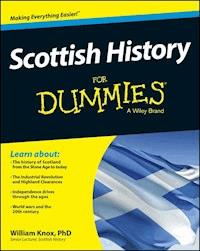
Explore the fascinating history of Scotland in an easy-to-read guide
Want to discover how a small country on the edge of Northern Europe packs an almighty historical punch? Scottish History For Dummies is your guide to the story of Scotland and its place within the historical narratives of Britain, Europe and the rest of the world. You'll find out how Scotland rose from the ashes to forge its own destiny, understand the impact of Scottish historical figures such as William Wallace, Robert the Bruce and David Hume and be introduced to the wonderful world of Celtic religion, architecture and monuments.
History can help us make connections with people and events, and it gives us an understanding of why the world is like it is today. Scottish History For Dummies pulls back the curtain on how the story of Scotland has shaped the world far beyond its borders. From its turbulent past to the present day, this informative guide sheds a new and timely light on the story of Scotland and its people.
- Dig into a wealth of fascinating facts on the Stone, Bronze and Iron ages
- Get to know how Scotland was built into an industrial economy by inventors, explorers and missionaries
- Discover the impact of the world wars on Scotland and how the country has responded to challenges created by them
- Find up-to-the-minute information on Scotland's referendum on independence
If you're a lifelong learner looking for a fun, factual exploration of the grand scope of Scotland or a traveler wanting to make the most of your trip to this captivating country, Scottish History For Dummies has you covered.
Sie lesen das E-Book in den Legimi-Apps auf:
Seitenzahl: 608
Veröffentlichungsjahr: 2014
Ähnliche




















Scottish History For Dummies®
Published by: John Wiley & Sons, Ltd., The Atrium, Southern Gate, Chichester, www.wiley.com
This edition first published 2014
© 2014 John Wiley & Sons, Ltd, Chichester, West Sussex.
Registered office
John Wiley & Sons Ltd, The Atrium, Southern Gate, Chichester, West Sussex, PO19 8SQ, United Kingdom
For details of our global editorial offices, for customer services and for information about how to apply for permission to reuse the copyright material in this book please see our website at www.wiley.com.
All rights reserved. No part of this publication may be reproduced, stored in a retrieval system, or transmitted, in any form or by any means, electronic, mechanical, photocopying, recording or otherwise, except as permitted by the UK Copyright, Designs and Patents Act 1988, without the prior permission of the publisher.
Wiley publishes in a variety of print and electronic formats and by print-on-demand. Some material included with standard print versions of this book may not be included in e-books or in print-on-demand. If this book refers to media such as a CD or DVD that is not included in the version you purchased, you may download this material at http://booksupport.wiley.com. For more information about Wiley products, visit www.wiley.com.
Designations used by companies to distinguish their products are often claimed as trademarks. All brand names and product names used in this book are trade names, service marks, trademarks or registered trademarks of their respective owners. The publisher is not associated with any product or vendor mentioned in this book.
LIMIT OF LIABILITY/DISCLAIMER OF WARRANTY: WHILE THE PUBLISHER AND AUTHOR HAVE USED THEIR BEST EFFORTS IN PREPARING THIS BOOK, THEY MAKE NO REPRESENTATIONS OR WARRANTIES WITH THE RESPECT TO THE ACCURACY OR COMPLETENESS OF THE CONTENTS OF THIS BOOK AND SPECIFICALLY DISCLAIM ANY IMPLIED WARRANTIES OF MERCHANTABILITY OR FITNESS FOR A PARTICULAR PURPOSE. IT IS SOLD ON THE UNDERSTANDING THAT THE PUBLISHER IS NOT ENGAGED IN RENDERING PROFESSIONAL SERVICES AND NEITHER THE PUBLISHER NOR THE AUTHOR SHALL BE LIABLE FOR DAMAGES ARISING HEREFROM. IF PROFESSIONAL ADVICE OR OTHER EXPERT ASSISTANCE IS REQUIRED, THE SERVICES OF A COMPETENT PROFESSIONAL SHOULD BE SOUGHT.
For general information on our other products and services, please contact our Customer Care Department within the U.S. at 877-762-2974, outside the U.S. at (001) 317-572-3993, or fax 317-572-4002. For technical support, please visit www.wiley.com/techsupport.
For technical support, please visit www.wiley.com/techsupport.
A catalogue record for this book is available from the British Library.
ISBN 978-1-118-67615-8 (hardback/paperback) ISBN 978-1-118-67612-7 (ebk) ISBN 978-1-118-67613-4 (ebk)
Printed in Great Britain by TJ International, Padstow, Cornwall
10 9 8 7 6 5 4 3 2 1
Scottish History For Dummies
Visit www.dummies.com/cheatsheet/scottishhistory to view this book's cheat sheet.
Table of Contents
Introduction
About This Book
Foolish Assumptions
Icons Used in This Book
Beyond the Book
Where to Go from Here
Part I: Getting Started with Scottish History
Chapter 1: Welcome to Scotland
The Peoples of Scotland
The Formation of Scotland
The Union with England and Its Uncertain Future
Chapter 2: From Nomads to Farmers: The Earliest Peoples
Boundaries and Landscape: The First People to Inhabit Scotland
The Ages of Man: The Stone Age, Bronze Age and Iron Age in Scotland
The Stone Age
The Bronze Age
The Iron Age
Anybody Out There? The People Who Came to Scotland from Europe
The Beaker people: Let’s get hammered!
The Celts: Holding firm
What Life Was Like for Scotland’s First Settlers
Tools and toil
Wealth and power
Death and religion
Chapter 3: Disunited Kingdoms (80–750)
Roamin’ in the Gloamin’: The Roman Invasion and (Near) Conquest
Another brick in the wall
What the Romans did for Scotland
When the Saints Come Marching In
Four Nations and Five Languages
Angles
Britons
Picts
Gaels
Part II: Making the Kingdom (840–1286)
Chapter 4: The Kingdom of Alba (840–1040)
The Disappearance of the Picts
Kenneth MacAlpin: King of the Scots?
The Viking Invasion
Putting down roots
Battling the Vikings: The North
Battling the Vikings and Saxons: The south
Mapping the kingdom
Chapter 5: Good Kings, Bad Kings and a Saintly Queen (1034–1153)
Enter Macbeth, Stage Right: The End of the MacAlpin Dynasty?
Malcolm and Margaret: The Ideal Couple?
Making Scotland more English
Making England more Scottish
Margaret and the soul of Scotland
The Four Stooges: Donald, Duncan, Edgar and Alexander
David I: The Revolutionary King
The governance of Scotland
The transformation of the Scottish Church
Anglo–Scottish relations
David I: The greatest of Scottish kings?
Chapter 6: Peace and Plenty? (1153–1286)
The Very Short Reign of Malcolm IV (1153–1165)
The Very Long Reign of William I ‘the Lion’(1165–1214)
War and its consequences
Challenges to royal authority
Big Bad John
Lamb or lion?
The Middling Reign of Alexander II(1214–1249)
Troubles with John
The Treaty of York
Expansion of the kingdom
The Golden Age of Alexander III (1249–1286)
The boy king
Coming of age
The Battle of Largs
Finding an heir
A golden age?
Part III: Making the Nation (1286–1542)
Chapter 7: The Wars of Independence (1286–1371)
The Auld Alliance
The Maid of Norway
Finding a king
The trouble with John
If you hate the English, clap your hands
The First War of Independence (1296–1328)
William Wallace and the Scottish resistance
Robert the Bruce
A spider’s tale
The Battle of Bannockburn
The Declaration of Arbroath
The Second War of Independence (1332–1357)
The Scottish resistance
Three cheers for the Auld Alliance!
The Scottish spring
The Return of the Boy King
He’s back, but not for long!
The second reign of David II
The Black Death
Chapter 8: The Foundations of the Stewart Dynasty (1371–1460)
The Reign of Robert II
Jobs for the boys
A little family difficulty
The Reign of Robert III
The rise of the Albany Stewarts
The English and Scottish battle in Northumberland
The Albany Governorship(1406–1424)
The Reign of James I
The fall of the Albany Stewarts
The early Renaissance prince
Money, money, money
The lord of the Isles
The French connection
To kill a king
The Reign of James II
The minority of James II
The Black Douglases
Accidents will happen
Economic and Social Life in Medieval Scotland
The unwashed
The urban elite
The Highlands and the clans
Saints and sinners
Trading networks
Chapter 9: Renaissance Scotland (1460–1542)
The Renaissance
Monarchy
Art
Architecture
Education
Literature
Music
The Reign of James III
A little family bother
Our friends in the north
Business as usual
The Reign of James IV
The lordship of the Isles
The Renaissance prince
Our friends in the south
The Battle of Flodden Field
The Reign of James V
The politics of regency
The Red Douglas
The Renaissance prince
James V and the Reformation
The Battle of Solway Moss
Everyday Life in Renaissance Scotland
The economy
Social life
Part IV: The Unmaking of a Nation (1540–1750)
Chapter 10: From Reformation to the Union of the Crowns (1540–1625)
Regency and Reformation
Rough wooing
The regency of Mary of Guise
The lords of the congregation
Reformation
The Reign of Mary, Queen of Scots
Conversing with John Knox
Finding a husband
The murder of David Riccio
Darnley has to go
The queen fights back
Mary has to go
The Reign of James VI
Civil war and revolution
The king and his lover
It’s witchcraft
Restoring royal authority
The Union of the Crowns
Chapter 11: King, Commonwealth and Revolution (1625–1690)
The Reign of Charles I
The Book of Common Prayer and more trouble for Charles
The National Covenant
Royal reaction
The Wars of the Three Kingdoms
We’ve got to talk about Charles
The Reign of Charles II
The Cromwellian occupation
The Restoration of the monarchy
The Reign of James II and VII
The Glorious Revolution of 1688
The Jacobite Rebellion of 1689
Everyday Life in 17th-Century Scotland
Living conditions
Emigration: Let’s get out of here!
The social structure
The social impact of religion
It’s witchcraft
Culture and education
Chapter 12: The Unmaking of a Nation (1690–1750)
The ‘Ill Years’
The Glencoe Massacre
Widespread famine
The Darien Scheme
The Union Debate
Bought and sold for English gold?
The Treaty of Union
Popular reactions to union
Economic consequences of union
The Jacobite Revolts
The 1715 rebellion
The 1719 rebellion: They’re at it again!
Pacification of the Highlands
The 1745 rebellion
National Identity: Turning Scots into North Britons?
Political Management
Part V: The Remaking of a Nation (1750–1918)
Chapter 13: A Nation in Transition (1750–1832)
Transitioning from an Agrarian Society to an Industrial One
Working conditions
Urban growth and urban crisis
The Highland Clearances: Ethnic Cleansing of the Highlands
Empire and Diaspora
The Enlightenment: Why Scotland?
Political Radicalism
Political management
The impact of the French Revolution
Show trials
Revolution is in the air
Radicalism Reborn
Agitation
Revolution in the air (again)
Enlightened Tories: An oxymoron?
Reform or revolution
The effect of the Great Reform Act of 1832
Chapter 14: The Making of Modern Scotland (1832–1918)
The Victorian Economic Miracle
The rewards of industry
Slowing down
Living in the City
Squalor and overcrowding
Poverty: Starving in the midst of plenty
The New Poor Law of 1845
The Highland Clearances: The Second Wave
In Search of Democracy
The Second Reform Act
Where is it going to end? More reforms
Women on the march
Liberal Scotland
The attack from the right
Religion and politics
The attack from the left
Liberalism restored
Emigration and Empire
North America
India
Australasia
Africa
The War to End All Wars
The social costs of war
The economy of war
The politics of war
Putting it all together
Part VI: New Beginnings (1918–2000)
Chapter 15: The Devil’s Decades: Politics and Poverty (1918–1945)
Toward the Depression: The Economy and Employment
Things aren’t working
It’s not getting any better
Hard Times
Responses to unemployment
Incremental improvements
Getting Back to Work
Jerusalem Postponed: The Politics of the Interwar Years
Fractures within the Liberal Party
The rise and fall of Labour
And along came the Tories
We are all Unionists now
Chapter 16: The Rebirth of a Nation (1945–2000)
Scotland and the Second World War
The blitz
The home front
Rationing
The politics of war
The Silent Social Revolution: War and Welfare (1945–2000)
Fighting for a better world
Nationalising the utilities
The Scottish Economy: From Ships to Chips
Fighting for a way of life
End of an empire
Politics in a Changing World (1945–2000)
The rise and fall of the Tories
The rise and rise of Labour
The mercurial Scottish National Party
The Scottish Parliament
Part VII: The Part of Tens
Chapter 17: Ten Great Places to Visit in Scotland
The Heart of Neolithic Orkney
Eilean Donan Castle
Glencoe
Bannockburn
St Andrews
Falkland Palace
The Necropolis
Melrose Abbey
Alloway
Whithorn
Chapter 18: Ten Little-Known Scottish People Who Are Worth Knowing About
Bridei, King of the Picts (616/628?–693)
St Ninian
Andrew de Moray (?–1297)
Patrick Hamilton (1504–1528)
Sir William Paterson (1658–1719)
Thomas Muir the Younger of Huntershill (1765–1799)
Lachlan Macquarie (1762–1824)
Mary Somerville (1780–1872)
Eliza Wigham (1820–1899)
Roland Eugene Muirhead (1868–1964)
Chapter 19: Ten Things Scotland Has Given to the World
The Flushing Toilet
The King James Bible
Criminal Fingerprinting
Whisky: Water of Life
Colour Photography
Anaesthetic
Raincoats
Golf
Dolly the Sheep
For Auld Lang Syne
About the Author
Cheat Sheet
More Dummies Products
Guide
Table of Contents
Begin Reading
Pages
1
2
3
4
5
6
7
8
9
10
11
13
14
15
16
17
18
19
20
21
22
23
24
25
26
27
28
29
31
32
33
34
35
36
37
38
39
40
41
42
43
44
45
46
47
48
49
50
51
52
53
54
55
57
58
59
60
61
62
63
64
65
66
67
68
69
70
71
72
73
74
75
76
77
78
79
80
81
82
83
84
85
86
87
88
89
90
91
92
93
94
95
96
97
98
99
100
101
102
103
104
105
106
107
109
110
111
112
113
114
115
116
117
118
119
120
121
122
123
124
125
126
127
128
129
131
132
133
134
135
136
137
138
139
140
141
142
143
144
145
146
147
148
149
150
151
152
153
154
155
157
158
159
160
161
162
163
164
165
166
167
168
169
170
171
172
173
174
175
176
177
179
180
181
182
183
184
185
186
187
188
189
190
191
192
193
194
195
196
197
198
199
200
201
202
203
204
205
206
207
208
209
210
211
212
213
214
215
216
217
218
219
220
221
222
223
224
225
226
227
228
229
230
231
232
233
234
235
236
237
238
239
240
241
242
243
244
245
246
247
248
249
250
251
252
253
254
255
257
258
259
260
261
262
263
264
265
266
267
268
269
271
272
273
274
275
276
277
278
279
280
281
282
283
284
285
286
287
288
289
290
291
292
293
294
295
296
297
298
299
300
301
302
303
304
305
306
307
308
309
310
323
324
Introduction
This book is about Scotland, a small island nation on the edge of northern Europe. And for 80 per cent of the period covered in this book, Scotland didn’t exist (at least not as we think of it today in territorial and political terms). Territorially, Scotland only assumed its current boundaries in 1470, with the acquisition of Orkney and Shetland, and politically it was only a nation-state from 1314 onward before voluntarily giving up its sovereignty in the Union of Parliaments with England in 1707 to create a new nation-state, Great Britain – a move that was deeply unpopular with ordinary Scots.
But in spite of its small size (just under 19 million acres) and several centuries of independence, Scotland has made a massive contribution not only to the history of these islands we call Great Britain but also to the modern world. Indeed, some historians have argued that Scotland – through its thinkers, engineers and scientists – invented the modern world.
Although Scotland has been a unitary state since 1470, it’s divided by geography. The Highland Boundary Fault line, which runs from the northeast to the southwest, separates Scotland not just geographically into highlands and lowlands, but also culturally. The lowlands had rich, fertile farming land; the highlands, with its harsher climate, had many more mountains and rivers, but the soil was extremely poor, so rearing animals (especially cattle and, later, sheep) was the main source of income.
Yet for much of our history, more people lived in the north of Scotland than in the south. Such are the many contradictions in the Scottish story. Scotland is also wetter and windier than the rest of Britain, with the Shetland Isles experiencing around 42 days of gales per year. Hearing can be a problem in that part of Scotland!
Scotland also shares a part of a larger island – Britain – with its neighbours, the English and the Welsh. As far the English were concerned, we were ‘noisy neighbours’ who were there to be subdued. The relationship between the two kingdoms for most of the period covered in this book was, on the whole, fractious and violent. But it was the territorial battles with England that were important in creating a sense of national identity for the Scots – something they have never lost from the Middle Ages to the present day.
About This Book
In this book, I don’t give a blow-by-blow account of the history of Scotland from the earliest times to the present. There isn’t enough space and, in any case, it would be boring. This isn’t a textbook, and it doesn’t pretend to be. It reflects my views as a historian (just as most histories reflect their authors’ points of view). I leave things out, I skip over things that seem irrelevant and include things that I hope you enjoy.
For any historian, the decision on what to put in and what to leave out is ultimately conditioned by the sources available. So, earlier chapters of the book are concerned with issues surrounding kingship and the relationship between Church and monarch; later chapters discuss elections and party politics.
The information is organised into chapters and parts so that you easily access what you need. Use the book as a reference – you don’t need to read the chapters in order from front cover to back, and you aren’t expected to remember anything. There won’t be a test at the end of the book.
Sidebars (text in grey boxes) and anything marked with the Technical Stuff icon are skippable – the information is interesting but not necessary to your understanding of the topic at hand. Within this book, you may note that some web addresses break across two lines of text. If you’re reading this book in print and want to visit one of these web pages, simply key in the web address exactly as it’s noted in the text, pretending as though the line break doesn’t exist. If you’re reading this as an e-book, you’ve got it easy – just click the web address to be taken directly to the web page.
Finally, as you read this book – and any other history – keep in mind that the wealthy and powerful left more traces of their lives than the poor and the illiterate did. Until relatively recently, 90 per cent of men and all women were denied a political role in Scottish society. So, all history has a certain bias, and the story is never complete. The past is continually being re-invented – that’s what makes it so fascinating and something we can all play a part in making!
Foolish Assumptions
In writing this book I’ve made a few assumptions about you, the reader:
You studied some Scottish history at school but were put off by the way it was taught, or maybe you liked it but your memory is a bit hazy about who did what.You haven’t studied Scottish history, but you’re interested in doing so and you’re not sure where to start.You enjoy a good story and want to know more about Scotland and its peoples.Icons Used in This Book
Throughout this book, you see pictures in the margins. These pictures are called icons, and they’re meant to draw your attention to key pieces of information. Here’s a guide to what the icons mean:
The Remember icon alerts you to the most important information – the elements of Scottish history that you don’t want to forget.
Sometimes my historian brain likes to go on a bit about details that aren’t essential. When this happens, I mark the text with the Technical Stuff icon. If you’re pressed for time, you can skip anything marked with this icon. On the other hand, if you read it, you’re sure to find fascinating titbits of information.
When I quote famous historical figures or others, I mark the quote with the First Hand icon.
Beyond the Book
In addition to the material in the print or e-book you’re reading right now, this product also comes with some access-anywhere goodies on the web. Check out the free Cheat Sheet at www.dummies.com/cheatsheet/scottishhistory for a guide to the historical periods of Scotland, a list of Scotland’s rulers, and the major events and battles in Scottish history.
You can also find online articles that extend the content covered in the book. I provide links to the articles at the beginning of every part. Whether you’re looking for information on the Vikings, the Black Douglases or the Treaty of Union, you can find it (and more) at www.dummies.com/extras/scottishhistory.
Where to Go from Here
You’re more than welcome to start reading this book at the beginning and work through it until you reach the end, but you don’t have to. You decide where you want to go and how far. If you want to know about William Wallace or Robert the Bruce, head to Chapter 10. If you’re more interested in Scottish Nationalism, turn to Chapter 16. The choice is yours.
If you’re still not sure where to start, have a look at the Table of Contents, or use the Index to look up names or places you’re curious about. The story of Scotland is rich in drama and character. All you have to do to discover it is turn the pages!
Part I
Getting Started with Scottish History
For Dummies can help you get started with lots of subjects. Visit www.dummies.com to learn more and do more with For Dummies.
In this part …
Find out about the ages – Ice, Stone, Bronze and Iron – as well as some weird and wonderful stuff about prehistoric peoples like the Celts and their world.Look at the battles fought by the Romans and the four main peoples of ancient Scotland – the Angles, Britons, Gaels and Picts.Discover the origins of kingdoms in the struggles of the ancient Scottish peoples against Roman domination.Consider the arrival of Christianity and the saints who spread the Gospel, like Columba and Ninian.Chapter 1
Welcome to Scotland
In This Chapter
Getting acquainted with the people who make up the land we call Scotland
Seeing how Scotland was formed
Examining how Scotland gained, lost and regained its independence
When you think about Scottish history, maybe it takes you back to the classroom, where you heard stories from teachers about great heroes and villains. You may have stamped on your brain tales about great men like Robert the Bruce or William Wallace; or women like St Margaret or Mary, Queen of Scots; or maybe the great explorers like David Livingstone or Mungo Park. You would have also heard of villains like Macbeth, or failures such as Bonnie Prince Charlie. These are all wonderful stories in their own right, and they receive their due in this book. But there is more to Scottish history than simply the doings of great men and women, and in these pages you find out more about this nation than a history of the usual suspects can tell you.
The Peoples of Scotland
The history of Scotland is a truly remarkable one. As a nation, Scotland has probably contributed more to world civilisation than any other country of a comparable size. In fact, you could argue that the Scots – through their historians, philosophers, engineers and scientists – invented the modern world. But how did that come to pass? What was it about the people and their history that allowed them to make such a significant contribution to the modern world?
You couldn’t put your finger on anything in the Scottish past to answer that question. For many centuries, nothing in particular distinguished the Scots from people from other parts of the globe. Indeed, you could argue that for most of Scotland’s history, it has lagged behind other societies, including – wait for it – England!
There aren’t any genetic clues either: ancient Scotland was made of at least five different peoples who spoke different languages. At first, they were simply members of tribes searching for food, but later they became farmers and members of small kingdoms. Of course, Scotland didn’t exist in their minds: borders and things like national identity were pretty meaningless.
Since ancient times, other people have settled in Scotland. The Romans came, saw and tried to conquer but left empty-handed. Much more successful were the Vikings, who arrived at the start of the ninth century. The Vikings not only raped and pillaged but, in time, also settled on the islands and on the northern coast and became Christians. They were followed by the Anglo-Normans, who arrived in the reign of David I. They were given lands and eventually became successful and powerful members of the Scottish aristocracy. The Bruce and the Stewart families, who were rulers of Scotland at various times, were from this stock.
From the 12th century, we had to wait until the 19th century for the next major influx of people into Scotland. This time it was the Irish, and this influx proved a bit more problematic! The Irish arrived by the thousands in the west of Scotland in the 1840s, fleeing the famine. Their religion made it difficult for them to integrate into Scottish society, which was staunchly Presbyterian. However, they eventually succeeded, only to be replaced by other immigrants from the British Commonwealth in the late 20th century. This last movement of people into Scotland has been on a scale much smaller than experienced in England, but still, one in five children in Glasgow schools is from an Asian background.
So, we are, in a famous Scottish saying, ‘aw Jock Tamson’s bairns’. There is no such thing as a genetically pure native Scots: we are a hybrid people, and the better for it.
The Formation of Scotland
When it comes to the formation of Scotland, we can start with the Romans. They did little for Scotland except unite the various tribes of the north against them. In fighting the Romans, the tribes realised that bigger was better. When the Romans arrived at the tail end of the third century, there were 17 different tribes; when they left, there were only 4(Angles, Britons, Gaels and Picts).
In the middle of the ninth century, Kenneth MacAlpin united the Picts and the Gaels, and the new territory was named Alba or Scotland. But he didn’t control the whole of Scotland – that was not achieved until 1460, when the Norwegians ceded Orkney and Shetland as part of payment of a dowry. So, what we now recognise as the boundaries of Scotland took a long time to be fixed.
Of course, the sovereignty of the kingdom was always contested by our friends in the south. Successive English kings tried to incorporate Scotland into their realm, without much success. The most determined attempt was by Edward I toward the end of the 13th century; that led to a national struggle for independence and made heroes of Robert the Bruce and William Wallace. The result was English recognition of the Scots’ claim to be an independent nation. But it didn’t end there. The Scots battled the English right up until the Union of Crowns in 1603 when a Scottish king, James VI, became the first king of England and Scotland.
The crowns were united but the nations were not. After about half a century of religious strife and battling the Stewart kings, the parliaments of the two countries were united in 1707 by the Treaty of Union. The Scottish Parliament voted itself out of existence. Why it did so is a matter of debate – people are still arguing over it. However, it meant that a new country called Great Britain was born, and the Scots had to learn to accept that they were British first and Scottish second, which they gladly did.
Scots were happy to accept what is known as a ‘dual identity’ because they were incorporated into the British Empire. They were quick to recognise a good thing when they saw it. So extensive was Scottish involvement with the empire, as administrators, traders and soldiers, that people have spoken about the ‘Scottish Empire’.
Access to new markets and sources of raw materials saw the Scottish economy begin to take off. On the backs of native genius inventors, like James Watt, who invented the steam engine, Scotland became an industrial powerhouse. Scotland led the way in engineering, iron, steel and shipbuilding. Although Scotland beat the world in technology, it was also breaking records for the wrong reasons: the highest rates of squalor, poverty and disease in western Europe.
The late 20th century saw Scotland lose its lead in industry to other countries, like Japan and Korea, and as a result Scotland transformed itself from a maker of ships to a maker of chips (electronic ones, but Scots like the potato ones too!). All the old skills and occupations have gone, and in their place have come new ones associated with what’s euphemistically called the ‘knowledge economy’. In the past, Scots went down pits; today, they work in brightly lit offices and shops, but in many cases for much less money.
With each successive stage in the country’s development, Scotland’s sense of identity has undergone change. From a land of a myriad different voices and cultures, it became fiercely nationalistic as a result of the struggles with the English. Then it learned to embrace a new dual identity, which from the 1970s onward became more nationalistic. Unlike the old forms of Nationalism, which were exclusive and masculine, the new identity is inclusive of all Scots, regardless of gender, ethnicity or race.
Identity is never fixed; it’s fluid and always in a state of forming and reforming itself. In that respect, Scotland is no different to any other country.
The Union with England and Its Uncertain Future
Scotland and England formed a union in 1707, but because no one was certain it was going to last, it was half-hearted and left the way open for a divorce. The English were in a hurry to get an agreement, so the Scots were able to negotiate a deal that allowed them to retain a separate legal and educational system and secure guarantees regarding the independence of the Church of Scotland – no Anglicanism here, thank you!
So, in spite of it being the beginning of a new country, each of the partners of the union had the building blocks of a nation-state intact in case they wanted to go their different ways in the future. Scotland had become a nation within a nation. The survival of these institutions was of no great importance at the time, but their very existence kept alive the memory of an independent Scotland.
No one doubts the Scottish commitment to Britain and its empire, but even at the high point of imperial pomp and circumstance, there were complaints about the way England had begun to stand for Britain. Instead of the British Empire, it was commonplace throughout the world to talk of the ‘English Empire’. As a result, people in Scotland started to demand some form of ‘home rule’, where the Scots controlled their own affairs but matters of national defence and foreign policy were still the responsibility of the Westminster Parliament.
However, as long as the British Empire stuffed the mouths of the middle class in Scotland with gold, the moaning was confined to a minority. Along came war in 1914, and the moaning became even quieter as the Scots responded more enthusiastically than any other part of Britain to fight for king and country. They also took the biggest hit!
The cause of Nationalism didn’t really get going again until the late 1960s, in spite of the formation of the Scottish National Party (SNP) in 1934. Scots were content with their dual identity – after all, they had fought another world war to defend it! But things started to go wrong in the 1970s, and by the end of 1974, the SNP found itself the second largest party in Scotland, with one-third of the vote in the second general election of that year and ten members of Parliament (MPs).
Both the Labour and Tory parties were worried, so they agreed to hold a referendum on devolution in 1978. But they rigged it in such a way that at least 40 per cent of voters would have to be in favour (many general elections have been won with less than that). The Scots were to have their own assembly, but at the last minute, they got cold feet and the dream was over. Things went back to the political status quo – it was once more a two-horse race, Labour versus Tory.
But the genie was out of the bottle. The support for Nationalism declined, but it didn’t disappear. All it needed was another spark to ignite it. Step forward the best recruiting sergeant Nationalism ever had – Prime Minister Margaret Hilda Thatcher!
At first, Thatcher’s election and the determination to roll back the frontiers of the state (hey, we’re subsidy junkies!) saw a massive increase in the Labour vote north of the border. Yes, while England voted for the Tories – even trade unionists – in Scotland it was Labour. It seemed as if the Scots were being governed by an alien government – there was a democratic deficit of enormous proportions. We didn’t want the Poll Tax; we didn’t want to chant the ‘greed is good’ mantra; and we didn’t want to fight the Argies (Argentinians)!
After a visit by the grey suits, Thatcher was gone by the end of 1990, and the Tories were out on their ear in 1997. By that general election, they had no MPs left in Scotland – it was a Tory-free zone! Teflon Tony Blair became prime minister in 1997 and promised a referendum on a Scottish Parliament. The Scots, in a historic vote, opted to restore their Parliament, which had been in abeyance for more than 300 years, and it sat for the first time in 1999.
The Parliament was set up in such a way that it encouraged power sharing. The first government was a coalition of Labour and Liberal Democrats. However, the tide of opinion in Scotland was flowing toward the SNP and its leader, Alex Salmond. Salmond did the unthinkable at the last general election and won a majority. Immediately, another referendum was on the cards. This time, the stakes were higher – independence would mean the breakup of Britain and an end to a union that had stood the test of time for 300 years.
Whether it will come to pass, who knows? It’s still not clear whether the vote for the SNP is a protest vote against the failings of New Labour and the present coalition government, or whether it’s representative of a genuine wish of the Scottish people to regain their independence. Only time will tell.
What kind of history?
History depends on documents or texts, which creates a bit of a problem, because for most of human history, people have been illiterate. The creators of documents tended to be the educated elite, and if you go back even further, only clerics. Kings needed clerics and clerics needed kings, so most of the documents that survived from the medieval period concern the church and kingship. The ordinary Scot was more or less invisible – a mere footnote in celebrations of great deeds and daring do.
Following the spread of literacy from the late 16th century onward, other voices began to be heard, although the history of great men still dominated. It was really only from the end of the Second World War that these other voices began to be taken seriously by historians. The Second World War was a people’s war, and that led to a people’s history. The working class began to appear in history books! From the 1970s on, so did women! History had ceased to be only a story about the rich and powerful. It had become more inclusive, telling the stories of previously marginalised groups and peoples: homosexuals, gypsies, unusual religious sects and many more.
Chapter 2
From Nomads to Farmers: The Earliest Peoples
In This Chapter
Considering the first people who visited and settled in Scotland
Looking at the Stone Age, Bronze Age and Iron Age in Scotland
Identifying the people who came to Scotland from throughout Europe
Envisioning everyday life for Scotland’s first settlers
In this chapter, I cover a greater period of time than the rest of the book put together. We can date settlement of Scotland to some 7,000 to 8,000 years ago, but we don’t have much of a clue about the earliest settlers. So much of what is written about them is guesswork, but intelligent guesswork. Because history relies on the written record, which didn’t exist during this period, what we know of the lives of the earliest settlers is derived almost solely from archaeology. However, it seems clear that well before the birth of Christ, we moved from being people who only hunted or foraged for food to people who herded animals and grew food – in other words, from nomads to farmers.
We know very little about Scotland’s ancient ancestors, but a number of things stand out. They lived through different ages, which lasted much longer than the period of recorded history. These ages were identified by the kind of raw materials (stone, bronze and iron) used and the technologies that developed around them. Perhaps the biggest change in the history of mankind was the transformation of the nomadic lifestyle into settled communities. That laid the basis for the evolution of more complicated societies – as the basic needs were met, the surplus could be used to maintain people (such as artists, kings, priests and warriors) who did not work the land.
In this chapter, I walk you through these earliest days of Scotland’s history, before anyone had even heard of ‘Scotland’.
Technically, we can’t speak about ‘Scotland’ in prehistory, because boundaries didn’t exist. But I use the term Scotland throughout this book to refer to the land we think of as Scotland today.
Boundaries and Landscape: The First People to Inhabit Scotland
The first map of Scotland was drawn up by the Roman Ptolemy in his Geography, written in the second century AD; the next map was drawn up 11 centuries later by Matthew Paris, a monk of St Albans. But for most of this period, Scotland was uninhabitable – it was too cold! Indeed, most of Scotland remained covered by glaciers when the cave paintings of Lascaux in France were created sometime in the 14th millennium BC.
It was only when the Ice Age began to come to an end in the 11th millennium BC that we have any evidence of human activity in the frozen north. When the ice caps began to melt, they had clearly made their impact on the landscape. Earlier sea levels had been lower, so Orkney and its islands, as well as many of the islands that make up the Inner Hebrides, were attached to the mainland. When the ice melted, they became islands.
The melting of the ice caps allowed for human habitation. As I mention earlier, Scotland was inhabited something like 7,000 to 8,000 years ago. Evidence drawn from archaeological finds shows that from 6,000BC, men from the south travelled up to Scotland and stayed for a few weeks, eating deer, wild boar and fish. Visitors also crossed from Ireland and did pretty much the same thing.
These visitors were nomads – people searching for food wherever they could find it. But some of them must have settled – even if for a short time – because the remains of Scotland’s first house, from 7,000 years ago, were discovered at Crathes, near Banchory, Aberdeenshire. This circular stone structure measured about 7.6 metres (25 feet) across and housed eight or nine people.
Prior to the Bronze Age, and 1,000 years before the Romans arrived in Scotland, complex societies existed. All we have as reminders of them are the mysterious stone circles, the henge monuments that can be found all over Britain. But there are other structures to consider. Chambered cairns like Maes Howe in Orkney were built to honour the dead, and many were built before the pyramids. At Maes Howe, the stone slabs, some weighing three tons, are so closely fitted together that you can’t insert a knife blade between them.
The Ages of Man: The Stone Age, Bronze Age and Iron Age in Scotland
Although it’s a bit unscientific, archaeologists and historians tend to think of the transition from nomads to farmers in terms of ‘ages’. An age is defined by the technology that is used to make tools and other objects. So, the three main ages of man are the Stone Age, the Bronze Age and the Iron Age.
The Stone Age
The first settlers were hunter-gatherers, who were active in what is known as the Middle Stone Age or Mesolithic period. The tools used by people during this period were made of stone, which gave rise to the name Stone Age. The polished stone axe heads that you see displayed in museums are probably the best known Stone Age tools.
During this period, people hunted animals and then processed the hides for clothes and shelter. From around 3,500BC, farming became a way of life. Human beings realised that herding and growing their food would be easier than struggling to find and kill it.
Stone Age people settled by the sea and on the islands. Travelling by land meant having to cope with forests, swamps and wild animals. For this reason, water became the only means of communication between these island communities. Most of these settlements were small in size but not without knowledge of each other. Skara Brae in Orkney, preserved by a freak sandstorm, is the finest example of a New Stone Age (or Neolithic period) village in northern Europe. It housed about 30 people, who shared the accommodation with their animals.
Old traditions of a nomadic life slowly died out, but by 2,000BC, communities in most parts of Scotland had settled on the land.
The Bronze Age
The Bronze Age is thought to have followed the Stone Age and began around 2,000BC. Bronze is made out of an amalgam of copper and tin. It grew in popularity because it was easier to work with and shape than stone. The knowledge of how to make bronze and work with it is thought to have come to Scotland from southern Britain or Ireland. At first, bronze was used only to make decorations such as brooches, but as the tools became more sophisticated, the emphasis was more on making weapons, such as swords and spearheads.
The Bronze Age is considered to have been warmer than the Stone Age, which is borne out by evidence of a fair number of settlements 91.4 metres (300 feet) above sea level. The fact that these settlers lived in timber roundhouses with extended families is further proof that the climate was changing for the better.
However, sometime during this period, settlement moved from upland areas to lowland areas. The most plausible explanations for this move are soil erosion and exhaustion. But there was also climatic change to consider. Dust clouds from volcanoes in Iceland floated in and made farming difficult, as did the fact that it was becoming wetter in the latter part of the second millennium.
The Iron Age
From around 800BC, iron technology was imported into Scotland from southern Europe. The advantages of iron over bronze were threefold:
It was harder.It was sharper.It lasted longer.The major invention of the age was the rotary quern for grinding grain. Its invention coincided with a major expansion of arable farming. This tool resulted in another push into the upland areas, as hillsides, such as the Cheviots, were cleared of forests.
The closing of BC also saw construction of large underground grain stores known as souterrains. When the Romans arrived, they entered a land largely cleared of forest, but extensive bogs and marshlands remained.
Anybody Out There? The People Who Came to Scotland from Europe
All these ages – particularly the Bronze Age and Iron Age – were identified with people who had come to Scotland from other parts of Europe. The two groups we have the most knowledge of were the Beaker people and the Celts. I fill you in on these groups in this section.
The Beaker people: Let’s get hammered!
Remains of the Beaker people – archers and horsemen – who lived at the beginning of the Bronze Age, around 2,000 BC, have been found throughout western Europe. They were given the name by archaeologists because of the distinctive pottery found in their graves. These were small drinking vessels, or beakers, which held mead or beer and were used in religious ceremonies to drink the deceased into the afterlife. In the past, the spread of this kind of pottery was linked to population movement conquest by the Beakers over native inhabitants – but more recent research has shown this to be false. It was more a transfer of a set of religious ideas in which alcohol consumption played a significant part.
The Beaker people didn’t just stand around all day drinking beer or making pottery; they were also skilled engineers and surveyors. They may have built the stone circles like the Stones of Stennes and the Ring of Brodgar on Orkney. Thirty stone circles and henges have been discovered in Scotland, but their purpose is a bit of a mystery. Most archaeologists think they were probably linked to the coming of the seasons and equinoxes because they were placed in such a way to observe the movements of the moon.
The most famous stones are at Callinish, Isle of Lewis. Here an avenue of 19 monoliths leads to a circle of 13 stones, which were completed around 1,500 BC. Evidence of this Beaker culture has also been discovered at Stonehenge in England and at Mycenae in Greece.
The Celts: Holding firm
Since the 18th century, it has been common to think of the British Isles, except England, as a Celtic fringe – in other words, the remnants of peoples who once inhabited a ‘Celtic Europe’ before the expansion of the Roman Empire. But where did these people come from?
The Celts seem to have replaced the Beaker people as the Celts’ language and culture spread throughout Europe. How do we know this? Well, because examples of the La Tène style of pottery and ironwork, which is decorated with circles and swirling patterns, turned up all over Britain. La Tène was a village in Switzerland, so how did this Celtic artwork make its way here? Through networks of trade.
People needed a common language that would allow them to communicate with each other. But in the end, how the Celts and their culture found their way to Britain is a still a bit of a mystery. Archaeologists have discounted colonisation because there was little evidence of a large-scale movement of people into Scotland a thousand years before the Romans arrived. So, it seems that the native late Bronze Age inhabitants gradually absorbed European Celtic influences and language.
Although Greek and Roman authors wrote of the Celtae or Keltoi, they never referred to the natives of Britain or Ireland as ‘Celts’. The Greek writer Pytheas referred to Britain as the ‘Pretanic islands’ and Orkney as the ‘Orcas’ (Orkney is one of the oldest recorded place names still in use).The Roman historian Tacitus described the Scots as ‘Britons’, but he noted their reddish hair and the fact that they were taller than those of the south. All spoke a variant of Celtic, which we could call British.
The Roman conquest and later exposure to the Roman colony of Gaul changed southern Britain during the first century AD. The British aristocracy in the south adopted Roman names, fashion and architecture. The peoples of the north were less exposed to Roman influence because they proved harder to conquer – a fact borne out by the later building of the Antonine Wall from the Clyde to the Forth and Hadrian’s Wall from Solway to the Tyne (see Chapter 3). Thus, Celtic culture continued largely untouched in the north.
What Life Was Like for Scotland’s First Settlers
The problem with archaeology is that we can only talk of peoples and rarely individuals. So much of what we know about how these people lived their lives, how they toiled, played and worshipped, we know from archaeology. But archaeology can’t tell us anything about what they thought or discussed.
In this section, I give you a composite picture of the economy and culture of these undoubtedly complex worlds.
Tools and toil
Population levels are hard to guess during the ages of man, but there were no concentrations of people in towns – they were far more dispersed. The New Stone Age and Bronze Age populations of the northwest Highlands and islands were potentially larger than in any period before the 18th century.
How did people survive? Hunting had given way to farming, so agriculture was the main occupation. But agriculture wasn’t based on private property. The culture was communal – there was little distinction between people based on wealth or birth. A New Stone Age tomb discovered at Isbister, on Orkney, shows that there were no social distinctions in death – there weren’t any individual graves.
People probably didn’t live long enough to accumulate much in the way of wealth – death rates were high and average life expectancy was only about 30 years. However, there were gender differences: Unlike today, men lived longer than women. But as a whole, it was a young community with very few old people.
Over time, the creation of a food surplus enabled social elites to come to prominence. So, we find prestige goods, such as jewellery, in the Bronze Age, suggesting that not everyone was working the land. The evidence of surplus also suggests that people did more than just survive and that their standard of living was comparable to levels found in northern and western Europe.
Wealth and power
From about 3,000BC, a more elaborate hierarchical social structure began to emerge. We can tell this from examining the contents of graves. During the Bronze Age, the chambered tombs of individuals point to the existence of a heavily armed warrior aristocracy whose power came from their control of the bronze trade.
But this powerful aristocracy seems to have disappeared at the beginning of the Iron Age – there was little inter-communal warfare, so there was no need for them. Land holding, rather than trade or ownership of prestige goods, was the mark of status in the Iron Age, as were the massive hill forts, which were built to emphasise the links of the people to the land and community rather than for the glorification of some individual.
Accommodation was also communal. People lived in what were called broch towers. These towers were found in the north and west of Scotland and were round in shape, with cone-like roofs, and capable of housing large numbers of people. In the east and south, the communal roundhouse, which was around 16 metres (52.5 feet) in diameter, was the main type of dwelling.
It was really only when the Romans invaded Britain and tried to extend their rule to northern Scotland that societies emerged that were of the same hierarchical nature as those found in the Bronze Age. Hill forts were built anew, with strictly graded layouts and walled citadels surrounded by terraces and enclosures, with an emphasis on hierarchy, division and exclusion. These forts were monuments to the power of war leaders and dynastic groups. As a result, farmhouses became more modest, and in the first few centuries of the first millennium AD, major social differences were evident. War with the Romans created new power structures based on warrior kings (see Chapter 3).
Death and religion
Iron Age Britain believed in more than 400 gods. Most were of the local variety, and some were animals, such as horses, bulls and deer. Rivers and lakes were considered sacred too. Burial monuments and places of worship dominate the records for the New Stone Age, while graves and grave goods constitute the material culture of the Bronze Age.
Before the adoption of Christianity in the post-Roman period, the detail of religious belief is entirely lost to history. But through archaeology, we can gain some insight into their beliefs. The big bones, like skulls and legs, found in chambered tombs suggest that flesh was allowed to decompose (as opposed to corpses being mummified) to allow the spirit to escape the body. Unlike modern society, the dead were venerated and visited at certain times of the year (for example, the winter solstice). There was also ritual sacrifice – virgins wanted!
Close links between religion and political power were pretty much unknown at this time, and it was only with the spread of Christianity that those links were strengthened. But there is evidence to suggest that organised religion existed. This was more obvious in the later New Stone Age (3,000 to 2,000BC) than before, as evidenced by the construction of hundreds of religious centres throughout Britain. Stone circles and ditched circular enclosures, known as henges (for example, the Ring of Brodgar and the Stones of Stennes, in Orkney), point to a shift in worship from the New Stone Age to the Bronze Age. In the Bronze Age, it was less focused on the sky (that is, the moon, sun and stars) and more focused on the gods of earth.
Chapter 3
Disunited Kingdoms (80–750)
In This Chapter
Seeing how Scotland fought off the Romans
Looking at the presence of Christianity in Scotland
Identifying the four linguistically separate groups who made up early Scotland
The hunter/gathers (see Chapter 2) gave way to more settled communities. These communities gradually formed alliances with one another, in order to resist the Romans’ attempts to conquer the north of Britannia – there was strength in numbers. Under this threat, in time, these tribes morphed into little kingdoms with a recognised ruler or king. The king’s standing was enhanced through anointment at the coronation by a representative of the Christian Church. The acceptance of Christianity only served to reinforce the dominant position of the king: one God, one king!
By the time the Romans had given up trying to conquer the north of Britannia, Scotland was divided roughly into four kingdoms, each with its own language. The only common tongue used in this period was the Latin of the Church.
Roamin’ in the Gloamin’: The Roman Invasion and (Near) Conquest
In 80 AD, Gnaeus Julius Agricola, governor of the province of Britannia, decide to invade the north. The Romans had been in England for 40 years and had been successfully Romanising that part of Britain. But in order to secure a strong northern frontier, Agricola decided to subdue the tribes of Scotland. He reached the River Tay with 20,000 men. A year later, 20 Roman forts had been built across the land between the Forth and Clyde – they were taking conquest seriously! Figure 3-1 shows a map of Scotland during Roman times.
Figure 3-1: Map of Scotland during Roman times.
In 83, Agricola took Galloway and then struck north into Morayshire by land, his navy supplying him by sea (a route later followed by Edward I, Oliver Cromwell and the Duke of Cumberland). Agricola built ten more forts and 2,092 kilometres (1,300 miles) of roads north of the Tyne.
According to the Roman historian Tacitus, the Battle of Mons Graupius was fought in 84, possibly at the Pass of Grange, near Huntly. It seems that a Roman army of 15,000 to 30,000 men faced a united force of 30,000 tribesmen of the Caledoni, as the Romans called the northern Scots, led by Calgacus. According to Tacitus, Calgacus lost 10,000 men (killed or wounded), while the Romans lost only 360. As Tacitus wrote,
men and horses were carried along in confusion together, while chariots, destitute of guidance, and terrified horses without drivers, dashed as panic urged them … the earth reeked with blood.
There have been so many fruitless attempts to precisely locate the site of the battle that we can’t be sure of the exact location. Some historians have suggested alternative sites, such as Bennachie, in Aberdeenshire, and the Gask Ridge, near Perth. But the truth is, we don’t know. A few historians have also questioned Tacitus’s account of the battle, arguing that he made it up in order to enhance the reputation of his son-in-law, Agricola.
Another brick in the wall
In the aftermath of battle, Agricola ordered his fleet to sail around the north of Scotland to prove that Britain was, indeed, an island and to receive the surrender of Orkney. He boasted that all the tribes of Britain had been subdued. There is some doubt about this because the bulk of the Caledonian army was still intact, and attacks continued on Roman positions.




