


23,99 €
Mehr erfahren.
- Herausgeber: Luath Press
- Kategorie: Geisteswissenschaft
- Sprache: Englisch
What do we mean by 'Scottish literature'? Why does it matter? How do we engage with it? Bringing infectious enthusiasm and a lifetime's experience to bear on this multi-faceted literary nation, Alan Riach, Professor of Scottish Literature at the University of Glasgow, sets out to guide you through the varied and ever-evolving landscape of Scottish literature. A comprehensive and extensive work designed not only for scholars but also for the generally curious, Scottish Literature: an introduction tells the tale of Scotland's many voices across the ages, from Celtic pre-history to modern mass media. Forsaking critical jargon, Riach journeys chronologically through individual works and writers, both the famed and the forgotten, alongside broad overviews of cultural contexts which connect texts to their own times. Expanding the restrictive canon of days gone by, Riach also sets down a new core body of 'Scottish Literature': key writers and works in English, Scots, and Gaelic. Ranging across time and genre, Scottish Literature: an introduction invites you to hear Scotland through her own words.
Das E-Book können Sie in Legimi-Apps oder einer beliebigen App lesen, die das folgende Format unterstützen:
Seitenzahl: 1422
Veröffentlichungsjahr: 2022
Ähnliche



















ALAN RIACH is a poet and teacher. Born in Airdrie, Lanarkshire, in 1957, he studied English literature at Cambridge University from 1976 to 1979 and completed his PhD in the Department of Scottish Literature at Glasgow University in 1986. His academic career has included positions as a research fellow, lecturer, Associate Professor and Pro-Dean in the Faculty of Arts at the University of Waikato, New Zealand, and he has given scholarly lectures, keynote addresses and public talks and poetry readings at universities, festivals and other venues internationally. He has introduced and taught Scottish and other literatures in four continents and two hemispheres, from Bengal to Bucharest, from Singapore to Montenegro, the USA, Australia, China, France, Poland and Spain. The publication of Scottish Literature: an introduction in the centenary year of the first appearance in print of Hugh MacDiarmid and on the 10th anniversary of the long overdue formal provision of the literature of Scotland into Scottish schools, consolidates a working lifetime’s commitment to the subject he professes, and celebrates its subversive endurance despite institutional neglect and hostility. It was prompted by a conversation with Paul Henderson Scott of the Saltire Society in 2005 and brings together the astonishing diversity of Scotland’s national literature, in language, geography, historical periods, literary expressiveness and sheer quality.
Other books by Alan Riach:
Poetry
This Folding Map
An Open Return
First & Last Songs
From the Vision of Hell: An Extract of Dante
Clearances
Homecoming
Wild Blue: Selected Poems
The Winter Book
Translations
Duncan Ban MacIntyre, Praise of Ben Dorain
Alasdair mac Mhaighstir Alasdair, The Birlinn of Clan Ranald
Criticism
Hugh MacDiarmid’s Epic Poetry
The Poetry of Hugh MacDiarmid
Representing Scotland in Literature, Popular Culture and Iconography: The Masks of the Modern Nation
Arts of Resistance: Poets, Portraits and Landscapes of Modern Scotland (with Alexander Moffat and Linda MacDonald-Lewis)
Arts of Independence: The Cultural Argument and Why It Matters Most (with Alexander Moffat)
Arts & the Nation: A critical re-examination of Scottish Literature, Painting, Music and Culture (with Alexander Moffat and John Purser)
The Edinburgh Companion to Twentieth-Century Scottish Literature (co-editor)
The International Companion to Edwin Morgan (editor)
First published 2022
ISBN: 978-1-80425-036-5
The author’s right to be identified as author of this book under the Copyright, Designs and Patents Act 1988 has been asserted.
Typeset in 11 point Sabon LT Pro by
Main Point Books, Edinburgh
© Alan Riach 2022
‘Teaching is probably the noblest profession in the world – the most unselfish, difficult, and honourable profession, but it is also the most unappreciated, underrated, underpaid, and under-praised profession in the world.’ Thus wrote Leonard Bernstein in his book Findings.
This book is for the teachers, and of the best of my own: Edward Stead, Tim Cribb, Helena Shire, Marshall Walker and Douglas Gifford, in partial repayment of a debt I’ll never want to close.
Contents
This is where we begin
Preface
PART ONE: THREE QUESTIONS
1Why read Scottish literature?
2What is literature?
3Was there ever a ‘British’ literature?
PART TWO: SCOTLAND EMERGENT
1The Gaelic tradition: the Three Great Cycles
2The Gaelic Otherworld
3Merlin, Arthur and Calgacus
4The Picts, The Gododdin and Columba
5From The Dream of the Rood to the Norse sagas
PART THREE: APPROACHES
1Performing Scotland: plays, drama and theatricality
2Poetry: how to read and what to read
3Stories and novels
PART FOUR: AUTHORS AND WORKS
1Early Gaelic poetry: the Dean of Lismore and the MacMhuirichs
2Thomas Rhymer and Wyntoun’s Cronykil
3The Bruce, The Wallace, Bannockburn and the Declaration of Arbroath
4Love is all you need: James I, The Kingis Quair
5The rule of compassion: Robert Henryson
6Not energy ordered, energised order: William Dunbar
7Poet and translator: Gavin Douglas
8Early plays, Philotus and David Lyndsay’s Satyre of the Thrie Estaitis
9The Latin tradition and George Buchanan
10The Latin tradition and Arthur Johnstone
11Defy them all: Elizabeth Melville
12Mark Alexander Boyd and the ‘Castalian Band’
13Sorrow in a deadly vein: William Drummond of Hawthornden
14The Border Ballads, Robert Kirk and the Marquis of Montrose
15Oddfellows: William Lithgow and Thomas Urquhart
16Gaelic poetry of the 17th century
17Gaelic poetry of the early 18th century
18More Gaelic poetry of the early 18th century
19Scottish Enlightenment authors: Stewart, Hume, Smith, Hutton, Ferguson
20In the eye of the storm: Alasdair mac Mhaighstir Alasdair / Alexander MacDonald
21The ecological eye: Donnchadh Bàn Mac an t-Saoir / Duncan Ban MacIntyre
22Gaelic poetry of the later 18th century
23James Macpherson and Ossian
24Ramsay’s The Gentle Shepherd, Home’s Douglas and Carstairs’s The Hubble-Shue
25Tender strengths: Robert Fergusson
26The politics of song: Robert Burns
27Poetry in English: from Thomson to Byron
28The doctor’s expeditions: Tobias Smollett
29What can this thing be?: James Hogg
30Divided loyalties, sympathies unbound: Walter Scott
31Domestic politics, fanatic extremes: John Galt
32The Tavern Sages and Ferrier, Baillie, Brunton, Oliphant, Cockburn and Reid
33Victorian Sages from Thomas Carlyle to Margaret Oliphant
34Gaelic poetry of the 19th century
35Prophet of modernity: Robert Louis Stevenson
36Stevenson’s contemporaries: from Charles Mackay to Florence Dixie
37Writers of the Industrial Revolution: from Thomas Campbell to Arthur Conan Doyle
38Gaelic poetry: from 19th century to the 20th century
39Beyond the Kailyard
40The internationalists: from R.B. Cunninghame Graham to Violet Jacob
41Gaelic poetry of the early 20th century
42Playwrights and plays: from Joanna Baillie to John Brandane
43Renaissance: Hugh MacDiarmid
44Questions of language: William Soutar and Edwin Muir
45Thin ice and voluminous works: Compton Mackenzie and Naomi Mitchison
46The morning star: Lewis Grassic Gibbon
47Matters of spirit: Neil Gunn
48Tragedy and comedy: Fionn Mac Colla and Eric Linklater
49Self-determinations: Catherine Carswell, Nan Shepherd and Willa Muir
50Playwrights and plays: Joe Corrie, James Bridie, Joan Littlewood and Ewan MacColl
51Edinburgh and Lochinver: Robert Garioch and Norman MacCaig
52Love and war: Somhairle MacGill-Eain / Sorley MacLean and Sydney Goodsir Smith
53Scouts of the limits: W.S. Graham and Deòrsa mac Iain Dheòrsa / George Campbell Hay
54Folk song and the dance of the intellect: Hamish Henderson and Edwin Morgan
55Deadliness and grace: Robin Jenkins and Muriel Spark
56Lords of the Isles: George Mackay Brown and Iain Mac a’ Ghobhainn / Iain Crichton Smith
57Gaelic poetry of the later 20th century
58Playwrights and plays: from Robert McLellan to John McGrath
59Literary fiction: from George Friel to Jessie Kesson
60Scotland and America: Alexander Trocchi and Gordon Williams
61Bestsellers: from Annie S. Swan to Nigel Tranter
62Resisting repression: James Kennaway, Agnes Owens, Archie Hind and Alasdair Gray
63An awkward squad: from David Lindsay to Andrew O’Hagan
64Gaelic prose fiction: from the 16th to the 20th centuries
65Gaelic prose fiction in English and the Ùr-sgeul initiative
66Modern Gaelic prose fiction: a flood of new novels
67Possible dancers: Irvine Welsh, Carl MacDougall and A.L. Kennedy
68Risky desires and natural needs: Iain Banks and Janice Galloway
69Scotland and further: James Robertson, Ali Smith and Alan Warner
70Forms of revival: Allan Massie, James Kelman and Alan Spence
71Scotlands (plural): from Janet Paisley to Kirstin Innes
72Gaelic fiction in the 21st century: satires, vexations and vicissitudes
73Playwrights and plays: from Robert Kemp to Liz Lochhead
74Plays: future prospects and past performance
75Plays in Gaelic: on the page and on the stage
76Plays, theatres and drama: a good night out
77Lowlander and Gael: Stewart Conn and Aonghas MacNeacail
78Three kinds of poet: Douglas Dunn, Tom Leonard and Liz Lochhead
79Nothing in uniform: from Veronica Forrest-Thomson to Jackie Kay
80Worlds of difference: from Tom Buchan to Kathleen Jamie
PART FIVE: DIVAGATIONS
1Languages, literature, humanity and tragedy
2Big themes and new approaches
3Mongrel nation: freedom, history and geography
4Modernity and war: visions beyond violence
5Genres and forms: crime, science fiction, children’s literature, song
6Scottish literature at play
7Psychology, flyting, philosophy and speculation
8Religion and sport
9Radio, film and TV
10New media
11Travel writing
12Diaspora
PART SIX: A LOOSE CANON
1The idea of a canon
2What a canon is
3What a canon is for
4A loose canon: significant authors and works of Scottish literature
5After the Canon: What next? Where to?
PART SEVEN: A GAZETEER OF SCOTTISH LITERATURE
Map
101 places to visit
Further reading
A select bibliography of histories of Scottish literature
Endnote
Acknowledgements
This is where we begin
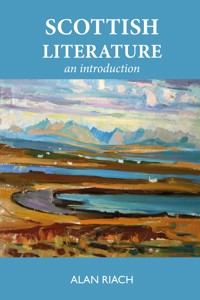
The painting on the front cover of this book depicts a mountainous landscape, sensually presented in vivid colours, with deep seawater and freshwater lochs, long straths of land forming bays and peninsulas around inlets: a natural and ancient world, but with a scattering of houses: a populated landscape, far from cities but occupied by the lives of people, their loves, concerns, and particular dispositions through generations. The painting is ‘The Cuillins, Evening, April 1964’ by John Cunningham (1926–98). The great Gaelic poet Somhairle MacGill-Eain or Sorley MacLean (1911–96) ends his poem ‘The Cuillin’ like this:
Thar lochan fala clan nan daoine,
thar breòiteachd blàir is strì an aonaich,
thar bochdainn, caitheimh, fiabhrais, àmhgair,
thar anacothruim, eucoir, ainneairt, ànraidh
thar truaighe, eu-dòchais, gamhlais, cuilbheirt,
thar ciont is truaillidheachd, gu furachair,
gu treunmhor chithear an Cuilithionn
’s e ’g èirigh air taobh eile duilghe.
Here are the lines in MacLean’s English translation:
Beyond the lochs of the blood of the children of men,
beyond the frailty of plain and the labour of mountain,
beyond poverty, consumption, fever, agony,
beyond hardship, wrong, tyranny, distress,
beyond misery, despair, hatred, treachery,
beyond guilt and defilement: watchful
heroic, the Cuillin is seen
rising on the other side of sorrow.
The poem was written in 1939, at the beginning of the Second World War. MacLean saw the rise of Fascism in Europe and imagined the mountain range of his native place as a geological opposition to human brutality, a permanent symbol of hope. He was born on the island of Raasay, beside Skye, and grew up looking over towards these mountains, climbing them as a young man.
By the 20th century most of Scotland’s population was living in cities – Glasgow, Edinburgh, Aberdeen, Dundee. So we might begin with a recognisable image of Scotland as a place of natural beauty and symbolic authority, but we must deepen our understanding with a sense of the historical complexity of Scotland’s national identity before we can begin to fully encounter the richness of Scottish literature. The geological physicality, the potent imagery, the experience over many generations of both country and city, the religious histories of Catholic and Protestant dominions, the political priorities of communal or profit-based economies, and most recently the doubleness of British imperial and independent Scottish identities, and above all the interpretations made possible by different, but overlapping languages, pre-eminently Gaelic, Scots and English – all these help form the particular kaleidoscope of singularity we call Scotland.
‘Scotland’ is a word that names a particular nation, defined by geographical borders. In the early 21st century, since the union of the crowns of Scotland and England in 1603 and the union of the parliaments of Edinburgh and London in 1707, this nation exists within the political state of the United Kingdom and Northern Ireland, with its global legacy of British imperialism. Scotland might be imagined in two different dimensions: as part of a political state with its imperial political legacy, and as a single nation of separate, multi-faceted cultural distinction, along with other nations in the world. As the American poet Charles Olson puts it in ‘Letter 5’ of The Maximus Poems:
Limits
are what any of us
are inside of
For people who grow up and live within the borders of this nation, certain things may be conferred by languages, geology, terrain, climate and weather, architectural designs, current behavioural habits and a history of cultural production, that might be different from such things elsewhere. The languages in which most Scottish literature is written – Gaelic, Scots and English – confer their own rhythms, sounds, musical dynamics, and the relations between them create their own character in the priorities of expression in speech and writing.
Geography creates another range of characteristics. Growing up speaking in different languages and living in different parts of Scotland, generates different prospects and perspectives. In the Borders, you might look south to England; along the east coast, you might look across to other northern European nations. Things look different again in the archipelagos of the north, Orkney and Shetland, and of the west, the Inner and Outer Hebrides; and different again along the west coast of mainland Scotland, or in the north in Caithness and Sutherland, or in the central fertile farmlands of Perthshire and Kinross, or in the central belt where most people in the country now live, the industrialised, now post-industrial, Glasgow, and Scotland’s capital (or ‘capital-in-waiting’), Edinburgh. All these locations suggest the diversity of perspectives Scotland – and Scottish literature – presents. Each one creates different ways of seeing. And such ways of seeing are not only a birth-right. They may also be learned. But as Hugh MacDiarmid points out:
It requires great love of it deeply to read
The configuration of a land…
Where did this nation begin?
Over half a millennium, from before Columba’s time in the 6th century, through Kenneth MacAlpin in the 9th century and Malcolm Canmore in the 11th century, different groups of people of different languages and cultural preferences got to know more about each other and began to live together in a comity of identity. Before them, there was birdsong. Before that, there was the ice.
Identity is a function of position, and position is a function of power.
This is where we begin.
Preface
THIS BOOK IS mainly concerned with retrieving and renewing, history brought into the present, the dead returned to the living. But above all it is a personal introduction. Its investment has been quite a lot of my life. It rests on a formidable quantity of scholarship, but it’s written with immediate attention to primary texts, and with relatively little reference to secondary critical material. Scottish literature has over long eras been neglected or deliberately obscured, so securing its place in the firmament is a kind of redress, a reclamation. To paraphrase a fictional character of diabolical intent, ‘Revenge is sweet, mine extends over centuries, and time is on my side.’ And all poets, as we know, are of the devil’s party.
In this overview of major periods, themes, authors and works of Scottish literature, I have chosen to emphasise certain authors, works, avenues of approach and aspects of consideration, which seem to me at this point in history to warrant emphasis. I hope the overarching story is accurate enough to the enormous and varied terrain, and I hope that what I say here works in the recognition that the terrain itself is always shifting, never entirely fixed, always open, never completely closed.
Some people, over many generations, have denied the validity of Scottish literature as a worthwhile area of study and attempted to tell the story of literature across the centuries as if there were only one central story to be told. For a long time, Scottish literature has been a neglected subject in our educational institutions. But as the great Scottish artist William Johnstone says in his book Creative Art in Britain (1950): ‘It is idle to blame teachers. My criticism of educational methods is aimed at certain consequences of the prevalent attitude to experience.’ And as Ezra Pound puts it in his ABC of Reading (1934): ‘the value of old work is constantly affected by the value of the new’. There is always a need to reassess work which the current ‘attitude to experience’ – especially as represented in most media every day – is urging us to neglect.
I have not written exclusively for professional scholars and critics but for people who enjoy reading, looking at paintings and sculptures, listening to music, and learning about things. I have included reference details in the body of the book, giving only date of publication for works that are easily identified, and place, publisher and further information as well as dates for specific works whose details are less accessible. Dates for the lives of authors are given where they first appear or where their works are discussed extensively. I have not used notes in the hope that the book might be read fluently, and such information as may be needed is provided in the main text. I think it was A.R. Orage who advised writers for his periodical, The New Age, to read their work out loud before submitting it. If it doesn’t work read aloud, it shouldn’t be printed. Good advice.
Marshall Walker, in his book Scottish Literature since 1707 (1996), confessed a ‘partiality for a view of literary works as incontrovertibly human products’ created ‘by real people with visions to impart according to more or less ascertainable aesthetic devices. Such works come from authors, not merely from other texts, but all texts are related in some way to a Zeitgeist.’ I agree with him.
Angus Calder, in his book Russia Discovered (1976), wrote of the authors of that country words that apply just as well to those of Scotland: ‘These great writers have so much to teach us about the use of time, the search for the full potential of every second, and the obligatory rage against whatever denies that to us. And no other reading, surely, is less a waste of time.’
My book is primarily concerned with such writers and makers of literature whose quality Calder describes but it is also ‘a view of literary works’ as Walker puts it, and therefore one among many acts increasing the possibility and extent of awareness of Scotland’s culture. A.P. Cohen, in an essay which ultimately addresses the relation between human awareness and ecology, ‘Oil and the Cultural Account: Reflections on a Shetland Community’, Scottish Journal of Sociology, 3 (1978), notes as follows: ‘Once one has become conscious of culture, it must be perceived and handled in a different way than previously.’
Here’s hoping.
Alan Riach, Alloway
April 2022
PART ONE
Three Questions
1
Why read Scottish literature?
THE ARTS ARE maps. They show us the terrain of life, contours, cliffs and coasts, they chart our deepest oceans and their rivers run like arteries across arid plains. But maps also tell us that human landscapes are always changing, and they require a special understanding, a training in how best they might be read. In answer to a question about the nature of art, the American novelist and poet Robert Penn Warren once said to a friend of mine, ‘Ah believe it’s just gettin’ yore reality shaped a little better.’ We have to learn how to make reality shapely.
The work of all the arts is to represent and interpret the world.
Represent and interpret.
Representation might suggest approval or even celebration, and interpretation might imply criticism or even satire. Art resists the numbing of the senses. It helps us to live more fully, engaged with the world and critical of it.
The function of all the arts, and especially of literature, is, at the same time, both representation and critique. Mimesis – the representation of reality in art – might give us a recognisable scene. But to articulate that scene in an aesthetic form is also to imply a selection and arrangement of material. And this involves a distancing from lived reality. The painting has its frame and space from the viewer, the pages of print have their book or magazine covers, the page is held at a distance from the understanding of the reader. The reader works to go through it and takes pleasure in that work. Music performed to be listened to addresses the listener in a different way from that performed to be danced to. For any writer or artist, the given world is never to be merely accepted and used, but celebrated and criticised, built upon or demolished. In this lies the fundamental manifesto of all writers and artists.
All art slows you down and quickens you at the same time. You have to take the time to stop and look and see, and listen, and hear, and read, what the world is, if you’re going to change it for the better.
But in an age of crass commercialism, the arts are disadvantaged, partly because the training that is needed to help us comprehend them is so vulnerable. The vanity of rampant managers and the strafing heartlessness of advertising clog up the channels of contemplation. In ‘Criticism, Art, Letters’, collected in The Best of Myles (1968), Flann O’Brien is only mildly exaggerating a popular philistinism when he declares:
There is no excuse for poetry. Poetry gives no adequate return in money, is expensive to print by reason of the waste of space occasioned by its form, and most of it is bad. Nobody is going to manufacture a thousand tons of jam in the expectation that five tons may be eatable.
He has a point, hasn’t he? You can imagine certain ministers of education coming out with this sort of thing without a trace of irony and getting knighthoods for the damage they do to generations.
The arts look after themselves. The creative force that produces them is so essential, so profoundly necessary, that they are as inevitable in human life as the desire for shelter, food and procreation. And sometimes, even when you’re not looking for it, the necessary thing will find you. A long time ago I came across an audio cassette in a drawer in a desk in an office I was using in a university I was visiting, and on it, hand-written, was the name of the American poet William Carlos Williams, and when I played the recording, I heard his voice on the tape say this:
…because the purpose of the artist, whatever it is, is to take the life which he sees, and raise it, raise it up, to an elevated position where it has dignity, just the same as a Navajo Indian puts a mark around a clay water pitcher and makes it distinguished, so the artist’s purpose in life, what he’s for, why he’s been preserved for the ages as he has been, the most, the imperishable thing, the one imperishable thing, that the world never lets die, is the work of art. Cities are wiped out, civilisation is wiped out, Homer persists. England will disappear. Shakespeare will be there. It’s that. The race cherishes that, cherishes the work of the artist. He’s the most important creature in any generation.
The arts – all the arts – are as inseparable from being human as the dance is from the dancer, as W.B. Yeats says in his poem ‘Among School Children’. But as the American critic Guy Davenport points out in his essay, ‘Do You Have a Poem Book on E.E. Cummings?’, in The Geography of the Imagination: Forty Essays (1981), if the purpose of journalism is to inform and disseminate, it isn’t doing its job: ‘Thirty years of liberal twiddling with the lines of communication have made it almost impossible to broadcast anything but received propaganda.’ And so, ‘what’s happening in the minds that keep other minds alive and give them the courage to live is reported, if at all, in a dangerously denatured and official trickle of news.’ When the arts are neglected or obscured, people suffer from ignorance and their lives are made dull.
The purpose of the arts is to help people to live. Yet new technologies change how things may be perceived and understood. They change the context in which we read anything. In the 1960s, Marshall McLuhan saw the way things were going and argued in his book The Gutenburg Galaxy (1962) that the print-based, book-reading culture that had characterised the western world since the 15th century was changing forever. At the start of the 17th century, at the time of the union of the crowns of Scotland and England in 1603, there were around 2,000 books in print. In the early 21st century, there are at least 15 million books available online. The problem we face with the digital archive is not the availability of material but how to select from it profitably, critically, happily: how to find what we need to spend our time on.
So much for generalisations. I would like to close in now on Scottish literature with some personal data that I hope will be relevant.
My parents encouraged my reading when I was a boy, and my grandfather especially encouraged me. I have a particular memory of my grandfather’s gigantic bookcase and what appeared to be hundreds of books, encyclopaedias, guides to world literature, titles like Races of the World, Everyman’s Encyclopaedia, the collected works of Shakespeare, Scott, Burns, Keats, Shelley and Byron. It was so big you could literally almost climb inside it when I was a wee boy. When I was about ten, my father gave me a copy of Huckleberry Finn and the notion of floating downriver on a raft still pleases me; then he gave me a copy of Moby-Dick and I still remember the shock I felt when I read the final chapter, when Ahab goes over the side. It took my breath away.
Great writing has this power. It helps you through all your life, one way or another. All the arts do this, I think, but literature is the greatest of them all because it gives you such a range and depth of experience of lives, languages, places, politics, and histories, other than your own.
Literature is the most liberating of all the things human minds have ever created.
The journalist Ryszard Kapuściński in his book The Other (2008) eloquently describes how every person is twofold: one is a human being like the rest of us, with joys and sorrows, good days and bad, desires and disappointments, the other is a carrier of culture, beliefs, language-systems, particular forms of expression, aspects of identity that differ in place and time. Both these aspects of every single person are always changing, dynamic, mobile, partial, variable. Yet this relation between what human beings have in common and what gives every one of us relations through nationality, history, tribe, family, religion, class and so on, is what gives us our potential. If we fully acknowledge what we have in common, we have secure ground for exploring and enhancing all those things that make us different. Understanding this fact and exploring its full complexity is above all the provenance of literature.
And literature arises from two basic human forms of expression: stories and songs. All else comes from these.
But literalism is always a danger. I remember a particularly egregious member of staff at a university English department meeting who suggested in all seriousness that Heart of Darkness should be taken off the curriculum because Mister Kurtz was not a very good role model for the students.
The proper reply was given, quick, merciful and ruthless: ‘Neither is Lady Macbeth!’
Of course the Macbeths are not role models: they are the embodiments of our human potential at its worst. The arts propose not literal but metaphoric truths. In his autobiography, Theme and Variations translated by James A. Galston, (1947), the conductor Bruno Walter defines this:
History! Can we learn a people’s character through its history, a history formerly made by princes and statesmen with an utter disregard of, frequently even in opposition to, its interests? Is not its nature disclosed rather by its poetry, by its general habits of life, by its landscape, and by its idiom? Are we not able more deeply to penetrate into a nation’s soul through its music, provided that it has actually grown on its soil? Is anyone entitled to speak with authority of the Russians who has not become familiar with Pushkin, Lermontov, Gogol, Dostoyevsky, Tolstoy, and Gorky, and has not listened to the music of Mussorgsky, Borodin, and Tchaikovsky? I have preserved the unshakable conviction that man’s spiritual accomplishments are vastly more important than his political and historical achievements. For the works of the creative spirit last, they are essentially imperishable, while the world-stirring historical activities of even the most eminent men are circumscribed by time. Napoleon is dead – but Beethoven lives.
Or, to paraphrase, Henry Dundas (1742–1811) – the immensely powerful Scottish Tory politician who was known as King Harry the Ninth or the ‘Great Tyrant’ – is decidedly dead, but in a different sense, his contemporary Robert Burns, in his poems and songs, lives on. Or Joseph Stalin (1878–1953) – the tyrannical Communist Party leader after the death of Lenin in 1924 – is dead, but his contemporary the Scottish poet Hugh MacDiarmid, in his works, lives on.
The foregoing is preliminary to the more specific answer to the question, ‘Why read Scottish literature?’ So let’s come to that now.
I was born in Scotland. I left when I was four and went to school and university in England, then returned to live in Scotland from 1979 to 1986, completing a PhD at Glasgow University. I went to New Zealand in 1986. New Zealand was absolutely central in world politics to my view at that time. The country was nuclear-free and the Greenpeace ship the Rainbow Warrior had just been blown up by French spies, with murderous loss of life. Teaching across the range at the university where I worked, the University of Waikato (it is the Maori name for the area and the river that runs through it), I was able to initiate courses in Scottish, Irish and ‘Postcolonial’ literatures and Creative Writing and to teach courses on English and American literatures and convene the big first-year ‘Introduction to Literature’ courses. I was thinking about how best to introduce what really mattered to me to students who might have no prior knowledge about these things to draw from.
I was asking myself, ‘What are the important things about Scottish literature you have to know about, to get a sense of the shape of the terrain, the character of the country, its national history, its music, languages, the major writers?’ And a number of key moments were clearly of massive importance in providing crucial aspects of the country’s myths and its actual history. There is the prehistory of Scotland, stories and songs from the Celtic and early Christian worlds, there were the Wars of Independence, then there was the Reformation, the Union of the Crowns in 1603 and of the Parliaments in 1707, the Enlightenment, Romanticism, the Industrial Revolution, world wars and revolutions, the rise of mass media: how should we approach literature in these contexts? Literature has its own special value but also, of course, it is connected and inter-related to other arts and across historical eras.
The historical depth of Scotland goes back to long before the word Scotland was used. Starting from any contemporary position, what would be the predominantly governing factors in appreciating an identity we could legitimately call ‘Scotland’? And would these factors apply equally well in other countries? What would they be if they were applicable anywhere? Could they yield descriptions of identity specific to particular countries?
I’d like to suggest two: geography and language. By which of course I mean in their pluralities: geographies and languages.
First, how should we begin to acquire a comprehensive understanding of the geographical variety of Scotland?
One example was set by the great American poet Walt Whitman in the 19th century. The essential principle is to start from wherever you are. Whitman begins one poem, ‘Starting from fish-shape Paumanok, where I was born…’ You begin by looking out the window, walking out the door. Whatever is immediately around you is where you begin from. Think of James Joyce and Dubliners, William Faulkner and Yoknapatawpha County, Lewis Grassic Gibbon and the Mearns of Kincardineshire in the north-east of Scotland. And it does not imply sentimental attachment, blind, flag-waving loyalty or any lack of irony. Consider Edward Dorn’s brilliant little poem, ‘Success?’:
Success? I never had to worry about success.
Coming from where I come from,
You were a success the minute you left town.
The Borders are a long way from Shetland, the Hebrides are a long way from Edinburgh, but all the different places of Scotland deliver a sense of complementarity, of plurality, of the relativity of cultural value, which is not the same thing as the sense of a single trajectory, a unified imperial history. This sense of diversity is matched by a sense of profundity, the depths from which our culture arises, the insights it can give us today.
And how should we think of the languages of Scottish literature?
The 18th century saw a flourishing of poetry and song in Gaelic, sometimes drawing from the same sources as James Macpherson, whose poems and stories of Finn and Ossian rise from pre-Christian myths, but they also deal directly with contemporary events, from the Jacobite rising of 1745 to the consequences visited upon the Highlanders after Culloden in 1746, and the Clearances, the enforced depopulation of Scotland, which has continued to this day. Two major poems not directly related to these events but still with astonishing immediacy and vibrant attraction are ‘Praise of Ben Dorain’ by Donnchadh Bàn Mac an t-Saoir / Duncan Ban MacIntyre (1724–1812), which describes a deer hunt across a wooded mountain, and ‘The Birlinn of Clanranald’ by Alasdair mac Mhaighstir Alasdair / Alexander MacDonald (c.1695–c.1770), which describes a sailing ship or birlinn, crossing through a storm on a journey from Scotland to Ireland. Both these major works draw on the Gaelic tradition common to both Scotland and Ireland, but there are also influences and affinities with English-language poems such as James Thomson’s The Seasons (1730) and the Scots-language poems and songs of Robert Burns and others. The name of Robert Burns should never be mentioned without also acknowledging the greatness of his contemporaries writing in Gaelic, and his great predecessors in the Scots language, Allan Ramsay and Robert Fergusson, and the English-language dominated writings of the Enlightenment, which preceded and continued through his lifetime.
Therefore, with a living sense of the diversity of terrain in the geography of Scotland, the Borders, the Highlands and Islands, the cities, the farmlands, the mountains and moors, the rivers and lochs and lochans; and with an acknowledgement of the vitality of living languages – pre-eminently in both our history and currently, Gaelic, Scots and English, but also in the acknowledgement of languages that have arrived and are in use more recently, we can imagine a set of co-ordinate points or magnetic poles or centres of gravity of one kind or another by which it may be possible to navigate our way through the whole theatre of Scottish literature. It’s an impossible voyage, of course. And since literature is one among many arts, each one interrelated, we should begin with the knowledge that the cradle of our understanding holds more potential than could ever be fulfilled.
And yet, isn’t that all the more reason to set it gently rocking, not just into sleep but towards a further awakening?
When I worked in New Zealand, we had a visit from the President of Ireland, Mary Robinson. The line she delivered then has haunted me ever since: ‘The arts are the genius of your country, and education is the key with which you unlock the door.’
Let’s open the door.
2
What is literature?
LANGUAGE, STORIES AND music are the basic components of literature, from the simplest memorised nursery rhyme to the most subtle and sophisticated of written texts. The most complex modern novels still arise from our sense of what makes a good story – bewilderment, discovery, finding out about things, where you are, where love can be found, what forces are working against it. The study of literature is based on the development of sensitivity to language and enhances the enjoyment of stories about people in different places, relationships, situations of difficulty or pleasure. The visual patterns of writing to be seen on a page or parchment and the sounds of speech in the air as they are uttered in voices suggest the two different but overlapping areas of sensual apprehension involved in the appreciation of literature: the visual and the aural. These are portals to reality. The advantage of literature over some other arts or popular media is the detail with which it sensitises such appreciation and the depth of engagement it invites with the difficult areas of human experience. It doesn’t solve problems, but it can help understanding.
The question, ‘What is literature?’ might be answered in a multitude of ways, none of them final or absolute. They would be suggestions, propositions, ideas that might be discussed. Here are seven.
LITERATURE IS A WORD SIGNIFYING ONE MAJOR ACTIVITY OF THE CREATIVE ARTS
Essential to its creation are language and stories. Stories can be told in various media, with or without words, but literature usually tells stories through words. (Sometimes it can be through only letters, or sounds.)
Words can be broken down and reassembled in their constituent parts, in letters (aesthetically precise visual signs, thus connected to drawing and painting) and sound (thus connected to music). Grammar normally implies narrative, as understanding moves along the line of the sentence. However, sentences might be held in the mind simultaneously and rhyme, metre, patterns of various kinds, can imply a kind of simultaneity in the musical coherence of a work of literature. The English poet Edmund Spenser (1552–99) imagined that his long poem The Faerie Queen (1590–96) might be held in the mind in its entirety and visualised like an enormous stained glass window in a cathedral, constructed, not in the assertive image of the poet, but rather for the glory of God. He hoped that what you might see through this vast, wondrous window, would not be him, but God.
In English, the word music is connected to the Greek Muses, quasi-divine figures who gave inspiration of one kind or another. In Scots Gaelic, however, the word for music is ceol and it has nothing to do with the Greek Muses. This word refers to the musical sounds made in piping, originally through bird-bone flutes (bird-bones being hollow). You can hear this when you pronounce it. In literature, poetry and music (ceol) are always connected (except in some examples of experimentalist poetry which deliberately try to reject the component of human tonality in utterance. Some reject the human voice and use computerised sound and non-standard grammatical effects of language. Generally, though, the infusion of music in poetry is clear: in songs and ballads, opera libretti, even in the rhythms and musical movement of verse that has no immediate instrumental accompaniment, and in the longer narrative rhythms of stories and novels, the musical component is always present. The American poet Ezra Pound tells us that poetry withers and dries out the further it is removed from music. This might be self-evident in the essential vocal function in the oral tradition, as well as in plays and theatres, whether performed to the most vulgar public, to the hypersophisticated sensibilities of a courtly audience, or to the rhetorical superclasses of the Kirk (of whatever disposition) but it is also present in the musical structures, rhythms and shapeliness you can feel in short stories and novels.
LITERATURE IS WRITTEN ART IN THREE PRINCIPAL GENRES: POETRY, FICTION, PLAYS
But other forms of writing may be read effectively as literature – the Bible or the Koran, philosophy, letters, diaries, journalism – all writing may be read and considered carefully by a trained literary sensibility, though that doesn’t mean that all writing is literature. Moreover, a literary sensibility brings good critical reading to work in other media precisely because we can train ourselves to appreciate storytelling and the languages of representation sensitively.
The various products of cinema, radio, television and comic books may all be read best by people not only specialised in their own discipline but also familiar with what literature can teach. This is also true of painting, sculpture and music in all its forms. In so far as a literary training shows you clearly how language works, it’s also very good help in seeing how professional politicians, advertisers and journalists manipulate language in their speeches, articles, adverts, reports and manifestos. The modern western world is saturated with the images, languages and sounds of commercialism. All advertising is heartless. It is trying to get something from you. Unlike advertising, literature is about touching. It is there to give you something.
To the degree that literature is the work of the creative imagination, its priority or emphasis of purpose is distinct from philosophy. But the writers of the Scottish Enlightenment – pre-eminently David Hume, James Hutton, Adam Ferguson and Adam Smith – are also masters of literary essay-writing and we should accommodate them within the remit of Scottish literature. Similarly, other forms of writing should be taken into account: essays, diaries, travel writing, ‘life-writing’ or autobiography, and so on. For example, William Lithgow (1582–1645) is one of the very first international world-travellers in his time, going from his native Lanarkshire as far afield as Africa and Constantinople, now Istanbul. A poet and prose writer fired by curiosity and the desire to wander through the world and see as many aspects of it as he could, he is a singular figure in our literary history.
In contemporary terms, there are other contexts for literary production than that of the published book. Scottish literature includes radio drama, television drama, film texts and inter-disciplinary works which bring together literary and other artistic forms. There is a long tradition of song in Scottish literature; not only of traditional ballads and folk songs but of more self-consciously artful song-settings of Scottish poems (the work of Burns and George Thomson, and of MacDiarmid and F.G. Scott, for instance). Further, the classical tradition of orchestral and chamber music has many examples of work inspired by or in dialogue with literary texts, such as Hamish MacCunn’s opera Jeanie Deans, based on Walter Scott’s novel The Heart of Midlothian or William Sweeney’s tone-poem based on Lewis Grassic Gibbon’s Sunset Song. If our primary concern is with poems, plays and prose fiction, we should keep ourselves receptive to all these other forms of literary writing too.
LITERATURE IS WORDS ARRANGED TO MAXIMUM EFFECTIVENESS AS ART
This prompts the question: What is art for?
I have given my answer already. The arts are there to help people to live. The arts are not leisure activities. They are essential. They are the best maps we have of human experience. Our poets and artists are our best guides to the worlds around us. In an era of distraction, the best of them address the things that matter. Technologies change and sciences progress. Discoveries are made, new things are found or formed. But the work of the artist is always current. As William Carlos Williams says in his poem, ‘Asphodel, that Greeny Flower’ (the lines in the original are italicised):
It is difficult
to get the news from poems
yet men die miserably every day
for lack
of what is found there.
In his novel Lanark, Alasdair Gray writes that Glasgow is ‘the sort of industrial city where most people live nowadays but nobody imagines living.’ This is what literature, and indeed all the arts, help us to do: to imagine how our lives might be, how they might be better, deepened, more beautifully curved or patterned, shaped, adventurous, enriched, enjoyed, made gamesome and quickened.
LITERATURE IS A CO-ORDINATION OF THREE INTERSECTING ENERGIES, FOUND IN PERSONALITY, HISTORY AND SUBSTANCE
By personality I mean the writer, who he or she is, individually, linguistically, socially, their mind, disposition, determination, character.
By history I mean the times they live through, actually – a war poet speaks of war, a sea poet goes to sea – or imaginatively: the artist can imagine anything, often more accurately than one whose experience of the same thing is lived and actual. But experience is real and valuable: Ezra Pound once said that Gavin Douglas’s translation of Virgil’s Aeneid was better than the original because Douglas had heard the sound of the sea. The creative imagination has its own history, and some eras offer imaginative insights others might foreclose. It was the inception of the Jacobean era in 1603 that allowed Shakespeare the possibility of writing his greatest tragedies.
By substance I mean the words themselves. They have gravity, weight, energy, history, component parts like syllables, vowels, consonants, letters, connectedness, music and visual import. Words are the actual material of the writer’s art.
LITERATURE IS A FORM OF COMMUNICATION, A NEGOTIATION THAT TELLS TRUTHS
Literature works between history and myth (or philosophy, including religions). It is not tied to documentary evidence about how people lived (the limitations of history), nor to the structures of systems of belief that seem to validate themselves as ideology (the limitations of myth). The Canadian critic Northrop Frye in his book Fables of Identity (1963), tried to argue and insist that all literature is grounded in such mythic structures. He was wrong.
History is a process of engagement with verifiable data and our interpretation of it. Myth arises from commitments of belief. More than in either, literature is always a negotiation of meaning, its language is always active. It can never be merely recording. It can never be merely formulaic. It is alive.
Negotiating, interrogating, finding balance is what literature does. It activates argument in the endlessly moving spaces between history (data, fact, scientifically verifiable information, documentary objectivity, interpretation validated by what can be proven) and myth (or religion, or ideology, or any belief systems, questioned or unquestioned, validated ultimately only by faith). Literature comes to life between these two areas. And by doing so, it brings things, engaging thoughts, curious questions, to life unpredictably. Literature is human existence come to life. It is therefore open, never closed. It is an act, as well as a product of aesthetic sensibility. It is an action, as well as an enactment of formal pleasure. It is an intervention.
The various languages in which Scottish literature has been composed are a major distinctive quality of the subject. Unlike English literature, Scottish literature immediately demands the recognition of the value and validity of different tongues. An important ecclesiastical tradition of writing in Latin includes poems attributed to St Columba (c.520–597) and the Life of Columba by Adomnán (c.624–704) through to the writing of George Buchanan (1506–82) and Arthur Johnstone (c.1579–1641).
The Gaelic tradition includes poems directly engaged with aspects of Scottish Highland history such as the Jacobite risings and the Clearances, and in the poem ‘Praise of Ben Dorain’ there is a distinct understanding of landscape, nature and human presence which is sharply different from contemporary English Romantic ideas of the sublime.
Since at least the 18th-century Enlightenment, Scottish literature has been written extensively in English. Enlightenment philosophers tried to remove the most distinctive Scots aspects of their diction from their writing and in the 19th century a gulf opened up between the authority of English as a language for narrative or storytelling in novels and the vernacular Scots spoken by characters acting in the story – often eccentric, comic or exaggerated characters. However, by the late 20th century, the use of the English language by Scottish writers had developed in distinctively Scots tones. In the poetry of Norman MacCaig, for example, the English is as close to the modulations of the speech of a Scottish voice as in any major English-language Scottish poet of the period.
The Scots vernacular tradition is one of the richest literary resources and most distinctive linguistic forms, both accessible to English-language readers and characteristically distinct from English-language literature. The Scots language in Scottish literature opens a door to one of the great linguistic mediums of European writing. Both Scots and English have common roots but they developed through different local, national and imperial histories and through different literary traditions. Scots is as ancient a language as English and has at least as many spoken varieties across the country. It would be as absurd to call Scots a dialect of English as it would be to call English a dialect of Scots. And since the range of languages spoken and written in Scotland continues to extend beyond those preeminently used over past centuries of literary production, it’s worth emphasising the validity of any language as a potential medium of Scottish literature.
A sensitivity to the fact that Scottish literature has been written in a number of languages establishes the sense that aesthetic and literary understanding is never absolutely singular. It is always engaged in dialogue. In this multi-vocal world, there can be no simple assertion of superior value in any single language, setting out to dominate all others with imperial certainty. There is always more than one way of seeing, more than one way of representing something, more than one way of interpreting it. In any language, communication may be direct, but there is always more than one story to be told. Each language does it differently and reveals different parts of the world. Every single one is only partial. But in a work of literature, it becomes communicable.
LITERATURE IS THE WRITTEN EXPRESSION OF REVOLT AGAINST ALL ACCEPTED THINGS
It is a form of resistance. The act, the expression, of literature, is to resist the vanity of all efforts to bind and contain imaginative life. It is to resist the mechanical excess of systematic meaning. It is to teach that intelligence and sensitivity reside with an irreducible openness, never with the closed.
LITERATURE IS A LONG CONVERSATION, USUALLY WITH THE DEAD; BUT IT IS A LIVING DIALOGUE
It is what happens between the work of art and the reader, just as the creation of the work of art by the artist is the moment of its formation. The pen on the page, the brush on the canvas, all the complex processes between the score of a piece of music and the bow coming down on the catgut, the ears listening to what sounds fill the air at that moment of its beginning. An Australian aboriginal blows pigment from his mouth onto his hand on a rock in the desert and the shape of the hand stays there, surrounded by colour: this is the moment of creation another will read, noting if the tip of a forefinger up to a certain joint is missing, what that might mean, what group that man might belong to. Aesthetics are a social code.
Or put it like this. Literature is a community – it could be a community of people who read books or who respond as they do at a certain time – but it’s not the book that is literature, or the people, it’s what happens between the book and the people, or even a single poem and a single solitary person reading it, that forms a community, a literature, an engagement with each other and possible readings, other readers who might also be imagined. That’s also what literature is: a reason to read, to carry on reading and enjoying the pleasure of that. This involves both play and seriousness, both close, inquisitive reading and liberating opposition to conventions and complacencies. It can help us to imagine and create a better world.
3
Was there ever a ‘British’ literature?
THIS BOOK IS concerned mainly with Scottish literature, but as we have seen, that national identity has been formed, been independent, been part of a British state and imperial expansion in different parts of the world, and continues to reinvent and reconstitute itself.
Reading Scottish literature takes you back before the British state or the United Kingdom, and it indicates ways forward beyond that.
In many other parts of the world, a convenient way of approaching the literatures of the different nations of the United Kingdom is to describe them as constituting a ‘British Literature’ – although this is no guarantee of homogeneity. More often, the word ‘British’ simply means ‘English’. What does our reading of Scottish literature contribute to an answer to the question, ‘Was there ever a “British” literature?’ In his poem, ‘The Difference’ Hugh MacDiarmid was characteristically forthright:
I am a Scotsman and proud of it.
Never call me British. I’ll tell you why.
It’s too near brutish, having only
The difference between U and I.
Scant difference, you think? Yet
Hell-deep and Heavenhigh!
T.S. Eliot, in a famous review in the periodical Athenaeum of 1919, asked ‘Was there a Scottish Literature?’ and concluded that there had been once but there was no longer. This was part of a strategic politico-literary move to oust Matthew Arnold from his central place as arbiter of taste in English letters and instate Eliot himself as critic-magus. His individual talent would realign ‘Tradition’ and coalesce American and English literature in English-language writing. Scottish literature had been a valid contributor along the way but had no contemporary currency, according to Eliot. For him, Burns was the last example of a decadent tradition.
Eliot, more English than the English, came from Missouri to High Anglican London. He followed a different path from Ezra Pound, who also abandoned America for London, but then abandoned London for European high culture and abandoned the botched civilisations of the west for the Classics of ancient China. In retrospect, Pound’s ever-expanding intellectual career looks more like one of cultural inclusiveness and accommodation, rather than anything narrowing, even if the last Cantos are desperately moving in their lyrical self-portrait of loneliness and exhaustion. But compare Eliot and William Carlos Williams. In his autobiography, Williams said that Eliot’s betrothal to Anglocentric letters and academic élitism in The Waste Land stopped him in his tracks, set him back 20 years, as it seemed to be opposed to the ‘primary impetus, the elementary principle of all art, in the local conditions.’ Eliot’s poem was ‘the great catastrophe’ – not too strong a term for Williams, a poet who had to rediscover and redescribe ‘the American grain’ – a distinctive tradition in American literature, a vernacular voice local to that place, ‘rooted in the locality which should give it fruit.’ When Eliot disparaged the contemporary viability of Scottish literature, he was only echoing what had been said a hundred years before him about American literature itself: Was there any? Robert Creeley told me that the poet George Barker once asked Williams the same question. Williams in America, like Hugh MacDiarmid in Scotland, was trying to make a poetry that would be nourished by its own geography, its own history. Eliot, supreme craftsman and pervasive influence, seemed intent to abandon that commitment and priority.
In this light, consider the violent argument between Edwin Muir and Hugh MacDiarmid in 1936. Lewis Grassic Gibbon and MacDiarmid were commissioning editors of a series of books about contentious issues in Scotland and Edwin Muir was invited to write about Walter Scott and Scotland but he turned in a book which effectively attacked the achievement of writers who had written in the Scots language. What he said was that the great Irish writers – pre-eminently Joyce and Yeats – had won international acclaim and achieved great literary worth through writing in English and this was the way forward for Scottish writers too. More than that. He said it was the only way forward for Scottish writers. He wrote: ‘Scotland can only create a national literature by writing in English.’
Muir asserted that the chief requirement for a national literature was a homogeneous national language and that Scots was no use for that. Only English would do. In this Muir was merely echoing Eliot, who in the 1919 Athenaeum essay had written: ‘The basis for one literature is one language.’ By which, he meant his own brand of the English language. There was no place for Scots in this dispensation. When Muir declared that Scottish literature could only go forward in English, MacDiarmid was enraged. MacDiarmid’s whole point was that there are different languages in Scotland, different voices – not only English but also Gaelic as well as Scots, voices of women as well as of men, and they all needed to find articulation in literature. He responded to Muir by editing The Golden Treasury of Scottish Poetry (1940), which includes poems translated not only from Gaelic but also from Latin, as well as poems in Scots and English – and nothing by Muir.
But Muir had a point too. The Irish writers do have an international cachet – a readership, especially in English and American universities – which is usually denied the Scots writers. And this is at least partly because the language allows them to be accommodated more quickly.
But is that a good enough answer?
‘All dreams of imperialism must be exorcised,’ MacDiarmid wrote once. ‘… Including linguistic imperialism, which sums up all the rest.’
The long hand of the law continues to finger your collar.
In Michael Alexander’s A History of English Literature (2000), we read: ‘Now that English is a world language, this history needs to be supplemented by accounts of other literatures in English…’ So far, so open-minded. However (next paragraph), ‘This volume is not a survey of present-day writing in English, but a history of English literature.’ The national identity has very quickly become coterminous with the national language. Next sentence: ‘The author, an Englishman resident in Scotland for over 30 years, is aware that a well-meant English embrace can seem imperial even within a devolving Britain.’
Good intentions are not enough. The consequences of this approach lead to Robert Louis Stevenson being listed in the book under ‘Minor fiction’: we are told that he was ‘once famous’ but ‘his work faded’. Dr Jekyll and Mr Hyde ‘makes a bonny film’ says Professor Alexander, but ‘has dated’ and ‘disappoints adult re-reading’. The word ‘bonny’ there is perhaps intended as affectionate but it carries a strong whiff of condescension delivered from a superior height of judgement. It may be well-meaning but it feels imperious. Alexander does not concur with the opinion of the great novelist Henry James: Jekyll and Hyde, said James, is ‘the most serious’ tale, ‘endlessly interesting, and rich in all sorts of provocation, and Mr Stevenson is to be congratulated on having touched the core of it.’ And how does Hugh MacDiarmid fare in this History of English Literature? Professor Alexander tells us that MacDiarmid ‘would not want house-room in a Sassenach literary history’ – and ostensibly honouring MacDiarmid’s putative wishes, Professor Alexander gives him none. Readers are introduced to Seamus Heaney and Derek Walcott but are told next to nothing about MacDiarmid.
Incidentally, the American scholar Nancy Gish has an excellent essay on Stevenson in the online International Journal of Scottish Literature (no.2), which rightly sees Jekyll and Hyde as prophetic of Modernism and 20th-century concerns as much as Conrad’s Heart of Darkness and Wilde’s Dorian Grey. But Alexander’s relegation of the Scots takes its part in a long tradition that goes back at least as far as Samuel Johnson responding to James Boswell’s suggestion that he could teach the good Doctor the Scots language so that he could enjoy Allan Ramsay’s play The Gentle Shepherd




