


17,99 €
Mehr erfahren.
- Herausgeber: John Wiley & Sons
- Kategorie: Geisteswissenschaft
- Serie: Dimensions of Security
- Sprache: Englisch
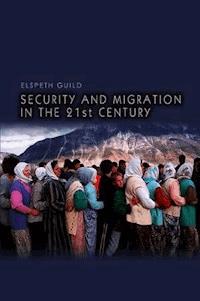
The 21st century has brought new and challenging dimensions to our understanding of security and migration. The old Cold War framework of security as related to war and peace, international relations and foreign affairs has given way to a multiplicity of competing notions, including internal security, human security and even social security. At the same time, migration has become a hotly contested issue, characterised by an enormous difference of views and objectives.
So what do we mean by security and migration in the contemporary world? How do these two important fields intersect? And what does this collision of policy concerns and public interests mean for states and individuals alike? In this cutting-edge book, Elspeth Guild seeks to answer these pressing questions, drawing on a wide range of recent examples from the impact of asylum seekers on state border security to identity security in citizenship rules to illustrate her arguments. By approaching the topic from the perspective of the individual – citizen of one state, migrant in another – the book examines key aspects of the security-migration nexus, such as the relationship with refugees; torture; extraordinary rendition; privacy and the retention of personal data; and human rights' protection.
The first volume in Polity's new 'Dimensions of Security' series, this book is a must-read for all students of international politics, development studies and related fields.
Sie lesen das E-Book in den Legimi-Apps auf:
Seitenzahl: 478
Veröffentlichungsjahr: 2013
Ähnliche




















Security and Migration in the 21st Century
Security and Migration in the 21st Century
ELSPETH GUILD
polity
Copyright © Elspeth Guild 2009
The right of Elspeth Guild to be identified as Author of this Work has been asserted in accordance with the UK Copyright, Designs and Patents Act 1988.
First published in 2009 by Polity Press
Polity Press
65 Bridge Street
Cambridge CB2 1UR, UK
Polity Press
350 Main Street
Malden, MA 02148, USA
All rights reserved. Except for the quotation of short passages for the purpose of criticism and review, no part of this publication may be reproduced, stored in a retrieval system, or transmitted, in any form or by any means, electronic, mechanical, photocopying, recording or otherwise, without the prior permission of the publisher.
ISBN-13: 978-0-7456-5877-3
A catalogue record for this book is available from the British Library.
Typeset in 11.25/13 pt Dante
by Servis Filmsetting Ltd, Stockport, Cheshire
Printed and bound by MPG Books Group, UK
The publisher has used its best endeavours to ensure that the URLs for external websites referred to in this book are correct and active at the time of going to press. However, the publisher has no responsibility for the websites and can make no guarantee that a site will remain live or that the content is or will remain appropriate.
Every effort has been made to trace all copyright holders, but if any have been inadvertently overlooked the publishers will be pleased to include any necessary credits in any subsequent reprint or edition.
For further information on Polity, visit our website: www.politybooks.com
Contents
Acknowledgements
1
Understanding security and migration in the twenty-first century
2
Migration, citizenship and the state
3
Migration, expulsion and the state
4
Armed conflict, flight and refugees
5
Migration, torture and the complicit state
6
Migration and data: documenting the non-national
7
Economy and migration
8
Foreigners, trafficking and globalization
9
Sovereignty, security and borders
Notes
Bibliography
Index
Acknowledgements
As the relationship between migration and security became increasingly complex in the new millennium, so the need for a fresh look at how the two concepts intersect appealed to me. When Louise Knight, Senior Commissioning Editor at Polity Press, invited me to write this book, the offer was irresistible. I would like to thank Louise and her colleagues at Polity for their unflagging support and encouragement. I appreciated this enormously. I must also thank the European Commission, Directorate General Research, for the generous financial support which it provided in the form of a Framework VI project, ‘CHALLENGE’, which permitted me the time to research this book and think through its consequences.
Many chapters have benefited substantially from the feedback I have had following their presentation at various conferences and seminars, most importantly from CHALLENGE partners at the twenty-two universities and institutes which have participated in the project over the past five years. In addition, I would like to thank Lund University, the London School of Economics and Kings College London for providing me with key opportunities to present my work beyond the scope of the CHALLENGE project, and to receive valuable in-put on it.
I would like to thank Professor Didier Bigo for his tremendous generosity, reading and commenting on many chapters, and Professor Kees Groenendijk for his wise advice on many aspects of my research. My intellectual debt to the two of them is very deep indeed. I must also thank most sincerely Professor R. J. B. Walker for illuminating so many aspects of political philosophy for me and encouraging me to complete the project. There are too many others to name, whose help and constructive criticism has assisted me greatly throughout the project.
1
Understanding security and migration in the twenty-first century
What is security? What is migration? Both these questions open hundreds of doors into many different disciplines, theories, practices and landscapes. Security as a term can be found in so many different settings and with so many different meanings that a flourishing academic discipline, security studies, has developed, within which the search for definitions is essentially contested. Anyone trying to get a mortgage will be focusing on a very different idea of security from the ones I will examine in this book. Similarly, the concept of migration can be found in multiple environments which point in completely different directions. For instance, Jacques Perrin’s 2002 film, Le peuple migrateur, translated into English as Winged Migration, achieved an Oscar award nomination in the Best Documentary category but does not include any humans. It is about birds.
Human migration has given rise to an academic discipline – migration studies. Like security studies, it comes within the wider framework of international relations. The focus is on the state as the key actor regarding migration, which is a cross-border activity carried out by individuals. The state may be the state of nationality or origin of migrants or that of their destination. The emphasis in the discipline is on the state and the acts of the state around flows of people.
Both migration studies and security studies as subcategories of political science and international relations tend to reach out towards other fields – human geography, law, history, anthropology, etc. But both remain nested in international relations. It is not surprising, then, that the work of academics in security and migration studies can be classified fairly satisfactorily using the main schools of thought of international relations and political science (Williams 2008). Like security studies, migration studies has some difficulty in determining the scope of its object. Bigo has shown that security studies depends on the enlargement of the insecurity envelope (Bigo 2006). Like blowing up a balloon, the greater the insecurity concerns presented by political actors, the bigger the security issues, and hence the remit of security studies, become. Migration studies has a similar tendency – the bigger the migration flows, the wider the scope for migration studies. As migration flows diminish in some areas (for instance, the forced migration flows to Europe in the beginning of the 2000s), the development of other fields such as security studies provides new points of reference both for political actors (concerns about refugees and terrorism) and for academics (Baldaccini & Guild 2007). In effect, what happens is that foreigners, described in various different ways (migrant, refugee, etc.), become caught in a continuum of insecurity (Bigo 2002). As the foreigner becomes compressed into state-determined categories, those categories are normatively defined, including by reference to insecurity. Political actors may focus on the ‘problem’ and ‘burden’ of asylum seekers one year, then the same or other political actors may rail against economic migrants as the source of insecurity the next. Many insecurity discourses are promoted at any given time – the capacity of one set of political actors successfully to impose their view of the most important one(s) depends on a wide variety of other factors. However, the ease with which the category of the foreigner may be added to an insecurity discourse, with the effect of heightening the perceived seriousness of the threat, remains constant.
In this book I will analyse the intersection of the two fields from the perspective of international political sociology – examining the individual and his or her movement; how the state frames and categorizes him or her as an individual and a migrant, citizen or indeterminate; and how that intersects with the construction of the individual1 as a security threat. This immediately provokes resistance; the state is not omnipotent. There is a clear correlation between the state-centric approach in migration studies and with that of mainstream security studies. Security studies tend to be dominated by a statist approach heavily influenced by realists, neo-realists and liberals (and neo-liberals). The term ‘critical security studies’ was coined to encompass a move away from these traditions and to examine again the meaning of the political in the definition of security and its study (Krause & Williams 2003). Central to critical security studies is a challenge to the doxa or belief that the academic experts know what the subject of the discipline is, that is to say what security is. Similarly, in this book I will challenge the supposition on which migration studies is based: that we know what migration is and which actors are entitled to determine the political in respect of migration. While critical migration studies has, as yet, not emerged as a separate approach, nonetheless this is the category which this book promotes. Building on critical security studies, I will examine both the subject matter of security (whose security, who is entitled to determine the politics of security) and that of migration (whose migration, who is entitled to determine the politics of migration). The insecurity continuum can be ruptured by the individual challenging his or her categorization: as a foreigner (for instance, I will examine the case of David Hicks in ), or by moving from the category of ‘terrorist’ to that of refugee (I will consider these cases in ). Similarly, it can be ruptured by a political decision no longer to treat a category of foreigners as foreign – for instance in the European Union (EU), nationals of one Member State who work and reside in another (I will consider this category in ).
Lesen Sie weiter in der vollständigen Ausgabe!
Lesen Sie weiter in der vollständigen Ausgabe!
Lesen Sie weiter in der vollständigen Ausgabe!
Lesen Sie weiter in der vollständigen Ausgabe!
Lesen Sie weiter in der vollständigen Ausgabe!
Lesen Sie weiter in der vollständigen Ausgabe!
Lesen Sie weiter in der vollständigen Ausgabe!
Lesen Sie weiter in der vollständigen Ausgabe!
Lesen Sie weiter in der vollständigen Ausgabe!
Lesen Sie weiter in der vollständigen Ausgabe!
Lesen Sie weiter in der vollständigen Ausgabe!




