


28,99 €
Mehr erfahren.
- Herausgeber: John Wiley & Sons
- Kategorie: Geisteswissenschaft
- Sprache: Englisch
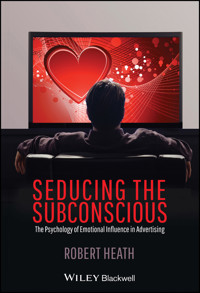
Our relationship with ads: it's complicated A must-read for anyone intrigued by the role and influence of the ad world, Seducing the Subconscious explores the complexities of our relationship to advertising. Robert Heath uses approaches from experimental psychology and cognitive neuroscience to outline his theory of the subconscious influence of advertising in its audience's lives. In addition to looking at ads' influence on consumers, Heath also addresses how advertising is evolving, noting especially the ethical implications of its development. Supported by current research, Seducing the Subconscious shows us just how strange and complicated our relationship is with the ads we see every day.
Sie lesen das E-Book in den Legimi-Apps auf:
Seitenzahl: 434
Veröffentlichungsjahr: 2012
Ähnliche




















Contents
Cover
Title Page
Copyright
Dedication
Foreword
Introduction
Love or Hate?
The Curious Case of O2
Part One: Taking Advertising Apart
Part Two: The Psychology of Communication
Part Three: Emotion and Consciousness
Part Four: Decisions and Relationships
Part Five: A Fresh Look at Advertising
Part 1: Taking Advertising Apart
Chapter 1: The Persuasion Model
Renault Clio Case Study
Chapter 2: Alternative Ideas
Walter Dill Scott
Herbert Krugman
Andrew Ehrenberg
Telma Noodles Case Study
Chapter 3: Why We Don't Pay Attention to Advertising
The Elaboration Likelihood Model
The Tyranny of Choice
Orange Case Study
Taking Advertising Apart: Summary
Part 2: The Psychology of Communication
Chapter 4: Learning and Attention
Attention
Level of Attention
Learning from Communication
Implicit Learning
Chapter 5: The Role of Memory
Working Memory
Long-Term Memory Systems
Implicit Memory
How Does Implicit Memory Work?
Conceptual Memory
Chapter 6: How We Process Communication
Perception
Conceptualization
Analysis
An Improved Theory of Communication Processing
Mere Exposure
Peripheral Exposure
The Power of Peripheral Exposure
Chapter 7: Problems with Getting Attention
Counter-Argument
Perceptual Filtering
Citroën Xsara Case Study
British Airways Case Study
Psychology of Communication: Summary
Part 3: Emotion and Consciousness
Chapter 8: Emotional Processing
Emotion and Feelings
How is Emotion Caused?
Why Have Feelings?
Emotional Conditioning
Andrex Case Study
Chapter 9: Our Adaptive Subconscious
Defining Conscious Thinking
Multiple Drafts Theory
The Grey Walter Precognitive Carousel
Hamlet Cigars Case Study
Chapter 10: Emotion and Attention
Arousal and Attention
Flaws in Attention Research
Measuring How Emotive Content Influences Attention
Levi's Odyssey Case Study
Emotion and Consciousness: Summary
Part 4: Decisions and Relationships
Chapter 11: Decision-Making
The Tale of Phineas Gage (Damasio 1994: 3)
Somatic Markers
Damasio's Model of Decision-Making
Audi Case Study
Chapter 12: The Power of Metacommunication
Emotional Communication and Brand Relationships
Testing Watzlawick's Theory
Cadbury's Gorilla Advertising Case Study
Chapter 13: The Subconscious Seduction Model
New Technology
The New Social Environment
The Tyranny of Choice
Intuition
“Along comes an ad …”
Subconscious Associative Conditioning
Michelin Baby Campaign Case Study
Subconscious Relationship Manipulation
Dove Self-Esteem Fund Case Study
The Subconscious Seduction Model
Decision and Relationship: Summary
Part 5: Taking a Fresh Look at Advertising
Chapter 14: Under the Radar
How Easily We Are Influenced
The Hofmeister Bear Case Study
Budweiser “Whassup?” Case Study
Chapter 15: The Hidden Power of New Media
John West Salmon Case Study
Banner Advertising
How We Read
Product Placement
Coca Cola Case Study
Chapter 16: Legal, Decent, Honest, and Truthful
The Marlboro Cowboy Case Study
Marlboro Grand Prix Sponsorship Case Study
McDonald's Case Study
Chapter 17: How to Spot Subconscious Seduction
Volkswagen Case Study
Tesco Supermarkets Case Study
Stella Artois Case Study
Nike Case Study
Conclusion
How Emotive Communication Influences us Subconsciously
A Case Study Retrospective
A Force for Evil or Good?
And Finally …
References
Index
This edition first published 2012 © 2012 Robert Heath
Wiley-Blackwell is an imprint of John Wiley & Sons, formed by the merger of Wiley's global Scientific, Technical and Medical business with Blackwell Publishing.
Registered Office: John Wiley & Sons Ltd, The Atrium, Southern Gate, Chichester, West Sussex, PO19 8SQ, UK
Editorial Offices: 350 Main Street, Malden, MA 02148-5020, USA 9600 Garsington Road, Oxford, OX4 2DQ, UK The Atrium, Southern Gate, Chichester, West Sussex, PO19 8SQ, UK
For details of our global editorial offices, for customer services, and for information about how to apply for permission to reuse the copyright material in this book please see our website at www.wiley.com/wiley-blackwell.
The right of Robert Heath to be identified as the author of this work has been asserted in accordance with the UK Copyright, Designs and Patents Act 1988.
All rights reserved. No part of this publication may be reproduced, stored in a retrieval system, or transmitted, in any form or by any means, electronic, mechanical, photocopying, recording or otherwise, except as permitted by the UK Copyright, Designs and Patents Act 1988, without the prior permission of the publisher.
Wiley also publishes its books in a variety of electronic formats. Some content that appears in print may not be available in electronic books.
Designations used by companies to distinguish their products are often claimed as trademarks. All brand names and product names used in this book are trade names, service marks, trademarks or registered trademarks of their respective owners. The publisher is not associated with any product or vendor mentioned in this book. This publication is designed to provide accurate and authoritative information in regard to the subject matter covered. It is sold on the understanding that the publisher is not engaged in rendering professional services. If professional advice or other expert assistance is required, the services of a competent professional should be sought.
Library of Congress Cataloging-in-Publication Data
Heath, Robert, 1947– Seducing the subconscious : the psychology of emotional influence in advertising / Robert Heath. p. cm. Summary: “Seducing the Subconscious reveals how this brave new advertising world works, using illustrative examples of advertising campaigns that have been hugely successful without anyone quite being able to recall what they were trying to communicate” – Provided by publisher. Includes bibliographical references and index. ISBN 978-0-470-97488-9 (hardback) 1. Advertising–Psychological aspects. I. Title. HF5822.H37 2012 659.101′9–dc23 2011043014
A catalogue record for this book is available from the British Library.
Wiley also publishes its books in a variety of electronic formats. Some content that appears in print may not be available in electronic books.
For Pippa
Foreword
“Advertising may be described as the science of arresting the human intelligence long enough to get money from it.”
Stephen Butler LeacockCrown's Book of Political Quotations (1982)
When people are asked about advertising, they often find it quite difficult to remember any. If pressed, they usually come up with famous old campaigns like “I'd like to buy the world a Coke… ,” or American Express “Don't leave home without it,” or The Marlboro Cowboy, or the Jolly Green Giant. In the UK they might mention the Cadbury's Smash Martians, the Guinness Surfer, Heineken “Refreshes the parts other beers cannot reach,” or the Gold Blend couple.
There then usually follows a discussion about how much advertising influences us. Most of us like to think that it doesn't influence us unless we are stupid enough to let it. We believe this because we assume advertising works by persuasion, and persuasion is associated with others (typically our parents) trying to argue us into doing something we don't want to do. Persuasion is a rational verbal process, so if we don't hear or remember what an advertisement says, how can we be persuaded by it?
Many experts agree that advertising isn't nearly as persuasive as it claims it is. In the opening paragraph of his book Advertising: The Uneasy Persuasion, Michael Shudson writes:
Advertising is much less powerful than advertisers and critics of advertising claim, and advertising agencies are stabbing in the dark much more than they are practicing precision microsurgery on the public consciousness. (Shudson 1984: xiii)
I agree with Shudson. Having worked in nine different advertising agencies over a period of 23 years, I can testify to just how much chance, serendipity, and stabbing in the dark is involved in the creation of great advertising campaigns. Admen may like to masquerade as experts in persuasion, but in many ways they are little more than gifted amateurs. I'd say the average young person on a date is many times more adroit in the art of persuasion than the average creative team.
But if advertising isn't very good at persuading us, how come those companies that use advertising are amongst the most successful in the world? I think the explanation is that advertising has ways of influencing us we are not aware of, and that don’t involve persuasion. In this matter Shudson and I are also in agreement, for while he asserts that ads are not very persuasive, he also acknowledges that:
This does not mean ads are ineffective. In fact … television ads may be more powerful precisely because people pay them so little heed that they do not call critical defences into play. (Shudson 1984: 4)
Shudson's source for this idea was the psychologist, Herb Krugman. Krugman's theories caused something of a stir in the 1970s, mainly because they suggested that TV advertising received low levels of attention. This was seen by the ad industry as being too difficult a pill to swallow, and Krugman's ideas were pretty much ignored until the start of the twenty-first century, when I wrote a monograph called The Hidden Power of Advertising (Heath 2001).
The Hidden Power of Advertising was based on Krugman's idea that TV advertising could influence us even when processed inattentively. Since its publication in 2001 there has been a steady growth in the number of people who accept that advertising subjected to “low attention processing” can be effective. That said, many of those who work in the ad industry still cling to the notion that advertising works only through persuasion, and works best at high attention.
Although my monograph referred extensively to psychology, it was not seen by academia as being rigorous enough. In order to overcome this hurdle I elected to become an academic myself. I studied for and was awarded a PhD, and I read and wrote articles in academic journals. But the more I researched the subject, the more it struck me that this “other” way in which advertising works, this alternative to persuasion, was quite possibly much more influential than persuasion. Many people have expressed worries about how advertising might be influencing us without our knowledge, might somehow be “manipulating” our behavior subconsciously; and now I was finding that their worries were not entirely without foundation.
This alternative way in which advertising works is what I call Subconscious Seduction. I should stress this has nothing to do with the subliminal effects mentioned in Vance Packard's famous book The Hidden Persuaders. Packard's claims about messages exposed below the threshold of perception were based on a hoax, and there is no evidence at all that advertising can influence us in this way. No, perhaps even more worrying is that advertising's ability to seduce our subconscious uses elements that are in our full view and easy for us to discern. The problem is that although we are able to perceive and attend to these elements, we mostly choose not to.
So advertising's ability to work in this way isn't like subliminal exposure, something we can legislate against or put a stop to. It happens partly because of the way our minds work, and partly because of the way we make decisions. This means that explaining the Subconscious Seduction model isn't a simple story: it involves collecting together and considering complex ideas about how we perceive and think and feel and remember and forget. These ideas have been brought into the public domain only in the last two decades, by academics such as Antonio Damasio, Daniel Dennett, Daniel Schacter, Joseph LeDoux, and Steven Rose. Although these ideas are complex, I have done my best to describe them in language that anyone can understand. I have sought to avoid the situation summed up so eloquently by my great friend the late Andrew Ehrenberg, who once told me: “There is nothing in the world so complex that it cannot, when considered by a group of clever people, be made more complex.”
There are many people who I must thank for helping me write this book. Most especially I would like to thank Paul Feldwick and Jon Howard, whose insights first inspired my research. Also, in no particular order, Tim Ambler, David Brandt, Jeremy Bullmore, Wendy Gordon, Arthur Kover, Agnes Nairn, Douglas West, and the dozens of others who have indirectly contributed to this book. Above all I should like to express my gratitude and love to my wife, friend, and subeditor Frances Liardet, without whose support my career as a writer might never have come to pass.
Introduction
“I think that I shall never seeAn ad so lovely as a tree.But if a tree you have to sell,It takes an ad to do that well.”
Jef I. RichardsRetort to Ogden Nash (1995)11
Advertising is a huge business, and a huge success story. You only have to look at the turnover of those companies who use advertising intensively (Procter & Gamble, Walmart, Unilever, Kraft, Nestlé, Johnson & Johnson, Reckitt Benckiser, etc.) to know that investing in advertising pays off in spades.
But trying to get under the surface and explain why advertising is so effective is surprisingly difficult. One reason is that the companies who use advertising to sell their goods don't have the least motive for letting others know how effective it is. Of course, the ad agencies have a motive for publicizing their success, because advertising is their advertising, so to speak. But they are bound to confidentiality by the people for whom they create the ads, the marketers who pay them, and those marketers much prefer success or failure to remain a well-kept secret. One reason for this is that if their competitors find out which ads work and which don’t, then all those competitors need to do is imitate the ads that are successful.
Competitive paranoia is especially rife in the USA, where more money is spent on advertising than anywhere else in the world. Ask a US ad agency how much their client has spent on a campaign, or how much it has earned them in extra revenue, and you'll find the door politely shut in your face. And if you do manage to find someone who can give you this information, you're more likely to get an injunction than permission to publish it.
There are a few exceptions. The ARF (Advertising Research Foundation) David Ogilvy Awards annually publish a series of case studies which occasionally give you an indication of how successful an advertising campaign has been. But the data are mostly very generalized. They'll tell you how much more awareness was created, or how many people liked the advertising. They might even mention how much sales have increased over a certain period, or how much their share of the market has grown. But there will rarely be anything specific about what the ad campaign actually achieved.
Lesen Sie weiter in der vollständigen Ausgabe!
Lesen Sie weiter in der vollständigen Ausgabe!
Lesen Sie weiter in der vollständigen Ausgabe!
Lesen Sie weiter in der vollständigen Ausgabe!
Lesen Sie weiter in der vollständigen Ausgabe!
Lesen Sie weiter in der vollständigen Ausgabe!
Lesen Sie weiter in der vollständigen Ausgabe!
Lesen Sie weiter in der vollständigen Ausgabe!
Lesen Sie weiter in der vollständigen Ausgabe!
Lesen Sie weiter in der vollständigen Ausgabe!
Lesen Sie weiter in der vollständigen Ausgabe!
Lesen Sie weiter in der vollständigen Ausgabe!
Lesen Sie weiter in der vollständigen Ausgabe!
Lesen Sie weiter in der vollständigen Ausgabe!
Lesen Sie weiter in der vollständigen Ausgabe!
Lesen Sie weiter in der vollständigen Ausgabe!
Lesen Sie weiter in der vollständigen Ausgabe!
Lesen Sie weiter in der vollständigen Ausgabe!
Lesen Sie weiter in der vollständigen Ausgabe!
Lesen Sie weiter in der vollständigen Ausgabe!
Lesen Sie weiter in der vollständigen Ausgabe!
Lesen Sie weiter in der vollständigen Ausgabe!
Lesen Sie weiter in der vollständigen Ausgabe!
Lesen Sie weiter in der vollständigen Ausgabe!
Lesen Sie weiter in der vollständigen Ausgabe!




