


18,99 €
Mehr erfahren.
- Herausgeber: ibidem
- Kategorie: Geisteswissenschaft
- Serie: The Best of Scholars and Scholarship in the Humanities
- Sprache: Englisch
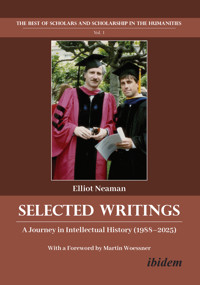
Elliot Neaman studied history and philosophy in Vancouver, Canada, Zürich, and Berlin before completing a doctorate in Modern European Intellectual History under the supervision of internationally known historian Martin Jay at Berkeley in 1993. The works contained in this volume of his selected writings are drawn from publications from 1988 to the present. They provide the reader with access to his multi-decade writings on Ernst Jünger, the German Student Movement of the 1960s, as well as other works on modern European thinkers such as Martin Heidegger and Carl Schmitt. This collection also features previously unpublished writings, including a concise volume of aphorisms and reflections reminiscent of Rochefoucauld and Schopenhauer. Additionally, it includes a foreword by Neaman’s former student Martin Woessner as well as an insightful interview he conducted with the author.
Das E-Book können Sie in Legimi-Apps oder einer beliebigen App lesen, die das folgende Format unterstützen:
Seitenzahl: 528
Veröffentlichungsjahr: 2026
Ähnliche




















ibidem Press, Hannover - Stuttgart
For Nina, who saw from far away what I could not see up close
Table of Contents
Acknowledgments
Introduction
Foreword
Part One: Collective Memory and Geopolitics
I. Politics of Life and Death: Globalism’s Conceptual Roots in German Military Strategy
II. Towards a Critical Hermeneutics of the Enemy: A Whigless Reflection on Collective Memory
Part Two: World and Ideas of Ernst Jünger
I. Unfinished Business: Ernst Jünger’s Legacy
II. Intimité: Ernst Jünger’s French Connections
III. Hiding in Plain Sight: Ernst Jünger’s Own Inner Emigration
IV. A Crononaut in Swabia: Ernst Jünger and Postwar German Conservatism
V. L’Ernst Jünger in the Sky with Diamonds: A Visit to Godenholm
VI. Mutiny on Board Modernity: Heidegger, Sorel and Soft Fascism
Part Three: Leftwing Radicalism in Postwar Germany
I. Ideas of and About 1968
II. West German Generations and the Gewaltfrage: The Conflict of the Sixty-Eighters and the Forty-Fivers
Part Four: The Book Matters
I. Avihu Zakai: The Pen Confronts the Sword: Exiled German Scholars Confront Nazism Albany: State University of New York, 2018
II. Johannes Fritsche: Historical Destiny and National Socialism in Heidegger’s Being and Time
III. Ben Mercer: Student Revolt in 1968: France, Italy, and West Germany Cambridge UP, 301 pp.
Part Five: Interview with Martin Woessner
Acknowledgments
I aim to keep my expression of gratitude short and sweet. I have been unwittingly lucky to have met and kept so many friends in my life. I must have done something right, and lucky to have received their trust and affection, deserved or not. To list them all here would run the risk of offending someone who I never should have left out. I wrote an exhaustive list in the acknowledgements section of my last book, Free Radicals. Things have not changed much, so I am grateful to you all, and will remain so to my last breath. I thank my family, my mother Leah, my sister Evelyn, my brother Noah, and my beautiful and wise daughter, Rebba Estie Spike-Neaman. I would like to express deep gratitude for this book to Columbia University Press and the ibidem Verlag in Germany, in particular the chief editor Christian Schön, as well as Karim Mamdani and the man who came up with the idea of this book in the first place, my new close friend Matthew Feldman. I thank my mentor and friend Martin Jay, for many years of dedication and support. His influence and inspiration can be found, it goes without saying, on every page of this book. I would also like to express deep thanks to the people around me who helped me through my recent, most involuntary medical leave. First and foremost, my step-daughter Kristin Joly, who saved my life, and the friends who were first responders and helped me get through the crisis, Nicholas Ballard, Liam Collins, Heath Pearson, Lars Trägårdh, Brett Green, Chris Hart, David Philpott, Tony Fels, Brian Weiner, Joe Wertman, Jeff Kahn, Jono Schrode, Carl Oddo, and last, but definitely not least, with deep gratitude and love, Nina Joly, the beautiful and smart woman, to whom the rest of my life and this book are dedicated.
Introduction
This book brings together a selection of my writings from 1988 to 2025 that trace what I have come to think of as my “journey through intellectual history.” I began my teaching career at the University of San Francisco in the immediate aftermath of the Cold War, when “the end of history” and the apparent triumph of liberal democracy framed much of our public conversation. I have written and taught through the unipolar moment, the Balkan wars, German reunification, the “long 1960s” in retrospect, the global war on terror, the return of hard geopolitics, and the present crisis of the liberal-democratic order. Throughout these tumultuous times, I have been preoccupied by a fairly constant set of questions: How do ideas travel between the pages of scholarly books (now also screens) and the mentalities of people in their daily lives? What is the connection between ideas and actions, in both the real and the now equally consequential digital world? How do states and movements use memory and myth to define enemies and justify violence? Can a Whigless, genuinely critical intellectual history contribute to both scholarship and public debate in an age that oscillates between technocratic complacency and apocalyptic panic? If we concede that history does not proceed in any kind of arc—that progress is not only non-linear, but also often regressive and impossible to predict—then how do we adjust our understanding of history accordingly?
The pieces collected here do not present a system or a definitive theory. The age of system-builders is long behind us. Theory is suspect. They are snapshots taken at different moments as I tried to make sense of the “subterranean forces” at work in our political and intellectual life. Read together, they trace an arc from geopolitics and collective memory through the world of Ernst Jünger and the Conservative Revolution, to left-wing radicalism in postwar Germany, and finally to extended engagements with other historians and philosophers whose books, in my view, still “matter” for how we understand the past we inhabit.
My most talented former student Martin Woessner, who is a distinguished scholar today in New York City, was kind enough to write a foreword for this book, “Intellectual History, San Francisco Style,” which situates this book in a very particular time and place: the University of San Francisco in the mid-1990s, where he encountered intellectual history in a city still haunted by the ghosts of the Beats, the Summer of Love, and, increasingly, the first visible tremors of Silicon Valley. He tells the story of arriving as an undergraduate in his parents’ footsteps, missing his own era’s transformations—email, Amazon, the “Silicon Valley-ification” of everything—for the same reason they missed the Grateful Dead on Haight Street: we were all too busy in the library.
In the foreword he describes how two teachers—a philosopher, Eduardo Mendieta, and a historian, myself—gave him complementary tools: slow, generous, hermeneutic reading on the one hand, and a stubborn insistence on context, reception, and the messy entanglement of ideas with politics on the other. He recalls a joke I made in a lecture on Heidegger—reducing Aristotle to “he was born, he wrote, he died”—only to then spend the rest of the hour doing exactly what Heidegger refused to do for Aristotle: reconstructing the philosophical and historical worlds in which such a thinker becomes possible. That movement, from close textual analysis out to the wider archipelago of institutions, events, and afterlives, is what Martin calls “intellectual history, San Francisco style.”
Martin also evokes the atmosphere of those years: the book-a-week Honors seminar on “Intellectuals and Crisis,” where we read everything from Stephen Kern and Peter Gay to Tony Judt, Greil Marcus, James Miller, and Richard Rorty; a second semester devoted entirely to Martin Jay’s Downcast Eyes and its French precursors and interlocutors; visits by Jürgen Habermas and Richard Rorty to our little hilltop campus; and his first encounters with my own work on Ernst Jünger and, later, on Germany’s “Red Decade.” For him, and for many students like him, these courses were not just about mastering content; they were rehearsals in how to think like an intellectual historian—how to follow ideas wherever they lead, without losing your sense of humor or your ethical bearings. Martin went on to publish a brilliant and witty book, Heidegger in America (Cambridge, 2010), in which he dazzled readers with all his learning and innate talent.
By framing this collection against that backdrop, Martin reminds readers that these essays came out of very concrete institutional and generational contexts: from Vancouver and Berlin to Berkeley and San Francisco, to New York and now back, in a way, to Columbia. He presents intellectual history not as a sterile subfield but as “the best kind of conversation-starter,” a way of connecting past, present, and future in a single, if sometimes vertiginous, field of vision. His foreword is, among other things, a testimony to what—if a teacher is lucky to have students like Martin—can be set in motion: intellectual trajectories that bend forward for decades. It is a reminder that the issues treated in this volume (fascism and antifascism, globalism and protest, youth revolt and terrorism, memory and enmity) have always been discussed, for better or worse, in particular rooms, with particular people, in particular cities.
If there is a single thread that ties these disparate pieces together, it is a suspicion of comforting stories—whether Whig tales of inevitable progress or romantic laments about lost communities and “ancient hatreds.” I have tried instead to practice a form of intellectual history that takes ideas seriously, follows them across borders and generations, and remains alert to the ways in which they can be weaponized as selective memory, or honest enlightenment. Whether this stance can help us navigate our own anxious moment is for the reader to judge. My hope is that these selected writings, read together with Martin Woessner’s foreword and an interview we did at my home in the spring of 2025, will at least show how I have tried to think with—and sometimes against—the history that has shaped us.
PART ONE: COLLECTIVE MEMORY AND GEOPOLITICS
The opening essays in Part I go back to conference papers I wrote early in my career, but have revised and expanded here. They grew out of two debates that defined the 1990s: the “end of history” discussion sparked by Francis Fukuyama, and the revival of geopolitics in the wake of the Balkan wars and the so-called unipolar moment of American power.
In “Politics of Life and Death: Globalism’s Conceptual Roots in German Military Strategy,” I track how notions like Lebensraum, sea power, and Großraum—elaborated by figures such as Ratzel, Mahan, Haushofer, and others—reappeared in the late-twentieth-century language of globalization and “globalism.” I argue that the apparent dematerialization of power in the age of the electronic herd and geo-economics never in fact displaced classical questions of territory, resources, and strategic position; it merely obscured them. The essay ends by contrasting Weimar geopolitics with today’s anti-globalization movements and populist revanchism, and by suggesting that any serious analysis of our world still has to think in terms of competing spatial orders and the necro- and biopolitics they entail.
“Towards a Critical Hermeneutics of the Enemy: A Whigless Reflection on Collective Memory” turns from space to time. Starting with Halbwachs and Warburg, and moving through Nietzsche, the Frankfurt School, Foucault, Lyotard, Rorty, and contemporary memory politics, I ask what happens when “collective memory” displaces older notions of historical inquiry. Through case studies ranging from Hindu nationalism and the Balkan wars to critical race theory, African-American storytelling, and Vladimir Putin’s fantasy of “historical unity” with Ukraine, I argue that collective memories are less organic inheritances, than deliberate, often cynical constructions. They divide the world into “our” memory and “theirs,” sacralize victimhood, and easily slide into a politics of enmity. Here I introduce an idea that runs through much of this volume: the need for a “hermeneutics of the enemy,” a non-Schmittian way (more on that later) of reading that exposes how we imagine and manufacture enemies, and how those imaginaries can become deadly when they fuse with state power, media, and new technologies.
PART TWO: THE WORLD AND IDEAS OF ERNST JÜNGER
My long engagement with Ernst Jünger is the subject of Part II. I stumbled upon On the Marble Cliffs in a Berlin used bookstore in 1983 and have been trying to understand Jünger—and what his reception tells us about Germany and Europe—ever since. My book A Dubious Past (California, 1999) examined his role in Weimar and the politics of his post WWII canonization. The essays collected here pick up that story and push it forward.
“Unfinished Business” sketches Jünger’s life from Wilhelmine soldier to Weimar dandy, inner emigrant under National Socialism, Paris diarist, Swabian hermit, LSD experimenter, and ultimately national icon and “centenarian sage.” I am less interested in hagiography or denunciation than in showing how Jünger’s work—on war, technology, the Worker, drugs, insects, diaries—became a screen onto which successive generations projected their own longings and fears. “Intimité” explores his complex French reception, where he was long hailed as le plus grand écrivain allemand and embraced by intellectuals whose own entanglements with Vichy, collaboration, and postwar amnesia are part of the story. “Hiding in Plain Sight” revisits On the Marble Cliffs through the lens of “inner emigration,” asking what kind of opposition is possible inside a dictatorship, and whether aestheticized allegory can substitute for political courage.
“A Chrononaut in Swabia” situates Jünger in postwar German conservatism and post-histoire debates. “L’Ernst Jünger in the Sky with Diamonds” reads Visit to Godenholm as a psychedelic Vexierbild that fuses esotericism, drugs, prehistory, and a search for transcendence beyond both fascism and technocratic modernity. “Mutiny on Board Modernity, Sorel, Heidegger and Soft Fascism” then widens the frame again, engaging the work of Zeev Sternhell and Hans Sluga to ask how fascism emerged from serious attempts to “correct” Marxism and transcend liberal modernity—and what it might mean today to speak of “soft fascism” in illiberal democracies that tolerate a certain amount of dissent while hollowing out liberal institutions from within.
PART THREE: LEFT-WING RADICALISM IN POSTWAR GERMANY
My work on Jünger and the conservative revolution eventually pushed me to ask a parallel question on the other side of the spectrum: how should we understand the German student movement and the radical left of the 1960s and 1970s? For the generation of ‘68, 1945 was the caesura for the right; 1968 became the putative turning point for democracy. Much of the literature written by the 68ers themselves cast them as heroic agents who dragged a fascist-remnant society into liberal modernity.
In “Ideas of and About 1968,” I argue that this self-image badly distorts causality. Democratization, anchoring in the Atlantic alliance, and the legal reckoning with National Socialism were largely the work of the two older generations of classical liberals who had lived through the Weimar collapse and the Third Reich. The student movement, by contrast, was the first major challenge to the consolidation of a stable democracy in the Federal Republic. Its most utopian, quasi-revolutionary strands—steeped in misreading Weimar's significance, Lenin, Mao, and decolonization—had to be defeated or domesticated for liberal norms and practices to take root.
At the same time, the “long 1960s” did bring genuine emancipation in civil rights, women’s rights, sexual mores, education, and youth culture. My contention is that these changes were driven more by global structural shifts and American cultural influence than by the often-provincial antics of the German student Left. The second essay in this section, co-authored with Dirk Moses, takes up the Gewaltfrage, the question of political violence, and the generational conflict between the “Forty-Fivers” and the “Sixty-Eighters.” We employ of his unique concept of the “Weimar Syndrome” to explain why so many debates in the Bonn Republic—from emergency laws to the Red Army Faction—were conducted under the shadow of 1933, with each side accusing the other of replaying the fatal script of Weimar. Here again, the theme of “melancholic repetition” and the dangers of analogical thinking in politics connects back to the essays on memory and the hermeneutics of the enemy.
PART FOUR (“THE BOOK MATTERS”) AND PART FIVE
The section I have called “The Book Matters” collects three substantial review-essays on works by intellectual historians Avihu Zakai, Johannes Fritsche, and Ben Mercer. They may look, at first glance, like conventional book reviews; in reality they are mini-essays in their own right, using these texts to revisit questions that animate the volume as a whole: exiled German scholars facing Nazism, Heidegger’s Being and Time and National Socialism, student revolts across France, Italy, and West Germany. I have kept them here because I still believe in the book as a political intervention, and in close reading as a form of intellectual history that can illuminate, and sometimes correct, our grand narratives.
The volume closes with the extended interview conducted by Martin Woessner. It is the most personal document in the book and offers readers who have followed me through Sils Maria, German trenches, Paris salons, Upper Swabia, Balkan villages, Berlin communes, Baader-Meinhof, ending in the faculty lounge, a different kind of entry into my work. In that conversation, I try to connect the abstract arguments of the preceding essays to the contingencies of my own life: how I came from Vancouver to Switzerland, then Germany, then Berkeley, to questions of fascism and anti-fascism, to 1968, to Ernst Jünger to the contemporary debates that now preoccupy us.
If there is a single thread that ties these disparate pieces together, it is a suspicion of comforting stories—whether Whig tales of inevitable progress or romantic laments about lost communities and “ancient hatreds.” I have tried instead to practice a form of intellectual history that takes ideas seriously, follows them across borders and generations, and remains alert to the ways in which they can be weaponized in the name of memory, identity, or salvation. Whether this stance can help us navigate our own anxious moment is for the reader to judge. My hope is that these selected writings, read together, will at least show how I have tried to think with—and sometimes against—the history that has shaped us.
Foreword
by Martin Woessner
INTELLECTUAL HISTORY, SAN FRANCISCO STYLE
I arrived at the University of San Francisco in the late summer of 1995, some thirty years or so after my parents had matriculated at the very same institution. The first in their families to go to college, Mom and Dad were diligent students: they spent more time hitting the books than exploring the countercultural ferment that would culminate in the famous Summer of Love, a happening my parents missed by just a few months, having already met, graduated, married, and moved down to Southern California by September, 1967. The family joke has always been that my parents were too busy studying in the library, or attending mass over in Saint Ignatius, to catch the Grateful Dead jamming, or the hippies dancing, just a few blocks away.
Traces of the psychedelic sixties still lingered when I got to the city by the bay three decades later, enticed to USF as much by an academic scholarship that promised to pay three-quarters of my tuition as by my parents’ fond memories of the place. Tie-dye everything could be found in the shops over on Haight Street, even if it was only a modest mix of tourists and students—the ones committed to a nostalgic, role-playing aesthetic built largely around the florals, patchouli, and shoelessness then in vogue—who seemed interested in buying any of it. City Lights, the famous Beat bookstore, was still going strong, as it is today, thankfully. And bands worth seeing still played the Fillmore, though the name of the concert promoter who made it famous, Bill Graham, now adorned the much larger Civic Auditorium where I saw Radiohead on their OK Computer tour. There was no way I was going to let that cultural milestone pass me by.
Every generation fancies itself wiser than the last, but it is only the retrospective gaze that makes sense of what is really going on. Back in the 1990s, I had no idea the small changes taking place all around me—personal computers, my first email account, the rise of a book-selling website called Amazon—would lead to yet another transformation of not just San Francisco or California or even the United States, but the whole world. The early signs of the gradual Silicon Valley-ification of everything were everywhere, bright and flashing, and yet I missed them completely. Just like my parents, I was too busy reading books—old-fashioned, analog ones, plucked from library stacks or bookstore shelves (Green Apple Books, also still going strong)—to notice.
My original plan was to be an English major. One pre-registration meeting with the history department chair, a formidable Renaissance scholar named Elisabeth Gleason, put an end to that. History it would be. I survived a couple of Professor Gleason’s upper-level courses, but just barely. She returned my papers drenched in so much scarlet—I remember thinking to myself at the time—that she must have purchased her red pens in bulk. Still, if I looked closely enough, there was usually a hint or two of encouragement buried somewhere in her comments. It was tough love, but it was enough to keep me within the orbit of the history department until I stumbled upon topics more interesting than the social and cultural consequences of the Black Death.
My good fortune was to have stepped on campus in the middle of what was, in retrospect, a pretty remarkable hiring spree at USF. The professors who became my mentors would not be old Jesuits, I quickly realized, but rather, young, hip intellectuals who seemed to have their fingers on the pulse of every meaningful debate in contemporary arts and letters. Studying with them opened up a whole new world for me, one built around strange, magical names—Michel Foucault, Jürgen Habermas, Richard Rorty—that I began slipping into conversation whenever and wherever I could. Those conversations usually took place at the local coffee shop or the dingy but delightfully named Would You Believe? Cocktails, an unassuming corner bar on Geary Boulevard without an ID-checking doorman that just happened to be two flights below the first off-campus apartment I shared with two other classmates. I’m pretty sure the second-wave coffee shops are long gone now, replaced by inevitable third- or even fourth-wave variants, but last time I checked, Would You Believe? is still there.
In those heady days of theory, ideas mattered, and my friends and I debated them vigorously, mostly because we had teachers who took them seriously. I ended up studying with professors who were committed to their research, but also to their students. They seemed eager and willing to introduce us to the life of the mind. Even better, they did not correct papers in red pen. Two of them, in particular, became my guides: a philosopher, born in Colombia but raised in New Jersey, who had trained at The New School and taught everything from Boethius to Habermas; and an historian from across the bay at Berkeley, though originally from Canada by way of Berlin, who introduced me to the subject I would one day call my own—though I had no way of knowing it back then, of course—the history of ideas.
From Eduardo Mendieta I learned to read slowly, carefully, and critically, all while remaining as hermeneutically generous to an author as I possibly could. But first I had to learn what the word hermeneutics meant. In no time I was immersed in more German philosophy than I ever dreamed existed, all of it seemingly pointing backward toward, or forward from, a philosopher whose first name, at least, I had no trouble pronouncing: Martin Heidegger.
Serendipitously, Elliot Neaman, the history professor who rescued me from the Renaissance, also knew a whole lot about German philosophy. And he knew a thing or two about Heidegger, too. Not only that, but he had lived in Berlin, which was as far away as one could get from San Francisco. If Eduardo, the philosopher, taught me to study texts closely, Elliot, the intellectual historian, reminded me not to lose sight of their contexts: the ones in which they first appeared, but also, and perhaps more importantly, the ones into which they were eventually disseminated and received. No philosophical treatise, text, or idea was an island, or, if it was, it was part of an archipelago that deserved surveying as a whole, not just as so many individual landmasses. Everything, I started to learn, was connected.
You had to be willing to put in the work to understand all this, though. It helped to have a sense of humor about things, too. “As good intellectual historians, in order to make sense of Heidegger,” Elliot told us in History 327, Modern European Intellectual History, “we would have to situate his thought in both philosophical and historical context.” This Elliot did brilliantly, summarizing all the relevant philosophical, historical, political, religious, and cultural contexts one needed to know to make sense of the Magician from Messkirch. But he did this in just two breathless paragraphs, before settling into his punch line. “If we had time, we could do all this,” he said, but we didn’t, so instead we would “have to be content with the description that Heidegger himself gave when he lectured on Aristotle: ‘he was born, he wrote, he died.’”1
The joke, of course, was that Elliot would not do to Heidegger what Heidegger had done to Aristotle. The rest of his lecture was a deep dive into Heidegger’s philosophical lexicon, covering everything from Dasein to Seinsvergessenheit, because, as Elliot told us, “giving a lecture on Heidegger” meant “giving a lecture on the German language, the peculiar and very idiosyncratic German of Martin Heidegger.” It’s that attention to detail, and that willingness to zoom in on a text one minute, and carefully back out to a larger context the next, that made me decide intellectual history was the subject for me. I may have lost out on the chance to be an English major, but I had gained something much better in the process, the chance to think like an historian and a philosopher at the same time—in other words, to pretend like I was an historian of ideas.
While telling somebody at a dinner party that you earn your living as an intellectual historian is often something of a conversation-stopper—“Is there such a thing as unintellectual history?” they always ask—I am thankful I learned, early on, that it is just the opposite, actually. Especially when it is done in the right spirit, intellectual history is the best kind of conversation-starter. It helps us understand not just the thoughts of the past but also, and perhaps more importantly, the beliefs, concepts, and discourses that have shaped our present. It even helps us to look ahead, into the world of tomorrow. While respecting the pastness of the past and the foreignness of the future, intellectual history reminds us that our lives are inescapably connected to both, that our world bends both backward and forward, sometimes at the very same time.
Thanks to the energy and initiative of the young scholars who had flocked to USF around the time I studied there, our little liberal arts campus on the hill became, somewhat improbably, a beacon of intellectual debate, one that stretched from the seemingly far-off past into a future very few of us could have imagined at the time. The most famous contemporary German philosopher, Jürgen Habermas, visited once to lecture about the moral legacy of the cold war, a subject less distant than it appeared, maybe, in the rearview mirror of the day.2 Richard Rorty, perhaps the most famous American thinker of the era, came up from Palo Alto to talk about the philosophy of history, only to be heckled in the Q&A by philosophy students who took issue with his easy-going relativism. Little did we know then that Rorty’s oft-repeated warnings—in books such as Achieving Our Country: Leftist Thought in Twentieth-Century America (1998)—about the demise of what he called the old left would be resuscitated one day as prescient, though largely unheeded, predictions about the rise of a political phenomenon like Trumpism.3 Maybe Rorty was right: we should have been worrying less about philosophical objectivity—the stuff the grad students obsessed over—and more about political freedom and economic inequality.
I first came across Rorty’s work in a seminar I took my sophomore year, Honors 339: Intellectuals and Crisis in the Twentieth Century. I still remember how heavy my shopping basket was when I purchased the required texts for the course at the campus bookstore. The class, as Elliot had designed it, was a book a week for fifteen weeks. We didn’t get to Rorty’s Contingency, Irony, and Solidarity (1989) until almost the end, week thirteen.4 By then, my classmates and I had already made our way through Stephen Kern’s The Culture of Time and Space (week 2); Peter Gay’s Weimar Culture (week 5) H. Stuart Hughes’s The Obstructed Path (week 3)and The Sea Change (week 8), Tony Judt’s Past Imperfect (week 10), Greil Marcus’s Lipstick Traces (week 11), and James Miller’s The Passion of Michel Foucault (week 12).5 I don’t know how any of us survived such a syllabus, but, to this day, the conversations we had in that bookcase-lined room in the back corner of Lone Mountain, with foghorns bellowing off in the distance, are some of my fondest memories of college.
No wonder I decided to do it all over again just two years later. Elliot taught Honors 339 again in the fall of 1998, the beginning of my senior year. On paper, it was a class I had already completed. But the syllabus was totally different this time around: a whole course devoted to just one big book, Martin Jay’s Downcast Eyes: The Denigration of Vision in Twentieth-Century French Thought (1993), which would be complimented with primary source materials stretching from Diderot to Guy Debord and Jacques Derrida.6 I had read Jay’s book on the Frankfurt School in the previous iteration of Honors 339—The Dialectical Imagination (week 9)—but I knew this would be something else entirely. And it was. I was thrilled I got to take the class as an independent study, especially because it culminated in the kind of reader-meet-author moment one remembers for a long time to come. After spending a whole semester parsing his sweeping intellectual and cultural history of ocularcentrism and its critics, my classmates and I got the chance to pepper Jay with more questions about Georges Bataille’s The Story of the Eye than he probably cared to answer.7 Still, the conversation continued amiably enough over Chinese food in the Outer Richmond, after which I made sure to get my copy of Downcast Eyes signed. The inscription was a good one: “From one Martin to another.”
It was while studying with Elliot—and eventually working as his research assistant—that I got a sneak peek into the life of the intellectual historian, a craft he had learned from Jay, his Doktorvater (though it was one of his professors back in Vancouver, Edward Hundert, an expert on Bernard Mandeville, who first introduced him to the guild, I later came to learn).8 When I first started taking Elliot’s classes, he was busy revising the manuscript, based on his Berkeley dissertation, of what would become his first book, A Dubious Past: Ernst Jünger and the Politics of Literature after Nazism (1999).9 Reading it alongside The Dialectical Imagination and Downcast Eyes, I could see how Elliot stayed true to Jay’s influence, while still charting his own unique path forward.
And what an ambitious path it was. Combining biography, literary reception, cultural analysis, and political history, all while offering keen close readings of one of Germany’s most mercurial writers, A Dubious Past showed me just how important it was to read widely but also critically, to argue carefully but also to appreciate paradox and uncertainty, too. How else could one make sense of a career—and a legacy—as complex and seemingly so all-over-the-place as Jünger’s? After all, his was a life that stretched past the century mark, included service in two world wars, globetrotting travel, extensive experimentation with drugs, and a perennial refusal to be fitted into any of the usual political, philosophical, or literary categories. Jünger was an “anarch” but not an anarchist; a militant nationalist, but never a Nazi; a self-taught entomologist but also a fantasist, somebody who maintained that “the real is just as magical as the magical is real.”10 It takes a kind of double-mindedness, Elliot argued, to take it all in, both “the ambiguity of Jünger’s authorship and the sharp contrasts of opinion manifested by the history of his works’ reception.”11
Regular historians could get away with just a recitation of the facts, maybe, but intellectual historians, I learned from Elliot, are held to a higher calling, if only by their choice of subject matter. We have to be willing to go wherever our subjects—be they novelists, philosophers, or artists; politicians, professors, or agitators—take us. And they can take us to some pretty far-off places. Part Two of the book you have in your hands proves as much, with essays ranging widely across Jünger’s life and various legacies. But parts One, Three, and Four—on the subjects of collective memory and geopolitics; leftwing radicalism in postwar Germany; and contemporary scholarship in European Intellectual History—offer ample proof of this fact as well. In them you’ll find fascinating accounts of ideas and concepts that, for better or worse, still shape our world: globalism and globalization, protest and revolution, fascism and antifascism.
Many of these essays stem from the research Elliot undertook after publishing A Dubious Past, research that eventually led to another wide-ranging book, Free Radicals: Agitators, Hippies, Urban Guerillas, and Germany’s Youth Revolt of the 1960s and 1970s (2016).12 If tackling Jünger meant taking a deep dive into conversative, even reactionary thought on the right, then narrating the various twists and turns of West Germany’s so-called Red Decade, spanning from 1967 to 1977, meant a deep dive into the rhetoric of the left. It meant balancing, as Elliot puts it in the opening pages of the work, “the authenticity of the rebellion with the disingenuousness with which the revolt was expressed.”13
Free Radicals shows how “the spirit and the mystique of 1968 did not fade away noiselessly,” but went on to inform everything from human rights activism to environmentalism in Germany, forming the backbone of the Green Party along the way. But Free Radicals also shows how utopian energies went in the other directions, too, sometimes ending up as decidedly dystopian realities: bank robberies, kidnappings, assassinations. “While the majority of the students came to accept the fact that their goals could only be achieved in small and unglamorous steps,” Elliot writes, “a small minority refused to accept the inevitable grayness of life and braced for the final contest between good and evil.”14 The end result was, as we well know, political violence, but of a particularly spectacular kind, a made-to-be-watched-on-television-or-at-the-movies kind, one that was one-part Alain Delon in a trench coat and two-parts The Battle of Algiers.15 Anybody who has seen Paul Thomas Anderson’s recent film One Battle After Another (2025)—a loose adaptation of Vineland,Thomas Pynchon’s 1990 novel of 1960s-era countercultural burnout—will recognize the aesthetic.16
Back in the 1990s, when I was first reading Pynchon (though never in an English class), the 1960s seemed impossibly distant to me—the stuff of my parents’ generation, not mine. But the 2020s seemed impossibly faraway, too. I never thought I’d end up here, doing this. I never thought I, too, would get the chance to follow in my mentor’s footsteps, just as he had followed in his. What good fortune, I continue telling myself. I’m very grateful Elliot’s intellectual journey, which took him from Vancouver to Berlin to the Bay Area, intersected with mine in San Francisco, that beautiful city by the bay, all those years ago. I think you’ll be glad it has intersected with yours in the shape of this book.
Martin Woessner
The City College of New York, CUNY, Center for Worker Education.
New York City
December 3, 2025
1 Elliot Y. Neaman, “History 327 Lecture: Heidegger” (Spring 1997), 2-3.
2 For more on this event, see Martin Woessner, “Habermas: Up from Heidegger,” Los Angeles Review of Books August 11, 2019.
3 Richard Rorty, Achieving Our Country: Leftist Thought in Twentieth-Century America (Cambridge, Massachusetts: Harvard UP, 1998). See also, Martin Woessner, “Rorty and Social Hope,” Los Angeles Review of Books, July 22, 2017.
4 Rorty, Contingency, Irony, and Solidarity (Cambridge: Cambridge UP, 1989).
5 Stephen Kern, The Culture of Time and Space, 1880-1918 (Cambridge, Massachusetts: Harvard UP, 1983); Peter Gay, Weimar Culture: The Outsider as Insider (New York: Harper, 1970); H. Stuart Hughes, Between Commitment and Disillusion: The Obstructed Path & The Sea Change, 1930-1965, with a new introduction (Middletown, Connecticut: Wesleyan UP, 1987); Tony Judt, Past Imperfect: French Intellectuals, 1944-1956 (Berkeley: University of California Press, 1992); Greil Marcus, Lipstick Traces: A Secret History of the 20th Century (Cambridge, Massachusetts: Harvard UP, 1989); James Miller, The Passion of Michel Foucault (New York: Simon & Schuster, 1993).
6 Martin Jay, Downcast Eyes: The Denigration of Vision in Twentieth-Century French Thought (Berkeley: University of California Press, 1993).
7 Georges Bataille, The Story of the Eye, trans. Joachim Neugroschel (San Francisco: City Lights, 1987).
8 E. J. Hundert, The Enlightenment’s Fable: Bernard Mandeville and the Discovery of Society (Cambridge: Cambridge UP, 1994).
9 Elliot Y. Neaman, A Dubious Past: Ernst Jünger and the Politics of Literature after Nazism (Berkeley: University of California Press, 1999).
10 Ernst Jünger, The Adventurous Heart: Figures and Capriccios, trans. Thomas Friese, ed. Russell A. Berman, with an introduction by Eliah Bures and Elliot Neaman (Candor, New York: Telos Press, 2012), 130. On the figure of the “anarch,” see Jünger, The Forest Passage, trans. Thomas Friese, ed. with an introduction by Russell A. Berman (Candor, New York: Telos Press, 2013).
11 Neaman, A Dubious Past, 271.
12 Elliot Y. Neaman, Free Radicals: Agitators, Hippies, Urban Guerillas, and Germany’s Youth Revolt of the 1960s and 1970s (Candor, New York: Telos Press, 2016).
13 Ibid., 2.
14 Ibid., 134.
15 Ibid., 169, 173.
16 Thomas Pynchon, Vineland (New York: Penguin, 1991).
Part One: Collective Memory and Geopolitics
To set the stage, or the table, if you prefer, to my selected writings, I have chosen two pieces that I wrote early on in my career as conference papers, never published. I have revised and updated them to present here as an indication in my early career interest in two academic debates, one on geopolitics, the other on collective memory. Both had to do with the politics of the 1990s, in particular the notion of the End of History, made famous by Francis Fukuyama, the other geopolitics, both of which had to do with the Balkan Wars and the so-called Unipolar Moment, when the United States seemed to possess unique power to shape history since the Soviet Union no longer posed a threat, and shaping a new liberal international order seemed a worthy goal, but more importantly, eminently doable. These two essays, written decades apart, belong together. Both ask how concepts forged in earlier crises—geopolitics and collective memory—continue to shape the ways we imagine the world, define enemies, and justify violence in the present.
“Politics of Life and Death: Globalism’s Conceptual Roots in German Military Strategy” reconstructs the intellectual genealogy of geopolitics from late–nineteenth-century political geography and naval strategy through Weimar and Nazi Germany, the Cold War, and the post-1990 era of globalization. It shows how seemingly technical ideas—Lebensraum, sea power, Großraum—became “necropolitical” doctrines that helped legitimate imperial expansion and, later, total war. The essay then tracks how these older notions re-emerge after 1989 in debates about globalization, “globalism,” and the unipolar moment: in Gulf War geo-economics, the porousness of borders under digital capitalism, the backlash against the “electronic herd,” and contemporary populist revolts against liberal internationalism. The main argument is that we cannot understand current conflicts—from the rise of right-wing populism to new forms of great-power rivalry—without recognizing how deeply our strategic thinking is still structured by earlier, often discredited, geographical and spatial imaginaries. In an era of renewed territorial wars, energy insecurity, and techno-nationalist competition, that historicization is more urgent than ever.
“Towards a Critical Hermeneutics of the Enemy: A Whigless Reflection on Collective Memory” turns to the question of the construction of the enemy. I could have called this essay a "Non-Schmittian Hermeneutics of the Enemy," but that would have required a very different exegesis. Here I treat “the enemy,” not as the foundation of politics (as in Nazi jurist Schmitt's legal theories), but as an object of inquiry—something to be explained, historicized, and morally constrained.
Schmitt treats the friend/enemy distinction as existential and inescapable; politics becomes the possibility of destroying the enemy. A critical alternative is to view enmity as historically and socially constructed, not ontological. Ask who defines the enemy, by which narratives, and for whose interests. I suggest we treat images of the enemy as diagnostic of a society’s fears, myths, and power structures, rather than as descriptions of some natural opposition
This essay begins with Halbwachs, Warburg, and the “memoriologists” of the late twentieth century, then moves through Nietzsche, the Frankfurt School, poststructuralism, and critical race theory to ask what we mean when we speak of “collective memory.” Against romanticized views of memory as an organic inheritance, the essay insists on its constructed, selective, and often instrumental character. Through case studies—from Hindu nationalism and the Macedonian question to the Balkan wars, Black storytelling in the United States, and Vladimir Putin’s fabricated history of a triune “Russian people”—it shows how elites manufacture narratives of victimhood and antiquity to mobilize communities, harden friend–enemy distinctions, and legitimize violence. The second half sketches what I call a “hermeneutics of the enemy”: a way of reading that exposes how collective memories are made, how they travel, and when they turn deadly.
At a moment when politics across the globe is saturated with memory talk—statues toppled or defended, school curricula weaponized, genocides invoked and denied, algorithmically amplified resentments circulating at high speed—these essays offer tools for thinking critically about both the spatial and temporal frameworks that underwrite such conflicts. They argue, in different registers, that if we want to understand our contemporary disorders, we have to take seriously the long, often uncomfortable histories of the concepts with which we describe them, and to remain vigilant about how those concepts can be turned into justifications for new rounds of exclusion and war.
I. Politics of Life and Death: Globalism’s Conceptual Roots in German Military Strategy
Isolationism and globalization are two sides of the same coin. Or to use a different metaphor from physics, isolationism and globalization are two related but opposite gravitational vectors on a geopolitical field line. To understand how geopolitics explains political ideology and policy, it is important to go back to the origins of geopolitics as a scholarly discipline, in order to understand the gravitational fields that have determined politics at a distance from World War I until today. The following attempts to a provide framework for that kind of paradigm.
At the beginning of America's short-lived Unipolar Moment after the end of the Cold War, Francis Fukuyama published a provocative thesis in 1989, the auspicious year as the Berlin Wall fell, called The End of History. The text set the tone for a series of debates on the future of liberalism as a set of economic and political doctrines that would, as he argued, be the only remaining ideological alternative in a world in which no nation could afford to isolate itself from the march of history into its final phase.1 More people dismissed the phrase "end of history" than had actually read his rich and complex argument. In many ways, Fukuyama's main intuition has withstood the test of time, especially the ignored Nietzschean description of the "Last Man." My argument in the following is, however, about something else, namely that several years earlier, a single term emerged as shorthand for what Fukuyama described: globalization, which transformed itself into a negative political term for activists: globalism.2 Globalism was not a new term. Globalismus was first used in a book, The War for Man's Soul (1943), by a German diplomat, Ernst Jäckh, who was an internationalist, alarmed by the expansionist policies of Hitler. He emigrated to the United States in 1940 and taught at the University of Columbia's School of International Affairs.3 The word globalism of the 1990s was similarly used, in a different context, to oppose the internationalization and global expansion of finance capital and corporate power.
Globalization and globalism are, in terms of international relations, versions of what was once called "geopolitics," a school of political geography that emerged as an intellectual discipline, movement, and fashion in Germany in the 1920s and 1930s. I wish to point out certain parallels and differences between that analysis of world politics and the contemporary re-ordering of trade and power relations, or what I would call post-Atlanticist geopolitics, in the wake of the end of the Cold War and the concomitant fundamental change in the status of territorial boundaries, made porous by electronic commerce, environmental pressures, mass immigration, and new communication technology. One purpose is to better understand the rise of rightwing populism across many countries today, but at a deeper level to articulate the subterranean forces at work in how geography affects international relations in many ways, that go far beyond physical features of the earth and the usual activities of populations studied by geographers.
The original impetus for geopolitics was developed by nineteenth-century political geographers, in particular Friedrich Ratzel (1844-1904) and Rudolf Kjellen (1864-1922), on the basis of Darwinian biology and vitalist ideas about the origins and development of modern states. Ratzel coined the phrase "Lebensraum" (Living Space) in his book The Earth and Life, published in 1901.4 The treatise was an attempt to provide a comprehensive description of the earth as an organic whole. The first part of the exposition described the watery surface of the globe, the rivers, oceans, and glaciers, in other words, the hydrosphere, while the second covered the atmosphere, that is, climate, light, heat, rain, and pressure, what we would call today simply weather patterns. In the third part, on the life of the earth, he employed a new term, "biogeography," the nomadic patterns of animals and peoples as an endless fight for nourishment. On pages 590-600, he introduces the ill-fated term Lebensraum, in a chapter that dealt with the "origins and mixing and meeting of the races. According to Ratzel, the oft-misused phrase "struggle for existence" actually meant "struggle for space."5 When space grows quadratically, the periphery only expands arithmetically; that is, the larger the territory, the less the possibility of contact and mixing with the neighbor. All plants and animals, according to Ratzel, fight for space—otherwise there would be constant population explosions. Ratzel did not accept race as a scientific category, because all humans can breed with one another, but like most nineteenth-century ethnographers, he accepted the term "race" to describe the different phenotypical characteristics of Blacks, Asians, and Whites. The white race, according to Ratzel, can be recognized by its fine hair, white skin, more noble facial construction, and higher intelligence.
Ratzel's publications coincided with the high point of European imperialism and provided a pseudo-scientific, "necropolitical" underpinning for the doctrine of geopolitics.6 Geopolitics went beyond a Darwinian framework and encompassed military, racial, demographic, and historical ideas that justified territorial expansion and the conquest of subject non-European peoples. Franz Neumann argued in Behemoth, a book published during WWII, that geopolitics was unscientific, but dangerous, since, from a Marxist perspective, "in the final analysis, geopolitics (was) nothing but the ideology of imperialist expansion."7 One need not take the side of this Leninist view to concede that the Great Powers clash before 1914 was driven by a geopolitically-informed strategy. After 1897, when Admiral Tirpitz was Secretary of State of the Imperial War Office, he set Germany on a course of rebuilding the navy that could be likened to the U.S. Star War Program of the 1980s: in other words, it was not just a plan to build heavy battleships (instead of lighter cruisers), but rather a visionary program to challenge the hegemonic position of England. Tirpitz's main influence in this thinking was the American theorist of geopolitics Alfred Mahan, who wrote in his classic The Influence of Sea Power in History (1890), that neither commercial raiding nor a defensive army would determine the relative military positions of the Great Powers, but rather control of the seas. Geopolitics was not just a hobby for armchair strategists, but rather played a real-world role in fracturing the relationship between Great Britain and Germany that led to World War I.
By ignoring the English overtures for an Anglo-German naval agreement in the late 1890s, Tirpitz's naval program had the effect of prodding Great Britain and France to resolve their colonial differences and work together to isolate Germany. In the case of Russia, Tirpitz insisted on taking Kia-Chow Bay, which interfered with Russia's plans for Northern China. Geopolitical calculations were also present in the growing investment, both military and economic, in the Ottoman Empire, the result of which was Russian anger and suspicion of German intentions in the Balkans, forcing Russia to turn to France and Great Britain in the alliance that eventually went to war against Germany. Germany was left with only one reliable ally, so the German government, backed by the generals, supported the adventurous Austrians to the hilt when the fateful steps were taken to declare war on Serbia. An even more sinister turning point for geopolitics came in the wake of the German defeat in 1918, when a geopolitical school emerged under the leadership of Karl Haushofer and his Zeitschrift für Geopolitik. This school transformed geopolitics from a set of military doctrines into a populist program. Geopolitics played a public role in fanning the widespread resentment in Germany against the harsh dictates of the Versailles Treaty.
Germany had lost its colonies and its territorial ambitions in the East, realized for a short time by the crushing dictate imposed on the Bolsheviks with the Treaty of Brest-Litovsk in the late winter of 1918. With a declining birthrate and the other social and economic crises of Weimar Germany as a backdrop, geopolitics provided the intellectual stimulus for a program of an aggressive foreign policy aimed at overturning Versailles. Geopolitik had an ambiguous relationship to National Socialism. On the one hand, the geopolitical version of German homogeneity did not stress race, but rather culture (Haushofer was married to a "half-Jewess, by Nazi terms). Hitler viewed colonies, the subject of the famous polemical novel People Without Space, as a distraction from his goal to build a vast continental empire to the east. On the other hand, with the political success of National Socialism in the 1930s, some geopoliticians began to support the expansive and aggressive foreign policy of the Nazis in accordance with what they considered to be pragmatic, "Realpolitik" considerations. Haushofer himself was a more complicated case. Rudolf Hess had been a student of his in the 1920s, and the 14th chapter of Mein Kampf concerning Ostpolitik is strongly influenced by geopolitical conceptions of space and the struggle for existence. Hitler's basic principle for conducting foreign policy was encapsulated in the dictum that "only a large enough space on this earth assures a people the freedom of existence."8 In Hitler's so-called Second Book, from 1928, Hitler elaborated on Germany's new foreign policy direction and quite openly declared that after the defeat of France, Germany would need to secure living space in Russia and other Eastern Territories, so that Germany would be existentially assured for the next hundred years.9
Haushofer, on the other hand, believed that Germany's best chance to secure hegemony on the Eurasian continent would be to enter into a tactical alliance with Russia and create a German-dominated federation of middle-European states as a bulwark against England and American capitalism. Haushofer was extremely skeptical of what he considered to be Hitler's foreign policy adventurism in the late 1930s, and as a result, he became persona non grata for the Nazi leadership. The question of the conceptual ties between geopolitics and National Socialism has long been debated among scholars, and cannot be addressed here, except to note that abstractly, geopolitics was clearly part of the National Socialist Weltanschauung, while its application as strategy was contested.
The Cold War that followed Hitler's defeat, caused primarily by a power vacuum in central Europe, obscured the importance of geopolitics in the rebuilding of Europe after 1945 for two reasons. First, it was discredited by the perceived association between geopolitics and the foreign policy disaster of the Third Reich. Second, the binary logic of superpower domination of the globe obscured the relevance of resources, borders, technology, and cultural/historical differences between nation-states. The Atlantic alliance was founded to "keep the Americans in, the Germans down and the Russians out," according to Lord Ismay, the first secretary-general of NATO. Smaller nations attached themselves to one of the two military blocs and could gain access to economic rewards and strategic protection through fidelity to one side or by playing one side off against the other. Geography could elevate a nation's strategic value. The second half of the twentieth century supposedly belonged to the realists, those theorists of international relations who believed, like Thucydides, that all nations are driven to compete with each other through honor, fear, or interests, and not much else. But with the defeat of fascism, the competition between the two remaining twentieth-century world systems created a fervent ideological struggle that resembled more the sixteenth-century European religious wars than either classical or modern wars of strategic advantage. Geopolitics during the Cold War was dominated by the "domino theory" in the West, the fear that communism was like an infectious disease that had to be contained, and the notion of Revolution/Counter-Revolution in the Soviet Union, best expressed in the Brezhnev Doctrine, which stated that all questions of legality and autonomy must be subordinated to the "laws of class struggle." Both doctrines justified intervention in the affairs of foreign countries in the name of protecting higher abstract principles, democracy, and communism. While many people think of geopolitics and Cold War realism as synonymous, the influence of the physical environment (location, resources, territory, and so forth) was vastly underemphasized by the foreign policy establishment.
The writings of Kennan, Gray, Luttwack, Kissinger, and Brzezinski, and many lesser-known thinkers, as well as journals and think-tank literature of the Cold War, all display a marked aversion to thinking about grand strategy as based in geography. With the fall of the Berlin Wall in 1989 and a decade of ever faster global integration (the fall of economic and technological walls between all nations that wish to participate in the world economy), geopolitics then came back to influence the discussion of foreign policy, economic development, technological progress, and global integration. According to globalization boosters, the world was no longer a closed system of limited resources, but rather reflected a new kind of decentralized synchronic system of production and distribution that shifts the emphasis from fixed boundaries and limited resources to information technology and its non-spatial (or cyber-spatial) structure. The Internet, accordingly, supposedly made individuals more powerful, corporations more mobile, governments weaker, and markets more sensitive to changing circumstances. By the late 1990s, globalization led to a backlash among people who resented the anonymous nature of powerful and volatile global markets and the apparent ability to cause havoc and dislocations as much as creating enormous and unprecedented wealth, the struggle between the 99% and the elites. In 1994, Robert D. Kaplan described the post-Cold War world as facing encroaching chaos driven by demographic pressures, environmental scarcity (like water shortages), urbanization, and resource depletion, leading to failed states, tribalism, and criminal anarchy, particularly in West Africa, as a new form of geopolitical instability replacing superpower conflict. He argued this would erode the nation-state, empower non-state actors like warlords, and shift conflicts from ideological to struggles for survival, challenging both the era's end of history optimism and clash of civilizations pessimism.10The debates on geopolitics in the early twenty-first century revolved around the question of how much culture, geography, ideology, and religion play in an age when political and economic success was measured by increasingly global and homogenization.
With the breakup of the Soviet Union in 1990, to put it another way, forty-five years of national security thinking in the United States and the containment principles of NATO became obsolete. The fixed markers of the Cold War suddenly evaporated with the dissolution of the Warsaw Pact in 1991 by the liberated, formerly communist states of Eastern Europe. When Saddam Hussein invaded Kuwait on August 2, 1990, and the United States assembled a coalition of thirty states which succeeded in pushing Iraq out of Kuwait in a 100-hour war, the contours for a New World Order emerged, in which so-called "rogue states" (now called "states of concern") would be held in check by the collective acts of a world policeman and international organizations.
The eruption of so-called ethnic wars in the 1990s, in the former Yugoslavia, Rwanda, the states of the former Soviet Union, and elsewhere tragically disclosed the limits of collective action by the international community. In terms of geopolitics, the New World Order disclosed the extent to which global strategy had changed drastically with the end of the Cold War. First, the world is no longer a chessboard, on which every space represents a potential win or loss for two competitors. During the Cold War, every international crisis represented either a threat or a potential advantage to the Western states or the Soviet Union. It was essentially a zero-sum game. After 1990, the rules for intervention changed. Nobody could come up with an ethical reason why a huge international coalition was assembled to force Hussein out of an undemocratic, half-feudal state run by the oil-rich rulers of Kuwait, the Al-Sabah family, but why the "West" stood by helplessly as Tutsis killed Hutus in Rwanda, or Serbs killed Muslims in Bosnia. But in terms of geopolitics, the relative inaction of the international community can be explained quite easily, since there was no Cold War pressure to force one side to act for fear that by not doing so, the other side would gain an advantage. Quite the contrary, when Albania broke out into a civil war in 1997, all Western governments scrambled to get their citizens out of the crisis area as soon as possible. When civil war broke out in Sierra Leone in the early part of 2000, no Western states were prepared to send troops to restore order, despite the pleas of the United Nations’ leadership.
A second, less noticed geopolitical reality was disclosed by the Gulf War. By the time Hussein's troops had captured Kuwait City and were able to loot the city of its gold faucets, Rolls-Royces, and airplanes, most of Kuwait's real wealth had already been transferred electronically to safe havens in Saudi Arabia, Western Europe, and North America. That was because oil wealth had for decades been converted into stocks, global real estate holdings, and other non-local assets. Although the Al-Sabah family nominally ruled over the physical borders of Kuwait, in fact, the annual 18-billion-dollar oil revenues were the foundation of a global investment strategy that had a net value of around 100 billion dollars in 1990. The consequences of ignoring Hussein would have been the disruption of the transnational machinery of global energy markets and a threat to major global capital. The Kuwait example led to the much larger question of economic globalization, or what may be better labelled geo-economics. Geopolitics in the era of globalization referred to the fall of economic walls around nations and the rise of what the neo-Liberal Thomas Friedman called the "electronic herd" into almost every aspect of the economic life of nominally autonomous nations. A series of economic panics in the late 1990s, from Mexico to South Asia, poignantly displayed the power of international flows of capital to create ripple effects across international boundaries, joining all nations together in moments of crisis. Globalism created unknown opportunities for wealth creation, as well as the undermining of living standards the biopower of the working class. in the old dominant centers of capitalist production. After China was admitted to the WTO by the Ministerial Conference in December 2001, so-called "management experts" began talking about vertical and horizontal integration, in which climate and geography suddenly played a large role.




