


Erhalten Sie Zugang zu diesem und mehr als 300000 Büchern ab EUR 5,99 monatlich.
- Herausgeber: Atlantic Books
- Kategorie: Geisteswissenschaft
- Sprache: Englisch
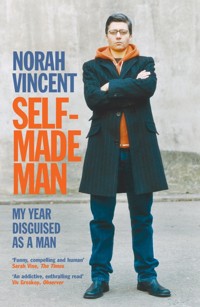
Norah Vincent became an instant media sensation with the publication of Self-Made Man, her take on just how hard it is to be a man, even in a man's world. Vincent spent a year and a half disguised as her male alter ego, Ned, exploring what men are like when women aren't around. As Ned, she joined a bowling team, took a high-octane sales job, went on dates with women (and men), visited strip clubs, and even managed to infiltrate a monastery and a men's therapy group. At once thought-provoking and pure fun to read, Self-Made Man is a sympathetic and thrilling tour de force of immersion journalism.
Sie lesen das E-Book in den Legimi-Apps auf:
Seitenzahl: 483
Veröffentlichungsjahr: 2023
Das E-Book (TTS) können Sie hören im Abo „Legimi Premium” in Legimi-Apps auf:
Ähnliche




















Self-Made Man
Norah Vincent is a freelance journalist working in New York City. This is her first book.
‘This intelligent, sensitive and often insightful woman concludes that, all in all, the lot of the modern man is not a particularly enviable one. Funny, compelling and human.’ Sarah Vine, The Times
‘One of the most sympathetic renderings of masculinity you’re likely to read this year . . . Intelligent, articulate and perceptive, Self-Made Man has much to offer men and women alike . . . Compelling.’ Lionel Shriver, Guardian
‘Fascinating . . . as layered and brilliant as a David Mamet drama.’ Roger Lewis, Daily Telegraph
‘A highly readable book which is also enlightening . . . Vincent demonstrates one of the less acknowledged advances of modern feminism: an unblinking broadmindedness which allows men the frailties of all human beings and is interested to observe them.’ Salley Vickers, Financial Times
‘An addictive, enthralling read: each chapter is progressively more fascinating as Ned becomes more ensconced in his new life . . . Breathtaking’ Viv Groskop, Observer
‘Sharp-witted . . . inspired . . . a fascinating bird’s-eye view of contemporary maleness . . . beautifully written . . . a brave and fascinating book . . . offering us perspectives that are entirely fresh and new . . . a good, companionable journey . . . and one well worth making.’ Christopher Hart, Sunday Times
‘I was converted to admiration by Vincent’s wholesale commitment to her project . . . frank and vivid . . . [Vincent] has the novelist’s sharp eye for the telling detail.’ Jenny McCartney, Sunday Telegraph
‘The acting gig of a lifetime.’ John Freeman, Scotland on Sunday
‘Intelligent, sympathetic and amusing . . . a very enjoyable read.’ Andrew Flanagan, Ireland on Sunday
‘A moving and often illuminating work . . . a bracingly frank personal account . . . Self Made Man is an exhilarating book . . . a wild ride.’ Joyce Carol Oates, TLS
‘Sympathetic . . . deeply perceptive . . . this eloquently constructed book makes for fascinating reading, as much for the chronicle of [Norah’s] own journey as for her insights into the male condition.’ Siobhan Murphy, Metro
‘A galloping read . . . Self Made Man transcends the in-built shallowness of the makeover genre, and delivers a funny, complex and highly compassionate plea for the liberation of men . . . Norah’s generosity of spirit is what makes the book so fresh.’ Erica Roberts, Pink Paper
‘While the side effects of Vincent’s experiment are fascinating (including what happens when she reveals herself to be female and the negative impact on her psyche), it is her field reporting from Planet Guy that holds the most novelty. Self-Made Man will make many women think twice about coveting male “privilege” and make any man feel grateful that his gender burden is better understood.’ Lily Burana, Washington Post
‘Thoughtful, entertaining . . . one of the great attributes of Self-Made Man is its lack of agenda or presuppositions . . . Self-Made Man transcends its premise altogether, offering not an undercover woman’s take on male experience, but simply a fascinating, fly-onthe-wall look at various unglamorous male milieus that are well off the radar of most journalists and book authors . . . so rich and so audacious that I’m hooked from page one.’ David Kamp, New York Times Book Review
To my beloved wife, Lisa McNulty,who saves my life on a daily basis
First published in the United States of America in 2006 by Viking, an imprint of Penguin Random House LLC, New York
First published in Great Britain in 2006 by Atlantic Books, an imprint of Atlantic Books Ltd
Copyright © Norah Vincent 2006
The moral right of Norah Vincent to be identified as the author of this work has been asserted by her in accordance with the Copyright, Designs and Patents Act of 1988.
All rights reserved. No part of this book may be reproduced or transmitted in any form or by any means, electronic or mechanical, including photocopying, recording or by any information storage and retrieval system, without prior permission in writing from the publisher.
The names and identifying characteristics of some people featured in this book have been changed to protect their privacy. Any resemblance between such names and identifying characteristics and those of actual persons, living or dead, is purely coincidental.
10 9 8 7 6 5 4 3 2 1
A CIP catalogue record for this book is available from the British Library.
Paperback ISBN 978 1 84354 504 0
E-book ISBN 978 1 80546 244 6
Atlantic Books
An imprint of Atlantic Books Ltd
Ormond House
26–27 Boswell Street
LondonWC1N 3JZ
www.atlantic-books.co.uk
But this my masculine usurped attire . . .
Conceal me what I am, and be my aid
For such disguise as haply shall become
The form of my intent . . .
Disguise, I see, thou art a wickedness
Wherein the pregnant enemy does much.
Shakespeare, Twelfth Night
Were it not better,
Because that I am more than common tall,
That I did suit me all points like a man?
Lie there what hidden woman’s fear there will,
We’ll have a swashing and a martial outside,
As many other mannish cowards have
That do outface it with their semblances.
Shakespeare, As You Like It
Contents
1. Getting Started
2. Friendship
3. Love
4. Sex
5. Life
6. Work
7. Self
8. Journey’s End
Acknowledgments
Self-Made Man
1
Getting Started
Seven years ago, I had my first tutorial in becoming a man.
The idea for this book came to me then, when I went out for the first time in drag. I was living in the East Village at the time, undergoing a significantly delayed adolescence, drinking and drugging a little too much, and indulging in all the sidewalk freak show opportunities that New York City has to offer.
Back then I was hanging around a lot with a drag king whom I had met through friends. She used to like to dress up and have me take pictures of her in costume. One night she dared me to dress up with her and go out on the town. I’d always wanted to try passing as a man in public, just to see if I could do it, so I agreed enthusiastically.
She had developed her own technique for creating a beard whereby you cut half-inch chunks of hair from unobtrusive parts of your own head, snipped them into smaller pieces and then more or less glopped them onto your face with spirit gum. Using a small, round freestanding mirror on her desk, she showed me how to do it in the dim, greenish light of her cramped studio apartment. It wasn’t at all precise and it wouldn’t have passed muster in daylight, but it was sufficient for the stage, and it would work well enough for our purposes in dark bars at night. I made myself a goatee and mustache, and a pair of exaggerated sideburns. I put on a baseball cap, loose-fitting jeans and a flannel shirt. In the full-length mirror I looked like a frat boy—sort of.
She did her thing—which was more willowy and faint, more like a young hippie guy who couldn’t really grow much of a beard—and we went out like that for a few hours.
We passed, as far as I could tell, but I was too afraid to really interact with anyone, except to give one guy brief directions on the street. He thanked me as “dude” and walked on.
Mostly, though, we just walked through the Village scanning people’s faces to see if anyone took a second or third look. But no one did. And that, oddly enough, was the thing that struck me the most about that evening. It was the only thing of real note that happened. But it was significant.
I had lived in that neighborhood for years, walking its streets, where men lurk outside of bodegas, on stoops and in doorways much of the day. As a woman, you couldn’t walk down those streets invisibly. You were an object of desire or at least semiprurient interest to the men who waited there, even if you weren’t pretty—that, or you were just another pussy to be put in its place. Either way, their eyes followed you all the way up and down the street, never wavering, asserting their dominance as a matter of course. If you were female and you lived there, you got used to being stared down because it happened every day and there wasn’t anything you could do about it.
But that night in drag, we walked by those same stoops and doorways and bodegas. We walked by those same groups of men. Only this time they didn’t stare. On the contrary, when they met my eyes they looked away immediately and concertedly and never looked back. It was astounding, the difference, the respect they showed me by not looking at me, by purposely not staring.
That was it. That was what had annoyed me so much about meeting their gaze as a woman, not the desire, if that was ever there, but the disrespect, the entitlement. It was rude, and it was meant to be rude, and seeing those guys looking away deferentially when they thought I was male, I could validate in retrospect the true hostility of their former stares.
But that wasn’t quite all there was to it. There was something more than respect being communicated in their averted gaze, something subtler, less direct. It was more like a disinclination to show disrespect. For them, to look away was to decline a challenge, to adhere to a code of behavior that kept the peace among human males in certain spheres just as surely as it kept the peace and the pecking order among male animals. To look another male in the eye and hold his gaze is to invite conflict, either that or a homosexual encounter. To look away is to accept the status quo, to leave each man to his tiny sphere of influence, the small buffer of pride and poise that surrounds and keeps him.
I surmised all of this the night it happened, but in the weeks and months that followed I asked most of the men I knew whether I was right, and they agreed, adding usually that it wasn’t something they thought about anymore, if they ever had. It was just something you learned or absorbed as a boy, and by the time you were a man, you did it without thinking.
After the incident had blown over, I started thinking that if after being in drag for only a few hours I had learned such an important secret about the way males and females communicate with each other, and about the unspoken codes of male experience, then couldn’t I potentially observe much more about the social differences between the sexes if I passed as a man for a much longer period of time? It seemed true, but I wasn’t intrepid enough yet to do something that extreme. Besides, it seemed impossible, both psychologically and practically, to pull it off. So I filed the information away in my mind for a few more years and got on with other things.
Then, in the winter of 2003, while watching a reality television show on the A&E network, the idea came back to me. In the show, two male and two female contestants set out to transform themselves into the opposite sex—not with hormones or surgeries, but purely by costume and design. The women cut their hair. The men had theirs extended. Both took voice and movement lessons to learn how to speak and behave more like the sex they were trying to become. All chose new wardrobes and names for their alter egos. Though the point of the exercise was to see who could pass in the real world most effectively, the bulk of the program focused on the transformations themselves. Neither of the men really passed, and only one of the women stayed the course. She did manage to pass fairly well, though only for a short time and in carefully controlled circumstances.
As in most reality television shows, especially the American ones, nobody involved was particularly introspective about the effect their experiences had had on them or the people around them. It was clear that the producers didn’t have much interest in the deeper sociological implications of passing as the opposite sex. It was all just another version of an extreme makeover. Once the stunt was accomplished—or not—the show was over.
But for me, watching the show brought my former experience in drag to the forefront of my mind again and made me realize that passing in costume in the daylight could be possible with the right help. I knew that writing a book about passing in the world as a man would give me the chance to survey some of the unexplored territory that the show had left out, and that I had barely broached in my brief foray in drag years before.
I was determined to give the idea a try.
But first things first. Before I could build this man I was to become, I had to think of an identity for him. I needed a name. The name had to be something familiar, something I might respond to when called. Failing to answer to my name would surely give me away as an impostor. For convenience I wanted something that started with the letter N. That narrowed the options considerably, and most of them were unappealing. There was no way, for example, that I was going to be known as Norman or Norm. Nick, when paired with Norah, seemed a little too clever by half, and Neil or Nate just didn’t suit me.
That’s when I hit upon the name Ned, a nickname from childhood that had long since fallen out of use, but one that was, as it happened, intimately tied to the project at hand.
I got the name Ned when I was about seven. I got it partly because Norah is a hard name to nick, but mostly because nothing but a boy’s name really made sense when you saw what my parents were faced with in their only daughter. Practically from birth, I was the kind of hard-core tomboy that makes you think there must be a gay gene.
How else to explain my instinctive loathing for dresses, dolls and frills of any kind when other girls delighted in such things? How else to explain the weird attachments and fetishes that came so young and against all social programming? Why, for example, did I insist on dressing like a ranch hand when I was barely out of diapers? Why did I choose to play the saxophone when every other girl chose the flute or the clarinet? Why did I covet my father’s tube of VO5, and shave my brothers’ GI Joes with his razors? Why was the only female doll I ever owned or liked an armor-clad Joan of Arc?
Impossible to say, really. Gender identity, it seems, is in the genes as surely as sex and sexuality are, but we don’t know why the programming deviates. Maybe a crossed wire somewhere, or the hormonal equivalent. It seems as likely an explanation as any for how it is that even before she’s old enough to know the meaning of desire or cultural signifiers, being born gay tends to make a girl crave helmets and hiking boots. Whatever the case, I was the happily twisted result of some gland or helix gone awry, a fate that found me playing Tarzan high in the apple tree on summer afternoons, and dressing in full-blown drag for Halloween by the time I was seven.
My mother has since said that she should have suspected something then, when I borrowed one of my father’s blazers and a porkpie hat, drew a beard and mustache on my face and went out trick-or-treating with all the other fairies and witches. I was, I said, going as an old man. I slid a pillow under the blazer to make a belly and I carried a cane.
But what would she have known, when I might well have been imitating her? She was an actor, and I had spent many childhood summers scampering around backstage or lurking in her dressing room as she made up for a show. One of her most memorable parts was a dual role in which she played Shen Te and Mr. Shui Ta in Bertolt Brecht’s The Good Person of Setzuan. Shen Te is a kind-hearted ex-prostitute who owns a tobacco shop in the Chinese province of Sichuan. Prey to swindlers and malingerers who take her for a pushover, Shen Te is facing financial ruin. To save her business, she disguises herself as a man, Mr. Shui Ta, her supposed ruthless male cousin, whom she invokes to do the dirty work of collecting debts and fending off beggars and thieves.
How could seeing my mother in this role have had anything but a profoundly inspiring effect on me, a kid already fascinated by disguise? Did women really pretend to be men in real life? What if they could, I wondered, and what could they get away with? My eyes widened at the prospect.
Thankfully, for my parents’ sake, my two older brothers were normal. The oldest, Alex, the consummate gentleman, also from birth, was often silently bewildered, but always kind and accommodating. Teddy, the middle one, was not. He was a hellion, the nicknamer in the family and ruthless at his trade. He was the real impetus behind Ned.
You see, Ned had a deeper meaning, connected intimately not only with my being a tomboy, but with the problems that that particular affliction presents in and around puberty. That’s the time in a tomboy’s life when sexual maturity and gender identity come smack up against each other in an unpleasant way.
Having older brothers means that the girls they know and like reach puberty before you do. This was always cause for anxiety among the girls I knew, since getting your period and—the real prize—growing incipient breasts was the gate we were all waiting to pass through. It meant everything. For one, it meant that you were suddenly of interest to the other half of the species. Until then, you were just dirty knees and elbows with nothing to show for yourself but the spaces between your teeth. Until then, you were just the last one picked for kick ball, and in my case, the lousy tagalong little sister who got no respect. But those early bloomers that my older brother and his friends were always ogling, the shapely sixth graders with lip gloss and B cups, they had something, and it drove gangly ragamuffins like me into frowning, envious retreats. Our lack of development was a sore subject not to be broached.
But broaching the unbroachable is what infernal brothers are for.
After school one day, Teddy and his friends found me playing with my small plastic army men on the front lawn. Bored as usual, they began taunting me about my lack of physical development. The unbroachable. I cowered, hoping they’d drift off if they didn’t get a rise out of me. But Teddy was inspired on this particular day. The nickname Ned was already in use by this time—they’d all been using it in their taunts, none of which was remarkable enough to remember. That is, until Teddy shouted above the fray the unforgettable and infuriating:
“Ned ass and no tits.”
Unsurprisingly, this elicited howls of laughter from the group.
It was true. Ned indeed had no ass and no tits and Ned knew it and wasn’t happy about it. I didn’t look up at this point, but I began pulling up fistfuls of grass. Then for some unknown reason—who, after all, can fathom the adolescent stream of consciousness—Teddy began shaking his hips back and forth suggestively, the way a bimbo who had hips or an ass might, and singing the word “milkshake!” as he did so. Naturally, all of his friends found this endlessly amusing and chimed in.
At this I promptly snapped. The sight of five boys loudly and publicly lampooning my pained, pathetic prepubescence in song was simply too much for me. I stood up, went into the garage, and emerged—by then in a teeth-gritting rage—brandishing one of Teddy’s ice hockey sticks. The boys found this funniest of all, which, of course, enraged me even more. I chased them around the neighborhood with the hockey stick for a good hour, with them laughing, dancing and shouting “milkshake,” then running and hiding, and me stalking and screaming and swinging.
And so, Ned was born. And that, in truth, was where this book began—that is, with the Ned who had no ass and no tits.
In Ned I had my new name and a starting point for a male identity. But once I had resolved to become Ned, I still had a fair amount of work to do to make passing as a man in daylight feasible on a regular basis. The first and most important step was to find out how to make a more believable beard than the slapdash version my drag king friend had taught me years before, something that would look real at close range over the course of an entire day or evening if need be.
As it happened I was lucky in this department. I had a lot of friends in theater, many of whom proved helpful in bringing Ned to life.
I decided to consult Ryan, a makeup artist of my acquaintance, who told me about a facial hair technique he’d used in a recent show. He said he thought it might work for me on the street if used sparingly.
It was far more subtle and specialized than the glue job I’d done in the Village, though in the end far simpler.
First, Ryan suggested using wool crepe hair instead of my own or someone else’s real hair. Wool crepe hair comes in long braided ropes, which you can buy from specialty makeup companies. It’s offered in a whole range of colors, from platinum blond to black, so I could buy whatever shade best matched my hair and always have a ready supply at hand without having to butcher my haircut.
Ryan showed me how to unwind the braids, comb the strands of hair together, then take the ends between my thumb and index finger and cut them with a hairdressing scissor into millimeter- or smaller-size pieces. By cutting them onto a piece of white paper and spreading them evenly across it, he showed me how to avoid clumping the hair when I applied the pieces to my face. He suggested using a makeup brush to do this—a large blush brush for my chin and cheeks, and a small eye shadow brush for my upper lip.
Next he applied a lanolin and beeswax-based adhesive called stoppelpaste to the portions of my face where I wanted the hair to stick. This would work better than spirit gum for several reasons. It’s invisible, whereas spirit gum tends to turn white on the skin and show through, unless you’re wearing a full hairpiece, which doesn’t ever look real on a woman’s face in the daylight. (I tried this.) Also, stoppelpaste is gentle on the skin, and can be taken off with a moisturizing makeup remover. Spirit gum, by contrast, must be removed with a harsh acetone thinner. It also dries and stiffens quickly. Stoppelpaste doesn’t. This, I imagined, would give me more freedom of movement and natural expression, an indispensable tool for making Ned believable.
At room temperature stoppelpaste is fairly dense stuff and tends not to spread easily, so Ryan suggested using a hair dryer to heat it for a few seconds before applying it. This melted it just enough to make it roll on smoothly. Doing one small patch at a time, he applied the stoppelpaste to my face, then dabbed the makeup brush in the clippings, then patted my face lightly with the brush until my whole chin and upper lip were covered in a light stubble.
Later, as I refined this process, I found that the scissors didn’t produce small enough pieces. If the pieces were too long, they tended to look more like they were glued to my face rather than growing out of it. I needed to make the pieces minuscule, so that they would look almost like dots. To achieve this effect, or the closest I could come, I bought a men’s electric beard trimmer and ran it across the tips of the hair, producing actual stubble-length pieces that, when applied, looked like a five o’clock shadow.
The key with the beard was not to put it on too heavily. My skin, like most women’s, is not only softer to the touch, but much smoother to the eye than a man’s. It’s also quite pale and pink in the cheeks. Consequently, as Ned, people were always telling me that I looked a lot younger than thirty-five, even though I had a lot of gray in my hair. But if your skin goes from peaches and cream above your cheekbones to Don Johnson below you look a little like Fred Flintstone. So I had to be careful not to get carried away with the stubble and try to stay within the bounds of what a young, fairly hairless man with fine skin would believably grow.
To help square my jaw I went to the barber and asked him to cut my hair in a flat top—a haircut I usually abhor on men, but which did a lot under the circumstances to masculinize my head. Then I went to the optician and picked out two pairs of rectangular frames, again to accentuate the angles of my face. One pair was metal, for all the occasions when I’d want to look more casual, and one was tortoiseshell, for the occasions—like work or on dates—when I’d want a more stylish look.
With the beard and the flat top, the glasses helped a lot in getting me to see myself as someone else, though the transformation was psychological more than anything else, and it took time to sink in. At first, I had a lot of trouble seeing myself as anyone but myself with hair glued to my face. I’d been looking at my face all my life, and I’d had short haircuts for much of that time. The stubble didn’t really change that. I was still me. But the glasses did change that, or at least they began to. Then it became a mind game that I played with myself, and soon, with everyone else as well.
In the beginning I was so worried about getting caught—not passing—that in order to ensure my disguise I wore my glasses everywhere, and often a baseball hat, along, of course, with the meticulously applied beard. But as time went on, as I became more confident in my disguise, more buried in my character, I began to project a masculine image more naturally, and the props I had used to create that image became less and less important, until sometimes I didn’t need them at all.
People accept what you convey to them, if you convey it convincingly enough. Even I began to accept more willingly the image reflected in the mirror, just as the people around me eventually did.
Once I’d finished doctoring my head and face, I began concentrating on my body.
First I had to find a way to bind my breasts. This is trickier than it sounds, even when you’re small breasted, especially when you’re determined to have the flattest possible front. First I tried the obvious—Ace bandages. I bought two of the four-inch-wide variety and strapped them tightly around me, fixing them in place with surgical tape to make sure that they wouldn’t unwind midday. This made my chest very flat, but it also made breathing painful and labored. Also, depending on how I was sitting, after a while the binding often slipped down and pushed my breasts up and together instead of out and down. Not a good look for a man.
In the end, cupless sports bras worked best. I bought them two sizes too small and in a flat-fronted style. Naked, it didn’t make me a board, but with a loose shirt and some creative layering it worked fine. It was the most dependable method. It never moved. It never fell. It did, however, dig into my shoulders and back, especially as I got bigger.
And I did get bigger. That was the next step in transforming my body. Lifting weights. Lots of weights. I consulted a trainer at my local gym, telling him about the project and asking his advice about how best to masculinize my body as much as possible without using steroids. He suggested building muscle bulk in my shoulders and arms.
Building muscle bulk happens in a two-step process. First by lifting heavy weights at low repetitions, and second by eating your body weight or more in grams of protein per day.
Each day I trained a different muscle. Through the week I worked each body part to exhaustion, but only once a week, taking at least one day off on the weekends for recovery. In my off time I ate and drank as much protein as I could shove down my neck. After six months, I’d gained fifteen pounds. I was still a small guy by normal measures, but my shoulders were recognizably broader and squarer, and this alone pushed me one step closer to manhood.
To complete the physical transformation, I went in search of a prosthetic penis that I could wear for verisimilitude as much as anything else. At a sex shop in downtown Manhattan I found what I have since come to refer to as a “packable softie.” This wasn’t a dildo, which, at its full and constant tumescence would have proven uncomfortable for me and alarming for everyone around me. Instead, this item, which I nicknamed “Sloppy Joe,” was a flaccid member designed especially for what drag kings call packing, or stuffing, your pants. It was better than a sock, and would give me, if not others, a more realistic experience of “manhood.” To keep it in place I wore it inside a jockstrap, since in a pair of tighty whities it moved too far afield when I walked and became too much of a distraction.
Finally, once the basic anatomy was in place, boobs strapped in, shoulders squared, beard applied and cock tucked, I took Ned shopping for clothes, in drag, of course. I bought him preppy, safe things like rugby shirts and khakis and baggy jeans. I didn’t want to splurge on a suit, but Ned needed a wardrobe for work, so I bought him three blazers, several pairs of dress slacks, four ties and five or six dress shirts. I bought a large supply of men’s white crew neck undershirts, which proved to be a staple of my wardrobe, casual or dress. I wore them under everything, partly as an extra layer to hide the seams of my bra, and partly to stouten my neck, or at least distract the looker’s eye from my lack of Adam’s apple and my hairless chest.
I made my last stop for Ned at the Juilliard School for the Performing Arts, where I hired a voice coach to help me learn to speak more like a man. My voice is already deep, but as with so many other things, I found that when you are trying to pass in drag, all the characteristics that seem masculine in you as a woman turn out to be far less so in a man.
My tutor went over a few gender cues in our lessons, but it took being Ned for quite some time before I realized just how differently men and women talk and how much damping down I would have to do as Ned so as not to arouse suspicion.
My tutor said, “Women tend to bankrupt their own breath.” She described and demonstrated the process by thrusting her chest and head forward when she spoke, and cutting off the rhythm of her breathing as she forced a stream of words from her mouth.
“Admittedly, this is a stereotype,” she said, “but generally women tend to speak more quickly and to use more words, and they interrupt their breathing in order to get it all out.”
I found this to be true in my own speech patterns, which jesting friends have sometimes described as torrential. I often run out of breath before I’ve finished my thought, and either have to gasp in the middle to make it through, or push the words out faster to finish sooner.
Since my training, I have also observed this phenomenon in action at various dinner parties or in restaurants. Women often lean into a conversation and speak in wordy bursts, asking to be heard. Men often lean back and pronounce with terse authority.
Naturally, what you do with your breath affects how your voice will sound. Using fewer words, speaking more slowly and sustaining my breath through the words all helped me to use the deeper notes in my register and to stay there. This meant, of course, that I couldn’t allow myself to get too excited about anything, because this would change my breathing, and my voice would pinch up to its higher reaches. Conversely, I found that relaxing and breathing deeply before I embarked on a day as Ned helped me to get into his voice, then his bearing and then his head.
The process of getting into Ned’s head raises an obvious question, and one that many people have asked about this book, mostly as a means of clarifying exactly what the book is meant to be and what they should expect to get out of it.
Am I a transsexual or a transvestite, and did I write this book as a means of coming out as such?
The answer to both parts of that question is no.
I say this with the benefit of experimental hindsight, because after having lived as a man on and off for a year and a half, if I were either a transsexual or a true lifestyle transvestite, I can assure you that I would know it by now.
For one thing, I would have experienced far more satisfaction living as Ned.
Transsexuals generally report that passing as a member of the opposite sex is an immense and pleasurable relief. They feel that they have finally come into their own after many years of living in disguise.
Just the opposite was true for me.
I rarely enjoyed and never felt in any way fulfilled personally by being perceived and treated as a man. I have never, as many transsexuals assert, felt myself to be a man trapped in the wrong body. On the contrary, I identify deeply with both my femaleness and my femininity, such as it is, more so after Ned, in fact, than ever before.
As you will see, being Ned was often an uncomfortable and alienating experience, and far from finding myself in him, I usually felt kept from myself in some elemental way. While living as Ned, I had to work hard to make myself do his work, to be him. It did not come naturally at all, and once he had served his purpose, I was happy to discard him.
As for cross-dressing, this, too, was not definitive for me or particularly enjoyable. I can’t deny the brief thrill I felt in getting away with the disguise, and in seeing a part of everyday life that other women don’t see. Wearing a dick between my legs was an odd and mildly titillating experience for a day or two. But that frisson wore off quickly, and I found myself inhabiting a persona that wasn’t mine, trying to approximate something that I am not and did not wish to be.
This is, therefore, not a confessional memoir. I am not resolving a sexual identity crisis. There is intimate territory being explored here. No question. As my childhood proclivities can attest, I have always been and remain fascinated, puzzled and even disturbed at times by gender, both as a cultural and a psychological phenomenon whose boundaries are both mysteriously fluid and rigid. Culturally speaking, I have always lived as my truest self somewhere on the boundary between masculine and feminine, and living there has made this project more immediate and meaningful to me. What’s more, I did partake in my own experiment, live it and internalize its effects. Being Ned changed me and the people around me, and I have attempted to record those changes.
But to say that I conducted and recorded the results of an experiment is not to say that this book pretends to be a scientific or objective study. Not even close. Nothing I say here will have any value except as one person’s observations about her own experience. What follows is just my view of things, myopic and certainly inapplicable to anything so grand as a pronouncement on gender in American society. My observations are full of my own prejudices and preconceptions, though I have tried as much as possible to qualify them accordingly. This book is a travelogue as much as anything else, and a circumscribed one at that, a six-city tour of an entire continent, a woman’s-eye view of one guy’s approximated life, not an authoritative guide to the whole vast and variegated terrain of manhood in America.
I wanted to taste portions of male experience and I wanted the people I met, the characters, their stories and our shared encounters to play as large a role as possible in my reportage. Yet I knew I had to impose some organizing principle on the final product.
I found that simply walking down the street as a man, while fruitful the first time or two I did it, didn’t give me enough substantive material to work with in the long term. I needed, I realized, to create discrete experiences for Ned in which he would make friends, socialize, work, date and be himself around people who didn’t know him, but whom he would get to know and sketch as more than acquaintances. True immersion was required, as were sustainable characters in manageable settings. I felt it would be too unwieldy to throw dozens of people at the reader in one long, confusing march of scattered themes and impressions, so instead, I chose to confine each setting and cast of characters to one chapter, and let the significant themes emerge from there.
Chapter two, for example, is about my eight-month stint on a men’s bowling team. Leisure, play and friendship are the salient themes, though others do present themselves and recur in later chapters. Chapter four is about strip club culture. Sex drive and fantasy are its prevailing themes. Chapters three and six cover the more normative experiences of dating and working as a man, while chapters five and seven—which take place in a monastery and a men’s movement group, respectively—represent my attempts to use the advantage of my male trappings to do what I could never do as a woman: infiltrate exclusive all-male environments and if possible learn their secrets.
I had each of these experiences in the order in which they appear—that is, I finished the season on the men’s bowling team before I went to the monastery, or to work, or to the men’s group meetings—so the general timeline is preserved, as well, I hope, as the sense of Ned’s accumulated growth and knowledge about masculine experience.
In order to disguise the identities of those involved, I have changed the names of every character, place of business and institution, and purposely omitted all specific references to location. So while I conducted my experiment in five separate states, in three different regions of the United States, I have avoided naming those states or regions.
Finally, a word on method. It will become clear to you if it is not already that I deceived a lot of people in order to write this book. I can make only one excuse for this. Deception is part and parcel of imposture, and imposture was necessary in this experiment. It could not have been otherwise. In order to see how people would treat me as a man, I had to make them believe that I was a man, and accordingly I had to hide from them the fact that I am a woman. Doing so entailed various breaches of trust, some more serious than others. This may not sit well with some or perhaps most of you. In certain ways it did not sit well with me either, and was, as you will see, a source of considerable strain as time wore on.
I began my journey with a fairly naive idea about what to expect. I thought that passing was going to be the hardest part. But it wasn’t at all. I did that far more easily than I thought I would. The difficulty lay in the consequences of passing, and that I had not even considered. As I lived snippets of a male life, one part of my brain was duly taking notes and making observations, intellectualizing the raw material of Ned’s experience, but another part of my brain, the subconscious part, was taking blows to the head, and eventually those injuries caught up with me.
In that sense I can say with relative surety that in the end I paid a higher emotional price for my circumstantial deceptions than any of my subjects did. And that is, I think, penalty enough for meddling.
2
Friendship
When I told my proudly self-confessed trailer-trash girlfriend that Ned was joining a men’s bowling league, she said by way of advice, “Just remember that the difference between your people and my people is that my people bowl without irony.” Translation: hide your bourgeois flag, or you’ll get the smugness beaten out of you long before they find out you’re a woman.
People who play in leagues for money take bowling seriously, and they don’t take kindly to journalists infiltrating their hardwon social lives, especially when the interloper in question hasn’t bowled more than five times in her life, and then only for a lark.
But my ineptitude and oddball status notwithstanding, bowling was the obvious choice. It’s the ultimate social sport, and as such it would be a perfect way for Ned to make friends with guys as a guy. Better yet, I wouldn’t have to expose any suspicious body parts or break a heavy sweat and risk smearing my beard.
Still, in practice, it wasn’t as easy as it sounded. Taking that first step through the barrier between Ned the character in my head and Ned the real guy among the fellas proved to be more jarring than I could have ever imagined.
Any smartly dressed woman who has ever walked the gauntlet of construction workers on lunch break or otherwise found herself suddenly alone in unfamiliar male company with her sex on her sleeve will understand a lot of how it felt to walk into that bowling alley for the first time on men’s league night. Those guys may not have known that I was a woman, but the minute I opened the door and felt the air of that place waft over me, every part of me did.
My eyes blurred in panic. I didn’t see anything. I remember being aware only of a wave of noise and imagined distrust coming at me from undistinguishable faces. Probably only one or two people actually turned to look, but it felt as if every pair of eyes in the place had landed on me and stuck.
I’d felt a milder version of this before in barbershops or auto body shops. This palpable unbelonging that came of being the sole female in an all-male environment. And the feeling went right through my disguise and my nerve and told me that I wasn’t fooling anyone.
This was a men’s club, and men’s clubs have an aura about them, a mostly forbidding aura that hangs in the air. Females tend to respond to it viscerally, as they are meant to. The unspoken signs all say NO GIRLS ALLOWED and KEEP OUT or, more idly, ENTER AT YOUR OWN RISK.
As a woman, you don’t belong. You’re not wanted. And every part of you knows it, and is just begging you to get up and leave.
And I nearly did leave, even though I’d only made it two steps inside the door and hadn’t even been able to look up yet for fear of meeting anyone’s eyes. After standing there frozen for several minutes, I had just about worked up the gumption to retreat and call off the whole thing when the league manager saw me.
“Are you Ned?” he asked, rushing up to me. “We’ve been waiting for you.”
He was a tiny, wizened stick figure, with a five-day growth of gray stubble on his chin, a crew cut to match, a broken front tooth and a black watch cap.
I had called earlier in the week to find out about the league, and he’d told me what time to show up and which guy to ask for when I got there. I was late already, and my nervous hesitations had made me later.
“Yeah,” I croaked, trying to keep my voice down and my demeanor unshaken.
“Great,” he said, grabbing me by the arm. “C’mon and get yourself some shoes and a ball.”
“Okay,” I said, following his lead.
There was no getting out of it now.
He walked me over to the front desk and left me there with the attendant, who was helping another bowler. As I stood waiting, I was able for the first time to focus on something beyond myself and my fear of immediate detection. I looked at the rows of cubbyholes behind the desk, all with those familiar red, blue and white paneled shoes stuffed in them in pairs. Seeing them comforted me a little. They reminded me of the good times I’d always had bowling with friends as a kid, and I felt a little surge of carelessness at the prospect of making a fool out of myself. So what if I couldn’t bowl? This was an experiment about people, not sport, and nobody had yet pointed and laughed. Maybe I could do this after all.
I got my shoes, took them over to a row of orange plastic bucket chairs and sat down to change. This gave me a few more minutes to take in the scene, a few more minutes to breathe and watch people’s eyes to see if they followed me, or if they passed over me and moved on.
A quick scan satisfied me that nobody seemed suspicious.
So far so good.
I’d chosen well in choosing a bowling alley. It was just like every other bowling alley I’d ever seen; it felt familiar. The decor was lovingly down at heel and generic to the last detail, like something out of a mail-order kit, complete with the cheap plywood paneling and the painted slogans on the walls that said: BOWLING IS FAMILY FUN. There were the usual shabby cartoons of multicolored balls and pins flying through the air, and the posted scores of top bowlers. The lanes, too, were just as I remembered them, long and glistening with that mechanized maw scraping at the end.
And then, of course, there were the smells; cigarette smoke, varnish, machine oil, leaky toilets, old candy wrappers and accumulated public muck all commingling to produce that signature bowling alley scent that envelops you the moment you enter and clings to you long after.
As far as I could see, only one thing had really changed in the last fifteen years. Scoring wasn’t done by hand anymore. Instead, everything was computerized. You just entered the names and averages of each player on the console at your table, and the computer did the rest, registering scores, calculating totals and flashing them on monitors above each lane.
As I scoped the room, I noticed the team captains all busily attending to their monitors. Meanwhile their teammates were strapping on wrist braces and dusting their palms with rosin, or taking advantage of a few last minutes of pregame practice.
I could see then that this was going to be laughable. They were all throwing curve balls that they’d been perfecting for twenty years. I couldn’t even remember how to hold a bowling ball, much less wing it with any precision. And that was the least of my worries. I was in drag in a well-lighted place, surrounded by some sixty-odd guys who would have made me very nervous under normal circumstances.
I was dressed as down and dirty as Ned got in a plaid shirt, jeans and a baseball cap pulled low over the most proletarian glasses I could find. But despite my best efforts, I was still far too scrubbed and tweedy amid these genuine articles to pass for one of them. Even at my burliest, next to them I felt like a petunia strapped to a Popsicle stick.
I was surrounded by men who had cement dust in their hair and sawdust under their fingernails. They had nicotine-sallowed faces that looked like ritual masks, and their hands were as tough and scarred as falcon gloves. These were men who, as one of them told me later, had been shoveling shit their whole lives.
Looking at them I thought: it’s at times like these when the term “real man” really hits home with you, and you understand in some elemental way that the male animal is definitely not a social construct.
I didn’t see how this could possibly work. If I was passing, I was passing as a boy, not a man, and a candy boy at that. But if they were judging me, you wouldn’t have known it from the way they greeted me.
The league manager led me toward the table where my new teammates were sitting. As we approached, they all turned to face me.
Jim, my team captain, introduced himself first. He was about five feet six, a good four inches shorter than I am, with a lightweight build, solid shoulders, but skinny legs and oddly small feet—certainly smaller than mine, which have now topped out at an alarming men’s eleven and a half. This made me feel a little better. He actually came across as diminutive. He wore his baseball cap high on his head, and a football jersey that draped over his jeans almost to his knees. He had a mustache and a neat goatee. Both were slightly redder than his light brown head of hair, and effectively hid the boyish vulnerability of his mouth. He was thirty-three, but in bearing, he seemed younger. He wasn’t a threat to anyone and he knew it, as did everyone who met him. But he wasn’t a weak link either. He was the scrappy guy in the pickup basketball game.
As he extended his arm to shake my hand, I extended mine, too, in a sweeping motion. Our palms met with a soft pop, and I squeezed assertively the way I’d seen men do at parties when they gathered in someone’s living room to watch a football game. From the outside, this ritual had always seemed overdone to me. Why all the macho ceremony? But from the inside it was completely different. There was something so warm and bonded in this handshake. Receiving it was a rush, an instant inclusion in a camaraderie that felt very old and practiced.
It was more affectionate than any handshake I’d ever received from a strange woman. To me, woman-to-woman introductions often seem fake and cold, full of limp gentility. I’ve seen a lot of women hug one another this way, too, sometimes even women who’ve known each other for a long time and think of themselves as being good friends. They’re like two backward magnets pushed together by convention. Their arms and cheeks meet, and maybe the tops of their shoulders, but only briefly, the briefest time politeness will allow. It’s done out of habit and for appearances, a hollow, even resentful, gesture bred into us and rarely felt.
This solidarity of sex was something that feminism tried to teach us, and something, it now seemed to me, that men figured out and perfected a long time ago. On some level men didn’t need to learn or remind themselves that brotherhood was powerful. It was just something they seemed to know.
When this man whom I’d never met before shook my hand he gave me something real. He included me. But most of the women I’d ever shaken hands with or even hugged had held something back, as if we were in constant competition with each other, or secretly suspicious, knowing it but not knowing it, and going through the motions all the same. In my view bra burning hadn’t changed that much.
Next I met Allen. His greeting echoed Jim’s. It had a pronounced positive force behind it, a presumption of goodwill that seemed to mark me as a buddy from the start, no questions asked, unless or until I proved otherwise.
“Hey, man,” he said. “Glad to see you.”
He was about Jim’s height and similarly built. He had the same goatee and mustache, too. He was older, though, and looked it. At forty-four, he was a study in substance abuse and exposure to the elements. His face was permanently flushed and pocked with open pores; a cigarette-, alcohol- and occupation-induced complexion that his weather-bleached blond hair and eyebrows emphasized by contrast.
Bob I met last. We didn’t shake hands, just nodded from across the table. He was short, too, but not lean. He was forty-two and he had a serious middle-aged belly filling out his T-shirt, the unbeltable kind that made you wonder what held up his pants. He had sizable arms, but no legs or ass, the typical beer-hewn silhouette. He had a ragged salt-and-pepper mustache, and wore large glasses with no-nonsense metal frames and slightly tinted aviator lenses.
He wasn’t the friendly type.
Thankfully, Jim did most of the talking that first night, and with his eyes, he included me in the conversation from the beginning. He had known Bob and Allen for a long time. They had all been playing golf and poker together several times a month for years, and Allen was married to Bob’s sister. I was a stranger out of nowhere without any shared work or home life experience to offer, and Jim’s social generosity gave me an in.
He was a natural comedian and raconteur, easy to listen to and talk to; the most open of the bunch by far, and charming as hell. He told stories of the worst beatings he’d taken in his life—and it sounded like there were quite a few—as if they were parties he’d been privileged to attend. He had a robust sense of his own absurdity and a charming willingness to both assign and ridicule his own role in whatever fate he’d been privy to. Even the most rotten things he’d been handed in life, things that were in no way his fault, things like his wife’s ongoing ill health—first cancer, then hepatitis, then cancer again—he took with a surprising lack of bitterness. He never fumed about anything, at least not in front of us. That, it seemed, was a private indulgence, and his only apparent public indulgences were of the physical variety—cigarettes, a few beers out of the case he always brought for the team and junk food.
We all usually ate junk food on those Monday nights, all of us except Bob, who stuck to beer, but let us send his twelve-year-old son Alex, who always tagged along on league night, next door to the 7-Eleven to buy hot dogs, candy, soda, whatever. We always tipped the kid a little for his services, a dollar here and there, or the change from our purchases.
Alex was clearly there to spend some quality time with his dad, but Bob mostly kept him at bay. If we weren’t sending him next door to fetch snacks, Bob was usually fobbing him off in some other way with a few extra dollars. He’d encourage him to go and bowl a few practice frames in one of the empty lanes at the end of the alley, or play one of the video games against the back wall. Alex was immature for his age, a chatty kid, and a bit of a nudge, always full of trivia questions or rambling anecdotes about some historical fact he’d learned in school. Typical kids’ stuff, but I couldn’t really blame Bob for wanting to keep him occupied elsewhere. If you let Alex hang on your arm, he would, and he’d make you wish you hadn’t. Besides, this was men’s night out, and most of what we talked about wasn’t for kids’ ears.
I noticed, though, that no one ever tempered his speech when Alex was around. We swore like stevedores, and nobody seemed bothered, including me, that a twelve-year-old was within earshot. I can’t say that the kid ever aroused any maternal instinct in me. I went along with the make-him-a-man attitude that seemed to prevail at the table. In that sense, Alex and I were on a par in our tutorial on manhood, just doing what was expected of us. I was never mean to him, but I participated heartily when the guys teased him. When he’d been going on for too long about Amerigo Vespucci or something else he’d picked up in social studies, either Jim or Allen would say, “Are you still talking?” and we’d all laugh. Alex always took it well, and usually just went right on talking.




