


5,99 €
Mehr erfahren.
- Herausgeber: Eric Simmons Enterprises, Inc.
- Kategorie: Geisteswissenschaft
- Sprache: Englisch
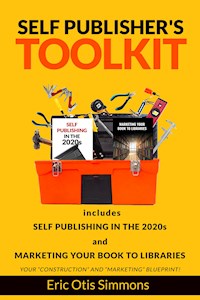
Self Publisher’s Toolkit is a two-in-one resource that shows you how to self publish a book and then market it to Libraries, a viable $30+ billion segment often overlooked by self publishers.
January 2019 to June 2020, Eric Otis Simmons’ self published books appeared 64 times on the leading online retailer’s “Best Sellers” list and in just over two years had been purchased by over 97 Libraries around the world. His article “
How To Get Your Book Into Libraries,” became the top Google search result, excluding Ads, out of over 2 billion, on the topic of “getting your book into libraries!”
Includes
Self Publishing in the 2020s and
Marketing Your Book to Libraries.
Your “Construction” and “Marketing” Blueprint!
Das E-Book können Sie in Legimi-Apps oder einer beliebigen App lesen, die das folgende Format unterstützen:
Veröffentlichungsjahr: 2020
Ähnliche

















ESETOMES is the brand name for titles written by Eric Otis Simmons. It is derived from, Eric Simmons Enterprises, Inc., followed by the word TOMES (books in a work of several volumes).
The “Self Publisher’s Toolkit” provides information on how to self publish a book, the steps typically involved, and some of the self publishing resources and “platforms” available. The reader is also provided information on how to engage a specific market segment, in this case, Libraries, with their self published work.
There is no guaranty made that self publishing of any book or other written or spoken language publication will generate any income, nor is there a guaranty of results. The same applies to the marketing of a self published book to a segment such as Libraries. In addition to the lack of any guaranty, express, or implied, there is also no express or implied warranty. Purchaser or any third party that receives this publication from a purchaser hereby acknowledges and agrees that the Author makes no representation or warranty, express or implied, at law or in equity, in any respect to any matter relating to the contents of this publication including, without limitation, any strategy, course of action, or other undertaking.
The Purchaser hereby waives any and all claims that may arise as a result of any actions or other activities or lack of same by the Purchaser or any third party that may or may not have resulted from the content contained within this Publication. Purchaser agrees to indemnify and defend the Author, the Author’s representatives, heirs, assigns, or designees against any and all claims by the Purchaser or any third party.
Self Publishers Toolkit
Copyright © 2020 by Eric Simmons Enterprises, Inc.
All rights are reserved.No part of this book may be reproduced or transmitted in any form or by any means without written permission from the Author.
Dedication
This book is dedicated to my mother, Wiletta. She touched many lives, especially mine, with her willingness to share information and knowledge with others, especially when she felt it would be helpful and beneficial.
Acknowledgments
My thanks to my wife, Cynthia, for supporting me in this writing endeavor. My appreciation also to the companies that have developed “platforms,” which enable us to share our self published works with others. Lastly, thank you to the hundreds of Librarians around the world for their vote of confidence in my written works.
About the Author
Without any prior book writing experience or knowledge of the publishing industry, on March 7, 2017, Eric Otis Simmons released his self published Memoir, “Not Far From The Tree.” From January 2019, when Simmons began tracking the book’s Amazon “Best Seller” sales results, through the date of this publication, the title had appeared on the list 24 times.
Eric, a Certified Webmaster, is the CEO/Founder of ESE, Inc., a website development firm. His company specializes in creating custom websites for Authors, Poets, compensation eligible College Athletes, High School Athletes, and others seeking to present their “Personal Brand” on the Internet for marketing, brand establishment, athletic recruitment, or similar purposes.His written works are copyrighted under the brand name of ESETOMES, which stands for ESE, Inc. plus the word TOMES (books in a work of several volumes).In addition to this book and his Memoir, his other self published titles, in order of publication are, “#HTSP - How to Self-Publish,” “ESETOMES Box Set,” an eBook compilation of his first two books and “Getting Your Book Into Libraries.” At the time of this publication, and since January 2019, his titles, combined, had made 37 appearances on Amazon’s “Best Seller” list and since January 2018, the books had been ranked in the “Top 1%” in worldwide sales 80 times and the “Top 10%,” 501 times. His article, “How To Get Your Book Into Libraries,” became the top Google search result, excluding Ads, out of over 2 billion results on the subject of “getting your book into libraries.” Simmons and his wife reside in metro Atlanta, and they have three adult children.
ESETOMES Books
Website - www.eseinc1.com/esetomes-books
Facebook - www.faceBook.com/esimmonsauthor
Twitter – www.twitter.com/esimmonsauthor
ESE, Inc.
Website - www.eseinc1.com
Facebook - www.facebook.com/ESE-Inc-1431136640304095/?ref=br_rs
Contents
Dedication
Acknowledgments
About the Author
Contents
Publisher versus Self Publishing
Chapter 1 - Self Publishing in the 2020s
MarketOutlook
The ABCs of Self Publishing
A – Write Your Book
B - Package Your Book
C - Channelize and Market Your Book
Chapter 2 - Marketing Your Book
Chapter 3 - Setting Up Your Book Business
Chapter 4 - Managing Your Book Business
Chapter 5 – Marketing Your Book to Libraries
Why Libraries?
Chapter 6 - Getting Started Marketing to Libraries
Chapter 7 - Building Your "Library Contacts Database"
Chapter 8 - Creating a "Mail Merge" Document
Chapter 9 – Tactics
Chapter 10 – Methodology Summary
References
Publisher versus Self Publishing
For many, the decision to self publish a book may be intuitive and come quickly, whereas, for others, validation may be needed as to whether one should go through a publisher or self publish. I fell into the latter category, even though I was pretty sure I wanted to self publish my first book. To validate the direction I felt I would be heading in, I decided to invest some time doing Google research to gain a better understanding of the differences between going through a publisher and taking the self publishing route. I came across an article entitled, “Pros And Cons Of Traditional Publishing vs Self-Publishing,” which proved quite beneficial. The piece was written by Joanna Penn, a best-selling Author who had transitioned from the traditional Publisher route to self publishing. After reviewing Penn’s information, I created a T-Chart with Publisher on the left side and Self Publish on the right. Underneath each heading, I listed the pros and cons. As a “visual learner,” I felt seeing information in this format would help me in deciding between the two alternatives.
When I concluded my research, I was able to confirm “Self Publishing” would be the best route for me because the “Pros” outweighed the “Cons,” in my view. Following is a synopsis of my notes from my research:
Publisher
Pros
Prestige
Distribution to bookstores via Sales Representatives
An Advance (i.e., upfront money) to the Author
Note: Per Penn, “…the advance is against royalties, which are usually 7-25% of the net book price. Royalties can be 10% on average. So, if you get an advance of $10,000, you then have to earn more than $10,000 out of your royalty rate on your book sales before you get any more money.”
Cons
Slow process. Could take 1-2.5 years before
your book launch
Royalties of
7-25% with the latter being generous. Hard to predict cash flow
Involves contracts and could be complex
May need an Agent
Self Publish
Pros
Total “
creative control
” over content and design
Faster time to market!
Higher Royalties.
Note: Amazon Kindle can be up to 70%!
Retain your rights to your book
Pick and choose who to sell your book to and through
Cons
Virtually, everything is on you
You may need to find:
A proofreader/editor
Cover Designer
The “Stigma” around Self Publishers (i.e., are you legit)
A lot of poorly written self published books
May be challenging to get into bookstores
Might be hard to get noticed for literary awards
Chapter 1
Self Publishing in the 2020s
Market Outlook
In researching the future of self publishing for this book, current indicators are, growth is expected for the industry in 2020 and beyond. In October 2019, Bowker, the exclusive U.S. agent for issuing International Standard Book Numbers (ISBNs), released findings from a study its affiliate ProQuest had conducted about the self publishing industry. ProQuest’s data revealed, “… self publishing grew at a rate of 40 percent in 2018 – and shows no signs of slowing down.” In the release, Beat Barblan, Vice President of Publishing and Data Services at Bowker and chairman of the board of the International ISBN Agency, is quoted as saying, “The self publishing landscape continues to improve, creating more and more opportunities for authors to manage their own path through the process.” Barblan also went on to say, “As more authors take advantage of the abundant tools now available to publish, distribute and market their own books, we expect that self publishing will continue to grow at a steady pace.”
In a Forbes.com October 2019 article, “While $26 Billion Publishing Industry Is Flat, This Vertical Segment Is Exploding. Leverage These Insights To Ride The Wave,” Bernhard Schroeder wrote, “An annual report from the Association of American Publishers indicated that the U.S. book publishing industry generated an estimated $26.23 billion in net revenue for 2017, representing 2.72 billion books. While this revenue is fairly flat, year over year, self publishing is rapidly rising with e-books, print on demand, and audiobooks bringing in billions of U.S. dollars in revenue each year.”
Self Publishing Jargon
To be able to “walk the walk” in the book world, you’ll find it helpful to be able to “talk the talk.” Familiarizing yourself with some of the “Lingo” used in the book “publishing” world will not only help boost your confidence when speaking with customers, fellow authors, and others; it can help enhance your credibility as well.
Due to my unfamiliarity with some of the terms used in the book publishing industry, early on in my self publishing career, I came close to what would have been an extremely embarrassing moment. I had emailed a Library some information about my first book, and I received a response back informing me the book had been sent over to the Library’s Collections Department for review. I became upset because I had no delinquent accounts with anyone and couldn’t imagine why a Collection Agency would be involved. Moments before I was about to fire off a blistering email to the Librarian who had emailed me, I decided to do a Google search to see if the word Collection meant something different in the Library world. It turns out the term refers to the books and other materials in a Library. Imagine how embarrassing it would have been if I had sent the email. I would have lost all credibility with the Library for not knowing what is perhaps their most widely used term. The following are a few terms used in the book publishing industry that I feel you should know so that you might avoid a potentially embarrassing moment like mine.
Independent Author, Indie, Indie Author, Self Publisher
In the book industry, you’ll hear terms such as Independent Author, Indie, Indie Author, and Self Publisher to describe you and me.
Title
Oxford Dictionary defines title as the name of a book, composition, or other artistic work.
Genre




