


48,99 €
Mehr erfahren.
- Herausgeber: John Wiley & Sons
- Kategorie: Fachliteratur
- Serie: Wiley Trading Series
- Sprache: Englisch
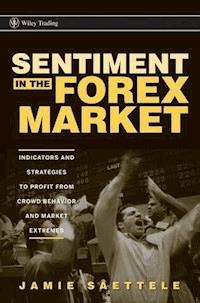
Crowds move markets and at major market turning points, the crowds are almost always wrong. When crowd sentiment is overwhelmingly positive or overwhelmingly negative ? it's a signal that the trend is exhausted and the market is ready to move powerfully in the opposite direction. Sentiment has long been a tool used by equity, futures, and options traders. In Sentiment in the Forex Market, FXCM analyst Jaime Saettele applies sentiment analysis to the currency market, using both traditional and new sentiment indicators, including: Commitment of Traders reports; time cycles; pivot points; oscillators; and Fibonacci time and price ratios. He also explains how to interpret news coverage of the markets to get a sense of when participants have become overly bullish or bearish. Saettele points out that several famous traders such as George Soros and Robert Prechter made huge profits by identifying shifts in crowd sentiment at major market turning points. Many individual traders lose money in the currency market, Saettele asserts, because they are too short-term oriented and trade impulsively. He believes retail traders would be much more successful if they adopted a longer-term, contrarian approach, utilizing sentiment indicators to position themselves at the beginning points of major trends.
Sie lesen das E-Book in den Legimi-Apps auf:
Seitenzahl: 249
Veröffentlichungsjahr: 2012
Ähnliche



















Contents
Title
Copyright
Dedication
Preface
Acknowledgments
Chapter 1: The Argument for a Sentiment-Based Approach
What is Fundamental?
Top-Down Approach
Reminiscences of a Stock Operator
Chapter 2: The Problem with Fundamental Analysis
How the Human Brain Works
The Myth of Economic Indicators
Nonfarm Payrolls
Gross Domestic Product
Trade Balance
Treasury International Capital
Producer and Consumer Price Indexes
Conclusion
Chapter 3: The Power of Magazine Covers
The Death of Equities—August 13, 1979
Magazine Covers in the Currency Market
Conclusion
Chapter 4: Using News Headlines to Generate Signals
Where to Look
Conclusion
Chapter 5: Sentiment Indicators
Commitments of Traders Reports
History of U.S. Futures Trading
Currency Futures History
Reading the COT Report
Using COT Data with Spot FX Price Charts
Understanding the Data
Watching the Commercials
Watching the Speculators
Commercial and Speculators Give the Same Signal
The Approach
Open Interest
Other Sentiment Indicators
Conclusion
Chapter 6: The Power of Technical Indicators
What is Technical Analysis?
Keep it Simple
What Time Frames to Use?
Support and Resistance
Determining a Bias
Fancy Momentum Indicators and Overbought/Oversold
When to Get Out
Chapter 7: Explanation of Elliott Wave and Fibonacci
Who Was Elliott?
Fibonacci: The Mathematical Foundation
Ratios
Specific Setups
Some Differences between Stocks and FX in Elliott
Building Up from Lower Time Frames
Multiyear Forecast for the U.S. Dollar
Multiyear Forecast for the USDJPY
Conclusion
Chapter 8: Putting it All Together
Why Most Traders Lose
Developing a Process
In Conclusion
Index
Copyright © 2008 by Jamie Saettele. All rights reserved.
Published by John Wiley & Sons, Inc., Hoboken, New Jersey.
Published simultaneously in Canada.
No part of this publication may be reproduced, stored in a retrieval system, or transmitted in any form or by any means, electronic, mechanical, photocopying, recording, scanning, or otherwise, except as permitted under Section 107 or 108 of the 1976 United States Copyright Act, without either the prior written permission of the Publisher, or authorization through payment of the appropriate per-copy fee to the Copyright Clearance Center, Inc., 222 Rosewood Drive, Danvers, MA 01923, (978) 750-8400, fax (978) 750-4470, or on the web at www.copyright.com. Requests to the Publisher for permission should be addressed to the Permissions Department, John Wiley & Sons, Inc., 111 River Street, Hoboken, NJ 07030, (201) 748-6011, fax (201) 748-6008, or online at http://www.wiley.com/go/permissions.
Limit of Liability/Disclaimer of Warranty: While the publisher and author have used their best efforts in preparing this book, they make no representations or warranties with respect to the accuracy or completeness of the contents of this book and specifically disclaim any implied warranties of merchantability or fitness for a particular purpose. No warranty may be created or extended by sales representatives or written sales materials. The advice and strategies contained herein may not be suitable for your situation. You should consult with a professional where appropriate. Neither the publisher nor author shall be liable for any loss of profit or any other commercial damages, including but not limited to special, incidental, consequential, or other damages.
For general information on our other products and services or for technical support, please contact our Customer Care Department within the United States at (800) 762-2974, outside the United States at (317) 572-3993 or fax (317) 572-4002.
Wiley also publishes its books in a variety of electronic formats. Some content that appears in print may not be available in electronic books. For more information about Wiley products, visit our web site at www.wiley.com.
Library of Congress Cataloging-in-Publication Data
Saettele, Jamie, 1982–
Sentiment in the forex market : indicators and strategies to profit from crowd behavior and market extremes / Jamie Saettele.
p. cm.—(Wiley trading series)
Includes bibliographical references and index.
ISBN 978-0-470-20823-6 (cloth)
1. Foreign exchange market. 2. Foreign exchange futures. 3. Investment analysis. I. Title.
HG3851.S23 2008
332.4′5—dc22
2008006112
To my parents, whose Love inspires me.
Preface
As public interest in the FX market has skyrocketed, so too has the amount of technical and fundamental research available to aspiring traders. An area that has failed to receive the same amount of attention is often considered part of the technical approach: sentiment. After the news releases are digested by floor traders, the fundamentals digested by economists, and the latest comments from the central banker are dissected, the market’s trend is still a product of underlying sentiment. That is the premise of this book. Much (if not most) of the information fed to retail traders is of little use when it comes to making money by trading. Trading is hardly as simple as buying or selling, because an economic indicator is good or bad. Similarly, the game is not as black or white as buying or selling, because price is above or below a moving average.
For one, I hope to prove that traditional approaches such as the economic indicator approach do not work. No consistent correlation exists between the U.S. dollar and U.S. economic indicators, but conventional wisdom says that the two move in lockstep. Why is this approach followed so fervently if its foundation is rooted in falsities? The reason that markets move in identifiable patterns is probably the same reason that many accept as gospel the conventional approaches to market analysis and trading that have marginally successful track records at best. That reason is the propensity for humans to follow the crowd, especially in situations as emotionally driven as trading. Although there are no doubt very successful news traders, the cost to the trader is significant: an expensive machine such as Bloomberg or Reuters, turbulent market conditions just after a news release, and most important—the emotional impulses that are our worst enemy in trading are heightened, and the ability to make a rational decision just after a news release is greatly reduced. I think that I can share with you a better (and cheaper) approach to analyzing and trading the FX market, an approach that will give you an edge, if only because you are not following the crowd.
Sentiment indicators such as the Commitments of Traders reports are followed by many market participants, but I have developed indicators with the data that are meant to pinpoint the few times each year that a market is likely to reverse. This helps to solve one of the biggest obstacles that many face: over-trading. By limiting yourself to making a decision when a specific set of circumstances are met, you are helping to solve the over-trading problem. Unconventional sentiment indicators such as news headlines and magazine covers offer some of the best trading signals every year. Not to be forgotten are more traditional technical tools such as RSI and slow stochastics. Is the conventional use, to indicate overbought and oversold levels, really the best way to go? I think that there is a better way.
What you will not find in this book are trade setups with rigid rules or money management tips. Markets are dynamic and the trader should be also. Money management will be different for everyone because everyone has an entirely different risk tolerance. What I hope that this book provides is a way for you to look at a specific market (and maybe others) for what it truly is: a collection of its participants that create a mind of its own, whose moves are endogenous in nature but, because of that very reason, can be exploited for profit.
Acknowledgments
I want to thank everyone that I work with at DailyFX but in particular Kathy Lien, who gave me a chance at DailyFX and convinced me to pursue this endeavor, Antonio Sousa, whose help with program trading through the years is indispensable, and Boris Schlossberg. Although Boris and I disagree on almost everything market related, he has helped me realize that more perspectives lead to a better perspective.
Chapter 1
The Argument for a Sentiment-Based Approach
At its core, sentiment is a general thought, feeling, or sense. In free markets, sentiment refers to the feelings and emotions of market participants. All of the participants’ feelings toward a specific market result in a dominant psychology that is either optimistic or pessimistic. Every change in price results from a change in the balance between optimism and pessimism. Price itself is a result of where collective psychology lies in the never-ending oscillation between optimism and pessimism. As oscillation suggests, the psychological state of a market experiences peaks (optimistic extreme) and troughs (pessimistic extreme). These sentiment extremes are what affect market tops and bottoms.
In the 1932 edition of Charles Mackay’s classic Extraordinary Popular Delusions and the Madness of Crowds, Bernard Baruch wrote in the foreword that “all economic movements, by their very nature, are motivated by crowd psychology.” Baruch went on to write in the same foreword that “without due recognition of crowd-thinking (which often seems crowd-madness) our theories of economics leave much to be desired.”1 It seems that so many, if not most, of the members of the financial community seem to forget these basic truths. Analysts, traders, and financial media members attribute reasons to price movements with an uncanny ease.
Lesen Sie weiter in der vollständigen Ausgabe!
Lesen Sie weiter in der vollständigen Ausgabe!
Lesen Sie weiter in der vollständigen Ausgabe!
Lesen Sie weiter in der vollständigen Ausgabe!
Lesen Sie weiter in der vollständigen Ausgabe!
Lesen Sie weiter in der vollständigen Ausgabe!
Lesen Sie weiter in der vollständigen Ausgabe!
Lesen Sie weiter in der vollständigen Ausgabe!




