


16,99 €
Mehr erfahren.
- Herausgeber: John Wiley & Sons
- Kategorie: Geisteswissenschaft
- Serie: Critical South
- Sprache: Englisch
This important intervention interrogates keystone features of the dominant European theoretical landscape in the field of populism studies, advancing existing debates and introducing new avenues of thought, in conjunction with insights from the contemporary Latin American political experience and perspectives. In each essay – the title a nod to the influential socialist thinker José Carlos Mariátegui, from whom the authors draw inspiration – leading Argentine scholars Paula Biglieri and Luciana Cadahia pair key dimensions of populism with diverse themes such as modern-day feminism, militancy, and neoliberalism, in order to stimulate discussion surrounding the constitutive nature, goals, and potential of populist social movements.
Biglieri and Cadahia are unafraid to court provocation in their frank assessment of populism as a force which could bring about essential emancipatory social change to confront emerging right-wing trends in policy and leadership. At the same time, this fresh interpretation of a much-maligned political articulation is balanced by their denunciation of right-aligned populisms and their failure to bring to bear a sustainable alternative to contemporary neo-authoritarian forms of neoliberalism. In their place, they articulate a populism which offers a viable means of mobilizing a response to hegemonic forms of neoliberal discourse and government.
Das E-Book können Sie in Legimi-Apps oder einer beliebigen App lesen, die das folgende Format unterstützen:
Seitenzahl: 339
Veröffentlichungsjahr: 2021
Ähnliche



















Table of Contents
Cover
Series Title
Title Page
Copyright Page
Epigraph
Foreword – Wendy Brown
Notes
Introduction
Notes
Essay 1 The Secret of Populism
The returns of populism
Modernization, class struggle, and the constitutive dimension of the political
Populism as ontology of the political
Notes
Essay 2 Neither Left nor Right: Populism without Apology
Populism, left and right?
Is all populism right-wing?
Just populism
Populism without apology
Notes
Essay 3 Against Neoliberal Fascism: From Sacrificial Identity to Egalitarian Singularity
Is populism a form of neoliberalism?
The prejudices of the liberal, anti-communist left
Autonomism: the opium of the people
Populism as transitional object?
Populism: antithesis of neoliberalism
Notes
Essay 4 Profaning the Public: The Plebeian Dimension of Republican Populism
Is populism anti-institutionalist?
Ruptural institutionality
Plebeian republicanism
Toward a republican populism?
Notes
Essay 5 Toward an Internationalist Populism
The beautiful souls of pure causes
The people and its leader
Toward an internationalist populism
Notes
Essay 6 The Absent Cause of Populist Militancy
Post-foundationalism and the absence of guarantees
Neither the cemetery nor the madhouse
The three militant questions
Notes
Essay 7 We Populists are Feminists
Let’s imagine the future
Feminism without identitarian closure
Populist feminism (or the antagonism of care)
Feminist populism (or the homeland is the other)
Notes
Bibliography
Index
End User License Agreement
Guide
Cover
Table of Contents
Begin Reading
Pages
ii
iii
iv
vi
vii
viii
ix
x
xi
xii
xiii
xiv
xv
xvi
xvii
xviii
xix
xx
xxi
133
134
xxii
xxiii
xxiv
xxv
xxvi
xxvii
xxviii
135
1
2
3
4
5
6
7
8
9
10
11
12
13
14
15
16
17
18
19
136
20
21
22
23
24
25
26
27
28
29
30
31
32
33
34
35
36
37
38
39
40
137
41
42
43
44
45
46
47
48
49
50
51
52
53
54
55
56
57
58
59
60
61
138
62
63
64
65
66
67
68
69
70
71
72
73
74
75
139
76
77
78
79
80
81
82
83
84
85
86
87
88
89
90
91
92
93
94
95
96
97
98
99
140
141
142
100
101
102
103
104
105
106
107
108
109
110
111
112
113
114
143
144
115
116
117
118
119
120
121
122
123
124
125
126
127
128
129
130
131
132
145
146
147
148
149
150
151
152
153
154
155
156
157
158
159
160
161
162
163
164
165
166
167
168
169
170
171
172
173
174
175
176
177
Series Title
Critical South
The publication of this series is supported by the International Consortium of Critical Theory Programs funded by the Andrew W. Mellon Foundation.
Series editors: Natalia Brizuela and Leticia Sabsay
Leonor Arfuch,
Memory and Autobiography
Paula Biglieri and Luciana Cadahia,
Seven Essays on Populism
Aimé Césaire,
Resolutely Black
Bolívar Echeverría,
Modernity and “Whiteness”
Celso Furtado,
The Myth of Economic Development
Eduardo Grüner,
The Haitian Revolution
Karima Lazali,
Colonia Trauma
María Pia López,
Not One Less
Pablo Oyarzun,
Doing Justice
Néstor Perlongher,
Plebeian Prose
Nelly Richard,
Eruptions of Memory
Silvia Rivera Cusicanqui,
Ch’ixinakax Utxiwa
Tendayi Sithole,
The Black Register
Seven Essays on Populism
For a Renewed Theoretical Perspective
Paula Biglieri and Luciana Cadahia
Translated by George Ciccariello-Maher
polity
Copyright Page
Copyright © Paula Biglieri and Luciana Cadahia, 2021
This English edition © 2021 by Polity Press
Excerpt from the article “The Populist Challenge to Liberal Democracy” by William Galston, Journal of Democracy 29:2 (2018), 5–19. © 2018 National Endowment for Democracy and the Johns Hopkins University Press. Reprinted with permission of Johns Hopkins University Press.
Excerpt from the article “How populist uprisings could bring down liberal democracy” by Yascha Mounk, The Guardian, March 2018 © Guardian News & Media Ltd 2020. Reprinted with permission of The Guardian.
Polity Press
65 Bridge Street
Cambridge CB2 1UR, UK
Polity Press
101 Station Landing
Suite 300
Medford, MA 02155, USA
All rights reserved. Except for the quotation of short passages for the purpose of criticism and review, no part of this publication may be reproduced, stored in a retrieval system, or transmitted, in any form or by any means, electronic, mechanical, photocopying, recording, or otherwise, without the prior permission of the publisher.
ISBN-13: 978-1-5095-4220-8 – hardback
ISBN-13: 978-1-5095-4221-5 – paperback
A catalogue record for this book is available from the British Library.
Library of Congress Cataloging-in-Publication Data
Names: Biglieri, Paula, author. | Cadahia, Luciana, 1982- author.
Title: Seven essays on populism : for a renewed theoretical perspective / Paula Biglieri and Luciana Cadahia ; translated by George Ciccariello-Maher.
Description: English Edition. | Medford : Polity Press, 2021. | Series: Critical South | Includes bibliographical references and index. | Summary: “A critical exploration of the meaning and potential of populism in contemporary political thought”-- Provided by publisher.
Identifiers: LCCN 2020027959 (print) | LCCN 2020027960 (ebook) | ISBN 9781509542208 (Hardback) | ISBN 9781509542215 (Paperback) | ISBN 9781509542222 (ePub) | ISBN 9781509547029 (Adobe PDF)
Subjects: LCSH: Populism.
Classification: LCC JC423 .B53 2021 (print) | LCC JC423 (ebook) | DDC 320.56/62--dc23
LC record available at https://lccn.loc.gov/2020027959
LC ebook record available at https://lccn.loc.gov/2020027960
by Fakenham Prepress Solutions, Fakenham, Norfolk NR21 8NL
The publisher has used its best endeavors to ensure that the URLs for external websites referred to in this book are correct and active at the time of going to press. However, the publisher has no responsibility for the websites and can make no guarantee that a site will remain live or that the content is or will remain appropriate.
Every effort has been made to trace all copyright holders, but if any have been overlooked the publisher will be pleased to include any necessary credits in any subsequent reprint or edition.
For further information on Polity, visit our website: politybooks.com
Tarsila do Amaral (1886–1973) is one of the most prominent representatives of Latin American modernism and one of the most renowned artists in Brazil. Her work Abaporu, 1928, inspired the Anthropophagic Movement in the plastic arts. To learn more: www.tarsiladoamaral.com.br.
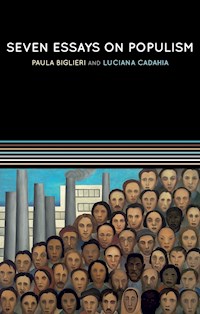
Her work Operários, 1933, is featured on the cover of this book and was created during the social phase of the artist’s work, after she returned from Russia.
Epigraph
Stand up, you who know how to feel and do not suffer the painful frigidity of academics.
Jorge Eliécer Gaitán
ForewordWendy Brown
Democracies are generally thought to die at the barrel of a gun, in coups and revolutions. These days, however, they are more likely to be strangled slowly in the name of the people.
The Economist, August 2019
... leftist populism is a profound error. It has no chance of matching the populist appeal of the right, and it dangerously validates some of the right’s arguments.
Tony Blair, The New York Times, March 2017
There can no longer be any doubt that we are going through a populist moment. The question is whether this populist moment will turn into a populist age – and cast the very survival of liberal democracy in doubt.
Yascha Mounk, The Guardian, March 2018
The People vs. Democracy
Title of Yascha Mounk’s 2018 book
When populists distinguish between the “people” and the “elite,” they depict each of these groups as homogeneous. Populism is the enemy of pluralism, and thus of modern democracy.
William Galston, “The Populist Challenge to Liberal Democracy”1
Mainstream political discourse today, both scholarly and journalistic, equates populism with hard-right mobilizations animated by zealous passion born of resentment and led by irresponsible demagogues. Populism is presumed anti-liberal in every sense of the word, as well as disdainful of Constitutionalism, universalism, limited state power, and democratic institutions. The discourse also holds populism responsible for bringing to power authoritarian, ethno-nationalist regimes around the globe, threatening the disintegration of the European Union and endangering the civilizing and civilized reign of liberal democratic values. It is figured as rightist in essence, or, as the case of Venezuela is believed to demonstrate, as inevitably turning autocratic or despotic.2 It is cast as embodying a simplistic and binaristic worldview, feeding on economic and cultural vulnerability, and rejecting facticity, truth, and expertise, as well as inclusion, pluralism, and tolerance.3 It is ugly to the core.
This vilification of populism is not unique to the present moment. Rather, Biglieri and Cadahia teach us in this rich and erudite work, populism has always been in disrepute. This is true in Europe where right-wing populism requires no modifier, and left or democratic populism are oxymorons. It is true in the United States, notwithstanding its rich history of populist rebellion against control of local and national government by financial elites. It is true in Latin America, where populism is associated with Peronism and socialism, neoliberalism and Chavismo. Populism, Biglieri and Cadahia remind us, has been disparaged by liberals and Marxists, globalists and institutionalists, social engineers and free-marketeers, oligarchic republicans and egalitarian social democrats, colonial managers and their postcolonial elite successors. It has been charged with deviating from true class struggle, symptomizing mal-development or failure to modernize, expressing social-psychic primitivism or regression to the mob, rebelling against democratic constraints and institutions, assaulting liberal universalism and inclusion, abhorring cosmopolitanism and globalism, and rebuffing expert and technical knowledge.
As the malignancies discursively associated with populism proliferate and diversify, how might we read this overdetermined outrage and see what it unwillingly confesses? Perhaps, Biglieri and Cadahia declare, populism’s threatening force carries an emancipatory secret, “the secret of the people” (1). Perhaps the horror of populism carries a horror of the people, especially of a politics of the people, the power of the people, real democracy. This is the suspicion that animates Seven Essays on Populism, a work situated in the history and politics of Latin America but fashioned from a richly international theoretical arsenal. This suspicion fuels the authors’ twofold bid to defend populism against all comers and to address populism’s internal challenges – its potential complicity with neoliberalism, exclusionary nationalisms, authoritarian leaders, mob affect, machismo, and more. Thus, a book that begins by cleaning centuries of mud from its object develops by helping that object meet contemporary political challenges. Biglieri and Cadahia want to redeem populism, to be sure, but also to contribute to its theoretical and political development for 21st-century “militant” left struggles.4
A theoretical orientation and apparatus are immensely helpful when undertaking a task of this magnitude. Theory helps to parse the sloppy ways the term has been bandied about, and to diagnose the hyperbole and the metonymic slide between its pejorative associations –“the aesthetically ugly, the morally evil, a lack of civic culture, contempt for institutions, [rife with] demagoguery, and irrationality” (4). Theory permits critical analysis of populism’s identification with historical backwardness and “regression,” revealing the conceits of modernity, modernization theory, and Orientalism on which this identification draws (5). Theory permits an exposé of the philosophical premises and political frames of liberal and left critiques of populism. Above all, theory permits Biglieri and Cadahia to formulate what they term the logics – rather than only the empirics – of populism, and thus disrupts the casual epistemological positivism fueling much of its opposition and securing the intellectual confidence of its enemies.
Biglieri and Cadahia are rigorous and imaginative theorists in their own right. They are also dedicated students of philosopher Ernesto Laclau, whom they identify as the first and most important contemporary thinker to lift populism from the dirt and make it central to rethinking the nature of “the political.” Through his own writing and the collaborative academic sites he helped to create in Essex and Buenos Aires, Laclau bore down on the “excess” that populism is always accused of generating to discover logics in that excess that precisely challenge the logics of liberalism and, later, neoliberalism. Populism, Laclau showed, challenges the liberal logics by which citizenship is always imagined individualized, power is imagined appropriately institutionalized, problems are imagined isolated from one another, and democratic popular sovereignty is reduced to voting and representation. Populism contests each of these as it brings into being “the people” in place of the citizen or voter; a “frontier” of contest between the people and the elite in place of isolated social problems; a “populist rupture” in place of referral of problems to institutions; and a counter-hegemonic struggle for a different order in place of popular sovereignty identified with parliamentary democracy.
For Laclau, these challenges to liberal political logics do not mean that populism is anti-democratic or assaults democracy. Rather, populism radicalizes expectations of and forms for democracy as it explodes liberal democratic fictions of institutional (and linguistic) neutrality and depoliticized social problems. Far from attacking democracy, populism for Laclau (and his sometimes co-author Chantal Mouffe) entails democracy’s radicalization and its dissemination beyond the formally political to domains conventionally designated as social and economic. Populism permits extension of democratic critiques and democratic demands to those subjected or excluded across a range of identities and experiences. Populism rejects both the (Marxist) reduction of oppression to class and the (liberal) reduction of exclusion or inequality to absent rights.
Let us take this more slowly. Far from being inherently right-wing reaction, for Laclau populism comprises a set of logics, a set of principles and a set of critiques. Above all, for Laclau, populism reveals “the ontology of the political.” By this, Laclau does not mean that populist content is the Ur spirit of politics, its ultimate truth and meaning. Nor does he mean that either populism or the political have fixed foundations or essential elements. On the contrary, Laclau’s insistence on populism’s revelation of the ontology of the political is relentlessly postfoundational; it corresponds to the absence of foundations and essences in political life. Far from being found in God, nature, reason or axioms of history, all political claims and formations are created, generated from militancy aspiring to hegemony. And populism’s subject, “the people,” is itself an empty signifier – articulated, rather than found or given, and irreducible to any specific population.
Populism’s status as the ontology of the political, then, correlates populism’s alleged “shiftiness” with the lack of foundations, fixed significations, and strict referents in the political. Thus, Laclau retorts to the charges that populism comprises vague, affective, and rhetorical discourse: “instead of counter-posing ‘vagueness’ to a mature political logic … we should start asking ourselves … ‘is not the “vagueness” of populist discourses the consequence of social reality itself being, in some situations, vague and undetermined?’” (Laclau, 2005a: 17). Instead of condemning populism’s “rhetorical excesses” and simplifications, he suggests, populism reveals rhetoric as fundamental to political life and at the heart of the constitution of political identities (2005a: 18–19). Instead of treating the eruption of politicized social demands as a dangerous disruption to liberal democratic norms – as a political malady – populism reveals social antagonisms as at the basis of all politics.
For Laclau, then, far from being a fallen form of politics, “populism is the royal road to understanding something about the ontological constitution of the political as such” (2005a: 67). We might also put this the other way around. Through the lens of populism, we can see just how profoundly anti-political much of Western political life and political theory has been. From Platonism and Marxism through liberalism and neoliberalism, most theory and practice aims at taming, reducing or disavowing the qualities of the political overtly expressed in populism – antagonism, rhetoric, constituted identity, indeterminacy and, above all, the power of the people. Most political theory and practice in the Western tradition has aimed at extinguishing these elements and instead identified “management of community [as] the concern of an administrative power whose source of legitimacy is a proper knowledge of what a ‘good’ community is” (2005a: x). Exceptions to this anti-political orientation are few and rare. There is Machiavelli, with his subtle appreciation of political drama, effect and affect, of invented formations and alliances, and his recognition that the health of republics, far from being endangered by popular “tumults,” is secured by them. There is Tocqueville, writing in the democratic (as opposed to oligarchic) republican tradition, who grasped the value for democracy – along with the messiness – of cultivating an energized people ambitious to share political power for purposes beyond pursuit of individual or class interests. And there is Gramsci, that ardent student of Machiavelli and not only Marx, who theorized the importance of actively linking popular struggles to articulate a new hegemonic bloc. Today, there are also left Schmittians, Deleuzians, and radical democrats, but they hold a tellingly small place in contemporary political theory, where liberal approaches reiterate the long tradition of attempting to expunge from politics contingency, fabrication, rhetoric, antagonism, agonism, and the popular – all that constitutes the political from a populist perspective.
Biglieri and Cadahia broadly endorse Laclau’s identification of populism with the ontology of the political. They focus especially on the aspect of this identification that features the transformation of different social antagonisms into allied political ones. As a politics that is explicitly made not born, a politics that does not express these social antagonisms directly and individually but, rather, actively (militantly) crafts them into a hegemonic formation opposing powerlessness to power, populism invents a new dividing line and the identities on both sides of it: “the underdog” versus the “power” in Laclau’s words, “the people versus the enemies of the people” in those of Biglieri and Cadahia (16). Here, they pursue Laclau’s alertness to populism’s unique alchemical capacity to transform segmented, siloed, or what he called differential demands into an equivalential relation with one another. This is the transformation that de-individuates these demands, developing instead a political frontier between the people and the power, a frontier that in turn opens new political possibilities and imaginaries. This is the alchemy that permits a critical perspective on and challenge to the discourse, organization, and arrangements, not merely the distributions, of the status quo. This is an alchemy that explodes the limits of the interest group pluralism of liberalism and the class politics of Marxism while remaining legible to and in present discourses. Therein lies populism’s deep immediate radical potential.
As they pursue this line of thinking, populism emerges not merely as a but the political form capable of challenging liberal individualization and depoliticization in the present. As it releases interests and identities from their silos, it substantively links – without dissolving – these identities to form a counter-hegemony that indicts the status quo and opposes the political power securing it. Populism reconfigures the excluded and dispossessed as articulating “different demands with one another until achieving an equivalential chain capable of challenging the status quo and establishing a frontier between those on the bottom (the articulated people) and those on top (the status quo)” (14). The “people” or the “plebs,” previously discounted, fragmented, and separated from each other, at once claim representation of the whole and politicize their exclusion (16).
In the United States, the best recent exemplar of the populist alchemy Biglieri and Cadahia are theorizing is not the white Americans constituting Trump’s base of support in 2016, but the 99% of the Occupy Movement earlier in the decade. The 99% comprised all sectors of labor, people of color, the indebted, the indigenous, the unbanked, the undocumented, the unhoused, the under-educated, the overcharged, the poor, working, and middle classes. The 99% was not a class, an identity or even an intentional coalition. Nor was its opposition only the state, the bosses, the bankers, the corporations or the rich. Rather, the 99% designated a people excluded, exploited, bilked, and disenfranchized; the “power” it opposed was the plutocrats. The 99% and the 1% identified the losers and winners of neoliberalism, privatization, financialization, and government bailouts in the aftermath of the 2008–9 financial crisis. The 99% included democracy itself and the well-being of the planet; the 1% extended to the Supreme Court majority and the international Davos crowd.5 Everything plundered, devalued or made precarious by capitalist plutocracy was linked in the aspirational hegemonic bloc of the 99%.
If Laclau’s bold move to identify populism with the political is troubled by the difficulty of stipulating the political, he surely succeeds in recovering populism from its derogatory associations to reveal its insurrectionary and radical democratic potential. However, more still is needed to unfasten it decisively from right-wing popular mobilizations supporting authoritarian leaders or regimes, and especially from ethno-nationalism and fascism. This unfastening is the key aim of Biglieri and Cadahia’s work. To achieve it, they carefully elaborate and dismantle the premises undergirding mainstream and left anti-populist critiques, including those of Eric Fassin, Slavoj Žižek, and Maurizio Lazzarato. They also critically analyze the claims of closer allies – Chantal Mouffe, Oliver Marchart and Yannis Stavrakakis – that populism may take right-wing forms but is equally available to left, emancipatory, another-world-is-possible democratic demands. Going a remarkable step further, Biglieri and Cadahia argue that populism is only left, only radically democratic, only anti-authoritarian, only the final and full realization of equality, liberty, universality, and community. Populism, they argue, is the emancipatory revolutionary theory and practice for our time. Conversely, what pundits call “populism” ought to be called by its true name: fascism.
Only left populism is populism, all other movements in the name of “the people” are fascist – how is such a claim possible? How, especially, can it be developed from a Laclauian formulation of populism in which “the people” is an empty signifier – always rhetorically designated, always a part representing the whole, always brought into being through articulations in every sense of the word? And how does this argument square with the worldwide eruption of what almost everyone calls authoritarian populism? How can these reactionary formations be purged from the populist treasure chest, and how is left populism purged of its persistent flirtation with non-democratic practices, especially given its connection to strong leaders and uncompromising demands?
The arguments Biglieri and Cadahia develop for this claim depend upon but exceed Laclau’s. For Biglieri and Cadahia, the equivalential relation that Laclau establishes as constitutive of a populist formation is sustained only when equality is achieved through heterogeneity, through embrace rather than expulsion or erasure of differences. They cite Jorge Alemán: “The pueblo is an unstable equivalence constituted by differences that never unify or represent the whole” (2016: 21). The people, they insist, is brought into being not through unification or homogenized difference but only through antagonism to the elite or dominant power. If heterogeneity is constitutive of a populist formation, then only by sustaining it does populism remain populism; only by sustaining it does “the people” remain an emancipatory formulation that insists on equality and justice for all.
Right-wing popular formations, by contrast, suppress difference to make and assert the “one people.” Right-wing formations make identity and equality dependent on suppression of difference internally, and exclusion of difference externally (38). Here drawing on Bataille, Biglieri and Cadahia insist that what distinguishes populism from right-wing popular movements is the latter’s fantasy of the homogeneity that signifies both “the commensurability of elements and [political] awareness of this commensurability” (39). Commensurability of elements and the unity and oneness it achieves depend on identifying equality with sameness and inequality with difference. Because it “involves the violence of trying to dissolve the play of difference–equivalence into a broader identity … a self-transparent people,” it is an essentially repressive and violent formulation and formation (39). To return to Laclau’s terms, the commensurability of elements, and the equality and unity staged through this commensurability, is fundamentally at odds with the equivalential logic or premise of populism. The right-wing “fantasy of the one-people that contains the longing for a life without problems or antagonisms within the tranquility of a homogeneous social space” cannot tolerate the “constitutive differences of the articulatory logic of populism” (39). Then, Biglieri and Cadahia wonder, “should we continue to call it populism, especially when the classic term ‘fascism’ exists?” (39). Their answer is definitive. What the pundits call authoritarian populism is no populism at all.
Having ripped away populism from right-wing popular formations, two projects remain. One is to unthread populism from its potential solicitude toward, and imbrication with, neoliberalism, nationalism, authoritarian leadership, state centrism, anti-institutionalism, and naturalism. The other is to connect populism decisively to socialism, feminism, radical democracy, popular sovereignty, international solidarity, ethics, and a politics of care. This is what Biglieri and Cadahia do across the last five essays of the book.
By now, the reader’s curiosity is piqued – how do they do it? – but also likely suspicious about the grandness, even grandiosity, of the project. It is one thing to redeem populism from ignorant punditry, anxious liberalism, colonial and modernization frames, or condemnations by unreconstructed Marxists. It is another to make populism so righteous, so complete, always landing on the correct square of every contemporary political challenge. Have Biglieri and Cadahia perhaps offered a new political theology, a political form both perfect in itself and inherently insulated from all that might compromise or sully it? If the political domain is open in signification, composition and direction, if it has no historical necessity and is rife with contingency, how and why would or could populist uprisings have such perfection and immunity? If the domain of politics is a realm of contingency, “without guarantees,” open to eruptions and alterations – if empty signifiers like “the people,” “freedom” or “feminism” can chime with many possible meanings – what does it mean to arrest this openness, these slides, with arguments about populism’s inherent ideational logics? Indeed, what does it mean to bring logics to this realm at all? Or to insist on populism’s insulation from dark forces through its logics? How can any political paradigm or formation be secured from imbrications with violence? Or escape the re-significations or inversions produced by genealogical fusions and transmogrifications? How do theoretical stipulations secure an object in a domain that does not submit to them? Or, to shift the register from Foucault and Gramsci to Weber, if the domain of the political is where ends and means have no necessary relation, and where certain political means easily overwhelm or subdue the ends they are adduced to serve, what protects populism against these things?
In short, have Biglieri and Cadahia not gone too far, over-played the hand they meant to win? Have they not pressed past their compelling redemption of the potential of left populism to insist that populism alone holds the promise of an emancipatory politics in the twenty-first century? Is there, perhaps, a confession of illegitimate desire here? A desire for populism to be not only “the royal road to understanding the political,” as Laclau argued, but the royal road to the Good, the True, and the Beautiful in politics … and, hence, beyond the political after all?
Still, we would do well to remember that most political concepts invite something of this kind from their partisans, both inside and outside political theory. Hence the many textual and activist efforts to redeem liberalism from its corruscation by neoliberalism, by right-wing libertarianism or by authoritarians. Or to distinguish democracy from market democracy, social democracy or even liberal democracy. Or to distinguish true communism from its repressive state form, or preserve feminism from its bourgeois or imperialist mode. From the protest chant, “this is what democracy looks like!” to scholarly identification of democracy with anti-populist norms and institutions by Levitsky and Ziblatt, to insistence on democracy’s agonistic nature by Mouffe, and its fugitive nature by Wolin, there is relentless normative stipulation of concepts in political theory and practice. That is what we do with open concepts, with sliding signification, when, as Stuart Hall reminds us, efforts to arrest that slide are at the heart of political struggle. If these are routine practices in politically invested political theory, even – and, perhaps, especially – in genres cloaking themselves in analytic objectivity yet deeply invested in liberalism, why deny this cleansing and redemption for populism? Especially if we remember the founding frame of Biglieri and Cadahia’s work – namely, that such a cleansing and redemption of populism is symptomatically refused by all who fear the power of the people, the politics of the people.
Let us try the question differently then. Readers would be counseled to ask not whether Biglieri and Cadahia’s formulations of populism’s inherently emancipatory force squares with “actually existing populism” (a historical–empirical question), or whether their identification of populism with the Good fully squares with a theory of the political foregrounding absent foundations, contingency and empty or floating signifiers. Rather, let us ask only whether Biglieri and Cadahia, as politically engaged political theorists, have developed a persuasive political theory of populism’s inherent and possible qualities, logics, limits, and potentials.
To answer this question, two others must be posed. Can a political paradigm, form or ideal be defended or protected on the basis of theoretical logics imputed to it? And can the deficiencies or vulnerabilities of political forms, paradigms or ideals be resolved at the level of theory? The first queries both whether such logics exist at all – whether, indeed, political forms have logics once they are on the ground of the real, rather than the theoretical – and whether political life unfolds in accord with them. The second queries whether political theory, notwithstanding its power to illuminate both the deficiencies and potentials of political life, nonetheless remains distinct from the living topos that it maps. This is not a retort to radical ideals by realpolitik – the latter, too, perpetuates a myth about transhistorical political logics. Rather, the problem is one articulated by Max Weber in his challenge to adopting conventional ethics for political life – whether those bound to particular convictions such as Christian virtue or non-violence, or to a particular end state, such as socialism or neoliberalism. For Weber, the problem with both “an ethic of conviction” and “an ethic of absolute ends” is that they ignore the distinctive ethical irrationality of the political realm. By this he does not mean that the realm is inherently immoral, but that actions motivated by one set of intentions potentially unleash effects at odds with those intentions, and may even violate them. Principles and paradigms of the Good, once they have entered political life, do not stay with their authorial intentions; politics is a theatre in which motivations are not decisive and have no ethical relationship to effects. For Weber, this does not mean jettisoning ethics but developing an ethical orientation appropriate to a sphere constituted by action, power and contingency, and shadowed continuously by the potential effects of violence. He identifies this orientation as “an ethic of responsibility.” Attempting an ethical orientation in political life means being responsible for the effects of one’s actions in a contingent, unpredictable sphere – not treating unintended consequences as external to one’s ethics. This is as true of individuals as it is of projects: neither can rest on purity of motives or adherence to the theoretical premises or logics. One cannot say: “Because my motivation is emancipation, and I have theoretically purified populism of all non-emancipatory elements, then anti-democratic, authoritarian, nationalist or other chauvinistic elements are no part of the populism I affirm and help create.” Theory and the logics it articulates can never clean the hands of actors or pave the course of actual events in political life.
Foucault approaches this problem a bit differently when discussing the absence of a distinctive governmental rationality in socialism, and the tendency to look to a “text” for the answer to this absence:
[I]f we are so strongly inclined to put to socialism this indiscreet question of truth that we never address to liberalism – “Are you true or are you false?” – it is precisely because socialism lacks an intrinsic governmental rationality, and because it replaces this essential, and still not overcome [absence of] an internal governmental rationality, with the relationship of conformity to a text. The relationship of conformity to a text, or to a series of texts, is charged with concealing this absence of governmental rationality. A way of reading and interpreting is advanced that must found socialism and indicate the very limits and possibilities of its potential action, whereas what it really needs is to define for itself its way of doing things and its way of governing. I think the importance of the text in socialism is commensurate with the lacuna constituted by the absence of a socialist art of government. (2010: 93–4)
Beyond the specific problematic of socialism, it seems to me, Foucault here offers a warning against seeking a theoretical substitute for the “arts of government,” the form of governing reason and specific instruments of power, that are part of any regime. Whether borrowed or sui generis, they will be employed and deployed. This problem, especially the effort to discover theoretical or textual substitutions for rationalities and techniques of governing, bears differently on political populism as a political form than it does on socialism as an economic one, but it is no less significant for this difference.
We of the meaning-making and theory-building species also generate world-making forces (religious, cultural, economic, social, political, technological) that escape our grasp and steering capacity. The combination yields a persistent temptation to attempt re-mastery of these forces with our intellects. Political theorists are especially vulnerable to trying to conquer with theory the elements of action, violence, rhetoric, staging, and contingency constitutive of the political. This conceit afflicts formal modelers, analytic philosophers, and left theorists alike. We persistently confuse theoretical entailments for political logics, political logics for political truths, and political truths for politics tout court. How might we escape this room of distorting mirrors while persisting in the intellectual work of theorizing political life?
These large questions do not answer whether Biglieri and Cadahia have offered a persuasive account of populism. They do query whether their brilliant defense of populism rests on theoretical moves that illuminate political life yet are not identical with it. I write this at a time of two ground-shifting popular movements in the United States: one brought Donald Trump to power in 2016, and continues to support his neo-fascist “leadership” along with licensing political and social expressions of every kind of supremacism: patriarchal, white, heterosexual, nativist (but not Native), nationalist, and wealth-based. The other, ignited by the George Floyd chapter in the long American history of anti-black policing, vigilantism, and incarceration, has generated sustained anti-racist protests across America and the world. As they demand racial justice, and attack existing institutions for failing to yield it, these protests express the metamorphosis of a social antagonism into a political formation, one in which the People oppose the Power, which Biglieri and Cadahia identify with populism. Broadening well beyond those immediately affected, the uprisings have brought nearly every sector in every region of America to the streets, and may have dealt the final blow to the Trump regime. They embody the transformative possibilities of popular resistance and long-term as well as spontaneous organizing, and they are igniting a new political imaginary, one in which entrenched injustices of the status quo spur rather than limit the making of a radically different future.
Notes
1
www.journalofdemocracy.org/articles/the-populist-challenge-to-liberal-democracy
.
2
“How Does Populism Turn Authoritarian? Venezuela Is a Case in Point”:
www.nytimes.com/2017/04/01/world/americas/venezuela-populism-authoritarianism.html
,
www.theatlantic.com/international/archive/2017/06/venezuela-populism-fail/525321
.
3
See Stephan Hahn, summarizing William Galston’s view, in “The Populist Specter,”
The Nation
, January 28 – February 4, 2019:
www.thenation.com/article/archive/mounk-galston-deneen-eichengreen-the-populist-specter
.
4
“Militant” is an important part of Biglieri and Cadahia’s political theoretical vocabulary. The term translates awkwardly into English, especially American English, where it signifies dogmatic and aggressive and hardened political views and a tendency toward extreme, sometimes violent, actions. By contrast, in French, Spanish, and Italian, its meaning is closer to political engagement as part of a cause, or what Biglieri and Cadahia call collective belonging. In fact, they insist, an emancipatory populist militant has precisely to be non-dogmatic. It would be, they wrote in an email to me, “someone who escapes dogmatism, someone who defends some principles and belongs to a collective formation or organization but, at the same time, is never fully captured by those principles, collective formation and organization. That is to say, someone who is always open to the new, to the critique, to the event.”
5
Occupy, it is important to remember, began as a protest against
Citizens United
, the 2011 Supreme Court decision delivering the
coup de grâce
to electoral democracy by lifting restrictions on corporate financing of campaigns.
Introduction
The book that the reader has in their hands does not aim to be a handbook offering basic and definitive definitions of populism and politics. Nor does it claim to be an academic book in the standard sense of the term, since it does not attempt to reinforce the imaginaries of objectivity or value-neutrality associated with academic work. In contrast to these two attitudes, this book is an avowedly militant one in which we embrace our political position as a way of taking responsibility for our own subjective involvement. Moreover, we believe that the crux of honesty and rigor in intellectual work lies precisely here: in being explicit about our locus of enunciation and putting it to the test. If we engage in this provocative gesture to foster debate around a term, especially one as controversial as populism, it is because we have something to say. And what we say comes from our experiences as women, as academics, as Latin Americans, and as political militants traversed by the various antagonisms that, between populism and neoliberalism, have emerged and continue to exist in our region. However, and despite the specific position from which we speak, we do not intend to produce a knowledge that is merely particular, as if our double condition as women and as Latin American means that we can only speak to local and specific problems. Very much to the contrary, our commitment is to attempt to grasp what is universalizable – in the sense of a situated universalism – in the problems, challenges, and responses offered by a locus of enunciation like Latin America within the emancipatory production of knowledge in the Global South and Global North. We are convinced that epistemic decolonization also involves understanding that local problems demand global solutions through the construction of egalitarian academic spaces for debating transformative ideas.




