


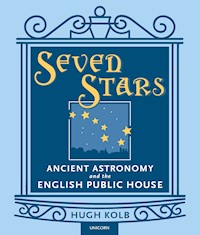
Erhalten Sie Zugang zu diesem und mehr als 300000 Büchern ab EUR 5,99 monatlich.
- Herausgeber: Unicorn
- Kategorie: Geisteswissenschaft
- Sprache: Englisch
Seven Stars traces the meaning and origins of the Seven Stars pub sign back 1500 years to the legal codes of the Anglo-Saxons and beyond that to the mythological astronomy of the ancient Mediterranean region. It is believed that the sign of the Seven Stars originated in the star cluster of the seven Pleiades which was considered to be a bunch of grapes in the sky in a Dionysian and Bacchic world view and therefore used as a suitable tavern sign. The first half of the book briefly tells the history of public drinking and its associated signs, and then describes the oldest and most interesting Seven Stars pubs in England going back to the 14th century. The second part is a discussion of the various meanings that have been proposed for the Seven Stars sign, many of them based on ideas from ancient astronomy. The distribution of the older pubs with the name is closely related to the areas of the Saxon and Mercian law codes that were in operation after the Danish invasions of the 9th and 10th centuries. The conclusion is that the symbolism involved retained surviving ideas from the mythological astronomy of the ancient Mediterranean world that survived in Anglo-Saxon culture but which were lost in the areas dominated by Scandinavian values where the social and political role of drinking establishments was distinctly different. This is a full and authoritative look at an ancient symbol that forms a small part in the building blocks of British cultural traditions.
Sie lesen das E-Book in den Legimi-Apps auf:
Seitenzahl: 348
Veröffentlichungsjahr: 2019
Das E-Book (TTS) können Sie hören im Abo „Legimi Premium” in Legimi-Apps auf:
Ähnliche




















Ye Olde Seven Stars, Withy Grove Manchester in 1908
CONTENTS
The Seven Stars, Robertsbridge
INTRODUCTION
Many histories of inns and taverns have been written over the past 150 years. These have inevitably concentrated on the most scenic and architecturally interesting or those that have prominent backstories, the more lurid the better. Famous old coaching inns with complex half-timbered fronts and sporting elaborate wooden carvings or plaster panels have interested writers since the days of Charles Harper, who published numerous surveys of English inns as rendezvous for the new-fangled breed of cyclists at the end of the nineteenth century. With the advent of the modern car (and before drink-driving laws became the hallmark of the caring state), numerous gazetteers of rural road houses and scenic country pubs showed the more affluent where to spend their weekends and holidays. Any hostelry that had attracted historical (and usually well-heeled) figures from Good Queen Bess and Bonny Prince Charlie to Jack Hawkins and Lord Nelson, or had been mentioned by William Shakespeare or Samuel Pepys, demanded attention. The majority of small inns and local bars without any marked architectural features, homicidal landlords or regular ghosts have not been worth consideration, however old they might claim to be.
Nobody has thought it worthwhile to publish histories of particular names or signs — a survey of Saracen’s Heads or a study of Horse and Ploughs — for their own sake. Admittedly, there is a limited mileage to be got out of such establishments as the King’s and Queen’s Heads. The number of candidates is limited and well known. Apart from a discussion of the politics and psychology of patriotism or whether the Elephant and Castle really was the Infanta of Castile, there is little to add.
Antiquarians and social historians have produced a number of studies of inn signs in general, starting with Larwood and Hotten’s The History of Signboards from the Earliest Times to the Present Day first published in 1866. These have generally been more interested in the exotic and decorative rather than the everyday and are weak on provenance and meaning. Bryant Lillywhite’s London Signs is comprehensive in its area and provides short explanations of the possible meanings of signs but many of these are inevitably speculative or superficial. When it comes to the Seven Stars they are definitely wrong, repeating errors that have been circulating in the printed media for several hundred years and which are now being perpetuated in the internet age.
The Seven Stars stand out as a special case. Compared to many other images used for pub signs, the depiction of seven stars has a wide range of cultural and literary associations. This is the main reason why so many conflicting explanations have been provided for the meaning of the name. Seven stars appear in religious and astronomical contexts that can be traced back to the first millennium BC and before. They appear in the Bible and other fringe religious texts from our Judaeo-Christian inheritance. They have been adopted by the Freemasons, a fraternity with an insatiable predilection for symbols of all kinds. They appear in many other political and religious settings, which makes it difficult to pin down one single explanation for their use as an inn sign. It is only by a concentrated analysis of the surviving pubs, their history and the symbolism of the Seven Stars over the past three thousand years that we can arrive at any sort of conclusion. The present book attempts to do this.
The Seven Stars, Foots Cray in the 1950’s
THE ORIGINS OF THE PUB
Any liquid that contains sugar can be used to grow yeast. This widespread and useful fungal micro-organism has two main forms of excreta: carbon dioxide and ethyl alcohol. The first allows us to make one of the staffs of life, leavened bread, the other beer and wine. The two natural sources of sugar are fruits and honey. A more plentiful supply can be obtained by germinating and then cooking cereal grains to release sugar from complex carbohydrates. The result is fermented by the yeast to produce a relaxing or intoxicating drink. Such alcoholic beverages, whether they be ale and beer brewed mainly from barley, wine from fermented grapes, or similar drinks obtained from a wide variety of grains, fruits and saps, are part of the human condition and have been appreciated by most cultures throughout history even when other vegetable intoxicants were available. A number of higher animals have been shown to select fermented fruit in preference to a fresh supply because of its alcohol content. Presumably early humans did the same long before the ideas of organised viniculture and agriculture arrived. For many years it was thought that living in permanent townships originally began because people found they could grow a surplus of cereals. This increased their food supply throughout the year and left time free for a settled existence where they could pursue cultural activities beyond mere hunting and gathering, such as making pots for brewing beer and fermenting more wine. Such ideas are changing.
The oldest known human monument is Göbekli Tepe in south-eastern Turkey. It is a collection of carved T-shaped pillars in circular enclosures dating from the Pre-pottery Neolithic, around BC 9000. There is no evidence of any living quarters associated with it. Villages did not appear in the area until the eighth century, and the first large town, Çatal Höyük, was built around BC 6000. Within the remains of Göbekli Tepe there are several large stone vats which could each contain up to 160 litres of liquid. Based on some tentative chemical analyses it is claimed that these show the residues of ritual brewing. The infill of the site also contains numerous animal bones. The argument put forward from this research is that seasonal feasting and drinking at specific religious sites was the trigger for bringing people together from their previously more isolated hunter-gatherer existence and was the source of later Neolithic organisation and, eventually, civilisation.1 The original purpose of selecting and deliberately growing cereals was not to make bread but to brew ale, although we might not recognise the result. It was probably an alcoholic barley gruel or porridge but, for all that, as or more nutritious than much else that was available with the added benefits of producing a good time and allowing people the apparent experience of communing with higher forces in the cosmos.
Communal drinking has carried on throughout history, from the symposia of the Greeks, the autumnal binges of the Persians and the feast days of the Vikings, down to the weddings, Christmases and Hogmanays of the modern world. In parallel with these, however, there have been establishments where people could go to spend a sociable evening drinking and, if necessary, eat or stay the night. They existed in ancient Egypt and Mesopotamia. We know about them mainly because of comments by elite writers that they might be a source of drunkenness, social ills, prostitution and subversive political meetings, and from the laws that were set down to control them.
Barley beer became a staple for life in Egypt and the Middle East. It was part of the daily allowance for all public servants, workers and soldiers, and was almost certainly healthier than drinking water straight from rivers and canals. More sophisticated wines were the reserve of the elite. One of the earliest civilisations that we know about is that of Sumeria, now southern Iraq. The first record of beer is on Sumerian temple accounts from the fourth millennium BC. These are a mixture of pictographic and numerical signs impressed into clay tablets. Signs that have been interpreted as representing barley groats, malt and jars appear on the same tablets in quantities of over 100,000 litres with the characters of an official who certified the record.2 Different jar signs suggest that several varieties of beer were being produced and one tablet notes the ingredients for eight different brews. The Sumerians even had a Goddess of Beer: Ninkasi. A poem lauding her survives from around BC 1800 which is essentially a recipe for brewing in eight stages. Mind you, too much should not be made of this because the Sumerians were determined polytheists and had deities for everything from the major celestial bodies and earthly forces down to bricks and saw blades.
The images on a cylinder seal from Ur dating to the third millennium BC showing people drinking beer and wine, and transporting a large jug
The first images of beer drinking are on cylinder seals from the Early Dynastic period of Sumeria during the third millennium BC. These show figures sucking up drink from large pots through a straw.3 Other images picture people or gods drinking what was probably wine from cups and bowls. One such lapis lazuli seal found by Sir Leonard Woolley in the Royal Cemetery at Ur shows people drinking beer and wine, and another two transporting a large pot suspended from a pole on what appears to be a quite sophisticated twowheeled cart. This suggests that brewing was carried out somewhere else and the beer was distributed to alehouses rather than being made on the premises. The complex recipes involving mixing dough with dates, baking it, soaking it with malted grain in large vats to make wort, brewing it and then draining through reed mats would indicate that centralised production was the most practical method.
The Babylonian Law Code of King Hammurabi, engraved on a stone pillar around BC 1775, set down four regulations out of a total of 282 for these alehouse keepers: sabitum in Old Babylonian — written in the characters of the older Sumerian language as munus lu kaš din na, literally ‘female beer-selling person’. Patrons could get credit for beer and repay with an equivalent amount of barley. The volume of grain for a corresponding quantity of drink was specified. If the landlady accepted silver money instead and overcharged, she could be thrown into the Euphrates, probably attached to a few weights to make things more interesting. This was a religiously based ordeal in which final judgment was left to the ‘holy river’. If she drowned the river god had agreed with the verdict. A priestess who set up an alehouse or was found drinking in one was to be burnt to death. Any landlady who overheard political conspirators in her establishment and did not report it to the royal court could be summarily executed. For a variety of reasons, in our more enlightened times, publicans no longer face the prospect of capital punishment in their line of business.
The gender of the language used in Hammurabi’s Laws show that it was mainly women in Babylon who sold and possibly made the beer. This is reinforced by the original beer deity being a goddess, which makes it strange that priestesses should have been subject to such stringent regulation. Perhaps it was due more to do whom they might associate rather than with any drinking they did. Later Assyrian references to brewing and selling beer often use the masculine form, sabu, so men must have been involved as well.
A typical Middle Eastern alehouse seems to have consisted of people sitting around a large pot and sucking up beer through straws, a practice still found in parts of east Africa. This basic filtration system prevents you getting mouthfuls of the barley husks and suchlike crud which are still floating about in the brew. Apart from this, we know very little about such premises. Developing urban societies drew people in from the countryside. Many would have lived in one room hovels so they required external services for eating and drinking. They also socialised more frequently than people in rural areas. The new cities temporarily accommodated traders and carters from round about to provide supplies and were centres of administration which needed to communicate with other cities and exchange personnel. It is only in Roman times that we start to get a clearer picture of this sector of the leisure and travel industry and how it operated.
We are told in the Gospel of St Luke that there were inns in the town of Bethlehem in the time of Caesar Augustus. In the rest of the empire the Romans had deversoria and hospes on the main roads which offered higher class accommodation for officials and bona fide travellers. Cauponae provided basic food, drink and accommodation, often near city gates. Tabernae sold wine but could also have more general goods, and popinae were cook shops for eating in. There were also ganeae, which were more disreputable eating houses. All these categories overlapped. The popina served liquid refreshment and looked more like a bar. The taberna may have been a taberna vinaria that sold wine or a taberna devertere and taberna meritoria that offered lodgings. The caupona (and even the popina) was often a part-time brothel, although nominally distinct from the fornix, lupanar or stabulum where, according to Petronius’ Satyricon, naked girls lined up with price tags round their necks. The popinae were particularly associated with gambling.
After being buried under the lava and ash from an eruption of Mount Vesuvius in AD 79 the city of Pompeii gives us a time capsule for this period of Mediterranean culture. Partial excavations have shown that there were thirty-four cauponae, 125 popinae and nine brothels in an area of 44 ha.4 The population of the whole city was only around 10,000. Many of the popinae were very small with a single room facing the street, fronted by a bar counter containing recessed jars for food and wine (dolia) and a cooking area at one end. By contrast, some of the cauponae were extensive with a garden or yard for carts, and attached buildings for cooking and accommodation. Out in the countryside the same businesses stayed closer to their core functions and were less involved in licentious behaviour.
Fermented alcoholic drinks must have come into Britain with the first people after the last glaciation. Communal drinking was the norm until the Roman invasion when urbanised Mediterranean customs and better communications started to take over. Therefore the first alehouses, taverns and inns in England would have been based on the forms described above, albeit rather less exposed to the elements than their Mediterranean cousins.
Writing in his Natural History (around AD 60), Pliny the Elder considered wine to be the characteristic product of Italy and Greece. Drinks made from fermented grain were the preserve of Gaul and Spain, as well as Egypt. Greek settlers in southern France may have introduced some viticulture but it was the Roman emperor Probus who decreed that growing vines should be encouraged in Spain, Gaul and southern Germany (and, possibly, England) around AD 280. Nevertheless, there has always been a perceived distinction in Europe between northern beer drinkers and southern wine drinkers.
This is a simplification but does not alter the fact that most of the wine drunk in northern Europe, and particularly in England, had to be imported and was a more expensive merchandise which replaced mead (fermented honey) as the drink of the elite. By contrast, ale and beer have come to be seen as an expression of the grass root traditions of native northern cultures. This affected who drank what and where it was sold. Early historians of the wine trade, such as André Simon, suggested that serious wine drinking did not start in England until the Anglo-Saxon period when the Christian church established it as part of the sacrament. However, typical Roman wine amphorae are found in numbers in southern and south-east England from the second century BC onwards.5
ALE, BEER AND CIDER
The words ‘ale’ and ‘beer’ are often used interchangeably but for some people they are really quite distinct products. As we have seen, the fermenting of grain goes back to the beginnings of organised human culture but the brew had to be cooked up especially and drunk fairly quickly before it went off. In the Middle Ages other ingredients, particularly herbs but up to and including dead chickens, were included to increase the range of flavours. Some of the herbs that were used may have had additional psychoactive properties in addition to the basic alcohol. For instance, seeds of the henbane plant were sometimes included. It is said that such brews were favoured by witches who valued the effects of the powerful alkaloid hallucinogens involved.
Sometime during the ninth century monks in southern Germany and Switzerland discovered that by boiling the wort with hops and then using a few more to flavour it they could produce a more astringent brew that lasted much longer in storage because of the antiseptic effects of tannins in the mixture. Other chemicals in hop flowers induce mildly relaxing and soporific effects. Botanically, hop plants (Humulus) are closely related to Cannabis, but this never seems to have bothered anybody. For a long time herbalists have used such hops for promoting sleep and as an analgesic and sedative. Dried flowers were sometimes put into pillows. This new addition to the diet may have made the rigours of monastic and convent life more congenial.
In the English tradition the basic drink fermented without hops is generally referred to as ale whereas the addition of hops turns it into beer. The first record of hopped beer being imported into England was from Flanders in 1288. However, it did not find universal favour for several hundred years. Some people railed against the use of hops, regarding them as a pollutant of traditional ale. People could be fined for adulterating ale with hops up until the sixteenth century. Henry VIII forbade the royal brewer putting hops in his ale. As late as 1651, John Taylor, ‘The Water Poet’, could write:
Beere is a Dutch Boorish Liquor, a thing not knowne in England, till of late dayes an Alien to our Nation.
People with a more European outlook nowadays tend to divide beers differently into ales and lagers, based on the fermentation process rather the ingredients. Ales are top fermented at room temperature whereas lagers are bottom fermented by a different species of yeast in near freezing conditions and then stored in the cold.6 Ale and beer also had to compete with another popular drink: cider.
Cider seems to have been produced in England before the Romans arrived but it was the Normans who put it on a firm basis. While cider was made right across the south of England and the West Country, in the late Middle Ages Kent and Sussex were its two strongest areas. Cider production rivalled that of ale in the countryside and many farm workers received the drink daily as part of their wages. Nowadays we associate cider production with the West Country, particularly Somerset, but this is because the area was, until recently, relatively underdeveloped and kept hold of older customs. For instance, people like Cecil Sharp would travel round Somerset after 1900 to collect folk songs which had died out in the rest of England. It was the commercial brewing potential of hopped beer that eventually saw off cider and the apple orchards of Kent were replaced by fields of hops. At the last count there were only four committed cider houses left in England. The rise of hops in Kent can be roughly dated from Daniel Defoe’s A Tour Thro’ the Whole Island of Great Britain published in 1724:
But the great wealth and encrease of the city of Canterbury, is from the surprising encrease of the hop grounds all around the place; it is within living memory of many of the inhabitants now living, and that none of the oldest neither, that there was not an acre ground planted with hops in the whole neighbourhood, or so few as not to be worth naming; whereas I was assured that there are at this time near six thousand acres of ground so planted, within a very few miles of the city.
The other main rivals to ale and beer in the eighteenth century were spirits. Gin and brandy (originating in Holland and France, respectively) had been available during the seventeenth century but it was the arrival of a Dutch monarch in William III that set in line a new trend. Taxes on beer were increased but restrictions on operating distilleries were removed. The result was an outbreak of hard drinking such as that satirised by William Hogarth in his 1751 engravings, Gin Lane and Beer Street. Much of the legislation concerning taxation and liquor licences over the next hundred years was concerned with trying to correct this imbalance and reduce the effects of gin shops. Outside England whisky was the spirit of choice in Ireland and Scotland. However, production of this was mainly a cottage industry until the big Victorian distillers came along.
ALEHOUSES AND TAVERNS
The standard triumvirate of the early drinks trade in England has always been alehouses, taverns and inns which respectively sold ale, wine and provided accommodation. While this was basically true, and was even reinforced by legislation at times, it is a major oversimplification. The original medieval alehouses were mainly private kitchens that chose to supply drink around harvest time when grain was available. During the Tudor period the Crown found it convenient to raise money by selling wine licences to anybody that wanted them, outside the restrictions of the Vintners’ Company. Thomas Dekker’s polemical writings in the middle of the seventeenth century state that just about every house and business in the suburbs of London was selling beer, whatever else its justification was for being there.
The Beer Act of 1830 similarly made it cheaper and easier to sell beer anywhere, mainly as an antidote to the increasing evil of gin shops. Such laws deliberately undermined the traditional outlets. In the 1830 Act it was specifically stated that it was:
‘for the better supplying of the public with beer in England,’ and to provide ‘greater facilities for the same therof than are at present afforded by licences to keepers of inns, alehouses and victualling houses.’
Inevitably this this led to complaints that everybody was now getting drunk on beer. According to the Canon of St Paul’s, Sydney Smith:
The new Beer Bill has begun its operations. Everybody is drunk. Those who are not singing are sprawling. The sovereign people are in a beastly state.
The result of these efforts was that during many periods of history any private house or business could become a part time beer house or tavern without the appurtenances that we would consider appropriate to such a role. Small alehouses were sometimes encouraged to provide basic accommodation such as a small room with a multiple use bed or even a free floor, thus encroaching on the trade of inns.
INNS
Buildings that we would recognise as inns probably came in with the Romans. The gap between the exit of the Romans in the year 410 and the start of the Christianised Anglo-Saxon kingdoms around 600 is a grey period when much of the urban structure of England broke down. There is a reference to tabernae along the roads during Early Saxon times, and Church Canon Law around 750 forbade priests from visiting taverns, so some of the earlier establishments may have survived. King Edgar passed a law in the middle of the tenth century trying to limit the number of alehouses in each village to one, showing that they must then have been a significant part of the scenery. Political stability and the need to travel must have encouraged business for some inns.
The arrival of Christian monasteries during the Anglo-Saxon period widened choice by providing accommodation for pilgrims at the shrines of popular saints who could be guaranteed to cure particular ills. Pilgrimage, in the sense of travelling to holy places for self-fulfilment or the curing of ills, has always been a feature of organised religious systems.
The Ostrich, Colnbrook
In England between around 600 and 1540 this took the form of visiting the shrines of saints in cathedrals and abbeys around the country. Once somebody had become the focus of miracles and unofficially canonised, their relics were translated to a shrine which could be controlled by the Church. The earliest English translation was that of St Augustine at Canterbury in 613, although later shrines were set up to saints who had died earlier such as St Alban (died around 300, translated 793) at the Abbey of that name.7 Paganism was outlawed in the law codes of King Cnut (anglicised as Canute) and people were forbidden from worshipping at ancient sites such as springs, hills and thorn bushes. Cnut, himself a Scandinavian with a pagan ancestry, made an ostentatious pilgrimage to Bury St Edmunds (then Beodricesworth) in 1020, where he founded an Abbey to reinforce his position as a Christian monarch. This may have been the start of mass pilgrimage in England.
Shrines became a major source of income for the abbeys and cathedrals that contained them, whatever was actually in the casket. The actions of Viking invaders and the occasional irritable monarch meant that martyrs were not in short supply during the Middle Ages. The monastic code drawn up by St Benedict of Nursia around 540 had laid out rules for accommodation and refreshments which were less austere than the earlier habits of the desert fathers. This included provision for pilgrims but they were to be kept separate from the main body of the chapter, with their own buildings and cooking facilities supervised by a delegated brother. Some of these hostels seem to have been privatised as early as the twelth century. The overflow at popular places like Canterbury and St Albans was quickly taken up by commercial inns that catered for the more well-heeled.
There are a number of surviving pubs, such as the Bingley Arms at Bardsey, the Godbegot in Winchester and the Ostrich at Colnbrook, that have a claim to having started out as monastic hostels in the tenth and eleventh centuries.8 Many people have proposed that ‘Ostrich’, which is a rather strange name for a pub, is a corruption of the word ‘Hospice’ (although others have suggested that it has something to do with feathers). In the late Middle Ages important religious centres like St Albans and Glastonbury could boast of up to a hundred inns each.
Pilgrimages to the Holy Land and the Crusades must have encouraged the mobility of some of the population at various times. This has provided a promotional line for pubs like the Ye Olde Trip to Jerusalem in Nottingham, which boldly asserts that it dates to 1189. This date has been widely rubbished. It is not supported by old records or the age of the existing buildings. However, the associated caves that were dug into the Castle Rock may have provided a convenient place to sleep from earlier times and an even environment for brewing ale. Some have attributed the quality of Nottingham beer to this convenient cellarage. The date chosen is that of the third Crusade, which singularly failed to recapture Jerusalem from the control of the contemporary Arab Muslim sultanate. Christian control was only briefly reinstated in 1229.
The pilgrimage business came to a sudden end between 1536 and 1540 with the dissolution of the monasteries under Henry VIII. However, this did not mean that all the inns just disappeared. A landlord made up a song in 1884 about the fact that there were still ninety-two in St Albans. Some of this survival may have been due to the fact that local Saint’s Days were linked to annual fairs and markets which continued to be patronised. The political stability and economic growth of Tudor England encouraged trade and the increased movement of people. In the absence of major public buildings, larger inns also became the main places for court proceedings and for music and the performance of plays.
Ye Olde Trip to Jerusalem, Nottingham
THE PUBLIC HOUSE
The term ‘public house’ first appeared in the middle of the seventeenth century and became more generally used during the Hanoverian period.9 The OED is rather ambiguous about it and attributes the first record of the word ‘pub’ to Hotten’s 1859 Dictionary of Slang. However, the phrase is found in Tobias Smollett’s The Life and Adventures of Sir Launcelot Greaves, written in 1760. Interestingly, the place described here seems to have been a real pub, the Black Lion in Weston, Nottinghamshire, and gives us a description of such a business in the eighteenth century:
It was on the great northern road from York to London, about the beginning of the month of October, and the hour of eight in the evening, that four travellers were by a violent shower of rain driven for shelter into a little public house on the side of the highway, distinguished by a sign which was said to exhibit the figure of a black lion. The kitchen in which they assembled, was the only room for entertainment in the house, paved with red bricks, remarkably clean, furnished with three or four Windsor chairs, adorned with shining plates of pewter and copper sauce pans nicely scoured, that ever dazzled the eyes of the beholder; while a cheerful fire of sea-coal blazed in the chimney.
It was possible to spend the night there but a local suggested they would be better off at an inn a few miles away.
‘Public house’ described a variety of licensed premises and implied something more professional and permanent than the average alehouse. Most small operators no longer brewed their own ale but bought in beer from breweries and became ‘tippling houses’. The focus was on the provider who might move on fairly quickly. Public houses, by contrast, were fixed institutions, often with characteristic names that we would recognise nowadays. They were under the control of licensing magistrates who, at the same time, often tried to suppress tippling houses down back alleys and in cellars. By the first half of the eighteenth century many larger outlets were selling cider, wine and spirits in addition to beer.
One of the main factors in the regularisation of trade was the rise of the commercial breweries. These were increasingly large businesses that needed to control their reputation and finances. One way of doing this was to buy up public houses and ensure that they only sold the brewery’s own beer. Landlords, who themselves would not have had the money to buy their own premises, were employed to run them. These ‘tied houses’ started to appear in earnest after the Napoleonic wars. By the beginning of the nineteenth century many brewers had also started building new, specially designed public houses. The architects of these often included the features of earlier ‘gin palaces’ with gas lighting, mirrors and comfortable furnishings to produce a more attractive environment. The invention of the bar counter and the beer engine helped to create the public house interior that we are familiar with nowadays.
Legislation from the middle of the nineteenth century effectively eclipsed any lingering official distinctions between alehouses, taverns and inns. It was the public house that was licensed rather than the particulars of what it sold. Nevertheless, there was still a hierarchy of hostelries existing in the popular mind, as in Jerome K. Jerome’s Three Men in a Boat, published in1889:
We therefore decided that we would sleep out on fine nights; and hotel it, and inn it, and pub it, like respectable folks, when it was wet, or when we felt inclined for a change.
The top end of the market had been taken over by French-inspired hotels. The older provincial coaching inns that had catered for stage coaches and the post started to become hotels after the current fashion. The arrival of the railways created entirely different patterns of movement across the country and new hotels in places where they had not existed before. Traditional inns on the old roads had to modify their functions or go out of business. The fact that an old building is now a public house does not tell you much about its earlier history. Most early alehouses were just a house that sold ale and have left little trace in the architectural record. Many small inns, however, would have been specially built and rebuilt in places that traditionally attracted reliable passing trade. Some of these have survived as public houses. When all else failed it was still possible for many centuries to make a reasonable living selling alcohol until the rise of twentieth century supermarket loss-leaders and drink-driving laws. As they lose their trade nowadays these older buildings are not necessarily being demolished any more, but their history is being obscured by being turned into bed and breakfasts, private houses, shops or even Asian restaurants.
Notes
1. Dietrich, et al. (2012): pp. 667ff.
2. Nissen et al. 1993: pp. 36-46.
3. Collon (2005): pp. 27 and 148, nos. 91 and 640.
4. Laurence (1994): pp. 70-87.
5. Cunliffe (2013): pp. 327 and 361-2.
6. Dornbusch (1997): pp. 90-6.
7. Nilson (1998): pp. 210-11.
8. Bruning and Paulin (1982): p. 20.
9. Clark (1983): pp. 195, 215 and 298.
INN SIGNS
If you have something to sell it helps to advertise, particularly in northern climes where the activities in a building may not be obvious from the street. Some shops pile their wares up on the side of the road, be they vegetables or cane chairs. This is less practical for alehouses and taverns. An obvious way of advertising is to put up a sign outside in the street.
The American logician and physicist Charles Sanders Peirce claimed to have divided up signs into three logically distinct categories: ‘icons’, ‘indexes’ and ‘symbols’. Icon comes from the Greek word for ‘image’ and means a literal representation of something. For instance, a picture or model of a glass or tankard outside a building would be a direct reference to the fact that drink was being sold inside. An index is an image of something that is related to the subject in hand. A picture of a bunch of grapes is not necessarily a suggestion that we have a fruit shop but has generally been understood to indicate the sale of wine. The sign is logically related to the subject, some would say semiotically, but this opens up a whole can of worms that we do not want to go into here. A symbol, by contrast, is an image that has no direct relation to the subject. Its meaning is solely the result of convention. Most people would understand the sign of the Pig and Whistle as referring to a pub (whether fictional or not) but it does not tell you anything about what you can get inside and you certainly would not go there to buy a musical porker. A few claim that such a sign that appears fanciful to us now is actually a corruption of something that was meaningful in the past. A pig might have been a bowl called a ‘piggin’ or ‘pix’, with whistle meaning ‘wassail’ or a word for small change. Even if this were true, the meanings are lost in the modern world and the relationship between pub and sign is seen and understood as arbitrary, as with most pub signs.
Unfortunately, these terms for signs are often used loosely or in other contexts. The issue is muddied even further by psychoanalytic theories that prefer to distinguish between ‘signs’ which are abstract and ‘symbols’ which have subconscious meanings attached to them. In the messy world of everyday life, attempts to force such words into academically watertight compartments are not very useful. People grow up in each culture with a set of references that they do not need to think about. For our purpose it is more useful to distinguish between specific signs which are mainly arbitrary labels attached to a particular building and generic signs which inform customers, sometimes indirectly, of the sort of activity that goes on inside. The former has become part of the address of the business whereas the latter, like a pawnbroker’s balls or a barber’s pole, just tells you what goes on inside. In the past, when many people were illiterate and taxation and postal services were poorly developed, the generic sign was much more useful to everybody.
The pub names we recognise today have developed over the past six hundred years and many can be placed in their historical context. Others may just reflect some prevailing fashion or the whim of a previous owner. It is difficult to be certain how long this naming for its own sake has been going on. In the English Place-Name Survey the earliest reference is to a taberna de Schyrebourn in 1280 but this is not really very distinctive. It is only in the last half of the fourteenth century that we have records of names like the George, the New Inn, the Sun and the Tabard.1 It has been suggested that this sort of naming did not really become universal until the eighteenth century.2 Some date the origin of the modern English pub sign to the invention of oil painting during the last half of the fifteenth century.
THE EARLY HISTORY OF INN SIGNS
In their English Inn Signs, first published in 1866, Jacob Larwood and John Hotten tried to claim such signs may have existed in Rome two thousand years ago. There are a few, brief classical references and archaeological survivals that show the Romans had paintings in or on their taverns but it is difficult to tell from these whether they were signs in the modern sense.
Original painted objects that had been captured as booty in wars were given to the state and exhibited in the Forum or in front of temples. Some of these were copied to decorate the outside of buildings. One supposed piece of evidence that there was a picture of a Cock on a sign in the Forum seems to have resulted from mistranslation of a personal name, Gallus (also gallus, the Latin for cockerel), combined with a story about a shield exhibited as a trophy showing a caricature of a Gaul (one of the tribe of the Galli) with his tongue sticking out that had been captured by Gaius Marius in his victory over the Cimbrians in BC 101.
In a version of Aesop’s fable about the Mice and the Weasels by Phaedrus (around AD 10) he says that this story is seen painted on taverns:
cum victi mures mustelarum exercitu, historia quot sunt in tabernis pingitur,
but this is a general statement and does not necessarily mean that there were taverns called the Mice and Weasels. Excavations show that many, if not most, taverns and inns had paintings, inscriptions and graffiti on the walls but very few of these can be interpreted as a sign that named the building. They were there for decoration or to amuse the customers. For instance, a surviving building that was either a wine bar or a public lavatory in Ostia has paintings of famous Greek philosophers on the wall, two of which have the inscriptions:
‘Solon rubbed his stomach to ease his motions’, and
‘Thales advised determined effort as a cure for constipation’.3
However, there was an inn in Pompeii that had a painting on the outside showing an elephant wound up in the coils of a serpent and being defended by a pigmy. Next to it was an inscription that said ‘Sittius restored the elephant’.4 It is not clear whether this refers to the restoration of the building or the painting, and as it has now disappeared all we have to rely on are modern references. It was not unusual for the painters of election notices or adverts to sign their name to them. A district of Rome on the Esquiline Hill was called the Vicus Ursi Pileati, which means the ‘Quarter of the Bear with a Felt Hat’. It has been suggested by several writers that this name came from a tavern sign in the area but the only evidence put forward for this is that in recent history there has been as an establishment called the Inn of the Bear in a similar position.
‘At the Bowls’ in Herculaneum, showing the prices of different wines
Other names have been suggested for taverns of the period, such as the Camel, the Great Eagle, the Little Eagle, the Serpent, the Great Crane, the Sword, the Wheel and the Olives.5 These have been based on references to a wall painting in the classical literature or images found on walls at excavated sites. In the main street of Herculaneum there are the remains of what has been described as a wine shop with a sign showing a row of ewers and above them the large message Ad Cucumas. One translation of this has been ‘At the Sign of the Bowls’. A cucuma was a large cooking pot or kettle, so a more exact translation would be ‘At the Cooking Pots’. Whether people would have used such a name to refer to the place is debatable. It looks more like an extended generic sign informing people of the produce on sale, which would have been food as well as wine. Underneath each wine jar is a price for the variety displayed.




