


26,99 €
Mehr erfahren.
- Herausgeber: John Wiley & Sons
- Kategorie: Geisteswissenschaft
- Serie: Classical Receptions
- Sprache: Englisch
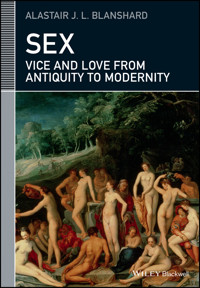
Sex: Vice and Love from Antiquity to Modernity examines the impact that sexual fantasies about the classical world have had on modern Western culture.
- Offers a wealth of information on sex in the Greek and Roman world
- Correlates the study of classical sexuality with modern Western cultures
- Identifies key influential themes in the evolution of erotic discourse from antiquity to modernity
- Presents a serious and thought-provoking topic with great accessibility
Sie lesen das E-Book in den Legimi-Apps auf:
Seitenzahl: 523
Veröffentlichungsjahr: 2015
Ähnliche




















Table of Contents
Cover
Series
Title
Copyright
Dedication
Illustrations
Preface
Part I: Roman Vice
1: Introduction
2: Naked Bodies
An Introduction (less than successful) to the Naked Body
The Naked Body in Greece
Naked Romans
The Love of Art and the Art of Love
3: Obscene Texts
Illustrating the Unspeakable
Talking Dirty
4: Erotic Rites
The Myth of the Orgy
Locating the Erotic in Roman Religion
5: Imperial Biography
The Private Lives of the Caesars
Explaining Roman Gossip Culture
Part II: Greek Love
6: Introduction
What is ‘Greek Love’? Scenes from a Courtroom I
7: Greece
The Loves of Hellas
The Platonic Vision
8: Rome and the West
Greece under Rome and Rome under Greece
Greek Love Burns Briefly, but Brightly
9: Renaissance and Enlightenment
Giving Birth in the Beautiful
The Pursuit of Love
10: Nineteenth Century and Beyond
Greek Love Triumphant
Sapphic Love
A Mixed Legacy: Greek Love in the Twentieth and Twenty-First Centuries
11: Epilogue
Scenes from a Courtroom II
Notes and Further Reading
Bibliography
Index
End User License Agreement
List of Illustrations
2: Naked Bodies
Figure 2.1 Horatio Greenough,
George Washington
(1840). An immodest president. Greenough’s statue has found few admirers. Smithsonian American Art Museum, transfer from the U.S. Capitol.
Figure 2.2 Hiram Powers,
The Greek Slave
(1851, after an original of 1844). ‘Clothed all over with sentiment’. The rapturous response to Powers’
Greek Slave
contrasts with reactions to Greenough’s
Washington
. Yale University Art Gallery. Olive Louise Dann Fund.
Figure 2.3 Campo Iemini Venus (second century AD). Scandal and modesty combined. Naked statues of Aphrodite titillate through the illicit pleasure of spying on the divine. British Museum. Image: © Trustees of the British Museum.
4: Erotic Rites
Figure 4.1
Metamorphoses of Venus
(1906), Plate 14. Private Collection. An orgy of the imagination. Pornographic etchings crystallize our notions of ancient sexual practice.
5: Imperial Biography
Figure 5.1 ‘A paradigm of licentiousness’. Malcolm McDowell as Caligula (1979, dir. Tinto Brass/Bob Guccione). Film still. Collection of William K. Zewadski.
8: Rome and the West
Figure 8.1 An object of desire. Winckelmann holds a portrait of Antinous in his hands as inspiration. Stiftung Weimarer Klassik und Kunstsammlungen, Weimar, Germany. Photo credit: © Bildarchiv Preußischer Kulturbesitz, Berlin, 2009.
9: Renaissance and Enlightenment
Figure 9.1 The return of Greek love. Donatello’s
David
ushers in the return of the classical body as the epitome of male beauty. Museo Nazionale del Bargello, Florence, Italy. © Scala/Art Resource, NY.
Figure 9.2 Michelangelo Buonarroti,
Ganymede
. Caught between spiritual and earthly desire. Ganymede has come to stand as a metaphor for the passions of Greek love. Harvard Art Museum, Fogg Art Museum, Gifts for Special Uses Fund, 1955.75.
10: Nineteenth Century and Beyond
Figure 10.1 Wilhelm von Gloeden,
Faun
. The escapism of Arcadia. For many nineteenth-century homosexuals, the Mediterranean offered the possibility of recovering a world of lost pleasures. Münchner Stadtmuseum.
Guide
Cover
Table of Contents
Begin Reading
Pages
cover
contents
ii
iii
iv
v
ix
x
xi
xii
xiii
xiv
xv
xvi
1
3
4
5
6
7
8
9
10
11
12
13
14
15
16
17
18
19
20
21
22
23
24
25
26
27
28
29
30
31
32
33
34
35
36
37
38
39
40
41
42
43
44
45
46
47
48
49
50
51
52
53
54
55
56
57
58
59
60
61
62
63
64
65
66
67
68
69
70
71
72
73
74
75
76
77
78
79
80
81
82
83
84
85
86
87
89
91
92
93
94
95
96
97
98
99
100
101
102
103
104
105
106
107
108
109
110
111
112
113
114
115
116
117
118
119
120
121
122
123
124
125
126
127
128
129
130
131
132
133
134
135
136
137
138
139
140
141
142
143
144
145
146
147
148
149
150
151
152
153
154
155
156
157
158
159
160
161
162
163
164
165
166
167
168
169
170
171
172
173
174
175
176
177
178
179
180
181
182
183
184
185
186
187
188
189
190
191
192
193
194
195
196
197
198
199
200
201
202
203
204
205
206
207
208
209
210
211
212
213
214
215
216
217
218
219
Classical Receptions
Series Editor: Maria Wyke, University College London
The ancient world did not end with the sack of Rome in the fifth century AD. Its literature, politics, and culture have been adopted, contested, used, and abused, from the middle ages to the present day, by both individuals and states. The Classical Receptions Series presents new contributions by leading scholars to the investigation of how the ancient world continues to shape our own.
Published
Classics and the Uses of ReceptionEdited by Charles Martindale and Richard F. Thomas
Ancient Rome and Modern AmericaMargaret Malamud
Antiquity and ModernityNeville Morley
SexAlastair J. L. Blanshard
In Preparation
The Ancient World in Popular CultureMaria Wyke, Margaret Malamud, and Lloyd Llewellyn-Jones
Sex
Vice and Love from Antiquity to Modernity
Alastair J. L. Blanshard
This edition first published 2010© 2010 Alastair J. L. Blanshard
Blackwell Publishing was acquired by John Wiley & Sons in February 2007. Blackwell’s publishing program has been merged with Wiley’s global Scientific, Technical, and Medical business to form Wiley-Blackwell.
Registered OfficeJohn Wiley & Sons Ltd, The Atrium, Southern Gate, Chichester, West Sussex, PO19 8SQ, United Kingdom
Editorial Offices350 Main Street, Malden, MA 02148-5020, USA
9600 Garsington Road, Oxford, OX4 2DQ, UK
The Atrium, Southern Gate, Chichester, West Sussex, PO19 8SQ, UK
For details of our global editorial offices, for customer services, and for information about how to apply for permission to reuse the copyright material in this book please see our website at www.wiley.com/wiley-blackwell.
The right of Alastair J. L. Blanshard to be identified as the author of this work has been asserted in accordance with the UK Copyright, Designs and Patents Act 1988.
All rights reserved. No part of this publication may be reproduced, stored in a retrieval system, or transmitted, in any form or by any means, electronic, mechanical, photocopying, recording or otherwise, except as permitted by the UK Copyright, Designs and Patents Act 1988, without the prior permission of the publisher.
Wiley also publishes its books in a variety of electronic formats. Some content that appears in print may not be available in electronic books.
Designations used by companies to distinguish their products are often claimed as trademarks. All brand names and product names used in this book are trade names, service marks, trademarks or registered trademarks of their respective owners. The publisher is not associated with any product or vendor mentioned in this book. This publication is designed to provide accurate and authoritative information in regard to the subject matter covered. It is sold on the understanding that the publisher is not engaged in rendering professional services. If professional advice or other expert assistance is required, the services of a competent professional should be sought.
Library of Congress Cataloging-in-Publication Data
Blanshard, Alastair.Sex : vice and love from antiquity to modernity / Alastair J.L. Blanshard.p. cm. – (Classical receptions)Includes bibliographical references and index.ISBN 978-1-4051-2291-7 (hbk. : alk. paper) 1. Sex–History. 2. Sex customs–History. I. Title.HQ12.B57 2010306.709–dc22
2009049287
A catalogue record for this book is available from the British Library.
For Suzanne,My first real teacher.
Illustrations
2.1
Horatio Greenough,
George Washington
(1840). An immodest president. Greenough’s statue has found few admirers. Smithsonian American Art Museum, transfer from the U.S. Capitol
.
2.2
Hiram Powers,
The Greek Slave
(1851, after an original of 1844). ‘Clothed all over with sentiment’. The rapturous response to Powers’
Greek Slave
contrasts with reactions to Greenough’s
Washington.
Yale University Art Gallery. Olive Louise Dann Fund
.
2.3
Campo Iemini Venus (second century AD). Scandal and modesty combined. Naked statues of Aphrodite titillate through the illicit pleasure of spying on the divine. British Museum. Image: © Trustees of the British Museum
.
4.1
Metamorphoses of Venus
(1906), Plate 14. Private Collection. An orgy of the imagination. Pornographic etchings crystallize our notions of ancient sexual practice
.
5.1
‘A paradigm of licentiousness’. Malcolm McDowell as Caligula (1979, dir. Tinto Brass/Bob Guccione). Film still. Collection of William K. Zewadski
.
8.1
An object of desire. Winckelmann holds a portrait of Antinous in his hands as inspiration. Stiftung Weimarer Klassik und Kunstsammlungen, Weimar, Germany. Photo credit: © Bildarchiv Preußischer Kulturbesitz, Berlin, 2009
.
9.1
The return of Greek love. Donatello’s
David
ushers in the return of the classical body as the epitome of male beauty. Museo Nazionale del Bargello, Florence, Italy. © Scala/Art Resource, NY
.
9.2
Michelangelo Buonarroti,
Ganymede
. Caught between spiritual and earthly desire. Ganymede has come to stand as a metaphor for the passions of Greek love. Harvard Art Museum, Fogg Art Museum, Gifts for Special Uses Fund, 1955.75
.
10.1
Wilhelm von Gloeden,
Faun
. The escapism of Arcadia. For many nineteenth-century homosexuals, the Mediterranean offered the possibility of recovering a world of lost pleasures. Münchner Stadtmuseum
.
Preface
Factoid n. Something that becomes accepted as a fact, although it is not (or may not be) true; spec. an assumption or speculation reported and repeated so often that it is popularly considered true; a simulated or imagined fact.
The Oxford English Dictionary lists the earliest reference of the word ‘factoid’ as occurring in a 1973 essay by Norman Mailer on Marilyn Monroe. It is no accident that ‘factoid’ should be coined to analyze one of the most eroticized and fantasized figures of the twentieth century. For when it comes to the topic of sex, the combination of illicit thrills, prurient fascination, and a desire for the personal and the private means that critical faculties get all too often thrown out the window and we find ourselves unable to resist a juicy story, no matter how improbable.
This book is a story about fantasy and the reality that lurks behind these fantasies. It is a history of facts and factoids. Its subject matter is the erotic desires that have been projected onto the cultures of classical antiquity. This work examines the impact that sexual fantasies about the classical world have had on western culture. Authors, artists, politicians, philosophers, and moralists have all turned to the classical world in a search to understand erotic desire. The classical world has regularly been invoked both as the home of sexual freedom and a haven for unnatural perversity. This monograph aims to examine the ways in which cultures have used classical erotica to locate and articulate their own erotic discourse. It attempts to unearth the various investments that cultures and individuals have made in antique sexual pleasure. It examines the ways in which the classical world has provided a mask for the dissimulation of acts of power as regulations of pleasure.
A history of classically inspired erotic imaginings provides a fruitful location for the discussion of the important role that imagined versions of antiquity have played in shaping notions about sexuality, guilt, desire, and love. This book seeks to juxtapose these fantasies with the reality of classical life. Not only does a narrative about sex in antiquity bring into relief the fantastic aspects of later constructions, but it also allows us an opportunity to observe the way in which the classical world exists in dynamic tension with the modern. Ideas about one impact on the other. In undertaking this task, this work hopes to make a contribution to two distinct conversations.
The first is a conversation about the role of sex and sexuality in western culture. One of the important theoretical breakthroughs made in the twentieth century was the realization that sex was more than just a mechanical act. There might be a biological imperative behind it, but this was not the only, or indeed the most important, factor conditioning sexual behavior. Sex is a story about culture as well as nature. This has ushered in a whole new understanding of the role and significance of sex.
Sex has been written into history. We can now examine the ways in which sexual behavior has been buffeted by social forces. Sex and the discourse surrounding it respond to political, economic, and ideological conditions. Very little about sex is now taken as immutable. The status of sex varies according to time and place. It comes into view as a category worthy of comment as a result of the actions of agents. Sex gains importance because it is a place where so many ideas about gender, the body, ethnicity, the nature of pleasure, and the purpose of life come together and coalesce. For these reasons, sex and the discussion of sex have proved useful mechanisms for gaining an insight into different cultures, especially those cultures where sexual activity has been excessively regulated or occupies a central position in the construction of identity (‘you can tell who I am, by who I sleep with’).
In addition to the history of sex, this work hopes to make a contribution to the burgeoning field of classical reception studies. Reception studies is located broadly within the tradition of the ‘history of ideas’ and traces the impact of the cultures of Greece and Rome on later cultures. There has always been an interest in tracing the influence of the antique past onto the modern. Within German scholarship, the study of the ‘afterlife’ (Nachleben) or ‘reception history’ (Rezeptionsgeschichte) are well-established areas of scholarship. What distinguishes classical reception studies from previous incarnations such as ‘the study of the classical tradition’ is a change in sensibility. Reception studies is less interested in quantifying high culture’s debt to ancient Greece or Rome. Rather than establishing pedigrees for great names, it is more interested in developing genealogies of ideas in which concepts mutate, evolve, or, sometimes, completely fail to have any epigone at all. It is democratic in the sense that it takes an interest in all fields of human endeavor, and feels happy to run the coarse against the refined to see what happens. It is a field of study that regards comic books and computer games as suitable objects of study as much as opera or old master paintings. Reception studies cuts across disciplinary boundaries, and draws upon the critical tools developed in disciplines such as film studies, art history, philosophy, gender studies, cultural history, performance studies, and the history of medicine.
The structure of this book is divided into two parts, ‘Roman Vice’ and ‘Greek Love’. On the surface, this division perpetuates a clichéd distinction about the immorality of Rome and the restrained virtue of Greece. It also feeds into another division, the split between heterosexuality and homosexuality. Since the very inception of the term, ‘Greek love’ has stood for the attraction between men whereas the key signifier of the sexuality of Rome has come to be the orgy, a queer encounter admittedly, but in which one of the many types of mingling that occurs is a mingling of genders. ‘Gay’ orgies always need to be identified as such. Like sex itself, the orgy has a tendency to be coded straight.
Binary divisions make a good place for starting a discussion about culture because they are so often used as a way of ordering the world. They get tangled up in each other. It is too easy to explain one binary distinction in terms of another. What’s the difference between men and women? Well, it’s like the difference between night and day, hot and cold, wet and dry, reason and madness, Greece and Rome. The arrangements are arbitrary, but they gain weight through repetition.
Yet, it is not the intention of this work to repeat clichés or perpetuate stereotypes about ways of viewing. While it is certainly worth exploring the reasons why Rome came to regularly stand for lasciviousness and viciousness in a way that Greece rarely did, it is also equally important to note those occasions when these divisions broke down or were not observed. For example, Roman ‘vice’ has a lot to tell us about the history of homosexuality, just as the story of Greek ‘love’ is crucial to an understanding of the development of the discourse around debauchery. For all the apparent clichés, it soon becomes clear that the idea that you could maintain a strict division between a Greek and Roman discourse in relation to sex turns out to be a fantasy in its own right.
It is for this reason, amongst others, that the book begins with a discussion of ‘Roman’ material before ‘Greek’. In the world of sex nothing ever plays straight and lines of influence become blurred and intermingle. One of the features of sexuality as a field of discourse is the way in which it encourages a riotous ludic disposition in its interlocutors. In discussions of sex, adherence to laws of strict chronology, attention to considerations of genre, and a critical sense of disbelief about the implausible or the impractical are oft put aside. People are eclectic in their usage of allusions. Greece may have primacy in time and, arguably, in prestige, but those positions are often reversed when it comes to discussions of sex. Roman material often provides the starting point and the matrix for understanding sexual activity with an invocation of Greek material only added as subsidiary or decorative supplement.
One other reason, apart from a desire to highlight clichés, for invoking the terms ‘vice’ and ‘love’ is that I want to use them in a particular technical sense and that is to signify two different modes of reception. One of the aspects that makes the reception of antiquity so fascinating as a phenomenon is the way in which it is possible to tell the story of the transmission of an idea in two different ways. One method is as a sustained encounter over time in which each subsequent engagement reacts to, and builds upon, all previous encounters. It’s a form of romance, a form of love. The other way is where an aspect of antiquity enters, apparently unmediated, straight into the cultural bloodstream. I say ‘apparently unmediated’ because a complete lack of mediation is an impossibility. Every encounter with antiquity always arrives pre-framed. Yet, there is a mode of engagement that ‘feels’ unmediated. A moment when you experience the sense that you are working without a tradition; that the ancient world is speaking to you directly. It’s the moment of the arrival of Plato in Renaissance Florence or the unearthing of an erotic picture in Pompeii or the unveiling of the Apollo Belvedere or the first time that the empress Poppaea looms over you thanks to the seemingly miraculous technology of Cinemascope. For the sake of a better term, let’s call this reaction to antiquity a type of vice (and let’s put the inherent moralizing inbuilt into the term aside, although perhaps not the sense of thrill). I have tried to encapsulate these two different modes of reception in the way in which I have told this story. I begin with ‘vice’ and the sharp juxtaposition of ideas and objects. In this section, I’ve been more interested in the story as a series of reactions to classical material than part of a long narrative. For this reason, it is arranged thematically rather than chronologically. The second half of the book attempts to examine reception through a longer timeframe and tells the story of the development of notions of same-sex attraction over time from ancient Greece to the twentieth century. Although the leap of ideas about Greek love from the Renaissance to the nineteenth century should remind us that the story of this love affair is anything but purely linear.
It is this desire to capture various forms and modes of reception that has encouraged me to include a number of ‘snapshots’ of classical reception as textboxes throughout the course of the book. These textboxes concentrate on important objects or themes that have been the subject of continued and varied interest over a long period of time. They are designed to give a sense of the range and flexibility in the reception story as well as a concentrated sense of the potency of the antique in the articulation of desire. The topics discussed in these textboxes include the appropriation of myth, the role of collecting and display in the construction of notions of the erotic, and the power of biography in the formation of fantasy.
One of the aims of the book is to establish those aspects of antiquity that have been the locus of erotic attention and to explain the reason for the explosion of discussion that surrounds them. It is not the intention to provide an exhaustive catalog of every sexual fantasy in which the ancient world has participated. This has meant that a number of not insignificant stories have been left out. So, for example, in focusing on ‘queer’ sex, I have chosen to concentrate more heavily on the issues of homosexuality and ‘group sex’ rather than, for example, S&M or transvestism. One obvious area of omission has arisen from the decision to concentrate largely on Anglo-American and European traditions. This is not through lack of interest in or failing to recognize the significance of events outside of the sphere of the West. Non-western encounters with classical sexuality are a rich and fascinating topic, combining as they do issues of colonial and post-colonial politics with the frisson caused by the interaction between western and indigenous traditions about sexual intercourse. To give just one example. In 1999, Calcutta’s first support group for lesbian, transsexual, and transgender women was created. They chose to name their group ‘Sappho’. Unpacking such onomastics, we find an interesting tale about the resonances of a western classical heroine with a group that looks both towards western notions of sexual freedom and, at the same time, desires to respect and validate Indian traditions of female love. Examining the aims and concerns of this group, we discover that this is not a simple story about the wholesale adoption of a monolithic notion of western sexuality. While the group happily runs under the slogan ‘Let there be courage, let there be Sappho’ and decorates its website with quotes from Sappho’s ‘Hymn to Aphrodite’, it also regularly indulges in debates in its newsletters about the applicability of western notions of homosexuality to Indian same-sex desire. Here the poet both speaks to and establishes distance from the passions of her contemporary Indian audience. Looking at the women of Calcutta’s reading of Sappho, we see a complex critique about the nature of sexual identity. There is a long history of such intersections and it could easily be expanded to include examples from the cultures of Japan, China, Africa, and the Arabic world. One suspects that we are only going to see further growth as the field of sexuality, like so many other areas, becomes increasingly globalized.
Suffice it to say, there are more stories to tell than the pages of this book can contain. Instead of covering every piece of the varied sexual mosaic, this book hopes to offer a map that charts out a large part of the terrain and points out some of the important landmarks. It is designed to illustrate some of the key texts and issues that have fed into the formation of sexual fantasy in the West. It also examines strategies that have been deployed in the appropriation and repackaging of the classical world by post-antique authors. In doing so, it hopes to offer a blueprint for understanding the forms of engagement that it has not explicitly covered. This book concentrates on the dynamics of appropriation rather than cataloging every instance of its occurrence.
The construction of the body is one of the important themes in the book. Fantasies about sex are inevitably based on preconceptions about the body – its accessibility, its desirability, and its capacities. Changing attitudes to nudity, differing notions of physical attractiveness, the methods by which the body could be revealed or obscured, the way in which desire could be read from the body, and the various investments that communities put into differing body types are explored in this work. The discussion of Roman vice begins with the problematic status of nudity in western culture. It traces the origins of these tensions back to the ancient world. Rather than being just a modern prudish hang-up, concerns about the status and interpretation of the naked body have existed ever since the Greeks. Nineteenth-century attitudes reflect a long-lived ambivalence.
Another important theme is the construction of the opposition between pagan and Christian sexuality. Like all such distinctions, the distinction between pagan and Christian is, at times fluid, and, at other times, rigidly enforced. Indeed, it is arguable that the chaste Christian is more of a fantasy than the degenerate Roman emperor. One of the important stories that I wish to trace is the way in which sex and sexuality have been used to facilitate religious discourse. We see this distinction resurfacing time and again in genres as diverse as polemics against naked statues, sermons against orgies, philosophic defenses of the study of Plato, or 1950s’ Hollywood epics. It is particularly invoked whenever value systems seem under threat or the identity of a community needs to be reasserted.
This book is interested in the political use of sex. Fantasies about classical sex have been as much about creating a form of political resistance as they have been about enforcing morals. Nineteenth-century suffragettes embraced the sexuality of wild figures such as maenads or Medea as a template for transgressive desire. Just as nineteenth-century homosexual activists piggy-backed on the cultural prestige accorded classical Greece. The political deployment of sex goes back as far as the gossip told about Roman imperial families or the anecdotes the Greeks told about the sex lives of barbarians. This book sets out a range of political strategies that have been deployed in the field of sex and sexuality.
The book is designed for a multiplicity of readers. I have tried to make the work as general and accessible as possible. It is intended as much for the modern historian who wants to learn about the erotic landscape of antiquity as the classicist who wants to trace what happens to this material after the end of the classical world. In trying to satisfy such different readers, I have inevitably been forced to explain what might seem obvious or beneath explanation to a specialist in their field. I hope they will forgive me, and find the new and unfamiliar material a suitable recompense.
Numerous debts, impossible to repay, have been accumulated during the writing of this book. I am grateful to Robert Aldrich, Peter Brennan, Paul Cartledge, Murray Dahm, Victoria Jennings, Julia Kindt, Frances Muecke, Ted Robinson, Paul Roche, Kim Shahabudin, Amy Stanley, Kathryn Welch, and Bill Zewadski. All of them helped, either wittingly or unwittingly, at various important stages during the writing of this book. A number of institutions also assisted in the book’s production. My own university, the University of Sydney, gave me resources and time to see it through to completion. I have particularly benefited from the surroundings and resources of the Centre for Classical and Near Eastern Studies of Australia (CCANESA). Parts of this book were written during fellowships at the University of Cincinnati and Corpus Christi College, Cambridge. I am grateful to Professor Getzel Cohen and Professor David Ibbetson for being such splendid hosts on these occasions.
Alastair J. L. BlanshardThe University of Sydney
Part IRoman Vice
1Introduction
In the aftermath of the 9/11 attacks, a number of still-shocked Manhattan inhabitants attempted to escape the horrors that haunted them through recourse to fantasy. For one night, a ‘sprawling loft in the Garment District’ became ancient Rome as Palagia, the self-proclaimed ‘queen of tasteful debauchery’ held Caligula’s Ball, an invitation-only orgy (Corrin and Moore 2002). The guests, all professional and under 40, dressed in sheer chiffon togas and indulged in threesomes, foursomes, wife-swapping, and light bondage. There was even a floorshow in which Palagia, surrounded by male assistants dressed as Roman legionaries, demonstrated the use of various sex toys and rode a tall, black, leather bench called ‘Caligula’s Horse’, after Incitatus, the horse made a senator by Caligula. Later Palagia was replaced by two performers called ‘Caligula’ and ‘Drusilla’ (the name of Caligula’s sister with whom he supposedly had an incestuous affair) who proceeded to give a demonstration of various positions of lovemaking.
Lesen Sie weiter in der vollständigen Ausgabe!
Lesen Sie weiter in der vollständigen Ausgabe!
Lesen Sie weiter in der vollständigen Ausgabe!
Lesen Sie weiter in der vollständigen Ausgabe!
Lesen Sie weiter in der vollständigen Ausgabe!
Lesen Sie weiter in der vollständigen Ausgabe!
Lesen Sie weiter in der vollständigen Ausgabe!
Lesen Sie weiter in der vollständigen Ausgabe!
Lesen Sie weiter in der vollständigen Ausgabe!
Lesen Sie weiter in der vollständigen Ausgabe!
Lesen Sie weiter in der vollständigen Ausgabe!
Lesen Sie weiter in der vollständigen Ausgabe!
Lesen Sie weiter in der vollständigen Ausgabe!
Lesen Sie weiter in der vollständigen Ausgabe!
Lesen Sie weiter in der vollständigen Ausgabe!




