


34,99 €
Mehr erfahren.
- Herausgeber: John Wiley & Sons
- Kategorie: Fachliteratur
- Sprache: Englisch
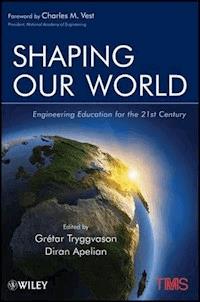
A look at engineering education today-- with an eye totomorrow Engineering education is in flux. While it is increasinglyimportant that engineers be innovative, entrepreneurial,collaborative, and able to work globally, there are virtually noprograms that prepare students to meet these new challenges.Shaping Our World: Engineering Education for the 21stCentury seeks to fill this void, exploring revolutionaryapproaches to the current engineering curriculum that will bring itfully up to date and prepare the next generation of would-beengineers for real and lasting professional success. Comprised of fourteen chapters written by respected experts onengineering education, the book is divided into three parts thataddress the need for change in the way engineering is taught;specific innovations that have been tested, why they matter, andhow they can be more broadly instituted; and the implications forfurther changes. Designed to aid engineering departments in theirtransition towards new modes of learning and leadership inengineering education, the book describes how to put into practiceeducational programs that are aligned with upcoming changes, suchas those proposed in the NAE's Engineer of 2020 reports. Addressing the need to change engineering education to meet thedemands of the 21st century head on, Shaping Our Worldcondenses current discussions, research, and trials regarding newmethods into specific, actionable calls for change.
Sie lesen das E-Book in den Legimi-Apps auf:
Seitenzahl: 532
Veröffentlichungsjahr: 2011
Ähnliche



















Contents
Cover
Title Page
Copyright
Foreword
Preface
Contributors
Part I: The Need and Context
Chapter 1: Meeting New Challenges: Transforming Engineering Education
1.1 Introduction
1.2 What is Engineering?
1.3 The Engineer of the twenty-first Century
1.4 The Next Few Years and the WPI Educational Program
1.5 Conclusion
Acknowledgment
References
Chapter 2: One World: Preparing Engineers for the Global Economy
2.1 Introduction
2.2 All Things to All Men
2.3 So what Do We Want and What Do We Need?
2.4 Summary
Chapter 3: Engineers: Leaders, Innovators, and Builders
3.1 Introduction: Personal Reflections
3.2 Societal Context
3.3 Human Resource Issues
3.4 Engineering for the twenty-first Century: a World of Opportunities
3.5 Concluding Comments
References
Chapter 4: Holistic Education: Learning and Doing in Context
4.1 Introduction
4.2 The WPI Plan
4.3 The Qualifying Projects
4.4 The Great Problems Seminars
4.5 On Grades, Dean's Lists, Competition, and Cooperation
4.6 The Holistic Continuum
4.7 A Framework for Continuing Development
4.8 Summary
References
Part II: Effective Practices
Chapter 5: Ignition: The Great Problems Seminars
5.1 Introduction
5.2 Background: The Gap to Bridge
5.3 Background: A Wider View
5.4 The Great Problems Seminars: Design Criteria
5.5 Great Problems Seminars: The Curriculum Details
5.6 Initial Assessment
5.7 External Assessment
5.8 Concluding Remarks
Acknowledgments
References
Chapter 6: Global Citizenship: Students Solving Real Problems Around the World
6.1 Introduction
6.2 WPI's Project-Based Curriculum
6.3 Educational Motivations and Implications
6.4 Program Overview and Impact
6.5 Implementation and Evolution of the Global Perspective Program
6.6 Program Oversight and Operation
6.7 Program Assessment
6.8 Risk Management
6.9 Transferability and Diffusion
6.10 Conclusion
References
Chapter 7: Fostering Citizenship and Advocacy Through the Humanities and Arts
7.1 Introduction
7.2 Extending the Context
7.3 Extending the Toolkit
7.4 Cultivating the Culture of Critical Inquiry and Civic Responsibility
7.5 Fostering Advocacy and Communication Skills
7.6 Conclusion
References
Chapter 8: The Capstone Project: An Integrated Experience
8.1 Introduction
8.2 The Major Qualifying Project Degree Requirement
8.3 MQP Implementation
8.4 Project Centers
8.5 Outcomes and Assessment
8.6 Future and Developing Challenges
8.7 Summary and Conclusions
References
Chapter 9: Technical Education in the Innovation Economy
9.1 Our Exciting, Challenging World
9.2 The Innovation Economy
9.3 Changing Focus of Education
9.4 The Original Worcester Polytechnic Institute Plan
9.5 New Educational Imperatives
9.6 The WPI Plan Today
9.7 Conclusions
References
Chapter 10: A New Discipline for a New Century: Robotics Engineering
10.1 Introduction
10.2 Education in Robotics
10.3 The Robotics Engineering BS Program at WPI
10.4 Assessment
10.5 Institutional Impact
10.6 Conclusions
Acknowledgment
References
Chapter 11: Graduate Education for the Professional Engineer
11.1 Introduction
11.2 Masters Degrees
11.3 Doctoral Degrees
11.4 Conclusion
References
Chapter 12: Holistic Graduate Education: Fire Protection Engineering
12.1 Introduction
12.2 A Matter of Life and Loss
12.3 A Long History of INFLUENCE
12.4 Global Pathways to Fire-Safety Leadership
12.5 The WPI Approach to FPE Education
12.6 FPE at WPI: The Intersection of Theory and Application
12.7 FPE Textbooks and Resources
12.8 Research and Scholarship
12.9 Conclusion
References
Part III: Outcomes and Implications
Chapter 13: Forty Years of Outcomes-Based Project Centric Education: Lessons Learned
13.1 Introduction
13.2 Assessment of the Plan's Effectiveness
13.3 What has Worked Well?
13.4 What Problems have Arisen?
13.5 How can the WPI Plan Be Implementedelsewhere?
13.6 Lessons Learned: Bringing About Change
13.7 What is Next?
References
Chapter 14: So Much Accomplished: So Much to be Done
14.1 Desirable Characteristics of Graduates
14.2 Corresponding Program Emphases
14.3 A Look to the Future
References
Biosketches
Copyright © 2012 by The Minerals, Metals & Materials Society.
All rights reserved.
Published by John Wiley & Sons, Inc., Hoboken, New Jersey.
Published simultaneously in Canada.
No part of this publication may be reproduced, stored in a retrieval system, or transmitted in any form or by any means, electronic, mechanical, photocopying, recording, scanning, or otherwise, except as permitted under Section 107 or 108 of the 1976 United States Copyright Act, without either the prior written permission of The Minerals, Metals & Materials Society, or authorization through payment of the appropriate per-copy fee to the Copyright Clearance Center, Inc., 222 Rosewood Drive, Danvers, MA01923 (978) 750-8400. fax (978) 750-4470, or on the web at www.copyright.com. Requests to the Publisher for permission should be addressed to the Permissions Department, John Wiley & Sons, Inc., 111 River Street, Hoboken, NJ 07030, (201) 748-6011, fax (201) 748-6008, or online at http://www.wiley.com/go/permission.
Limit of Liability/Disclaimer of Warranty: While the publisher and author have used their best efforts in preparing this book, theymake no representations orwarrantieswith respect to the accuracy or completeness of the contents of this book and specifically disclaim any implied warranties of merchantability or fitness for a particular purpose. No warranty may be created or extended by sales representatives orwritten sales materials. The advice and strategies contained herein may not be suitable for your situation. You should consult with a professionalwhere appropriate. Neither the publisher nor author shall be liable for any loss of profit or any other commercial damages, including but not limited to special, incidental, consequential, or other damages.
Wiley also publishes books in a variety of electronic formats. Some content that appears in print may not be available in electronic formats. For more information about Wiley products, visit the web site at www.wiley.com. For general information on other Wiley products and services or for technical support, please contact the Wiley Customer Care Department within the United States at (800) 762-2974, outside the United States at (317) 572-3993 or fax (317) 572-4002.
Library of Congress Cataloging-in-Publication Data
Tryggvason, Gretar.
Shaping our world: engineering education for the 21st century / Gretar
Tryggvason, Diran Apelian.
p. cm.
ISBN 978-0-470-92974-2 (pbk.)
1. Engineering–Study and teaching. I. Apelian, Diran. II. Title.
T65.T76 2012
607.1–dc23
2011028224
oBook ISBN: 9781118138267
ePDF ISBN: 9781118138236
ePub ISBN: 9781118138243
eMobi ISBN: 9781118138250
10 9 8 7 6 5 4 3 2 1
Foreword
Charles M. Vest
This book is in large measure a memoir. It is the memoir of an institution, Worcester Polytechnic Institute (WPI). Why would anyone want to read an institutional memoir, and why would an institutional memoir have a forward-oriented subtitle like Engineering Education for the 21stCentury? The answers will become apparent as the reader delves into this book. It should be read because it holds remarkably clear lessons and guidance for the future of engineering education. For the most part, it presents an in-depth view of the 40-year history of the WPI Plan. You may ask, “History?” Well, yes, but it is an intriguing Back to the Future kind of history, because in the 1970s WPI started down a path that many US engineering schools are just now attempting to define, build, and travel down today in the dawning years of this new century.
The late 1960s and early 1970s were a time of social unrest, pervasive angst about our nation's actions in Viet Nam, questioning of basic principles of all sorts, and rebellion against structure, including structure in higher education. Some institutions were badly damaged during these years by introducing ill-thought-out “reforms” that simply lowered standards, threw away any semblance of respect for intellectual discipline, endlessly fragmented knowledge, and brought political ideology to curricular areas where it did not belong. Other institutions in fact were substantially strengthened through bold actions planned through serious introspection and open-mindedness. WPI presents a wonderful example of such strengthening through the establishment of the WPI Plan, a more-or-less radical, and certainly bold, new pathway through undergraduate engineering education. It was project-oriented, imparted to students early on an understanding of what engineers actually do, connected them in an experiential manner with the wider world, emphasized competencies in basic science and engineering techniques, and continually reminded them that engineers are absolutely essential to meet most great human challenges, but that they cannot do so alone. All of this was, of course, prescient.
Let me fast forward to today, the early years of the twenty-first century. What are engineering educators worrying about, and what is the new context in which their students, as engineers, will live and work? They are worrying about how to make their students understand early on the excitement and relevance of the engineering profession. They are worrying about how to address the reality and opportunity of globalization as literally hundreds of millions of people are rather suddenly becoming better educated, technically oriented, and businesses and processes are spread around the globe. They are worrying about how best to utilize the enormous computing power and instant communication through a vast and pervasive network that integrates us all together. They are worrying about how to attract more bright and creative students and prepare them to build economies and provide employment through innovation and entrepreneurship. And they are worrying about how best to immerse engineering students in an environment and expectations that will directly relate them to the great challenges of our times, feeding a world population approaching nine billion people; providing clean, affordable, and sustainable energy; delivering health care, and, more importantly, delivering health to the world's neediest; and facing the many other grand challenges associated with the expanding human understanding, power, and impact on our planet.
Now the Back to the Future nature of this book becomes apparent. The questions and challenges of engineering education in 2011 are congruent with the goals and nature of the WPI Plan as it was formulated 40 years ago. There are many lessons for us to learn, and they are laid out directly and well in this book. To see the congruence, we need look no farther than the subjects of WPI's Great Problems Seminars that engage first-year students and are team taught by engineering professors and professors from other fields that would be needed to solve complex techno-social problems:
Feed the WorldPower the WorldHeal the WorldGrand ChallengesWell, OK, these specific topics were not introduced until 2007, but the point is that the educational style imbedded in the plan permits such introductions and the flexibility to adjust to a changing world. And this is a wonderful way to introduce students at the very beginning of their studies to what engineers do and why it matters. Inspiration, motivation, and empowerment are built into the freshman year.
From the beginning, the WPI curriculum included three Qualifying Projects:
The Interactive Qualifying Project (IQP) that engaged small student teams in addressing complicated, broad-based problems of societal importance, many carried out in other countries;The Major Qualifying Project (MQP) that is, in essence, a team-based capstone project; andThe Sufficiency Project that demonstrates mastery of subject matter from the humanities and arts.Today, WPI has established a Global Perspective Program (GPP) that enables 50% of its students to spend time in another country in intense project-based, experiential service learning—an admirable, indeed enviable accomplishment.
These brief glimpses of the WPI Plan, its goals, and relevance to the future of engineering education raise a fundamental question, “Does it work?” That question undoubtedly was on the minds of the 33% of the WPI Faculty who voted against its adoption in 1970, and it should be on the mind of any educator interested in adapting this outcomes-based and project-centered educational program wholly or in part today. Fortunately, a good bit of assessment has been conducted throughout the plan's history, and the assessment is summarized in this book.
Although this volume is predominantly authored by WPI faculty members, including its president, additional authors have been included both to bring external and contextual perspectives, for example, Curtis Carlson, CEO of SRI International. Engineering Education visionary Eli Fromm also contributes a chapter.
Throughout Shaping Our World, the authors have painstakingly related their work and thinking to a vast array of the contemporary literature of goals and means of engineering education. Hence, this book implicitly serves as a useful guide to this literature.
Although I deemed this an institutional memoir, it is one that has a beginning, but no end in sight. The WPI Faculty has properly made the WPI Plan a living, adapting system with a constant philosophy of hands-on, project-based learning that signals relevance, builds student responsibility, and inspires and empowers them to use their technological skills to contribute to society.
I am grateful that editors Gretar Tryggvason and Diran Apelian have delivered this volume to provide guidance and lessons learned to engineering educators. There is much to be learned here, and much inspiration for change to be garnered.
Charles M. Vest
President
US National Academy of Engineering
Preface
In the past two decades we have seen a plethora of studies, reports, and books that articulate the shortcomings of engineering education and what is lacking in the curriculum. These studies and reports have reminded us that the engineering curriculum has not changed much in the past few decades, while the world has changed dramatically. However, many of these studies have focused on identifying the problem and articulating the general needs, rather than outlining specific proposals on how to educate the engineer of the twenty-first century.
Both of us came to WPI from other universities; Apelian in 1990 from Drexel University, and Tryggvason in 2000 from the University of Michigan. Both of us oversees fairly large research groups and have a long track of scholarly accomplishments. We are also ardent students of engineering education and have been involved with various educational initiatives over the last two to three decades. At WPI, we found an educational program that does exactly what all the various studies have been calling for; namely, student outcomes that capture the attributes of the “Engineer 2020.” These undergraduate learning outcomes are as follows:
Have a base of knowledge in mathematics, science, and humanistic studies.Have mastered fundamental concepts and methods in their principal areas of study.Understand and employ current technological tools.Be effective in oral, written, and visual communication.Function effectively both individually and on teams.Be able to identify, analyze, and solve problems creatively through sustained critical investigation.Be able to make connections between disciplines and to integrate information from multiple sources.Be aware of how their decisions affect and are affected by other individuals separated by time, space, and culture.Be aware of personal, societal, and professional ethical standards.Have the skills, diligence, and commitment to excellence needed to engage in lifelong learning.The paradox we were faced with is that the engineering community has been calling out what is needed, and yet at WPI, an educational paradigm was established in 1970 to do exactly what is being called for. This paradox was the genesis of this book. We decided to document and to write a user's manual that describes how to do it, if you will, rather than writing as to what is needed and what is the problem. The title Shaping Our World: Engineering Education for the 21stCentury represents our view and belief that through a holistic education we will ensure the development of the next generation of successful leaders and engineers. This is not a new suggestion: when the École Polytechnique was founded in France during the French Revolution (1794), mathematician Pierre-Simon Laplace stated that the École Polytechnique should aim to produce young people “destined to form the elite of the nation and to occupy high posts in the state.” What is being followed today at WPI is true to our middle name of “Polytechnic,” similar to what the founders of the very first Polytechnique had in mind.
The book is organized in three distinct sections: (i) The Need and Context; (ii) Effective Practices; and (iii) Outcomes and Implications. Four chapters provide the context, followed by eight chapters that describe effective practices throughout the undergraduate and graduate programs. Specific attention is given to project-based learning methods to ensure that the above-cited learning outcomes can be met. Lastly, two chapters address 40 years of outcomes and the path ahead.
We are fortunate and privileged to have had a distinguished group of authors contributing to this book. In addition to our cherished faculty colleagues who contributed and assisted us, we are indebted to President Dennis Berkey of WPI for his support and encouragement. We also want to acknowledge: Michael Dolan, Sr. Vice President of Exxon Mobil Corporation for his chapter on preparing engineers for the Global Economy; Dr. Curt Carlson, President and CEO of SRI International for his contributions on the Innovation Economy; Prof. Eli Fromm of Drexel University, Roy Brothers University Professor and Professor of Electrical and Computer Engineering. Eli is the inaugural recipient (2002) of the Bernard M. Gordon Prize from the National Academy of Engineering for his significant contributions to engineering and technology education. He authored our closing chapter titled “So Much Accomplished: So Much to Be Done.” A biosketch on each author is given at the end of this book. We are grateful that we had such a cadre of remarkable contributing authors.
In closing, we want to give special thanks to Laura Hanlan of WPI's Gordon Library. She and her colleagues Lynne Riley, Joanne Beller, and Robin Benoit assisted us with the references and citations. We appreciate Michael Dorsey's help in obtaining photos from our university archives. We also want to acknowledge the support and guidance of Anita Lekhwani of Wiley-Blackwell for her steadfast support. Lastly, we salute Dean Emeritus William Grogan, and the pioneering faculty of 1970 who were not content with the status quo, envisioned a future, and made it happen.
Diran Apelian
Grétar Tryggvason
Contributors
Diran Apelian, Howmet Professor of Engineering, Director, Metal Processing Institute, WPI, Worcester, Massachusetts, USA
Dennis D. Berkey, President and CEO, WPI, Worcester, Massachusetts, USA
Curtis R. Carlson, President and CEO, SRI International, Menlo Park, California, USA
David DiBiasio, Department Head and Associate Professor, Chemical Engineering, WPI, Worcester, Massachusetts, USA
Michael J. Dolan, Senior Vice President, Exxon Mobil Corporation, Irvine, Texas, USA
Eli Fromm, Professor, Electrical and Computer Engineering, Drexel University, Philadelphia, Pennsylvania, USA
Nikolaos A. Gatsonis, Professor, Mechanical Engineering, WPI, Worcester, Massachusetts, USA
Michael A. Gennert, Department Head, Computer Science, Director, Robotics Engineering, WPI, Worcester, Massachusetts, USA
Arthur C. Heinricher, Dean of Undergraduate Studies, WPI, Worcester, Massachusetts, USA
Fred J. Looft, Department Head and Professor, Electrical & Computer Engineering, WPI, Worcester, Massachusetts, USA
Natalie A. Mello, Director, Global Operations, Interdisciplinary & Global Studies, WPI, Worcester, Massachusetts, USA
Svetlana Nikitina, Assistant Professor, English, Department, Humanities & Arts, WPI, Worcester, Massachusetts, USA
Kathy A. Notarianni, Department Head and Associate Professor, Fire Protection Engineering, WPI, Worcester, Massachusetts, USA
John A. Orr, Professor, Electrical & Computer Engineering, WPI, Worcester, Massachusetts, USA
Yiming (Kevin) Rong, Professor, Mechanical Engineering, WPI, Worcester, Massachusetts, USA
Jerome Schaufeld, Professor, Entrepreneurship, WPI, Worcester, Massachusetts, USA
Richard D. Sisson, Jr., Professor and Dean of Graduate Studies, WPI, Worcester, Massachusetts, USA
David Spanagel, Assistant Professor, History, Humanities and Arts, WPI, Worcester, Massachusetts, USA
Grétar Tryggvason, Professor, Aerospace & Mechanical Engineering, University of Notre Dame, Notre Dame, Indiana, USA
Richard F. Vaz, Dean of Interdisciplinary & Global Studies, WPI, Worcester, Massachusetts, USA
Kristin Wobbe, Department Head, Chemistry & Biochemistry, Associate Dean, First Year Experience, WPI, Worcester, Massachusetts, USA
Part I
The Need and Context
Chapter 1
Meeting New Challenges: Transforming Engineering Education
Grétar Tryggvason and Diran Apelian
1.1 Introduction
Engineering education is embarking on a transformation as profound as the birth of engineering as a profession in the nineteenth century and the establishment of scientific knowledge as the foundations of engineering in the middle of the twentieth century. The change is driven by the emergence of a connected, competitive, and entrepreneurial global economy, where successful engineers will need a technical competency and a professional skill set that differs from what worked in the past. Technology has made globalization possible and globalization, in turn, is affecting technology in profound and often unexpected ways. While globalization has increased prosperity and opened new and larger markets, globalization and Internet connectivity has also made available labor, that is often both educated and cheap. It is impossible to predict the long-term impact of these changes on the socioeconomic structure of developed and developing countries, but what is clear is that the prosperity of nations is intrinsically linked to a population with the knowledge and know-how to develop and produce goods and services that are competitive [1, 2]. The education of innovative and entrepreneurial engineers is therefore of critical importance to every nation.
The modern professional identity of engineers emerged in the early nineteenth century with the establishment of the Ecole Polytechnique in France and the foundation of professional engineering societies in England. The current way of educating engineers was already established by the early twentieth century, but the content has, of course, changed significantly since then. The last major shift in engineering education in the United States goes back over half a century when the role of science in the educational program increased significantly [3]. Although some evolution certainly has taken place, those changes are relatively modest and the basic structure and course content of a modern engineering program is very familiar to someone educated in the 1960s. The time for another major reexamination of engineering education is overdue. Countless committees, taskforces, panels, and commissions have already addressed the need and eloquently emphasized that the competitiveness of the country and therefore our standard of living hinges on our ability to educate a large number of sufficiently innovative engineers [4–8, for example].
Lesen Sie weiter in der vollständigen Ausgabe!
Lesen Sie weiter in der vollständigen Ausgabe!
Lesen Sie weiter in der vollständigen Ausgabe!
Lesen Sie weiter in der vollständigen Ausgabe!
Lesen Sie weiter in der vollständigen Ausgabe!
Lesen Sie weiter in der vollständigen Ausgabe!
Lesen Sie weiter in der vollständigen Ausgabe!
Lesen Sie weiter in der vollständigen Ausgabe!
Lesen Sie weiter in der vollständigen Ausgabe!
Lesen Sie weiter in der vollständigen Ausgabe!
Lesen Sie weiter in der vollständigen Ausgabe!
Lesen Sie weiter in der vollständigen Ausgabe!
Lesen Sie weiter in der vollständigen Ausgabe!
Lesen Sie weiter in der vollständigen Ausgabe!
Lesen Sie weiter in der vollständigen Ausgabe!
Lesen Sie weiter in der vollständigen Ausgabe!




