


7,19 €
Mehr erfahren.
- Herausgeber: Luath Press
- Kategorie: Lebensstil
- Sprache: Englisch
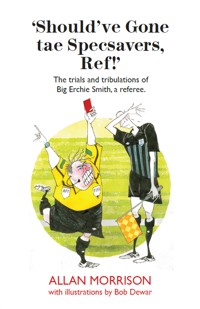
The referee. You can't have a game without one. The most hated man (or woman) in football but you have to invite one to every game. Enjoy a laugh at the anti and wicked humour of Scottish referee Big Erchie, a powerhouse at five foot five, and a top grade referee who strikes fear into he hearts of managers and players alike as he stringently applies the laws of the game. But Big Erchie is burdened with a terrible secret… He's a Stirling Albion supporter. EXCERPT: A booking by Big Erchie is a painstaking ritual for both player and referee as he calmly and prosaically enters the name of the offender in his book with the care of a monk drawing an illustrated letter, while at the same time gutting and filleting the culprit in a voice reminiscent of an acetylene torch set on full heat. Alas, on occasion, a frustrating petulant demonstration of power causes him to show a red card when a yellow would probably have suffice. Deep in his bosom, Big Erchie is consumed by a loathing of simulation, especially diving in the box. 'Some of that lot should get an Oscar nomination thrown in with their red card,' he continually moans. His trademark waving of his arms accompanied by a snort and roll of the eye suggests that, for some players, bringing back the birch would not be inappropriate.
Das E-Book können Sie in Legimi-Apps oder einer beliebigen App lesen, die das folgende Format unterstützen:
Seitenzahl: 144
Veröffentlichungsjahr: 2013
Ähnliche















ALLAN MORRISON is a prolific author; his previous books includeLast Tram tae Auchenshuggle! which combines three of his passions: humour, nostalgia and Glasgow. His media appearances include The One Show, Richard and Judy and The Fred MacAulay Show.
He is involved in charity work and after-dinner speaking, and is a member of his local Rotary club. Allan enjoys hill-walking, sport and travel, and is a keen football supporter. He and his wife live in the West of Scotland, and he is the proud grandfather of four grandchildren.
‘Should’ve Gonetae Specsavers, Ref!’
The trials and tribulations of Big Erchie Smith, a referee.
ALLAN MORRISON with illustrations by BOB DEWAR
LuathPress Limited
EDINBURGH
www.luath.co.uk
First Published 2013
ISBN (print): 978-1-908373-73-1
ISBN (eBook): 978-1-909912-57-1
The author’s right to be identified as author of this work under the Copyright, Designs and Patents Act 1988 has been asserted.
© Allan Morrison 2013
Contents
Acknowledgements
Introduction
Meet Big Erchie
Scotland’s National Stadium
Kick-Off
Temptation Part 1
Temptation Part 2
Yellow Cards
Big Erchie and Gazza
Red Cards
Managers
Pride, Prejudice and Penalties
Throw-Ins
Goal of the Month?
Extra Time
A Short History of Refereeing
Refereeing Guidelines and The Laws of the Gameas defined by FIFA
Acknowledgements
For their encouragement, help and advice my thanks go to the staff at the Scottish Football Museum at Hampden, especially Blair James, the Visitor Support Officer. Also John Allan, Jim Crumlish, Eric and Val Grieve, Ron Hachey, Craig and Lorna Morrison, Andrew Pearson, Lynne Roper, Robert Russell, the late Ron Sheridan, Margaret Wallace, Archie Wilson, John and Morag Wilson.
Introduction
FOOTBALL IS THE PEOPLE’S GAME. People enjoy watching it almost as much as they enjoy playing it and fan culture is a vibrant and expressive aspect of football. Scotland’s national obsession is an incurable disease, a collective insanity. Triumph, tragedy and heart-stopping excitement… that’s Scottish football.
The game is a form of identity for many supporters, with clubs acting as a focal point in many a community. It is said that there are two things you can never change in life – your mother and your football team. Fan passion, agitation and noise add atmosphere and energise matches, so entertaining the crowd is fundamental. And supporters are most definitely their team’s 12th man.
Scottish football has existed since time immemorial. Wild Scotsmen kicked around the heads of unfortunate Roman soldiers foolish enough to venture north,which resulted in dispatches being sent to Italy thatthe Romans might be better to avoid this dangerous place. Teams of Italian stonemasons were swiftly dispatched to the periphery of the Empire to build a wall under the watchful eye of Emperor Hadrian, who blatantly ignored planning permission in order to keep the Scottish footballing tribesmen away from the civilised south.
There are many recorded games of football played at large festivals and gatherings throughout the years, though many of them would come under the category of ‘mob football’. Early football matches appear to have been rough, indeed sometimes brutal, contests.
Although most games were portrayed as violent, there were clearly some with an element of skill. In 1568 such a game was witnessed by Mary Queen of Scots, during her imprisonment at Carlisle Castle. An account of the game states:
Twenty of her retinue played at football before her for two hours, very strongly, nimbly, and skilfully, without foul play – the smallness of their ball occasioning their fairer play.
The reference to the size of the ball fits in with an amazing discovery made while renovation work was being done at Stirling Castle in the 1970s. High up in the roof beams of the Queen’s Bedchamber a ball was discovered which has been dated as originating from between 1537 and 1542. It is reckoned to be the oldest existing football in the world.
The early part of the 19th century would witness the birth of the modern game. In 1824, John Hope, a student at Edinburgh University, founded the world’s first football club. Apparently Hope created the ‘Foot-Ball Club’ in order that he and his friends could regularly play football.
The members of the Third Foot-Ball Club all paid subscription fees and John Hope kept a careful record of the club’s accounts. These accounts refer to the purchase of ‘hail-sticks’ (goalposts), bladders and leather casings. Rules were also drawn up which included a rule banning tripping, and one whereby a free kick could be awarded when the ball went out of bounds. Unfortunately the Third Foot-Ball Club went out of existence in 1841, probably owing to John Hope and his friends getting a little old to play. In 1874 Hope was involved in creating Edinburgh’s first Association club, the ‘Third Edinburgh Rifle Volunteers FC’.
Football has been played in Scotland wherever there has been a reasonably flat open space. It could be ‘tanner ba’ street games (so called because a small rubber ball cost a sixpence, known colloquially as a tanner) or alternatively a bald tennis ball, a burst beach ball, a bundle of rags or newspapers all tied with string were used, although in the latter case when it rained, the ball would come apart. Stranger options used were wicker balls or sometimes even pigs’ bladders. Open spaces gradually gave way to gravel and cinder pitches on which many a footballer ended up with skint knees. Mothers were continually complaining to their offspring about scuffed shoes and boots.
Football nowadays has an inviolate place in the Scottish national psyche. Scotland loves this game that, in just 90 minutes, can take you on an emotional rollercoaster. Then there’s the charisma of great players, the passion of the fans, some of it served unfortunately with a spoonful of sectarianism. Players are at the heart of the game. Some are natural goal scorers, others great defenders, while others have all round skill and flair.
The famous Scottish ‘Tartan Army’ of supporting foot soldiers faithfully invades other countries, mixing with other teams’ supporters in a friendly manner. And the Tartan Army stay faithful to the cause, regardless of the outcome of the battle.
Nowadays you can’t have a football match without a referee, and although it is a tough job, it’s their own choice that they cop an earful from thousands of people while having their eyesight and parentage called into question. Even the fourth official gets it in the neck, although you have to ask what purpose is served in haranguing a fellow when one of his jobs is merely holding up a board to show the numbers of substituted players or the amount of added time.
Someone once said:
Every football team could use someone who knows how to play every position, knows when a player is definitely offside and knows when it’s a penalty. The only problem is that it’s difficult getting him to put down his pie and Bovril and come down from the terracing or stand.
That’s why we need referees.
This book’s hero, Big Erchie, first made his mark with the Scottish media and public when he red-carded all 22 players, plus the linesmen, in a Highland League match. Now, in the mainstream Scottish football arena of bigotry, booze and Bovril, Big Erchie tries to apply impartial judgement although his humour can be withering at times. And the poor man carries a terrible burden… he’s a secret Partick Thistle supporter.
Meet Big Erchie
AN ARTICLE ON THE PRIORITIES OF LIFE talks about the need for food, clean water, oxygen and sleep as fundamental to living, plus some of the biological homeostatic mechanisms keeping us alive. It goes on to identify money and financial investments as being important. Amazingly, there is not one mention of the key essence of life dominating Scotland: football. Football, the life blood of Scotland with its key ingredients of closed minds, pies, Bovril and prejudice, a game with 22 players, two linesmen and tens of thousands of ‘referees’.
Our hero, Big Erchie, was brought up on a farm in Perthshire, making him resilient to wind, rain, snow, mud, midges, ramblers, bawling bulls, bolshie coos and awkward critters. His father had once played football for Partick Thistle, and relics of a bygone age sat in a display cabinet in the farm living room, much to the chagrin of Erchie’s mother. They consisted of an old leather lace-up football, a pump, an adaptor, an inner tube and some patches.
Bestride his father’s throbbing old Massey Ferguson tractor, Erchie was master of all he saw, while on either side his two dedicated sheepdogs awaited his shrill whistle. Clearly this was a perfect finishing school for a life in football refereeing with his very own Field of Dreams, although Erchie sometimes commented that the dogs reacted quicker than some players. But no longer does Erchie live in a rural area. He has now stayed for many years in an apartment in the heartland of football bigotry: Glasgow.
Erchie’s hooded, steely eyes – the cumulative effect of years peering through perpetual drizzle – his thin slash of a mouth, and his now well-known streak of thrawn ruthlessness have given him a commanding, no-nonsense look, much recognised by the media, the Scottish footballing fraternity, the Scottish Professional Football League (SFA), and anyone who has reached the argumentative stage of the inebriated in his local hostelry in Glasgow’s city centre. Unfortunately, from time to time, Erchie’s wicked sense of humour and wisecracks do get him into trouble.
Loved by the press as one of Scottish football’s characters, Big Erchie has adapted his lifestyle to suit his persona. His tractor has given way to other trusty steeds. Once it was a Triumphmotorbike because he had been impressed by Marlon Brando riding his inThe Wild One.Nowadays it’s a Harley Davidson Electra Guide Ultra Classic upon which he zooms in devil-may-care mode to each stadium with his black leathers, gauntlets, Arai helmet and trailing raffish scarf (carefully chosen for its neutral colours). He is no Hell’s Angel, though many football fans think otherwise.
In the match officials’ changing room along with his assistant referees, and the distinctive aroma of long forgotten football socks, jock-straps and sweaty shirts, his preparation is something to behold. After all, the match might be on the telly.
Standing his ground and insisting that a player come and talk to him after committing a foul can bring abject terror to the perpetrator of the misdemeanour. Suddenly players appear baffled, incredulous or apparently absentminded as to their alleged conduct. Although Erchie is well known for letting play flow to a team’s advantage after an obvious foul, he surreptitiously watches the culprit for the rest of the time the player is on the park, which may not be overlong.
A booking by Big Erchie is a painstaking ritual for both player and referee as Erchie calmly and prosaically enters the name and number of the offender in his book with the care of a monk drawing an illustrated letter, while at the same time gutting and filleting the culprit using his wicked sense of humour in a voice reminiscent of an acetylene torch set on full heat. Alas, on occasion, a frustrating petulant demonstration of power causes him to show a red card when a yellow would probably have sufficed.
Deep in his bosom, Big Erchie is consumed by a loathing of ‘simulation’, especially such exhibitions as diving in the box or when a player is through on goal. ‘Some of that lot should not only get a red card but Oscar nominations thrown in,’ he continually moans. His trademark waving of his arms accompanied by a snort and roll of the eye suggests that, for some players, the rack, thumbscrew or the birch would not be inappropriate.
Life on the cutting edge of professional football is not easy, especially now that he is now no longer in the first flush of youth and is continually witnessing a parade of pimply referees who are yet to start shaving entering the footballing ranks. However Erchie, though smaller than most, is still reasonably fit, mobile, astute, never nonplussed, technically accomplished and utterly ruthless.
With senior teams in Scotland now employing large numbers of foreign players with a limited English vocabulary (although many of the Scottish players suffer from the same deficiency), Erchie has devised his very own style of hand waving and finger pointing much loved by press photographers.
Erchie has his favourite players past and present. Denis Law, Kenny Dalglish, Jim Leighton, Jimmy Johnstone, Brian Laudrup, Henrik Larsson, Willie Miller and Gaza (though Erchie always thought he was inclined to use his elbows over much) are just a few among his litany of icons. Indeed, talking about some of these individuals and their skills can make him moist-eyed, his heart palpitating. For Erchie always recognises talent but can also be appreciative of the player who, although lacking in natural ability and somewhat raw, gives it his best.
Our hero dislikes ‘the establishment’ in general, but appreciates that his employers at the SPFL specifically select him for games where his renowned discipline is necessary to ensure the game will not get out of hand.
Every match is different. For instance, Scottish local derbies can involve a gruesome, feral ritual of mayhem and bloodletting. Treacherous swamps, shark-infested waters, minefields and snipers’ alleys can sometimes be preferable to meeting disgruntled fans with their effing and blinding after such sanguinary games.
Despite criticism, Erchie is never churlish or vindictive. He recognises that footballers came in a phalanx of shapes, sizes and temperaments. Sometimes he opts to be considerate of players’ idiosyncrasies, merely chastising them surprisingly gently while ominously chuckling quietly to himself. He prefers players who readily acknowledge a situation and he absolutely abhors whingers.
His tolerance does not go as far as mistakes made by other referees when he is acting as an assistant referee. Then he can be heard shouting abuse at them into his mike, especially when they make decisions apparently plucked from the far flung corner of unlikelihood.
Being relatively small in stature (there is no minimum height restriction for referees) he can at times be almost spectral as he ghosts in and out of groups of players, stopping personal feuds and sorting out shoving and pushing at corner kicks.
His love of the ‘beautiful game’ is such that he takes a personal interest in the line-up formations of teams, sometimes being amazed at the starting eleven selected by managers. And to oversee his beloved soccer he is happy to not only turn out on sunny afternoons at large prestigious grounds, but also ash-grey stadia at the fag end of some unremarkable town in the depths of winter. As Erchie has remarked: ‘Ah’ve even refereed at small grounds where, with their attendances, they announce the names of the spectators to the teams!’
Scottish weather can play a significant part in refereeing, with some games on a knife-edge as to whether or not they go ahead. Erchie’s number one concern is wind, when his carefully combed hair can be impacted, leaving an exposed shining pate vulnerable to the lens of photographers. However he does admire the stoicism of players and fans who turn up for matches on a day when even dogs refuse to leave home.
Attention-grabbing headlines which praise his refereeing expertise are carefully preserved by Erchie in a series of albums. Any newspaper reviews which attack his quirkiness and independence of spirit are quickly dispensed with. He considers the opinions of Scottish sportswriters on the whole to be a mish-mash of bollocks and pig-headedness.
Big Erchie’s self-esteem is sacrosanct to his overall image, and even his appellation as ‘Big Erchie’ instils pride, as it is acknowledged by all and sundry that he is somewhat special to the Scottish game. Stories proliferate as to his part in dauntingly difficult matches both in Scotland and elsewhere with his reputation for sorting out aggressive and violent behaviour. Lusty, unsophisticated chanting of his name from the terracing is music to his ears, and he hopes that his masters at the SPFL listen to the acknowledgement of his expertise by the paying punters.
Big Erchie’s idea of relaxation away from refereeing is to immerse himself in the music of Elgar, especially ‘Enigma Variations’and ‘Land of Hope and Glory’.Elgar had endeared himself to Big Erchie when he learned that the composer loved football and had supported Wolverhampton Wanderers.
Sometimes of a Saturday night, sipping his favourite malt whisky, Big Erchie sits and watches a match on the telly he has just refereed, cringing when the high profile scrutiny of up to 23 cameras capture a doubtful decision on his part.
Throughout the years he has borne abuse and verbal lacerations by Scottish fans of all teams without any bitterness, enduring the weekly jibes with dignity, secretly believing his judgement to be better than that of thousands of biased eejits.
And, regardless of the final score, Erchie always regards himself as the real star in every match.
Scotland’s National Stadium
HAMPDEN PARK IS THE OLDEST continually used international stadium in the world. It has been on its present site in the Mount Florida area of Glasgow since it was first opened in October 1903.




