


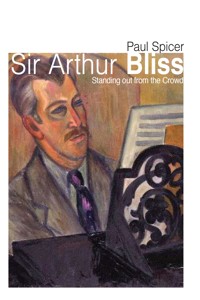
Erhalten Sie Zugang zu diesem und mehr als 300000 Büchern ab EUR 5,99 monatlich.
- Herausgeber: Robert Hale Non Fiction
- Kategorie: Geisteswissenschaft
- Sprache: Englisch
Arthur Bliss (1891–1975) was one of the most important British musicians of his age. Born into a family where music played a highly significant role, his talent emerged early. He served with distinction in the Great War, in which he was both injured and gassed. After the War he set the musical world alight with ultra-modern works, earning himself the soubriquet enfant terrible and leading to his first major work, the Colour Symphony. His dual American/British birthright led to a close connection with the USA and marriage to an American girl, Trudy Hoffman, who would be a mainstay of his life. Before long he became the most performed British composer abroad and his portfolio of works included ballet, film (H.G. Wells's Things to Come remains one of the finest film scores), opera, orchestral, chamber, choral works and song. He was a diplomat, a skill that was recognized in many appointments from the Government to travel using music as soft power, notably to Russia in 1956. He served as Director of Music at the BBC from 1942–4, was knighted and soon after appointed Master of the Queen's Music. Bliss was a private figure who stated that the only way to get to know him was through his music. Paul Spicer takes this as his starting point for this pioneering biography, which underlines the timely importance of a complete reappraisal of this important composer's music.
Sie lesen das E-Book in den Legimi-Apps auf:
Seitenzahl: 900
Veröffentlichungsjahr: 2023
Das E-Book (TTS) können Sie hören im Abo „Legimi Premium” in Legimi-Apps auf:
Ähnliche




















First published in 2023 by
Robert Hale, an imprint of
The Crowood Press Ltd
Ramsbury, Marlborough
Wiltshire SN8 2HR
www.crowood.com
This e-book first published in 2023
© Paul Spicer 2023
All rights reserved. This e-book is copyright material and must not be copied, reproduced, transferred, distributed, leased, licensed or publicly performed or used in any way except as specifically permitted in writing by the publishers, as allowed under the terms and conditions under which it was purchased or as strictly permitted by applicable copyright law. Any unauthorised distribution or use of this text may be a direct infringement of the author’s and publisher’s rights, and those responsible may be liable in law accordingly.
British Library Cataloguing-in-Publication Data
A catalogue record for this book is available from the British Library.
ISBN 978 0 7198 3158 4
All plate images supplied by the author.
Every reasonable effort has been made to trace and credit illustration copyright holders. If you own the copyright to an image appearing in this book and have not been credited, please contact the publisher, who will be pleased to add a credit in any future edition.
Cover design by Maggie Mellett
CONTENTS
Preface
Acknowledgements
Chapter One: The Curtains Open
Chapter Two: The Nation Arming
Chapter Three: The Diaghilev Effect
Chapter Four:A Colour Symphony
Chapter Five: Love Via the Stage: The ‘Volcanic Anglo-American’
Chapter Six: Towards Morning Heroes: 1927–1930
Chapter Seven: Things to Come: New Paths
Chapter Eight: Strings, Travel Guides and Checkmate
Chapter Nine: An American Interlude
Chapter Ten: The Dance Resumes: The BBC, Miracle in the Gorbals and Adam Zero
Chapter Eleven: Towards Grand Opera and Beyond
Chapter Twelve: Master of the Queen’s Musick
Chapter Thirteen: Musical Diplomacy, The Lady of Shallot, and Opera for Television
Chapter Fourteen: Unblessed Beatitudes
Chapter Fifteen: Australian Interlude and a Vision of Retrospect
Chapter Sixteen: The Curtains Close
Endnotes
Bibliography
Index
Preface
I was approached to write this book as soon as my biography of Sir George Dyson had gone to press in 2014. When asked, I realized how little I knew about Bliss, and how unfamiliar I was with his music. What I did know generally failed to excite me, and I felt so agnostic about the project that I seriously questioned whether I was the right person to undertake it. However, I then realized that I could turn this into a positive by making the music pass certain critical tests. I am certainly no apologist for Bliss. This is an issue for many biographers who work too hard to persuade their readers that so-and-so’s music has the divine spark, questioning why concert promoters and recording studios are not lining up to programme his or her music.
Writing this preface after having finished the main text of the book, I am now in a position to evaluate the whole oeuvre and to weigh up Bliss’s character. I can ask the question posed in the first chapter as to whether we know Bliss any better for listening to his music. He certainly wasn’t going to help us by opening himself up to scrutiny. In his second Desert Island Discs programme in 1972, which should be a light-hearted but fairly candid canter through his life, enthusiasms and loves, he simply sounded tetchy at being submitted to questioning by Roy Plomley. He eased up somewhat as the programme unfolded, but he gave the impression of the whole interview being a rather disagreeable necessity. This was a good example of the protective shield he presented to the world. The Times obituary noted ‘his handsome military bearing’ and reminded readers that he served as an officer in the Grenadier Guards in World War I. He never lost that military bearing, which also made him appear unapproachable to strangers. It was also in that terrible, wasteful war that he lost the brother he loved so much, a loss that coloured so many of his works throughout his life.
Living as we do in an informal age of personal revelation when even members of the Royal Family wash their dirty linen in public, the guarded persona of well-known people whose lives encompassed the two World Wars seems like a foreign country. Bliss’s conducting manner is similarly unemotional, like Boult’s – efficient, accurate and putting the onus on the players to make the music come alive, the detailed work done in rehearsal. One is reminded of Boult’s comment after seeing André Previn conducting rather wildly on one occasion: ‘I wonder what he did in rehearsal?’ It was a different world. So, Bliss’s comment suggesting that if we want to get to know him then we should listen to his music tells us that it was only when he expressed himself through music that he put his innermost thoughts on display. The skill is in the reading.
Bliss’s output of composition can be loosely divided into five periods: the pre-war juvenilia, the post-war ‘enfant terrible’ works, the 1922 Colour Symphony and the beginnings of maturity, the high maturity works from 1929, loosely starting with Pastoral and Serenade, through Morning Heroes and onwards, and finally, the ‘Indian summer’ works of the last seven years (Angels of the Mind, Cello Concerto, Metamorphic Variations and The Shield of Faith). It is an engaging journey that, given my initial agnosticism, found me becoming more and more involved and wondering what the next musical revelation would be. The final period is, to my mind, the most interesting and shows Bliss writing deeply personal works which have a searingly emotional core. The extraordinary thing is his desire to go on composing – and composing better than ever – in these last years all through his serious final illness. His famed energy levels never really faltered, right to the end.
Bliss himself felt he would be a poor subject for a biographer as he had no perversions, extra-marital affairs, or the need to pep himself up with drugs. He was, to all intents and purposes, a very ordinary, normal, and deeply committed husband to his remarkable wife, Trudy, who outlived him by thirty-three years, dying in 2008 aged one hundred and four. It is therefore of real interest to understand how this ‘normality’ is reflected in his music. My instinct is to say that what becomes apparent as the years progress is a deepening of the emotional core which mirrors the deepening of the bond between him and Trudy. This would seem to furnish us with an explanation for the outstanding works of his ‘Indian summer’ and a warmth of expression which, whilst certainly not absent from earlier works, positively glows in these final works.
During the writing of this book, I had serious conversations with a number of deeply committed Bliss aficionados, wanting to know what it was that spoke to them so strongly about his music. But as my own investigation developed it became clear there were going to be a number of works which stayed with me for life, showing with absolute clarity the journey I had travelled. This also begged the question as to why, as a British music specialist, I did not know these remarkable works earlier in my life. This, then, is at the heart of the writing of this book. I want the reader to share my journey of exploration, and to join me in the excitement of discovery. I want them to get to know this remarkable man, to listen, and to share my new found enthusiasm for this music with another generation of music lovers who, like me, will find the sheer variety, colour, vibrancy, drama, and the deep well of emotional undercurrent irresistible.
Acknowledgements
A number of people have been key to the writing of this biography to whom I am deeply indebted. Karen Sellick, Bliss’s younger daughter, was a source of huge encouragement throughout, and especially as the book was nearing completion when she was very ill. One of her daughters read a number of chapters to her during her final illness. Very sadly, Karen died before she could see the whole text, but it was partly her very positive reaction to what she was read which spurred me on with greater confidence to complete the book. She was a very special person and I was privileged to be able to speak to her often. It was good, too, to be able to meet her elder sister, Barbara, at the start of the research back in 2014, and to gather some of her memories of her father before her death early in 2020.
Perhaps the most helpful of all has been my old friend, Andrew Burn, Chairman of the Bliss Trust, who has such a long-standing association with, and knowledge and love of Bliss’s music. He not only helped me with factual information through the many programme notes and articles he has written for recordings, concerts and periodicals, but perhaps more importantly was a sympathetic ear and sounding board when my early agnosticism over Bliss’s music threatened to boil over. His calm, wise counsel was what eventually helped me to see the light. I also want to thank the Bliss Trust, especially Elizabeth Pooley, for their generous sourcing of many scores that have been so important to read as Bliss’s life progressed. The Trust has also provided generous financial support for the photographs and images used in the book. Both Elizabeth Pooley and Andrew Burn were extremely helpful in assisting with all aspects of the photographic material.
I also acknowledge, with thanks, the black and white photographs that have been supplied from the Bliss Archive at Cambridge University Library. They can be identified by the acronym ‘CUL’ by each photograph.
Giles Easterbrook, a founding member of the Bliss Trust, and fount of knowledge of all things relating to Bliss, has been a constant companion in the enormous amount he has written about so many of Bliss’s works. It was therefore with the greatest sadness that we learned of his early death in late August 2021 just as the first draft of this book was delivered. His spirit hovers over all these pages.
Robert Milnes, another Bliss trustee and a good friend of Trudy Bliss, has been extremely helpful in providing personal information otherwise not in the public domain. Monica Darnbrough has provided me with reams of concert reviews, articles and cuttings from the Times throughout the writing process which has been such a help in saving time when, already seven years into the writing of the book, time was of the essence to the ever-patient publishers.
I must put on record the great help I received from Robert Clark relating to Bliss’s First World War period. Another important contact who proved a mine of information was Professor Jonathan Elkus, who I met at the University of San Francisco at Berkeley where his father, Albert, had headed the Music Department and invited Bliss to be a visiting Professor around the time of the outbreak of World War II. The Music Librarian, John Shepherd, was also very helpful in allowing me to see the large quantity of Bliss-related material held there. It was valuable to see where Bliss worked and see the Hertz Hall where Bliss’s ballet The Lady of Shalott was premiered. Relating to this, the staff at the Museum of Performance and Design of San Francisco Ballet proved most helpful in providing programmes and photographs relating to this premiere and subsequent performances. Caroline Williams also helped with her research into Trudy Bliss’s family in America, as did Paul Jackson of the University of Winchester, who did a great deal of research around Santa Barbara and was very helpful in pointing me to important locations there.
Lewis Foreman has, as ever, proved a mine of information and a source of privately made recordings where no commercial alternative currently exists. Pianist Mark Bebbington, who recorded all Bliss’s piano music for Somm Recordings, was very kind in loaning me all his Bliss piano scores and giving me very helpful opinions on various works from the perspective of the professional pianist. The indefatigable John Smith of the Royal Birmingham Conservatoire kept me plied with references to Bliss, which he found in many different sources. Bill Sneddon was also very helpful with his remarkable research into the details of Bliss’s father’s various marriages.
I would like to place on record my gratitude to the librarians at the Cambridge University Library who were so helpful to me on my numerous visits to the Bliss archive there. Nothing was too much trouble for them. Finally, and most importantly, I must place on record my grateful thanks to the British Academy/Leverhulme Foundation for the research grant I was awarded, aided by staff at the Royal Birmingham Conservatoire, which helped in particular to fund my American research.
This book, like the other biographies I have written, has taken a long time to finish because of a busy professional life, which had to take precedence because it pays the bills. That it has been finished at this point in the summer of 2021 is thanks to the Covid-19 pandemic and lockdowns that enabled me to focus on it almost entirely for some eighteen months – together with composition, which provided much-needed contrast to the writing of words. This balance of work seems to me to have its equivalent in the essence of music, light, shade and contrast of mood, all of which are at the heart of this story.
Chapter One
THE CURTAINS OPEN
‘If you want to know about me, listen to my music’. So said Bliss towards the end of his life. Bliss’s friend, the poet Robert Nichols, quoted an aphorism by F.H. Bradley in his preface to Such Was My Singing: ‘It is good to know what a man is, and also what the world takes him for. But you do not understand him until you have learned how he understands himself.’1 So here is another side to Bliss’s desire for us simply to get to know his music. We need also to know what Bliss wants us to know through what he writes of himself in his music. And is this to be taken as the real deal? Does Bliss understand himself and is he speaking the truth to us through his music? Are there gestures or characteristics that regularly appear which are intended to make us feel a certain way about him? As I am to tell you the story of his life I want, as a biographer, to be certain that I am being told the truth. How can a biographer translate Bliss’s desired ‘listening’ into the written word? A challenge, certainly. But the more the immersion in his music, the more the traits of personality emerge, and the more complex yet the task becomes. There is a detective story here and we are urged to examine the clues to the mystery through the pages of Bliss’s music. There will be no Agatha Christie-like dénouement in a stylish drawing room at the end, but the course of this narrative will hope to lay bare the essential elements which will lead the reader to want to go and investigate Bliss’s music for themselves – surely the desired outcome for any musical biography.
But before we can start dusting for fingerprints, we have to amass our facts, see where Arthur Bliss came from and understand what early childhood influences set him up for the possibility of the noteworthy career that was to develop.
Bliss was a hybrid in being born of an American father and an English mother. This conceptual duality remained of the utmost significance throughout his life, even being mirrored in his own marriage to an American. Bliss’s father, Francis, known as Frank (1847–1930), was a seventh generation American born in Brooklyn, Long Island, but whose family for all the previous generations had lived in Springfield, Massachusetts, to where the first of the Blisses to live in the USA emigrated from Rodborough, near Stroud in Gloucestershire in the seventeenth century. He was the second of four children born to Elijah and Mary Bliss. Elijah (1816–1899) is recorded as having had a number of different jobs through his career, and at various times was described as an importer, a merchant, an oil and cloth manufacturer, and a ‘secretary’. He was obviously quite well-to-do if the last address at which Frank lived with them was anything to go by: 111, Sixth Avenue, Brooklyn, a large brownstone house typical of the area. After his wife’s death in 1884 aged 61, Elijah moved to London for his remaining years. He sailed from New York and arrived in Liverpool on 8 May 1891, three months before Arthur’s birth.
Frank Bliss’s first wife was Lillie Pancoast, who he married in 1884 but who died two years later. They had one son, George born in 1885, Bliss’s half-brother, who was educated at Haileybury College and who died in 1927, aged only forty-two. Frank’s second wife was Celestine Adrienne Leture, who he married in Brooklyn on 19 October 1875. It is not clear when she died, although we know Frank was a widower when he married Agnes Davis on 6 November 1890. They had three children, Arthur Edward Drummond (b.1891), Francis Kennard (b.1892), and James Howard (b.1894). However, Agnes was only to survive until Arthur was four years old. Arthur remembered her in his autobiography As I Remember as an ardent music lover and that ‘she must have been a good amateur pianist, if the volumes of her music that I have, all marked with her phrasing and fingering, are sufficient proof.’2
Frank Bliss had come to the UK as a representative of John D. Rockefeller’s Standard Oil Company in 1896. They lived in Barnes, a prosperous and leafy suburb bordering the Thames in south London. Their house, called Hawthornden, was in Queen’s Ride overlooking Barnes Common, and would later be destroyed in the Blitz. Agnes died in Nice, France, on 18 March 1895 and was repatriated to be interred in the cemetery at Mortlake, close to Barnes. Whether because Hawthornden had too many personal memories to bear, or because with the children still so young it seemed the appropriate moment for a change, Frank decided to buy a house in Holland Park, Bayswater. No. 21 is a very substantial detached house in one of the most desirable parts of London, which Arthur described as ‘very big and magnificent’3 and it was their home for the more than a quarter of a century.
‘Big and magnificent’ might also describe Frank Bliss – not that he was tall; a passport application noted that he was a little over 5’ 8” with a ‘healthy’ complexion and a moustache, but he was a distinguished-looking man with a strong personality and a firm set of principles. He was also a ‘man who loved fine things and was a discriminating collector.’4 Arthur soaked up the essence of these beautiful things all around him and felt them to be ‘an imperceptible but abiding form of education’. In a moving tribute he went on to say that ‘I was supremely lucky not only in having such a father, to whom indeed I owe all that I may have myself achieved, but also having one who by his own ability and hard work was able to give me the perfect environment in which to spend the years of my youth.’5
There is no doubt as to the good fortune Arthur and his brothers had in being born into such a wealthy, loving and supportive environment, but there was never any question that this privilege might be abused or taken advantage of as the boys were expected to work out their own destiny with the same application that their father had shown in achieving his success.
Are there any clues from these earliest days as to the direction Bliss’s music might take in due course, especially his strong dramatic instinct? He recounted being fascinated by clocks – so fascinated, indeed, that his concerned father felt moved to remove or cover them: rhythm, pulse and chiming quarters. A performance of Ravel’s L’Heure Espagnol years later would bring it all back. A fascinating mechanical Chinese vase at home would play music while a tea drinking mandarin complete with drooping moustaches would appear and retract as if by magic. ‘Glittering splendour’6 witnessed watching Queen Victoria’s Diamond Jubilee was another early impression, together with experiencing John Philip Sousa’s famous band: ‘Was it the immaculate white kid gloves that Sousa drew on before raising his baton, with something of a Beecham panache, which attracted me most or the drilled precision with which various groups of his band, cornets, trombones, woodwind, acknowledged in turn the applause? I forget, but I wish I could re-hear how he performed those marches of his.’7 Add to this his father’s habit of telling his boys stories from Homer’s Iliad and the Odyssey when out walking and, aged about eight, the intimidating dancing lessons he had to undergo with the venerable Mrs Wordsworth, described later in Bliss’s life by the great Dame Ninette de Valois as ‘formidable’. The process of growing into our skins is the process of gathering and filtering experiences. The key is which of those experiences remain as stimulants to feed the creative mind.
Music was an essential part of the household routine and all three boys were encouraged to learn instruments. Arthur, being the eldest, perhaps naturally took his mother’s instrument, the piano; Kennard played the clarinet, and Howard, the cello. The three boys played chamber music together in the spacious surroundings of their own home, or as photographs show, their grandmother’s (Agnes’s mother) house in Mortlake. The boys used to love Sunday visits to their grandparents, partly because the garden bordered the river. On Boat Race days there was the thrill of seeing the competing Oxford and Cambridge eights striving to reach the finishing point first. The result was announced by either dark blue (Oxford) or light blue (Cambridge) papers floating down into the garden, thrown from a hot air balloon at the conclusion of the race.
Schooling had begun in 1898 at the Norland School in Holland Park Avenue. This was followed two years later at the pre-preparatory Wilkinson’s School in Orme Square near to Holland Park. Then, in 1902, Arthur was sent to Bilton Grange School, a preparatory school very close to Rugby to which all three boys in their turn would go. These schools were fairly grim places and Bliss described Bilton Grange as having ‘Dickens-like horrors.’8 It is therefore of little surprise to find that it was the ‘self-effacing and dedicated music master’ who provided the antidote to the general brutality in the form of an introduction to Beethoven and his piano Sonatas, and on leaving, a gift of the two volumes of Schubert’s Sonatas which Bliss kept in use throughout his life.
Beethoven proved to be a very powerful stimulant to the young Bliss who, wound up to fever pitch in his desire to know more about this maverick genius, had a recurring dream in which he was to have a lesson with Beethoven himself. In his imagination Beethoven was living in a derelict hut by the Thames and Bliss ran through the streets to get to him only to be stopped by sinister playing from a band in whichever way he turned. Flinging himself forward he got to the hovel where Beethoven awaited only to be told by a ‘veiled figure’ that ‘The master is dead’(!) The boy certainly had a vivid imagination – perhaps another early fingerprint.
At Bilton Grange, Bliss discovered an essential personality trait: ‘I had quickness and facility, but not the faculty of concentration.’9 Allied to this was a much later self-assessment: ‘I admit to being a bad subject for the camera, as I am too for the portrait painter and the sculptor. My temperament demands activity, not a passive role: I only feel myself in action.’10 These traits are two sides of the same coin. And further: ‘If my music is to make any impression it must move on, and not be static; that is the very essence of my own character.’11 And now, perhaps, a second fingerprint has emerged from our detective’s dusting. The essential first lesson in the art of concentration came into sharp focus when at Bilton Grange Bliss tried and failed to play a piece of Handel from memory. As he put it, in the process of learning the music ‘the next page of the score was always more interesting than the one in front of me, with its instant difficulties to overcome.’12 Never again, even when conducting his own music, did he trust his memory. Another side to this was Bliss’s habit of revising works sometimes several times. Perhaps the next page always being ‘more interesting’ led him to hasty conclusions which needed rectifying later, something, as we will see, which was to be counterproductive to the acceptance of some of his scores.
Prizes for French, maths and music showed an early academic aptitude, and school concerts were never without a contribution from the young Bliss (or his brothers when they arrived). Drama at the school was another extra-curricular activity in which he participated, but sport was not, at least according to the school records, much in evidence at this stage. Significantly, he met E J Dent, of King’s College, Cambridge, an old boy of the school, who visited for a weekend, attending concerts on both the Saturday and Sunday evenings, and playing the piano himself. He was to become a good friend and mentor of both Arthur and Kennard later on when they went up to Cambridge.
Bilton Grange, whilst undoubtedly a tough regime, was a civilized school with a sizeable proportion of its boys learning musical instruments and singing (there were three choirs). A feature of Sunday evenings was an informal concert which gave the boys an opportunity to show off their skill and have a goal for their practising.
In common with a fair proportion of the boys at Bilton Grange, Bliss went on to Rugby School, just a few miles away. He started there on 28 September 1905 in W.N. (‘Spitter’) Wilson’s house. Wilson obtained his nickname because of his propensity to spit when talking. In trying to overcome it he often made a sound which to the boys sounded like ‘ob’. This led to a probably apocryphal remark often quoted at the time ‘Little boys should be (ob)seen and not heard’!13 Wilson was also responsible for the management of an ‘Army Class’ that prepared boys for entrance to the Army Colleges at Woolwich or Sandhurst, which was seen as a very significant change in the balance of the curriculum dominated by Classics.
Music in the public schools at this time was a peripheral, extra-curricular activity and, as Bliss put it, ‘In my time any boy who showed a determination to become a musician was rara avis, to be treated with a good deal of condescension, if not worse. All teaching and practising had to be squeezed in after school hours and in very inadequate premises.’14 The Director of Music was the remarkable Basil Johnson, who remained at Rugby until 1914, when he moved to Eton – succeeded at Rugby by George Dyson. Bliss was fortunate in having such an able, supportive and dedicated master to lead him forward. As he remembered: ‘He fought hard for increased opportunities. I owe him many happy hours of a Sunday afternoon at his house playing on two pianos with friends and gaining in this way knowledge of classical symphonies.’15 And at last we come to the first mention of a Bliss composition performed at the Johnson’s house. ‘Somewhat unusual, it was a quartet for piano, clarinet, cello and timpani, written for my brother Kennard and myself, with the addition of two friends who played the cello and drums in the school orchestra. Still under the spell of Beethoven it consisted of variations in the somber key of C minor. The small invited audience recoiled each time the timpani were thwacked and finally could not restrain their laughter: perhaps a good preparatory lesson against some future audience reactions.’16 Howard had not joined the school at this point or he would have undoubtedly been the cellist in the performance. The choice of instruments obviously reflected the experience he had in playing chamber music with his brothers at home.
A forward-thinking young temporary music master standing in for a sick colleague introduced Bliss to the music of Debussy and Ravel trying to subvert Bliss’s hero-worship of Beethoven who, along with the other great composers of the past, the evangelizing teacher wished to consign to the dustbin of history. ‘At fifteen years of age I was immediately captivated by the French masters. I loved the delicious sounds and poetry of Debussy and the cool elegant music of Ravel – no beetling brows and gloomy looks here, but a keen and slightly quizzical look at the world.’17 This was the first modern music Bliss had encountered and its effects would be clear to hear in his first serious works. He met Ravel in 1919 and told him how influential his music was on him at such an early age and was met with a classic Gallic shrug, which to Bliss showed that it was not a view shared by the new young composer turks snapping at Ravel’s heels. ‘My affection for his music has never wavered. Some of his work may consist of trifles, but they are trifles fashioned with all the imagination and finish of a Fabergé ornament.’18
There are two other pieces dating from his time at Rugby. One is an arrangement of Tchaikovsky’s March and Valse des Fleurs for clarinet and cello first performed on 17 January 1908, and the other, a much more substantial sounding Trio for piano, clarinet and cello which was first performed on 19 January 1909. He was obviously keen to use his Christmas holidays productively both in writing and being able to rehearse the music with his brothers before term started.
The opening of the new Temple Speech Room at Rugby on 3 July 1909 by King Edward VII was a great occasion in the history of the school, and in young Bliss’s life to date. The Speech Room was designed by the great Victorian architect Sir Thomas Jackson who had been the architect for the enlargement of Butterfield’s impressive school chapel in 1896. When a distinguished previous Headmaster, Frederick Temple, who had risen to become Archbishop of Canterbury, died in 1903, it was felt that a suitable memorial would be a new school hall large enough to accommodate the rising numbers in the school. It was designed with an ‘Albert Hall’ style of stage with tiered choir seating rising to an organ which occupied most of the width of the wall above. An impressive building indeed and one in which, in his last year at the school, Bliss was to perform several times, undoubtedly the most important of which was singing in a performance of Elgar’s Dream of Gerontius in April 1910.
The growing importance of Elgar’s music to Bliss was recounted when he wrote: ‘My musical life during the years at Rugby was enriched by a growing love for the music of Elgar. I had heard the Enigma Variations on several occasions, and in my last year at Rugby I took part in a performance of Gerontius, which put the seal on my fervent admiration. The summers we spent so close to the Malvern Hills made much of his music seem an intimate utterance of our own pleasures.’19 Holidays were pleasantly varied and mostly in England at this time, ‘Christmas in London, Easter by the sea, generally near Swanage, and for the summer months my father used to rent some house in the beautiful counties of Worcestershire, Shropshire or Herefordshire.’20 But these local places were balanced, once the boys were a little older but still at school, by two wonderful skiing holidays at Territet in Switzerland. However, for all the excitement of the ski slopes, Bliss preferred the summer holidays spent in England. They spent five holidays in Cradley Rectory in Herefordshire, Bliss enjoying being able to drop into the church next door and play the organ, and also developing a passion for microscopy encouraged by the local curate. So engrossing did this become that Bliss’s father bought him his own microscope. ‘This miniature and magic world of beauty provided the perfect anodyne for the frustrations and failures of creative efforts.’21
‘Creative efforts’, whether frustrating or successful, are very often encouraged in the young by contact with an influential person – perhaps by the hero-worship of a major composer. In Bliss’s case this was undoubtedly Elgar. He tried, unsuccessfully, to elicit a signed photograph from his hero when at school, and didn’t manage to actually meet him until 1912, when he was two years into his Cambridge studies. Once that meeting had taken place, although turbulent later on, their relationship flourished and was particularly supportive when Bliss was on the frontline in France. Elgar sent Bliss a copy of his Cockaigne overture to France in the first week of the battle of the Somme. It was signed and had ‘Good luck’ inscribed in the flyleaf. When the war had ended, Elgar invited Bliss to come to hear a playthrough of his new Violin Sonata. There was a full house of distinguished people including Bernard Shaw and Landon Ronald. W.H. Reed, for many years leader of the London Symphony Orchestra and a close friend of Elgar’s, played the violin, and Elgar himself played the piano. Bliss turned the pages and recalled: ‘Was my disappointment due to the far from brilliant performance or to the belief that its musical substance had little in common with the genius of his earlier masterpieces? I hope I sat quiet, as if absorbed.’22
Bliss’s time at Rugby was coming to an end in 1909 but another long-lasting influence was to come from a rather unexpected source and demonstrate the serendipitous nature of teaching. Rupert Brooke’s godfather, Robert Whitelaw, was, according to Bliss, an inspired teacher and a real eccentric who positively quivered with excitement when declaiming ‘famous passages from King Lear and Oedipus Rex.’23 Bliss would go to Whitelaw’s house to have his Latin or Greek verse corrected and marvelled at his teacher’s passion for barrel organs. ‘Outside in his drive there was usually one hired, or, if he was lucky, two, grinding out tunes from the Italian operas… I have never heard anyone except Whitelaw who could handle words, especially Greek or Latin, under a sound barrage… Certain Verdi tunes are now debarred from my enjoyment.’24
At the end of his time at Rugby, Bliss decided that he should take the opportunity of learning – or at least being exposed to a stringed instrument and he took some holiday lessons with the distinguished German violinist Wilhelm Sachse who had been teaching one of his half-brothers. Bliss decided to try his hand at the viola but never progressed as Sachse would always prefer to get him to accompany Brahms violin sonatas during his lessons instead. This may say more about Bliss’s potential on the viola as Sachse perceived it especially with only a few weeks of tuition in prospect than anything else, but, as Bliss commented, he learned the great Brahms sonatas this way. Bliss’s later work with Lionel Tertis on the Viola Sonata written for him would teach him far more than he ever gathered from Sachse in his short period of tuition.
Bliss started at Pembroke College, Cambridge in the autumn of 1910. It was in every sense a whirlwind of experiences. After the hothouse, closed environment of public school, university was a sudden breath of fresh air – not that in those days there weren’t some school-like restrictions, but essentially it was an adult environment and it was possible to rub shoulders with like minds and to extend experience through exposure to brilliant young people and older teachers. The two people he related to most strongly were Charles Wood and Edward Dent (of Bilton Grange memory). With Wood he studied counterpoint and fugue. Despite a seemingly conservative way of teaching Bliss grew to admire and like his teacher greatly. His conservatism, however, extended to his musical tastes, and on taking him to hear the British premiere of Schoenberg’s Five pieces for Orchestra in the Queen’s Hall Wood had to be disowned for laughing hysterically during the performance!
Wood was one of the first students at the newly founded Royal College of Music in its original building on the west side of the Royal Albert Hall in London. He studied with Stanford and Parry before moving to Selwyn College, Cambridge and then to a teaching post at Gonville and Caius College, becoming its first Director of Music in 1894. He lost a son in the first World War, just as Bliss was to lose his younger brother, Kennard.
It was Edward Dent who was to prove an abiding friend and influence, not only to Arthur Bliss, but to his younger brothers, as we shall see. Bliss described him as ‘the most stimulating influence, bringing into a somewhat provincial backwater a keen breeze from musical Europe. He gave generously of his time to young musicians, and a visit to his house might lead to playing through an act of a Mozart opera, with Dent singing most of the parts in Italian, or a heated discussion about contemporary music.’25 One of the great attractions about Dent for Bliss was his recent return from a long period spent in Europe and a resulting friendship with Ferruccio Busoni whose playing, as Bliss noted, like Liszt’s was given added authority through the creative side of their personalities. His interpretations were as stimulating as they were unorthodox. An example of this which Bliss referred to was Busoni’s use of the pedal in Bach’s Chromatic Fantasy and Fugue. ‘In the Fantasy… his arrangement allowed of a mysterious blurring of colours, far more orchestral in sound than the keys of the piano seemed capable of giving. He was a unique phenomenon among the great players I have heard, and I am grateful that even at second hand I had a chance to glimpse something of his ideals.’26
One figure at this time who had been at Cambridge between 1892–5 was Ralph Vaughan Williams whose quiet musical revolution was sweeping through the musty corridors of the establishment. Bliss took part in one of the earliest performances of the Sea Symphony. He was also present at the first performance of On Wenlock Edge given by the tenor Steuart Wilson, with the extraordinary W. Denis Browne (also a casualty of the first War) playing the piano. Bliss does not recall who the string players were, but he remembers with absolute clarity RVW himself sitting at the front dressed in tweeds and smoking a pipe: ‘a massive man with a magnificent head.’27
Bliss’s recollections of his Cambridge years are few and far between, and we are left with the impression that a very good time was had by all and that study was something of a necessary evil. Occasional mentions of new music are there: a society that Bliss founded with some friends, modestly called ‘The Gods’, was formed to play through their new works in what Bliss described as ‘a mood of mutual admiration’. He admitted to a ‘reluctance to concentrate, except haphazardly, on the central core of my being, my music. Life with a very large capital L was too delicious just to breathe in, and I think that I mortgaged the immediate future by this dilettantism, just when I should have closed the doors on a good slice of life and locked myself in with my work.’28
One of the earliest extant works we have from this time is a piano piece composed in his first year at Cambridge (1910) called May-Zee. Its dedication is slightly pretentiously written in French: ‘Composée et Dediée à son amie MW’. We assume that the ‘M’ of the initials is the ‘Maisie’ of the title. Perhaps she was one of those who made Cambridge ‘just too delicious to breathe in’ – who knows? However, this accomplished short piece shows a rather socially restricted salon-style waltz. It has elegance and style, and a degree of virtuosity is needed to bring it off in performance. It was published by Gould and Company.
Two years further into his studies at Cambridge came a wholly different piano Intermezzo, a more mature conception; introspective in nature, more substantial, and showing a far more interesting, reflective side to Bliss’s creative nature. It was published by Stainer & Bell at the same time as his first Suite for Piano, dedicated to his father and published by Joseph Williams. The Suite is a much more extensive and interesting work, and is the first multi-movement work we have. It isn’t surprising, perhaps, that all the earliest works are for piano: Bliss was an accomplished pianist, and these early pieces, which he must have played himself, show a real feel for the instrument and some of its possibilities. Stylistically it is still rooted in Edwardian England, with Brahms hovering over his shoulder. There is nothing here to hint at what will come so vividly into focus after the War. But every composer’s progression is fundamentally different. The Suite is still a significant work, with its central Ballade being a big-boned movement lasting nearly eight minutes. What is revealed as these pages unfold is an obviously extrovert temperament which has a tender core. This is a real fingerprint. For while the means of expression and the style in which he will express himself develops out of all recognition, the underlying personality which needs to express itself is there to be read in embryo in these pages. What is interesting about the relatively immature piano writing of these movements is how much of the music is located in the centre of the piano keyboard. He doesn’t venture much to the extremes, which gives the music a rather ‘boxed in’, thick textured feel and shows how this music will have been written at the piano. Even the Scherzo is rather lumpen in this way, with the small helter-skelter run from the top of the piano right at the end feeling like a sudden moment of freedom.
The next work, Valses Fantastique, written the following year in 1913, is a far more interesting conception and shows a considerable leap forward in stylistic invention. There is no doubt that the French school is beginning to weave its magic web around his creative mind. Ever since being introduced to Debussy and Ravel at Rugby he had obviously been trying to process this ‘cool elegant music’, as he called it. Here, in this new work, there are the first signs that his collar was being loosened, his brow unbeetled, and his view more quizzical (to use his descriptions of Ravel). The work is in four movements and was later withdrawn along with the two works already discussed, although two movements of the Valses Fantastique were used right at the end of his life for A Wedding Suite for piano celebrating the wedding of his half-sister, Enid in 1974.
The pianistic writing in the Allegretto Amabile first movement is very considerably advanced from the earlier works, and shows the influence of Ravel (whose Valses nobles et sentimentals had been published two years earlier). The movement opens as if nothing had changed, but soon the clouds seem to part. While he finds it difficult to assume Ravel’s degree of French nonchalance and grace, there is a real feeling that he wants to lighten his mode of expression. The second movement, Poco piu andante, continues the journey, and the third movement, Poco lento e molto espressivo, is the closest he comes to Ravel’s impressionistic world. It is also notable that he now moves out of the centre of the piano keyboard using a far greater expanse of the instrument. The fourth movement, Introduction – moderato, grows out of the previous movement and shows yet more harmonic advances, bringing the work to a beautifully dreamy and impressionistic conclusion.
Only recently formed at Cambridge, The Apostles had been another, far more influential society than the more inward-looking ‘Gods’. At that stage all were male, but it later became the Bloomsbury Group when it moved to London and included Virginia Woolf and Vanessa Bell. This highly subversive group of free-thinkers rejected Victorian values, and were influenced themselves by the revolutionary philosophical ideas of Bertrand Russell and G.E. Moore. They encapsulated the new thinking in his summary that ‘one’s prime objects in life were love, the creation and enjoyment of aesthetic experience and the pursuit of knowledge.’29 They promoted a new informality and freedom of expression which were cemented by the huge social changes which flowed as a reaction to the Great War so soon to engulf Europe.
Bliss was not genetically disposed to sign up to the whole package of ethics espoused by this group, but he was of the new generation for whom deference to the older generation was not an automatic right; it had to be earned. His father’s rock-like New England principles were deeply embedded in Bliss’s psyche and would not be abandoned at a whim, or even after three years of relatively wild Cambridge experiences. Moving to the Royal College of Music in 1913 to study briefly with Stanford he found the experience disheartening to the extent that he preferred ‘to forget the hours I spent with Stanford: they were not many and from the first moment when he scrawled on my manuscript “he who cannot write anything beautiful falls back on the bizarre”, I felt the lack of sympathy between us. He was a good teacher when in the mood: I felt that instinctively, and certain maxims, such as “Let in air to your score”, linger in the mind as truisms to be followed, but his own disappointments as a composer perhaps affected his outlook and he had a devitalising effect on me.’30 Crucially, he went on, ‘at the age of twenty-two I was too old to conform, and like my brother Kennard, a hero-worshipper of Berlioz, I regarded the defiant attitude of the great Hector towards the Paris Conservatoire as the only right one for a student.’31
One of the most salutary experiences of the RCM on the young Bliss was his exposure to the greatest compositional talents among the students of his generation, Herbert Howells key amongst them (notably Stanford’s favourite student). Bliss’s recollection of Howells is interesting: ‘His quickly written scores, showing a beautiful resolute calligraphy, with their technical maturity simply disheartened me. I had to learn one of the most painful lessons in life, that there are others who are born with more gifts than oneself: no amount of self-confidence can at heart convince one to the contrary.’32 And yet Bliss was to go on to have a far more successful career – at least on the face of it and in the mainstream – than Howells. But, as an aside, perhaps where Howells’s loss of his son Michael at the age of nine to polio was an almost debilitating leitmotif throughout his life which he hoped, though failed, to exorcise through the writing of Hymnus Paradisi, Bliss did, to a greater extent, exorcise the ghost of his dead brother through the writing of his own requiem to Kennard, Morning Heroes, and to move on.
One of the great experiences of his RCM time was going to the Drury Lane Theatre with his closest friends of the time, Howells, Arthur Benjamin and Eugene Goossens, to see the latest Diaghilev production of a Stravinsky ballet. Stravinsky was the man of the moment – even of the generation. Slightly later than the years we are currently investigating Bliss gave a lecture to the Society of Women Musicians on 2 July 1921. In this wide-ranging talk he took a look at music in various countries ending with Russia. Fascinatingly, he congratulates the Russians ‘not only for what they have created, but also for what they have killed…’33 He continues: ‘Let us take a toll of some of their victims.
1. The oratorio composed especially for the provincial festival on the lines laid down by the Canon [sic] and Chapter.
2. The symphonic poem á la Strauss, with a soul sorely perplexed, but finally achieving freedom, not without much perspiring pathos.
3. The pseudo-intellectuality of the Brahms camp followers, with their classical sonatas and concertos, and variations, and other ‘stock-in-trade’.
4. The overpowering grand opera with its frothing Wotans and stupid King Marks.
Give me such works as Le Sacre du printemps, L’Histoire du soldat, the Sea Symphony and Savitri, The Eternal Rhythm and The Garden of Fand, the Ravel Trio and de Falla’s Vide Breve, L’Heure espagnole and the Five Pieces of Schoenberg, and you can have all your Strauss Domestic and Alpine symphonies, your Scriabin poems of Earth, Fire and Water, your Schreker, your Bruckner, and your Mahler.’34 Ouch! A young man’s exhortation indeed, and notable that before long he would be writing his own sonatas, concertos and a grand opera. His final word in this outburst was reserved for the Germans as a whole: ‘I fear I cannot say a good word of German music: it is to me anathema, not because it is Teutonic, but because to my mind it is at the same time ponderous and trivial, or, in the jargon of present-day science, boundless, yet finite.’35 This from a man who idolized Beethoven and loved playing the Brahms violin sonatas with his viola teacher. But this, also, from a man who had just lost a much-loved brother to the Germans in the conflict we will come to in the next chapter.
We are getting slightly ahead of ourselves in our timeline, but whether or not these opinions were those of hot-headed youth there is no doubt that they were sincerely held and also acted upon in his own compositions of those years, as we will see in Chapter Three.
Bliss’s developing relationship with Elgar had grown a real reciprocity so that the Elgars took a serious interest in Bliss’s first foray into the medium of the string quartet. He noted ‘The Elgars were very sympathetic friends to me during the following years [after his initial meeting]. When the war came, she [Lady Elgar] wrote to me in France:
Dear Mr Bliss,
I must send you a few lines to tell you I had great pleasure on Friday as I was able to hear your Quartet. I did so wish you could have been present too as it was, at least it seemed to me, beautifully played and was received with much warmth of applause… I much wished that Sir Edward could have heard it… the music seemed so full of eager life and exhilarating energy and hope, and the writing for the instruments so interesting, and producing delightful effect, some beautiful cello sounds in the first movement for instance. I shall hope to hear it again… I hope your leave will really come before long and we hope you will let us know and come and see us as soon as possible…’36
The Quartet in A major was written in 1914 and given its first performance on 7 July that year in the Blisses’ home in Holland Park, played by Nettie Carpenter and Eugene Goossens (violins), Ernest Young (viola) and Howard Bliss (cello). Its first public performance was given in the Aeolian Hall by the Philharmonic Quartet: Arthur Beckwith and Eugene Goossens, Raymond Jeremy and Cedric Sharpe, on 25 June 1915. The quartet played it regularly after this. Bliss dedicated the work to his Cambridge friend and mentor, E.J. Dent. Dent, in reply complained that ‘all young composers embarrassed him by putting his name at the head of their earliest and most immature chamber works(!)’37 In the way that the Valses Fantastique was such a step forward from earlier piano works, this quartet shows just how grounded Bliss’s compositional technique was by now and it is of little surprise therefore that he found Stanford’s strictures unsympathetic. There is also little doubt that Stanford would have found ‘modern stinks’ to excoriate in this new work from his student and it could well be that Bliss would have found that more encouraging than the small details of criticism which Stanford might have tried to circle with his famous blue pencil. But this work actually falls after Bliss’s time with CVS.
What comes across in this first instrumental work is the freedom of the individual lines – a hallmark of a real composer. Never mind that the language is not yet formed into a personal style. The music of this quartet is very much of its time and the influence of Vaughan Williams (with some almost direct quotations from On Wenlock Edge composed only three years earlier) looms large not only in the mood and character of some of this music but also in its use of instruments and textures. It is a shame that Bliss didn’t have the confidence to keep the quartet in his list of works because, early as it is, it has some real inventiveness and a sense of command in its compositional processes. Playing for some twenty minutes, it is also a substantial chamber work.
Written around the same time and seen through Novello’s presses by his father, like the string quartet while Bliss was on active service, was a Piano Quartet in A minor written for and dedicated to the pianist Lily Henkel and her Quartet. Bliss remembered that it ‘was given a public performance in Bath while I was there (recuperating after being wounded) at Prior Park, and the event was considered by my commanding officer sufficiently noteworthy to have the cadet corps officially represented at the concert! So his second-in-command stoically came into Bath with me, and sat through what turned out to be the first serious concert he had ever attended – an endearing example of protocol duly observed.’38
The Piano Quartet is another substantial work in three movements lasting just under twenty minutes. The two outer movements are built on classic formal (Sonata) lines but are interrupted by a tiny two-minute scherzo. It is a lovely foil to the intense seriousness of the first movement and has some of the most interesting scoring of the whole work. In fact, this little movement feels like a fingerprint, so much more natural does it feel as an expression of Bliss himself. The brevity which defies convention also feels like an attempt to break loose from the very obvious stylistic shackles of the other movements. His friend, the poet Robert Nichols, wrote very interestingly about originality in the autobiographical preface to Such Was My Singing, his collection of poems written between 1915 and 1940:
‘Goethe remarks: “People are always prating on about originality, but what do they mean? As soon as we are born the world begins to work on us, and this continues to the end. What can we call our own save energy, strength and will? Could I give an account of all that I owe to great predecessors and contemporaries, there would be but small balance in my favour 39… Perhaps what those who demand “originality” of the poet actually desire is to feel the presence of a distinct personality. If so, they are in good company. For the same poet said to Eckermann: “Personality is everything in art and poetry”.’ 39,40
In the present writer’s opinion this applies absolutely to Bliss. For there is a very clear and powerful personality at work which is not necessarily reflected by a wholly original voice – but then how many composers can we name who are original in the way Goethe means?
The only other works of which we know, or think we know, that were written in 1914 are a lost Rhapsody for clarinet and piano. and a song, Tis time, I think, by Wenlock town, setting a poem by A.E. Housman. The rhapsodic piano part of the song would certainly place it at this time or even slightly earlier. The thickness of the piano textures seems to place it closer to the Intermezzo of 1912 perhaps, but the manuscript (it was not published) gives no real clue. It has a poignant ending powerfully observant of Housman’s final verse and finally repeating the words ‘Wenlock Edge’ almost as a final glance over the shoulder:
Oh tarnish late on Wenlock Edge,
Gold that I never see;
Lie long, high snowdrifts in the hedge
That will not shower on me.
This is a substantial song and shows Bliss’s instinctive feeling for vocal line. That is different from a memorable melodic line – something to which we will return a number of times during the course of this narrative. It is no surprise that Bliss amassed a considerable list of songs in his output during his life, of which this was the first. It was obviously a medium he enjoyed.
Another song possibly from this time – perhaps 1915 – is The Hammers setting an onomatopoeic poem by Ralph Hodgson which starts:
Noise of hammers once I heard,
Many hammers, busy hammers,
Beating, shaping, night and day,
Shaping, beating dust and clay
Saw the hammers laid away.
The pounding of the hammers in Bliss’s setting is reminiscent of Honneger’s famous representation of a steam train in Pacific 231 of 1923 and Mossolov’s Iron Foundry of 1927 but evidently predating both. George Dyson’s The Blacksmiths of 1934 also sets a fantastical alliterative medieval poem about the noise of an iron foundry. All these pieces show the power of music to describe visceral energy, and of all the works so far discussed, this perhaps comes closest to Bliss’s own feelings about himself as being a man of action, energy and drive, a major fingerprint which is possibly his defining characteristic. Perhaps most interesting of all in this setting are the very final bars which are inconclusive, leaving a question mark hanging in the air reflecting the final line: ‘silent hammers of decay’.
One final recollection from Bliss of this time points up an important personality trait which emerged earlier. He elected not to live at home whilst studying at the RCM, despite the closeness of his father’s house to Kensington, because there were too many servants in the house. ‘I must not only be alone, but feel that I am.’41 He compared himself to his friend Darius Milhaud who could work in a crowded room and he wished he had that facility of concentration. But as we saw in his fateful concert all those years earlier at Bilton Grange this was not something which was going to change. Conditions needed to be right for him so he could work effectively and marshal his concentration.
Chapter Two
THE NATION ARMING
From the houses then, and the workshops, and through all the doorways,
Leapt they tumultuous—and lo! Manhattan arming.
To the drum-taps prompt,
The young men falling in and arming;
The mechanics arming, (the trowel, the jack-plane, the blacksmith’s hammer, tost [sic] aside with precipitation;)
The lawyer leaving his office, and arming—the judge leaving the court;
The driver deserting his wagon in the street, jumping down, throwing the reins abruptly down on the horses’ backs;
The salesman leaving the store—the boss, book-keeper, porter, all leaving;
Squads gathering everywhere by common consent, and arming;




