


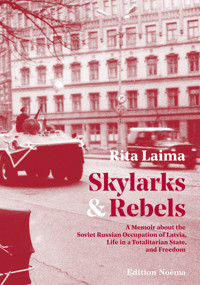
32,99 €
Mehr erfahren.
- Herausgeber: ibidem
- Kategorie: Geisteswissenschaft
- Serie: Edition Noema
- Sprache: Englisch
Skylarks and Rebels is a story about Latvia’s fate in the 20th century as told by Rita Laima, a Latvian American who chose to leave behind the comforts of life in America to explore the land of her ancestors, Latvia, which in the 1980s languished behind the Soviet Iron Curtain. In writing about her own experiences in a totalitarian state, Soviet-occupied Latvia, Laima delves into her family’s past to understand what happened to her fatherland and its people during and after World War II. She also pays tribute to some of Latvia’s remarkable people of integrity who risked their lives to oppose the mindless ideology of the brutal and destructive Soviet state.
Das E-Book können Sie in Legimi-Apps oder einer beliebigen App lesen, die das folgende Format unterstützen:
Seitenzahl: 1237
Veröffentlichungsjahr: 2017
Ähnliche




















ibidemPress, Stuttgart
Table of Contents
Introduction
Hello! Sveiki! (Latvian) Labas! (Lithuanian) Tere! (Estonian)
With gratitude
Glossary
Prologue: A Country the Size of West Virginia
A Latvian Folk Tale about Ezere
PART ONE: New Jersey Latvian American Girl and Trimda (Exile)
Hillside Haven
Programmed for Latvia
Catskill Summers
Latvian Bohēma
PART TWO: Latvia as a Battlefield—World War II
The Two Wars’ Long Shadows
Refugees, Immigrants, Exile
Opaps (Paternal Grandfather)
Omamma (Paternal Grandmother)
Dimmed Lights (Great-Grandparents)
Pēteris and Dārta Bičolis of Sēlija
Augusts Jānis and Amālija Rumpēters of Vidzeme
Great-Grandparents Antons and Matilde Lejiņš of Northern Vidzeme
Enemies of the Soviet State: A Latvian Hero and His Bride
Victims of Soviet Repression: Photographs of Velta (b. Rumpētere) and Eduards Rapss
PART THREE: Return to Terra Incognita
Crossing the Border
The Latvian Soviet Socialist Republic
Cold Light in Rīga
3/5 Raiņa bulvāris
Latvian Poster Art
Farewell, Latvia!
Interlude (November 1980–September 1981)
PART FOUR: The 1980s
Tuk! Tuk! I’m Home!
Rīga (1201)
Letter dated January 4, 1983 to my parents in New Jersey
New Beginnings at Krāmu iela 10/4a, Tel. 211951
Letters
Excerpts from a letter dated January 15, 1983 to my parents
Rīga up Close
A Strange Incident at the Rīga Bourse
Puppets and Masters
Practicum
Zeppelin: Rīga Central Market (Central Kolhoz Market)
Desecration
Art in the Forest
“Old Friends” (Bookends) and the Magic of Ramave
1983: A Wedding in Snow
In-Laws
Comme des Communistes: Trying to Look Chic in a Command Economy
The Controller Is Coming!
Leniniana
“Communism’s Victory is Inescapable!”
Fresh Air in the Latvian Countryside
Ghosts
Judenfrei: Tamāra and the Jews of Latvia
Roosters and Cats in Old Rīga
Jūrmala
New Life
Mushrooms
The Gift
Ad Astra per Aspera: Gunārs Astra, Our Bright Star
Crippling Humility
“Traitors”: Remnants of Bourgeois Nationalism
Russian Boots on the Ground
Kurzeme: Strazde—Spāre—Pope—Ventspils—Ēdole—Alsunga—Kuldīga
Vot, vot, Comrade Ilmarovna!
Entertainment
1984: A Ruckus at St. Peter’s
The Water Breaks
Baby Blues
Maskačka’s Edžus
A joke about Rīga’s monuments.
1985–1986 / Squeezed
1985: The Red Spot
1986: Our Rage against the Machine: Chernobyl
Is It Easy to be Young? Latvian Youth Behind the Iron Curtain
1986: Hoping for Change
PART FIVE: The Thaw
Klāvs
1987: Depression
Sandy*
1988: “Rīga Retour”
1987: Helsinki-86; “Queen Latvia is Awakening”
1988: Life in an Approximation
More on Approximation
The Beginning and End of Indian Village
1988: The Latvian Flag
June 14, 1988
Labvakar! (“Good Evening, Latvia!”)
1988: Baltica
1988: Bearslayer
Bearslayer
A Stronghold in the Fatherland
The Latvian Popular Front
Litene
Light in Darkness
1989: “Come out, justice, from your metal coffin”
“Sex scandal”
X-Rated
A Death in Piebalga
1989: The Human Chain
Too Good to Be True?
The Fall of the Berlin Wall
1990: A New Beginning
Together in Eternity
Together in Song
Summertime
First day of school
It’s a boy!
The Lenins Come Down
1991: The Barricades, January 13–21
Dedovshchina: “Hazing”
Fragile democracy, frail baby
1991–1992: A Dream by the Gauja
“And It’s All Over Now, Baby Blue”
PART SIX: The 1990s; Freedom; Farewell.
The Russian Mafia
Latvia: The Most Beautiful Country in the World
*
About the cover page illustration and its back (above): A birthday wish dated September 24, 1967 from two Latvian Soviet political prisoners, Viktors Kalniņš and one Jānis (surname unknown), to their prison mate, Estonian freedom fighterEnn Tarto(born in September 1938), on his 29th birthday in a prison camp in Mordovia. The card depicts the Latvian Freedom Monument, the Daugava River, and Rīga. The inscription on the back reads: “Greetings to Enn on his birthday! We wish you all the best in the future and the fulfillment of all your dreams and hopes. 24. IX. 67. Mordovia. Viktors. Jānis.”
Illustration courtesy of Enn and Piret Tarto.
The coat of arms of the Republic of Latvia designed by Rihards Zariņš and adopted in 1921. Source: Wikimedia Commons (https://commons.wikimedia.org/wiki/File:Coat_of_arms_of_Latvia.svg)
Country denoted for them not just a particular geographical environment known and cared for in every detail, but a cultural space alive with stories, myths, and memories. It furnished food, drink, and shelter, as well as every sort of sustenance for the mind and spirit.
—Iain McCalman, The Reef
Live Free or Die.
—The official motto of the US state of New Hampshire as coined by General John Stark
Deeper meaning resides in the fairy tales told to me in my childhood than in any truth that is taught in life.
—Friedrich Schiller
If you can’t resign yourself to leaving the past behind you, then you must recreate it.
—Louise Bourgeois
Photograph of astopa saktaor crossbow fibula, traditionally worn by men in the eastern Baltic area, courtesy of Andris Rūtiņš, BalticSmith.com.
Cīrulīti mazputniņ, negul ceļa maliņā.
Rītu jāsi bargi kungi, samīs tavu perēklīti.
Samīs tavu perēklīti, iecels tevi karietē.
Iecels tevi karietē, novedīs vāczemē.
Novedīs vāczemē; tur tev liks mežā braukt.
Tur tev liks mežā braukt, tur tev liks malku cirst.
Kad tu malku sacirtīsi, tad tev liks guni kurt.
Kad tu guni sakurīsi, tad tev liks bruņas kalt.
Kad tu bruņas nosakalsi, tad tev liks karā iet.
•
Skylark, little bird, don’t sleep by the roadside.
Tomorrow the harsh masters will come; they’ll crush your little nest.
They’ll place you in their carriage and take you to Germany.
They’ll drive you into the forest and make you chop a lot of wood.
When you finish chopping, they’ll make you build a fire.
When you build the fire, they’ll make you hammer armor.
When you finish the armor, they’ll make you go to war.
(Old Latvian folk song)
A map of the three Baltic States, Estonia, Latvia, and Lithuania, which lie on the eastern rim of the Baltic Sea. Source: Wikitravel (author Peter Fitzgerald) http://wikitravel.org/shared/File:Baltic_states_regions_map.png
With love to my children: Krišjānis (1984) and Jurģis (1990), born in Soviet-occupied communist Latvia; Tālivaldis (2001) and Marija (2005), born in the land of freedom and democracy, the United States; and to my grandson Teodors (2014) and my granddaughter Kirke (2016), both born in the free and independent Republic of Latvia.
In loving memory of my grandparents, Augusts and Emma Rumpēters and Jānis and Līvija Bičolis, who passed on the light and love.
I also dedicate this memoir to Latvians, Lithuanians, and Estonians around the world.
“How many years can some people exist before they're allowed to be free?”
—Bob Dylan
“How could you live in communist Latvia?!”
—A question the author has often been asked.
Sweet sixteen: My older brother Arvils and I in Washington, DC in August 1976 to remind people of the notorious Molotov-Ribbentrop Pact signed by Nazi Germany and the Soviet Union on August 23, 1939, and to protest the ongoing Soviet occupation of Latvia, Lithuania, and Estonia. For many years the Baltic exile community remained strong, politically active, and dedicated to the cause of restoring the Baltics’ independence. (Family photo)
Introduction
“I want to live in a free Latvia!” A photograph from 1991 and the “Barricades” time. (Unknown photographer)
These are the memories that I carried around inside of me for years after I left Latvia in 1999. For a while I simply could not find the time to sit down and write; I bore two more children into the world, and their needs consumed me. When my daughter was born in 2005, I realized it was “soon or never.” Numerous unsuccessful job searches seemed to signal the urgency to turn to writing and try to capture the end of a dark era in Eastern Europe that many of my American compatriots knew little about. I had been there and lived through my “fatherland” Latvia’s last decade under the brutal Soviet Russian occupation, but not that many people knew where Latvia was or what life in the Soviet Union had been like. And in spite of independence, the future of Latvia, Latvians, and our beloved language, the key to our identity, remained clouded by uncertainty and tough economic times. This situation added to my sense of urgency. Nor was I getting younger. Each year seemed to dissolve into the last, compressing my sense of time.
While I dug into my memory, Latvians continued to emigrate from their native land in droves. Each year, as I became one year older, Latvia’s population diminished, with more people dying off than being born. There were many reasons for this, including the distant events of World War II and the Soviet occupation, which had a long-lasting, detrimental impact on the Baltic States. As I wrote, people of great significance to Latvia passed away, leaving a void. For a small nation each individual carries great weight. The oldest members of the former Latvian exile community (that is, my parents’ generation, which experienced the war) are dying off these days. Latvia’s demographic situation has become precarious. My story is about identity, language, patriotism, love, loss, and an archetypal landscape; it’s also about being young, idealistic, and fearless. I was full of curiosity, longing, and love when I traveled to the “fatherland” (tēvzeme in Latvian), the land of my ancestors, the country my grandparents were forced to leave due to terrible events beyond their control. My story will resonate with the descendants of Balts and East Europeans whose countries ended up behind the Soviet Iron Curtain after the war, whose families became refugees, and who sought to preserve their ethnic identity while becoming part of America. This is why I feel a deep kinship with my fellow Balts and with Poles, Ukrainians, Czechs, Hungarians, Jews, etc. Some of us still wonder where home is.
In this book I have retained diacritical marks to pay tribute to my mother tongue. Latvian, a very old Indo-European language, is the most basic and most important component of my identity. The United States of America is a country of immigrants, and Americans have come to accept all sorts of foreign names as part of their heritage. For this I love America.
As a first-generation American I am well integrated but not assimilated. I have no shame in speaking to my children in Latvian with Americans within earshot (I hope my fellow citizens do not consider me rude for doing so). I discovered that my fellow hockey, soccer, and school parents are a tolerant bunch. My Latvian language is a gift passed down through scores of generations, and I have no intention of breaking “the chain” of continuity. Our open American society makes me feel accepted. Our children’s American public schools display Latvian flags alongside other flags representing the countries of their students’ origins. What a great way to nurture American patriotism through the acceptance of its nation’s amazing diversity!
My son in his American team’s hockey uniform. (Family photo)
I enjoy reading the names on the jerseys of the hockey players we watch on the ice: it is also in those names that the diversity of America the Beautiful is revealed. Chinese, Finnish, French, German, Hungarian, Italian, Latvian, Polish, Russian, Swedish—names from all over the world—reflect the American nation’s history and essence. Life in Latvia in turn exposed me to its multi-cultural history. I became acquainted with Russia’s rich cultural and dramatic historical legacy and influence, even though in the Soviet era its positive effects on Latvian history were, mildly put, exaggerated and far-fetched. I was able to see a bit of Estonia and Lithuania while living in Latvia and realized again just how strategically important the relationship between the Baltic States is. In the 1990s I was able to easily travel to other countries in Europe. Stockholm, Amsterdam, Copenhagen, Salzburg, Helsinki, Vienna, Venice… So many beautiful, wonderful, and different destinations could be reached from Latvia within a couple of hours of air travel. Living in Europe was exhilarating, and it made me realize that I was an amalgam of European and American influences.
Although I am Latvian, this book is also dedicated to Latvia’s Baltic neighbors, Lithuania and Estonia. The Latvian and Lithuanian (Baltic) languages are closely related. Old Prussian, now extinct, was once part of this language group. Estonian, the language of our hardy neighbor to the north, is a Finno-Ugric language and not at all like Latvian or Lithuanian. The Baltics are a distinct region of northeastern Europe with unique histories, cultures, and landscapes. My parents always spoke of Latvia, Lithuania, and Estonia as if they were members of a close family that had suffered the same fate in the 20th century.
Hello! Sveiki! (Latvian) Labas! (Lithuanian) Tere! (Estonian)
I am very proud of the fact that I know part of my lineage, and that I can trace my roots back in time to places on the map of Latvia: Vidriži, Aloja, Birži, Augstkalne... There are some places in the United States that bear names of Latvian origin, like Livonia (Michigan), Riga (New York), and Riga Lane (on Long Island). We Latvians get a big kick out of this. I am proud of my two flags: our Latvian red-white-red flag and the Star-Spangled Banner of the United States of America. Latvian Jewish artist Roman Lapp’s hand from his exquisite series of drawings, “Hands for Friends,” is a perfect illustration of what I am. These colors symbolize my belonging to two very different cultures, which have made me the person that I am. One flag represents an obscure region of the Old World; the other symbolizes the New World and the United States and its break from the colonial fold. The United States of America remains the world’s brightest beacon of freedom and democracy: it has granted asylum to persecuted people from around the world. Among those were the Baltic refugees after World War II who could not return to their homelands on account of the Soviet occupation. My dual identity has undoubtedly enriched me.
I love the American motto “Life, Liberty and the pursuit of Happiness” from the United States’ Declaration of Independence. These words are loaded with meaning and connotations, especially when I think about the other half of my identity—the Latvian side. Latvia’s quest for life, liberty, and the pursuit of happiness lasted a very short time, commencing in 1918 and coming to a violent end in 1940 with the Soviet invasion. While others rejoiced, World War II did not end happily for the Baltic States: for nearly 50 years these nations would be brutally oppressed by the Soviet communists. My grandparents barely escaped the “Russian bear.” So many Latvian lives were lost in the 20th century, that it is a wonder that our nation survived into the 21st century.
I spent 17 years in Latvia—from late 1982 until March 1999. Part of that time was under the Soviet Russian occupation (until 1991). My charmed youth in the United States propelled me to the USSR in a strange state of euphoria and fear. I think that basic American freedoms, the American way of life, and my exposure to a lot of culture from an early age—art, music, literature, theater, and cinema—went a long way in keeping me “charged” in the depressing Soviet era, when life was lived as if in an aquarium. American popular culture and humor also strengthened me for what I was to endure in communist Latvia. “Hogan’s Heroes” with Colonel Wilhelm Klink and Sergeant Hans Schultz had made us Latvian Americans laugh (although the Nazi occupation in Latvia had been exceedingly brutal and deadly). Totalitarianism would reveal itself to me in all its dark and dreary colors.
The words of many American and British rock songs would serve as a kind of buffer between my open and inquisitive mind and the oppressiveness of Soviet reality in the 1980s. “Where are you goin’ to, / What are you gonna do? / Do you think it will be easy? / Do you think it will be pleasin’? / (…) / It’s my freedom, / Don’t worry about me, babe…” (Steve Miller, “Living in the USA”) Unlike my compatriots in occupied Latvia, as an American citizen I had the freedom to travel, and I never took this freedom for granted. As soon as I was old enough, I wanted to get out of the house and see new places. First on the list was Latvia, which our family and Latvian American society had been talking about for years. Fantastically, my experience there would correspond with history in the making: “The present now / Will later be past / The order is rapidly fading…” (Bob Dylan, “The Times They Are A-Changin’”) You’re young only once. Pumped up by the energy of the music I listened to and bored out of my mind by American suburban life, I felt I was ready for anything. Even adventures in a place that US President Ronald Reagan would deem “the Evil Empire.”
Because so little was known about the Baltic countries during the years of the Soviet occupation, we were used to hearing many strange questions in the United States. For instance, my friend Gerry at Parsons School of Design wanted to know if people in Latvia wore clogs. “Is Russian Latvia’s official language?” “Are you Latvians Russian?” This obsession with Russia grated on my nerves. Luckily, the Baltic States have clearly emerged from Russia’s shadow, with many of my fellow Americans now recognizing the names of our countries. After independence in 1991, Latvian, Lithuanian, and Estonian athletes have been winning medals at the Olympic Games to the cheers of Balts all over the world. (For example: Latvians Martins Dukurs [SILVER, skeleton, 2010 Vancouver] and Māris Štrombergs—aka “The Machine” [GOLD, BMX, 2008 Beijing; GOLD, BMX, 2012 London]; Lithuanians Rūta Meilutytė [GOLD, breaststroke 100 m, 2012 London] and Laura Asadauskaitė [GOLD, Modern Pentathlon, 2012 London]; Estonians Erki Nool [GOLD, decathlon, 2000 Sydney] and Heiki Nabi [SILVER, Greco-Roman wrestling 120 kg, 2012 London], etc.) After years of being forced to compete under the despised Soviet flag, Baltic athletes could finally compete under their national colors and hear their anthems fill stadiums around the world.
As an American in Soviet Latvia in the 1980s, I was a curiosity and a mystery. My Latvian heritage did not seem that important to anyone; it was the fact that I was American that was initially so intriguing to the people I encountered. Yet most of them were too scared to ask questions. Most Latvians could not understand what I was doing in Latvia in the first place, and this nurtured wild rumors. CIA, KGB… “Why on earth was I lingering on a sinking ship?” was the question I heard from time to time in the early eighties. (If the ship was sinking, that was a good reason to hang around, I thought.) As time passed, the curiosity dissipated; people lost interest when they grew used to my presence. (Rīga is not that big.) My strange haircut—an extreme mullet of sorts—grew out, and I blended in. Soviet leaders came and went, the tide of history changed, and the great “upheaval” began. A trickle at first but then building into a torrent of emotion and daring protest … The late 1980s were an unforgettable historical period of “national awakening” in Latvia, Lithuania, and Estonia, prompted by Soviet leader Mikhail Gorbachev’s policies of perestroika and glasnost after decades of repression, the numbing beat of Soviet communist ideology, and economic stagnation under the Politburo’s heavy, all-controlling paw.
In my book I often refer to Latvia as the “fatherland,” because Latvians traditionally refer to their native country this way. “I placed my head on the boundary / To defend my fatherland; / Better that they took my head / Than my fatherland” are the words of an old Latvian daina or folk poem/song. You won’t find the word “motherland” in Latvian dainas and literature, but in artistic and especially sculptural representation Latvia is depicted as a woman. Latvia’s Freedom Monument in Rīga is the figure of a woman—the mother who gave us life and defends her children, as we should defend her. The word tēvzeme evokes feelings of patriotism and protectiveness. Our history has been marked by so many tragedies, that we all feel protective of our beautiful country.
As the mother of three sons, I have thought a lot about all the Latvian boys and men who gave their lives for the idea and reality of a free and independent Latvia (in the Latvian War of Independence [1918–1920] and during WWII), and about those who were forcibly conscripted into foreign armies (Nazi Germany’s and the Soviet Union’s Red Army, for example) and died in wars they should never have been a part of. Their countless names are impossible to list. Their bones are scattered across Latvia, Russia, Belarus, Poland, Germany, and elsewhere. Some of Latvia’s veterans from World War II still survive, cheered and cursed, their role in the last war misunderstood. The remnants of the Latvian Legion fought in the “Kurzeme Fortress” (also known as the “Kurzeme Cauldron”) against the advancing Red Army in World War II, helping thousands of Latvian refugees, including my grandparents and parents, to escape across the Baltic Sea to freedom. We Latvians have a duty to explain our complicated history, in which allegiances were forced upon us at gunpoint.
I also reflected on the women of Latvia—mothers, sisters, daughters, sweethearts, and wives who had to hold Latvia together with their bare hands and survival instinct. In the early 1920s National Geographic reporter Maynard Owen Williams visited war-torn Latvia and wrote: “[… This country] owes a heavy debt to its women, who drive the wagons, harvest the flax, pile up the grain, tend the cattle, sweep the streets, pull the carts, run the hotels, tend the street markets, keep the stores, shovel the sawdust, and juggle the lumber.” (Williams, Maynard Owen. “Latvia, Home of the Letts.” National Geographic Magazine October 1924) My grandmothers were typical Latvian women: stoic and ingenious, patient and persevering. One led her children out of harm’s way on a perilous flight across Europe from Stalin’s “Red Terror.” The other remained behind, cut off from escape by circumstance and responsibility: she and her young sons (my uncles) were among the millions of captives caught behind the Soviet Union’s Iron Curtain.
The Baltic States’ geography has not been kind to its human populations. Numerous waves of war leveled much of what human hands built in the Baltic lands. Those busy hands went back to work time and time again. Despite these cycles of destruction, my people survived, and they are a fascinating bunch. Latvia, shaped like a peasant’s clog, is a repository of stories of tragedy and remarkable resilience: one only has to start digging, reading…
Ultimately, it is many people who made this book possible. My parents Baiba and Ilmārs Rumpēters and my grandparents, Līvija and Jānis Bičolis, and Augusts Rumpēters, instilled in me a deep love for the Latvian language and our cultural legacy. In my youth I basked in the light of my parents’ friends, writers, poets, painters, and musicians, most of whom have passed away by now. I mourn their absence. My children, Krišjānis and Jurģis (born in Latvia), and Tālivaldis and Marija (born in the United States), made me realize how important it was to tell my story and to document a decade of Latvia’s history under totalitarian oppression. My friends, especially in Latvia, helped me with my story by remembering certain details. The terrible suffering of the populations of Latvia, Lithuania, and Estonia in the last century was also a reason for working on my memoir. For too long the Baltic peoples had suffered without a voice.
A bit about my work on this book: I did much of my research online; I have strived for accuracy but am not a historian; and this is a memoir. I wanted to give my people a voice. I had to translate just about every source from Latvian myself (marked as Tr. RL). It is an endeavor of creative non-fiction. Many of the subjects that I mention can and should be pursued separately. The Nazi German and Soviet Russian occupations of the Baltic States deserve continued serious study. My book is laid out in such a way as to introduce the reader to my youth, which paved the way for adventures in my “fatherland.” I felt it was important to provide historical background information about Latvia in the 20th century; after all, events there explain why I was born in the United States.
So welcome to Latvia, a place I spend a lot of time thinking about, mainly because family and friends live there, and I think I would like to go back. My story is about being bicultural and exploring my family’s European roots. It is also a memoir about Latvia in its last decade as a satellite republic of the militarily mighty and fearsome totalitarian state, the Union of Soviet Socialist Republics. In that unhappy union Latvia, Lithuania, and Estonia, independent and thriving countries before World War II, were reduced to the status of occupied provinces and nearly erased from world memory. I had the privilege of being in Latvia to witness firsthand the last decade of their oppression come to a much awaited end, as the “the Evil (Soviet) Empire” collapsed, and freedom was restored. Today that freedom is under threat again both from the outside and from within, and lessons learned in Latvia have provided a perspective on troubling times in Europe and, much to my surprise and dismay, in the United States.
Rita Laima
With gratitude
Gunārs Astra, Lidija Doroņina-Lasmane, and Juris Ziemelis: Their courage will always be an inspiration.
The Cultural Foundation of the World Federation of Free Latvians for its financial support
Toms Altbergs
Edmunds (“Edžus”) Auers—For his mother’s pastries and tea, for sharing his precious books from the pre-war era with us, and for all the Soviet jokes and many laughs
Tālivaldis Bērziņš for Tālivaldis Augusts and Marija Līvija
Parsla Blakis for her unwavering enthusiasm
Jānis Borgs
My mother Baiba Bičole for reading Latvian folk tales to me when I was little
Kārlis Dambītis
Sarma Dindzāne-Van Sant
Olģerts Eglītis
Mārtiņš Grants
Ēriks Jēkabsons
Tija Kārklis
Arvis Kolmanis
Andris Krieviņš for Krišjānis and Jurģis and the beautiful photographs
Ēvalds Krieviņš
Juris Krieviņš for showing me the beauty of Latvia
Biruta Krieviņa for teaching me the value of hard work and persistence
Uldis Liepkalns
Ivars Mailītis
Mārtiņš Mintaurs
Karu Kuu
Valters Nollendorfs
Gunārs Opmanis
Valdis Ošiņš
My wonderful Raiņa bulvāris folks: Jāzeps and Ināra Lindbergs; Tamāra Legzdiņa; Māra Lindberga and Gunārs Lūsis; Inta and Ivars Sarkans; Daina Lindberga; Linda Lūse
Composer Steve Reich for his “Music for 18 Musicians” (1974–1976) – the sound of time collapsing
Kārlis Račevskis
Baņuta Rubess
Guntars Rumpēters
My father Ilmārs Rumpēters whose prolific artistic output has always been a source of inspiration
Reverend Visvaldis Rumpēteris
Anna Rūtiņa
Uģis Sprūdžs
Alfrēds Stinkulis
Jānis Stundiņš
Valdis and Inese Supe for their friendship and hospitality in Latvia
Tekla Šaitere
www.senes.lv
Kaspas Zellis
Mārtiņš Zelmenis
Ilze Znotiņa
October 1980: My first time in Latvia (then the Latvian Soviet Socialist Republic) visiting as a 20-year-old art student. This photo was taken on the roof of the 22-story Press Building (completed in 1978). The Press Building housed the editorial offices of most of Latvia’s newspapers and magazines in the Soviet era. Construction of a new suspension bridge across the Daugava River is visible to the left. The work was completed the following summer (1981). The old floating pontoon bridge was eventually dismantled. On the day of this photo shoot I was painfully aware that my time in Latvia was running out. (Photograph courtesy of Gunārs Janaitis)
Latvia was and remains for me both a reality and a dream. This scene that I drew in the 1980s of our everyday life in the Latvian countryside in Piebalga—doing the dishes, baking bread, taking care of the children—is now a distant memory of something lost and something gained.
Storks in the Latvian countryside in summer. (Photo by Juris Krieviņš)
Fond memories of life in Latvia: My sons Krišjānis and Jurģis with their cousins, Elīna and Alise, and a baby deer that their father rescued and raised on our farm in northern Latvia. Their “Omīte” (grandmother) Biruta Krieviņa can be seen walking to the barn, where she kept cows, pigs, and poultry. (Photo by Andris Krieviņš, 1992)
Glossary
Blats—A word from the Soviet era in Latvia that describes the system of connections, favors, and “who you know” in a centralized, impoverished economy, in which stores carried few attractive goods, and good services were hard to come by. For instance, if someone said, “I have blats at the butcher shop on Blaumaņa iela,” it meant “I know someone at the butcher shop on Blaumaņa iela who can get me some quality meat’” (unavailable to walk-in customers). My father-in-law had this kind of blats at a butcher shop. He took portraits of the manager’s family events and was reciprocated with good cuts of meat, which he shared with us. The decades-long system of blats promoted favoritism and spawned nepotism and corruption, problems that Latvia and all post-Soviet societies struggle with today. It also taught a part of society to calculate their relationships.
Cheka / chekist—The Soviet secret police, better known as the KGB. A chekist is a KGB operative.
Eastern Europe—I use the term Eastern Europe to describe the countries that found themselves behind the so-called Iron Curtain and under Soviet communist influence after World War II.
The Free World—A term used during the Cold War to describe countries with democratic political systems, freedom of speech, and free market economies, namely the United States, Canada, and Western Europe (as opposed to the Soviet Union and Eastern Europe).
Iela—The Latvian word for street
The Iron Curtain—“The political, military, and ideological barrier erected by the Soviet Union after World War II to seal off itself and its dependent eastern and central European allies from open contact with the West and other noncommunist areas. The term Iron Curtain had been in occasional and varied use as a metaphor since the 19th century, but it came to prominence only after it was used by the former British prime minister Winston Churchill in a speech at Fulton, Missouri, US, on March 5, 1946, when he said of the communist states, ‘From Stettin in the Baltic to Trieste in the Adriatic, an iron curtain has descended across the Continent.’” (Encyclopedia Brittanica)
Laima—The Latvian goddess of fate and fortune. Ej, Laimiņa, tu pa priekšu, / Es tavās pēdiņās, / Nelaid mani to celiņu, / Kur aizgāja ļauna diena. (An old Latvian daina, which translates as: “Walk, Laima, ahead of me, / I’ll walk in your footsteps, / Don’t let me go down the path / Of the bad day.”
Trimda—The Latvian word for exile. The word trimda stands for all the Latvians who left Latvia as political emigrants during World War II and then convened abroad to establish a temporary alternative Latvian society. The aim of the exile community was to preserve Latvian identity abroad while engaging in political activism to speed up the collapse of the Soviet Union. Trimda Latvians founded congregations, bought or built churches, established schools and camps for their children, published books, read their own Latvian language newspapers, organized concerts, theater performances, art exhibits, and other social activities, striving to preserve the memory of Latvia and the Latvian language and culture. The Soviet Latvian authorities mistrusted trimda Latvians and initiated smear campaigns against some of its leaders.
Prologue: A Country the Size of West Virginia
THIRD ELEGY
Strange to hail from almost anonymous shores
in overexplored Europe where the Baltic
still hides a lunar side, unilluminated
except for subjugations, annexations
which continue unabated for centuries.
No problem for anyone to name the Nordic countries
from Iceland to Finland,
but how about the Baltic ones?
Surely one and the same language
is spoken there? If not Russian,
at least something akin to German?
You will never guess unless we unravel
the skein of Indo-European and Finno-Ugric
language families, ponder Babel
to clear up the Baltic,
and who has time for such marginal myths?
We persist with the subsoil. Grass is another
favored metaphor (trampled upon, it springs back),
or limestone cliffs filed away by gales
yet undefiled, withstanding millennia.
It is strange to hail from the dark side of the moon
while supposedly we inhabit the same planet.
There are Third World pockets inside Europe
one tends to overlook, anonymous shores
marked with an x or a mental question mark.
If only you incline in the Baltic direction,
you begin to hear the dirge of a beehive
and perceive in underwater outline
an amber chamber built with pollen of grief.
Ivar Ivask.Baltic Elegies. Norman, Oklahoma:World Literature Today, 1987.
Translated by Valters Nollendorfs
So let it be known: my family hails “from the dark side of the moon” and “a Third World pocket inside Europe,” from a country called Latvia. I am also American, born in the United States in 1960 as a child of refugees fifteen years after the end of World War II. My parents and all their predecessors were born in Latvia, as far as I know. I could claim to be 100% Latvian, but maybe there are some Liv, Estonian, Lithuanian, German, Swedish, Polish, or Russian genes mixed in there due to so many foreigners crossing Latvia over the course of history, breaching ethnic borders, and setting up camps or permanent bases on our lands, taking what they coveted and leaving the rest for my ancestors to subsist on. With all the wars and foreign occupations, fires, the bubonic plague, childhood mortality, waves of emigration, and deportations that went on for centuries years in Latvia, I consider myself and other Latvians alive today to be the survivors of the fittest and most fortunate. My parents’ generation certainly seems to be robust, living to a ripe, old age.
Latvian musicians from Kurzeme in a photograph from the early 20th century. Many Latvian folk songs and melodies are hundreds of years old. Passed down from generation to generation, they symbolize my nation's resilience.
As a tiny link in a very long chain that stretches back in time, I cherish the ancient language passed down to me, as well as the rich treasure chest of Latvian culture: our delightful folk tales; our riddles rooted in everyday life; our witty, wise proverbs; our merry, foot-stomping folk dances and soothing, sometimes melancholic melodies played on the kokle (a wooden stringed instrument), the bagpipes, and the fiddle; the so-called dainas—our unique folk poetry that expresses all aspects of human existence; our traditional crafts; our ethnic jewelry with its ancient, mystical designs; our lovely folk costumes; our wooden architecture that merges so well with our northern landscape; and so on. It is a deep chest that we can be proud of, dip into for inspiration, and share with others.
A 19th century pūra lāde (dowry chest) from the Valka region. (Pauls Kundziņš, Latvju sēta, 1974.)
Latvia, a country slightly bigger than the state of West Virginia, lies on the eastern shore of the Baltic Sea opposite Sweden. Latvia’s neighboring countries include Estonia to the north, Russia to the east, Belarus to the southeast, and Lithuania to the south. Latvia’s geographical location as a country bordering northern Europe’s Baltic Sea, a strategic waterway and transit route, and as a stepping stone between Europe and Russia, has been both a blessing and a terrible curse. A tasty geopolitical morsel, the territory of Latvia has tempted foreign armies to invade, raid, and occupy it, leaving lasting political, cultural, linguistic, and genetic imprints. (Perhaps this is why there are so many beautiful Latvian women and good-looking men.)
The peoples that preceded Latvia’s modern nation. Source: Wikimedia Commons https://en.wikipedia.org/wiki/Balts#/media/File:Baltic_Tribes_c_1200.svg (© CC BY-SA 3.0 https://creativecommons.org/licenses/by-sa/3.0/deed.en)
Before German emissaries of the Holy Roman Empire and warrior monks began conquering the territory of ancient Latvia in the 13th century, it had been settled by numerous groups of peoples or tribes. These were: the Kurši (Curonians); Zemgaļi (Semigallians), Latgaļi (Latgalians), Sēļi (Selonians), and the Līvi (Livs or Livonians), a people linguistically related to the Finno-Ugric Estonians, Finns, and Hungarians. Like the ancient Vikings, the Kurši also took to the seas. One after the other, the local tribes ceded land to the Germans who named it Terra Mariana, the official name for medieval Livonia. The “castle hills” of our ancestors, pre-dating German arrival, can be found all over Latvia, many of them concealed by trees and bushes. The impressive stone ruins of the German invaders’ ancient fortified castles still stand today, looking more and more like rocky outcrops of the earth.They are fascinating reminders of the distant past, when peoples and faiths collided under the northern sun.
The Latvian language belongs to the family of Indo-European languages. Latvian and Lithuanian are Baltic languages said to be distantly linked to Sanskrit. Old Prussian was once part of this “family” but died out in the late 17th or early 18th century. The Old Prussians were conquered by the Teutonic Knights in the 13th century. Latvian and Lithuanian are said to be among the oldest languages in Europe.
Janīna Kursīte, a Latvian linguist and literary scholar, says: “It’s mostly true that Latvian and Lithuanian are among the oldest of Europe’s languages. Russian philologist Vladimir Toporov, who was also very familiar with Baltic culture, once said that Latvian and Lithuanian enjoyed a unique status among European languages in that they were both a ‘mother’ and a ‘daughter’ to European languages. The richness of the (Latvian) dainas and their ancient, mythical motifs are unique and archaic; you won’t find anything like the dainas among living languages and European cultures. At the same time, in terms of abstract notions of the modern world, the Latvian language is very recent, much more recent than German, English, and Russian; our modern-day Latvian was ‘created’ in the second half of the 19th century. Atis Kronvalds, Krišjānis Valdemārs, and Auseklis (Miķelis Krogzemis) were among those creating new Latvian words. We are both ancient and young; that is our blessing and our curse.”
It is interesting to note the similarities between the two remaining Baltic languages, Latvian and Lithuanian, and then the Finno-Ugric languages, Liv, Estonian, and Finnish:
English
Latvian
Lithuanian
Liv
Estonian
Finnish
star
zvaigzne
žvaigždė
tēḑ
täht
tähti
sun
saule
saulė
pǟvaļiki
païke
aurinko
sky
debess
dangus
tōvaz
taevas
taivas
river
upe
upė
joug
jõgi
joki
forest
mežs
miškas
mõtsā
mets
metsä
earth
zeme
žemė
mõ
maa
maa
brother
brālis
brolis
veļ
vend
veli
hand
roka
ranka
kež
käsi
käsi
The territory around Rīga, the capital of Latvia, was originally settled by the indigenous Livs. Rīga was founded in 1201 as a political and military base for a holy war against the native pagans by Bishop Albert. The campaign was successful and established a powerful foothold for German rule for centuries to come.
Left: Rīga. Scene on the Daugava River. Original wood engraving by J. Koerner, 1878. Image courtesy of Mark Dechow Antique Prints, Maps, and Rare Books, Hamburg, Germany.
In 1282 the city of Rīga joined the Hanseatic League, an important economic alliance in northern Europe. Over the centuries Rīga was visited and settled by people of various nationalities and cultures. Artifacts from its colorful history—coins, furniture, tools, model ships, and silverware—are on display at the Museum of the History of Rīga and Navigation (1773) in the old town. The stories of the city’s past are evident in its buildings and in Old Rīga’s intriguing street names, which beg to be explained, as well as in its houses of worship. Over the centuries Rīga prospered and grew. The Daugava River served as a gateway between East and West. Other major cities in Latvia include the port cities of Ventspils and Liepāja on the Baltic Sea, Jelgava with its famous palace Rundāle, designed by Francesco Bartolomeo Rastrelli (1700–1771), architect of St. Petersburg, and Daugavpils on the Daugava River.
I am lucky to have in my possession some faded photographs of my Latvian ancestors, my senči. I look upon their faces with love and like to imagine what their day and age in Latvia was like. These photographs, as well as a Bible printed in Rīga in 1794 that was passed down to me by my maternal grandmother, I count as my most precious material possessions. My Grandmother Līvija’s and Grandfather Augusts’ slim volumes of poetry in perfectly preserved bindings (his written between 1914 and 1925—a stormy period than includes World War I, Latvia’s independence from Russia, an invasion by the Bolsheviks, and the first years of the newly independent Republic of Latvia) transcend time and space. We are linked through our mother tongue.
An old family photograph that my grandmother Līvija gave to me of a family wedding in Zemgale, circa 1900.
The language of my grandparents’ poetry, Latvian, is not only ancient, it is beautiful, poetic, and evocative. It was the first language I heard as a child. I can speak and write it, and I am passing it down to my children. I cannot live without the Latvian language. It is as important to me as the air I breathe. It is the deepest part of my personal identity and a link to other Latvians around the world. Russian poet, exile, and Nobel laureate Joseph Brodsky (1940–1996) wrote: “I belong to the Russian culture. I feel a part of it, its component, and no change of place can influence the final consequence of this. A language is a much more ancient and inevitable thing than a state. I belong to the Russian language.” (Poetry Foundation) I can say the same about the Latvian language: it is my spiritual home.
Latvia has been a multicultural country for centuries. Ethnic Latvians comprise its majority. Minorities include Russians, Belarusians, Ukrainians, Jews, Lithuanians, Poles, Roma, etc. Latvia’s ethnic makeup was drastically altered under Nazi and Soviet rule. Its Jewish population was annihilated during the German occupation. Later under the Soviet policy of Russification, Latvia absorbed hundreds of thousands of Russian speakers. Latvia’s Russian speaking population grew at an alarming rate under Soviet rule. This legacy remains a source of social and political tension in Latvia even today, especially in its relations with belligerent Russia.
Rīga Railway Bridge inauguration in May 1914. Until its declaration of independence in 1918, Latvia was part of the Russian Empire. Source: Wikimedia Commons https://commons.wikimedia.org/wi ki/File:Riga_railway_bridge_inaug uration.jpg (© Public Domain)
Prior to the Soviet occupation in 1940, Rīga was a thriving port city that enjoyed trade and commerce with many Western European countries. Around the turn of the 20th century Rīga had a small British community with its own Anglican Church, St. Saviour’s, near the Daugava River. Soil was shipped from across the sea so that the church could be built on British soil. George Armitstead (1847–1912), born into a British merchant’s family, became Rīga’s mayor in 1901. Russian Orthodox churches throughout Latvia attest to Russia’s influence in the region. The tumultuous and tragic events of the two world wars left a permanent impact on Latvia, its population, and its architectural legacy.
A fine son of Rīga’s British community more than a hundred years ago: George Armitstead, Rīga’s fourth mayor, at the turn of the 20th century. Armitstead was an engineer and entrepreneur. His magnificent neo-gothic hunting lodge, Jaunmoku Castle (Schloss Neu-Mocken) in Kurzeme, is a popular tourist attraction. Source: Wikimedia Commons https://commons.wikimedia.org/wiki/File:GeorgeArmitstead.jpg (© Public Domain)
Latvia’s Baltic German population, once so powerful in Latvia, is long-gone, forced to repatriate under Hitler’s orders starting in 1939. Germans had been around in Latvia for centuries as masters and commanders and had a great effect on on my ancestors’ culture, customs, religion, character, and mentality. Not all of the influences were negative. Germans left us beautiful parks, churches, manors, and other notable buildings.
Latvia’s synagogues before World War II reflected Jewish history in Latvia that could be traced back to the 16th century. Latvian literature and Latvian folk songs have references to Germans, Jews, Roma, and Russians. Many Jews who settled in Latvia after the war emigrated in the 1970s. The region of Latgale with its distinct Latgalian dialect or language (depending on whom you ask) has also been decimated over time.
The ruins of Eleja Manor in the 1930s. Built in the early 19th century in the style of classicism for Baron von Medem, the estate’s buildings were torched in 1915 by the retreating Russian Army. Image courtesy of the National Library of Latvia collection “In Search of Lost Latvia.”
Latvia’s indigenous Liv population is nearly gone, and the Liv language on the verge of extinction. It may yet survive, thanks to the efforts of some fanatic Liv descendants. In his beautiful book of black and white photographs, Lībieši (2008), Juki Nakamura has documented the last of the Livs living in Latvia today.
“Vanishing voices”: A group of Livs in their Sunday best photographed in their seaside village Sīkrags by Vilho Setele in 1912. “Vanishing Voices” was a compelling article published in National GeographicMagazine in October 2012 about the world’s vanishing languages. Source: www.nba.fi/liivilaiset/Latvia/1Latvia.html
Latvians are “a small, thievish nation that lives in trees and eats mushrooms.” In another version we are “a small, quarrelsome nation.” Someone claimed that Winston Churchill coined this description. Others say it goes back centuries. Silly though it sounds, sometimes it describes us quite well. Our weakness is our infighting, especially in the political realm. We like to perpetuate the myth that our national character is marred by envy, jealousy, malice, and grudges. There are plenty of folk songs that seem to substantiate these claims. Supposedly we will do anything to trip up another Latvian: “Latvietis latvietim gardākais kumoss” (“A Latvian is a Latvian’s favorite morsel”), and so on. These self-deprecating comments are funny up to a point. Yet events in history speak of our ability to consolidate, especially in the face of adversity, which has been our constant companion for centuries.
“Princess Bolete”: a most perfect edible mushroom sitting in a soft carpet of green moss in Kurzeme, Latvia. (Photo by Aigars Adamovičs)
As for real mushrooms, in the late summer and early fall giddy Latvians don rubber boots and head into the forest with baskets and knives in search of glorious edible fungi, of which there is an astonishing abundance. For sautéing, marinating, and drying, mushrooms like King Bolete (Boletus edulis or baravika in Latvian), Slippery Jacks (sviesta beka), chanterelles (gailene), Saffron Milk Caps (rudmiese), Russula (bērzlape), etc. thrill Latvians young and old. In the spring, fungi connoisseurs also hunt for that special delicacy, morels (Morchella sp. or murķeļi). Most Latvians have a countryside retreat where they go to enjoy the outdoors, a bit of gardening, and culinary activities like berry picking and mushroom hunting. This is a marvelous way to stay in shape while enjoying the beauty and bounty of Latvia’s nature.
Our ancestors built their homes with logs and planted oaks, lindens, and other trees around their houses for beauty and shelter. In ancient times their fortified castles on top of castle hills were constructed of timber before the advent of the crusaders. Even when the Germans started grabbing our lands, converting us to Christianity and making serfs of us, our ancestors stubbornly clung to their pagan ways and sought out oak trees, a symbol of male strength and courage, for worship and offerings. Other trees besides the oak were anthropomorphized. The linden symbolizes feminine beauty. Pērkons, our ancient god of thunder, rumbled and grumbled from his celestial perch. Our fates were determined by Laima, the goddess of destiny. Many ancient superstitions have survived into modern times, and some Latvians have sought to revive their ancestors’ pagan religion, which is deeply rooted in nature.
Latvia’s climate is similar to that of Europe’s Scandinavia. Long, dark winters with considerable precipitation—sludge in the capital, snow in the countryside, dreary rainfall—are followed by short but brilliant summers with long days and short nights. Latvia’s climate is excellent for raising crops, including grains, vegetables, fruit, and flowers. My personal favorite, the dahlia, thrives in Latvia’s temperate summers.
The relatively shallow Baltic Sea never really warms up; swimming in it is a cold but refreshing experience. With the soft, white sands of the popular seaside resort Jūrmala next to the Gulf of Rīga, the picturesque, boulder-strewn beaches of the Vidzeme coastline, and Kurzeme’s beautiful, quiet, relatively empty beaches and old fishing villages that stretch along the open Baltic Sea, Latvia’s history has been defined by its meeting with the sea. Centuries ago it attracted foreigners who sought to claim it. At the end of World War II, departing from its shores, thousands of Latvians fled in fishing boats and German ships from the Red Army to Sweden and Germany. Under the communists, most areas along the sea were off-limits to the average Soviet citizen. The beaches were fastidiously patrolled by Soviet border guards, smoothed and combed to track the footprints of anyone attempting to escape from the USSR via the sea. Today the approximately 500-kilometer shoreline is open and accessible to the public. Latvians can still fish in their waters; however, rigid European Union quotas are endangering that age-old way of life captured in Latvian folk ditties: The sea did roar, the sea did hiss, / What lies at the bottom of the sea? / Gold and silver / And some mothers’ dear sons.
A photograph taken at a Liv fishing village in Kurzeme in 1912 of fishermen sorting their catch near Miķeļtornis. Source: Vilho Setele, 1912. http://www.nba.fi/liivilaiset/Latvia
The Baltics have a way of casting a spell on people who have lived there for a longer period of time. American diplomat George Kennan (1904–2005), who worked at the American Legation in Rīga in the 1930s, took note: “(Visiting Stockholm), something in the light, the sunlight, the late Northern evening suddenly made me aware of (...) Latvia and Estonia, and I suddenly was absolutely filled with a sort of nostalgia for (…) the inner beauty and meaning of that flat Baltic landscape and the waters around it. It meant an enormous amount to me. You can't explain these things." (Costigliola, Frank. “Is This George Kennan?” The New York Review of Books. Dec. 8, 2011.) Latvia’s gentle, verdant landscape dotted with gigantic boulders, many of them dubbedvelnakmeņior “Devil’s Rocks,” cast a spell on me, too, when I lived there.
“The Ruler of Vadakste” (Vadakstes valdnieks): a giant of a boulder in Ezere, Kurzeme near the Lithuanian border. The story goes that the last proprietor of Ezere Manor, Baron von Toll, ordered his peasants to move this boulder to his park. This task took the poor men ten years to complete, from 1845 to 1855.
Source: J. Sedols, Wikimedia Commons. https://commons.wikimedia.org/wiki/File:Vadakstes_vald nieks_-_akmens_Ezeres_park%C4%81_2000-11-04.jpg (© CC BY 3.0 https://creativecommons.org/licenses/by /3.0/deed.en)
A Latvian Folk Tale about Ezere
Several centuries have passed since that time when Ezere Manor was ruled by Baron von Nolcken. Back then it was simply called Nolcken. There was a terrace on the manor house’s east side, where each morning the baron would sit and drink coffee. From the terrace the river, the Vadakste, which formed the border (between Latvia and Lithuania—RL), was well visible. The baron was a ruthless sadist. Beneath the manor, where the baron often dined with guests, he had constructed a maze of passages. These passages connected the manor house with the chapel and the river, which had once been deep and navigable by ships. It was said that these passages had been dug by slaves. Long, deep, and gloomy, they were filled with dangerous traps. According to the baron’s instructions, secret cellars had been constructed beneath the passages to entrap hapless wanderers.
One such passage was located right beneath the terrace. While the baron entertained his guests on the terrace, beneath it people sentenced to death for minor transgressions stumbled about trying to find a way out. At a certain point in the passage a large millstone had been set into the floor. If someone stepped on the stone, it tipped, propelling the victims into a dark and damp cellar filled with the bones of other victims.
The newlywed wife of the baron’s son, the beautiful Ezere, fell into this trap, too. The young baron and Ezere had just celebrated their wedding. They and other young couples were playing the traditional game of hide-and-seek. Unsuspecting Ezere stepped on the millstone and fell into the cellar. But she was a sorceress. Outraged by what she discovered, she woke up the dead. They emerged above ground, chasing off the evil baron, and Ezere became ruler of the manor. That is how it came to be known as Ezere. (Latvian historical folk tale. Source: http://www.ezere.lv/35550/vesture1. Tr. RL)
Lielezere Manor. Source: © J. Sedols, Wikipedia. https://lv.wikipedia.or g/wiki/Att%C4%93ls:Ezeres_mui%C5%BEas_pils_2000-11-04.jpg (© CC BY-SA 3.0 https://creativecommons.org/licenses/by-sa/3.0/)
Ghost stories are attached to many of Latvia’s old German manor houses, which remind me of the mansions of the American South. For some reason many of them feature a lady “in green” (zaļā dāma). Was there any truth to the Ezere tale? Had there once been a sadistic baron, a serial killer who had turned his manor into a house of horrors? Baron von Toll must have had a cruel streak in him as well, ordering his subordinates to roll a humongous boulder for ten years from the river to his park. Many of the old manor houses of the Baltic German landed gentry still stand in Latvia, some of them particularly ghostly in their state of neglect or abandonment.
Latvia, land of lore, boasts countless legendary “sacred” springs associated with tales of pagan worship and sacrifice. Our many castle hills inspired tales of mysterious passages and vanishing people and animals. Latvian peasants with lots of time to kill during the long, cold, dark winters spun yarns near the fire about hedgehogs becoming kings and orphans meeting God disguised as a beggar…
Groves of straight birch trees sweep the Baltic sky like gentle brushes. In the spring many Latvians tap into the sap, fermenting it for thirst-quenching, hangover-healing consumption after celebrating the summer solstice in late June. Ancient oak trees of enormous girth rise from the meadows and fields, their massive limbs and fingers providing a perch for birds, shaking down acorns in the fall for wildlife to feed on. Linden trees burst into fragrant bloom in early summer, attracting bees and other pollinators as well as humans in search of fragrant, healthy herbal teas. Latvia’s magnificent forests are full of wildlife; its mysterios bogs beckon with shiny cranberries. If our planet Earth’s biodiversity has diminished severely in the last half-century, then in Latvia it seems to be flourishing. According to Yale University’s 2012 Environmental Performance Index, Latvia was ranked the second cleanest country in the world. Paradoxically, the backwardness of the Soviet economy and agricultural system just may have contributed to Latvia’s “cleanness” and its high ecological rating. Most of Latvia’s lakes are clean and full of fish.
My son Jurģis photographed at our house in northern Latvia with toys he made from acorns. (Photo by Andris Krieviņš)
What kinds of creatures call Latvia’s open spaces and forests home? My people have whimsical dainas and folk songs about moose, elk, deer, bears, wolves, foxes, the gorgeous lynx, wild boar, polecats or fitchews, the hare, ermines, weasels, red squirrels with their cute tufted ears, flying squirrels, hedgehogs, badgers, otters, seals, and other animals, birds, fish, insects, and snakes, including the venomous odze (adder). The now extinct auroch or wild ox (taurs) and wisent or European bison (sūbris, sumbrs) once roamed across Latvia. Each summer storks from Africa visit Latvia to build their nests on chimneys and telephone poles; their clattering can be heard from far away. People in Latvia are close to nature, because they spend a lot of time outdoors sowing, planting, and harvesting. In the early 1990s wolves attacked and ate our beloved dog, Duksis… Latvia was a bit wild back then and still is.
Latvia is also a former battleground where men of various armies fought and died in many wars. The sounds of the skylark, cuckoo, corncrake, owl, and choruses of insects sang fleeting eulogies. Today it is hard to imagine that Latvia could sustain so much bloodshed, destruction, and human displacement in the conflicts of the previous century. Its quiet forests remind me of the quiet and peace of great cathedrals, and my generation has no personal recollection of these conflicts. Yet war has a way of rippling into the future. We are part of its aftermath. In the 1990s, when I first visited Kurzeme, I was enraptured by its beauty and sobered by thoughts of the war, the streams of refugees, and the tragedy of Latvia in the 20thcentury.
Ärmelband "Kurland," 1945. (“Army Group Courland Cuff Title.”) Source: Wikimedia Commons. https://commons.wikimedia.org/wiki /File:%C3%84rmelband_Kurland.jpg (© Public Domain)
Latvia’s highest mountain, Gaiziņš, which rises a mere 312 meters above sea level in the central part of Vidzeme, is more like a hill. The first time I climbed up its slope in the summer, I giggled. This was it? Our famous Gaiziņš “mountain”? However, the view from the top was breathtaking. Latvia’s countryside provides no points of dramatic beauty like the Swiss Alps or New Hampshire’s White Mountains. Its beauty is soft, a verdant velvet of rolling hills, forests, meadowlands, fields of ripening grain, and blue lakes that reflect a bright blue northern sky. Dusty roads cut through the scenic landscape dotted with old wooden buildings.
Lovely lakes, some quite deep like Dridzis in Latgale (65.1 meters), and smaller waterways add sparkle to the green landscape. Two large rivers wind through Latvia: the Daugava (“river full of souls”), emerging from the east in Russia and Belarus and flowing into the Gulf of Rīga near the Latvian capital; and the Gauja, which unfurls in the central part of the region of Vidzeme, loops northwards and then snakes south, depositing its waters into the gulf as well. Living in Rīga, the Daugava became a part of my life; I walked across it many times, always admiring the reflection of Rīga’s centuries-old skyline. The only other city to occupy such a meaningful place in my identity is New York.
Latvia continues to change. with each generation encountering a new set of problems and challenges. My family’s history reflects that of its country. My grandparents were born at the turn of the 20th century, when Latvia was still part of Tsarist Russia. They grew up against a backdrop of dramatic historical events and completed their higher education in the newly independent Republic of Latvia. As communist Russia underwent tumultuous and bloody changes that transformed it into an even more dangerous, unpredictable neighbor, my grandparents started careers and families in the exciting years of free and independent Latvia. That brief 20-year period of independence was marked by the rapid dismantling of an old and unjust political system based on centuries of Baltic German minority rule, the redistribution of land, the rebuilding of Latvia’s industry, which had been destroyed by World War I, and the steady growth of wealth, stability, and international recognition. But Latvia’s independence, bought with blood, would be short-lived.
Four generations in Olaine, Latvia in 1984: on the wall a portrait of my great-great-grandfather Jānis Rumpēters (1831–1915); my paternal grandmother Emma (born Lejiņa) Rumpētere; my son Krišjānis and I. (Photo by Andris Krieviņš)




