


Erhalten Sie Zugang zu diesem und mehr als 300000 Büchern ab EUR 5,99 monatlich.
- Herausgeber: Ithaca Press
- Kategorie: Geisteswissenschaft
- Sprache: Englisch
I am a free-born woman, and not a slave of anyone' , Manuy bint Khalfan, Speaking to a British Agency in Sharjah on 24th October 1938. Manuy bint Khalfan was a female slave who was sold and mortgaged several times before she finally escaped from her master. This book is dedicated to her memory, and to the memory of all the other slaves who have had the will to escape. Many books have been written about slavery, but what makes this one unique is that it presents the problem of slavery using the statements and life stories of individual slaves. Manumission procedures applied in the Persian Gulf required that applicants produced written statements describing the circumstances of their enslavement and their reasons for having run away from their masters. British Agencies therefore have at their disposal the life stories of almost 1000 slaves, named and speaking in their own voices. Their statements are published for the first time in this book. The analysis of these statements sheds light on various aspects of social, religious and political life in the Gulf in this period, and the way in which slaves were treated. It allows us to answer some questions fundamental for understanding the history of Persian Gulf societies in the first half of the 20th century; particularly the role of slave labour in the pearl industry, the conformity of social practice with religious norms concerning slavery, the position of the British government in regard to slavery in the Gulf, and the role of the British system of manumission in the eradication of slavery.
Sie lesen das E-Book in den Legimi-Apps auf:
Seitenzahl: 833
Veröffentlichungsjahr: 2012
Das E-Book (TTS) können Sie hören im Abo „Legimi Premium” in Legimi-Apps auf:
Ähnliche




















SLAVERY AND MANUMISSION
British policy in the Red Sea and the Persian Gulf in the first half of the 20th century
Jerzy Zdanowski
2013www.ithacapress.co.uk
Slavery and Manumission British policy in the Red Sea and the Persian Gulf in the first half of the 20th century
Published by Ithaca Press 8 Southern Court, South Street Reading, RG1 4QS, UK
www.ithacapress.co.ukwww.twitter.com/Garnetpubwww.facebook.com/Garnetpubblog.ithacapress.co.uk
Ithaca Press is an imprint of Garnet Publishing Ltd.
Copyright © Jerzy Zdanowski, 2013
All rights reserved. No part of this book may be reproduced in any form or by any electronic or mechanical means, including information storage and retrieval systems, without permission in writing from the publisher, except by a reviewer who may quote brief passages in a review.
First Edition 2013
ISBN: 9780863724404
British Library Cataloguing-in-Publication Data A catalogue record for this book is available from the British Library
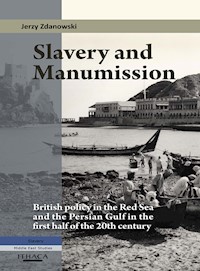
Typeset by PHi Business Solution Ltd., IndiaJacket design by Garnet PublishingCover photo from the collection of Dr. Abdulrahman Al-Salimi, published with his kind permission
To the memory of Manuy bint Khalfan from Dibah, who was sold several times and was several times mortgaged, and who finally escaped from her master. In a desperate situation in a British Agency in Sharjah on 24 October 1938, she stated, ‘I am a free-born women and not a slave of anyone.’
This is also to the memory of all other slaves who have tried to escape from slavery.
Contents
List of Maps
Glossary
Preface and Acknowledgements
Introduction
Chapter 1 Slavery in Arabian Societies at the Turn of the 20th Century
Slaves in the Hijaz
Slave Presence on the Arabian Coast of the Persian Gulf
The Trade in Slaves
Bodyguards, Servants and Divers
Female Slaves
Chapter 2 British Manumission and its Impact on the System of Slavery
Islamic Manumission
Three Silent Factors of Domestic Slavery
British Anti-Slavery Politics in the Hijaz and in the Persian Gulf
The Manumission Movement in the Persian Gulf in the 1920s and ’30s.
Reliability of the Slaves’ Stories
Agitation Against the British Manumission
Chapter 3 The Red Sea: The Problem of Abyssinia and Relations with Ibn Saud
Abyssinia: The Unsolved Problem
Regulations in the Sudan and the Report of Major Diggle
The Slavery Convention of 1926
The Prevention of the Traffic in Slaves in the Red Sea
The Right to Manumit and Relations with Ibn Saud
Chapter 4 The Persian Gulf: The Problem of Makran and Relations with Persia
The Arab Rulers and the Recovery of Slaves
The Difficulties in Makran
Importation from India
The Right to Manumit and Relations with Persia
Conclusion Slavery, Manumission and Politics
Appendix The List of Slaves Manumitted at British Agencies in the Persian Gulf between 1909 and 1949
Bibliography
Maps
The Southern Red Sea Coasts
The Arabian Sea Region
Glossary
‘abd
A slave
‘aib
Something disgraceful
amir
A prince, ruler, or governor
Arabian coast
The coast of the Persian Gulf from Kuwait to Ras Musandam
Badawin
Nomads
baghala
The largest type of dhow (see below) with decks and a crew up to 100 men, used for ocean sailings
Baharinah
Shi‘i Arabs in Hasa and Bahrain
boom
A large boat
barwah
An agreement between a captain and a diver
bin
An Arabic term for ‘son of’
bint
An Arabic term for ‘daughter of’
delal
An owner of the camel caravan
dhow
Any boat or ship in the Persian Gulf and Red Sea with a lateen sail
fatwa
A religious opinion
firman
A royal decree issued by the Ottoman Sultans
ghasa
Divers
ghaus
A diving season
al-ghaus al-bard
The earliest diving season, literally ‘cold diving’, which started in the middle of April and continued for 40 days
al-ghaus al-kabir
The principal diving season, literally ‘great diving’, which began in June or occasionally in May after the end of the wind called the Shimal, and lasted until September
ghulam
A male slave servant in Baluchistan
hadhari
Town dwellers
hadith
Stories about Muhammad and other founders of Islam
India Office
A ministry in London from which the Arabian coast and the Persian Gulf were administered from 1858 to 1947
irade
A royal decree
istishhad
A declaration of slaves’ owners, claiming a runaway slave, that a slave was a diver in debt or that he had committed a crime
kaffara
The freeing of a slave
kaniz
A female slave servant in Baluchistan
khatm
A balance of wages due to a diver at the end of the pearl diving season
khidam
Slaves employed in pearl diving
Khilafists
Members of a pan-Islamic movement in India to protect the Ottoman Empire during the aftermath of World War I
lakh
An unit of rupees, which equals 100,000 rupees – written as Rs. 1,00
Mahdi
The prophesied redeemer in Islamic eschatology
majlis
A council of the elders
The Majlis
The Persian Parliament
mamluk
A slave
mawalid
Slaves born in slavery
ma’atuq
An emancipated slave
mudabbar
A type of freed slave
mudir
A petty governor
mujannah
The winter diving season when the fishery was conducted by wading in the shallows along the coast
mukatib
A type of freed slave
munshi
An assistant to British political officers who served at the Residency in the Gulf, agencies, consulates, telegraph stations
musaqqam
A merchant who dominated the pearl-diving industry
mutawwa
A Wahhabi religious man
muwallid
A domestic slave
nakhuda
The captain of a boat
native agent
Non-European assistants to British political officers indigenous to a region who served as political agents, commercial agents, and intelligence agents
qadi
An Islamic judge
quffal
The end of the ‘great diving’
panchayat
Assembly of elders
Persian Gulf
al-Khalij al-Farsi
Commonly accepted name of the region before 1950s
raddah
The diving season, literally ‘return’, which started a few days after the ghaus al-kabir (see earlier) was concluded and lasted about three weeks
radhafah
Extra hands
rakbah
The beginning of the ‘great diving’
Ramadan
The Islamic month of fasting
salaf
An advance given to a diver about ten days before the commencement of the pearl diving season
salifat al-ghaus
A diving court
sheikh
A title of a religious official or a member of a ruling family
shahuf
A small boat
shimal
A wind in the Persian Gulf
siyub
Haulers
Swahili coast
East Africa and Zanzibar
tisqam
An advance given to a diver in the ‘off’ season
towash
A creditor
Trucial Coast
The Arab coast of Trucial Oman (today United Arab Emirates)
ulama
(sing.
alim
)
Muslim legal scholars
umm walad
The mother of a type of freed slave
Wahhabis
Members of a sect within Sunni Islam, founded in the 18th century by Muhammad ibn Abd al-Wahhab in Central Arabia, who advocated the strict observance of religious norms; the Saud family belonged to this sect
walaid
An apprentice
Preface and Acknowledgements
In 1927 the public in Great Britain was shocked upon receiving the news that two slave-owners in Sierra Leone who recaptured runaway slaves were prosecuted. The charges were for assault and conspiracy. Despite this, they were acquitted on the grounds that although slavery was a lawful institution in this British Protectorate it was not in the colony of Sierra Leone. This judgement was delivered in spite of the fact that a century and a half earlier another famous case resulted in Mansfield’s judgement, which provided that a slave who set foot on the soil of England ceased to be property in the eyes of the law.1 The incident of 1927 provoked a new campaign against slavery. Sir Ransford Slater, the Governor of Sierra Leone, pushed a bill through the Colonial Legislature freeing slaves of the Protectorate from January 1928. This incident was described in The Times on 3 December 1929. By the end of the same year, Lady Kathleen Simon published a book entitled Slavery in which she narrated the story. Moreover, she read the literature on the subject, studied the report of the League of Nations and, from this material, she included in her book an account on the different places in the world where slavery still persisted. The worst offenders in this volume were Abyssinia, Arabia, China and Liberia. Lady Simon agreed that Ras Tafari Makonnen, the ruler of Abyssinia, was anxious to put down slavery in his country, but she stressed that the difficulties of Ras Tafari Makonnen were too immense to obtain much local support for his pledges. The sufferings of the slaves both in Abyssinia and Arabia who crossed the land were compared in the book to the sufferings of the slaves who crossed the Atlantic in the 17th century. (Slaves, once dismissed and famished, ended their lives in the talons or the jaws of wild bird or wild beast, or, tied neck by neck, they were driven by whip by masters who had to fight for their prey from time to time with rival slave raiders.2)
As a result of the publications and the anti-slavery campaign, some enquiries on the subject reached the Foreign Office. New articles were published in which new aspects of the subject were stressed. In particular, a Jerusalem newspaper, Sunday Chronicle, attracted attention by writing that the pilgrimage to Mecca and Medina was another source of slavery in the Hijaz, a region in the west of present-day Saudi Arabia. The article said that stranded Muslims were often compelled to sell their children to pay for their passage back home. In Great Britain the question of slavery in Arabia was raised in the House of Commons on 13 March and 29 April 1929.3 The Agency at Jeddah was asked to comment on the matter and, on 8 June 1929, H.G. Jakins sent a report in which he pointed out that it was commonly accepted in Jeddah and Mecca that in the previous two or more years, the import of slaves into Arabia diminished considerably. The slave market, in consequence, became almost entirely confined to persons of long residence in Arabia. The sale of Abyssinian girls was very rare and children of domiciled slaves were offered for sale only occasionally. Jakins did not agree that the pilgrimage was the principal factor in the trade. He was informed about isolated cases of pilgrims who were travelling alone on foot and were kidnapped by Bedouins and sold into slavery, but these facts were not of recent occurrence. Moreover, the repetition of this was unlikely as absolute security of the pilgrim was enjoyed under Ibn Saud. Jakins doubted the value of the report on the sale of offspring by indigent parents. The few cases of the sale of children into slavery were of old standing, and referred, rather, to the disposal of children entrusted to guardians.4
The report of H.G. Jakins was used by the Foreign Office to prepare a memorandum on the slave traffic in Arabia, which was communicated by the British Delegation to the League of Nations in 1929. The memorandum stated that the import of slaves into the Hijaz had diminished considerably in recent years and that such traffic in slaves as continued to exist was confined chiefly to the occasional instances of slaves and their children already domiciled in the Hijaz. It was stressed that apart from increased control of foreign authorities over the pilgrims and greater security in the country itself, the measures taken by Great Britain contributed significantly to a decrease in the slave traffic. These measures were the results of the power of manumission and of control by British sloops at sea.5
This book is on slavery, manumission and British politics in the Red Sea and Persian Gulf in the first half of the 20th century. It presents these problems at the level of regional and international politics but also at the level of the everyday life of slaves and the everyday work of British officials involved in the affairs of the region.
I am indebted to several people and institutions and I wish to name them because I was aware of constant support from them when I was preparing the text.
I wish to express my gratitude to Professor Harry T. Norris of the School of Oriental and African Studies (SOAS) in London who never ceased his interest in my research work and whose extraordinary academic achievements have always been ‘an example for emulation’ to me.
I would like to thank Professor William Gervase Clarence-Smith from the SOAS for an extensive overview of the studies on slavery. I am much obliged to Professor Ehud Toledano from the Tel Aviv University, Israel, for his critical remarks on the first version of the material. Professor Shaun Marmon from the Princeton University encouraged me to continue my research and I extend my thanks to her. I would also like to thank Professor Marmon for the invitation to participate in the seminar Slavery, Race and Gender in Islamic Society in the Department of Religion, Princeton University, USA, in March 2012, which was an exceptional opportunity to present my sources. Chosen aspects of my research were presented at the seminar in the Middle East Institute at Columbia University in New York on March 2012 and I express my gratitude to Professor Lawrence Potter and Director Astrid Benedek for their kindness.
I presented preliminary reports of my research at several seminars, and in particular in December 2007 at the Faculty Seminar at the Department of Islamic and Middle Eastern Studies of the Institute of Asian and African Studies of the Hebrew University in Jerusalem, Israel, chaired by Professor Reuven Amitai. Ambassador Robert Finn was so kind as to give me the floor at the Brown Bag Lunch Seminar at the Faculty of Oriental Studies of the Princeton University, USA, in April 2008. Professor Ulrike Freitag and her most hospitable staff were my audience in June 2008 at the Zentrum of Modernes Orient in Berlin, Germany. I would like to thank Professor Nimrod Hurvitz and Dr. Daniella Talmond who were kind enough to invite me to talk in the Ben-Gurion University of the Negev, Israel, in November 2009. I am much obliged Dr. Soli Shahvar, Director of The Ezri Center for Iran & Persian Gulf Studies at University of Haifa, Israel, who proposed me to visit his Center in November 2009 and talk to his staff. I am grateful to Dr. Eugene Rogan, Director of the Middle East Centre at St Antony’s College in Oxford, UK, for giving me the floor to present the results of my research in December 2010. I am also much obliged to Dr. Derek Hopwood for his most valuable remarks. Sir James Craig from Oxford, who served in the Trucial States in 1961–1964, was kind enough to meet me and show me a blank Manumission Certificate – the same kind as the hundreds I had found filled out, ready to be granted to those slaves applying for freedom. I would like to thank Dr. Abdularahman Salimi, the editor of the Omani journal Al-Tasamoh (Tolerance), for the unique opportunity to visit Muscat, Oman, in January 2010 and give a talk at the Great Mosque of Sultan Qabus.
The problem of slavery is still a sensitive one in the Arabian Peninsula societies as they are at the stage of building up nations, but I am sure that at some point there will be space for discussion on this matter. My presentation at the seminar at the Sheikh Zayed University at Abu Dhabi, United Arab Emirates, in November 2007 provoked some questions from students concerning the roots of their families. I was asked to check some names in my database and it was the most rewarding moment of my research.
I am very grateful to many outstanding academicians who took part in these seminars and paid attention to my research. Their remarks were extremely useful for further study, but, of course, I am entirely responsible for its final results.
The Polish Ministry of Science and Higher Education provided me with a grant to spend time at the National Archives and the India Office Records Library in London, and this was a critical moment in my plan to conduct this research. I would like to thank the British Academy for the acceptance of visits to London within the Exchange Programme with the Polish Academy of Sciences and especially to Francine Danaher for her assistance. This book is a result of research made during the last four years, but my acquaintance with the records of the India Office began in 1989, when the India Office Library was located at Waterloo. I wish to express my gratitude to the staff of this institution for allowing me access to all the files in their possession. I would also like to thank the staff of the National Archives for kindness and help shown to any ‘new to Kew’.
I received much assistance from the staff of the Institute of Mediterranean and Oriental Cultures of the Polish Academy of Sciences in Warsaw, Poland: Dorota Dobrzyńska and Agata Wójcik. I would like to thank them for this. I shouldn’t miss mentioning my daughter Natalia with whom I have read several hundred statements containing the slaves’ life stories. This reading was a memorable time.
Maria Bożenna Fedewicz was my English text consultant and her contribution to this book goes far beyond linguistic suggestions. I also thank Stephen Goldsmith Hedrick for polishing the last version of the manuscript and Artur Bujak for drafting the maps.
I cannot thank enough my wife Irina and daughter Natalia for their patience and forbearance in the face of endless pressures.
For the permission to transcribe the statements into my text, I am grateful to the British Library.
As far as transliteration of Arabic words in this book is concerned, it must be admitted that official correspondence found in the records contains the names of places and names of people written in different variant forms, depending on the writer. It was decided to preserve the original forms and only the most common names of the period – for example, Ibn Saud, the Hijaz, Sharjah or Batinah were adapted to the system used. The system of transliteration used here is that ʻayn is indicated as ʻand hamzah as᾽.
NOTES
1William Murray, 1st Earl of Mansfield (1705–1795), was a judge known for his eloquence and the strict impartiality of conduct. In his famous judgement in 1772 in the case of James Somersett, brought to England as a slave, Mansfield held that there was no legal backing for slavery.
2The Times (extract). ‘Slavery in Arabia’, Public Record Office, London, Foreign Office 371/13735 E 6304/1822/91 (hereafter cited as FO).
3Foreign Office to T.F. Poulter, 28 May 1929, FO 371/13735 E 2244/1822/91.
4H.G. Jakins to Sir Austen Chamberlain, No. 135, Jeddah, June 1929, FO 371/13735 E 3370/1822/91.
5Slavery Convention. Annual Report of the Council. ‘Letter from the British Delegation to the Secretary General’, 6 September 1929, E 4656, FO 371/ 13735.
Introduction
Slavery has been a universal phenomenon in human history and has existed since the dawn of time. We can hardly find a part of the earth that has not experienced slavery. ‘It was not peculiar to any culture, nor did it derive from any specific set of shared social values’ we read in Ehud R. Toledano’s study on slavery in the Ottoman Empire.1 Many other historical studies prove that every human society was familiar with this institution and all monotheistic religions have accepted it. ‘Very few societies have remained historically untouched by it, while, at different times and in different degrees, most have seen a more or less strong presence of slaves employed for a variety of different purposes within them’ stress Enrico Dal Lago and Constantina Katsari.2 Consequently, any book on slavery in this particular part of the world is not about something exceptional but refers to a universal phenomenon.
Slavery played an important role in the economies and administrations of Western and Eastern worlds. In 1776, Adam Smith considered the economics of European colonization to be very beneficial for Britain and, indeed, ‘the new transatlantic trade had directly or indirectly increased the wealth of Europe, providing new products and a “vent” for surplus product’.3 Susan Dwyer Amussen shows in her study on English society in the 17th century that the reciprocal relations between England and the enslaved territories in the New World determined the European understanding of race and therefore transformed European societies.4 In the 19th century, the British anti-slavery campaign in Egypt contributed, as it has been presented in the monograph of Diane Robinson-Dunn, to the contemporary ideas of Englishness.5 Slavery finally provoked the development of the basic ideas of European civilization such as freedom and property.6 Orlando Patterson’s study Slavery and Social Death proves that slavery and freedom are intimately connected and that a premise that ‘slavery should have nothing to do’ with freedom is false. In some instances in the history of the Western world, a cultivation of freedom was combined with a preservation of slavery. The greatest promoters of the ideas of the Enlightenment, George Washington and Jefferson, were slaveholders.7 It proves that slavery was a historical and social phenomenon, and that to understand it we should consider its particular social essence and particular historical dynamics.
The question of slavery has been inevitably connected with manumission. The basic meaning of manumission is the freeing of individuals and families or a release from the state of slavery. However, this transition from slave status to freedom was not simple. It created significant problems for both sides: slave and master. For slaves, their critical moment was their incorporation into a society of free people. For slaveholders, this act affected their social status, dignity and economic position in society. Thus, manumission was a cultural problem, and a social problem.8 Patterson writes that as enslavement was life-taking, manumission was an act of life-giving: ‘The slave was gaining life as a gift offering in gratitude for the master’s freely given decision to release him from slavery.’9 However, such release was arranged differently in particular cultures. There were various modes of release from slavery and, at any given time, most societies employed several of them. Some slaves achieved full manumission at once; others attained it over time; still others remained for the rest of their lives in a twilight state of semi-manumission. But even full manumission did not mean the extinction of the system of slavery. As a rule, the number of people set free was small when compared with the total population of slaves. Thus, manumission was consistent with, and even contributed to, the existence of slavery as a system.10 Besides, as anthropologists have agreed, the real meaning of manumission is ‘a creation of a civis’. The master merely releases the slave from his dominium. What passes to the man is not what belongs to the master; his liberty and civitas are not subtractions from those of the dominus – hence what is released is something other than what is acquired. Manumission as an act of granting slaves their freedom is just the beginning of a long process of their incorporation into a society of free men.11
Olivier Pétré-Grenouilleu distinguishes two main processes as part of the exit from slavery. Manumission – understood as the process wished for or consented by the masters – was the first one; it facilitated, in most cases, the reproduction of the slave system as a whole. The second process in the exit from slavery was stimulated by the evolution of global society and provided a slow decline of the slave system.12 This process concerns an entire slave population and is more complex than manumission, especially in societies with a relatively large slave population. Stanley Engerman perceives this evolution as starting at a point in time when slavery has become unprofitable and slaves are no longer able to provide any economic gains. Historically, there were relatively few such cases in modern times – among them the transition from Roman slavery and the developments in medieval Scandinavia.13 It means that neither with the evolution of global society nor in a time when slavery has become unprofitable does the process necessarily lead to the extinction of slavery. History proved that abolitionist legislation was required in the total eradication of the practices related to slavery. On the other hand, abolitionist measures were not sufficient without the evolution of global society.14 Thus, slavery has been a social and historical phenomenon with its particular social essence and historical dynamics.
Abolitionism is another great topic related to slavery. It was a project that appeared in the 18th century and was the result of various philosophical and political movements.
Opposition to the massive and brutal African slave trade and to slavery in general had its first effective voice among British and colonial American Quakers /…/. By the late eighteenth century, disapproval of the slave trade was powerful in the Western Hemisphere, and that disapproval was expressed largely in religious terms.15
Slavery as a humanitarian trend at the height of colonialism was a great intellectual achievement by European civilization. But abolition was also part of European policy in the East – particularly the policy of civilizing other people. The process of making Asian and African people free encompassed legal, social, economic, political and military actions. It went through everyday processes of different institutions and everyday work of officials at different levels of foreign and colonial service. The necessity of combining moral assumptions with political and economic interests occasionally created dilemmas and provoked discussions.16 Marika Sherwood pointed out that ‘during the long crusade that succeeded in persuading Parliament to pass the Abolition Act of 1807, it had proved relatively easy for campaigners to procure support from the British people. Millions signed petitions. But there were also petitions opposing abolition, from Liverpool, Manchester, Glasgow, Bristol and Lancaster.’17
The slave trade within the British Empire was abolished by the 1807 Act. It put an end to the transatlantic trade maintained by Britain throughout the 18th century and was condemned later on by, among others, George Canning, who denounced it as the ‘scandal of the civilized world’.18 But by 1807, when Parliament outlawed participation in the slave trade, British slavers ‘had probably shipped more than 2.6 million captive Africans to the Americas’.19 British governments made great efforts to eradicate slave trade by administrative, military and diplomatic measures. The Foreign Office’s Slave Trade Department and the Admiralty adopted tactics that would stop trafficking in different parts of the world, including East Africa and the Near and Middle East. After World War I, Britain tried to secure treaties and measures aimed at suppressing the slave trade through a termination of slavery by the League of Nations.
The history of abolitionist politics in Britain began in 1788, when the Parliamentary debate aimed at outlawing the shipping of slaves took place. In 1792 the House of Commons passed a resolution on the abolition of the slave trade, but it took several years for the practical steps to bring into effect the abolition.20 Humanitarian arguments for abolition were argued by abolitionist societies, groups and individuals – including such prominent campaigners as William Wilberforce.21 The relative decrease in the importance of the West Indies for the British economy diminished commercial and strategic arguments against abolition and provided the successful passage of the bill in 1807. But even then, the commerce persisted as the demand for slaves remained high in Brazil, Cuba and the south of the United States (where cotton was produced). ‘British governments had in any case an economic interest in ensuring that a highly profitable trade should not simply pass into the hands of foreign competitors.’22 At the congress of Vienna in 1815, Lord Castlereagh, Britain’s Foreign Secretary, attempted to convince the powers to establish a moral foundation for action against the slave trade but progress towards achieving an international accord on this matter was small and disappointing for abolitionists. There was very limited support for abolition in France at that time as the French merchants expected high profits from the return to France of its colonial possessions.23
The transatlantic slave trade continued well into the 1860s; it was suppressed thanks to both the diplomatic and naval measures of the British Foreign Office with its Slave Trade Department and the Royal Navy deployed in the Atlantic and the Caribbean. There is little doubt regarding the moral fervour and enthusiasm of British commanders and sailors involved in the suppression of slave trade. The same could be said about the abolitionist campaigners and the British and Foreign Anti-Slavery Society, founded in 1839 by Joseph Sturge, which remained a significant political force in Britain throughout the 19th century.24 At the same time, though, abolition remained a large political issue and the British Parliament questioned the cost in terms of both men and money for maintaining anti-slavery squadrons in different parts of the high seas; the British Foreign Office was trying to avoid both the destabilization and intervention by other powers in particular parts of the world caused by British Anti-Slavery measures.25 As Suzanne Miers writes in her study on the 19th-century trade in slaves: ‘[H]umanitarianism, although a vital and enduring force in the long international struggle upon which Britain was now [after 1807 – J.Z.] to embark, was not usually by itself sufficiently powerful a motive to move either the British or other government to effective action. Fortunately, however, the suppression of slave traffic often dovetailed well with Britain’s other interests, and with those of other powers.’26
K. Hamilton and F. Shaikh share the opinion that ‘nowhere did the British find it more difficult to reconcile their humanitarian aspirations than with the perceived strategic needs in the Near and Middle East’.27 It was in the British interest to preserve the Ottoman and Persian empires as bulwarks against the further expansion of the Russian empire. At the same time the preservation of the authority of the Arabian littoral sheikhdoms in the Persian Gulf guaranteed this territory would not fall to other European rivals. It has been pointed out by many scholars that, unlike the slavery practised in the Caribbean and southern states of the United States, slavery in the Islamic world was, in general, domestic rather than economic. Slaves were an integral part of the household and thus their personal status was regulated by Islamic law.28 This means they were protected from abuse, and that the possibility of changing their status as slaves was prescribed and observed by free people. However, it doesn’t prove that slaves, even manumitted, occupied equal positions with their actual or former masters. On the contrary, their personal status remained inferior compared with the status of their former owners.
Thus, the manumission in the Arab world didn’t obligatorily mean liberation in a Western sense. T.G. Otte is of the opinion that freed slaves and their progeny remained ‘clients in perpetuity of their former owner and his successors’. Of course, this was a general tendency and some examples of ‘independency’ can be traced. It also refers to the status of slave women. Concubines were freed when they gave the birth to the master’s child. But as women they retained the position of the inferior adult. Otte highlights another aspect of slave–free people relations in Arab societies. We read: ‘Any attempt to challenge the practice of slavery /…/ represented a challenge also to the personal authority of the Muslim male in the Muslim home, and was thus a threat to the Muslim polity and society.’29 This aspect seems to be very important in understanding the reasons for the preservation of slavery for so long in some parts of the Arab world.
This book is about slavery, manumission and British policy related to slavery and manumission in the Red Sea and the Persian Gulf in the late colonial period. It aims to present the involvement of Great Britain in the suppression of the slave trade and in the eradication of slavery in the region throughout the first half of the 20th century. It also aims to introduce readers to the manumission policy adopted by the British Agencies in the region and to the question of the impact of this policy on slavery in Arabian societies.
Striking aspects of the majority of studies on slavery are that they provide us with excellent statistics, describe the mechanism of enslavement, give the routes of slave trading, and describe the economic and social condition of enslaved people. However, slaves themselves generally remain anonymous. Anonymity of slaves, even in the records, has been stressed in many studies. Deryck Scarr, in his book on slaving and slavery in Mauritius and other islands of the Mascareignes in the first half of the nineteenth century, admits that slave autobiographies are non-existent in these islands, and that even particular events are scrambled in recorded slave memories. Notarial archives like that of Morel Duboil in the Seychelles contain the lists of slaves named with descriptions, ages and birthplaces in marriage contracts, partnership agreements, estate and death inventories and wills of slaves owners, but, as Scarr concludes, these ‘names like Prosper, Scipion, Alexandre, Ajax, Hercules, Rosalie, Amélie bear little or no resemblance to individual identities’.30
What makes this book unique is that it presents the problem of slavery at a basic level using the life stories of individual slaves known by their names. We know their names from their statements made at British Agencies. The procedures of manumission applied by the British in the Persian Gulf provided that applicants for the certificate of freedom had to produce written statements describing the circumstances of their enslavement and the reasons for their having run away from their masters. These procedures were introduced to secure social and political stability in the region, which was important for British interest in the East; as a result, we have at our disposal a vast amount of material on slavery and British policy – the life stories of almost 1,000 slaves, speaking in their own voices, no longer silent as they had been thus far in most studies on slavery. The analysis of these statements sheds light on various aspects of social, economic and political life along the Arabian shore of the Gulf. It allows us to discuss some questions important for understanding the history of Arabian Peninsula societies, and in particular the role of slave labour in the pearl industry, the nature of slavery on the Arabian shore, and the conformity of social practice with religious norms concerning slavery.
The book refers to British policy in the Red Sea and the Persian Gulf and, as such, it exposes the position of British foreign and colonial institutions regarding slavery, procedures and instructions concerning manumission and the perception of slavery by British officials working in the region. British residents, envoys and agents possessed vast knowledge on how the local societies were functioning and they formulated opinions of first-class importance for decision-making process in London. The book, finally, discusses the role of the British system of manumission in the eradication of slavery in the region and refers to the main problems regarding British relations with local powers related to the British right to manumit.
The book is based on archival material contained in records collected at the National Archives in Kew and in the India Office Records kept at the British Library. The documents used in this study were produced by the British Foreign Office and colonial institutions, and in particular: (1) the British Agency and the Legation at Jeddah; (2) the Political Residency in the Persian Gulf in Bushire with its Agencies in Bahrain, Kuwait, Sharjah and Muscat; (3) the Government of India, which was responsible for the administration of the Persian Gulf; and (4) the India Office in London, UK. The records concerned have been arranged in the archive groups: FO 84 (Slave Department and successors: General Correspondence before 1906, 1816–1892), FO 367 and 371 (Foreign Office: Political Department: General Correspondence from 1906, 1906–1966) in the National Archives, and in R/15 (the British Residency and Agencies in the Persian Gulf) of the India Office Records. The records of the British Residency in the Persian Gulf have been allocated the reference R/15/1 followed by the Agencies: Bahrain, R/15/2, Sharjah, R/15/4, Kuwait, R/15/5 and Muscat, R/15/6.
NOTES
1Ehud R. Toledano, As If Silent and Absent. Bonds of Enslavement in the Islamic Middle East, New Haven, London: Yale University Press, 2007, p. 1.
2Enrico Dal Lago and Constantina Katsari, ‘The Study of Ancient and Modern Slave Systems: Setting an Agenda for Comparison’, in Slave Systems. Ancient and Modern, ed. by Enrico Dal Lago and Constantina Katsari, Cambridge: Cambridge University Press, 2008, p. 3.
3A.R. Diley, ‘The Economics of Empire’, in The British Empire. Themes and Perspectives, ed. by Sarah Stockwell, Malden MA, Oxford, Victoria: Blackwell Publishing, 2008, p. 100.
4Susan Dwyer Amussen, Caribbean Exchanges. Slavery and Transformation of English Society, 1640–1700, Chapel Hill: The University of North Carolina Press, 2007.
5Diane Robinson-Dunn, The Harem, Slavery and British Imperial Culture. Anglo–Muslim Relations in the Late Nineteenth Century, Manchester and New York: Manchester University Press, 2006.
6See, for example, The British Empire. Themes and Perspectives, ed. by Sarah Stockwell, Malden MA, Oxford, Victoria: Blackwell Publishing, 2008.
7Orlando Patterson, Slave and Social Death. A Comparative Study, Cambridge, Mass., and London, England: Harvard University Press, 1982, pp. VIII–IX.
8The following studies refer to this matter: Race and Slavery in the Western Hemisphere: Quantitative Studies, ed. by S.L. Engerman and E.D. Genovese, Princeton: Princeton University Press, 1975; W.A. Green, British Slave Emancipation: The Sugar Colonies and the Great Experiment, 1830–1865, Oxford: Oxford University Press, 1976; N.R.E. Fisher, Slavery in Classical Greece, London: Duckworth Publishing, 1993; M.I. Finley, Ancient Slavery and Modern Ideology, London: Chatto and Windus, 1980; Slavery in Africa, ed. by Suzanne Miers and Igor I. Kopytoff, Wisconsin: University of Wisconsin Press, 1977; Thomas Wiedemann, Greek and Roman Slavery, Baltimore: Johns Hopkins University Press, 1981; O. Patterson, op. cit.
9O. Patterson, p. 211.
10See Stanley Engerman, ‘Emancipation Schemes: Different Ways of Ending Slavery’, in Slave Systems, op. cit., p. 265.
11W.W. Buckland, The Roman Law of Slavery, Cambridge: Cambridge University Press, 1908, pp. 714–715 (see also O. Patterson, p. 211).
12Olivier Pétré-Grenouilleu, ‘Processes of Exiting the Slave Systems’, in Slave Systems, p. 264.
13S. Engerman, p. 266.
14O. Pétré-Grenouilleu, p. 264.
15Lewis R. Scudder III, The Arabian Mission’s Story. In Search of Abraham’s Other Son, Grand Rapids, Michigan, Cambridge: Wm. B. Eedermans Publishing Co., 1998, p. 5.
16See Frank J. Klingberg, The Anti-Slavery Movement in England (1926), Hamden CT: Archon Books, 1968; John Pollock, Wilberforce, Tring: Lion Publishing, 1977; Clare Midgley, Women Against Slavery, London: Routledge, 1992; Robin Blackburn, The Overthrow of Colonial Slavery, London: Verso, 1988; Eric Williams, Capitalism and Slavery (1964), London: Andre Deutsch, 1975; David Eltis, Economic Growth and the Ending of the Transatlantic Slave Trade, Oxford: Oxford University Press, 1987; J.L. Hammond and M.R.D. Foot, Gladstone and Liberalism (1952), London: English Universities Press, 1967.
17Marika Sherwood, Abolition. Britain and the Slave Trade Since 1807, London, New York: I.B. Tauris, 2007, p. 145.
18See David Miliband, ‘Foreword’, in Slavery, Diplomacy and Empire. Britain and Suppression of the Slave Trade, 1807–1975, ed. by Keith Hamilton and Patrick Salmon, Brighton, Portland: Sussex Academic Press, 2009, p. VII.
19David Richardson, ‘The British Empire and the Atlantic Slave Trade, 1760–1807’, in The Oxford History of the British Empire, vol. II, The Eighteenth Century, Oxford: Oxford University Press, 1998, ed. by P.J. Marshall, pp. 441–64. Cited after: K. Hamilton and Farida Shaikh, ‘Introduction’, in Slavery, Diplomacy and Empire, p. 2.
20Hugh Thomas, The Slave Trade: The History of the Atlantic Slave Trade, 1440–1870, London: Papermac, 1997, pp. 507–09.
21William Hague, William Wilberforce: The Life of the Great Anti-Slave Trade Campaigners, London: Harper Perennial, 2008, pp. 142–68.
22K. Hamilton, F. Shaikh, ‘Introduction’, in Slavery, Diplomacy and Empire. Britain and Suppression of the Slave Trade, 1807–1975, eds. Keith Hamilton and Patrick Salmon, Brighton, Portland: Sussex Academic Press, 2009, p. 3.
23Ibid., pp. 6–7.
24Howard Temperley, British Antislavery, 1833–1870, London: Longman, 1972, pp. 62–92.
25K. Hamilton, F. Shaikh, ‘Introduction’, p. 12.
26Suzanne Miers, Britain and the Ending of the Slave Trade, London: Longman, 1975, p. 7.
27K. Hamilton, F. Shaikh, ‘Introduction’, p. 13.
28See Bernard Lewis, Race and Slavery in the Middle East: An Historical Enquiry, Oxford: Oxford University Press, 1990; J. Hunwick, ‘Islamic Law and Polemics over Race and Slavery in North and West Africa (16th–19th Century)’, in Slavery in the Islamic Middle East, ed. by Shaun Marmon, Princeton, NJ: Marcus Wiener, 1999, pp. 43–68; Suzanne Miers, ‘Slavery: A Question of Definition’, in The Structure of Slavery in the Indian Ocean and Asia, ed. by G. Campbell, London: Frank Cass, 2004, pp. 4–5.
29Otte, T.G. ‘A Course of Unceasing Remonstrance: British Diplomacy and the Suppression of the Slave Trade in the East, 1852–1898’, in Slavery, Diplomacy and Empire. Britain and Suppression of the Slave Trade, 1807–1975, eds. Keith Hamilton and Patrick Salmon, Brighton, Portland: Sussex Academic Press, 2009, p. 94.
30Deryck Scarr, Slaving and Slavery in the Indian Ocean, Houndmills, Basingstoke, London, New York: Macmillan Press Ltd, St. Martin’s Press, Inc., 1998, pp. 4–5.
Chapter 1
Slavery in Arabian Societies at the Turn of the 20th Century
Slaves in the Hijaz
Slavery and traffic of slaves in Arabia goes back to ancient times.
In 1869, Lieutenant-Colonel Charles Herbert, acting Consul-General in Baghdad, prepared a report on slave traffic in the Persian Gulf and stressed that slavery was an integral part of Muslim society, sanctioned by Islamic law. He was convinced that it would be impossible to eradicate the trade so long as Islam dominated local societies.1 Other British residents and officials working in the Near and Middle East were also aware that slavery formed an important component of Muslim households, especially in the case of richer people. In September 1869, Consul Pisani reported on the white slave traffic from Istanbul to Cairo. He confirmed that the white slaves were carried on to Egypt, but for the establishment of the Viceroy and very seldom for the public. The slave traffic operated without the knowledge of the Porte and was carried on clandestinely by certain women who bought young girls from destitute parents and trained them for the harem of the Egyptian Viceroy. The scale of the white slave trade was limited by the high prices for the girls. It was only the Viceroy who could afford such luxuries. The British Consul insisted that the Porte issue new orders for the cessation of the slave trade, and the Ottoman authorities promised to meet this request. That said, the Consul doubted that such a measure would immediately stop traffic. He was of the opinion that it was impossible to eradicate, at once, such an old practice. People arriving in Istanbul or other parts of the Empire with slaves for sale were very careful to enter them on their passports as servants or people appertaining to their household. Slaves were generally imported in small numbers in order to avoid suspicion. All black slaves coming to Turkey were sent from Egypt and, according to the British Consul, it depended entirely on the Viceroy to put a stop to the traffic.2 In September 1869, H. Elliot informed the Lord of Clarendon about formal obstacles in eradicating slavery. He reported on the case in Smyrna where the local governor, while promising to endeavour to liberate certain slaves that the British Consul had notified him of, doubted whether he had the right to enter the private houses of the slave-dealers. The governor wanted to be authorized by the Grand Vizir to take such a measure but failed to gain permission. The Grand Vizir would not authorize him to enter, forcibly, private houses – the reason being the tradition of holding women’s apartments in inviolable respect. This tradition rendered the entry of a private dwelling difficult.3
In the same year, the British Consul-General to Constantinople travelled by steamer from Egypt to Turkey and witnessed a gang of black slaves coming over from Egypt. He was convinced that thousands of slaves were transported down the River Nile annually, destined for Turkey and the Viceroy’s palace. After Egypt was supplied, the rest were exported elsewhere within the Ottoman Dominions. Thus, the firman of 1857 was habitually violated with the recognition of the Turkish Government. In Istanbul the trade was carried on by private houses out of the sight of the foreign population. White slaves were generally taken to various private houses in a particular quarter of Istanbul and from there distributed to various harems. The Consul-General considered that to establish details, if disputed, of this trade would involve employing measures that he didn’t feel prepared to adopt without instructions from London. The white slave traffic was not accompanied by cruelty. Parents brought up the girls for sale, who themselves looked to it as gaining a position and security in life, as did girls in other countries. The purchasers got wives and concubines that they could neither procure elsewhere nor do without. Thus, all parties were satisfied. Occasionally, slaves were sold by one proprietor to another; it was only their sale by public auction that was forbidden. The Consul-General tried to bring to the attention of the Lord of Clarendon that it was common practice for Muslim women in the Ottoman Empire to buy a female slave, to bring her up, educate her to those accomplishments that were known to be most prized by husbands, with a view to disposing of her in matrimony on favourable terms. So, the slaver was involved in the forming of Harems. In the large Harems of wealthy Pashas it was the duty of the mistress to provide in due course husbands for her slaves, who frequently received a dowry.4
Lewis Pelly, the British Resident in the Gulf who visited Riyadh in 1865, left interesting remarks concerning the everyday life in the Wahhabi Central Arabia. The Wahhabi Ameer owned Abyssinian slaves and used to grant them their freedom. Moreover, on such an occasion he granted some of them their concubines, who were imported, usually, from Egypt. Some of these women were said to be of Georgian extraction. However, concubinage was not approved of in Central Arabia. A man could have four wives at one and the same time, and could divorce at pleasure, but the favourite of that time was a wife, not a concubine. It was common to preserve the principle that blood once tainted could not be purified. Hence, if an Arab married an African woman and had issue, the half-caste son was not permitted to marry a pure Arab wife in the hope of purifying his breed back to that of Arab. On the coastline of the Persian Gulf the situation differed: a son by a black wife was as well thought of as another. The example of Sultan Suwayni of Oman proved this. His father was a pure Arab, Sayyid Said, but his mother was of Abyssinian origin.5
The English traveller Charles M. Doughty, who travelled to Central Arabia in the 1880s, recounted that African slaves were brought to Arabia every year with the Hajj. He met many slaves from Abyssinia who told him that ‘In [their] country were trunks of wild coffee-trees great as oaks.’ We read that
There are bondsmen and bondwomen and free Negro families in every tribe and town; many are home-born and free-born, muwalladin. A few people may be seen, in Teyma, of half-Negro blood. They are descendants from freedmen who, when grown to substantial living standards, have taken poor white women of the sunna or smiths’ caste, which is supposedly illiberal. A pleasant looking young Heteym woman in the Kella at M. Salih was the wife of a Negro askar, Nejm’s freedman who had been sent to keep the cisterns at Moaddam.6
Alois Musil, a famous Czech scholar and traveller who travelled to the Northern Najd in 1915 and who left us with an extensive description of the history of the House of Shammars and the Jabal Shammar Emirate, referred several times to slavery. During the time of the greatest prosperity of the Emirate under Prince Muhammad bin Rashid, 1869–1897, the bodyguard of the prince comprised 400 slaves who dwelt in groups of 20 each and were supported by the prince. One remark is very interesting. Musil says that as public morality in Hayel, the centre of the Emirate, was at a very low level, the numerous illegitimate children were deposited in the mosques. They were brought up at the expense of the prince and divided among the slaves. As bodyguards, slaves were totally devoted to the prince. In 1868, Bandar, one of the Shammar princes, rebelled against his older brother, but was defeated. In the final moments of battle he could rely only on his slaves; when he was slain his bodyguard was scattered, pursued and cut down. Some of his slaves escaped and went to the mountains, but after some time they were discovered and slaughtered.7
Almost every desert sheikh had his male slaves – whether born in the family or bought – and their womenfolk had female slaves. Bought slaves were the rule. Male slaves were received as a gift from fellow-sheikhs or were bought in Mecca when people were on the Hajj. The desert people in the Najd and the Northern deserts had a natural inclination to treat their slaves well. This was explained by the fact that desert people were more religious than the people in towns. Slaves were used in the desert for drawing water for sheep and camels, and for cutting brushwood for the building of tents. They did much of the work connected with caring for and tending camels.
In the Hijaz and Najd, slaves, male and female, were highly desirable. Comfort, enjoyment, respect and dignity depended on them. They represented the most profitable form of investment. The desire to possess them was a ruling passion. Among rich townsmen and the Bedouins it was a question of respect to give a female slave a dowry at a daughter’s marriage. The dignity and reputation of a ruler was dependent on the number and quality of his slaves. Slaves were the mainstay of the middle class. They were the most trusted servants in Arab townsmen’s households. In the case of poorer people the slaves often earned their owners a livelihood and commonly acted like devoted members of the family. Accordingly, they were treated as such. They served as water carriers, labourers, clerks, camel men, cashiers, managers, fishermen, masons, housekeepers and everything else. They were employed inside and outside the house. When they were skilled, they were hired out and brought their earnings to their owners. Female slaves were at once wives and servants to masters who often were not able to afford a regular wife. As a result, public opinion in the Hijaz and Najd was strongly in favour of slavery.8
There is no means of even estimating the number of slaves owned in the Hijaz and Najd. However, in those towns the percentage of slaves within the total population was high – possibly even as high as 10 per cent. Prices for slaves varied. Young female slaves fetched from £70 to as much as £200. Male slaves fetched from £20 to £150, depending on age, skill, health and physical appearance. These slaves were bought in Abyssinia for a few pounds by slave-dealers. The average price of slaves had risen in the course of the previous years, but not as a result of the increasing difficulties regarding importation. It was due to the fact that increasingly more owners, for one reason or another, could no longer afford to buy and keep slaves as they used to do before. As a result, the demand for slaves diminished. Another factor affecting the demand for slaves was the introduction of heavy dues by the Hijaz Government on pilgrims. Motor cars, introduced into the factor, played the same role. The widespread adoption of this means of transportation for pilgrims struck a blow at the livelihood of the camel men and camel owners, and of a considerable proportion of the population of the country. Many sheikhs and wealthy merchants became too poor to keep slaves. Besides, the current peaceful conditions and security meant there was no real need to maintain large bodies of slaves for the purpose of attack and defence.9
The demand for slaves in the Hijaz and Najd was met by: (1) the organized capture and importation of slaves from Africa, mainly from Abyssinia; (2) the opportunities afforded by the pilgrimage; and (3) the purchase of slaves from Yemen and the enslavement of Yemenis. The last issue created the greatest problem for the British, as its solution was outside the boundaries of practical politics and its extinction could only follow from a solution that saw an end to slavery in Arabia in general. The largest proportion of slaves imported from Africa were transported to the coast through French Somaliland and Eritrea, chiefly the former, and were shipped from Tajura or other ports or points in those territories. By 1930, the transport of slaves through the Sudan was virtually stopped as a result of legislation and administrative action taken by British authorities. The retail traffic was extremely difficult to suppress. It was equally difficult to estimate its dimension; estimates varied from 300 to 400 to more than 1,000 slaves. Principally these were children and adolescent girls imported into Arabia. The measures taken in French Somaliland to check the slave trade were generally ineffective. The Italian land patrol in Eritrea was carried out more successfully, and the slave-trade found it more difficult to transport slaves to the coast through Eritrean territory than through French Somaliland. The patrolling of the Red Sea was, in theory, the duty of the French, Italian and British Governments. According to this theory, the French patrolled a small portion of the coastline opposite Perim and the French Somali coast outside; the Italians patrolled the Eritrean coast; and the duty of patrolling all other coasts, as well as the Red Sea proper, fell to the British. In practice, the French and Italian patrols were more superficial in nature. There was no French ship patrolling the Red Sea or stationed at any French Somaliland port, and the only sea patrol provided by the French was a sloop that was attached to a Mediterranean base and dispatched on a cruise in the Red Sea twice a year. The Italians maintained a sloop at Massawa, but it was used more for survey work than for patrolling. The British patrol was carried out by two sloops – although, generally, only one sloop was engaged while the other was being refitted in Malta. The British sloop patrolled the whole of the Red Sea from Akaba to Perim and also paid visits to Aden. Occasionally, the sloop undertook a cruise further east along the southern coast of Arabia.10
The sale of children by their parents or guardians became extremely rare. The increasingly strict passport and sanitary control exercised by the authorities of all countries interested in the pilgrim traffic – e.g. the Sudan and Federated Malaya – meant the practice should have ceased altogether. Consul H.G. Jakins considered that many stories regarding selling children referred, in fact, to the tradition of giving a daughter in marriage for good monetary consideration, and that this practice did not fall under the trade of slaves. He was of the opinion that the general movement of slaves into the Hijaz was from the south. Its source was the Yemen, where the economic situation led to a general disposal of superfluous slaves. Cargoes with slaves from Africa occasionally landed on the southern half of the Red Sea coast. The British Consul presented the view that apart from these two factors – that is, increased control by foreign authorities, and greater security in the country itself – the right of manumission maintained by Great Britain and the presence of British sloops in the Red Sea played a decisive role in lessening slave traffic. The power of manumission exercised by the British Consul at Jeddah added a considerable element of risk to the purchase of a slave who, if dissatisfied with his master, could (and did) apply to obtain his freedom and, if he or she desired, to repatriate. The owner was in no way compensated for the loss. During 1927 and 1928, 80 slaves were manumitted by the British Agency at Jeddah. Regarding the control exercised by British sloops, it was undoubtedly a deterrent as regarded the importation of slaves into Arabia by dhow and resulted in a very marked decrease of this kind of entry. Jakins agreed that there were still a few dhow owners who ran slaves in limited numbers as a speculative adventure, but there was practically no wholesale seaborne traffic.11
Slave Presence on the Arabian Coast of the Persian Gulf
Slavery in Arabia had a long record in the times of the British presence in the area as part of the British policy towards the region. In 1831, Lieutenant-Colonel Hennell, Resident of the Persian Gulf, reported on the successive adhesion of the Sultan of Muscat and the chiefs of the Arabian coast to Great Britain’s policy for the suppression of the slave trade. At the same time, he regretted that the Persian Government continued its obstinacy in refusing to join the British Government’s efforts in this matter. The problem was that even in the case of the seizure or detention of a Persian vessel carrying slaves, Persia denied the Sultan of Muscat’s and the Imam of Zanzibar’s rights to confiscate such a vessel. The British Resident indicated that the Negro slaves were imported into Persia almost invariably either directly from Zanzibar or from the Port of Muscat. He thought that if the supply from those two sources were cut off, trade would entirely cease. He was of the opinion that ‘either from the absence of power or the want of inclination, nothing in respect to active measures can be looked for from H.H. the Imam at Zanzibar and his son Sayed Thoweynee at Muscat’. The British Resident was sincerely convinced of the final success of the ‘philanthropic measures’ of the British Government for putting down the slave trade and proposed some technical steps to be taken to sufficiently achieve the goal. In the case of the Imam and his son it was necessary that they were induced to declare any foreign vessel violating their ports’ regulations against the export or import of slaves as liable to seizure and confiscation, and at the same time to request the aid of the British Government to enable him to execute his engagement with it for the suppression of this traffic. Then, the Resident previewed a simple method of eliminating the traffic. He thought that two vessels stationed at Zanzibar, one in Muscat and one offshore, would suffice to put down the slave trade. In the case of the traffic of Abyssinian and Somali slaves in the Red Sea, where the former were Christians and the latter were Muslims, it was necessary to declare the vessels engaged in carrying away either of the classes of slaves as pirates. They were also liable as such to seizure and confiscation.12




